
MINI REVIEW: JOURNEY OF SOLID DISPERSION TECHNIQUE FROM BENCH TO SCALE
6
0
0
Full text
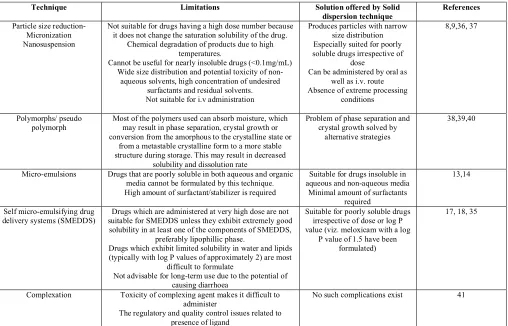
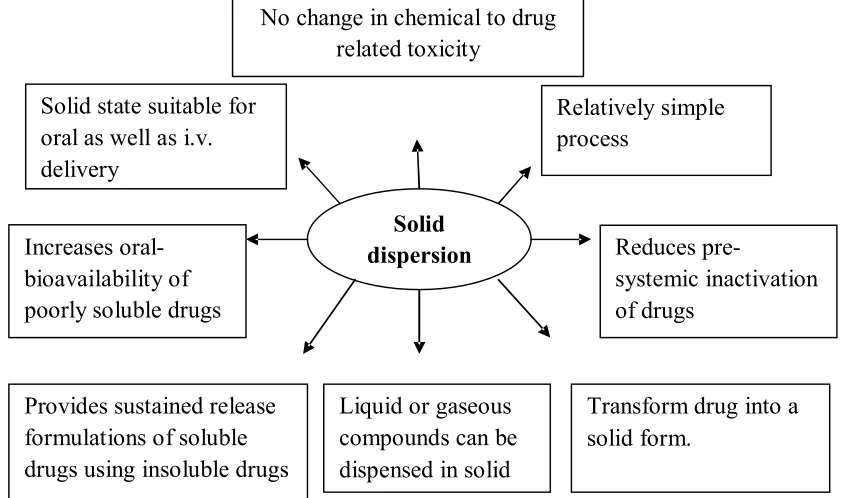
(2) Choudhary Ankush et al. IRJP 2 (8) 2011 46-51 emulsions are more popular as they enhance the solubility of the drug in the oil phase and avoid hepatic first pass-metabolism12. Nevertheless, in addition to the need of high concentrations of surfactants for the formulation of emulsions, drugs which are poorly soluble in both aqueous and organic media cannot be formulated by this technique. Micro-emulsions are also sensitive to temperature and pH changes and are relatively metastable. The major drawback is again the need of high concentrations of surfactants/co-surfactants making them unsuitable for i.v administration13,14. Further, dilution of micro-emulsions below the critical micelle concentration of the surfactants could cause precipitation of the drug15,16. SMEDDS (Self micro-emulsifying drug delivery systems) were originally discovered to overcome the stability problem of microemulsions11. However, they too suffer from the difficulty of formulating hydrophobic drugs (log P value ≤ 2) into such formulations17, 18. SMEDDS formulations are not advisable for long-term use due to the potential of causing diarrhoea19. In addition, drugs with high doses pose difficulty in formulation. Above all, the various emulsified delivery systems can only be used orally because of the nature of the excipients. The concept of complexation is advantageous compared to other methods owing to the toxicity problems of surfactants. On the other hand, the regulatory and quality control issues related to presence of ligand may add complication and cost to the development process20, 21. The concept of solid dispersions was originally proposed by Sekiguchi and Obi, who investigated the generation and dissolution performance of eutectic melts of a sulfonamide drug and a water-soluble carrier in the early 1960s. Solid dispersions are prepared by using several methods, such as the fusion (melt) method, hot melt extrusion and the solvent method. Solid dispersion is generally acceptable method for BCS class II drugs and has been discussed in detail by various authors22,23. It is becoming increasingly popular because of many potential advantages such as suitable for oral as well as i.v delivery, free from toxic constituents, simple process and reduces pre-systemic metabolism (Figure 1). Formulation of drugs as solid dispersions offers a variety of processing and excipient options that allow for flexibility when formulating for poorly water soluble drugs. Further, the concept of solid dispersion is better compared to other methods because of many potential reasons (Table 2). Regardless of numerous advantages and extensive research only a few drugs have been successfully launched in market (Table 3). This might be. IRJP 2 (8) August 2011. because of many possible problems discussed under challenges in solid dispersion approach. CHALLENGES IN SOLID DISPERSION APPROACH In spite of much research in the area much success has not been possible because of many prospective drawbacks such as Ø problems in scale up Ø cost-prohibitive nature Ø stability of the drug and vehicle Ø changes in crystallinity of the drug Ø requirement of high percentage of carrier materials (more than 50-80% w/w) These problems have been surmounted to some extent by some possible solutions. For instance, the problem of tackiness due to the use of water soluble (low melting point) polymers such as mannitol, poly-vinyl-pyrrolidone and poly-ethylene-glycol, have been resolved by using hydrophilic swellable polymers such as sodium carboxy methyl cellulose, sodium starch glycolate and pregelatinized starch24. Further, combined carriers can be used instead of using high amounts of single carrier material. This approach not only reduces the amount of carrier material required but also increases the drug dissolution8,9. Some other alternative strategies have been developed to commercialize solid dispersions. Spraying on sugar beads using a fluidized bed coating system The approach involves a fluidized bed coating system, wherein a drug-carrier solution is sprayed onto the granular surface of excipients or sugar spheres to produce either granule ready for tableting or drug-coated pellets for encapsulation in one step25,26. The technique is useful in solving problems related to material handling and compression. Solid dispersions are soft, waxy and possess poor compressibility and flowability. If they are encapsulated in hard gelatin capsule it delays the dissolution process of drug because the process will not start till the capsule shell has disintegrated to allow solid dispersion to come in contact with the gastric fluid and gelatin capsule shells are denaturated27. Solid dispersions of itraconazole using hydroxyl-propyl-methyl-cellulose (HPMC) in an organic solvent of dichloromethane and ethanol have been successfully manufactured using this approach28. Direct capsule filling Direct filling of hard gelatin capsules with the liquid melt of solid dispersions avoids grinding-induced changes in the crystallinity of the drug. However, PEG cannot be used as a suitable carrier for the direct capsule-filling method as the water-soluble carrier dissolves more. Page 46-51.
(3) Choudhary Ankush et al. IRJP 2 (8) 2011 46-51 rapidly than the drug, resulting in drug-rich layers formed over the surface of dissolving plugs, which prevents further dissolution of the drug29. Therefore, surfactants such as polysorbate 80, phosphatidyl choline) must be mixed with the carrier to avoid formation of a drug-rich surface layer30. Changes in crystallinity have been a major problem with solid dispersion resulting in their instability. The crystallization of ritonavir from the supersaturated solution in solid dispersion system was responsible for the withdrawal of ritonavir capsule from the market. This major obstacle has been unravelled by direct capsule filling technique. Hard gelatin capsules of Triamterene have been successfully formulated using a Zanasi LZ 64 capsule filling machine (Zanasi Co., Bologna, Italy)31. Electrostatic spinning method A more recent technology is the combination of solid dispersion with nanotechnology32. In this process, a liquid stream of a drug/polymer solution is subjected to a potential between 5 and 30 kV. When electrical forces overcome the surface tension of the drug/polymer solution at the air interface, fibers of submicron diameters are formed. As the solvent evaporates, the formed fibers can be collected on a screen to give a nonwoven fabric, or they can be collected on a spinning mandril. The fiber diameters depend on surface tension, dielectric constant, feeding rate, and electric field strength33. Itraconazole/ HPMC nanofibers have been prepared using this technique34. FUTURE PROSPECTS Solid dispersions are one of the most attractive processes to improve drug’s poor water solubility. Two trends strongly favour an increasing role for solid dispersions in pharmaceutical development: the increasing number of drug candidates which are poorly soluble and the substantial improvements in the manufacturing methods for solid dispersions that have been made in the last few years. In recent years, a great deal of knowledge has been accumulated about solid dispersion technology, but their commercial application is limited. Much research is still required for solid dispersion technique to flourish. REFERENCES 1. Goldberg AH, Gibaldi M, Kanig JL. Experimental evaluation of eutectic mixture: urea-acetaminophen system. J Pharm Sci 1966; 55 Suppl 2:482- 487. 2. Goldberg AH, Gibaldi M, Kanig JL. Experimental evaluation of griseofulvin-succinic acid solution. J Pharm Sci 1966; 55 Suppl 3:487-492. 3. Serajuddin ATM. Bioavailability enhancement of poorly watersoluble drugs by solid dispersion in surface active and selfemulsifying vehicles. Bull Technique Gattefosse 1997; 90:43-50.. IRJP 2 (8) August 2011. 4. Improving solubility & permeability in drug candidates. Conference: 23rd & 24th June 2005, Pre-conference workshop: 22nd June2005, Thistle Marble Arch, London, UK. 5. Speiser PP. Emulsions and nano-suspensions for the formulation of poorly soluble drugs. In: Muller RH, Benita S, Bohm B, editors. Poorly soluble drugs, a challenge in drug delivery. 2nd ed. Stuttgart: Med pharm Scientific Publishers;1998. p. 15-28. 6. Lipinski C. Poor aqueous solubility-an industry wide problem in drug discovery. An Pharm Rev 2002; 5: 82-85. 7. Pinnamaneni S, Das NG, Das SK. Formulation approaches for orally administered poorly soluble drugs. Pharmazie 2002; 57: 291-300. 8. Krause K, Muller RH. Production and characterization of highly concentrated nano-suspensions by high pressure homogenization. Int J Pharm 2001; 214: 21-24. 9. Sonal AP, Bhushan RR, Sunil RB, Sunil PP. Nano suspension: at a glance, Int J Pharm Sci 2011; 3: 947-960. 10. Blagden N, Gavan PT, York P. Crystal engineering of active pharmaceutical ingredients to improve solubility and dissolution rates. Adv Drug Del Rev 2007; 59: 617-630. 11. Patel R, Patel N, Patel NM, Patel MM. A novel approach for dissolution enhancement of Ibuprofen by preparing floating granules. Int J Res Pharm Sci 2010; 1: 57-64. 12. Surjyanarayan M, Snigdha SM. Micro-emulsion Drug Delivery System: A Platform for Improving Dissolution Rate of Poorly Water Soluble Drug. Int J Pharm Sci Nanotech 2011; 3: 88-102 . 13. Ran Y, Zhao L, Xu Q. Solubilization of Cyclosporin A. AAPS Pharm Sci Tech 2001; 2: 199-205. 14. Moshers G, Thompson DO. Encyclopaedia of pharmaceutical technology. 2nd. Newyork: 2002; Marcel Dekker Inc.; 2002. 15. Paul BK, Moulik SP. Micro-emulsions: an overview. J Dispers Sci Technol 1997; 18: 301-304. 16. Tenjarla SN. Micro-emulsions: An overview and pharmaceutical applications. Ther Drug Carrier Syst 1999; 16: 461–521. 17. Charman SA, Charman WN, Rogge MC, Wilson TD, Dutko FJ, Pouton CW. Self emulsifying drug delivery systems: formulation and biopharmaceutics evaluation of an investigational lipophillic compound. Pharm Res 1992; 9: 87-93. 18. Colin WP. Self emulsifying drug delivery system, assessment of the efficacy of emulsification. Int J Pharm 1985; 27: 335-348. 19. Gershkovich P, Hoffman A. Uptake of lipophilic drugs by plasma derived isolated chylomicrons and linear correlation with intestinal lymphatic bioavailability. Eur J Pharm Sci 2005; 26: 394-404. 20. Thompson DO. Cyclodextrins, enabling excipients: their present and future use in pharmaceuticals. Crit Rev Ther Drug Carrier Syst 1997; 14: 1-104. 21. Rajewski RA, Stella VJ. Pharmaceutical applications of cyclodextrins, in vivo drug delivery. J Pharm Sci 1996; 85: 1142-1169. 22. Sekiguchi K, Obi N. Studies on absorption of eutectic mixture: a comparison of the behavior of eutectic mixture of sulfathiazole and that of ordinary sulfathiazole in man. Chem Pharm Bull 1961; 9: 866-872. 23. Lobenberg R, Amidon GL. Modern bioavailability and bioequivalence and biopharmaceutics classification system: new scientific approaches to international regulatory standards. Euro J Pharm Biopharm 2000; 50: 3-12. 24. Rane Y, Mashru R, Sankalia M, Sankalia J. Effect of hydrophilic swellable polymers on dissolution enhancement of carbamazepine solid dispersions studied using response surface methodology. AAPS Pharm Sci Tech 2007; 8: E1–E11.. Page 46-51.
(4) Choudhary Ankush et al. IRJP 2 (8) 2011 46-51 25. Beten DB, Amighi K, Moes AJ. Preparation of controlled-release co-evaporates of dipyridamole by loading neutral pellets in a fluidized-bed coating system. Pharm Res 1995; 12: 1269-1272. 26. Ho HO, Shu HL, Tsai T, Sheu MT. The preparation and characterization of solid dispersions on pellets using a fluidized bed system. Int J Pharm 1996; 139: 223-229. 27. Serajuddin ATM. Solid dispersion of poorly water-soluble drugs: early promises, subsequent problems, and recent breakthroughs, J Pharm Sci 1999; 88: 1058-1066. 28. Gilis PA, De Conde V, Vandecruys R. N beads having a core coated with an antifungal and a polymer. US patent 5633. May 27, 1997. 29. Serajuddin ATM, Sheen PC, Mufson D, Bernstein DF, Augustine MA. Effect of vehicle amphiphilicity on the dissolution and bioavailability of a poorly water-soluble drug from solid dispersions. J Pharm Sci 1988; 77: 414-417. 30. Law SL, Lo WY, Lin FM, Chaing CH. Dissolution and absorption of Nifedipine in poly (ethylene glycol) solid dispersion containing phosphatidylcholine. Int J Pharm 1992; 84: 161-166. 31. Walker SE, Ganley JA, Bedford K, Eaves T. The filling of molten and thixo formulations into hard gelatin capsules. J Pharm Pharmacol 1980; 32: 389-393. 32. Ignatious F, Baldoni JM. Electrospun pharmaceutical compositions. World patent 0154667. August 2, 2001. 33. Deitzel JM, Kleinmeyer J, Harris D, Beck TNC. The effect of processing variables on the morphology of electrospun nanofibers and textiles. Polymer 2001; 42: 261-272. 34. Verreck G, Chun I, Peters J, Rosenblatt J, Brewster ME. Preparation and characterization of nanofibers containing amorphous drug dispersions generated by electrostatic spinning. Pharm Res 2003; 20: 810-817.. 35. Gurusamy S, Kumar V, Mishra DN. Preparation and evaluation of solid dispersion of meloxicam with skimmed milk. Yakugaku Zasshi 2006; 126: 93-97 36. Blagden N, De Matas M, Gavan PT. Crystal engineering of active pharmaceutical ingredients to improve solubility and dissolution rates. Adv Drug Del Rev, 2007; 45:33-38. 37. Pathak N, Kumar A, Sahoo S, Padhee K. Techniques for enhancement of dissolution rate of poorly soluble drugs: an overview. Int J Pharm Sci 2011; 3: 1020-103. 38. Singh DP, Dhaked U, Mishra AK. Solid dispersions, promising future: a review. Int J Drug Formul Res 2010; 1:65-82. 39. Goldberg AH, Gibaldi M, Kanig JL. Increasing dissolution rates and gastrointestinal absorption of drugs via solid solutions and eutectic mixtures. J Pharm Sci 1965; 54: 1145-1148. 40. Patil RM, Maniyar AH, Kale MT, Akarte AM, Baviskar DT. Solid dispersion: strategy to enhance solubility. Int J Pharm Sci Rev Res 2011; 8: 66-73 41. Ghebremeskel AN, Vemavarapu C, Lodaya M. Use of surfactants as plasticizers in preparing solid dispersions of poorly soluble API: Selection of polymer-surfactant combinations using solubility parameters and testing the processability. Int J Pharm. 2007; 328: 119-29. 42. Kaur R, Grant DJ, Eaves T. Comparison of polyethylene glycol and polyoxyethylene stearate as excipients for solid dispersion systems of griseofulvin and tolbutamide II: dissolution and solubility studies. J Pharm Sci 1980; 6911: 1321-1326. 43. Pharma info. net. Formulation strategies for improving drug solubility using solid dispersions, (Updated Dec 2009; cited 2011 April 14). Available from http://www.Pharmainfo.net/. 44. Formulation Strategies for Poorly Soluble Drugs. AAPS 45th Annual Pharmaceutical Technologies Arden Conference February 1-5, 2010, West Point, New York, USA.. Table 1: Various approaches for solubility enhancement TECHNIQES SUBTYPES Particle size reduction i) Micronization ii) Nanosuspension i) Polymorphs Modification of the crystal habit ii) Pseudo polymorphs i) Micro-emulsions Solubilization by surfactants ii) Self micro-emulsifying drug delivery systems. IRJP 2 (8) August 2011. Complexation. i) Use of complexing agents. Drug dispersion in carriers. i) Solid solutions ii) Eutectic mixtures iii) Solid dispersions. Page 46-51.
(5) Choudhary Ankush et al. IRJP 2 (8) 2011 46-51 Table 2: Comparison of solid dispersion method with other techniques for solubility enhancement Technique. Limitations. Particle size reductionMicronization Nanosuspension. Not suitable for drugs having a high dose number because it does not change the saturation solubility of the drug. Chemical degradation of products due to high temperatures. Cannot be useful for nearly insoluble drugs (<0.1mg/mL) Wide size distribution and potential toxicity of nonaqueous solvents, high concentration of undesired surfactants and residual solvents. Not suitable for i.v administration. Polymorphs/ pseudo polymorph. Most of the polymers used can absorb moisture, which may result in phase separation, crystal growth or conversion from the amorphous to the crystalline state or from a metastable crystalline form to a more stable structure during storage. This may result in decreased solubility and dissolution rate Drugs that are poorly soluble in both aqueous and organic media cannot be formulated by this technique. High amount of surfactant/stabilizer is required. Micro-emulsions. Self micro-emulsifying drug delivery systems (SMEDDS). Complexation. Drugs which are administered at very high dose are not suitable for SMEDDS unless they exhibit extremely good solubility in at least one of the components of SMEDDS, preferably lipophillic phase. Drugs which exhibit limited solubility in water and lipids (typically with log P values of approximately 2) are most difficult to formulate Not advisable for long-term use due to the potential of causing diarrhoea Toxicity of complexing agent makes it difficult to administer The regulatory and quality control issues related to presence of ligand. Solution offered by Solid dispersion technique Produces particles with narrow size distribution Especially suited for poorly soluble drugs irrespective of dose Can be administered by oral as well as i.v. route Absence of extreme processing conditions. References. Problem of phase separation and crystal growth solved by alternative strategies. 38,39,40. Suitable for drugs insoluble in aqueous and non-aqueous media Minimal amount of surfactants required Suitable for poorly soluble drugs irrespective of dose or log P value (viz. meloxicam with a log P value of 1.5 have been formulated). 13,14. 17, 18, 35. No such complications exist. 41. 8,9,36, 37. Table 3: Marketed solid dispersion formulations Name of drug Griseofulvin Amprenavir Calcitriol Cyclosporine Indomethacin Nelfinavir mesylate Ritonavir Nifedipine Nabilone. IRJP 2 (8) August 2011. Technology involved Melt Process Melt process Melt granulation Spray freeze drying Fusion & Mold technique Solvent evaporation Drug loading Co-precipitation Spray freeze drying. Year of approval 1975 2011 2009 2007 2009 1997 2004 2004 1977. Brand name Gris-PEG Agenerase Rocaltrol A/I neural Indomethacin Viracept® Norvir® Adalat SL Cesamet. Company name Wander GlaxoSmithKline Roche Novartis Eisai Co Agouron Pharmaceuticals Abbott Laboratories Abbott Laboratories Eli-Lilly. Reference 42. 43 43 43 43 43 43 44 44. Page 46-51.
(6) Choudhary Ankush et al. IRJP 2 (8) 2011 46-51 No change in chemical to drug related toxicity Solid state suitable for oral as well as i.v. delivery. Relatively simple process Solid dispersion. Increases oralbioavailability of poorly soluble drugs. Provides sustained release formulations of soluble drugs using insoluble drugs. Liquid or gaseous compounds can be dispensed in solid form. Reduces presystemic inactivation of drugs. Transform drug into a solid form.. Fig 1: Benefits of solid dispersion technology. IRJP 2 (8) August 2011. Page 46-51.
(7)
Figure
Related documents
Table S8 Assembly statistics for the Mycosphaerella graminicola version 1 (8.9 6 draft) and version 2 (finished) sequences compared to the 10 6 draft sequence of Stagonospora
"Seismic Design of Pile Foundations in Southern Indiana." Proceedings of the Fourth International Conference on Recent Advances in Geotechnical Earthquake Engineering
These inversions and transpositions chequered with S.suis 2 strains whether change the expression of virulent or relate genes, which deserve our further study … Previ- ous studies
Last year, I asked several transfer students in the Honors Program about the major benefits they experienced in being a member of the program.. The following is a summary of
This paper uses the band-pass filter approach of Cuddington and Jerrett (2008) to: (i) study long-term trends in crude oil and coal prices and (ii) to search for evidence of
As part of the research, the authors selected two small case studies from New York City and Troy, New York and used the freight trip generation (FTG) and service trip attraction
Using Timoshenko and Euler – Bernoulli beam theories, as an analytic approach, the governing equations of transverse vibrations of both thick and thin beams were derived and applied
– Ultra-high performance concrete demonstrated good correlations between: the mass loss and the dynamic modulus ratio before and after F–T cycles, the water absorptivity and increase
