Augmented Reality in Design
Education: Landscape
Architecture Studies as AR
Experience
Jeremy Kerr
and Gillian Lawson
Abstract
The rapid and ongoing development of digital technologies continues to create new
opportunities for education. Over the last decade this has enabled the establishment of
blended learning approaches and online education. More recently, Augmented Reality (AR)
has emerged as a unique technology that can transform learning experiences across diverse
disciplines. This article outlines the development of an AR prototype,Master of Time, which
was created to educatefirst year students and non-designers on the foundational principles
of landscape architecture. This study examines the learning potential and benefits of AR
technology with a focus on creating new practices in digital storytelling across situated
experiences. In outlining project outcomes, the authors propose a series of critical design
principles, strategies and methodologies for educators to apply when developing AR learning
experiences across disciplines. Included within this is a framework for transdisciplinary and
co-design collaboration, which is essential for educators working in the forefront of learning
technologies.
Keywords
augmented reality, landscape architecture, landscape design, mobile learning, m-education, educational technology
Introduction
With the wide adoption of smartphones and an increasing use of augmented real-ity (AR) for a variety of contexts, from orienting tourists to locative gaming, it is unsurprising that this technology is being perceived as a new modality for learning. AR is a technology that combines real and virtual information together, allowing it
to be accessed in 3D physical environments (Kipper & Rampolla 2013). This can lead to rich immersive experiences and allow for different environments to be transformed into responsive and personalised learning spaces. The unique educa-tional opportunity this presents is explored in this study through the development
of a mobile device-based AR prototype titled Master of Time [1]. This is an
experi-mental work commissioned as part of a series of milestones celebrating 50 years of landscape architecture education at Queensland University of Technology (QUT), with a central aim of showcasing future pathways for education. The initia-tive is approached as a way to develop new pedagogies for design education and create transformative learning. This article outlines both the design process and
outcomes of the project in order to contribute to the growingfield of educational
technology studies.
Mobile-driven AR is identified as being a highly pertinent emerging technology
for landscape architectural education as site visits are historically integral to its
ped-agogy. The site for Master of Time is the Brisbane City Botanic Gardens, selected
due to its close proximity to QUT’s campus and historic landscape design. In order
to facilitate maximum usage, it is accessible for free via Apple’s App Store and the
Google Play Store, which not only allows its primary user group QUT’s first year
Landscape Architecture students to partake in the local learning experience, but also members of the public, including local and international tourists, as well as prospec-tive landscape architecture students. The educational aim of the prototype is to teach users about the underpinning foundations of landscape architectural design. Encompassed within this is viewing the City Botanic Gardens through the eyes of
landscape architects and exploring the fundamental ‘ways of seeing’ that is core to
disciplinary practice. These‘ways of seeing’are closely aligned with the technology’s
ability to add layers of understanding and knowledge to real spaces. The overall project aim sees its educational core not simply being based on a transferal of
knowledge, but using the technology to assist in facilitatinga shift in perspective.
In developing the project it became apparent there exist few precedents. Due to the conceptual approach and technological and design complexity of the educa-tional model, this required the project include participation from other design disci-plines at the university, including staff from interactive and visual design and the creative arts. As a result, a methodology for educational design, based around transdisciplinary collaboration, is developed for the project. Also involved in this methodology is collaborating directly with potential users of the platform, through a foundation of co-design and user/student-centred design. Entailed here is the participation of current and recent landscape architecture students and potential
future students, currently in high school, all of whom could be regarded as ‘digital
natives’, the key target demographic for the work.
Augmented reality and education
AR is a combination of both real and virtual information, it is interactive and
oper-ates within a 3D environment (Kipper & Rampolla 2013). Azuma’s (1997)
founda-tional work identified that augmented reality systems are those enabling real and
virtual objects to coexist within the same space for interaction in real time. Azuma also distinguished AR from virtual reality (VR), noting that the latter is a derivative of the former. VR represents a complete environmental simulation. The most com-mon AR model today sees content accessed via smartphones. Typically AR will
Jeremy
Kerr
and
Gillian
occur through utilising a mobile’s GPS functions to identify locations and points of interest, or alternatively by a user using their camera and screen to point at identi-fying markers. Digital content is then revealed at these points.
From the 1990s onwards AR technology has been applied across the indus-tries of medicine, military, manufacturing and entertainment, and more recently it
has expanded into advertising, healthcare as well as education (Akcßayır & Akcßayır
2017; Bitter & Corral 2014; Bower et al. 2014; Uzunboylu & Yıldız 2016). Within
education, the adoption of AR and most commonly AR apps, represents a strand of m-learning and technology-enhanced learning (TEL). Such terms identify broader changes occurring across educational paradigms. M-learning relates to mobile-dri-ven technologies being used for educational purposes, while technology-enhanced learning encompasses technologies and approaches such as augmented reality,
ubiquitous learning (u-learning), serious games and learning analytics (Bacca et al.
2014; Johnsonet al.2014).
One of AR’s key strengths lies in learning content within this context being‘
dy-namic’ and not ‘static’ and ‘two dimensional’ like most pre-existing educational
materials (Kesim & Ozarslan 2012). Uzunboylu & Yıldız (2016) have noted this
dif-ference may be integral in engaging contemporary and future students, who are
regarded as digital natives. Radu (2014, 1539) identified that there is unique
bene-fit for these students through the physicality of the experience, wherein‘the
lear-ner is physically enacting the educational concepts’. Bower et al. (2014, 6) also
noted in this regard AR ‘offers educators the opportunity to provide “perfectly
situated scaffolding”in ways that were not previously possible’.
Key challenges have been identified for the emergingfield of AR-based
educa-tion, including the critical lack of expertise in teachers working in this area in terms
of theoretical, design and technical skills. Early on, Kerawallaet al. (2006) identified
these barriers for successful AR educational models, and also speculated that the additional time required for educators to work on AR-based learning, in contrast
to other teaching models, represented a further major impediment. Rasimah et al.
(2011) noted limitations occurring due to a lack of a foundational knowledge and
‘conceptual framework’ for teachers to apply this technology. Ertmer et al.
(2012) observed that without such deep understanding, implementation can
become‘superficial’and ultimately unproductive. Such instances risk the technology
being perceived as a novelty, rather than a rich, new educational tool.
Landscape architecture & AR
While tertiary education has explored AR usage, landscape architecture as a disci-pline is markedly absent from documented applications. Despite this there is clear
opportunity for development in this domain. While landscape architecture’s core
distinguishing mode of education has long been studio-based learning, as it is in many design-related disciplines (Chou 2017), a key characteristic of the landscape
architectural design studio is the complex site-specific nature of studio projects
and the importance offield trips to such locations. In this context learning related
to culture, ecology, indigeneity, perception and seasonality occurs outside of the classroom and in selected outdoor and indoor locations. Teaching design through situated or site-centric learning however, is becoming seriously challenged in
uni-versities. This is similarly occurring in other disciplines with a strong field-based
component, such as geography, geology and the environmental sciences (Webb &
Jeremy
Kerr
and
Gillian
Stafford 2013, 29). Smith (2004) observed the limiting of such activities being due to time and budget constraints for both students and universities, and this contin-ues to present day. A potential solution to address this is for students to indepen-dently explore environments, guided by designed resources, outside of class time and at their discretion. At present, arguably AR represents the most sophisticated form of learning resources to assist with this.
Some effective models which educators can draw upon to develop site-based resources exist within informal learning contexts, which have proliferated in their use of AR faster than formal educational contexts. Two broad, contrasting approaches exist here, though both share the application of the same core
ele-ments: defined paths, digital text, images, videos, audio clips and interactivity. Most
common is a straightforward, pragmatic approach, while the other is more evoca-tive and creaevoca-tive. In terms of landscape architecture, encapsulating the pragmatic
approach is the‘Garden Guide’ smartphone app for the Chicago Botanic Gardens
(Chicagobotanic.org 2018) and reflecting a more evocative approach is the ‘fairy
hunting’app for the Melbourne Botanic Gardens. The Garden Guide app enhances
a visit to the park through using its GPS features to allow visitors to find their
way to any plant or point of interest, as well as providing curated walking tours of
the most popular display gardens. Encompassed in this app is a‘plantfinder’, which
contains photos and information of over 2,500,000 plants in the collections data-base. In terms of design, this represents an encyclopaedic use of AR and a rich,
self-directed‘outdoor classroom’for individuals. In contrast, the more experimental
‘Disney Fairies Trail’ app for visitors to experience the Melbourne Royal Botanic
Gardens is designed particularly to engage children. Created in collaboration with entertainment company Disney, the app encourages children (and other users) to explore the gardens using a phone or tablet screen on which fairies appear to hover in the garden and this leads to a tour of the space. While this creative and narrative-based approach is popular, it has also been criticised for its emphasis on story experience over educational value (ABC News 2014) and for its constant, dominant use of technology while users are in a natural environment.
Significantly, the Master of Time project explores developing a learning
proto-type based in what can be considered the middle space between these two
exem-plars. It attempts to seamlessly combine a story-driven, fiction-based narrative
experience with a more traditional fact-based and walking guide-based approach.
Master of Time
: a transdisciplinary and co-design-based
collaborative process
In terms of design process, in order to meet the aims of developing a future-facing
learning model forfirst year students and non-landscape architects, a collaborative,
co-design framework was established. This approach directly applied literature
emphasising that ‘collaboration is viewed as the basis for the making of new and
novel artefacts in contemporary cultures’ (Thomas 2015, 296). Consequently,
rep-resentatives from the university’s interactive design, communication design and
interior design disciplines all came to participate in the project alongside the land-scape architecture staff, as well as past, present and potentially future landland-scape architecture students. In the case of the students, this participation acknowledged
the importance of users being true experts of their own experience (Steen et al.
Jeremy
Kerr
and
Gillian
2011). Through applying a co-design framework, user insight and creativity was utilised throughout all key design stages.
In selecting technology for the AR experience, the design team determined early on that rather than develop a standalone app and navigating complex tech-nology design and costs, an established app platform would be utilised. Conse-quently, it was decided to design the prototype for delivery within a pre-existing,
local GPS driven app, Story City (see https://www.storycity.com.au/), which allows
for transmedia content and supports local artists and designers. Traditionally,
though, Story City has been used to create fictional, choose-your-own-adventure
style stories. The Master of Time project sought to reinvent what an augmented
reality experience could be within the parameters of Story City, operating beyond
the platform’s established formats. As the project defined itself further and the
possibilities for learning experiences were explored, the collaborative team
expanded to include cinematographers, visual effect artists, afiction writer, actors,
a musician, and locative media production staff. Integral within this multi-disciplin-ary team was the design studio, Ai3D (see http://www.ai3d.com.au), which spe-cialises in 3D digital imagery and animation, and is directed by a former student of
QUT’s landscape architecture programme.
Figure 1
The co-design process
Jeremy
Kerr
and
Gillian
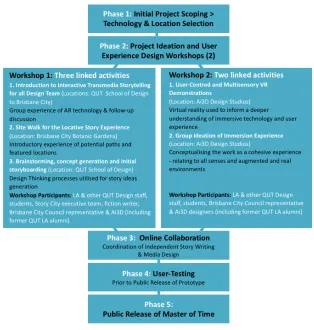
The co-design process for the project is summarised in Figure 1. This displays
that following the initial selection of specific technology and the site location, a
ser-ies of co-design workshops occurred. These workshops consisted of multiple ses-sions and allowed for collaborators to work together and foster transdisciplinary design ideas for the project. Importantly, the workshops allowed for all collabora-tors better to understand aspects of the technology being utilised through partici-pation in experiential learning. In total, two all day workshops occurred with over 25 participants in each. Following the workshops the team worked independently within areas of specialisation for the project (i.e. the writer developed a draft
script, animators worked on animatingfilm footage etc.). Asynchronous
communica-tion via email and online shared documents allowed for team feedback to occur across contributions, and ensured all participants understood overarching project direction and development.
Master of Time
: co-design outcomes and user journey
Key outcomes generated in the initial co-design workshops centred on (a) the
nar-rative storytelling experience and (b) defining a unique, multi-sensory user
experi-ence. In terms of the narrative design, developed here was a unique interweaving
of educational aspects with an overarching story, specifically conceived to give an
emotional depth to the work. In framing the narrative, a core concept/theme
emerged, which centred on why urban parks exist and what needs they fulfil in
our contemporary world. This theme was iterated into a storyline which entailed a
lead character needing to escape the‘busyness’of the modern world and
eventu-ally finding peace in the tranquillity and timelessness of nature. In the story, the
main character (an avatar for the user) is approached by a‘mysterious guide’ with
an invitation to the Gardens and he promises to teach the secrets of time in the natural space of the park. As the narrative progresses, it is revealed that the mysterious guide is Harry Oakman, one of the landscape architects who designed the City Botanic Gardens. Throughout the story, across various locations within the park, the main character learns to obtain respite from the busy world
through the timeless experience of nature, hence becoming a‘Master of Time’.
This narrative approach saw the AR experience depart radically from an
instruc-tional format, which is standard for park and nature tours. Afinal narrative–
primar-ily driven by video sequences, which features actors and incorporates experimental
photography and animation-based special effects – was developed to directly link
five selected locations across the park. Along with the story progressing at each of
these park locations, key foundational principles and understandings in landscape architecture design are revealed, integrated directly into the story itself.
To complement the narrative, in the second workshop the team began to
con-ceive further the work from a foundation of user experience, which involved defi
n-ing the multisensory impressions that would envelop the entire user journey. In
reflecting upon the story’s theme of peacefulness and respite in a park, this came
to encompass an experience ofmindfulness. Aubrey (2017) notes that mindfulness
is‘conscious attention on what you are experiencing, right at the present moment’
and observes that it ‘creates space and quiet in your head’. As such, the work’s
user experience design aims to create a sense of mindfulness that can also be seen
as being meditative and healing. This experience approach then defined the
cre-ation of all the media assets for the work, from design of type to soundtrack to
Jeremy
Kerr
and
Gillian
interface design to art direction and editing of video footage, as well as the construction of the script.
In terms of the final Master of Time user journey this consists of visiting six
separate locations in total and ‘unlocking’ and viewing a short narrative video at
each. These sites are:
1. Starting point: a city location on the QUT campus at the edge of the park where the user is met by the mysterious guide;
2. the Banyan Trees, the oldest and culturally significant trees in the Gardens;
3. the Bamboo Thicket, which operates as the‘quiet heart’of the park;
4. the Lily Pond, in which a hidden ecosystem thrives underwater;
5. the Ring of Palm Trees, which reflects the change of seasons; and
6. the edge of the Brisbane River, representing the traditional land of the Jagera/ Yaggera people.
Within the AR experience, in order to navigate from one of these locations to
the next, users follow instructions on their mobile device. Wayfinding is provided via
directional guides from the narrator, as well as text-based instructions and a Google map identifying where the user is and where to go. When the prototype detects the right location, it unlocks the next part of the story in the form of a video vignette. Each of the videos relates to the location of the user and occurs with narration and progresses the storyline. Text is also provided on-screen to assist users.
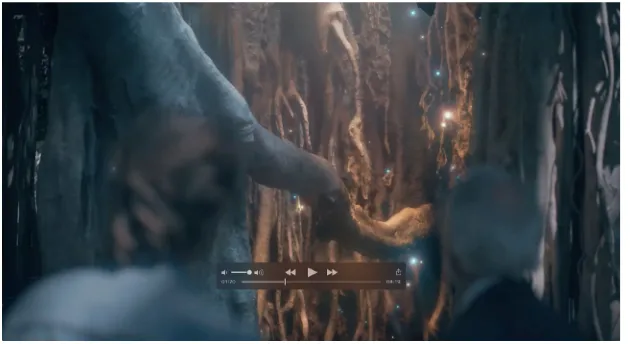
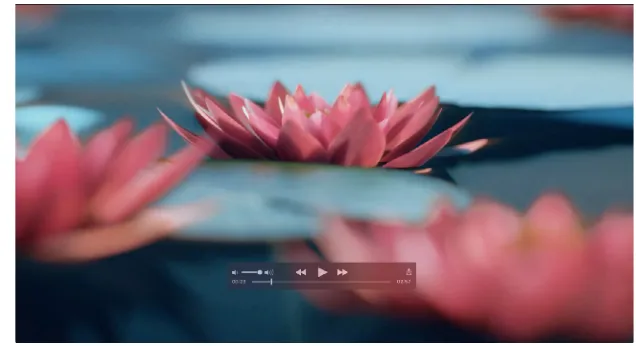
Visuals taken from the video vignettes are displayed in Figure 2, 3, 4 and 5. In each case, these demonstrate the distinctly cinematic approach taken in the video-based storytelling. Figure 2 displays footage activated at the Banyan Trees (location 2), where the timelessness of the trees is emphasised through visual effects indicating the passing of time. Figure 3, 4 and 5 display footage viewed at the Lily Pond (location 4), displaying unusual perspectives of the space. This sequence begins with water lilies being revealed from underwater (Figure 3),
then water lily flowers opening and closing in response to changes of day to
night (Figure 4) and finishes with the thriving ecosystem underwater (Figure 5).
Within this ecosystem are tadpoles, worms, eels and water bugs, and even the feet of ducks swimming above through the water are seen, and the sequence
Figure 2
Footage activated at the Banyan Trees
Jeremy
Kerr
and
Gillian
also zooms in to capture tardigrades, microscopic creatures that live within the ecosystem. Figure 6 shows a visual from the video displayed at the Ring of Palm Trees (location 5), highlighting the dramatic transition of shadows across the day from an aerial view.
Master of Time
: initial user experience evaluation
Following theMaster of Timeprototype becoming operational, site user testing was
undertaken by members of the wider collaborative team and volunteer QUT staff and students. The testing occurred either independently or in pairs and saw users complete the AR experience in its entirety and afterwards provide a full journey evaluation. Data collection consisted of each participant recording observations Figure 4
Footage viewed at the Lily Pond. Water lilyflowers opening and closing in response to changes of day to night
Figure 3
Footage viewed at the Lily Pond. Water lillies being revealed from underwater
Jeremy
Kerr
and
Gillian
verbally via a device as they undertook the AR experience, as well as when refl ect-ing on the experience holistically once completed. Seven users tested the proto-type in the initial evaluation stage and a thematic analysis of user feedback transcripts was undertaken to identify key impressions and insights and to inform
further iterations ofMaster of Time.
In terms of overall feedback all of the participants saw the work as successful in its key aims of providing a unique, engaging and education-based experience.
There werefive major themes identified within user feedback:
• An engagement with the narrative,
• Impact on learning
• Connection with nature
• Engagement with visualisations
• Ease of interaction and navigation
These are outlined below and serve to clarify why the work proved effective. Figure 6
Visual from the video displayed at the Ring of Palm Trees
Figure 5
Footage viewed at the Lily Pond. Thriving ecosystem underwater
Jeremy
Kerr
and
Gillian
An engagement with the narrative
All users identified a level of delight and enjoyment in undertaking the journey
across the sites and following the story depicted in the video vignettes. The theme of gaining respite from the pressures of the modern world resonated with all users, regardless of background and age. For some users this seemed to have a
larger impact, with three noting it prompted reflection and consideration of their
use of time and work-life balance.
Users identified that the story effectively linked all the site locations and that
each section of the narrative seemed to contribute meaningfully to the overall story. It was observed that the educational aspects relating to each site added to the story and overall worked seamlessly within the context of the narrative. Two
respondents identified that prior to undertaking Master of Time they felt that this
form of AR experience might be ‘drawn out’and repetitive. Upon undertaking the
experience, the users stated that each location visit seemed to‘flow’and build
pur-posefully upon the previous. The users noted that the unique content and different forms of video depiction were key in distinguishing each site and preventing a sense of repetitiveness.
Impact on learning
Users found theMaster of Timea valuable way to learn, acknowledging they greatly
appreciated the immersiveness of the experience and that it changed their percep-tion of natural spaces and how they are designed. The majority of users (all those without a landscape design background) felt they had begun to understand the foundational elements of landscape design, and that it changed their awareness of how landscape architects understood and related to the natural environment.
Users noted that seeing content on the screen, presented in a specific way,
and then looking at it first hand, made points resonate strongly. This directly
relates to what Radu (2014, 1539) identifies as a major strength of AR, being that
it allows for multiple representations to appear close together or at the same time and he suggests that this form of information delivery can assist students to learn
better. In this case it was seen by users as a key factor in allowing them to‘unlock’
what landscape designers see in the environment that non-designers may not yet see.
Connection with nature
All users, each of which had used the park previously, noted a shift in their
appre-ciation of the space and an increased ‘connection’ to it through using the
proto-type. All indicated they had a deeper understanding of how the park could make
someone – including themselves – ‘feel’ and better understood the therapeutic
qualities of such locations. Users identified an experience of ‘relaxing’, ‘slowing
down’and ‘taking in nature’ within the space, which is aligned to a sense of
mind-fulness. These users did note, however, that these sensations were not experienced
initially as atfirst they were somewhat overwhelmed as they had to become
accus-tomed to the AR interface, and ways to operate it and navigate the park.
In terms of identifying how a sense of mindfulness was generated, one user
indicated that the role of the soft-spoken narrator was extremely influential. Noted
here was that throughout the vignettes at each site the narrator would draw
attention to features and details surrounding the user – the sound of nature, the
casting of shadows, the reveal of sunlight, the texture of leaves– very much like a
Jeremy
Kerr
and
Gillian
guided walking meditation in nature would do. It was observed that this process raised awareness, and slowed the user down so there was a focus entirely on
specific aspects of the environment.
Engagement with visualisations
All users made specific reference to the cinematic qualities of the video vignettes.
Here it was noted that the footage‘beautifully captured’ aspects of the park that
‘we just wouldn’t be able to see otherwise’. The most popular sequences for users
were those which involving flying above the park, time lapse, and underwater
shots, capturing aspects of the park not possible to see with the human eye and encompassing the ephemerality of landscape architecture.
Users appreciated the short length of each instalment, one stating it acted as
a‘burst of information’ that also allowed time for the user to appreciate each
set-ting in terms of the‘real world’once the videofinished. In respect to watching the
videos, users stated that they did not feel this aspect dominated the experience. It
was observed by one user that as he was surrounded by the ‘scene’ (in the real
world) as he viewed each vignette, this meant the small screen footage never‘took
over’the experience completely.
Ease of interaction and navigation
All users viewed the experience as relatively seamless, which is seen as an essential
design consideration (Billinghurstet al.2001; Boweret al.2014; Changet al.2010).
As mentioned previously, users found the navigation process awkward at the
begin-ning, however once it was understood at thefirst site location, most noted the
expe-rience became more straightforward. It was observed that the challenge of navigating the AR interface was assisted through it being consistent throughout the work and across all sites. Users appreciated the approach whereby multiple guidance options to locations were given and content was generated as the participant moved through a location, rather than relying on them to interact directly with the interface. It was recognised that the content generation allowed for an emphasis on viewing the locations and not a preoccupation with operating a device.
The key usability issue identified in feedback related to the external
environ-ment affecting a user’s ability to follow content on a mobile device. Most
com-monly cited was sunlight hitting the mobile screen and obscuring content. One user noted that he compensated for this by moving out of direct light at each loca-tion (notably areas of shade were factored into the choice of these). Also noted was that the sounds of people and other sources in the park made listening to the
soundtrack, including the narrator, difficult at times.
Emerging principles for AR education design from
Master of Time
From examining and reflecting over the Master of Time’s design outcomes, user
feedback and the creative process itself, the following series of five key design
principles were formulated to inform future approaches in site-driven AR learning initiatives:
• Identify and develop a core experiential theme/s for the user.
• Develop a unique conceptual approach for the narrative.
Jeremy
Kerr
and
Gillian
• Design to be multisensory –but consider both AR and real-world contexts.
• Apply AR and its multimedia elements in meaningful and authentic ways and
design for gaps.
• Apply an approach for transdisciplinary collaboration.
These strategies represent a foundation which the research team aim to test
and iterate in upcoming projects, and which may contribute to field work of other
researchers.
Identify and develop a core experiential theme/s for the user
The application of an overarching experience design theme, which in this case was
creating a sense of mindfulness and connection to the serenity of nature, served to unify the diverse aspects of the AR experience and create something that was harmonious, engaging and memorable, and distinct from the learning experience. It
is recommended that an experiential theme/s should be explicitly identified by a
design team to ensure all design elements–ranging from the overt to the subtle–
align throughout the learning experience. Aspects to consider here include visual design and branding, photography and videography of content, use of sound, types of pauses and designed engagement with the surrounding environment. It also bears mentioning that an experiential theme could change as the narrative pro-gresses, with all aspects of the experience design adjusted accordingly.
Develop a unique conceptual approach for the narrative
Interwoven with the experiential theme is for the learning to incorporate a sup-porting original story/narrative. In aiming for a unique narrative to drive the AR
experience the learning firmly applies a pedagogical approach based on
edutain-ment. Evidence captured by this study and others (Jarvin 2015; Nemec & Trna 2007) increasingly demonstrate the learning potential of this creative-led approach to education. The AR format allows for a distinct breaking away from conventional
and traditional pedagogies – and this project serves as a model of how this can
occur with a simple narrative, and how it may be employed within the format of video/drama-based vignettes. In terms of developing a potential storyline and nar-rative approach, the design workshop model based around design thinking ideation is an effective approach to apply, allowing a team to collaborate to create an appropriate and authentic narrative that is also original.
Design to be multisensory
–
but consider both AR and real-world
contexts
In conceptualising an AR-led education project consider all five senses of the
user – both in terms of the technology being created, as well as their sensory
experience in the ‘real’ environment, outside of the technology. Attention should
be focused on making sure there is no conflict between the two contexts, such
as distractions from sounds or competing visual content. Considering this
explic-itly is a way to avoid a risk of ‘cognitive overload’ (Dunleavy et al. 2009) in AR
education. In applying this approach, it is essential that designers undertake mul-tiple site visits and gather data on the environment and its multi-sensory experi-ence at the different times users may use it. Following the development of AR content, the prototype should then be extensively tested within the site environ-ment to ensure a cohesive and unobstructed experience. Also essential in
Jeremy
Kerr
and
Gillian
undertaking these multiple site visits is ensuring health and safety risks are considered in the design.
Apply AR and its multimedia elements in meaningful and
authentic ways and design for gaps
A key strength in utilising locative AR media is that it allows a user to be able
to see and experience a space in new ways, rather than rely on verbal
communi-cation and text (the traditional modes of learning) to impart knowledge and understanding. As such, appropriate media should be used to provide focus and
information (ideally through visual means that show rather than ‘tell’) and
oppor-tunities need to be created for the user to simply ‘be’ within the environment,
in order to assimilate the learning. It is essential that space is created for the environment to be understood so as learning is not principally occurring through
the AR media. Such moments of engagement and reflection within a site are
possible through integrating cues within the AR experience to ensure these pauses occur.
Apply an approach for transdisciplinary collaboration
The approach presented in Figure 1, with its distinct collaborative phases and structure, is a proven model that can be used not only in developing AR education projects with inexperienced teams, but be adapted for developing learning initia-tives across all forms of new technology. Educational projects centring on new technologies typically require multi-disciplinary teams, yet often these works are
created ‘organically’ and without a defined design process. This model serves to
ensure all stakeholders understand the technology with experiential depth at the start of the project, and have a vital role throughout the process. The co-design
workshop and follow-up online collaboration model can result in a more efficient
production process and a cohesive work that is defined by shared goals. Such a
model allows for potentially more ambitious edutainment works to be created, and
in some ways sees AR learning production approached like a film collaboration,
rather than adopting a standard app design workflow.
Conclusion
Early review and testing demonstrate that the Master of Time project has
suc-ceeded on multiple levels as a landscape design educational tool. Certainly this will
be further explored in future, larger-scale user testing across first year student
groups. While in the past the foundational knowledge contained within the AR ini-tiative might be attempted to be relayed through the more passive experience of a lecture or a reading, or a class excursion to a site, this work shows how technology can be used in new ways to facilitate active and meaningful learning which
immerses the learner. In effect, Master of Time allows for curriculum to now be
delivered via what can be considered as a new form of mobile blended learning.
Blended learning with videos in online lectures can prove engaging for students and improve application of theoretical principles to individual site-based project
work (Thomsonet al. 2014), though such lectures are typically not readily
accessi-ble while students are in the field. AR offers a new individualised learning
experi-ence, a‘burst of information’while engaging with theory and being surrounded by
a site in the real world.
Jeremy
Kerr
and
Gillian
At a time when educational models are in a state offlux with the emergence of new technologies, this project demonstrates how future learning can become richer and have more potential impact. Consequently, it shows that the additional effort needed to develop such technology-heavy resources may be worth it.
Indeed, such effort is further justified when one considers that once dynamic
learning platforms like the Master of Time are developed, they are ongoing and
self-sufficient. Moreover, these can be used outside of formal curriculum to
pro-mote a degree or discipline to the public as well.
Given that mobile media is becoming the dominant and ‘natural interface
through which humans function’(Oppegaard & Grigar 2014, 29), it is necessary to
explore the many possibilities through which education can occur via this device.
WithMaster of Timeexperimenting with pedagogical approaches–and stretching the
boundaries of how AR can operate and engage users – it is hoped this will inspire
others. Furthermore, its successful collaborative model represents a practical frame-work for future-focused transdisciplinary design within the educational sector.
Jeremy Kerris the coordinator and a senior lecturer for the Interactive and Visual Design Program at the QUT School of Design, Brisbane, Australia and a design practitioner with over 15 years’industry experience. Jeremy’s research focus lies in the exploration and development of design and design frameworks to advance community capacity building and self-advocacy. His current research includes design-led initiatives in the areas of education across institutional sectors, intercultural design, and mental health and well-being. Contact address: Queensland University of Technology, School of Design, 2 George Street, Brisbane, Queensland 4001, Australia. Email: [email protected]
Gillian Lawsonis an associate professor and the head of the School of Landscape Archi-tecture at Lincoln University, Christchurch, New Zealand. She is a registered landscape architect with over 20 years’academic experience in landscape architecture. Gillian’s research interests focus on social practices in public and private spaces, particularly in rela-tion to learning and teaching in landscape architecture. Her current research includes collab-orative projects undertaken in Vietnam, India and China. Contact address: Lincoln
University, School of Landscape Architecture, Lincoln 7647, Christchurch, New Zealand. Email: [email protected]
Note
1. Master of Timeis accessible via the Story City web site (https://www.storycity.com.au/ stories/new-QUT-landscape-architecture-ad venture/) and available on the Story City app
at Google Play (for Android devices) and at the App Store (for iOS devices). Full function-ality ofMaster of Timeis only available on site at the Brisbane City Botanic Gardens.
References
ABC News(2014) Parents Divided over
New Botanic Gardens Fairy-Hunting App For Children, 22 December (online). Available at: http://www.abc.net.au/news/
2014-12-22/parents-divided-melbourne-botanic-gardens-fairy-finding-app/5984216
(accessed 18 December 2017).
Akcayir, M. & Akcayir, G.(2017)
Advantages and challenges associated with
Jeremy
Kerr
and
Gillian
augmented reality for education: a systematic review of the literature, Educational Research Review, Vol. 20,
pp. 1–11.
Aubrey, A.(2017) Mindfulness Apps Aim
To Help People Disconnect From Stress (online). Available at: http://www.npr. org/sections/health-shots/2017/10/16/ 557633144/mindfulness-apps-aim-to-help-people-disconnect-from-stress (accessed 12 February 2018).
Azuma, R.(1997) A survey of augmented
reality,Presence, Vol. 6, No. 4, pp. 355–85.
Bacca, J., Baldiris, S., Fabregat, R., Graf, S. & Kinshuk. (2014) Augmented reality trends in education: a systematic review of
research and applications,Educational
Technology & Society, Vol. 17, No. 4,
pp. 133–49.
Billinghurst, M., Kato, H. & Poupyrev, I. (2001) The magicbook-moving seamlessly
between reality and virtuality,IEEE
Computer Graphics and Applications, Vol. 21,
No. 3, pp. 6–8.
Bitter, G. & Corral, A.(2014) The
pedagogical potential of augmented reality
apps,International Journal of Engineering
Science Invention, Vol. 3, No. 10, pp. 13–17.
Bower, M., Howe, C., McCredie, N.,
Robinson, A. & Grover, D.(2014)
Augmented Reality in education–cases,
places and potentials,Educational Media
International, Vol. 51, No. 1, pp. 1–15.
Chang, G., Morreale, P. & Medicherla, P. (2010) Applications of augmented reality systems in education, in D. Gibson & B.
Dodge [Eds]Proceedings of Society for
Information Technology & Teacher Education International Conference 2010. Chesapeake, VA: Association for the Advancement of Computing in Education (AACE), pp.
1380–5.
Chicagobotanic.org. (2018) GardenGuide, Chicago Botanic Garden (online). Available at: https://www.chicagobotanic.org/app (accessed 18 December 2017).
Chou, R.(2017) Going out into thefield:
an experience of the landscape architecture studio incorporating service-learning and
participatory design in Taiwan,Landscape
Research, Vol. 43, No. 6, pp. 784–97.
Dunleavy, M., Dede, C. & Mitchell, R. (2009) Affordances and limitations of immersive participatory augmented reality simulations for teaching and learning, Journal of Science Education and Technology,
Vol. 18, No. 1, pp. 7–22.
Ertmer, P., Ottenbreit-Leftwich, A., Sadik,
O., Sendurur, E. & Sendurur, P.(2012)
Teacher beliefs and technology integration
practices: a critical relationship,Computers
& Education, Vol. 59, No. 2, pp. 423–35.
Jarvin, L.(2015) Edutainment, games, and
the future of education in a digital world, New Directions for Child and Adolescent Development, No. 147, pp. 33–40.
Johnson, L., Adams Becker, S., Estrada, V.
& Freeman, A.(2014)Horizon Report 2014
–Higher Education Edition. Austin, TX: The New Media Consortium.
Kerawalla, L., Luckin, R., Seljeflot, S. &
Woolard, A.(2006)‘Making it real’:
exploring the potential of augmented reality for teaching primary school science, Virtual Reality, Vol. 10, No. 3, pp. 163–74.
Kesim, M. & Ozarslan, Y.(2012)
Augmented reality in education: current technologies and the potential for
education,Procedia–Social and Behavioral
Sciences, Vol. 47, pp. 297–302.
Kipper, G. & Rampolla, J.(2013)
Augmented Reality. Amsterdam: Syngress/ Elsevier.
Nemec, J. & Trna, J. (2007) Edutainment
or entertainment: education possibilities of didactic games in science education, in
J. Nemec [Ed.] The Evolution of Children
Play, 24th ICCP World Play Conference.
Brno, Czech Republic: Pedagogická
fakulta, Masarykova univerzita, pp.
55–64.
Oppegaard, B. & Grigar, D.(2014) The
interrelationships of mobile storytelling: merging the physical and the digital at a
national historic site, in J. Farman [Ed.]The
Mobile Story: Narrative Practices with Locative Technologies. New York & London:
Routledge, pp. 17–33.
Jeremy
Kerr
and
Gillian
Radu, I.(2014) Augmented reality in education: a meta-review and cross-media
analysis,Personal and Ubiquitous Computing,
Vol. 18, No. 6, pp. 1533–43.
Rasimah, C., Ahmad, A. & Zaman, H. (2011) Evaluation of user acceptance of
mixed reality technology,Australasian
Journal of Educational Technology, Vol. 27,
No. 8, pp. 1369–87.
Smith, D.(2004) Issues and trends in
higher education biologyfieldwork,Journal
of Biological Education, Vol. 39, No. 1, pp. 6–10.
Steen, M., Manschot, M. & De Koning, N.
(2011) Benefits of co-design in service
design projects,International Journal of
Design, Vol. 5, No. 2, pp. 53–60.
Thomas, K.(2015) The practice of
collaboration as ethical activity in art/s
education?,International Journal of Art &
Design Education, Vol. 34, No. 3, pp. 296– 308.
Thomson, A., Bridgstock, R. & Willems, C.
(2014)‘Teachersflipping out’beyond the
online lecture: maximising the educational
potential of video,Journal of Learning
Design, Vol. 7, No. 3, pp. 67–78.
Uzunboylu, H. & Yıldız, E.(2016)
Augmented reality research and
applications in education,New Trends and
Issues Proceedings on Humanities and Social Sciences, No. 11, pp. 238–43 (online). Available at: http://prosoc.eu (accessed 24 May 2017).
Webb, J. & Stafford, R.(2013)
Location-based mobile phone applications for
increasing student engagement withfi
eld-based extra-curricular activities,Planet, Vol.
27, No. 1, pp. 29–34.
Jeremy
Kerr
and
Gillian