Gender Differences in Risk Behaviors Among Adolescents Who
Experience Date Fighting
Shelley R. Kreiter, MD; Daniel P. Krowchuk, MD; Charles R. Woods, MD; Sara H. Sinal, MD; Michael R. Lawless MD; and Robert H. DuRant, PhD
ABSTRACT. Objective. Although dating violence fre-quently begins during adolescence, few studies have fo-cused on date fighting in middle and high school stu-dents. Fewer studies have studied gender differences in date violence. This study examines whether gender-spe-cific patterns of risk behaviors exist among adolescents who report date fighting.
Design. The study was conducted on data collected from 21 297 students in grades 8 through 12 participating in the Vermont 1995 Youth Risk Behavior Survey. Data were analyzed on 20 724 students (females550.1%) who reported: 1) never having been involved in a physical fight (n58737); 2) that their last physical fight was with a girlfriend, boyfriend, or other dating partner (n5432); and 3) that their last fight was with someone other than a dating partner (n 5 11 555). Indicators of violence (weapon carrying, being threatened, and fighting), sui-cide attempts, substance use, sexual behavior, and preg-nancy were analyzed withx2tests. Significant variables
were analyzed with stepwise logistic regression.
Results. Of the males, 1.8% and of the females, 4.2% reported that their last fight was with a boyfriend, girl-friend, or dating partner. Risk behaviors significantly associated among females who only experienced date fighting included the number of male sexual partners in the past 3 months (adjusted odds ratio: 1.48; 95% confi-dence interval: 1.26 –1.74), number of suicide attempts in the past 12 months (1.55; 1.30 –1.85), riding in a car with a drinking driver (1.23; 1.10 –1.37), injection of illegal drugs (2.87; 1.10 –7.50), use of alcohol before last sexual encoun-ter (1.53; 1.27–1.86), number of pregnancies (1.66; 1.26 – 2.21), forced sex (2.92; 2.18 –3.91), and inhalant use (1.19; 1.06 –1.34). Risk behaviors significantly associated among males who experienced only date fighting were sexual activity (4.11; 2.24 –7.53), number of male partners in the past 3 months (1.40; 1.12–1.75), number of times of getting someone pregnant (1.68; 1.17–2.40), experiencing forced sex (2.38; 1.11–5.13), and the number of times threatened with physical violence in past 12 months (1.82; 1.53–2.17). When compared with adolescents who reported fighting with someone other than a date, risk factors significantly associated with date fighting among females were the number of male sexual partners in the past 3 months (1.21; 1.10 –1.34), older age (1.21; 1.10 –1.34), carrying a weapon in the past 30 days (.77; .66 –.90), experiencing forced sex (1.70; 1.30 –2.22), condom non-use (1.96; 1.60 –
2.41), and number of times of being threatened with physical violence in past 12 months (1.11; 1.01–1.22). The risk factors among males were the number of male sexual partners in the past 3 months (1.43; 1.28 –1.60), experienc-ing forced sex (1.91; 1.02–3.60), and older age (1.34; 1.14 – 1.57).
Conclusions. The patterns of risk behaviors differed among male and female adolescents reporting dating violence. Females who reported date fighting were more likely than were nonfighters to have attempted suicide, to engage in sexual and human immunodeficiency virus risk behaviors (use of injectable drugs), to have been pregnant, experienced forced sex, and to have ridden in a car with a drinking driver. Sexual behaviors, including same-gender sexual partners, forced sex, and having been threatened with physical violence, were associated with date fighting among males. These findings are important in screening adolescents at risk for date violence.
Pediatrics1999;104:1286 –1292;date fighting, adolescence, risk behaviors, gender.
ABBREVIATIONS. YRBS, Youth Risk Behavior Survey; OR, odds ratio.
V
iolence among today’s youth is a significant social and public health problem.1–10The 1997Centers for Disease Control and Prevention Youth Risk Behavior Survey (YRBS) revealed that 36.6% of students in grades 9 through 12 had been in a physical fight during the 12 months before the survey, with;115 physical fighting incidents occur-ring per 100 students per year.11 Many adolescents
are faced with violence within their communities,2– 6
schools,7and within their homes.2
Issues of dating violence have received consider-able attention after a landmark study by Makepeace12
in 1981, but most of the research has focused on adult couples or, to a lesser extent, college men and women. Although dating violence frequently begins during adolescence, few studies have addressed its occurrence among high school and middle school students.
The majority of adolescents have begun dating by 16 years of age, and many have experienced an epi-sode of partner violence by age 15.13Studies of dating
violence among high school students in 1983 and 1986 reported rates of 12.1% and 26.9%, respective-ly.13,14 Among 8th and 9th grade students in North
Carolina in 1996, 36.5% of dating females and 39.4% of dating males reported at least one episode of date violence.15Between 7% and 26% of pregnant
adoles-From the Department of Pediatrics, Brenner Children’s Hospital and Health Services, Brenner Center for Child and Adolescent Health, Wake Forest University School of Medicine, Winston-Salem, North Carolina. Received for publication Jan 4, 1999; accepted Apr 27, 1999.
Reprint requests to (S.R.K.) Department of Pediatrics, Wake Forest Univer-sity School of Medicine, Medical Center Blvd, Winston-Salem, NC 27157. E-mail: [email protected]
cents reported violence during pregnancy, usually by a boyfriend or family member.16,17These findings
suggest that adolescent dating violence is an impor-tant problem and that early risk factor identification and interventions are needed urgently.15
There is little consensus concerning factors that may contribute to violence in a dating relationship or serve as predictors for those at risk. Although many interventions for adults are aimed primarily at the female as the victim, studies of high school students report the prevalence of dating violence perpetration to be about equal for males and females.13,14,18Malik
et al19 and Foshee et al15found that girls were more
likely than boys to perpetrate general dating vio-lence, but that adolescent boys perpetrated more sex-ual dating violence than girls. Other potential risk factors for dating violence include the use of alcohol and other substances. Two studies of high school students reported drug and alcohol use as contribut-ing factors in the occurrence of a violent datcontribut-ing inci-dent.14,20 Symons et al18 reported that alcohol and
drug use among adolescents was predictive of expe-riencing dating violence. Other potential risk factors include lower school performance, a greater number of dating partners,21being black,14,18and exposure to
other forms of violence within the family22,23or
com-munity.19 Problem-Behavior Theory24 proposes that
adolescent risk and problem behaviors may cluster to form a risk behavior syndrome. Although two studies have demonstrated an association between partner violence with the use of alcohol and illegal drugs,14,20 it is not known if adolescent dating
vio-lence is associated with other health risk and prob-lem behaviors.
This study examined the association of adolescent dating violence with other risk and problem behav-iors among 8th through 12th grade students. We also evaluated whether gender differences exist in the relationships among dating violence and other risk behaviors and whether awareness of a youth’s risk behaviors could allow ascertainment of risk for per-petrating or experiencing partner violence.
METHODS Sample Selection
The Vermont YRBS was administered in 1995 to 8th through 12th grade students attending 79 randomly selected Vermont public and private schools. The Vermont YRBS is a self-adminis-tered questionnaire with 91 multiple choice questions and is avail-able in English and Spanish. It is based on the national YRBS developed by the Centers for Disease Control and Prevention to assess the prevalence of health risk behaviors among youth in the United States. The Vermont YRBS differs from the national YRBS because it is administered to all students in each selected school rather than selected classrooms within each selected school. The sample consisted of 60.8% of all 8th through 12th grade students in Vermont. Participation was voluntary and anonymous. Of the eligible students (n521 297), 85% completed evaluable question-naires. The Vermont YRBS are public use data that include demo-graphic information and questions about safety and violence; suicidal tendencies; tobacco, alcohol, and other drug use; aware-ness of human immunodeficiency virus/acquired immunodefi-ciency syndrome; sexual behavior and pregnancy; body weight issues; diet; physical activity; and other risk behaviors, including riding with drinking drivers. These questions have been shown to have adequate reliability on test–retest analysis.25Over 100 con-sistency checks were conducted on the Vermont YRBS data to exclude careless, invalid, or logically inconsistent responses.26
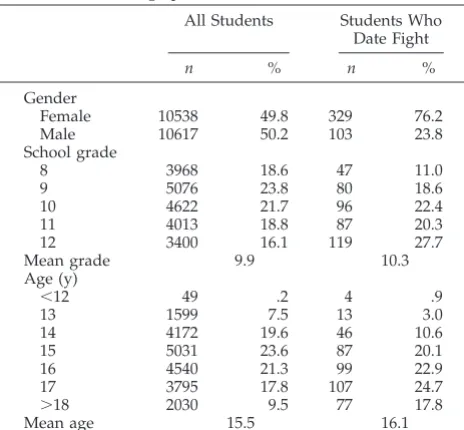
The demographic information collected was limited to age, gender, and grade (Table 1). Vermont middle and high school students are 97.5% white, therefore, information on race was not included to protect the confidentiality of students from minority racial and ethnic groups.
Outcome/Dependent Variable
For this study, data were analyzed on students who reported either never having been involved in a physical fight (n58737), or who reported that their last physical fight was with a girlfriend, boyfriend, or other dating partner (n5432). Adolescents who reported date fighting also were compared with those who re-ported that their last physical fight was with someone other than a dating partner (n511 555). These three categories of students were determined using responses to the question, “The last time you were in a physical fight, with whom did you fight?” Those never involved in a fight responded to the choice, “I have never been in a physical fight.” Those involved in date fighting re-sponded to the choice, “A boyfriend, girlfriend, or date.” Those who reported their last fight to be with someone other than a boyfriend, girlfriend, or date responded to the choices, “A total stranger” (n5945); “a friend or someone I know” (n54996); “a parent, brother, sister, or other family member”(n52947); “some-one not listed. . . ” in other choices (n51575); or “more than one of the persons. . . ” listed in the other choices (n51092).
Predictor/Independent Variables
The variables that were examined in relation to dating violence included: smoking frequency; suicidal ideation and attempts; ex-perience of threats of physical violence; weapon carrying; fre-quency of drinking, drinking while driving, and riding with drinking drivers; use of marijuana, cocaine, inhalants, and spit tobacco; and use of anabolic steroids. Variables of sexual behavior that were examined were sexually activity; perceived human im-munodeficiency virus risk; numbers of male or female partners; forced sex; alcohol or drug use before last sexual intercourse; condom use; and having been pregnant or having gotten someone pregnant. These variables were selected for analysis based on Problem-Behavior Theory.24
Statistical Analysis
Bivariate analyses were stratified by gender and conducted usingx2, Cramer’s V,fcoefficient and Kruskal-Wallis analysis of variance tests. Cramer’s V tests andfcoefficients were used to measure the strength of association between two categorical ables. The bivariate analyses were used to determine which
vari-TABLE 1. Demographic Characteristics of Students All Students Students Who
Date Fight
n % n %
Gender
Female 10538 49.8 329 76.2
Male 10617 50.2 103 23.8
School grade
8 3968 18.6 47 11.0
9 5076 23.8 80 18.6
10 4622 21.7 96 22.4
11 4013 18.8 87 20.3
12 3400 16.1 119 27.7
Mean grade 9.9 10.3
Age (y)
,12 49 .2 4 .9
13 1599 7.5 13 3.0
14 4172 19.6 46 10.6
15 5031 23.6 87 20.1
16 4540 21.3 99 22.9
17 3795 17.8 107 24.7
.18 2030 9.5 77 17.8
Mean age 15.5 16.1
ables would be analyzed with multiple logistic regression analy-sis. Variables found significantly correlated with report of last physical fight with a dating partner (P,.001) were analyzed with a stepwise multiple logistic regression analysis with a forward inclusion of independent variables, using the likelihood ratio ap-proach. Analyses were performed using SPSS for Windows 7.0 (SPSS, Inc, Chicago, IL).
RESULTS
Of the students, 432 (2% of total students) reported that their last fight was with a boyfriend, girlfriend, or date. Of the 20 724 students who responded to the question regarding their last fight, 329 females (1.6%) and 103 males (.5%) reported fighting with a date. Of those students who reported fighting with a date, 76% were female and 24% male. Similarly, of the students who reported never having been in a fight (8737), 66.2% were female and 33.8% were male (P# .0001;f5 2. 045). Among the 11 555 students who had been in a fight with someone other than a date, 36.8% were female and 63.2% were male (P#.0001;
f 5 2. 15). The mean age and median grade for a student reporting date fighting were 16 years of age and the 10th grade, respectively (Table 1).
It was hypothesized that males and females would differ in regards to health risk behaviors that would be associated with date fighting, therefore, bivariate analyses were performed separately for each gender. In analyzing the relationship between date fighting and sexual behaviors, date fighting was associated more strongly in females with being sexually active, the number of male sexual partners, using a condom before last sex, using alcohol before last sex, having been forced to have sex, or having been pregnant. The number of female sexual partners was not
asso-ciated with date fighting. Date fighting among males was associated with the number of male sexual part-ners and having gotten someone pregnant, although the association was less than seen with females (Ta-ble 2).
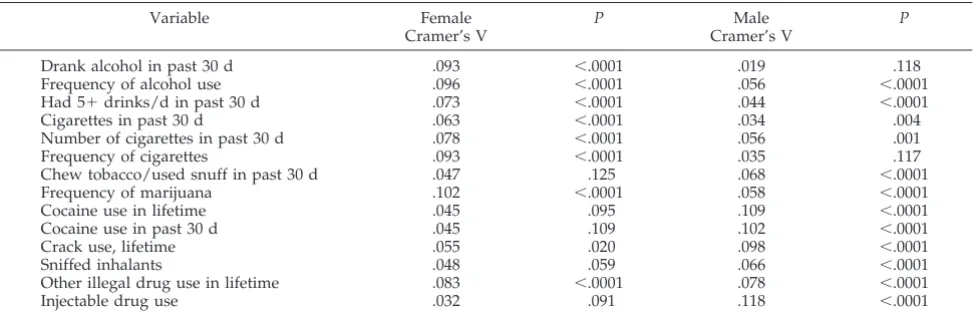
The relationship between the substance use vari-ables and date fighting was weak for both males and females. For females the largest correlation was be-tween the frequency of marijuana use and date fight-ing. The strongest correlates of date fighting among males were injection drug use and the frequency of cocaine use (Table 3).
Among females, in terms of other risk behaviors, date fighting was associated more strongly with older age, school grade, riding with a drinking driver, driving while drinking, having been threat-ened with violence, and suicide attempt than in males. In contrast, among males who reported fight-ing with a date, there was a stronger association with physical fighting, anabolic steroid use, and suicide behaviors (Table 4).
All variables that were significantly associated (P ,. 001) with date fighting in bivariate analyses were entered into multiple logistic regression models. Eight variables correctly classified 95% of the females who reported no other fighting except date fighting, compared with female adolescents who had not fought (Table 5). For each increase in the number of male sexual partners in the previous 3 months, there was an increased risk of being involved in a date fight of 1.48 for each partner, compared with those who had never had sexual intercourse. The risk of being involved in a date fight increased 1.55 times for
TABLE 2. Relationships Between Sexual Behaviors and Date Fighting
Variable Female
Cramer’s V
P Male
Cramer’s V
P
Sexually active .202 ,.0001 .065 ,.0001
Number of male partners in lifetime .212 ,.0001 .168 ,.0001
Number of male partners in past 3 mo .231 ,.0001 .189 ,.0001
Number of female partners in lifetime .050 .085 .076 ,.0001
Number of female partners in past 3 mo .051 .111 .078 ,.0001
Used condom with last sex .227 ,.0001 .072 ,.0001
Forced sex .149 ,.0001 .077 ,.0001
Number of times pregnant/gotten someone pregnant .147 ,.0001 .119 ,.0001
Used alcohol or drugs before last sex .204 ,.0001 .068 ,.0001
TABLE 3. Relationships Between Substance Use and Date Fighting
Variable Female
Cramer’s V
P Male
Cramer’s V
P
Drank alcohol in past 30 d .093 ,.0001 .019 .118
Frequency of alcohol use .096 ,.0001 .056 ,.0001
Had 51drinks/d in past 30 d .073 ,.0001 .044 ,.0001
Cigarettes in past 30 d .063 ,.0001 .034 .004
Number of cigarettes in past 30 d .078 ,.0001 .056 .001
Frequency of cigarettes .093 ,.0001 .035 .117
Chew tobacco/used snuff in past 30 d .047 .125 .068 ,.0001
Frequency of marijuana .102 ,.0001 .058 ,.0001
Cocaine use in lifetime .045 .095 .109 ,.0001
Cocaine use in past 30 d .045 .109 .102 ,.0001
Crack use, lifetime .055 .020 .098 ,.0001
Sniffed inhalants .048 .059 .066 ,.0001
Other illegal drug use in lifetime .083 ,.0001 .078 ,.0001
each suicide attempt in the previous 12 months, with females reporting no suicide attempts as the refer-ence group. Compared with those females who never injected drugs, the risk of date fighting in-creased 2.87 times for each time injection drug use had occurred. Adolescent females who had ever ex-perienced forced sex were 2.92 times more likely also to have been involved in date fighting as their last fight than females who had not experienced forced sex. Date fighting also was associated with the fre-quency of riding in a car with a drinking driver, number of pregnancies, frequency of inhalant use, and having drunk alcohol or used drugs before the last sexual experience.
When adolescent females who had been involved in date fighting were compared with those who had fought with someone other than a date, boyfriend, or girlfriend during their last fight, six variables cor-rectly classified 92.9% of the students in these two categories. As the number of male sexual partners during the previous 3 months increased, the risk of date fighting increased 1.21. Because the reference group was not being sexually active, the odds ratio (OR) for one recent sexual partner was 2.42. Age had the same OR of 1.21 with 12 years of age or younger as the reference category. Frequency of weapon car-rying was associated inversely with date fighting and was associated with an increased risk in engag-ing in fightengag-ing with someone other than a date. Fe-male adolescents who had been the victims of forced sex were 1.70 times more likely to have been in-volved in a date fight than girls inin-volved in other types of fights. Date fighting also was associated
with nonuse of a condom at last sex (OR: 1.96) and the number of times the girls had been threatened with physical violence. Girls threatened 4 or 5 times were 3.33 times more likely to be involved in a date fight as their last fight (Table 6).
When adolescent males who had fought with a date, girlfriend, or boyfriend were compared with males who had not fought, 97.8% of these youth were classified correctly by five variables. The risk of date fighting increased as the frequency of male sex-ual partners, having gotten someone pregnant, and having been threatened with physical violence in-creased. For example, males with 3 or more male sexual partners in the previous 3 months were 4.2 times more likely also to have fought with a date at their last fight. Being sexually active and having experienced forced sex also increased the risk of date fighting (Table 7).
When males involved in a date fight were com-pared with other males who had fought with some-one other than a date at their last fight, two variables remained significantly correlated with date fighting after adjusting for age. The number of recent male sexual partners and being the victim of forced sex were both associated with an increased risk of in-volvement in date fighting, compared with males involved in other types of fighting during their last fight (Table 8).
DISCUSSION
Of the 8th through 12th grade Vermont students participating in the survey, 2% (432) of the students reported that their last fight was with a date. This
TABLE 4. Relationships Between Demographics, Violence, Risky Behaviors, Suicide, and Date Fighting
Variable Female
Cramer’s V
P Male
Cramer’s V
P
Age .145 ,.0001 .062 ,.0001
Grade .128 ,.0001 .037 .038
Passenger in car with drinking driver .098 ,.0001 .056 ,.0001
Drove car while drinking in past 30 d .075 ,.0001 .049 .001
Drive while drinking .153 .0001 .047 .018
Carried weapon in past 30 d .025 .584 .055 ,.0001
Threatened with physical violence in past 12 mo .071 ,.0001 .035 .058
Physical fight with injuries needing treatment .056 .007 .165 ,.0001
Fight at school in past 12 mo .037 .533 .144 ,.0001
Seriously considered suicide .055 ,.0001 .060 ,.0001
Attempted suicide in past 12 mo .076 ,.0001 .154 ,.0001
Attempted suicide requiring treatment .063 ,.0001 .121 ,.0001
Steroid use .052 .032 .089 ,.0001
Perceived HIV risk .062 .001 .048 .001
TABLE 5. Risk Factors Associated With Dating Violence Among Adolescent Females Compared to Adolescent Females Who Have Not Been in a Fight
Variable Adjusted OR 95% CI Partialr P
Number of male partners in past 3 mo 1.48 1.26, 1.74 .010 ,.0001
Number of suicide attempts in past 12 mo 1.55 1.30, 1.85 .101 ,.0001
Number of times riding in car driven by drinking driver, past 30 d 1.23 1.10, 1.37 .073 .0003 Number of times of injection of illegal drugs in lifetime 2.87 1.10, 7.50 .035 .032
Drink alcohol before sex 1.53 1.27, 1.86 .090 ,.0001
Number of times pregnant 1.66 1.26, 2.21 .070 .0004
Number of times sniffed or inhaled in lifetime 1.19 1.06, 1.34 .056 .003
Forced sex 2.92 2.18, 3.91 .152 ,.0001
CI indicates confidence interval.
finding is in keeping with the other research on adolescent dating violence, that date fighting can and does occur in middle and high school students and is not a phenomenon seen only in college students and adults. We found that the mean grade for date fight-ing among these students was the 10th grade; 11% of the students reporting date fighting on their last date were 8th grade students. Foshee et al15 found that
37% of females and 39% of males in the 8th and 9th grades reported being a victim of date violence on at least one occasion.
Other studies have reported prevalence rates of physical dating violence among high school students to range from 9% to 39%.13,14,19 –21,23Similar rates have
been reported among college students, ranging from 17% to nearly 65%.12,27–35It is not surprising that the
prevalence would be found to be higher in older and college age students, because date violence tends to increase with dating experience and with more established and intimate relationships.11,36,37 Our
percentages are also smaller because we measured fighting with a date, boyfriend, or girlfriend during their last fight and not the lifetime frequency of date fighting. The percentage of students reporting date fighting also may be underestimated because of a student’s understanding or perception of dating vi-olence or abuse. Symons et al,18 for example, found
that 60% of high school students had been involved in at least one violent act during a dating
relation-ship, although only 12.7% perceived these incidents as abuse.
Conflicting data exist regarding the relationship between gender and dating violence.23,33,38For
exam-ple, various reports indicate no gender differences with respect to perpetrating date fighting13,14or being
victimized,15,19 whereas other reports suggest that
females report more perpetration of date fighting,15,19
even while controlling for self-defense.15 It also has
been reported that males perpetrate more sexual dat-ing violence than do females.15,33We found that
fe-males were nearly 3 times more likely than fe-males to report that their last fight was with a date. Because of the limitations of the survey, we were not able to make a distinction between the student being a vic-tim or perpetrator of the date fighting. Our findings also may reflect reporting bias, because males may underreport violent behaviors, and females are more likely to use milder forms of abuse, such as pushing and slapping, which may not be interpreted as fight-ing.
This study explored gender differences in patterns of risk behaviors associated with reporting of date fighting. Jessor24defines risk behavior as any
behav-iors that interfere with an adolescent’s physical and psychosocial health and development. He points out that among some adolescents, health risk and prob-lem behaviors tend to cluster because different risk behaviors help meet similar psychosocial develop-mental needs as well as having the same causal factors. The clustering of these behaviors may pro-vide insight into identifying students at risk for date fighting. In exploring these differences, we further attempted to separate adolescents who reported their last fight to be with a date, boyfriend, or girlfriend from those students who had not fought in the last year and from those adolescents who reported other physical fights in the past 12 months.
Females who reported fighting with a date were more likely to report suicide attempts, have been pregnant, to have multiple male sexual partners, to
TABLE 6. Risk Behaviors Associated With Dating Violence Among Adolescent Females Compared to Adolescent Females Who Experience Other Violence
Variable Adjusted OR 95% CI Partialr P
Number of male sexual partners in past 3 mo 1.21 1.10, 1.34 .075 .0002
Age 1.21 1.10, 1.34 .079 .0001
Carry a weapon in past 30 d .77 .66, .90 2.068 .0007
Forced sex 1.70 1.30, 2.22 .079 .0001
Condom non-use 1.96 1.60, 2.41 .137 ,.0001
Number of times threatened with physical violence in past 12 mo 1.11 1.01, 1.22 .039 .023
CI indicates confidence interval.
Of the females, 92.9% were classified correctly by this model.
TABLE 7. Risk Behaviors Associated With Dating Violence Among Adolescent Males Compared to Adolescent Males Who Had Not Been in a Fight
Variable Adjusted OR 95% CI Partialr P
Sexually active 4.11 2.24, 7.53 .176 ,.0001
Number of male sexual partners, past 3 mo 1.40 1.12, 1.75 .106 .003
Number of times gotten someone pregnant 1.68 1.17, 2.40 .099 .005
Forced sex 2.38 1.11, 5.13 .069 .027
Number of times threatened with physical violence past 12 mo 1.82 1.53, 2.17 .267 ,.0001 CI indicates confidence interval.
Of the males, 97.8% were classified correctly by this model.
TABLE 8. Risk Behaviors Associated With Dating Violence Among Adolescent Males Compared to Adolescent Males Who Experience Other Violence
Variable Adjusted OR
95% CI Partial r
P
Number of male sexual partners in past 3 mo
1.43 1.28, 1.60 .205 ,.0001
Forced sex 1.91 1.02, 3.60 .048 .045
Age 1.34 1.14, 1.57 .111 .0003
CI indicates confidence interval.
have experienced forced sex, and to engage in risky behaviors, such as drug use and riding in cars with drinking drivers, than females who reported never having been in a fight. Malik et al19found that
sub-stance use was a positive predictor of dating violence victimization among girls. Similarly, another study found that alcohol and drug use were predictors of date abuse18or the use of alcohol or drugs before an
incident of date abuse.20It could be speculated that
these substances may lower inhibitions that may lead to less self-protective behavior when these girls find themselves in high-risk situations. In contrast, among males who reported date fighting on their last date, behaviors of sexuality, such as being sexually active, being forced to have sex, and the number of male partners, and physical threats of violence, were more likely to be predictive of date fighting.
Forced sex was a positive predictor of date fighting in both males and females, although the limitations of this survey do not allow us to determine whether the forced sex was in the context of a dating relation-ship, whether the male or female was the perpetrator or victim, or whether the forced sex occurred within a heterosexual or same gender sexual relationship. Both males and females can be victims of sexual violence within a dating relationship. Foshee15
ported that 14.5% of females and 6.9% of males re-ported sexual victimization, although sexual orienta-tion was not considered. A recent study of Vermont adolescents found that 30% of girls and nearly 10% of boys reported forced or pressured sexual inter-course.39 It is also not surprising that an unwanted
sexual advancement, regardless of sexual orienta-tion, would lead to date fighting.
An interesting finding in our study was the asso-ciation between same gender sex and date fighting in males. The YRBS asks the question of the number of males or females that one has had sexual intercourse with, but does not determine sexual orientation spe-cifically. It is estimated that at least 1 in 10 teenagers struggle with issues regarding sexual orientation, with many heterosexual youth experimenting with same gender sexual experiences. A survey of 9th through 12th grade students in Massachusetts found that 2.5% of the student population reporting gay/ lesbian/bisexual orientation, with nearly 67% being of male gender. Gay youth are at significant risk for many health risks and problem behaviors,40as well
sexual victimization, either as assaults or by acqui-escing to sexual encounters. Many gay and lesbian youth are also the subject of verbal abuse and phys-ical brutality.41DuRant et al42showed that the
num-ber of male sexual partners of sexually active male adolescents correlated with a higher frequency of victimization and use of violence, and that this vio-lence may be more defensive than offensive. The struggle of acquiring a homosexual or bisexual iden-tity at an early age places the individual at risk for dysfunction,41 and the negative images of
homosex-uality can challenge an adolescent’s fragile self-concept of masculinity, resulting in defensiveness, hostility, and homophobia.43
There are several limitations to this study. The YRBS is a cross-sectional survey of self-report data
and cannot be used to infer causality. It also was not designed to directly measure or address issues of date or partner violence. The traditional definition of abuse includes physical assaults, verbal threats, sex-ual violence, and psychological maltreatment. In contrast, this survey only addressed physical fight-ing and relied on the student’s perceptions of what constitutes fighting with a date. Whether one views the violence that they are experiencing or perpetrat-ing as abusive is influenced by their own stereotypes about abusive relationships or the conditions under which the violent act occurred. As a result, the prev-alence of date violence may have been underesti-mated. Sampling was also limited to those students who were present on the day of the survey. Students who exhibit many of the risk behaviors associated with date fighting are less likely to attend school regularly or to have dropped out, and the potential exists for underestimation of the actual prevalence of date fighting.
Because our student sample was 97% white and 70% rural, the generalizability of these findings is limited. However, data regarding the relationship between race and date fighting are conflicting. Al-though some studies show no ethnic or racial differ-ences, Foshee15 found that white adolescents
re-ported less victimization and perpetration of nonsexual dating violence than either blacks or members of the other racial group category but found no racial differences for sexual victimization. Several other studies suggest that black adolescents are also more likely to experience date fighting than are white or Asian American adolescents,14,44
whereas a higher rate of dating assault was found to occur among white college-aged couples.31 These
groups of adolescents all may possess different health risk behaviors that may place them more at risk for date fighting.
Despite these limitations, our findings confirm that date fighting occurs among middle and high school students and is associated with other health risk behaviors that are gender specific. It is imperative that predictors of dating violence are identified early so that those at risk are identified and appropriate interventions can be instituted. Several dating vio-lence programs for both males and females have shown promise for changing attitudes and prevent-ing date violence among adolescents.45– 47 When
health care providers are evaluating their female ad-olescents, a history of substance abuse, multiple sex-ual partners, and suicide risk should alert the pro-vider to probe for partner violence. Among males, homosexual activity suggests the need for investiga-tion into date fighting. Adolescents who report date fighting should be referred to appropriate mental health resources or violence prevention programs if they exist within their community.
REFERENCES
1. Koop CE, Lundberg GB. Violence in America: a public health emer-gency.JAMA. 1992;267:3075–3076
3. DuRant RH, Pendergrast RA, Cadenhead C. Exposure to violence and victimization and fighting behavior by urban black adolescents.J Ado-lesc Health. 1994;15:311–318
4. DuRant RH, Getts AG, Cadenhead C, Emans J, Woods ER. Exposure to violence and victimization and depression, hopelessness and purpose in life among adolescents living in or around public housing.J Dev Behav Pediatr. 1995;16:233–237
5. DuRant RH, Getts AG, Cadenhead C, Woods ER. The association be-tween weapon carrying and the use of violence among adolescents living in or around public housing.J Adolesc Health. 1995;17:376 –380 6. DuRant RH, Getts AG, Cadenhead C, Woods ER. Correlates of the
frequency of weapon carrying by adolescents living in or around public housing.J Adolesc. 1995;18:579 –592
7. DuRant RH, Kahn J, Beckford PH, Woods ER. The association of weapon carrying and fighting on school property and other health risk and problem behaviors among high school students.Arch Pediatr Ado-lesc Med. 1997;151:360 –366
8. Ruchuba L, Stanton B, Howard D. Violent crime in the United States: an epidemiologic profile.Arch Pediatr Adolesc Med. 1995;149:953–960 9. Rosenburg ML, O’Carroll PW, Powell KE. Let’s be clear: violence is a
public health problem.JAMA. 1992;267:3071–3072
10. Prothrow-Stith D, Weissman M.Deadly Consequences. New York, NY: Harper Collins Publications Inc; 1991
11. Centers for Disease Control and Prevention. Youth risk behavior sur-veillance—United States, 1997.MMWR CDC Surveill Summ. 1998;47:3 12. Makepeace JM. Courtship violence among college students.Fam
Rela-tions. 1981;30:97–102
13. Henton J, Cate R, Koval J, Lloyd S, Christopher S. Romance and violence in dating relationships.J Fam Issues. 1983;4:467– 482
14. O’Keefe NK, Brockopp K, Chew E. Teen dating violence. Soc Work. 1986;31:465– 468
15. Foshee VA. Gender differences in adolescent dating abuse prevalence, types and injuries.Health Educ Res. 1996;11:275–286
16. Berenson AB, San Miguel VV, Wilkinson GS. Prevalence of physical and sexual assault in pregnant adolescents.J Adolesc Health. 1992;13:466 – 469 17. Parker B, McFarlane J, Soeken K. Abuse during Pregnancy: Effects on maternal complications and birthweight in adult and teenage women.
Obstet Gynecol. 1994;84:323–328
18. Symons PY, Groer MW, Kepler-Youngblood P, Slater V. Prevalence and predictors of adolescent dating violence.J Child Adolesc Psychiatr Nurs. 1994;7:14 –23
19. Malik S, Sorenson SB, Aneshensel CS. Community and dating violence among adolescents: perpetration and victimization.J Adolesc Health. 1997;21:291–302
20. Burcky W, Reuterman N, Kopsky S. Dating violence among high school students.Sch Counselor. 1988;35:353–358
21. Bergman L. Dating violence among high school students. Soc Work. 1992;37:21–27
22. Roscoe B, Callahan JE. Adolescents’ self-report of violence in families and dating relations.Adolescence. 1985;20:545–553
23. Smith JP, Williams JG. From abusive household to dating violence.J Fam Violence. 1992;7:153–165
24. Jessor R. Risk behaviors in adolescence: a psychological framework for understanding and action.J Adolesc Health. 1991;12:597– 605
25. Brener ND, Collins JL, Kann L, Warren CW, Williams BI. Reliability of
the youth risk behavior survey questionnaire. Am J Epidemiol. 1995;141: 575–580
26. Vermont Agency of Human Services. Office of Alcohol and Drug Abuse Programs.The Vermont Youth Risk Behavior Survey 1995 Statewide Report. Burlington, VT: Vermont Agency of Human Services, Office of Alcohol and Drug Abuse Programs; 1996
27. Bernard ML, Bernard JL. Violent intimacy: the family as a model for love relationships.Fam Relations. 1983;32:283–286
28. Billingham RE, Henningson KA. Courtship violence.J Sch Health. 1988; 58:98 –100
29. Bogal-Allbritten RB, Allbritten WL. The hidden victims: courtship vio-lence among college students.J Coll Stud Pers. 1985;26:201–204 30. Deal JE, Wampler KS. Dating violence: the primacy of previous
expe-rience.J Soc Personal Relationships. 1986;3:457– 471
31. Lane KE, Gwartney-Gibbs PA. Violence in the context of dating and sex.
J Fam Issues. 1985;6:45–59
32. Cate RM, Henton JM, Koval J, Christopher FS, Lloyd S. Premarital abuse: a social psychological perspective.J Fam Issues. 1982;3:79 –90 33. Makepeace JM. Gender differences in courtship violence victimization.
Fam Relations. 1986;35:383–388
34. Marshall LM, Rose P. Gender, stress and violence in the adult relation-ships of a sample of college students.J Soc Personal Relationships. 1987; 4:299 –316
35. Bookwala J, Frieze IH, Smith C, Ryan K. Predictors of dating violence: a multivariate analysis.Violence Vict. 1992;7:297–311
36. Laner MR, Thompson J. Abuse and aggression in courting couples.
Deviant Behav. 1982;3:229 –244
37. Stets JE, Pirog-Good MA. Violence in dating relationships.Soc Psychol Q. 1987;50:237–246
38. Koval JE. Violence in Dating Relationships.J Pediatr Health Care. 1989; 3:298 –304
39. Shrier LA, Pierce JD, Emans SJ, DuRant RH. Gender differences in risk behaviors associated with forced or pressured sex.Arch Pediatr Adolesc Med. 1998;152:57– 63
40. Garofalo R, Wolf RC, Kessel S, Palfrey J, DuRant RH. The association between health risk behaviors and sexual orientation among a school-based sample of adolescents.Pediatrics. 1998;101:895–902
41. Remafedi G. Adolescent homosexuality: psychosocial and medical im-plications.Pediatrics. 1987;79:331–337
42. DuRant RH, Krowchuk DP, Sinal SH. Victimization, use of violence, and drug use at school among male adolescents who engage in same-sex same-sexual behavior.J Pediatr. 1998;133:113–118
43. Remafedi G. Fundamental issues in the care of homosexual youth.Med Clin North Am. 1990;74:1169 –1179
44. Makepeace JM. Social factor and victim-offender differences in court-ship violence.Fam Relations. 1987;36:87–91
45. Avery-Leaf S, Cascara M, O’Leary KD, Cano A. Efficacy of a dating violence prevention program on attitudes justifying aggression.J Ado-lesc Health. 1997;21:11–17
46. Foshee VA, Linder GF, Bauman KE, et al. The safe dates project: theoretical basis, evaluation design and selected baseline findings.Am J Prev Med. 1996;12:39 – 47
DOI: 10.1542/peds.104.6.1286
1999;104;1286
Pediatrics
Lawless MD and Robert H. DuRant
Shelley R. Kreiter, Daniel P. Krowchuk, Charles R. Woods, Sara H. Sinal, Michael R.
Fighting
Gender Differences in Risk Behaviors Among Adolescents Who Experience Date
Services
Updated Information &
http://pediatrics.aappublications.org/content/104/6/1286
including high resolution figures, can be found at:
References
http://pediatrics.aappublications.org/content/104/6/1286#BIBL
This article cites 45 articles, 2 of which you can access for free at:
Subspecialty Collections
icine_sub
http://www.aappublications.org/cgi/collection/adolescent_health:med
Adolescent Health/Medicine
ub
http://www.aappublications.org/cgi/collection/psychosocial_issues_s
Psychosocial Issues
following collection(s):
This article, along with others on similar topics, appears in the
Permissions & Licensing
http://www.aappublications.org/site/misc/Permissions.xhtml
in its entirety can be found online at:
Information about reproducing this article in parts (figures, tables) or
Reprints
http://www.aappublications.org/site/misc/reprints.xhtml
DOI: 10.1542/peds.104.6.1286
1999;104;1286
Pediatrics
Lawless MD and Robert H. DuRant
Shelley R. Kreiter, Daniel P. Krowchuk, Charles R. Woods, Sara H. Sinal, Michael R.
Fighting
Gender Differences in Risk Behaviors Among Adolescents Who Experience Date
http://pediatrics.aappublications.org/content/104/6/1286
located on the World Wide Web at:
The online version of this article, along with updated information and services, is
by the American Academy of Pediatrics. All rights reserved. Print ISSN: 1073-0397.