INTERNATIONAL RESEARCH JOURNAL OF PHARMACY
www.irjponline.com
ISSN 2230 – 8407
Research Article
STABLE COMPOSITION AND SIMPLE MANUFACTURING PROCESS OF PREGABALIN CAPSULES
Packiaraj Jeyachandran Manohari *, Venkateswaran Chidambaram Seshadri, Sumathi Vinay Rao,
Narendra Reddy Parvatha, Muthuraj Perumal, Harsha Vardhana Reddy Venkateshannagari,
Sri Hariteja Seelamantula, Mahendhirababu Sankar
Hibrow Healthcare Pvt Ltd, “Delvin Formulations”, Corporate: #51, 3
rdFloor, Tower ‘C’, Tek Meadows,
Old Mahabalipuram Road (OMR), Shozhinganallur, Chennai – 600119, Tamil Nadu, India
*Corresponding Author Email: [email protected]
Article Received on: 31/05/19 Approved for publication: 22/06/19
DOI: 10.7897/2230-8407.1007235
ABSTRACT
Pregabalin is indicated for epilepsy. Pregabalin drug product is available in market as Solution, Capsules and Extended Release tablets. This research aims to formulate a stable composition and process for Pregabalin Capsules that exhibits comparable physico-chemical characteristics to brand product capsules. Before initiating the formulation work, API and Brand product was completely characterized. Excipients were selected based on the brand product characterization and Drug-Excipient compatibility study. Based on the API characterization, brand product characterization and Drug-Excipient compatibility study, preliminary formulation work was initiated. A direct blending process was followed for final blend preparation. The final blend was filled into capsule shells using ACG-Pam MF-30 capsule filling machine. During stability evaluation of different prototypes at accelerated storage condition of 40°C / 75% RH, the formulation containing Colloidal Silicon Dioxide showed higher level of impurity, Pregabalin Related Compound-C (4-Isobutylpyrrolidin-2-one) or Pregabalin Lactam Impurity. The observation of incompatibility of Pregabalin with Colloidal Silicon Dioxide was doubly confirmed by Drug-Excipient compatibility studies. When the incompatibility reaction was investigated at molecular level, it was observed that one mole of water gets released when Pregabalin reacts with Colloidal Silicon Dioxide. This was further confirmed by mass balancing the molecular weights of reactants, Pregabalin and Colloidal Silicon Dioxide with the product, Pregabalin Related Compound-C. Thus the final formulation was made without Colloidal Silicon Dioxide and has Lactose Anhydrous as diluent; Pregelatinized Starch as Binder and Disintegrant; and Talc as glidant and lubricant. The drug product showed comparable physico-chemical characteristics with brand and also found to be stable.
Key Words: Direct Blending, Incompatibility with Colloidal Silicon Dioxide.
INTRODUCTION
Pregabalin is a 3-isobutyl chemical derivative of inhibitory neurotransmitter γ-amino butyric acid (GABA).1 An
anti-epileptic drug, Pregabalin acts by blocking Ca+2 ion entry into neuron by binding to voltage gated Ca+2channels at the synapse region in turn modulating the release of excitatory neurotransmitters such as Glutamic acid, Noradrenalin, etc. According to WHO latest records, around 50 million people are suffering with epilepsy worldwide and around 2.4 million people are being diagnosed every year. Recent estimates show that 70% of people suffering with epilepsy can live seizure free if they are diagnosed and treated properly. Besides treating epilepsy Pregabalin is also is used for management of fibromyalgia, post therapeutic neuralgia, neuropathic pain etc. Because of economic reasons, generic prescriptions are increasing now-a-days when compared to brand prescriptions. Therefore the current research targets the need to develop a cost effective, robust and quality generic for the Pregabalin innovator product.2, 5-10
MATERIALS & METHODS
Pregabalin from Divi’s, India; Anhydrous Lactose from DFE, Germany; Pregelatinized Starch from Colorcon, USA; Talc from Imerys, USA; Colloidal Silicon Dioxide from Evonik, USA; Empty Hard Gelatin Capsule Shells from Acg, India; All the reagents, salts, solvents used were of USP grade from Avantor & Merck, India. Columns and Impurities used were of USP
monograph specified. Brand product Capsules, 1 bottle of each strength was sourced with licence in-compliance with local and international regulatory norms.
Equipments & Instruments
#20 and #40 ASTM Sieves of Dharma Scientifics; Double Cone Blender of Gansons; Manual Capsule Filling Machine (MF-30) of Acg-Pam; Stop Watch of Casio; De-humidifier of Origin; Digital Hygrometer of HTC; Electronic Weighing Balance of Shimadzu; Vernier Caliper of Mitutoyo; Disintegration Tester With Disks of Electrolab; Bulk Density / Tap Density Tester of Electrolab; Particle Size Distribution Tester of Electrolab; Dissolution Tester of Electrolab; HPLC of Waters; Milliq Water of Merck Millipore; Infra Red Moisture Balance of Ohaus.
Methods
API Characterization
API was characterized with respect to Bulk density, Tapped density, Angle of repose and Particle size distribution.
Brand Product Characterization
All strengths of the brand product was characterized with respect to description of capsule, size of the capsule shell, weight of capsule and content, capsule fill weight, lock length, disintegration time, dissolution, composition and packaging configuration.
Drug-Excipient Compatibility Study
Binary mixtures of drug and excipient in the ratio of 1:1 was prepared and placed in a Petridish and exposed to 40°C / 75% RH for 14 days in both open and closed condition. The samples were analyzed for assay and related substances.3-4
Formulation
Based on API characterization, Brand product evaluation and Drug-excipient compatibility study results, excipients were selected for prototype formulation. Since 25 mg is the lowest strength, trials were taken to optimize the composition based on stability outcome. A direct blending process with a dose proportional approach was followed. Except Colloidal Silicon Dioxide and Talc, all the ingredients were sifted through #20 ASTM mesh and blended in a double cone blender at 15 rpm for 15 min. The Colloidal Silicon Dioxide and Talc were finally sifted through #40 ASTM mesh and blended with the bulk at 15 rpm for 5 min. The final blend was characterized with respect to bulk density, tapped density, angle of repose and blend uniformity. The final blend was then filled into hard gelatin capsule shells using manual capsule filling machine. Post filling, the filled capsules were evaluated for weight variation of filled capsules, weight variation of fill content, lock length variation, disintegration time and dissolution. The filled capsules were then packed in HDPE bottles capped with PP closures and evaluated for stability at 40°C / 75% RH for 3 months. During stability, the capsules were evaluated for Assay, Related Substances and Dissolution. Based on stability evaluation results of 25 mg strength, the composition was finalized and final composition and process was adopted and evaluated for other strengths.
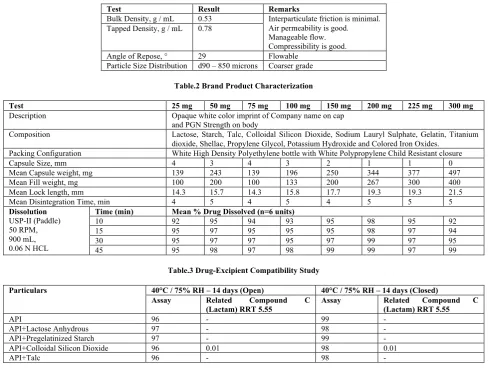
Table. 1 API Characterization
Test Result Remarks
Bulk Density, g / mL 0.53 Interparticulate friction is minimal. Air permeability is good. Manageable flow. Compressibility is good. Tapped Density, g / mL 0.78
Angle of Repose, ° 29 Flowable Particle Size Distribution d90 – 850 microns Coarser grade
Table.2 Brand Product Characterization
Test 25 mg 50 mg 75 mg 100 mg 150 mg 200 mg 225 mg 300 mg
Description Opaque white color imprint of Company name on cap and PGN Strength on body
Composition Lactose, Starch, Talc, Colloidal Silicon Dioxide, Sodium Lauryl Sulphate, Gelatin, Titanium dioxide, Shellac, Propylene Glycol, Potassium Hydroxide and Colored Iron Oxides.
Packing Configuration White High Density Polyethylene bottle with White Polypropylene Child Resistant closure
Capsule Size, mm 4 3 4 3 2 1 1 0
Mean Capsule weight, mg 139 243 139 196 250 344 377 497 Mean Fill weight, mg 100 200 100 133 200 267 300 400 Mean Lock length, mm 14.3 15.7 14.3 15.8 17.7 19.3 19.3 21.5
Mean Disintegration Time, min 4 5 4 5 4 5 5 5
Dissolution
USP-II (Paddle) 50 RPM, 900 mL, 0.06 N HCL
Time (min) Mean % Drug Dissolved (n=6 units)
10 92 95 94 93 95 98 95 92
15 95 97 95 95 95 98 97 94
30 95 97 97 95 97 99 97 95
45 95 98 97 98 99 99 97 99
Table.3 Drug-Excipient Compatibility Study
Particulars 40°C / 75% RH – 14 days (Open) 40°C / 75% RH – 14 days (Closed) Assay Related Compound C
(Lactam) RRT 5.55
Assay Related Compound C (Lactam) RRT 5.55
API 96 - 99 -
API+Lactose Anhydrous 97 - 98 -
API+Pregelatinized Starch 97 - 99 -
API+Colloidal Silicon Dioxide 96 0.01 98 0.01
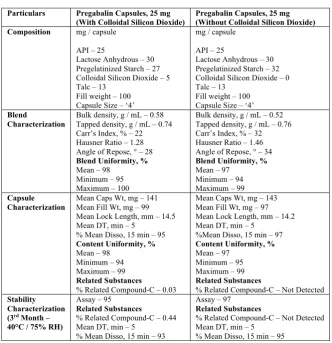
Table.4 Prototype Formulation Particulars Pregabalin Capsules, 25 mg
(With Colloidal Silicon Dioxide)
Pregabalin Capsules, 25 mg (Without Colloidal Silicon Dioxide) Composition mg / capsule
API – 25
Lactose Anhydrous – 30 Pregelatinized Starch – 27 Colloidal Silicon Dioxide – 5 Talc – 13
Fill weight – 100 Capsule Size – ‘4’
mg / capsule
API – 25
Lactose Anhydrous – 30 Pregelatinized Starch – 32 Colloidal Silicon Dioxide – 0 Talc – 13
Fill weight – 100 Capsule Size – ‘4’
Blend
Characterization
Bulk density, g / mL – 0.58 Tapped density, g / mL – 0.74 Carr’s Index, % – 22 Hausner Ratio – 1.28 Angle of Repose, ° – 28
Blend Uniformity, %
Mean – 98 Minimum – 95 Maximum – 100
Bulk density, g / mL – 0.52 Tapped density, g / mL – 0.76 Carr’s Index, % – 32 Hausner Ratio – 1.46 Angle of Repose, ° – 34
Blend Uniformity, %
Mean – 97 Minimum – 94 Maximum – 99
Capsule Characterization
Mean Caps Wt, mg – 141 Mean Fill Wt, mg – 99 Mean Lock Length, mm – 14.5 Mean DT, min – 5
% Mean Disso, 15 min – 95
Content Uniformity, %
Mean – 98 Minimum – 94 Maximum – 99
Related Substances
% Related Compound-C – 0.03
Mean Caps Wt, mg – 143 Mean Fill Wt, mg – 97 Mean Lock Length, mm – 14.2 Mean DT, min – 5
%Mean Disso, 15 min – 97
Content Uniformity, %
Mean – 97 Minimum – 95 Maximum – 99
Related Substances
% Related Compound-C – Not Detected
Stability Characterization (3rd Month –
40°C / 75% RH)
Assay – 95
Related Substances
% Related Compound-C – 0.44 Mean DT, min – 5
% Mean Disso, 15 min – 93
Assay – 97
Related Substances
% Related Compound-C – Not Detected Mean DT, min – 5
% Mean Disso, 15 min – 95
Table. 5 Composition of Pregabalin Capsules, 50 mg, 75 mg, 100 mg, 150 mg, 200 mg, 225 mg & 300 mg Ingredients mg / capsule
50 mg 75 mg 100 mg 150 mg 200 mg 225 mg 300 mg
Pregabalin 50 75 100 150 200 225 300
Lactose Anhydrous 60 8.25 11 16.5 22 24.75 33
Pregelatinized Starch 64 8.37 11.13 16.75 22.67 25.12 33.5
Talc 26 8.38 11.17 16.75 22.33 25.13 33.5
Fill weight 200 100 133.3 200 267 300 400
Particulars Blend Characterization
Bulk density, g / mL 0.53 0.51 Tapped density, g / mL 0.77 0.80 Carr’s Index, % 31.1 36.3 Hausner Ratio 1.45 1.57 Angle of Repose, ° 27 32 Blend
Uniformity, %
Mean 98 97
Minimum 96 95 Maximum 99 100
Particulars Capsule Characterization
Capsule size 3 4 3 2 1 1 0
Mean Capsule Fill Weight (mg) 246 137 174 248 331 365 499 Mean Fill Weight (mg) 203 98 135 198 264 304 402 Mean Lock Length (mm) 15.5 14.1 15.5 17.8 19.5 19.6 21.1
Mean Disintegration Time, min 5 5 4 5 5 4 5
Content Uniformity, %
Mean 97 98
Minimum 95 96 Maximum 99 99 % Related
Substances Related Compound-C Not Detected Not Detected Not Detected Not Detected Not Detected Not Detected Not Detected
Dissolution
USP-II (Paddle) 50 RPM, 900 mL, 0.06 N HCL
Time, min Mean % Drug Dissolved (n=6 Units)
10 95 94 95 93 94 96 95
15 97 96 96 94 95 97 98
30 98 98 99 98 97 99 100
45 99 100 99 99 99 99 100
Characterization (3rd Month –
40°C / 75% RH)
% Related Compound-C
Not Detected
Not Detected
Not Detected Not Detected Not Detected Not Detected
Not Detected
Mean DT, min 5 5 5 5 5 5 5
% Mean Disso in 15 min
94 96 95 94 95 95 96
+
Pregabalin Colloidal Silicon Dioxide Pregabalin Related Compound-C
(Pregabalin Lactum Impurity)
C8 H17 NO2 Si O2 C8 H15 NO
Figure.1 Schematic Representation of Pregabalin Incompatibility with Colloidal Silicon Dioxide
RESULTS & DISCUSSION
API Characterization
API was characterized with respect to Bulk Density, Tapped Density, Angle of Repose and Particle Size Distribution and the details as follows in the Table.1. From the data it is evident that the API has optimal flow and compressibility characteristics ideal for a direct blending process.
Brand Product Characterization
The brand product, was characterized with respect to Description of Capsule, Size of Capsule shell, Weight of capsule & content, Capsule fill weight, Lock length of capsule, Disintegration time, Dissolution, Composition and Packaging configuration and the details as follows in Table.2.
From the data it is evident that the brand has made scale-up / scale down or dose proportional design i.e. for 25 mg and 50 mg a common blend was made and for 75 mg to 300 mg a separate common blend was made. From the dissolution profile it is evident that the rate and extent of drug release is of “rapid and completely dissolving type”.
Drug-Excipient Compatibility Study
Based on the API and brand product characterization, excipients were selected for checking the compatibility with API and the details as follows in Table.3. From the tabulated data it is evident that there is a possible interaction of API with Colloidal Silicon Dioxide in the physical mixture itself. For the preliminary formulation work, Colloidal Silicon Dioxide was considered as part of composition and influence of the same on drug degradation was monitored during stability evaluation.
Formulation
The preliminary formulation work was initiated with 25 mg strength. Two (2) batches were made by direct blending process, one batch including Colloidal Silicon Dioxide and the other excluding Colloidal Silicon dioxide. The final blend of both the batches were completely characterized with respect to bulk density, tapped density, compressibility index, hausner ratio, angle of repose and blend uniformity in 10 different locations in blender. The final blend was then filled in hard gelatin capsule
shells using manual capsule filling machine, the filling operation was characterized with respect to Weight of capsule & content, Capsule fill weight, Lock length of capsule, Disintegration time, Uniformity of dosage units (in 10 different locations in encapsulated frame) and Dissolution. The filled capsules were then packed in high density polyethylene bottles equipped with polypropylene closures and stability evaluated at 40°C / 75% RH for 3 month and evaluated for Assay, Related Substances, Disintegration Time and Dissolution.
From the Table.4 it is evident that though the batches made with and without colloidal silicon dioxide showed good blend flow, good capsule fill characteristics and comparable disintegration and dissolution characteristics with the brand product but from the stability view point, the batch made with Colloidal Silicon Dioxide showed raise in drug degradation. There exists an incompatibility reaction possibly the degradation of API in the presence of Colloidal Silicon Dioxide which specifically resulted in rise of Pregabalin Related Compound-C (4-Isobutylpyrrolidin-2-one). Schematically the reaction is represented as follows in Fig.1
Based on the above evidence, the formulation was proceeded for other strengths without Colloidal Silicon Dioxide and for every strength blend, capsule and accelerated stability evaluation was done and found comparable to the brand product. In the following Table.5 the complete formulation, blend, capsule and stability characterization details of other strengths were provided.
CONCLUSION
RH for 3 months. One of the major finding during the prototype formulation is the identification of incompatibility of Pregabalin and Colloidal Silicon Dioxide.
ACKNOWLEDGEMENTS
The authors thank the Managing Directors, Mr. Jayaseelan Jayachandran and Mrs. Bernice Sugirtha Jayaseelan for permitting us to utilize the facility and resources of Sai Mirra Innopharm, Ambattur, Chennai, Tamil Nadu.
REFERENCES
1. [email protected] [home page on the Internet] Product Label Information of Lyrica® (Pregabalin) Capsules, CV. Date of browsing. 25th May 2019. Available from: https://www.accessdata.fda.gov/drugsatfda_docs/label/2019/ 021446s036,022488s014lbl.pdf.
2. Vasantakumar Pai K, Harsha J, Gowda DV, Praveen Sivadasu and Meenakshi S. Development and Evaluation of Pregabalin Capsules Using QbD Approach. Journal of Chemical and Pharmaceutical Research 2017; 9(6), 37-44.
3. Lee HA, Lee S, Yim SV and Kim BH. Bioequivalence of two formulations of Pregabalin 150 mg capsules under Fasting conditions in healthy male subjects. International Journal of Clinical Pharmacology and Therapeutics 2017; 55(2), 171-176.
4. Mahjabin Haque. A Thesis on “Compatibility Study of Albendazole, Levofloxacin and Pregabalin with Various Excipients and their Subsequent Formulation Optimization”. East West University; 2015. p.1-98.
5. Hotha, K.K., Roychowdhury, S. and Subramanian, V. Drug-Excipient Interactions: Case Studies and Overview of Drug
Degradation Pathways. American Journal of Analytical Chemistry 2016; 7, 107-140.
6. Sonali S. Bharate, Sandip B. Bharate and Amrita N. Bajaj. Interactions and incompatibilities of pharmaceutical excipients with active pharmaceutical ingredients: a comprehensive review. Journal of Excipients and Food Chemistry 2010; 1 (3), 3-26.
7. Aydogan E, Comoglu T, Pehlivanoglu B, Dogan M, Comoglu S, Dogan A, Basci N. Process and formulation variables of Pregabalin microspheres prepared by w/o/o double emulsion solvent diffusion method and their clinical application by animal modeling studies. Drug development and industrial pharmacy 2015; 41(8), 1311-20.
8. Pawar RG, Gadhave MV, Jadhav SL and Gaikwad DD. Formulation and evaluation of Pregabalin Sustained release matrix tablet. International Journal of Pharmaceutical Research and Development 2012; 4(2), 153-159.
9. Vinit Sharma, Shalini Sharma, Sukbir Lal Khokra, Ram Kumar Sahu, Rajendra Jangde, Jagdish Singh. Formulation, development and evaluation of Pregabalin sustained release matrix tablets. Der Pharmacia Lettre 2011; 3(5), 326-331. 10.Kyu HoJeong, Hye SeungWoo, Chae JinKim, Kyung
HwaLee, Jun YoungJeon, Sang YoungLee, Jae-HoonKang, SangkilLee,Young WookChoi. Formulation of a modified-release Pregabalin tablet using hot-melt coating with glyceryl behenate. International Journal of Pharmaceutics 2015; vol. 495, 1(10), 1-8
Cite this article as:
Packiaraj Jeyachandran Manohari et al. Stable composition and simple manufacturing process of pregabalin capsules. Int. Res. J. Pharm. 2019;10(7):149-153 http://dx.doi.org/10.7897/2230-8407.1007235
Source of support: Nil, Conflict of interest: None Declared