Illinois Initiative to Increase Developmental Screening
in Medical Homes
abstract
In 2005, the Enhancing Developmentally Oriented Primary Care (EDOPC) project of the Illinois chapter of the American Academy of Pediatrics and the Illinois Department of Healthcare and Family Services began a project to improve the delivery and financing of preventive health and developmental services for children in Illinois. The leaders of this ini-tiative sought to increase primary care providers’ use of validated tools for developmental, social/emotional, maternal depression, and domestic violence screening and to increase early awareness of au-tism symptoms during pediatric well-child visits in children aged 0 to 3 years. These screenings facilitate identification of children at risk and those who need referral for further evaluation. Primary barriers to such screenings include lack of practitioner confidence in using vali-dated screening tools. In this article we describe the accomplishments of the EDOPC project, which created training programs to address these barriers. This training is delivered by EDOPC staff and peer edu-cators (physicians and nurse practitioners) in medical practices. The EDOPC project enhanced confidence and intent to screen among a large group of Illinois primary health care providers. Among a sample of primary care sites at which chart reviews were conducted, the EDOPC project increased developmental screening rates to the target of 85% of patients at most sites and increased social/emotional screening rates to the same target rate in nearly half of the participat-ing practices.Pediatrics2010;126:S160–S164
AUTHORS:Scott G. Allen, MS,aAnita D. Berry, MSN, CNP/
APN,bJuanona A. Brewster, MDiv, MTS, MJ,aRam K.
Chalasani, MBBS, MPH,band Patricia K. Mack, RN, MS,
LMFTb
aIllinois Chapter, American Academy of Pediatrics, Chicago,
Illinois; andbAdvocate Health Care, Park Ridge, Illinois
KEY WORDS
early childhood developmental screening, Enhancing Developmentally Oriented Primary Care, EDOPC, developmental screening in the medical home, use of validated tools in well-child visits, Illinois early well-childhood screening initiatives, Illinois chapter, American Academy of Pediatrics
ABBREVIATIONS
EDOPC—Enhancing Developmentally Oriented Primary Care FQHC—federally qualified health center
ASQ—Ages & Stages Questionnaire
ASQ:SE—Ages & Stages Questionnaire: Social-Emotional
www.pediatrics.org/cgi/doi/10.1542/peds.2010-1466K
doi:10.1542/peds.2010-1466K
Accepted for publication Sep 1, 2010
Address correspondence to Juanona A. Brewster, MDiv, MTS, MJ, Early Childhood Development Projects, Illinois AAP, 1400 W Hubbard St, Chicago, IL 60642. E-mail: [email protected]
PEDIATRICS (ISSN Numbers: Print, 0031-4005; Online, 1098-4275).
Copyright © 2010 by the American Academy of Pediatrics
The American Academy of Pediatrics recommends formal developmental screening,1 and referral for services
through early-intervention programs has been shown to improve children’s developmental outcomes.2,3The Illinois
chapter of the American Academy of Pediatrics and the Illinois Department of Healthcare and Family Services jointly formed the Enhancing Devel-opmentally Oriented Primary Care (EDOPC) program. The EDOPC project works to improve the delivery and fi-nancing of preventive health and devel-opmental services for children from birth to the age of 3 years, build on existing programs to develop a range of strategies in primary care settings to enhance practice change, and work with stakeholders to introduce or en-hance existing public health policy and best practices.
A main goal of the EDOPC project is to help clinicians in primary care medical homes integrate routine developmen-tal screening into well-child care.4The
EDOPC project defines routine develop-mental screening as documented im-plementation of validated screening tools for all children from birth to the age of 3—not just children who may be at risk on the basis of surveillance, clinical judgment, parent reporting, or some combination of these—at least once each year during well-child visits.
The best developmental screening in-struments have good psychometric properties, including adequate sensi-tivity, specificity, validity, and reliabil-ity, and have been standardized in diverse populations. Several parent-report instruments have excellent psy-chometric properties and require much less physician time than instru-ments that require direct examina-tion.5 However, medical practice has
not achieved widespread and consis-tent implementation of validated screening tools as a result of barriers such as lack of confidence,
unfamiliar-ity with such tools, and difficulty inte-grating screening into practice routines (American Academy of Pediat-rics, American Academy of Pediatrics Periodic Survey of Fellows, unpub-lished data, 2000).
We report here on the accomplish-ments of the EDOPC project.
OBJECTIVES
The EDOPC project was designed to:
● increase the confidence and knowl-edge of primary care providers re-garding the identification of devel-opmental issues or delays;
● increase routine staff implementa-tion of validated developmental screening tools during well-child visits; and
● determine the impact of technical assistance and support as tools to help implement consistent screen-ing by usscreen-ing validated screenscreen-ing tools.
Although the EDOPC project also has addressed a series of policy and sys-tems changes, we describe here the project’s impact on developmental and social/emotional screening only.
METHODS
The information in this article is based on the project’s experience from its inception in 2005–2007. The EDOPC project solicited primary care sites on the basis of targeted geographical re-gions (primarily in the Chicago, IL, met-ropolitan area) and site willingness to receive training and participate in pre-training and postpre-training testing and evaluation.
The EDOPC project actively solicited federally qualified health centers (FQHCs) to participate in this project, because the FQHC mission and strat-egy requirements include improving the health status of underserved pop-ulations in targeted service areas. To accomplish this mission, FQHCs assess
the needs of the communities and pop-ulations they serve. On the basis of that assessment, the FQHCs design cultur-ally and linguistically appropriate health service programs. This plan-based process enables FQHCs to pro-vide resources that are culturally and linguistically unique and appropriate to the needs of the community and population served at that location, thus addressing some of the barriers faced in each community.
Over the project period, the EDOPC pro-gram conducted 336 trainings at 164 sites throughout Illinois on core topics for 2873 unique participants, including 165 trainings on developmental and social/emotional screening and refer-ral. The EDOPC project conducted the majority of training sessions by using a practice-based (academic-detailing) model, and these sessions focused on practice systems change. Most train-ing sessions included both clinical and practice administrative staff mem-bers. On the basis of sensitivity and specificity values and ease of integra-tion into practice routines, partici-pants were taught how to use 2 parent-report tools: the Ages & Stages Questionnaire (ASQ) and the Ages & Stages Questionnaire: Social-Emotional (ASQ:SE). In addition, be-cause of the recognized need for cul-tural effectiveness, faculty members discussed how to speak to families generally and with consideration for what “developmental” and “social/ emotional” issues might mean in a family’s particular culture.
EDOPC project objectives. Specifically, participants used these forms to indi-cate whether the training had en-hanced their ability to identify develop-mental delays and to indicate their intent to screen.
The EDOPC project used chart audits to determine if the proportion of young children screened for developmental issues in participating practices had increased after the introduction of EDOPC project training and technical assistance. EDOPC project staff en-couraged these sites to participate in this evaluation because they had many providers and, therefore, had the po-tential to conduct more well-child vis-its than smaller sites.
The EDOPC project randomly sampled the medical records of 25 children aged 4 to 24 months at the chart-review sites before the site training and at least twice yearly thereafter to assess provider compliance with EDOPC screening recommendations, which included the following targets:
● implementation of the ASQ at least once by the 1-year well-child visit for at least 85% of the patients;
● implementation of the ASQ in the second year of life by the 2-year well-child visit for at least 85% of the patients; and
● implementation of the ASQ:SE in the second year of life by the 18-month well-child visit for at least 85% of the patients.
RESULTS
In 2007,⬎324 (90%) of the responding primary care providers believed that the training had improved their skills and confidence in these areas. It is in-teresting to note that a higher propor-tion of respondents in 2005 had indi-cated that the training had improved
higher could be that the groups that requested training first consisted of the most motivated providers and those who recognized that they lacked knowledge about screening and referring for developmental delays.
Compared with the pretraining base-line, the EDOPC project training in-creased the percentage of clinicians who intended to implement screening by⬎86% in 2005 and 2006 and by 102% in 2007. Although significant percent-ages of primary care providers indi-cated at before the test that they were already screening children for devel-opmental delays and social/emotional issues, EDOPC project staff and faculty who visited participating practices re-ported anecdotally that few providers were actually using standardized tools and that screening, if occurring, was inconsistent within sites. Further-more, the baseline chart audits con-firmed these reports by revealing that before the EDOPC intervention, these sites had no documented developmen-tal screening protocol and, instead,
re-Eighteen sites agreed to undergo peri-odic chart audits by EDOPC project staff to assess progress in implement-ing regular developmental and social/ emotional screening, of which 16 (⬃10% of participating practices) were able to undergo baseline and at least 1 postintervention chart audit by 2007. The sites that underwent chart reviews included 11 FQHCs or FQHC look-alikes (clinics designated by the Health Resources and Services Admin-istration to meet requirements in Sec-tion 330 of the Public Health Service Act), 3 residency training programs, and 2 private practices.
Developmental Screening, 1-Year Visit
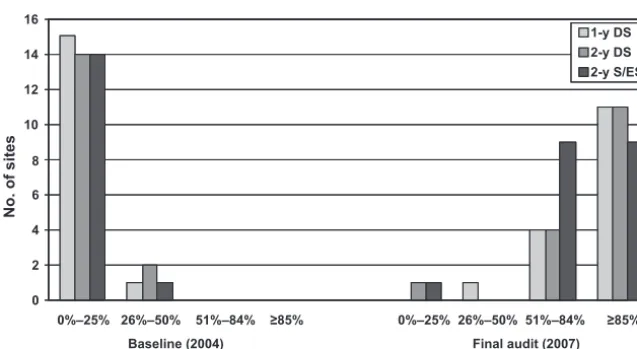
As Fig 1 reveals, at baseline only 4 sites (25%) were doing any routine develop-mental screening, and they were only doing so in 4% to 32% of patients in the first year of life. By the most recent audit (performed at each site in 2007), 11 of 16 sites (68.8%) had met the ob-jective of screening 85% of the chil-dren by the 1-year well-child visit, and
0 2 4 6 8 10 12 14 16
0%–25% 26%–50% 51%–84% ≥85% 0%–25% 26%–50% 51%–84% ≥85% 1-y DS 2-y DS 2-y S/ES
Baseline (2004) Final audit (2007) Screening rates
No. of sites
FIGURE 1
the other sites had screening rates that ranged from 48% to 83%. (For some cases in which training occurred in 2007, the first posttraining audit was also the most recent.)
Developmental Screening, 2-Year Visit
Fig 1 shows data from the 24-month developmental screening chart audit. At baseline, only 2 sites (12%) were routinely performing any screening for developmental delay, and only in 27% to 45% of the children in the sec-ond year of life. By the most recent au-dit (in 2007 at all sites), 11 sites (68.8%) met the objective of screening 85% of the children in the second year of life by the 2-year well-child visit, and all other sites had screening rates of 18% to 84%.
Social/Emotional Screening, 18-Month Visit
Fig 1 shows data from the 18-month social/emotional screening audit. At baseline, only 1 site (6%) was routinely screening children for social/emo-tional issues. By the most recent audit, 7 of 16 sites (46.7%) met the objective of screening 85% of the children in the second year of life by the 18-month well-child visit, and the other 53.3% of the sites had screening rates of 5% to 81%.
DISCUSSION
As evidenced by its name, the EDOPC project was conceived as a primary care orientation that respects paren-tal input on child development and uses an evidence-based approach to increase early identification and refer-ral of children with suspected develop-mental delays. The model—academic-detailing using trained peer educators combined with ongoing and consistent technical assistance— has been and
continues to be successful in facilitat-ing practice change.
Primary care providers respond favor-ably to education about screening tools, and these attitudes can begin to address barriers to screening and in-crease practitioner confidence. Subse-quent to an educational intervention, practice systems tend to increase their routine screening; however, such change occurs over time and with varying success.
Although the EDOPC program is unique, other American Academy of Pe-diatrics chapters have provided simi-lar education, technical assistance, and monitoring through information received from other initiatives. For ex-ample, the Assuring Better Child Health and Development Program, funded by the Commonwealth Fund and administered by the National Academy for State Health Policy, helps states improve the delivery of early child development services for low-income children and their families.
We recognize the limitations of this study, which include a small and bi-ased sample that underwent chart re-views, limited access to charts, and no formal analysis of the technical assis-tance and ongoing communication that the project used to ensure appro-priate implementation and documen-tation of screenings. In addition, par-ticipants in the training sessions described here were self-selected and, therefore, are assumed to be inter-ested in developing their skills and knowledge related to early childhood development. Furthermore, although the success in practices targeted for chart reviews indicates that interven-tions such as the EDOPC project can change practice systems, these prac-tices, by virtue of their willingness to participate in chart reviews, may rep-resent the most motivated providers.
The process of repeat visits to conduct chart reviews resulted in enhanced in-teraction with project staff and the provision of additional technical assis-tance at the chart-review sites that were not available to the other sites.
Finally, barriers to referrals subse-quent to screening and the impact of these barriers on practice systems have not been fully examined. Although EDOPC leaders recognize that the lack of knowledge about referral options and a perceived lack of treatment op-tions are barriers to screening, they did not evaluate these factors. The EDOPC project is collaborating with Il-linois Early Intervention and the IlIl-linois Department of Healthcare and Family Services to use claims and service data to explore referral issues.
CONCLUSIONS
EDOPC project training and technical assistance had a positive impact on confidence gained, intent to screen, and actual screening practice. The EDOPC project needs further evalua-tion of factors that lead to success in routine screening in primary care and barriers that prevent it. Additional work to examine the relationship be-tween EDOPC project training and practice change across a broader pop-ulation of primary care providers is needed.
ACKNOWLEDGMENTS
We are grateful for the support of the Illinois Academy of Family Physicians and Ounce of Prevention Fund for their involvement in the project planning and training. We also thank the Mi-chael Reese Health Trust, Illinois Children’s Healthcare Foundation, W. Clement and Jesse V. Stone Founda-tion, Illinois Department of Healthcare and Family Services, Chicago Commu-nity Trust, and Irving B. Harris Founda-tion for funding the project.
Children With Disabilities, Section on Devel-opmental Behavioral Pediatrics; Bright Fu-tures Steering Committee, Medical Home Initiatives for Children With Special Needs Project Advisory Committee. Identifying in-fants and young children with developmen-tal disorders in the medical home: an algo-rithm for developmental surveillance and screening [published correction appears
diatrics. 2006;118(1):405– 420
2. Shonkoff JP. From neurons to neigh-borhoods: old and new challenges for devel-opmental and behavioral pediatrics [in French].J Dev Behav Pediatr. 2003;24(1): 70 –76
3. Rydz D, Shevell MI, Majnemer A, Oskoui M. Developmental screening.J Child Neurol. 2005;20(1):4 –21
on Children With Disabilities. Role of the medical home in family-centered early in-tervention services. Pediatrics. 2007; 120(5):1153–1158
DOI: 10.1542/peds.2010-1466K
2010;126;S160
Pediatrics
K. Mack
Scott G. Allen, Anita D. Berry, Juanona A. Brewster, Ram K. Chalasani and Patricia
Increase Developmental Screening in Medical Homes
Enhancing Developmentally Oriented Primary Care: An Illinois Initiative to
Services
Updated Information &
http://pediatrics.aappublications.org/content/126/Supplement_3/S160
including high resolution figures, can be found at:
References
#BIBL
http://pediatrics.aappublications.org/content/126/Supplement_3/S160
This article cites 5 articles, 3 of which you can access for free at:
Subspecialty Collections
al_issues_sub
http://www.aappublications.org/cgi/collection/development:behavior Developmental/Behavioral Pediatrics
following collection(s):
This article, along with others on similar topics, appears in the
Permissions & Licensing
http://www.aappublications.org/site/misc/Permissions.xhtml
in its entirety can be found online at:
Information about reproducing this article in parts (figures, tables) or
Reprints
http://www.aappublications.org/site/misc/reprints.xhtml
DOI: 10.1542/peds.2010-1466K
2010;126;S160
Pediatrics
K. Mack
http://pediatrics.aappublications.org/content/126/Supplement_3/S160
located on the World Wide Web at:
The online version of this article, along with updated information and services, is
by the American Academy of Pediatrics. All rights reserved. Print ISSN: 1073-0397.