54 |
P a g e
SCH-BASED LEACH ALGORITHM TO ENHANCE
THE NETWORK LIFE TIME IN WIRELESS SENSOR
NETWORK (WSN)
Md. Nadeem Enam
1, Arun Kumar Bag
21
M.tech Student,
2Assistant.Prof, Department of ECE, Bengal Institute of Technology & Management,
Shantiniketan, West Bengal,(India)
ABSTRACT
A Wireless sensor network (WSN) is comprised of hundreds and thousands of small tiny devices called sensor
nodes which are distributed in such a way so as to monitor real environment conditions such as temperature,
pressure, humidity etc. But most of the wireless sensor networks are constrained to their low network lifetime
due to high energy consumption. Moreover, it is impractical to replace batteries of sensor nodes placed in harsh
environments, so after a particular time span nodes start to die and lead to network failure. So various
optimization techniques are opted while routing packets to the base station in order to minimize energy
consumption and prolong network lifetime. The low-energy adaptive clustering hierarchy (LEACH) protocol
deploys randomized rotation of cluster heads to evenly distribute the energy load among all sensors in a WSN.
In this paper we proposed a new algorithm LEACH with supporting cluster heads (LEACH-SCH) which
enhance the network lifetime by calculating the supporting cluster heads (SCHs) after selecting the cluster
heads (CHs). The simulation result of proposed algorithm has been compared for its network life time in
MATLAB with LEACH algorithm.
Keywords: Cluster Head, LEACH, Network Life Time, Routing Protocol, Wireless Sensor Network
I. INTRODUCTION
The Wireless Sensor Network (WSN) consists of a large number of small, relatively in expensive and low
power sensors, which are equipped with a sensor module capable of sensing some quantity about the
environment, a digital processor for processing the signal from the sensor and performing network protocol
function and a battery to provide energy for operation. The collected data by sensors send to a central computing
system, called the base station or sink. These sensors are self-organizing and are connected to each other
through wireless links as shown in Fig.1
55 |
P a g e
So Wireless Sensor Network represent a new paradigm for extracting data from the environment for application
that include monitoring of a variety of environment for application that include home security,
chemical/biological detection, medical monitoring and surveillance [1] [2]. Since the sensor nodes are equipped
with small, often irreplaceable, batteries with limited power capacity, it is essential that the network be energy
efficient in order to maximize the network lifetime [3]. Routing in Wireless Sensor Networks (WSNs) is a
challenging issue as because of the limitation of resources in terms of power supply, processing capability and
transmission bandwidth. Depending upon the network structure, routing in wireless sensor networks can be
classified into various categories. Hierarchical –based routing is one of them. In a hierarchical routing protocol
first of all nodes are grouped together to form a cluster. Afterward the node with higher energy will become
cluster head (CH). In this way each cluster comprises of a master node better known as cluster head (CH)
followed by member nodes. Cluster Head perform the task of data aggregation and also responsible for sending
and Processing the information to the base station (BS), whereas the remaining nodes of that cluster will
perform sensing operation. In recent few years, many routing protocols have been proposed for Wireless Sensor
Networks [4][7]. Clustering is an important method used to manage network energy consumption efficiently
[10]. In this approach each group of sensor has a cluster head node that aggregate data from its respective
cluster and send it towards the base station (BS) as a representative sample of its cluster.
We have presented a new threshold algorithm to maximize the wireless sensor network lifetime. The main idea
in this proposed method is the selection of cluster head that can be reduce the low energy nodes to be cluster
head, leading to the sensor nodes start to die in early time. Simulation result comparing the original LEACH and
proposed algorithm (LEACH-SCH).
Several cluster- head protocols have been proposed in the literature, with the objective of maximizing the sensor
network lifetime. Here LEACH is taken for finding the improvement scope due to its hierarchical structure and
well developed algorithm for some definite wireless sensor network.
II. LEACH
Low Energy Adaptive Clustering Hierarchy (LEACH) is the first hierarchical cluster based routing protocol
proposed by W.R. Heinzelman for Wireless Sensor Networks [2]. It is the most popular energy-efficient
protocol that reduces power consumption in WSNs. The routing algorithm is designed to collect and deliver data
to the data sink typically a base station. The main objectives of LEACH are given below.
(1) Extension of the network life time.
(2) Reduced energy consumption by each sensor node.
(3) Use of data aggregation to reduce the number of communication messages.
To achieve these objectives, LEACH adopts a hierarchical approach to organize the network into a set of
clusters [6]. Each cluster is managed by a selected cluster head (CH). The newly appointed cluster head
performs various tasks. The first task consists of periodic collection of data from the members of the cluster
.After gathering the data, the cluster head aggregates it. The second main task of CH is to transmit the
aggregated data directly to the Base station (BS). The transmission of the aggregated data is achieved over a
56 |
P a g e
Fig.2: LEACH Network Model [5 ]
The third main task of the cluster head is to create a TDMA-based schedule whereby each node of the cluster is
assigned a time slot that it can use for transmission. The CH advertises the schedule to its cluster members
through broadcasting. To reduce the likelihood of collisions among sensor nodes within and outside the cluster,
LEACH nodes use a code-division multiple access-based scheme for communication.
The basic operations of LEACH are organized in two distinct phases. The first phase, the setup phase, consists
of two steps, cluster head selection and cluster formation. The second phase, the steady-state phase, focuses on
data collection, aggregation and delivery to the base station. The duration of the set up phase is assumed to be
relatively shorter than the steady-state phase to minimize the protocol overhead. At the beginning of the set up
phase, a round of cluster head selection starts.
The Setup phase and Steady state phase are illustrated in figure given below.
To determine cluster head (CH), a node, n, generates a random number between 0 and 1 and compares it to the
cluster head selection threshold, T (n). The node becomes a cluster head if its generated value is less than T (n).
To meet these requirements, the threshold T (n) of a competing node “n” can be expressed as follows.
T (n) = P/1-P* [r mod (1/P)] if n €G
= 0 other wise
The variable „G‟ represents the set of nodes that have not been selected to become cluster heads in the last 1/P rounds and „r‟ denotes the current round. The predefined parameter „P‟ represents the cluster head probability. It
is clear that if a node has served as a cluster head in the last 1/P rounds, it will not be elected in this round. At
the completion of cluster head selection process, every node that was selected to become a cluster head
advertises its new role to the rest of the network. Upon receiving the cluster head advertisements, each
remaining node selects a cluster to join. The nodes then inform their selected cluster head (CH) of their desire to
become a member of the cluster. Upon cluster formation, each cluster head creates and distributes the TDMA
57 |
P a g e
CDMA code, which is then distributed to all members of its cluster. In this way the set up phase comes to an
end and signals the beginning of the steady-state phase. During steady-state phase, nodes collect information
and use their allocated slots to transmit to the cluster head the data collected. After gathering the data, the cluster
head aggregates it (which not only minimizes redundancy but also reduces the total amount of data sent to the
sink) and transmit this aggregated data directly to the Base station (BS). After a certain period of time spent on
the steady-state Phase, the network goes into the set up phase again and enters another round of selecting cluster
heads [5].
III. PROPOSED ALGORITHM (LEACH-SCH)
A new proposed algorithm LEACH with supporting cluster heads (LEACH-SCH) is considered here. This
approach is very helpful for long distance communication. This algorithm is implemented in MATLAB and
results are compared with the LEACH algorithm. In this scheme after selecting the cluster heads (CHs) the
supporting cluster heads (SCHs) are calculated. These supporting cluster heads received data from the cluster
heads and transmit data to the base station. In this process the energy efficiency of cluster heads and life time of
cluster heads increases, which results into the enhancement of network life time as well. In the algorithm of
LEACH-SCH „sch_th‟ is the threshold value for generation of supporting cluster head. For example if total
no. of nodes are 100 and if the percentage of becoming CHs is set as 10% then 10 number of node will become
CHs. Out of 10 nodes supporting cluster heads will be depends on „sch_th‟.
The governing equation for the calculation of approximate no. of supporting cluster head is given below:
So according to above equation if „sch_th=0.5‟ then approximately 5 nodes are able to become supporting
cluster heads.
58 |
P a g e
3.2 Algorithm of LEACH-SCH is Provided in Figure Given Below
Algorithm of LEACH-SCH
3.3 Energy Consumption Model (For LEACH-SCH):
In order to study the energy efficiency of the network, the radio model for receiving and transmitting an L-bit
(packet size) message is used. The following given Radio Energy Dissipation Model in figure is used by the
LEACH algorithm as well as by our proposed algorithm (LEACH-SCH). In this model, the transmitter
dissipates energy to run the radio electronics & the Power amplifier, whereas the receiver dissipates energy to
run the radio electronics.
Radio energy consumption model
The energy consumed for transmitting an L-bit message by the transmitter at a distance„d‟ is given as Tx_e,
Tx_e= packet_size*(Etx_elex+ (Eamp*d))
59 |
P a g e
Rx_e= packet size*(Erx_elec)
Where Etx_elec is transmitter circuit energy consumption per bit and Erx_elec is receiver circuit energy
Consumption per bit. Eamp refers to the effect of amplifier [8].
IV. SIMULATION RESULT
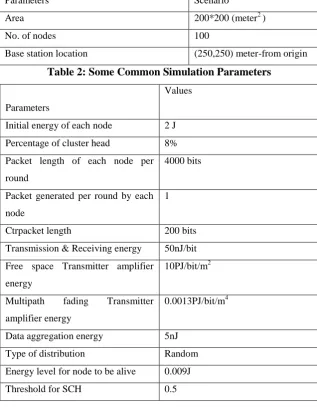
The simulation parameters used for developing LEACH and proposed algorithm (LEACH-SCH) is shown in
Table1. Some common parameters used for simulation of all protocol are shown in Table 2.
Table 1: Simulation Parameters of LEACH and LEACH-SCH
Parameters Scenario
Area 200*200 (meter2 )
No. of nodes 100
Base station location (250,250) meter-from origin
Table 2: Some Common Simulation Parameters
Parameters
Values
Initial energy of each node 2 J
Percentage of cluster head 8%
Packet length of each node per
round
4000 bits
Packet generated per round by each
node
1
Ctrpacket length 200 bits
Transmission & Receiving energy 50nJ/bit
Free space Transmitter amplifier
energy
10PJ/bit/m2
Multipath fading Transmitter
amplifier energy
0.0013PJ/bit/m4
Data aggregation energy 5nJ
Type of distribution Random
Energy level for node to be alive 0.009J
60 |
P a g e
4.1 Comparison Graph of LEACH with LEACH-SCH
The simulation result of the proposed scheme (LEACH-SCH) is much improved covering more number of
rounds in comparison to LEACH. Hence the proposed scheme has the longest network lifetime. So, with
increase in network lifetime, energy efficiency is also enhanced with the proposed scheme.
V. CONCLUSION AND REMARKS
Beyond a numerous advantages of wireless sensor networks, there is always a constraint of energy consumption
associated with wireless sensor networks because it is very difficult or impractical to replace batteries in harsh
areas. So, the only way to meet this limitation is to use better optimization techniques in order to make the
wireless sensor network more efficient. In the proposed scheme, it is evaluated that LEACH-SCH homogeneous
systems improve network performance over traditional LEACH protocol in order to increase network lifetime
and energy efficiency increment. Moreover, Results show it can achieve better network lifetime in WSN.
Therefore, the method to modify the threshold may be an effective way to resolve the problem of network
energy consumption. It is concluded through simulation results (comparison graph of LEACH with
LEACH-SCH) that nodes in the network (considering LEACH-LEACH-SCH) remain alive for longer times (rounds) than the
LEACH .The simulation results show that the energy efficiency of the wireless sensor network is highly
improved and the network lifetime is prolonged up to more number of rounds.
The proposed algorithm (LEACH-SCH) modified leach is totally based on the modification of the threshold for
the selection of cluster and the supporting cluster head. Which has undoubtedly given a good high performance
and this performance can further be improved when we incorporate the optimization techniques like G.A or PSO
61 |
P a g e
REFERENCES
[1] I.Akyildiz, W. su, Y. Sankara subramaniam, and E. Cayirci, “A Survey on Sensor Networks”, IEEE
Communication Magazine, pp.102-114, August 2002.
[2] W. Heinzelman, A. Chandarakasan and H. Balakrishnan,”Energy-Efficient Communication Protocols for
Wireless Sensor Networks”, International Conference on System Science, Hawaii, January 2000.
[3] J. N. Al-Karaki, A.E. Kamal, “Routing technique in wireless sensor: a survey”, IEEE Wireless
Communications, Vol.11, no.6, pp.6-28, 2004.
[4] M. Bani Yassein, A. Al-zou‟bi, Y. Khamayseh, and W. Mardini, “Improvement on LEACH Protocol of
Wireless Sensor Network” (VLEACH), International Journal of Digital Content Technology and its
Applications, pp. 132-136, June 2009.
[5] Kazem Sohraby, Daniel Minoli, and Taieb Znati, “Wireless Sensor Networks” (Technology, Protocols, and
Applications), Second Edition Wiley India, 2010
[6] Jyoti Singh, Bhanu Pratap Singh, and Subhadra Bose Shaw, “A Survey on LEACH-based Hierarchical
Routing Protocols in Wireless Sensor Network”, International Journal of Engineering Research &
Technology (IJERT), pp. 98-102, June 2014
[7] A Akkaya and M. Younis, “A Survey on Routing Protocols for Wireless Sensor Networks”, Science Direct,
September 2003.
[8] FAN Yiming, and YU Jianjun, “The Communication Protocol for Wireless Sensor Network about LEACH”,
International Conference on Computational Intelligence and Security Workshops, pp. 550-553, 2007
[9] Reena, Sunil Phulre, and Rekha Pandit, “Wireless Sensor Network and its Routing Protocol: A Survey
Paper”, International Journal of Computer Science and Mobile Computing, Vol. 2, Issue 6, pp. 60-64, June
2013
[10] Haosong Gou, Younghwon, and Hongqingzang, “A Partition-Based LEACH Algorithm for Wireless
Sensor Networks”, IEEE Ninth International Conference on Computer and Information Technology, pp.