R E S E A R C H
Open Access
Capturing lessons learned from evidence-to-policy
initiatives through structured reflection
Fadi El-Jardali
1,2,3,4*, John Lavis
4,5,6,7, Kaelan Moat
5,8, Tomas Pantoja
9and Nour Ataya
1Abstract
Background:Knowledge translation platforms (KTPs), which are partnerships between policymakers, stakeholders, and researchers, are being established in low- and middle-income countries (LMICs) to enhance evidence-informed health policymaking (EIHP). This study aims to gain a better understanding of the i) activities conducted by KTPs, ii) the way in which KTP leaders, policymakers, and stakeholders perceive these activities and their outputs, iii) facilitators that support KTP work and challenges, and the lessons learned for overcoming such challenges, and iv) factors that can help to ensure the sustainability of KTPs.
Methods:This paper triangulated qualitative data from: i) 17 semi-structured interviews with 47 key informants including KTP leaders, policymakers, and stakeholders from 10 KTPs; ii) document reviews, and iii) observation of deliberations at the International Forum on EIHP in LMICs held in Addis Ababa in August 2012. Purposive sampling was used and data were analyzed using thematic analysis.
Results:Deliberative dialogues informed by evidence briefs were identified as the most commendable tools by interviewees for enhancing EIHP. KTPs reported that they have contributed to increased awareness of the importance of EIHP and strengthened relationships among policymakers, stakeholders, and researchers. Support from policymakers and international funders facilitated KTP activities, while the lack of skilled human resources to conduct EIHP activities impeded KTPs. Ensuring the sustainability of EIHP initiatives after the end of funding was a major challenge for KTPs. KTPs reported that institutionalization within the government has helped to retain human resources and secure funding, whereas KTPs hosted by universities highlighted the advantage of autonomy from political interests.
Conclusions:The establishment of KTPs is a promising development in supporting EIHP. Real-time lesson drawing from the experiences of KTPs can support improvements in the functioning of KTPs in the short term, while making the case for sustaining their work in the long term. Lessons learned can help to promote similar EIHP initiatives in other countries.
Background
In recent years, there has been an increase in global calls to ensure health policymaking is informed by re-search evidence to improve health systems and popula-tion health [1,2]. Most recently, the Beijing Statement from the Second Global Symposium on Health Sys-tems Research called for promoting knowledge transla-tion (KT) by developing communities of practice and
enhancing trust between researchers, policymakers, and stakeholders [3].
In response to these calls, efforts have been directed towards strengthening evidence-informed health policy-making (EIHP) in low- and middle-income countries (LMICs) where major health challenges exist and there are limited resources to address these challenges. Particu-larly, KT platforms (KTPs), which are partnerships be-tween policymakers, researchers, civil society groups, and other key health system stakeholders, are being established worldwide by the World Health Organization Evidence-Informed Policy Networks (WHO EVIPNet) in order to facilitate the process of translating research evidence into policy and action [4]. Some of the activities supported by these KTPs include the synthesis of research to address * Correspondence:[email protected]
1Department of Health Management and Policy, American University of Beirut, Riad El Solh, PO Box 11–0236, Beirut 1107 2020, Lebanon
2Knowledge-to-Policy (K2P) Center for Health, American University of Beirut, Riad El Solh, Beirut 1107 2020, Lebanon
Full list of author information is available at the end of the article
health policy priorities (e.g., evidence briefs for policy), as well as convening deliberative dialogues (sometimes called policy dialogues) that bring different health actors to-gether to deliberate about a problem, the options for ad-dressing it, and key implementation considerations [5-7].
With KTPs at various stages of implementation, little is known about their activities for enhancing EIHP [7,8]. A recent review of the experience of the Zambia Forum for Health Research (ZAMFOHR) highlighted key les-sons learned during the organizational development of the KTP including the importance of organizational is-sues to achieve buy-in among the community and the necessity of investing in building the capacity of the wider community and KTP staff to undertake KT activ-ities [7]. Few studies exist on KT in LMICs and there are inconsistencies among the available studies on the factors identified as influencing the use of evidence [9,10]. As such, there is a need to understand the factors that enable or hinder KTP work in LMICs in order to improve the ongoing activities of KTPs and inform the experience of other growing KTPs.
This paper seeks to gain a better understanding of i) the activities conducted by KTPs from LMICs to link re-search evidence to policy, ii) the way in which KTP leaders, policymakers, and stakeholders perceive these activities and their outputs, iii) key facilitators for sup-porting KTP work, as well as the challenges encountered and the lessons learned that can assist in overcoming these challenges, and iv) factors that can help to ensure the sustainability of KTPs. This paper solicits the views of KTP leaders, policymakers, and stakeholders from 10 KTPs in LMICs. It also draws on a document review and observation of deliberations at the International Forum on EIHP in LMICs held in Addis Ababa from August 28thto 30th2012, which was hosted by the Ethi-opian Health and Nutrition Research Institute (EHNRI), and organized by EVIPNet. The International Forum brought together more than 137 KTP team members, policymakers, stakeholders, and researchers from 25 countries to share their experiences on EIHP and iden-tify opportunities for improving EIHP in LMICs.
Methods
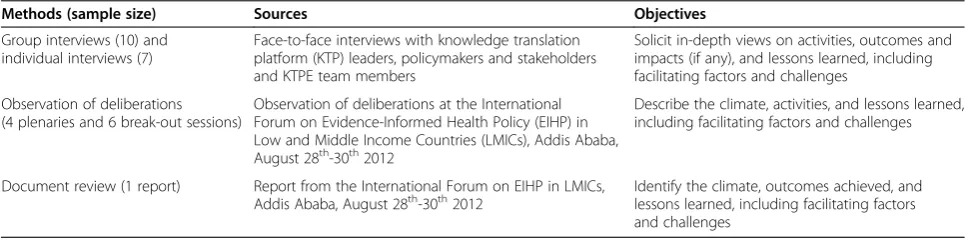
This structured reflection drew on multiple sources of qualitative data, namely i) semi-structured group and in-dividual interviews with key informants including KTP leaders, policymakers, and stakeholders from the coun-tries where the KTPs are formed, and Knowledge Trans-lation Platform Evaluation (KTPE) team members who were responsible for evaluating KTPs in different coun-tries; ii) document review of the report from the Forum on EIHP in LMICs; and iii) observation of deliberations at the International Forum (Table 1). The approach used in this study was primarily focused on the data gained from the group and individual interviews. Data gener-ated from interviews were triangulgener-ated with the docu-ment review and observation of deliberations to confirm, challenge, and refine emerging themes from the inter-views. The reliability and validity of the data were en-hanced through iterative data collection, the use of multiple methods for data collection, and the ongoing discussion of findings within the research team.
A multi-level purposive sampling strategy was used. First, KTPs that were funded by Supporting the Use of Research Evidence (SURE) and the Alliance for Health Policy and Systems Research (AHPSR) were sampled. Second, individuals and groups of individuals were sam-pled based on their association with these platforms. Third, documents and deliberations held at the Forum were sampled based on their relevance to the work undertaken by the platforms. The specifics of each pur-posive sampling strategy are detailed in the sections that follow.
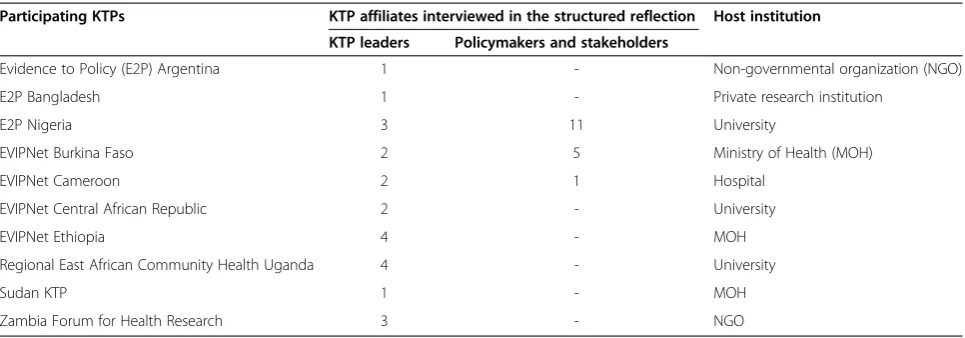
Ten KTPs were funded by one or both of SURE and the AHPSR and were included in this study (Table 2). SURE is a collaborative project that supports the EVIP-Net in Africa and the Region of East Africa Community
Health (REACH) Policy Initiative [11]. The AHPSR’s
overall goal is to promote the generation and use of health policy and systems research as a means to im-prove health and health systems in developing countries. It pursues this goal by developing and harnessing exist-ing methods and approaches to improve both the quality
Table 1 Data collection methods, sources, and objectives
Methods (sample size) Sources Objectives
Group interviews (10) and individual interviews (7)
Face-to-face interviews with knowledge translation platform (KTP) leaders, policymakers and stakeholders and KTPE team members
Solicit in-depth views on activities, outcomes and impacts (if any), and lessons learned, including facilitating factors and challenges
Observation of deliberations (4 plenaries and 6 break-out sessions)
Observation of deliberations at the International Forum on Evidence-Informed Health Policy (EIHP) in Low and Middle Income Countries (LMICs), Addis Ababa, August 28th-30th2012
Describe the climate, activities, and lessons learned, including facilitating factors and challenges
Document review (1 report) Report from the International Forum on EIHP in LMICs,
of research and its uptake [12]. Four of these KTPs are
WHO-sponsored EVIPNet’s: EVIPNet Burkina Faso,
EVIPNet Cameroon, EVIPNet Central African Republic (CAR), and EVIPNet Ethiopia. KTPs funded by the AHPSR include EVIPNet Cameroon and ZAMFOHR, as well as other more project-oriented (e.g., time-limited) initiatives such as Evidence to Policy (E2P) Argentina, E2P Bangladesh, and E2P Nigeria. The Sudan KTP was initially supported by the World Health Organization Regional Office for the Eastern Mediterranean (WHO EMRO). REACH Uganda is a closely aligned initiative with WHO-sponsored KTPs.
Framework for assessing knowledge translation platforms (KTPs)
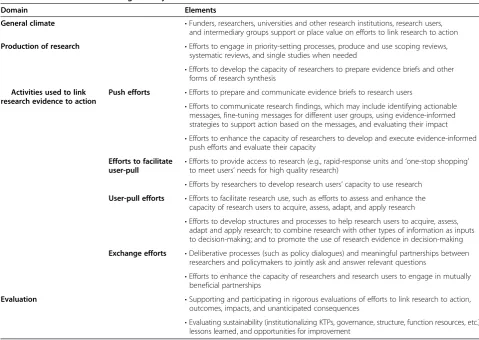
The framework developed by Lavis et al. [13] was used to guide data collection. The framework identifies four domains for assessing country-level efforts to link re-search to action: i) the general climate for rere-search use; ii) the production of research that is both highly relevant to and appropriately synthesized for research users; iii) the mix of clusters of activities used to link research to action which include push efforts, efforts to facilitate user-pull, user-pull efforts, and exchange efforts; and iv) the evaluation of efforts to link research to action. The framework also identifies the corresponding elements that are conducive to linking research to action in each domain (Table 3). The elements of this framework are based on potential innovations that are being imple-mented to link research to action but that require fur-ther rigorous evaluation. This framework was previously adapted to assess activities of researchers [14,15] and health research funding agencies in linking research to action in LMICs [16].
Group and individual interviews
Purposive sampling was used to select participants based on their association with these platforms. KTP leaders
(and team members), responsible for directing and co-ordinating activities of the KTP in their own countries, were interviewed. Additionally, policymakers and stake-holders related to the work of these platforms from dif-ferent settings were interviewed. These were identified via a respondent-driven technique whereby KTP leaders suggested potential key informants who could provide additional information. Interviews were also conducted with members of the KTPE team, which includes re-searchers from McMaster University, the American Uni-versity of Beirut, and Pontificia Universidad Catolica de Chile. The KTPE team members are part of the Evaluat-ing Knowledge-Translation Platforms in Low- and
Middle-Income Countries project that was initiated in 2009 to
evaluate KTPs that are being launched around the world. Participants were notified of the objectives of the inter-views and were approached for the interview after secur-ing their verbal approval. All interviews were conducted face-to-face. Interviews were tape-recorded only after obtaining the permission of participants. All interview data was treated as confidential and the anonymity of par-ticipants was preserved. Care was taken to ensure that comments could not be attributed to a single individual (or KTP) to protect the confidentiality of respondents.
Ten group interviews were conducted with a total of 39 key informants. Group size ranged from two to eight participants per group. Group interviews with as few as two participants were previously used in several qualita-tive studies [17-20]. Group interviews lasted for one to two hours on average. In addition, seven individual inter-views were conducted and lasted for an average of 45 mi-nutes. Six group interviews were tape-recorded and were transcribed verbatim. Extensive notes were taken for the remaining group interviews and for the individual inter-views and they were summarized shortly thereafter.
Interviews with KTP leaders were guided by a semi-structured interview tool developed by the KTPE team. An adapted version of the interview tool was used for Table 2 Participating knowledge translation platforms (KTPs) and their host institution
Participating KTPs KTP affiliates interviewed in the structured reflection Host institution KTP leaders Policymakers and stakeholders
Evidence to Policy (E2P) Argentina 1 - Non-governmental organization (NGO)
E2P Bangladesh 1 - Private research institution
E2P Nigeria 3 11 University
EVIPNet Burkina Faso 2 5 Ministry of Health (MOH)
EVIPNet Cameroon 2 1 Hospital
EVIPNet Central African Republic 2 - University
EVIPNet Ethiopia 4 - MOH
Regional East African Community Health Uganda 4 - University
Sudan KTP 1 - MOH
interviewing policymakers, stakeholders, and KTPE team members, which allowed them to focus on questions based on their area of expertise. The development of the semi-structured interview tool was guided by the frame-work adapted from Lavis et al. [13] and involved review-ing several iterations by team members to ensure its robustness. The interviews covered topics on general cli-mate for supporting (or hindering) efforts to link re-search to action; activities and outputs undertaken by KTPs including priority setting, engaging in push efforts, facilitating user-pull, pull efforts, and exchange efforts; KTP’s evaluation efforts and their perceptions of the re-sults of their activities; facilitators for supporting KTP work, challenges encountered, and lessons learned that can assist in overcoming challenges; and critical factors that can help to ensure the sustainability of KTPs. Inter-view tools are enclosed in Additional files 1 and 2.
Document review
The document review helped to identify efforts under-taken by KTPs to link research evidence to action and derive key lessons for improving country-level efforts to support EIHP in LMICs. The document review was
cross-checked with findings from interviews and obser-vation of deliberations. Material examined included a re-port summarizing the proceedings of the International Forum on EIHP in LMICs. The report was prepared by the WHO International Forum Organizing Committee and it provides an overview of the Forum including plenaries, workshops, and small group sessions that took place. It is organized around the framework for assessing country-level efforts to link research to action and high-lights key messages and lessons learned that emerged during the Forum [21]. The document was reviewed and summarized in a data collection sheet that included the title of the document and the data related to the four domains for assessing efforts to link research to action framework.
Observation of deliberations
Observations of deliberations at the International Forum on EIHP in LMICs were recorded. Materials examined included notes on observation of deliberations and hands-on workshops, and meeting minutes of four plen-aries and six sessions from the Forum. Sessions from the Forum were sampled based on their relevance to the Table 3 Framework for assessing country-level efforts to link research to action*
Domain Elements
General climate •Funders, researchers, universities and other research institutions, research users, and intermediary groups support or place value on efforts to link research to action
Production of research •Efforts to engage in priority-setting processes, produce and use scoping reviews, systematic reviews, and single studies when needed
•Efforts to develop the capacity of researchers to prepare evidence briefs and other forms of research synthesis
Activities used to link research evidence to action
Push efforts •Efforts to prepare and communicate evidence briefs to research users
•Efforts to communicate research findings, which may include identifying actionable messages, fine-tuning messages for different user groups, using evidence-informed strategies to support action based on the messages, and evaluating their impact •Efforts to enhance the capacity of researchers to develop and execute evidence-informed
push efforts and evaluate their capacity
Efforts to facilitate user-pull •
Efforts to provide access to research (e.g., rapid-response units and‘one-stop shopping’ to meet users’needs for high quality research)
•Efforts by researchers to develop research users’capacity to use research
User-pull efforts •Efforts to facilitate research use, such as efforts to assess and enhance the capacity of research users to acquire, assess, adapt, and apply research
•Efforts to develop structures and processes to help research users to acquire, assess, adapt and apply research; to combine research with other types of information as inputs to decision-making; and to promote the use of research evidence in decision-making
Exchange efforts •Deliberative processes (such as policy dialogues) and meaningful partnerships between researchers and policymakers to jointly ask and answer relevant questions
•Efforts to enhance the capacity of researchers and research users to engage in mutually beneficial partnerships
Evaluation •Supporting and participating in rigorous evaluations of efforts to link research to action, outcomes, impacts, and unanticipated consequences
•Evaluating sustainability (institutionalizing KTPs, governance, structure, function resources, etc.), lessons learned, and opportunities for improvement
*
work undertaken by these KTPs. Participants in these sessions shared their experiences on the ways in which KTPs can encourage and promote EIHP initiatives and engage different actors in efforts to support EIHP. The observations focused on the climate for and activities of KTPs, facilitators for supporting KTP work, challenges encountered, and lessons learned that can assist in over-coming these challenges. Observations were recorded by three members of the research team. They were then compiled and compared against each other. Observa-tions helped to verify information obtained through the interviews and the document review. Each document was reviewed and summarized in a data collection sheet.
Data analysis
Data analysis was guided by the framework developed by Lavis et al. [13]. Data analysis was conducted by the lead author (FEJ) using a grounded iterative approach, and shared with the other team members (JNL, SC, TP, KAM) during several stages of the analysis as a way to confirm, challenge, and feedback into the further refinement of themes. Preliminary results were also shared with a group of doctoral students studying EIHP to the same effect.
Data from the interviews, document review, and ob-servation of deliberations were holistically analyzed such that data collected from the three sources were gathered using the same data analysis sheet, rather than analyzing data from different sources separately. Thematic analysis was used. Open coding was conducted first, whereby findings were broken into similar concepts and ideas. Axial coding was then conducted, which involves organ-izing the emerging concepts into themes [22]. Themes were pre-identified based on the study objectives, inter-view questions, and additional themes emerged during the analysis. Themes were then categorized based on the framework by Lavis et al. [13]. Recurring themes and emerging patterns across respondents from different KTPs and the corresponding countries were then ana-lyzed. Illustrative quotations were identified to support the narrative description of the themes.
Results
A total of 23 KTP leaders and 17 policymakers and stake-holders were interviewed from the 10 KTPs (Table 2), in addition to 7 KTPE members. At the time of the interviews, KTPs were three years old except for E2P Argentina, E2P Bangladesh, and EVIPNet Ethiopia, which were two years old. KTPs were at different levels of implementation. EVIPNet Burkina Faso and EVIPNet Ethiopia were at the early phases of implementation and were recruiting human resources and planning to expand activities. The remaining KTPs were planning for asses-sing the outcomes of their activities or for sustaining their KTPs and obtaining long-term funding.
The following sections present the common themes that emerged from the interviews and that were triangu-lated and confirmed with the document review and ob-servation of deliberations. The themes were grouped under the main domains for assessing country-level ef-forts to link research to action.
General climate
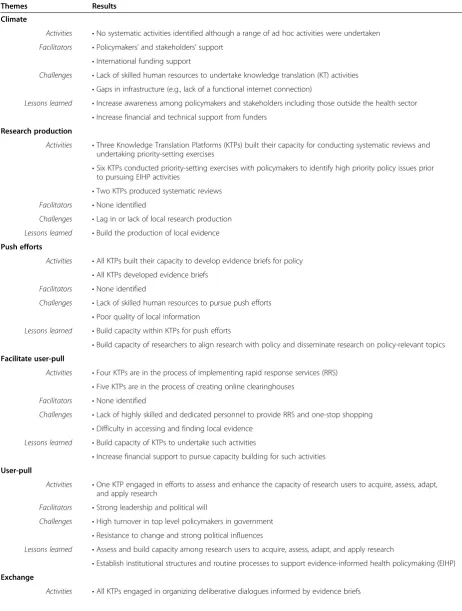
The extent of support for and value given to efforts to link research to action was variable among KTPs. Results from the interviews, document review, and observation confirmed that the support provided to KTPs by policy-makers and stakeholders as well as the financial support provided by international funders were key for enabling EIHP initiatives (Table 4). The main challenges to sup-porting EIHP work were the lack of skilled human re-sources to undertake KT activities and the difficulty in managing multiple roles within KTPs.
Despite efforts by funders, policymakers, and stake-holders to support EIHP, findings suggested that much should be done for building support for EIHP initiatives in LMICs. Increasing the awareness of policymakers and stakeholders on the importance of EIHP, including those outside the health sector, was often highlighted as a re-quirement for creating a climate that supports KT activ-ities. For example, discussions at the Forum highlighted the importance of mapping institutional structures at the national level to understand the optimal ways and emerging opportunities for targeting policymakers and stakeholders, which would also require that KTPs build their capacity in lobbying and understanding the political context. Additionally, KTP leaders repeatedly urged fun-ders to play a stronger role in supporting KT activities in LMICs mainly through increasing financial support pro-vided to KTPs, strengthening technical capacity of KTPs to undertake KT, as well as providing mentorship oppor-tunities to KTPs and more flexibility with funding (for ex-ample in terms of providing KTPs with more time to discuss and explore innovative KT ideas) (Table 4).
Production of research
Findings revealed that efforts exerted by KTPs under the domain of research production are still limited. Interviews indicated that only a few KTPs engaged in producing sys-tematic reviews. The lag in or lack of local research pro-duction and the urgent need to build the propro-duction of high quality, policy-relevant systematic reviews and local single studies were repeatedly emphasized across inter-views, the document review, and observations (Table 4).
Push efforts
Table 4 Activities used to link research to action, facilitators, challenges, and lessons learned
Themes Results Climate
Activities •No systematic activities identified although a range of ad hoc activities were undertaken Facilitators •Policymakers’and stakeholders’support
•International funding support
Challenges •Lack of skilled human resources to undertake knowledge translation (KT) activities •Gaps in infrastructure (e.g., lack of a functional internet connection)
Lessons learned •Increase awareness among policymakers and stakeholders including those outside the health sector •Increase financial and technical support from funders
Research production
Activities •Three Knowledge Translation Platforms (KTPs) built their capacity for conducting systematic reviews and undertaking priority-setting exercises
•Six KTPs conducted priority-setting exercises with policymakers to identify high priority policy issues prior to pursuing EIHP activities
•Two KTPs produced systematic reviews Facilitators •None identified
Challenges •Lag in or lack of local research production Lessons learned •Build the production of local evidence
Push efforts
Activities •All KTPs built their capacity to develop evidence briefs for policy •All KTPs developed evidence briefs
Facilitators •None identified
Challenges •Lack of skilled human resources to pursue push efforts •Poor quality of local information
Lessons learned •Build capacity within KTPs for push efforts
•Build capacity of researchers to align research with policy and disseminate research on policy-relevant topics
Facilitate user-pull
Activities •Four KTPs are in the process of implementing rapid response services (RRS) •Five KTPs are in the process of creating online clearinghouses
Facilitators •None identified
Challenges •Lack of highly skilled and dedicated personnel to provide RRS and one-stop shopping •Difficulty in accessing and finding local evidence
Lessons learned •Build capacity of KTPs to undertake such activities
•Increase financial support to pursue capacity building for such activities
User-pull
Activities •One KTP engaged in efforts to assess and enhance the capacity of research users to acquire, assess, adapt, and apply research
Facilitators •Strong leadership and political will
Challenges •High turnover in top level policymakers in government •Resistance to change and strong political influences
Lessons learned •Assess and build capacity among research users to acquire, assess, adapt, and apply research
•Establish institutional structures and routine processes to support evidence-informed health policymaking (EIHP)
Exchange
developed evidence briefs, with significant variation in the number of produced briefs across KTPs at the time of interviews. A common perception among the inter-viewed KTPs was that evidence briefs were useful tools for influencing policymaking. This view was illustrated by a KTP leader:
“We have done interesting work in terms of working
with policymakers and researchers in developing
evidence briefs that could be used for policymaking”
Participants acknowledged that the process of develop-ing evidence briefs was burdensome and lengthy; this was mainly attributed to a lack of skilled human re-sources to prepare evidence briefs and poor quality of
local information to support evidence briefs. As such, the need for further capacity building to ensure that or-ganizations and individuals within countries have the skills to prepare evidence briefs was repeatedly empha-sized. Additionally, participants emphasized the need for researchers to better align their research with high prior-ity policy issues in their countries and accelerate their ef-forts in disseminating research evidence and making it readily accessible for policymaking (Table 4).
Efforts to facilitate user-pull
Establishing rapid response services (RRS) and“one-stop
shopping” through online clearinghouses were
under-taken by some KTPs in order to facilitate user-pull, with varying degrees of implementation across KTPs. While
Table 4 Activities used to link research to action, facilitators, challenges, and lessons learned(Continued)
Facilitators •Skilled human resources to moderate deliberative processes •Support of policymakers and stakeholders
•Location within the Ministry of Health brings KTPs closer to policymakers and stakeholders Challenges •Difficulty in convincing policymakers, stakeholders, and researchers to interact
•High turnover in top level policymakers in government
Lessons learned •Build the capacity of researchers and KTPs to engage in exchange efforts
•Extend interactions to community members, donors, international community, and the media •Provide incentives for the participation of policymakers and researchers
•Interact with other KTPs to share experience and best practice
Evaluation
Activities •Four KTPs had evaluated evidence briefs, deliberative dialogues, and capacity building sessions through pre/post intervention questionnaires
•None of the KTPs had yet begun to assess the long-term impact of their activities in policymaking Outcomes •Seven KTPs reported increased awareness of the importance of EIHP initiatives among policymakers,
stakeholders, and researchers
•Eight KTPs reported strengthened relationships among policymakers, stakeholders, and researchers •Six KTPs reported that their evidence briefs helped inform policymaking at the government level •Six KTPs reported increased demand for KT products by policymakers
•Three KTPs reported enhanced capacity among KTP members for developing evidence briefs and deliberative dialogues •One KTP reported enhanced capacity among policymakers for accessing, assessing, and using research evidence Facilitators •Strong leadership support particularly from policymakers at the government level to achieve outcomes Challenges •Perception that monitoring and evaluation (M&E) activities were challenging
•Lack of capacity within KTPs to conduct M&E activities Lessons learned •Intensify M&E efforts to build the case for sustainability
Sustainability
Views •Six KTPs viewed their work as a long-term initiative Facilitators •None identified
Challenges •Difficulty in ensuring the sustainability of EIHP initiatives •Difficulty in identifying long-term sources of funding
Lessons learned •Institutionalize KTPs within the structures (or processes) of the government •Build and retain capacity within KTPs and similar organizations
challenges encountered under this domain varied across KTPs, a set of common challenges emerged from the in-terviews and were confirmed by the document review and observations. These common challenges were the lack of skilled and dedicated personnel to conduct ef-forts to facilitate user-pull and the difficulty encountered by KTPs in accessing and finding local evidence mainly due to the unwillingness of policymakers and research institutions to share local data. As such, the need for building the capacity of KTPs to undertake efforts that facilitate user-pull and for scaling up financial support to pursue capacity building for such initiatives were fre-quently emphasized (Table 4). REACH Uganda, EVIPNet Burkina Faso, and ZAMFOHR highlighted how collabor-ation among them helped to develop their skills in implementing RRSs. They emphasized that this type of knowledge sharing is essential for scaling up approaches to facilitating user-pull in other countries.
User-pull efforts
Efforts to enhance the capacity of research users to acquire, assess, adapt, and apply research were rarely undertaken by KTPs. Common challenges to pursuing user-pull efforts included resistance to change and strong political influences. Additionally, a number of KTPs re-ported that high turnover in top level policymakers in the government, including political appointees and civil servants, contributed to the leakage of capacity, severed relationships, and shuffled priorities, as a KTP leader explained:
“Top level policymakers will stay for a short period of
time because their appointment is political. As such, it is important to target mid-level policymakers because they are the engine of policymaking, stay longest in the
system, and can be more readily reached.”
In order to support user-pull efforts, interviews and the document review indicated that there is a need to as-sess and build capacity among research users to acquire, assess, adapt and apply research to help ensure their ac-tive engagement in EIHP initiaac-tives. Such efforts should be combined with establishing institutional structures and routine processes (e.g., criteria for promotion and legislation) for research users to encourage their engage-ment in EIHP activities. For example, E2P Nigeria con-tacted policymakers through formal organizations in order to encourage their participation in EIHP initiatives and provided certificates following capacity building ses-sions (Table 4).
Exchange efforts
Efforts to engage in deliberative processes and collabor-ation among research users, researchers, and funders
constituted a core component of EIHP initiatives. Delib-erative dialogues informed by evidence briefs were per-ceived by interviewees as the“most commendable [tools for enhancing EIHP]” and “activities [KTPs] were most proud of”. Interviews reported that deliberative dialogues had the potential to influence the use of evidence in policy formulation, influence the perceptions of policy-makers, stakeholders, and researchers regarding the availability of research evidence, and strengthen the rela-tionship between policymakers, stakeholders, and re-searchers. At the same time, interviewees emphasized that these are their own perceptions about the short-term influence of deliberative dialogues and that it is still early in their KTP work to comment on the long-term impact of deliberative dialogues on the use of evidence in policymaking. These perceptions are illustrated in the following quotes by KTP leaders:
“Deliberative dialogue was the main pathway of
influence. It provided a public face to our work.”
“Options that were proposed[in the deliberative
dialogue informed by an evidence brief]were integrated in the strategic plan for accelerating
maternal survival.”
“[During deliberative dialogues]it was very interesting to see how actors with different interests and views on the healthcare system were willing to discuss new ideas, and contribute without putting aside their
differences. This was very encouraging for us.”
Findings revealed that key components that facilitated the engagement of KTPs in conducting deliberative pro-cesses were skilled human resources to moderate delib-erative processes and the support of policymakers and stakeholders and their willingness to participate in such initiatives. In addition, being hosted within the Ministry of Health (MOH) facilitated interactions between KTPs and policymakers and stakeholders.
Suggestions for strengthening exchange efforts included extending interactions beyond those between researchers and policymakers at the government level to include a diverse range of research users including community members, donors and the international community, and the media. Increasing opportunities to engage with other KTPs doing similar work in order to share experience and best practice was also highlighted, as a KTP leader stated:
“It would have been interesting to have more
interaction with other KTPs in order to see how other initiatives are working and whether they face similar
Evaluation
A common theme that emerged from the interviews and was confirmed by the document review and observations was the need for intensifying monitoring and evaluation (M&E) efforts. Generally, M&E activities were seldom undertaken by KTPs in LMICs. This lag in conducting M&E activities was attributed to the lack of capacity within KTPs to conduct M&E activities, particularly in implementing M&E approaches and tools, and in analyz-ing data, as well as the prevailanalyz-ing perception among KTP leaders that M&E activities were particularly challenging endeavors.
When asked about the key outcomes resulting from EIHP activities, interviewees emphasized the increased awareness among policymakers, stakeholders, and re-searchers on the importance of EIHP initiatives. This was illustrated by a policymaker:
“[The KTP in our country]has become a household name in the MOH as evident by the level of
participation[of policymakers and stakeholders]in
EIHP initiatives.”
Additionally, strengthened relationships among policy-makers, stakeholders, and researchers were common out-comes of the KTP work, as mentioned in the interviews. Furthermore, evidence briefs reportedly helped inform policymaking at the government level. For example, pol-icymakers from Nigeria attested to the utility of evidence briefs developed by E2P Nigeria in informing decisions for launching the Ebonyi State Helminth Control Programme. Other frequently mentioned outcomes included an in-creased demand for KT products by policymakers, enhanced capacity among policymakers for accessing, assessing, and using research evidence, and enhanced cap-acity among KTP members for developing evidence briefs and dialogues.
Key to achieving outcomes and bringing about change was strong leadership support particularly from policy-makers at the government level, as emphasized in the inter-views, document review, and observation of deliberations. Discussions during the interviews and at the Forum of key facilitators for conducting KTP work acknowledged the central role that strong leadership plays in the process of establishing collaborative partnerships between research funders, research producers and users, and for promoting EIHP initiatives. KTP leaders reported that committed high-level policymakers within the government (e.g., advi-sors of the Minister of Health) were among the essential facilitators to their KT work.
Sustainability
Ensuring the sustainability of EIHP initiatives after the end of funding was identified by interviewees as a major
challenge confronting KTPs. Three interrelated factors were commonly cited to play a strong role in influencing the sustainability of KTPs.
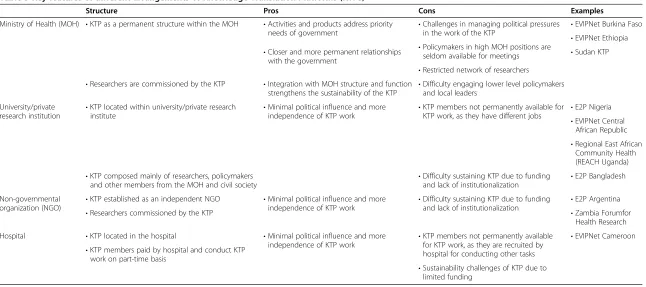
The first factor that emerged was the institutionalization of KTPs within the structures (or processes) of the gov-ernment. There were various arrangements for hosting KTPs. Three KTPs were hosted by the MOH, two were hosted by a university, one by a government re-search institution, and one by a hospital, while one was an independent non-governmental organization (NGO) (Table 2). Findings on the structure, pros, and cons of the different KTP arrangements are summarized in Table 5.
Institutionalization was thought to help overcome challenges related to retaining capacity and funding, as indicated by interviewees, document review, and obser-vation of deliberations. For example, institutionalization of KTPs within the MOH ensured the continuous fund-ing of EIHP activities and salaries. This can be demon-strated by EVIPNet Ethiopia, which was established by the National MOH as the Directorate of Technology Transfer & Research within the EHNRI; it is composed of staff paid by autonomous public authorities to con-duct KTP work. Its strategic direction, activities, and KT priorities are informed by policymakers at the MOH. Participants noted that close linkages to the MOH strengthens the sustainability of KTP work, provides proximity to policymakers, and increases the prospects that KTP work is utilized in policymaking.
At the same time, it was emphasized that KTPs should pay attention to maintaining their autonomy from polit-ical interests and governmental control and should pro-tect themselves from the instability and turnover in top level policymakers at the government level, which are mainly influenced by political changes in authority. Be-ing located within a university or a research institute whilst having close collaboration with and support from policymakers and stakeholders was a suggested alterna-tive for institutionalization:
“The instability in the MOH and lack of appropriate
capacity makes the university a better alternative[for
our KTP].”
The second factor influencing sustainability was fund-ing availability. All KTPs were financed by international funders (e.g., SURE and AHPSR) and six of these re-ported difficulty in identifying long-term sources of fi-nancing following the end of international funding, as a KTP leader illustrated:
“Lack of long-term funding means that efforts are
focused on looking for funding instead of focusing on
Table 5 Key features of different arrangements of Knowledge Translation Platforms (KTPs)
Structure Pros Cons Examples
Ministry of Health (MOH) •KTP as a permanent structure within the MOH •Activities and products address priority
needs of government •
Challenges in managing political pressures
in the work of the KTP •
EVIPNet Burkina Faso •EVIPNet Ethiopia •Policymakers in high MOH positions are
seldom available for meetings •Sudan KTP •Closer and more permanent relationships
with the government
•Restricted network of researchers
•Difficulty engaging lower level policymakers and local leaders
•Integration with MOH structure and function strengthens the sustainability of the KTP •Researchers are commissioned by the KTP
University/private research institution •
KTP located within university/private research
institute •
Minimal political influence and more
independence of KTP work •
KTP members not permanently available for KTP work, as they have different jobs •
E2P Nigeria
•EVIPNet Central African Republic •Regional East African
Community Health (REACH Uganda) •E2P Bangladesh •Difficulty sustaining KTP due to funding
and lack of institutionalization •KTP composed mainly of researchers, policymakers
and other members from the MOH and civil society
Non-governmental organization (NGO) •
KTP established as an independent NGO •Minimal political influence and more
independence of KTP work •
Difficulty sustaining KTP due to funding and lack of institutionalization •
E2P Argentina
•Zambia Forumfor Health Research •Researchers commissioned by the KTP
Hospital •KTP located in the hospital •Minimal political influence and more
independence of KTP work •
KTP members not permanently available for KTP work, as they are recruited by hospital for conducting other tasks
•EVIPNet Cameroon •KTP members paid by hospital and conduct KTP
work on part-time basis
•Sustainability challenges of KTP due to limited funding
al.
Health
Research
Policy
and
Systems
2014,
12
:2
Page
10
of
15
licy-systems
.com/content
Finally, the third key factor that emerged to influence sustainability was the need for building and retaining capacity within KTPs, with special focus on conducting M&E activities and developing skills in advocacy and “selling the idea”of EIHP (Table 4).
Discussion Principal findings
The establishment of KTPs in a broad range of LMICs is a promising development in supporting EIHP. KTPs re-port that they have contributed to increased awareness of the importance of EIHP initiatives and strengthened relationships among policymakers, stakeholders, and re-searchers, while acknowledging the urgent need for KTPs to conduct more robust M&E efforts to assess the outcome and impact of their activities on health policy-making. Furthermore, deliberative dialogues informed by evidence briefs for policy have been among the most commended tools by interviewees for informing policy-making, partly because they provided a public face for the work of KTPs. Additionally, deliberative dialogues can potentially strengthen interactions among policymakers, stakeholders, and researchers, which in turn increases the prospects for research use in policymaking [23].
It is important to note that KTPs were not able to spe-cify how research evidence was used in policymaking (e.g., was the use of evidence instrumental, conceptual, or sym-bolic? Did it inform policy development or implementa-tion?). The impact of implementing evidence-informed policymaking (e.g., improvement on population health sta-tus) has not been assessed and there were no clear mecha-nisms for undertaking such initiatives. However, this structured reflection provides a snapshot in time of the work of KTPs and their efforts to scale up activities to link research evidence to policymaking and assess the impact of their work, which is still ongoing.
Findings from this structured reflection indicated that KTPs have scaled up push and exchange efforts to link research evidence to policymaking. However, KTPs’ pro-duction of research, efforts to facilitate pull, user-pull efforts, and evaluation efforts need to be intensified in their view. In order to facilitate these efforts, findings suggested building the production of local evidence, building the capacity of KTPs and research users to undertake such activities, and increasing financial sup-port to pursue capacity building and M&E activities.
Variations in achieving EIHP activities among KTPs have been due to the differences in support systems and value placed on efforts to link research to action avail-able to KTPs in their countries. Strong leadership and support from policymakers at the government level in addition to funding and technical support (e.g., availabil-ity of mentors) from international funders were key fa-cilitators to conducting EIHP activities. However, the
lack of skilled and dedicated human resources to conduct push efforts, efforts to facilitate user-pull and exchange ef-forts, and to evaluate these efforts impeded KTPs.
Ensuring the sustainability of EIHP initiatives after the end of funding was identified as a major challenge con-fronting KTPs. KTPs reported that institutionalization within government structures or processes has helped to retain human resources and secure funding for their KTP activities, whereas KTPs hosted by universities highlighted the advantage of attaining autonomy from political interests while maintaining close collaborations with and support from policymakers and stakeholders.
Strengths and limitations
The study has several strengths. First, the data were col-lected using three different sources (interviews, docu-ment review, observation of deliberations), which helped enhance understanding of KTP experiences and allowed cross-checking of findings. Second, the “framework for assessing country-level efforts to link research to action” that was used for analysis helped build a comprehensive understanding of activities, the set of facilitators and challenges influencing each of these activities, and key learnings for enhancing these activities within each com-ponent of the framework. Third, this study is one of the very few reporting on the early experiences of KTPs in LMICs and can help identify opportunities for improv-ing ongoimprov-ing activities of KTPs and informimprov-ing the experi-ences of other growing KTPs in LMICs.
With regards to limitations, our sample of interviewees was drawn from KTP staff and leaders and then from policymakers and stakeholders. Eliciting the opinion of a larger number of policymakers and stakeholders at the country level can potentially provide additional in-depth insights on the work of KTPs from the perspective of the groups that KTPs eventually aim to reach and influ-ence. This can provide valuable information for assessing initiatives conducted by KTPs, tailoring EIHP initiatives to their needs, and improving the work of KTPs in each setting. That said, KTP leaders come from different backgrounds, such as policymakers at the government level and stakeholders from civil society as well as re-searchers, and have provided their perceptions on EIHP activities from these perspectives. Additionally, the document review and observations and synthesis of de-liberations from the International Forum included find-ings from the perspectives of policymakers, stakeholders, and researchers, in addition to KTP leaders.
Findings in relation to previous studies
research production and limited alignment with regional priorities, as well as lack of skills among research users to acquire, assess, adapt, and use research evidence, were also previously reported to hinder EIHP activities in LMICs [25-28]. There is little empirical evidence on ef-fective KT approaches and how KT strategies can be tai-lored for different contexts and disciplines [31-35]. The positive views held by interviewees regarding evidence briefs and deliberative dialogues are supported by a recent survey of policymakers, stakeholders, and researchers from LMICs, whereby respondents viewed evidence briefs and deliberative dialogues very favorably and reported strong intentions to act on what they learned in the briefs and dialogues [36]. Lessons drawn from the experience of ZAMFOHR included the necessity of performing compre-hensive situation analyses to understand the evidence-to-policy climate and the operational niche for the KTP and the importance of networking to benefit from the experi-ence of other KTPs, funding opportunities, and technical support [7]. ZAMFOHR’s experience, as well as findings from other studies, suggested focusing the KTP program on building the capacity of its own staff, policymakers, stakeholders, and researchers to engage in EIHP [7,26-29], which also confirm lessons learned from KTPs in the current study. Furthermore, making changes to the exist-ing institutional structures and incentives provided to re-searchers and research users were suggested strategies to encourage them to engage in EIHP initiatives [25,28-30].
Implications for practice and future research
Findings from this study suggest the need for intensify-ing efforts to increase research on effective KT strategies and understanding KT tools in different contexts. Specif-ically, further research is needed to systematically deter-mine how the ways in which evidence briefs, deliberative dialogues, and other KT strategies are designed, their content and the context in which they are developed will influence their usefulness in supporting EIHP [9,36,37]. A recent systematic review reported that contextual fac-tors, particularly the institutions, interests, and values of a given context, as well as issue-related factors (such as whether issues are polarizing, salient, or familiar to pol-icy actors) can influence views regarding evidence briefs among their intended users [38]. Similarly, future re-search may explore the ways in which contextual factors and policy issues can influence other strategies (e.g., cap-acity building targeted at research producers and users) for supporting the use of research evidence in policy-making processes.
There is a general assumption that evidence-informed policymaking will inevitably improve outcomes; however, there is no robust evidence base to support/disprove this assumption. As such, assessing the impact of policies in-formed by evidence briefs for policy and deliberative
policy dialogues (e.g., improved health of the population) is needed to complete the M&E cycle and to make the case for supporting EIHP. Further research comparing governance structures of KTPs in different contexts and the factors influencing their sustainability is also much required, given the current volatility of these initiatives as indicated in this study.
This structured reflection provided four key lessons to improve the activity of KTPs and to help inform those interested in establishing KTPs in their own countries. Firstly, concerted efforts should be directed towards cap-acity building for preparing evidence briefs, conducting deliberative dialogues, implementing a RRS, developing and maintaining online clearinghouses, and evaluating these activities among those engaging in these EIHP ac-tivities. A systematic review reported that training in using systematic reviews and providing peer-group sup-port facilitated the uptake of evidence from systematic reviews [31]. Capacity building ought to go hand-in-hand with raising the awareness of policymakers, stake-holders, and researchers alike on the importance of EIHP in addition to developing their skills to engage in EIHP activities (e.g., skills of policymakers to access, as-sess, and apply research; and skills of researchers to align research production with policy priorities, produce sys-tematic reviews, effectively disseminate their research, and engage with policymakers). In Nigeria, for example, a training workshop that focused on capacity development for EIHP and building partnerships between policymakers, stakeholders, and researchers showed significant improve-ments in participants’knowledge and their understanding of the health policymaking process and the use of evi-dence [8]. Different capacity-building approaches can be implemented and assessed with both researchers and research users and tailored to different contexts; for ex-ample, comparing the use of group workshops with one-to-one meetings on building the capacity of policymakers, stakeholders, and researchers [39].
Ontario requires training for civil servants in finding and using research evidence, incorporating assessments of the use of research evidence as part of performance reviews. It also requires civil servants making submis-sions to the minister or to cabinet to document the key sources for research evidence that were searched and de-clare that relevant findings were used to inform the sub-mission [42].
Secondly, the further expansion of financial support from funders, government sources, or revenue-generating activities will be needed to support and retain capacity within KTPs as well as to ensure the sustainability of these activities. Additionally, funding agencies could play a stronger role in promoting EIHP by requiring the pres-ence of a KT component as a condition for the funding of proposals and by facilitating the sharing of experiences across different KTPs and international and local actors. For example, the Michael Smith Foundation for Health Research proposes five key functional areas that funders can undertake for effective KT, these are advancing KT science, building KT capacity, managing KT projects, funding KT activities, and advocating for KT [40]. This funding agency suggests specific examples of funding agencies’activities, including funding knowledge synthesis and other KT strategies as well as KT model testing, pro-viding awards for research use and uptake (e.g., to adapt and implement research evidence), and developing partner-ships with governmental organizations and NGOs in order to leverage limited human and financial resources and align with existing and new initiatives and research [40].
Thirdly, there is a need for each KTP to think stra-tegically about institutionalizing itself in a way that pro-vides greater access to support and a better opportunity to influence policies. Where the KTP locates itself is a critical variable in its organization and operations and should be based on a comprehensive situational analysis of contextual factors related to EIHPs [7]. It should also be aligned with the structures (or processes) of the gov-ernment. Additionally, more attention needs to be given to ensuring leaders at all levels with a vision to support EIHP are identified and supported in their work.
Finally, more attention needs to be paid to integrating M&E activities as key components of KTPs right from their conception. M&E activities should be viewed as tools for obtaining the buy-in of research users and fun-ders for supporting KTPs where appropriate, which in turn would help to ensure the sustainability of KTPs. It is important that KTPs integrate their M&E work start-ing from the plannstart-ing phase of KT work and that they allocate sufficient resources to implementing M&E. The KTPE team developed a range of tools that can assist KTPs in conducting M&E activities including survey tools to evaluate the perceptions of users of evidence briefs and deliberative dialogues, a brief survey administered every
two years to a sample of policymakers, stakeholders, and researchers to assess outcomes of KT activities, and case studies to capture impacts of KT activities on the use of research evidence in policymaking. Very few systematic reviews examine implementing research findings into pol-icy [41]. There are various challenges to evaluating the im-pact of research use in policymaking; these include metrics that are difficult to define, the fact that the use of research evidence differs depending upon the context, and the resource- and time-intensive nature of impact studies [40]. As such, further research can concentrate on asses-sing the outcomes and impacts of conducting KT activities on the use of research in policymaking in addition to assessing the impact of evidence-informed policies on the health system and the health of the population.
Conclusions
Real-time lesson-drawing from the experiences of KTPs can support improvements in the functioning of KTPs in the short term, while making the case for sustaining their work in the long term. Furthermore, the lessons derived from this study can be used to promote the es-tablishment of similar evidence-to-policy initiatives in other countries.
Additional files
Additional file 1:Interview guide (KTP leader version).
Additional file 2:Interview guide (policymaker/stakeholder/ researcher version).
Abbreviations
AHPSR:Alliance for Health Policy and Systems Research; CAR: Central African Republic; E2P: Evidence to policy; EIHP: Evidence-informed health
policymaking; EHNRI: Ethiopian Health and Nutrition Research Institute; KT: Knowledge translation; KTP: Knowledge translation platform; KTPE: Knowledge translation platform evaluation; LMICs: Low- and middle-income countries; M&E: Monitoring and evaluation; NGO: Non-governmental organization; REACH: Region of East Africa Community Health; RRS: Rapid response services; SURE: Supporting the use of research evidence; WHO EMRO: World Health Organization Regional Office for the Eastern
Mediterranean; WHO EVIPNet: World Health Organization Evidence-Informed Policy Networks; ZAMFOHR: Zambia Forum for Health Research.
Competing interests
The authors declare that they have no competing interests.
Authors’contributions
All authors meet criteria for authorship. All authors approved the article for submission. FEJ contributed to the conception, design, interpretation of the data, and analysis as well as to drafting and critically revising the article. JNL contributed to the conception, design, and analysis as well as critically revising the article. KAM and TP contributed to the conception, data collection and to critically revising the article. NA contributed to data analysis and reviewing drafts.
Acknowledgements
Author details 1
Department of Health Management and Policy, American University of Beirut, Riad El Solh, PO Box 11–0236, Beirut 1107 2020, Lebanon. 2
Knowledge-to-Policy (K2P) Center for Health, American University of Beirut, Riad El Solh, Beirut 1107 2020, Lebanon.3Research, Advocacy and Public Policy-making, Issam Fares Institute for Public Policy and International Affairs, American University of Beirut, Riad El Solh, PO Box 11–0236, Beirut 1107 2020, Lebanon.4Department of Clinical Epidemiology and Biostatistics, McMaster University, CRL-209, 1280 Main St. West, Hamilton, ON L8S 4 K1, Canada.5McMaster Health Forum, MML-417, 1280 Main St. West, Hamilton, ON L8S 4 L6, Canada.6Centre for Health Economics and Policy Analysis, McMaster University, CRL-209, 1280 Main St. West, Hamilton, ON L8S 4 K1, Canada.7Department of Political Science, McMaster University, CRL-209, 1280 Main St. West, Hamilton, ON L8S 4 K1, Canada.8Program in Policy
Decision-making, Centre for Health Economics and Policy Analysis, McMaster University, CRL-209, 1280 Main St. West, Hamilton, ON L8S 4 K1, Canada. 9Department of Family Medicine, Pontificia Universidad Católica de Chile, Centro Médico San Joaquín, Av. Vicuña Mackenna 4686, Macul, Santiago, Chile.
Received: 25 September 2013 Accepted: 9 January 2014 Published: 17 January 2014
References
1. World Health Assembly:Resolution on Health Research.2005. http://www. who.int/rpc/meetings/58th_WHA_resolution.pdf.
2. World Health Organization:The Bamako Call to Action on Research for Health.2008. http://www.who.int/gb/ebwha/pdf_files/EB124/B124_12Add2-en.pdf.
3. Beijing Statement from the Second Global Symposium on Health Systems Research.2012. http://healthsystemsresearch.org/hsr2012/images/stories/ downloads/beijing%20_statement.pdf.
4. Hamid M, Bustamante-Manaog T, Truong VD, Akkhavong K, Fu H, Ma Y, Zhong X, Salmela R, Panisset U, Pang T:EVIPNet: translating the spirit of Mexico.Lancet2005,366:1758–60.
5. Lavis JN, Permanand G, Oxman AD, Lewin S, Fretheim A:SUPPORT Tools for evidence-informed health Policymaking (STP) 13: preparing and using policy briefs to support evidence-informed policymaking.
Health Res Policy Syst2009,7(Suppl 1):13.
6. Lavis JN, Boyko JA, Oxman AD, Lewin S, Fretheim A:SUPPORT Tools for evidence-informed health Policymaking (STP) 14: organising and using policy dialogues to support evidence-informed policymaking.Health Res Policy Syst2009,7(Suppl 1):14.
7. Kasonde J, Campbell S:Creating a knowledge translation platform: nine lessons from the Zambia Forum for Health Research.Health Res Policy Syst
2012,10:31.
8. Uneke CJ, Ezeoha AE, Ndukwe CD, Oyibo PG, Onwe F:Promotion of evidence-informed health policymaking in Nigeria: bridging the gap between researchers and policymakers.Glob Public Health2012,7:750–65. 9. Orem JN, Mafigiri DK, Marchal B, Ssengooba F, Macq J, Criel B:Research,
evidence and policymaking: the perspectives of policy actors on improving uptake of evidence in health policy development and implementation in Uganda.BMC Public Health2012,12:109. 10. Young J:Research, policy and practice: why developing countries are
different.J Int Dev2005,17:727–734.
11. World Health Organization (WHO) Supporting the Use of Research Evidence (SURE).http://www.who.int/evidence/sure/en/.
12. Alliance for Health Policy and Systems Research (AHPSR).http://www.who.int/ alliance-hpsr/about/en/.
13. Lavis JN, Lomas J, Hamid M, Sewankambo NK:Assessing country-level efforts to link research to action.Bull World Health Organ2006,84:620–628. 14. Lavis JN, Guindon GE, Cameron D, Boupha B, Dejman M, Osei EJ, Sadana R, Research to Policy and Practice Study Team:Bridging the gaps between research, policy and practice in low- and middle-income countries: a survey of researchers.CMAJ2010,182:E350–E361.
15. Cameron D, Lavis JN, Guindon EG, Akhtar T, Posada FB, Ndossi GD, Boupha B, Research to Policy and Practice Study Team:Bridging the gaps among research, policy and practice in ten low- and middle-income countries: development and testing of a questionnaire for researchers.Health Res Policy Syst2010,8:4.
16. Cordero C, Delino R, Jeyaseelan L, Lansang MA, Lozano JM, Kumar S, Moreno S, Pietersen M, Quirino J, Thamlikitkul V, Welch VA, Tetroe J, ter Kuile A, Graham ID, Grimshaw J, Neufeld V, Wells G, Tugwell P:Funding agencies in low- and middle-income countries: support for knowledge translation.Bull World Health Organ2008,86:524–534.
17. Herbert DL, Loxton D, Bateson D, Weisberg E, Lucke JC:Challenges for researchers investigating contraceptive use and pregnancy intentions of young women living in urban and rural areas of Australia: face-to-face discussions to increase participation in a web-based survey.J Med Internet Res2013,15:e10.
18. Irvine-Meek J, Gould ON, Wheaton H, Todd LE:Acceptability and face validity of a geriatric self-medication assessment tool.Can J Hosp Pharm
2010,63:225–232.
19. Perry JA, Olshansky EF:A family’s coming to terms with Alzheimer’s disease.West J Nurs Res1996,18:12–28.
20. Gregory SW Jr, Webster S:A nonverbal signal in voices of interview partners effectively predicts communication accommodation and social status perceptions.J Pers Soc Psychol1996,70:1231–40.
21. EVIPNet:Report on International Evidence Informed Health Policy in Low- and Middle-Income Countries.Addis Ababa, Ethiopia; 2012. http://global.evipnet. org/wp-content/uploads/2013/02/Addisreport2012.pdf.
22. Kendall J:Axial coding and the grounded theory controversy.West J Nurs Res1999,21:743–757.
23. Lavis J, Davies H, Oxman A, Denis JL, Golden-Biddle K, Ferlie E:Towards systematic reviews that inform health care management and policy-making.J Health Serv Res Policy2005,10(Suppl 1):35–48.
24. El-Jardali F, Makhoul J, Jamal D, Ranson MK, Kronfol NM, Tchaghchagian V: Eliciting policymakers’and stakeholders’opinions to help shape health system research priorities in the Middle East and North Africa region.
Health Policy Plan2010,25:15–27.
25. El-Jardali F, Jamal D, Ataya N, Jaafar M, Raouf S, Matta C, Michael S, Smith C: Health policy and systems research in twelve Eastern Mediterranean countries: a stocktaking of production and gaps (2000–2008).Health Res Policy Syst2011,9:39.
26. El-Jardali F, Lavis JN, Ataya N, Jamal D:Use of health systems and policy research evidence in the health policymaking in eastern Mediterranean countries: views and practices of researchers.Implement Sci2012,7:2. 27. El-Jardali F, Ataya N, Jamal D, Jaafar M:A multi-faceted approach to
promote knowledge translation platforms in Eastern Mediterranean countries: climate for evidence-informed policy.Health Res Policy Syst
2012,10:15.
28. El-Jardali F, Lavis JN, Ataya N, Jamal D, Ammar W, Raouf S:Use of health systems evidence by policymakers in eastern Mediterranean countries: views, practices, and contextual influences.BMC Health Serv Res2012, 12:200.
29. Hamel N, Schrecker T:Unpacking capacity to utilize research: a tale of the Burkina Faso public health association.Soc Sci Med2011,72:31–38. 30. Dowdy DW, Pai M:Bridging the gap between knowledge and health: the
epidemiologist as Accountable Health Advocate (“AHA!”).Epidemiology
2012,23:914–918.
31. Wallace J, Byrne C, Clarke M:Making evidence more wanted: a systematic review of facilitators to enhance the uptake of evidence from systematic reviews and meta-analyses.Int J Evid Based Healthc2012,10:338–346. 32. Wallace J, Nwosu B, Clarke M:Barriers to the uptake of evidence from
systematic reviews and meta-analyses: a systematic review of decision makers’perceptions.BMJ Open2012,2:e001220.
33. LaRocca R, Yost J, Dobbins M, Ciliska D, Butt M:The effectiveness of knowledge translation strategies used in public health: a systematic review.BMC Public Health2012,12:751.
34. Scott SD, Albrecht L, O’Leary K, Ball GD, Hartling L, Hofmeyer A, Jones CA, Klassen TP, Kovacs Burns K, Newton AS, Thompson D, Dryden DM: Systematic review of knowledge translation strategies in the allied health professions.Implement Sci2012,7:70.
35. Barwick MA, Schachter HM, Bennett LM, McGowan J, Ly M, Wilson A, Bennett K, Buchanan DH, Fergusson D, Manion I:Knowledge translation efforts in child and youth mental health: a systematic review.J Evid Based Soc Work2012,9:369–95.
37. Dobbins M, Hanna SE, Ciliska D, Manske S, Cameron R, Mercer SL, O’Mara L, DeCorby K, Robeson P:A randomized controlled trial evaluating the impact of knowledge translation and exchange strategies.Implement Sci
2009,4:61.
38. Moat KA, Lavis JN, Abelson J:How contexts and issues influence the use of policy-relevant research syntheses: a critical interpretive synthesis.
Milbank Q2013,91:604–48.
39. Waqa G, Mavoa H, Snowdon W, Moodie M, Nadakuitavuki R, Mc Cabe M, Swinburn B:Participants’perceptions of a knowledge-brokering strategy to facilitate evidence-informed policy-making in Fiji.BMC Public Health
2013,13:725.
40. Holmes B, Scarrow G, Schellenberg M:Translating evidence into practice: the role of health research funders.Implement Sci2012,7:39.
41. Orton L, Lloyd-Williams F, Taylor-Robinson D, O’Flaherty M, Capewell S:The use of research evidence in public health decision making processes: systematic review.PLoS One2011,6:e21704.
42. Wilson M, Lavis J, Grimshaw J:Supporting the use of research evidence in the Canadian health sector.Healthcare Q2012,15:58–62.
doi:10.1186/1478-4505-12-2
Cite this article as:El-Jardaliet al.:Capturing lessons learned from evidence-to-policy initiatives through structured reflection.Health Research Policy and Systems201412:2.
Submit your next manuscript to BioMed Central and take full advantage of:
• Convenient online submission
• Thorough peer review
• No space constraints or color figure charges
• Immediate publication on acceptance
• Inclusion in PubMed, CAS, Scopus and Google Scholar
• Research which is freely available for redistribution