R E S E A R C H
Open Access
How can we establish more successful knowledge
networks in developing countries? Lessons learnt
from knowledge networks in Iran
Bahareh Yazdizadeh
1*, Reza Majdzadeh
2, Ali Alami
3and Sima Amrolalaei
1Abstract
Background:Formal knowledge networks are considered among the solutions for strengthening knowledge translation and one of the elements ofinnovative systemsin developing and developed countries. In the year 2000, knowledge networks were established in Iran’s health system to organize, lead, empower, and coordinate efforts made by health-related research centers in the country. Since the assessment of a knowledge network is one of the main requirements for its success, the current study was designed in two qualitative and quantitative sections to identify the strengths and weaknesses of the established knowledge networks and to assess their efficiency.
Methods:In the qualitative section, semi-structured, in-depth interviews were held with network directors and secretaries. The interviews were analyzed through theframework approach. To analyze effectiveness,social network analysisapproach was used. That is, by considering the networks’research council members as‘nodes’, and the numbers of their joint articles - before and after the network establishments - as‘relations or ties’, indices of density, clique, and centrality were calculated for each network. In the qualitative section, non-transparency of management, lack of goals, administrative problems were among the most prevalent issues observed.
Results:Currently, the most important challenges are the policies related to them and their management. In the quantitative section, we observed that density and clique indices had risen for some networks; however, the centrality index for the same networks was not as high. Consequently the attribution of density and clique indices to these networks was not possible.
Conclusion:Therefore, consolidating and revising policies relevant to the networks and preparing a guide for establishing managing networks could prove helpful. To develop knowledge and technology in a country, networks need to solve the problems they face in management and governance. That is, the first step towards the realization of true knowledge networks in health system.
Keywords:Knowledge network, Evaluation, Health management organization, Iran
Background
knowledge networks include a group of professional orga-nizations that work on a common subject to strengthen each other’s research and communication capacities, share their knowledge base, and identify solutions which can satisfy national and international decision makers’needs.
The most significant advantage offormalknowledge
net-works, in comparison with other knowledge netnet-works, is their influence on decision-making individuals and/or
organizations [1]. Networks can act as bridges between search and policy [2]. On the other hand, doing re-search activities within a network and in the presence of a wide range of stakeholders is one of the approaches for strengthening the tie between knowledge producers
and users in a Knowledge Translation and Exchange
at-mosphere [3]. The presence of knowledge stockholders in the knowledge networks pushes the data and infor-mation to produce the knowledge which will impact the decision of decision makers. Various factors influ-ence the way networks are viewed. Among these factors are advances made in Information and Communication Technologies; recognition of the need for multiple * Correspondence:[email protected]
1Knowledge Utilization Research Center, Tehran University of Medical
Science, No 1547, North Karegar St, Enghelab Ave, Tehran, Iran Full list of author information is available at the end of the article
interventions to solve social, economic and environ-mental problems; the disappointment of the commu-nity and academicians in the negligence of research findings in the decision makings process and; lack of credit and appreciation of the private sector’s experi-ence [1]. Knowledge networks’activities revolve around three main fundamental themes: joint projects and in-formation exchange, interaction with stakeholders, and network management. Knowledge networks themselves are based on seven main principles [4]:
Knowledge networks
1) are purpose-driven 2) are working networks
3) require organizational commitment, in addition to the individuals’and specialists’participation, 4) are based on experience; not merely on personal or
organizational interest
5) are cross-sectional and cross-regional
6) must empower and capacitate all the members, and finally
7) are interactive networks
Knowledge networks which are active in the field of
health should move toward the goal of “better research
for better health” by, first, supporting and leading re-search toward its highest quality and, second, setting up effective interactions with research centers [5].
In 2000, knowledge networks were introduced to Iran’s health system to organize, lead, empower, and coordin-ate efforts among medical research centers in the coun-try. The statute passed for the establishment of the research networks included the following goals: deter-mining national and macro-level research priorities in line with each network’s mission; coordinating and con-verging research themes among research centers; creat-ing and strengthencreat-ing the spirit of team-work among researchers and stakeholders; creating international col-laborations with similar global research networks; pro-moting the quality and the quantity of research studies by making available data, resources, facilities, and equip-ment shared by other members of the network. These networks must, at all times, have at least one ongoing macro-level research project at hand with the collabor-ation of at least 50% of their members.
At the time this study was conducted, ten medical re-search networks were active throughout the country. These networks and their years of establishment (brought in parentheses) are as follows: Molecular Medicine (2000), Medical Biotechnology (2001), Medi-cinal Herbs (2002), Stem Cells and Pharmaceutical Sci-ences (2005), Traditional Medicine, Cancer, Neurology, Ophthalmology and Mental Health (2006), Infectious and Tropical Diseases (2007). On the whole, 204 research
centers, schools and institutes had memberships in these networks.
Iran is among the countries that have had the fastest growth rate in the production of science in the past two decades in the world and in the region [6,7]. Iran’s 20-year-perspective-document has been set for 2025. The country’s first approach toward achieving these visions is to prepare a long-term plan specific for advancing
sci-ence and technology. The primary goal of this “
road-map” is to strengthen the national innovation systems;
one of the components of which is knowledge networks [8]. Aninnovation systemis defined as“an open network of organizations both interacting with each other and operating within framework conditions that regulate their activities and interactions”. Of the components of innovation systems are innovative activities and frame-work conditions (rule of game) [9].
The lessons learnt from establishing and maintaining knowledge networks in Iran can not only prove benefi-cial to improving the performance of knowledge net-works, but also they provide insights into the status of innovation systems in developing countries. The current study was, therefore, designed to examine the experi-ences gained from the establishment of official know-ledge networks in Iran. The results of this study will also be helpful for low- and middle-income countries with similar conditions of scientific and technological devel-opment, which their main research funds are publicly provided.
Methods
As stated above, this study was conducted in two sections: qualitative and quantitative. The qualitative section examined the strengths and weaknesses of net-works in their formation and performance; the quantita-tive section, on the other hand, was conducted by holding in-depth interviews with administrators and
secretaries of the networks through network analysis
procedures.
a) Qualitative section
In-depth interviews were held with network directors and secretaries at their workplaces. The interviews began with questions like the following:
“With what objective was this network established?”
“Has the network achieved the outlined goals?”
“Which obstacles have affected the network’s performance?”
The interviews were then continued based on the re-sponses given to these questions. All interviews were
audio-recorded upon the participants’consent and
Theframework approachwas used to analyze the quali-tative section’s data. That is, after the initialopen coding was done, the extracted codes were classified according to
the themes proposed by the‘Knowledge Networks:
Guide-lines for Assessment’tool [10]. This tool was published by the International Institute of Sustainable Development in 2004. It introduced four categories of Effectiveness, Struc-ture and Governance, Efficiency, and Resources for the as-sessment of networks. According to this guideline, network ‘effectiveness’ is defined as transparency of the network goals and the rate by which these goals are achieved according to the network’s strategic plan. The strategic plan elaborates the relations of network members with each other and with other decision makers who are influenced by the knowledge produced by the network (who), the relevant knowledge gaps (what), how the stake-holders are contacted (how), and eventually the decisions influenced by the knowledge produced in the network. In the‘structure and governance’domain, the following were assessed: network formation, network structure, and fi-nally network formalizing. In the‘efficiency’domain, rela-tions and interaction among members, organizational support, procedures and trends for determining network’s capacity for effective collaborations are assessed. In the
‘resource’ domain, human resources, financial resources, time and sustainability were evaluated.
Because no intervention was done in this study and it did not have any maleficent consequences for individuals and/or their personal lives, oral consent alone was ob-tained from its participants. The study has been ap-proved by the Institutional Review Board of University
of Tehran’s Medical Science Faculty which follows the
Helsinki Declaration.
b) Quantitative section
The goal of the quantitative section is to assess the effect-iveness of the networks using the social network analysis method. This method has been suggested for evaluating member-participation in network activities and is used as an indicator of network effectiveness. In fact, social net-works are comprised of a group of members which are connected to each other through meaningful social rela-tions. These relations can be used to analyze the struc-tures that have been formed by the members [11].
‘Centrality’,‘density’and ‘nature and strength of relation-ships’are among the indicators that have been suggested for this purpose [12].‘Centrality’is the concept from that of a property of a single actor to that of a group of actors within the network [13].‘Density’is expression of the total number of links present in relation to the total number of links that are theoretically possible for any given network. The measure of density is the number of links divided by the total possible number of links [14].‘Tie strength’ de-scribes strength of the relationship between two people,
and trust are two relationship features that have great im-pact on what happens in a social network [15]. Also an-other indicator ‘Clique’, which is suggested in social network analysis, represents the internal coalition of a net-work [16]. In this study we used centrality, density and clique to describe the knowledge networks.
Bearing in mind the executive limitations of the project (e.g. recognition of articles attributed to the knowledge network’s projects in the database was not possible), it was decided that the‘before and after uncontrolled’method be used in the population which consisted of network re-search council members. The rere-search council members were defined as‘nodes’and the numbers of shared articles with other network members were defined as‘relations or
ties’ between the nodes. The names of research council
members were extracted from network documents. Then, their joint articles were searched in PubMed information bank. Two time spans were considered in this search; fore the networks establishment (the number of years be-fore the establishment of the network), and after the networks establishment (the number of years from the es-tablishment of the network up to December 2011). These two time spans are equal, meaning whatever the number of years there are from the time of establishment of the network up to Dec 2011, the same number of years are considered from the time of establishment backwards. Hence, this period is not identical for all the networks. Next, the matrix was drawn and the numbers of joint arti-cles in these two time spans were delineated. The goal of network analysis was to examine the difference between the numbers of joint articles published by research centers and individuals before and after network establishments. The data were analyzed by UCINET software.
Results
a) Qualitative section
In-depth interviews were held with ten network director and secretaries from the ten networks that had been established by the time this study was conducted. On the whole, the networks’performances and their rates of achievement of their outlined goals were not desirable. One of the participant’s statements clearly reflects this matter:
“I will not give you the network reports… I will only report my colleagues’and my own activities”.
The barriers mentioned in the interviews were classified into four main themes of‘effectiveness, structure and gov-ernance, efficiency, and resources and sustainability’:
➢Effectiveness
Utilization of research results
Although there is a strategic plan in each network, there is no clear and definite plan for the practical utilization of research results. The results of the Infectious Diseases Network’s project, which is a member of ‘Center for Dis-ease Control of the Ministry of Health and Medical
Edu-cation’, are used more often because their research
projects are ordered by the Center for Disease Control (CDC).
Establishing network websites
Network websites are very important infrastructure for communication between stockholders. Based on the state-ments of the participants, the design and the updating of the network websites are not satisfactory. ,Therefore one of the network goals which was access to researchers’ in-formation was not achieved either. One of the network secretary stated that some of the research centers did not give their information to the network secretariat; hence the network website was not up-to-date.
➢Structure and governance
In this section, network management, network forma-tion (member selecforma-tion and duty assignments), network structure (management and member interactions and network leadership) and finally, network formalizing (procedures for decision making, preparations and im-plementation of a work plans) are evaluated.
Governance
According to two of the participants, networks have not been institutionalized in the Ministry of Health; there-fore, no clear responsibilities have been assigned for them either. At the moment, networks only have a gen-eral definition and their duties are not clear, so it’s not possible to specify precise evaluation criteria for them. Since their establishment, the objectives of networks have changed for many times and each time these changes have brought about a great deal of confusion. As stated by one participant, there have never been any specific goals and a suitable management system in the networks:
“What bothers our networks is a lack of directionality. In fact, networks have no ultimate or long-term goals! Nor do they have any intermediate- or short-term goals! They’ve turned into research councils that receive 60 or 70 Tumans [Iran’s national currency] a year and only sit together in meetings and ratify projects.
Participants had different views on the specialization of network activities in certain fields or diseases. A re-search deputy-manager of one of the network members believed that specific networks must be established for
each disease or field in order enable networks to achieve their goals. On the contrary, the secretary of another
network member thought that the general title of “
re-search network” will be meaningless if networks were to work on a specific field, then instead of generally saying
“research networks”, these institutions must be
ad-dressed as “disease X’s research web”. It must be noted that although networks are separated based on their areas of study, there are considerable overlaps among their field of interest.
Another problem is that, the formation of some organi-zations in the country, such as Headquarter of Innovation in Stem Cells, has brought the activities of similar research networks to a stop.
According to another participant:“If only rules, regula-tions, bylaws, and all the policies were well-coordinated and arranged, just like a car’s gearbox, to work together and to do something big. In reality though, rules and reg-ulations are not coordinated like a car, where all the bits and pieces are well in harmony. We work in one area, or an action begins, but then because the other gears and parts are not coordinated, the action comes to a halt; ei-ther the money’s not there, or the researcher isn’t inter-ested, or I don’t know! The policies change rapidly. Numerous problems exist in this area.”
In addition, the instability of the policies of the Minis-try of Health on networks has complicated the situation for networks and has caused networks to function inde-pendent of the national administration policies.
Moreover, as stated by one of the network’s secretaries, the secretariats doe not have sufficient authority to lead and manage their responsibilities. One reason is the method by which funds are allocated to network pro-jects. The network secretariats do not have a device to monitor the progress of the projects, because the allo-cated fund is directly deposited to the research centers’ accounts from the Ministry of Health and Medical Edu-cation (MOHME), so, the centers do not send their pro-gress reports to the network secretariat.
Network secretariat structure
Member selection
According to the participants, when network establish-ments began, members of research centers were chosen based solely on individual interests and abilities, and no specific criterion was considered. On the other hand, some research centers became network members only to benefit from its financial resources. Thus, this issue af-fects their level of participation in furthering networks goals. Additionally, the problems existent in networks have caused research centers to gradually lose their in-centives to take part in network activities - the number of centers participating in strategic meetings is a proof of this matter.
➢Efficiency
This section will inspect the network’s internal manage-ment and its relevant considerations.
Interaction among the network secretariats and research centers and communications of research centers with each other
As stated by the interviewees, collaborations among the research centers are extremely weak. The significance of communication among the centers is so great that; be-cause of communication weaknesses, one network could not be established at all.
The centers’incentives for entering the networks
At the moment, research centers gain points by joining networks. This kind of encouragement does inspire the idea of becoming a member, but does not create incen-tives for further cooperation with the network.
➢Resources and sustainability
In this section, the adequacy of human and financial re-sources in networks will be examined.
Financial resources
All the participants believed that the financial resources allocated to the projects are meager, and not in accord with the expectations of MOHME for presentation and administration of macro-level and whole-scale projects. It should also be noted that networks do not have an in-dependent budget.
Allocation of Funds to network projects
As stated above, funds allocated to research centers are not monitored by the network secretariat and making fi-nancial supervision is practically impossible. Many net-works cannot grant the centers a new budget based on the developments in their projects.
Administrative issues concerning the allocation of funds
The administrative process for fund allocation is as fol-lows: The MOHME will deposit the fund to the bank account of research center’s university. It will then in-form the network secretariat through an official letter. Afterwards, through another letter, the secretariat will let the research center know of the deposit. Only then, and after going through relevant procedures may the research center receive the allocated fund from the uni-versity. The big problem is the time it takes to inform the centers about their deposited funds (sometimes it takes up to 9 months). This is why in some cases the research center didn’t receive its fund from the univer-sity at all.
b) Quantitative section
In this section, the numbers of joint articles published by the research council members of the 6 knowledge networks were extracted. This was achieved by consid-ering the numbers of joint articles written in equal time spans before and after the network’s establishment (the number of years since the network’s establishment until December 2011 was calculated and equal number of years was considered for the time span before the net-work establishment).
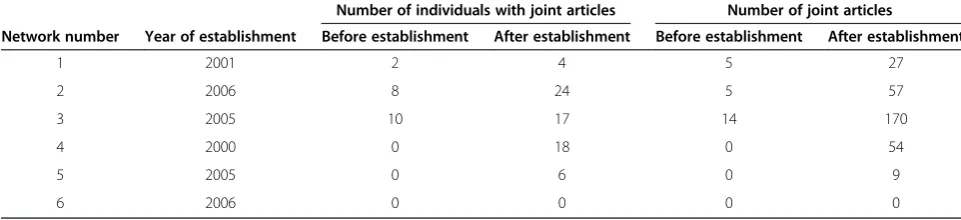
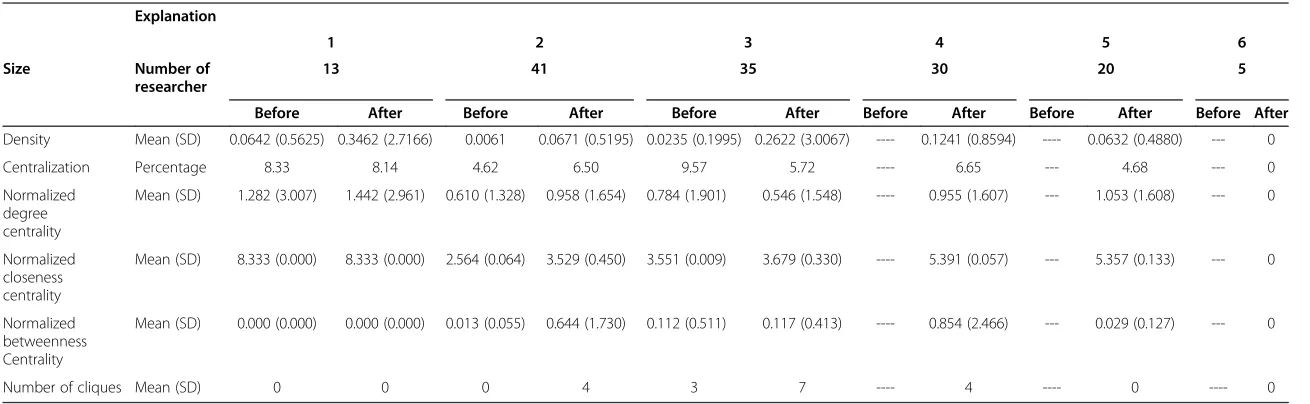
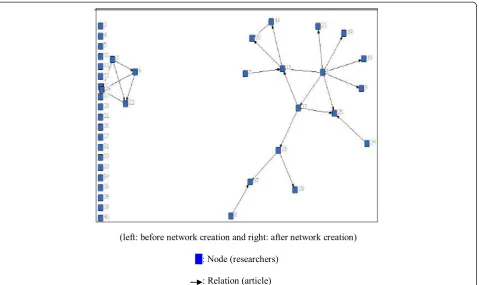
All articles extracted with this method have been listed in Table 1. The results of network analysis and its indicators are listed in Table 2. In these tables, the net-works have been labeled with numbers 1 to 6. It must be noted that in the quantitative section, members of only 3 out of the 6 reviewed networks had joint articles both before and after the establishment of their corre-sponding networks. Figure 1 illustrates the network dia-gram for one the knowledge networks as example.
Density
Since their establishment, Networks 1, 2 and 3, have ex-perienced an increase in density. That is to say, the number of scientific interactions among the members of these networks has increased since their formation. Two of the networks (4 and 5) have joint article only after their establishment, so, the observed density only be-longs to post-establishment period. Evidently, one net-work (Netnet-work 6) had no joint articles to imply the cooperation of its members before and after its forma-tion. Even after its establishment, members did not pro-duce a single research project.
Centrality
cooperation. After member 1, the most active partici-pant is Member 13. The available information about this group indicates the formation of a subgroup, which consists of members 2, 6, 22, and 39. Among the mem-bers of Network 3, Member 15 shows the highest levels of centrality, while in Network 4, Member 2 held a similar position only after the network's formation.
Clique
In social networking, cliques represent the internal coali-tion of a network. In this research, only cliques with a minimum of 3 members were examined. As illustrated in Table 2, Network 1 consisted of zero cliques both be-fore and after its establishment; Network 3 had three and seven cliques before and after it establishment re-spectively, whereas Network 2 had zero and four clique before and after the network establishment.
Discussion
Over time, network evaluation has proven itself to be a key element in the success of a knowledge network. The purpose of this study was to find the strengths and weaknesses of knowledge networks and to assess their effectiveness in Iran.
In the qualitative section it was determined that all four aspects including effectiveness, structure and gov-ernance, efficiency, and resources and sustainability had their own weaknesses. Non-transparency of the network goals and network management were among the most important problems. This weakness is reflected in the quantitative part. Network analysis results suggest that the mentioned knowledge networks cannot be consid-ered true networks due to very limited interactions within them. This study reveals that after the establish-ment of networks, the number of joint articles of indi-viduals has increased considerably. Apparently, the formation of knowledge networks in the country has provided a ground for further cooperation among re-searchers of the same discipline; However, when investi-gate more deeply, this proves not to be the case for two
reasons. Firstly, the activities in the network are, accord-ing to a participant in the qualitative section, the result of individual interactions and incentives - not network interaction. Secondly, based on the density index, the number of members with joint articles in each network is very low; most of the collaborative articles only belong to a few members. In fact, internal coalition increased in only two of the networks (2 and 3) after their formation. As a matter of fact, even before its formation, members of Network 3 had already conducted joint studies which led to the publication of their results. The establishment of this network, most probably, created conditions which led to an increase in internal coalition of the members. On the contrary, within other networks, the establish-ment of a knowledge network has not been able to cre-ate internal coalition among members. As shown in other studies [17], the main weakness in Iran’s research
centers is “centralized teamwork”, which makes them
heavily dependent on the presence and status of certain individuals; hence their path to success is quite unstable.
A network's objectives should be determined at the very early stages of its establishment, as should be de-fined the path, assessment criteria, and the manner by which members will be selected [18]. Setting goals and specifying a problem (or problems) are among the key elements for establishing a new network. Without them, a recently formed network shall always remain in its infancy [19]. For example, if capacitating is the
ultimate goal of a research network’s research and
educational programs, then the research network must be homogenous. However, if the main objective of
es-tablishing a network is to clear the path from idea to
implementation, then a heterogeneous set of stock-holders (including basic, clinical and technological research centers, and pharmaceutical and medical companies, policy makers, patients) must be intro-duced into the network’s system.
Network management is about formalizing communi-cations between members and being responsive to both members and non-members [20]. It is about how Table 1 Number of individuals with joint articles and number of joint articles before and after the establishment of the networks
Number of individuals with joint articles Number of joint articles
Network number Year of establishment Before establishment After establishment Before establishment After establishment
1 2001 2 4 5 27
2 2006 8 24 5 57
3 2005 10 17 14 170
4 2000 0 18 0 54
5 2005 0 6 0 9
Table 2 Network analysis indicators in each research network
Explanation
1 2 3 4 5 6
Size Number of
researcher
13 41 35 30 20 5
Before After Before After Before After Before After Before After Before After
Density Mean (SD) 0.0642 (0.5625) 0.3462 (2.7166) 0.0061 0.0671 (0.5195) 0.0235 (0.1995) 0.2622 (3.0067) ---- 0.1241 (0.8594) ---- 0.0632 (0.4880) --- 0
Centralization Percentage 8.33 8.14 4.62 6.50 9.57 5.72 ---- 6.65 --- 4.68 --- 0
Normalized degree centrality
Mean (SD) 1.282 (3.007) 1.442 (2.961) 0.610 (1.328) 0.958 (1.654) 0.784 (1.901) 0.546 (1.548) ---- 0.955 (1.607) --- 1.053 (1.608) --- 0
Normalized closeness centrality
Mean (SD) 8.333 (0.000) 8.333 (0.000) 2.564 (0.064) 3.529 (0.450) 3.551 (0.009) 3.679 (0.330) ---- 5.391 (0.057) --- 5.357 (0.133) --- 0
Normalized betweenness Centrality
Mean (SD) 0.000 (0.000) 0.000 (0.000) 0.013 (0.055) 0.644 (1.730) 0.112 (0.511) 0.117 (0.413) ---- 0.854 (2.466) --- 0.029 (0.127) --- 0
Number of cliques Mean (SD) 0 0 0 4 3 7 ---- 4 ---- 0 ---- 0
et
al.
Health
Research
Policy
and
Systems
2014,
12
:63
Page
7
o
f
1
0
licy-systems
.com/content
decisions are made about important issues within a net-work. It is the process through which organizations shape their interests, establish and realize their policies, manage differences and resources and fulfill their duties. Effective network governance is based on 5 principles: legitimacy, accountability, direction, performance, and fairness. It must be noted, though, each network can have different objectives, members, connections and values and a governing procedure may be designed and executed exclusively for each network [21]. Planning and monitoring tools must be designed to guide know-ledge networks in these issues.
Knowledge network evaluation procedures are still very young. A number of methods have been proposed for knowledge network assessment including SWOT Analysis, Results Based Management, Logical Frame-work Analysis, Outcome Mapping, and Appreciative Inquiry. Each of these methods emphasizes their own criteria [22]. Nevertheless, to evaluate all the dimen-sions thoroughly, network objectives, its target audi-ences, and the level of assessment must be determined. For example, government- and community-based net-works providing health services are advised to conduct the analysis in three levels: community, network, and organization/participant [23]. Furthermore, capacity building in a knowledge network occurs in three levels; individual, organizational and environmental levels,
which may also be used for network evaluation [4].
From the knowledge networks’ audiences’ point of
view, evaluation of a network where the members con-sist of caregivers, policymakers, and researchers, net-work analysis should cover two dimensions: netnet-work dimensions (network width, network components, and implementation site), and knowledge exchange dimen-sion (exchange of knowledge, context of exchange, and facilities of exchange) [24]. And if the network’s main objective is to affect policies, then function evaluation is preferred to structure evaluation [25]. One of the latest approaches to knowledge network evaluation was introduced by Brian W. et al. They suggest three di-mensions for network evaluation: Logic framework which is the same as theinput–output model, and is es-pecially useful once the knowledge networks set cap-acity building as its goal; Governance analysis which is the classification introduced by IISD (which was used in this study),but whose categories have changed to Re-source, Structure and Governance, Progress Markers (IISD equivalent of ‘Efficiency’), Impacts (IISD equiva-lent of ‘Effectiveness’) and Sustainability; and finally, Network analysis, which stresses network evaluation based on the community of participants.
of network analysis is to find out the answer to a sim-ple question: Has an actual network been formed? [26]. All network analysis methods focus on a knowledge
network’s management and formation. A useful method
to evaluate network impact is payback framework. A
payback framework studies the impact of the health re-searches in five levels: knowledge advanced, capacitat-ing buildcapacitat-ing, impacts on decision-makcapacitat-ing, impacts on health, and socioeconomic impacts [27-29]. Different
studies have put emphasis on this framework’s
generalizability in the evaluation of research systems. It seems that payback framework is suitable for evaluating a network’s impacts after it’s establishment.
One major limitation in this study was the differences between the ages of the networks. Based on a network’s years of formation, expectations from the networks with different ages vary (e.g. there are different expecta-tions from networks with 1–3 years, 4–6 years, 7–10 years and beyond 10 years of formation), and evaluation criteria differ for networks with diverse ages [10]. An-other limitation was considering the number of articles as the main gauge for the efficiency of knowledge networks, and we ignored other aspects of knowledge networks such as capacity building and their effect on decision making.
Building a powerful innovation system requires power-ful knowledge networks. On the other hand, innovation
systems are informal in developing countries and their
progress in technological and organizational infrastruc-tures is unsatisfactory [30]. According to the 2012 Glo-bal Innovation Index, Iran has a low rating among countries of upper-middle income class [31]. Therefore in order to achieve the specified goals set forth by the 20-Year-Perspective document, reinforcing the innovation system and embedding knowledge networks into their structure is inevitable.
To develop knowledge and technology in a country, networks need to solve the problems they face in man-agement and governance. That is, as this study con-cludes, the first step towards the realization of true knowledge networks in Iran’s health system.
Conclusion
Consolidating and revising policies relevant to the net-works and preparing a guide for establishing managing networks could prove helpful. To develop knowledge and technology in a country, networks need to solve the problems they face in management and govern-ance. That is, the first step towards the realization of true knowledge networks in health system.
Abbreviations
MOHME:Ministry of health and medical education.
Competing interest
The authors declare that they have no competing interest.
Authors’contributions
BY designed and implemented the project, and wrote the first draft of the paper. RM presented the idea of the study and participated in the design of the project. AA prepared network analysis and SA participated in the implementing the project. All authors have read and approved the final manuscript.
Acknowledgement
This article is the result of a project sponsored by Tehran University of Medical Sciences’Deputy of Research under project number 88-04-102-9982. We would like to extend our gratitude to the network directors and secretaries who participated in the study. We are also deeply grateful to the KTE Office for holding the sessions in which the results of the study were presented to its stakeholders.
Author details 1
Knowledge Utilization Research Center, Tehran University of Medical Science, No 1547, North Karegar St, Enghelab Ave, Tehran, Iran.2Knowledge Utilization Research Center; Epidemiology and Biostatistics Department, School of Public Health, Tehran University of Medical Science, Tehran, Iran. 3
Department of Health, School of Public Health; Social Determinants of Health Research Center, Gonabad University of Medical Sciences, Gonabad, Iran.
Received: 5 March 2014 Accepted: 25 October 2014 Published: 29 October 2014
References
1. Creech H:Strategic Intentions: Principles for Sustainable Development Knowledge Network. InIISD Working Paper.Canada: International Institute for Sustainable Development; 2001.
2. Mendizabal E:Understanding Networks:The Functions of Research Policy
Networks.UK: Overseas Development Institute; 2006.
3. Straus S, Tetroe J, Graham I:Knowledge dissemination and exchange of knowledge. InKnowledge Translation in Health Care: Moving from Evidence
to Practice.Canada: Wiley- Blackwell; 2009:238.
4. Luijendijk J, Mejia-Velez D:Knowledge networks for capacity building: A tool
for achieving the MDGs?Delft, the Netherlands: Workshop Proceedings on
Design and Implementation of Capacity Development, UNESCO-IHE Institute for Water Education; 2005.
5. Ng SM, Weindling AM:The impact of networks on clinical trials in the United Kingdom.Trials2009,10:100.
6. Moin M, Mahmoudi M, Rezaei N:Scientific output of Iran at the threshold of the 21st century.Scientometrics2005,62(2):239–248.
7. Archambault E:30 Years in Science, Secular Movement in Knowledge Creation.
Canada and USA: Science Metrix; 2010.
8. Larijani B, Majdzadeh R, Delavari AR, Rajabi F, Khatibzadeh S, Esmailzadeh H, Lankarani KB:Iran’s Health Innovation and Science Development Plan by 2025.Iranian J Publ Health2009,38:13–16.
9. Hendrickson L, Balaguer A, Ballantyne D, Baranyai K, Collins R, Drake P, Josipovic G, Marshall M, Still B, Talbot L, Verey B:Australian Innovation
System Report 2011.Australia: Australian Goverment, Department of
Innovation, Industry, Science and Research; 2011.
10. Creech H, Ramji A:Knowledge Networks: Guidelines for Assessment.Canada: Heather Creech, Director Knowledge Communications; 2004.
11. Prell CH, Hubacek K, Reed M:Stakeholder analysis and social network analysis in natural resource management.Society & Natural Resources: An
International Journal2009,22(6):501–518.
12. Huppé G, Creech H, Knoblauch D:The Frontiers of Networked Governance. InIISD report.Canada: International Institute for Sustainable Development; 2012.
13. Everett GM, Borgatti PS:Extending Centralit. Models and methods in social
network analysis.New York: Cambridge University Press; 2005:57–76.
14. Pryke S:Social Network Analysis in Construction.England: Wiley-Blackwell; 2012. 15. Kuafman M:Analyzing the Social Web.United States of America: Elsevier Inc; 2013. 16. Hanneman AR, Riddle M:Introduction to social network methods.Riverside,
CA: University of California; 2005.
17. Yousefi-Nooraie R, Akbari-Kamrani M, Hanneman AR, Etemadi A:Association between co-authorship network and scientific productivity and impact indicators in academic medical research centers: a case study in Iran.
18. Foundation (CHSRF), C.H.S.R:Network Notes ll: Knowledge Networks.Canada: Canadian Health Services Research Foundation.
19. Creech H:Form follows Function: Management and goverment of a formal
knowledge network.Canada: International Institute for Sustainable
Development; 2001.
20. Governance: Structure and process for decision-making and accountability,
International Institute for ustainable Development.2012. Available from:
http://www.iisd.org/networks/gov/.
21. Network Notes IV Governing Sideways:Guidelines to Network Governance,
Canadian Health Services Research. Canada: Canadian Health Services
Research Foundation. http://www.cfhi-fcass.ca/Libraries/ Network_Notes_ENGLISH/Network_Notes_IV_%E2%80%
93_Governing_Sideways_Guidelines_to_Network_Governance.sflb.ashx. 22. Creech H:Measuring while you manage: planning, monitoring and evaluation
knowledge networks.Canada: International Institute of Sustainable
Development; 2001.
23. Provan KG, Milward HB:Do Networks Really Work? A Framework for Evaluating Public-Sector Organizational Networks.Public Administration
Review2002,61(4):414–423.
24. Conklin J, Stolee P:A model for evaluating knowledge exchange in a network contxt.CJNR2008,40(2):116–124.
25. Mendizabal E:Understanding Networks: The Functions of Research Policy Networks.
London, U.K: Working Paper 271. Overseas Development Institute; 2006. 26. Wixted B, Holbrook A:Conceptual Issues in the Evaluation of Formal Research
Networks.Canada: Simon Fraser University; 2008.
27. Buxton MJ, Hanney S:[Developing and applying the Payback Framework to assess the socioeconomicimpact of health research].Med Clin (Barc)
2008,131(Suppl 5):36–41.
28. Yazdizadeh B, Majdzadeh R, Salmasian H:Systematic review of methods for evaluating healthcare research economic impact.Health Res Policy Syst2010,8(6). http://www.health-policy-systems.com/content/8/1/6. 29. Wooding S, Hanney S, Buxton M, Grant J:Payback arising from research funding: evaluation of the Arthritis Research Campaign.Rheumatology
(Oxford)2005,44(9):1145–1156.
30. Intarakumnerd P, Chairatana P, Tangchitpiboob T:National Innovation System in Less Successful Developing Countries:The case of Thailand.
Research Policy2002,31:1445–1457.
31. Dutta S:The Global Innovation Index: stronger innovation linkage for global
growth.France: INSEAD and WIPO; 2012.
doi:10.1186/1478-4505-12-63
Cite this article as:Yazdizadehet al.:How can we establish more successful knowledge networks in developing countries? Lessons learnt from knowledge networks in Iran.Health Research Policy and Systems 201412:63.
Submit your next manuscript to BioMed Central and take full advantage of:
• Convenient online submission
• Thorough peer review
• No space constraints or color figure charges
• Immediate publication on acceptance
• Inclusion in PubMed, CAS, Scopus and Google Scholar
• Research which is freely available for redistribution