REVIEW ARTICLE
Volatile halogenated agents are essential for a balanced anesthesia but they do have significant effects on the cardiovascular system and these effects should be kept in mind during the course of anesthesia to avoid adverse effects and morbidity. An attempt to assess the mechanism of actions of the volatile agents on the cardiovascular system was included with this narrative study.
physiology; cardiovascular system; volatile anesthetic agents; cardiac index; heart; contractility; rhythm, heart rate; baroreceptor reflex; systemic vascular resistance
hese days, anesthesia is considered essential for many kinds of surgeries and actions. Generally, anesthesia may give analgesia, amnesia, hypnosis, and relaxation of muscles. The depth of a given anesthesia can differ from minor sedation to general anesthesia (GA). G.A. causes significant changes in hemodynamics, specifically during the induction part of anesthesia [1]. Volatile agents affect circulatory performance and this includes the effects on cardiac output, heart rate, systemic vascular resistance, cardiac conduction system, myocardial contractility, coronary blood flow, and blood pressure. When thinking about the anesthetic management of patient, safety is the most important aim, therefore it is important to maintain an ideal circulation and use pharmacological or other management strategies to protect the circulatory system during the perioperative period. It is also important to know and anticipate the cardiovascular actions of the inhalational anesthetic drugs that are chosen to provide anesthesia. General anesthesia holds the use of different-modal techniques, involvement of volatile or intravenous drugs with opioids and/or local anesthesia. Therefore, most cardiovascular side effects of inhalational anesthetics are rarely observed [2]. The volatile anesthetics (V.A.) are gases that are used to produce and maintain GA. The mostly used volatile anesthetics (halothane, isoflurane, Desflurane and sevoflurane) have some effects on the normal cardiovascular physiology. At the same time, it is important to maintain circulatory stability to prevent dangerous effects on the mentioned system during general anesthesia. So we have to study in details about both the cardiovascular system with its important hemodynamic parameters such as (heart rate,
blood pressure, myocardial contractility, cardiac output and systemic vascular resistance) that are considered to have the most important role in hemodynamic stability, and the volatile anesthetic agents’ profiles, specifications, mechanism of action, and the effects on heart and circulation.
Mean Arterial Pressure
Halothane, isoflurane, desflurane, and sevoflurane induce decreases in mean arterial pressure when given to healthy human volunteers in similarly and dose depending style [3]. The amount of reduction in mean arterial pressure in volunteers is more than that which occurs during surgical stimulation. The same, secondary increased preoperative systemic blood pressure level, as accompanied by anxiety, may be followed by hypotension that go above the real pharmacological effect of the inhalational anesthetic. In comparison with volatile anesthetics, nitrous oxide is different because it produces either no change or moderate rises in systemic blood pressure [4-5]. The reduction in blood pressure induced by halothane is, in part or in whole, a result of reduction in contractility of myocardium and cardiac output, while with isoflurane, desflurane, and sevoflurane, the reduction in systemic blood pressure is mainly caused by reduction in systemic vascular resistance.
Heart Rate
The administration of isoflurane, Desflurane, and sevoflurane, but not halothane to healthy human volunteers result in increased heart rate [3]. Sevoflurane raises heart rate at concentrations of > 1.5 MAC only, while isoflurane and Desflurane seem to increase heart rate at lower concentrations. Heart rate effects detected in patients undergoing surgery could be somewhat different from those documented in volunteers due to so many confusing variables affecting the heart rate. E.g., a small dose of opioid (morphine in the preoperative medication or fentanyl intravenously immediately before induction of anesthesia) can stop the heart rate increase associated with isoflurane and seemingly the other volatile anesthetics [6]. Increased
T
From the 1Department of Anesthesiology and Critical Care, Imam
Khomeini Hospital Complex, Tehran University of Medical Sciences, Tehran, Iran.
Received: 9 July 2017, Revised: 1 August 2017, Accepted: 19 August 2017
The authors declare no conflicts of interest.
*Corresponding author: Professor of Anesthesiology and Critical Care, Deputy for Research, Department of Anesthesiology and Critical Care, Imam Khomeini Medical Complex, Tehran University of Medical Sciences, Tehran, Iran. E-mail: [email protected]
390 http://aacc.tums.ac.ir
activity of sympathetic nervous system, as accompanies anxiety, may abnormally increase heart rate and the amount of the real pharmacologic effect of the inhalational anesthetic. Likewise, extreme parasympathetic nervous system activity may cause unanticipated increases in heart rate when anesthesia is started.
The common thought of stable heart rate despite a reduction in blood pressure while giving halothane may detect suppression of the carotid sinus (baroreceptor-reflex response) by halothane, in addition to drug-induced reductions in the rate of sinus node depolarization. Junctional rhythm and related reductions in systemic blood pressure most likely indicate depression of sinus node activity by halothane. Halothane also diminishes the speed of conduction of cardiac impulses over the atrioventricular node and His-Purkinje system. At 0.5 MAC, desflurane induces reductions in systemic blood pressure like those caused by isoflurane but does not arouse an increased heart rate as dose isoflurane. This variation is not explained by different effects of these anesthetics on the baroreceptor-reflex reaction [7]. In neonates, administration of isoflurane is accompanied with reduction of the carotid sinus reflex reaction, as revealed by drug-produced falls in blood pressure that are not accompanied by rises in heart rate [8]. Heart rate responses through administration of isoflurane also appear to be reduced in elderly patients, while isoflurane-induced increases in heart rate mostly occur in younger patients and may be emphasized by the existence of other drugs (atropine, pancuronium) that mimic vagolytic effects.
Cardiac Output and Stroke Volume
Halothane, isoflurane, desflurane, and sevoflurane induce decreases in cardiac output when given to healthy human volunteers in similarly and dose depending style [3]. Sevoflurane reductions cardiac output at 1 and 1.5 MAC, while at 2 MAC cardiac output recuperate to closely wakeful values. Sevoflurane leads to a minor decrease in cardiac output than does halothane administered to infants [9]. Due to variable effects on heart rate (halothane doesn't cause change and heart rate increases in the presence of the other inhalational anesthetics), the left ventricular stroke volume decreased 15% to 30% for all the inhalational agents. In patients, the rise in heart rate may tend to compensate drug-induced reductions in cardiac output.
Furthermore to well maintenance of heart rate, isoflurane’s slight depressant effects on cardiac output could reflect stimulation of homeostatic mechanisms. It is unclear whether they are due to direct cardiac depressant effects. Certainly, inhalational anesthetics, comprising isoflurane, induce similar dose-dependent suppression of myocardial contractility while studied in vitro using isolated preparations of papillary muscle. The vasodilating effects of the ether-derivative volatile agents make the direct myocardial depression induced by these drugs less obvious than that of halothane. Actually, too much concentrations of these drugs administered to patients can lead to collapse of cardiovascular system. In vitro suppression contractility of myocardium induced by nitrous oxide is about one-half that produced by comparable concentrations of volatile anesthetics.
Additional probable clarification for the lesser effect of isoflurane on myocardial contractility may be its higher
anesthetic potency relative to that of halothane [4]. The inclusion is that isoflurane might more readily suppress the brain and so, at a particular MAC value, seem to spare the heart. Actually, in animals, the minor myocardial depression through the administration of isoflurane shows a greater border of safety between the dose that induces anesthesia and that which induces collapse of cardiovascular [10].
Systemic Vascular Resistance
Halothane, isoflurane, desflurane, and sevoflurane induce reductions in systemic vascular resistance when given to healthy human volunteers in similarly and dose depending style [3]. So, although these four volatile agents reduce the systemic blood pressure in comparison, just halothane does so mainly by reducing cardiac output. E.g., the reduction of changes in systemic vascular resistance by giving halothane confirms that drops in systemic blood pressure induced by this drug correspond to decreases in contractility of myocardium. The other volatile agents reduce blood pressure mainly by decreasing systemic vascular resistance. Falls of systemic vascular resistance through administration of isoflurane mainly reflect significant (up to fourfold) rises in blood flow of skeletal muscle [11]. Moreover cutaneous blood flow is increased by isoflurane. The implications of these changes in blood flow may include (1) excess (wasted) perfusion relative to O2 needs, (2) loss of body heat because of increased cutaneous blood flow, and (3) improved delivery of drugs, for example muscle relaxants, to the neuromuscular junction.
A failure of a drop in systemic vascular resistance during halothane administration does not mean that this drug does not has vasodilating effects on some organs. Obviously, halothane has strong effect as cerebral vasodilator and cutaneous vasodilation is noticeable. These vasodilatory effects of halothane, nevertheless, are compensated by loss of changes or vasoconstriction in other vascular beds such that the general effect is unchanged intended systemic vascular resistance.
The upturn in cutaneous blood flow induced by all volatile agents arterializes peripheral venous blood, providing an another to sample arterial blood for assessment of pH and PaCo2 [12]. These drug-produced rises in cutaneous blood flow probably reflect a central inhibitory action of these agents on the mechanism of regulation of temperature. unlike to inhalational agents [13].
Cardiac Dysrhythmias
The ability of volatile agents to reduction the dose of epinephrine required to induce ventricular cardiac dysrhythmias is extreme with the alkane derived halothane and minimal to non-existent with the ether derived isoflurane, desflurane, and sevoflurane [14-16]. As against adults, children tolerate higher doses of subcutaneous epinephrine from 7.5-10.0 mg/kg given with or without xylocaine through halothane anesthesia. Mechanical stimulus accompanied by giving epinephrine for managing cleft palate has been associated with dysrhythmias [17].
during administration of enflurane [18]. In spite of the obvious protective effect of xylocaine, the systemic concentrations of the local anesthetic are ,1 mg/ mL when it is subcutaneously injected with epinephrine [19].
In veterinary, improvement of the arrhythmogenic effects of epinephrine free of the dose of halothane between alveolar concentrations of 0.5 percentage and 2 percentage have been observed [20]. If factual in patients, it is expected that cardiac dysrhythmias due to epinephrine will continue till the halothane concentration falls to, 0.5%. Therefore, therapeutic interferences other than reducing the inhaled concentration of halothane might be essential to treat cardiac
dysrhythmias punctually due to epinephrine.
The clarification for the variations between volatile anesthetics and the arrhythmogenic effects of epinephrine can reflect the effects of these agents on the spread rate of cardiac impulses through the heart conduction system. However, halothane and isoflurane both slow the rate of Sino-atrial node discharge and extend His-Purkinje and ventricular conduction times [18].
Results
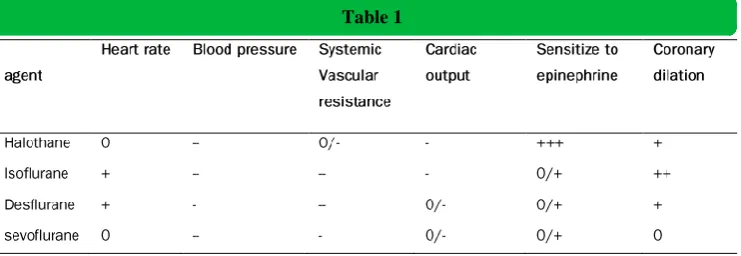
All the results can be shown in (Table 1).
Table 1
0 no change, + increased, ++ more increased, +++ most increased, - decreased, - -More decreased, - - - most decrease
Discussion
Strong volatile anesthetics depress the contractility of myocardium in both healthy and unhealthy hearts [21]. There is a small difference in the severity of cardiac depression when comparing the modern potent volatile agents (isoflurane, Desflurane, sevoflurane), but all seem to be causing less cardiac depression compared with halothane. The relaxation of myocardium may be slowed by potent volatile anesthetics, and diastolic ventricular rigidity also typically increases with more potent inhaled anesthetic administration. With concerns to coupling of the left ventricle and the arterial system, potent volatile agents seem to have minimum effects at low concentrations. In contrast, at higher concentrations (during experimental situations) greater depression of ventricular contractility happens, in relation to arterial vasodilation, leading to less mechanical efficiency and decrease blood flow. As much as general circulatory parameters, reduction of baroreflex activity and negative chronotropy happens with all potent volatile agents, although to a smaller range compared to halothane. There is constantly decreased blood pressure, largely related to anesthetic vasodilation effects and reduced ventricular afterload, in addition to modest anesthetic negative inotropic effects. There can moreover be vagally mediated circulatory effects associated to harmful airway stimulation from potent volatile agents which are administered in rapidly increased inspiratory concentrations. Volatile anesthetic agents commonly slow the conduction of heart depending on the dose, comprising prolongation of the Q-T interval, though dramatic disturbances in conduction for example bradycardia or atrioventricular block are rarely observed by modern potent inhaled agents [22]. A relation between potent inhaled agents and epinephrine-induced dysrhythmias has been documented for many years. Regulation of coronary vascular resistance is the chief effector by which coronary blood flow is distributed and delivery of substrates is identical to local needs of myocardium. All the potent inhaled agents have vasodilatation properties that reduce
392 http://aacc.tums.ac.ir
protein kinase activation, as well as signaling pathways related to reactive oxygen type. These ischemia-reperfusion cascades cause either rapid cell death (mitochondrial transition pore activation and cell death) or cell death by apoptosis. These preconditioning effects are thought to occur in both premature phase, up to several hours, and in a late phase, which can be at more than 24 hours and possibly longer. Early protective effects (limitation of necrosis or apoptosis initiation) may have different mechanisms in comparison to late effects, where modulation of inflammation is particularly noticeable. Clinical anesthetic studies have confirmed protective effects of inhalational anesthetics in terms of less release of injury markers and well post-ischemia mechanical function [25].
Conclusion
Volatile agents are cornerstone agents used in anesthesia. Generally they have parallel pharmacological and clinical effects, in the same time their effect on body systems have variances. The metabolism and accompanied toxicity of these agents is dissimilar for each drug, and use of them must be specified for every patient according to his history of underlying disease, and his cardiovascular situation. The cardio protective features of halogenated agents are of clinical importance. The effect of these agents must be considered during cardiac surgery and other surgeries that not related to the heart. All volatile agents have been shown to produce a dose-dependent reduction in myocardial contractility and cardiac loading situations. These suppression effects reduce oxygen demand of myocardium and might, thus, have advantageous role on the myocardial oxygen requirement through ischemia conditions. Newly, trial indication has obviously improved that in addition to these indirect protecting effects, volatile agents also have direct protective features against reversible and irreversible damage of myocardial ischemia. Existing of ischemia is a strong essential adaptation phenomenon by which transitory periods of sub-lethal ischemia cause marked acceptance to subsequent fatal ischemia. The possible use of these protective features of these agents in clinical practice is the matter of continuing research.
According to the new “American College of Cardiology/American Heart Association Guidelines” volatile agents can be useful during non-cardiac surgery for the preservation of GA with hemodynamic stability for patients on threat for ischemia, but no mark-based medicine exists in surgeries that is not related to the heart [26].
At the end we should emphasize that the investigation on halogenated agents do not come to an end and every new study brings some new area of usefulness of them and in this field the anesthesiologist can find a way by knowledge and art to do the best with these agents [27].
References
1. Rivenes SM, Lewin MB, Stayer SA, Bent ST, Schoenig HM, McKenzie ED, et al. Cardiovascular effects of sevoflurane, isoflurane, halothane, and fentanyl-midazolam in children with congenital heart disease: an echocardiographic study of myocardial contractility and hemodynamics. Anesthesiology. 2001; 94(2):223-9.
2. Pagel PS. Cardioprotection by volatile anesthetics: Established scientific principle or lingering clinical uncertainty?J Cardiothorac Vasc Anesth. 2009; 23(5):589-93.
3. Regueiro-Purriños M, Fernández-Vázquez F, de Prado AP, Altónaga JR, Cuellas-Ramón C, Ajenjo-Silverio JM, et al.
Ventricular arrhythmias and mortality associated with isoflurane and sevoflurane in a porcine model of myocardial infarction. J Am Assoc Lab Anim Sci. 2011; 50(1):73-8.
4. Eger EI. Isoflurane (Forane): a compendium and reference: Anaquest; 1985.
5. Hornbein TF, Eger EI, Winter PM, Smith G, Wetstone D, Smith KH. The minimum alveolar concentration of nitrous oxide in man. Anesth Analg. 1982; 61(7):553-6.
6. Cahalan MK, Lurz FW, Eger EI, Schwartz LA, Beaupre PN, Smith JS. Narcotics decrease heart rate during inhalational anesthesia. Anesth Analg. 1987; 66(2):166-70.
7. Muzi M, Ebert TJ. A comparison of baroreflex sensitivity during isoflurane and desflurane anesthesia in humans. Anesthesiology. 1995; 82(4):919-25.
8. Murat I, Lapeyre G, Saint-Maurice C. Isoflurane attenuates baroreflex control of heart rate in human neonates. Anesthesiology. 1989; 70(3):395-400.
9. Wodey E, Pladys P, Copin C, Lucas MM, Chaumont A, Carre P, et al. Comparative Hemodynamic Depression of Sevoflurane versus Halothane in Infants An Echocardiographic Study. Anesthesiology. 1997; 87(4):795-800.
10. Wolfson B, Hetrick W, Lake C, Siker E. Anesthetic indices--further data. Anesthesiology. 1978; 48(3):187-90.
11. Stevens WC, Cromwell TH, Halsey MJ, Eger EI, Shakespeare TF, Bahlman SH. The cardiovascular effects of a new inhalation anesthetic, Forane, in human volunteers at constant arterial carbon dioxide tension. Anesthesiology. 1971; 35(1):8-16.
12. Williamson III DC, Munson ES. Correlation of peripheral venous and arterial blood gas values during general anesthesia. Anesth Analg. 1982; 61(11):950-2.
13. Smith NT, Calverley RK, Prys-Roberts C, Eger E, Jones CW. Impact of nitrous oxide on the circulation during enflurane anesthesia in man. Anesthesiology. 1978;48(5):345-9.
14. Johnston RR, Eger EI II, Wilson C. A comparative interaction of epinephrine with enflurane, isoflurane, and halothane in man. Anesth Analg. 1976; 55(5):709-12.
15. Moore MA, Weiskopf RB, Eger 2nd E, Wilson C, Lu G. Arrhythmogenic doses of epinephrine are similar during desflurane or isoflurane anesthesia in humans. Anesthesiology. 1993; 79(5):943-7.
16. Navarro R, Weiskopf RB, Moore MA, Lockhart S, Eger 2nd E, Koblin D, et al. Humans anesthetized with sevoflurane or isoflurane have similar arrhythmic response to epinephrine. Anesthesiology. 1994; 80(3):545-9.
17. Ueda W, Hirakawa M, Mae O. Appraisal of epinephrine administration to patients under halothane anesthesia for closure of cleft palate. Anesthesiology. 1983; 58(6):574-6.
18. Horrigan RW, Eger EI, Wilson C. Epinephrine-induced arrhythmias during enflurane anesthesia in man: a nonlinear dose-response relationship and dose-dependent protection from lidocaine. Anesth Analg. 1978;57(5):547-50.
19. Stoelting RK. Plasma lidocaine concentrations following subcutaneous or submucosal epinephrine-lidocaine injection. Anesth Analg. 1978; 57(6):724-6.
20. Metz S, Maze M. Halothane concentration does not alter the threshold for epinephrine-induced arrhythmias in dogs. Anesthesiology. 1985; 62(4):470-4.
21. Preckel B, Müllenheim J, Hoff J, Obal D, Heiderhoff M, Thämer V, et al. Haemodynamic changes during halothane, sevoflurane and desflurane anaesthesia in dogs before and after the induction of severe heart failure. Eur J Anaesthesiol. 2004; 21(10):797-806.
22. Yildirim H, Adanir T, Atay A, Katircioglu K, Savaci S. The effects of sevoflurane, isoflurane and desflurane on QT interval of the ECG. Eur J Anaesthesiol. 2004; 21(7):566-70.
23. Duncker DJ, Bache RJ. Regulation of coronary blood flow during exercise. Physiol Rev. 2008; 88(3):1009-86.
24. Frässdorf J, De Hert S, Schlack W. Anaesthesia and myocardial ischaemia/reperfusion injury. Br J Anaesth. 2009; 103(1):89-98.
25. De Hert SG, Turani F, Mathur S, Stowe DF. Cardioprotection with volatile anesthetics: mechanisms and clinical implications. Anesth Analg. 2005; 100(6):1584-93.
2002 guidelines on perioperative cardiovascular evaluation for noncardiac surgery) developed in collaboration with the American Society of Echocardiography, American Society of Nuclear Cardiology, Heart Rhythm Society, Society of Cardiovascular Anesthesiologists, Society for Cardiovascular Angiography and Interventions, Society for Vascular Medicine and Biology, and Society for Vascular Surgery. J Am Coll Cardiol. 2007 Oct
23;50(17):e159-241.