The University of San Francisco
USF Scholarship: a digital repository @ Gleeson Library |
Geschke Center
Doctoral Dissertations Theses, Dissertations, Capstones and Projects
3-2018
Access Without Equity: Institutional Logics of
University Middle Managers and Valuing Diversity
Emerald TempletonUniversity of San Francisco, [email protected]
Follow this and additional works at:https://repository.usfca.edu/diss Part of theHigher Education Administration Commons
This Dissertation is brought to you for free and open access by the Theses, Dissertations, Capstones and Projects at USF Scholarship: a digital repository @ Gleeson Library | Geschke Center. It has been accepted for inclusion in Doctoral Dissertations by an authorized administrator of USF Scholarship: a digital repository @ Gleeson Library | Geschke Center. For more information, please [email protected].
Recommended Citation
Templeton, Emerald, "Access Without Equity: Institutional Logics of University Middle Managers and Valuing Diversity" (2018).
Doctoral Dissertations. 457.
The University of San Francisco
ACCESS WITHOUT EQUITY: INSTITUTIONAL LOGICS OF UNIVERSITY MIDDLE MANAGERS AND VALUING DIVERSITY
A Dissertation Presented to
The Faculty of the School of Education Leadership Studies Department
In Partial Fulfillment
Of the Requirements for the Degree Doctor of Education
By
Emerald Templeton San Francisco
ii ABSTRACT
iii
ACKNOWLEDGEMENTS
This dissertation was a labor of love, struggle, and transformation. It would not have been possible without the support of my community, my faith, and resilience drawn from life experiences.
This acknowledgement cannot illustrate the immense sense of gratitude, and pride, I feel to be a part of such a supportive community; however, this dissertation would not be complete without it. Mom and Dad – “thank you” is not nearly enough to express my appreciation for your sacrifice, love, prayers, and encouragement throughout my life. But, thank you for who you are and for who you have shaped me to be.
Embarking on doctoral studies has been one of the most challenging projects thus far – and, we made it! This degree was earned for all three of us. I love you and look forward to passing on your legacies of family, faith, hard work, and love.
Much gratitude and love to my sister circle. There are too many to name, but you know who you are. You have been the shoulder to cry on, ears to hear, eyes to envision alongside me, and the conscience to constructively criticize. Thank you. We will continue to need each other as our doctoral journeys are just the beginning to the good work we will do – I look forward to serving alongside you.
iv
you have especially provided the tender love and care (and quiet) I needed to make it through those last steps. Thank you, sweetness.
A big thank you to my dissertation committee! Drs. Negron-Gonzales and Henfield, you two are profound thinkers and educators. I aspire to reach your level of critical analysis and deep understanding for the work you do. Thank you for engaging in this project with me.
Dr. Desiree D. Zerquera – THANK YOU, more times that I can ever say. I am a better researcher, educator, thinker, and writer because of your influence. Thank you for encouraging me to stretch. You are no-nonsense, but all love and I appreciate you so much for that. We struggled through this dissertation together, but your partnership, support, and mentorship have been staples throughout this process. I hope that this work makes your proud and that I can give at least half of what you have given me to my students.
v
This dissertation, written under the direction of the candidate’s dissertation committee and approved by the members of the committee, has been presented to and accepted by the Faculty of the School of Education in partial fulfillment of the requirements for the degree of Doctor of Education. The content and research methodologies presented in this work represent the work of the candidate alone.
Emerald Templeton March 29, 2018
Candidate Date
Dissertation Committee
Dr. Desiree Zerquera March 29, 2018 Chairperson
Dr. Genevieve Negron-Gonzales March 29, 2018
vi
TABLE OF CONTENTS
SIGNATURE PAGE ………i
ABSTRACT ... ii
ACKNOWLEDGEMENTS ... iii
LIST OF TABLES ... ix
LIST OF FIGURES ... x
CHAPTER I ... 1
THE RESEARCH PROBLEM ... 1
Statement of the Problem ... 1
The Problem of Equity ... 2
“Racing” Higher Education ... 4
Campus Environments ... 6
Background and Need for the Study ... 6
Purpose of the Study ... 11
Theoretical Framework ... 14
Institutional Logics in Organizations ... 14
The Logics of Equity and Inclusion ... 16
Educational Significance ... 19
Limitations ... 20
Definition of Terms ... 21
CHAPTER II ... 23
REVIEW OF THE LITERATURE ... 23
Introduction ... 23
Organizational Culture and Climate ... 24
Equity and Inclusion in Higher Education ... 28
The Black Student Experience ... 31
Summary ... 35
CHAPTER III ... 36
RESEARCH METHODOLOGY... 36
Restatement of the Purpose ... 36
Research Design ... 37
vii
Data Collection ... 42
Participants ... 45
Data Analysis ... 46
Trustworthiness ... 48
Ethical Considerations ... 49
Limitations ... 49
Background of the Researcher ... 50
CHAPTER IV ... 51
FINDINGS ... 51
Introduction ... 51
Analysis of Institutional Documents Regarding Diversity ... 51
Proposition 1. Logics Shape and Define Norms and Rules ... 52
Theme 1: Identity and prestige. ... 53
Theme 2: Commitment to diversity and inclusivity. ... 54
Proposition 2. Daily Operation of HWI’s Misplace Diversity ... 58
Theme 1: Crisis of racial underrepresentation. ... 59
Theme 2: Assignment of responsibility. ... 62
Proposition 3. Actors Navigate Multiple and Competing Logics ... 65
Theme 1: Tensions between culture and climate. ... 66
Theme 2: Lingering historical implications. ... 70
Semi-structured Interviews of University Middle Managers ... 74
Proposition 1. Logics Shape and Define Norms and Rules ... 76
Theme 1: Diversity is an essential value... 76
Theme 2: How diversity is valued. ... 79
Theme 3: Who is responsible for diversity? ... 84
Theme 4: Engaging diversity. ... 86
Proposition 2. Daily Operations of HWI’s Misplace Diversity ... 88
Theme 1: Absconding responsibility. ... 88
Theme 2: Reactive versus proactive climate. ... 92
Theme 3: The dominate narrative of whiteness. ... 95
Proposition 3. Actors Navigate Multiple and Competing Logics ... 104
viii
Theme 2: Institutional values and resource allocation. ... 109
Theme 3: Tension between the logics of valuing diversity. ... 111
Summary ... 117
CHAPTER V ... 120
DISCUSSION, IMPLICATIONS & CONCLUSIONS ... 120
Summary of Findings ... 121
Proposition 1. Logics Shape and Define Norms and Rules ... 122
Proposition 2. Daily Operations of HWI’s Misplace Diversity ... 124
Proposition 3. Actors Navigate Multiple and Competing Logics ... 125
Discussion of Findings ... 127
Research Questions 1 ... 127
Research Question 2 ... 129
Implications ... 131
Conclusions ... 133
REFERENCES ... 134
APPENDICES ... 141
Appendix A Consent to Participate in a Research Study ... 142
Appendix B Protocol for Dissertation Study ... 144
Appendix C Invitation to Participate in Study ... 145
Appendix D Demographic Pre-Survey ... 146
ix
LIST OF TABLES
x
LIST OF FIGURES
CHAPTER I
THE RESEARCH PROBLEM Statement of the Problem
Institutions are composed of individual actors - actors who come with values, attitudes, and beliefs that shape how they behave and make sense within those institutions. The policies, procedures, and processes within institutions provide a
framework by which individual actors operate. These established governing practices are embedded within a system of ideals that inform the climate in which individuals exist. University middle managers – actors charged with leading programs, departments, and subdivisions within the organization – play an integral role in the development and reinforcement of the ways of thinking and behaving. In the hierarchy of higher education student affairs, middle managers are situated between key decision makers such as administrators, and support staff. Led by directives from up top, middle managers serve as implementers – delivering messages about what is important, where to focus resources, which students to serve, and how to serve them. Their day-to-day tasks entail navigating between priorities – competing or converging – of the institution and their personal values.
Higher education in the US is built upon a long history of elitism and exclusion which has had the most detrimental impact on underrepresented student populations and students of color (Harper & Hurtado, 2007; Karkouti, 2010; Yosso, 2005). Structural inequities, including messages about who higher education is for and, even, who or what is valued are pervasive from the application and admissions process throughout
2
their success in college. Many of which are informed by the campus climate (Hooks, 2003; Museus & Jayakumar, 2012; Patton, 2006; Strange and Banning, 2001), and the prevalence of conditions that are unsafe or exclusive. Some research suggests that
students of color, specifically Blacks and Latinxs, have more academic deficiencies when compared to their White and Asian counterparts (e.g. low test scores, lack of exposure or knowledge, no or low value of education, lack of financial resources, etc.) (Cokley & Chapman, 2008; Contreras, 2005; Kane, 1998; Parker & Flowers, 2003; Tierney & Hagedorn, 2002). While some views seem to indicate that problems in education lie with students, counterviews in research highlight the impact institutions and their actors have on students of color (Harper, 2009; Smart, Kuh, & Tierney, 1997; Strange & Banning, 2001). For, it is often institutional actors’, such as middle managers, relation to the norms, rules, and practices on college campuses that greatly inform the climate. The Problem of Equity
In higher education research, literature about students of color has centered on the adjustments students must make to their environment, but not nearly as much
3
characteristics (Tierney, 1999). For example, some research has suggested that Black and Latinx families don’t value education, or that Black and Latinx students have lower academic ability. Further, this type of research supposes that students must be
incentivized or encouraged to acclimate to their environment. In contrast, strengths-based and equity-framed research sheds light on the academic successes within communities of color (Bensimon, 2005; Yosso, 2005) indicating the gains that have been made in college admissions and bachelor degree completion (Allen & Zepeda, 2007). Black students have upwardly trending numbers of college admissions and graduation (Allen & Zepeda, 2007; Cokley & Chapman, 2008). Unlike the longstanding notion of Black student academic failure, the shift in educational research seems to indicate that students themselves are not the deficit, but, it is the system in which they are situated that is failing them. Though attention has shifted toward a focus on the systematically oppressive structure of higher education, Allen and Zepeda (2007) nevertheless noted, “despite gains in baccalaureate degree completion, racial gaps in graduate education remain, especially for research degrees,” (p. 76).
Yosso (2005) purported that one of the most common forms of racism in education is deficit-thinking. This way of thinking attributes gaps in education to communities of color, placing the blame on students’ supposed lack of cultural
knowledge and parents’ lack of value or support of their child’s education. She extended that “[educators] most often assume that schools work and that students, parents and communities need to change to conform to this already effective and equitable system,” (Yosso, 2005, p. 75). Comparatively, universities operate upon this same idea.
4
discovery, and development - a necessary process from which the traditional young adult will emerge with the skills to compete in the job market and make a positive impact on society. However, many institutions that uphold structures of exclusion and
marginalization have not included mechanisms respective of the social, cultural, and often political, capital that students of color bring along with them. In turn, the systems which may seemingly operate effectively for some students, may indeed perform as ineffective and inequitable for Black students.
“Racing” Higher Education
5
553). Together, these theories paint a picture of the construction of race as a tool for inequitable educational opportunities.
Colleges and universities, historically built to serve the White elite (Anderson, 2002; Harper et al., 2009), are increasingly more demographically diverse. Diversity in terms of race and ethnicity, and even nationality, is seen as a resource for college campuses - an added (economic) value to be sought after (Altbach & Knight, 2007; Clark, 2011; Gose, 2013; Lyke, 2013). The face of the student population has changed; however, the underlying characteristics of the institutional culture are still very much grounded in White hegemony. Race, which is central to understanding how American society operates (Bonilla Silva, 2003; Hooks, 2005; Ladson-Billings & Tate, 1995), is one of the most common provocations of oppression and exclusion within education (Yosso, 2005). Deficit-thinking – the belief that students of color experience low academic performance because of their, or their families’, deficits – attributes gaps in education to communities of color, placing the blame on students (Bensimon, 2005; Johnson-Ahorlu, 2012; Yosso, 2005) rather than shifting the focus to systems that create roadblocks for them. The sociohistorical roots of racist practices in institutions perpetuate inequity for Black students. Accordingly, Johnson-Ahorlu (2012) pointed out that
6 Campus Environments
To better understand how students of color fare on historically White college campuses, one must understand the campus environment. Strange and Banning (2001) proposed that aspects of campus environments serve to influence the interactions of the people who occupy it: “Implicit in this perspective is the assumption that institutions themselves bear the responsibility for the design and creation of campus environments arranged appropriately for meeting educational purposes,” (p. 2). Black students in predominantly White institutions (PWI) enter spaces that are often designed without consideration of, or in spite of, their occupancy (Cabrera et al., 2016; Smith et al., 2007). Aspects of the campus culture (e.g. team mascot, memorials, student activities, food choices, course offerings, etc.) may not reflect or validate aspects of their identity. While there is much research that suggests ways institutions can look inwards and evaluate their administrative and curricular practices to support Black student success (Allen; 1992; Bensimon, 2005; Harper & Hurtado, 2007; Sedlacek, 2010), still, curricularly many campuses have little or no representation of Black authors and researchers in course materials, or of Black faculty and staff members on campus. Institutional actors responsible for meeting the educational needs of students must then understand what Black students need, specifically, to create an inclusive community that supports student success.
Background and Need for the Study
7
education has long been riddled with procedures, policies, and practices that marginalize minoritized, specifically, Black students. In an effort to be more equitable, many college campuses have employed regulatory efforts such as affirmative action (Garces, 2012; Starcher, 2012) and diversity education programs (Andrade & Rivera, 2011; Wilson, 2013). However, some institutional practices, values, and beliefs serve as blockades to Black students. Allen (1992) purported that during the Civil Rights Movement in the US, “[i]ncreased Black access to higher education was seen as one major solution to the problem of racial inequality,” resulting in “dramatic increases in the number of African-American students attending predominantly White colleges and universities” (p. 26). These enrollments continue to increase, though Black students continue to encounter institutional actors and structures with little validation of their cultural identity and result in them feeling less academically supported (Guiffrida & Douthit, 2010, Parker &
Flowers, 2003). Further, systems of exclusion such as race-blind admissions (Kane, 1998; Park, 2014), standardized testing (Contreras, 2005; Kane, 1998; Sedlacek, 2010), and honors and advanced placement programs (Ladson-Billings, 1998) remain in place to make access to education problematic.
8
to the already challenging nature of the college experience, can greatly influence Black students’ academic, social, and personal spheres (Banks, 2010; Smith et al., 2014; Strange & Banning, 2001), resulting in a climate that feels uninviting and harsh.
According to Husband (2016), “‘[c]hilly climates’ continue to contribute to high attrition rates of African American students matriculating at predominantly White colleges and universities,” (p. 91). It is the covert and everyday forms of racism – a chilly, harsh climate - that maintain a system of oppression (Hooks, 2003; Sue et al, 2007). Allen (1992) eloquently shared:
To date, research on Black students in U.S. higher education has generated as many questions as answers. There is a particular need to understand the effects of individual and institutional characteristics on student outcomes and, at the same time, to explore the relative importance of more proximate factors (such as campus race relations) versus more distant factors (such as parent educational attainment) as explanations for differential achievement by Black college students. (p. 32)
Facilitating a historical analysis of college access for Blacks, Harper et al. (2009) posited that “racial issues have resurfaced at almost every juncture in the history of American education” (p. 403). The questions of access to and equity in higher education, though theorized, remain prevalent today.
9
master’s and doctoral degrees increased between the 2003-04 and 2013-14 academic years, from 564,300 to 754,500 (34%) and from 126,100 to 177,600 (41%), respectively (National Center for Education Statistics). Of the 754,500 master’s degrees conferred in 2013-14, only 88,515 - about 12 percent - were held by Blacks. The lack of Black students in graduate education programs is one key factor that shapes that environment for those students. To create a climate that is inclusive, perhaps there need not only be critical mass of those excluded, but the capacity to support those excluded.
In response to the diversity of individuals within the workforce and higher education, organizations have assumed a need for diversity management and therefor have invested in the development of diversity education programs. Human Resources departments have relied on Equal Employment Opportunity (EEO) and Affirmative Action regulations to increase demographic diversity and to mediate issues of equity and access. Institutions of higher education have long ago established diversity and inclusion offices, and some, have designated a Chief Diversity Officer to meet the changing demographics of students, faculty, and staff. Moreover, some institutions of higher education are pursuing statuses as minority serving institutions (e.g. Historically Black Colleges and Universities, Hispanic Serving Institutions, and Women’s Colleges) to align their institutional missions with ones of equity and access (Zerquera et al, 2017).
The California Master Plan developed in 1960 by the University of California Board of Regents was intended to legislate a plan for meeting the burgeoning needs of the workforce through California’s community colleges, state colleges, and the
10
demographically diverse workforce. In light of such changes on college and university campuses, programs designed to “manage” diversity are increasingly relied upon, to not only provide access to institutions, but to address the needs of the growing racially and ethnically diverse student populations. Often, establishing stand-alone policies and
offices-of-one, institutions of higher education relegate diversity work to being added to a task list, rather than filtering changes throughout the institutional structure (Brayboy, 2003; Clark, 2011; Starcher, 2012; White et al., 2013). Moreover, these programmatic attempts to increase diversity overshadow the broader considerations for ensuring equity as an outcome.
Diversity, equity and inclusion, often used in tandem, are quite separate entities. In the case of this study, where diversity refers to the ethnoracial differences across populations, equity and inclusion refers to the value of that diversity. Though one entity does not necessarily beget the other, they are both needed in serving students. Equity and inclusion, buzzwords used in higher education institutions to note representation of people of color or other marginalized groups, are often unclearly defined and
impetuously made a part of missions and institutional values (Marques, 2010; Templeton et al, 2016). For an institution to define equity and inclusion, it would need to determine what diversity is and how it is represented on its campus.
11
this population is particularly important as these individuals are actors whose roles have the most immediate and direct impact on students. As Museus and Jayakumar (2012) relayed, this view is important because:
We believe it is quite common for institutions and agents within them to act based on their own cultural values, beliefs, and assumption, without fully understanding or taking into account the impact that such actions can have on students of color who come from cultures that are very different from those predominate on their campuses. (p. 29)
University middle managers oversee student services programs and are charged with implementing institutional priorities, policies, and mandates. Contrary to the distance that exists between other leaders on campus (i.e. Administrators) and students, middle
managers are uniquely juxtaposed to students, often in day-to-day exchanges with them and directly influencing the climate through which students navigate. While much research on higher education leadership focuses on faculty-student interactions and administrative operations, relatively little research addresses the impact of middle
managers on universities and how students are served. A look at their logics will provide insight into the values, beliefs and assumptions that shape how they operationalize service to marginalized populations.
Purpose of the Study
12
understanding of how their work is situated within the larger context of the institution is influenced by the dominant logics of the university. The theory behind student success in higher education is that the achievement of success is accessible to all students given the right programs and services. Individual actors who manage and implement pathways to success, then, are intimately connected to the progress and outcomes of students. As disparities arise in outcomes (e.g. student experience, graduation rates, employment rates, income, and/or admission to graduate programs), one must consider what the gap are in the process.
Black students, already a marginalized population on college campuses, are further marginalized in graduate education (Allen & Zepeda, 2011). The traditional college student - white, middle-class, 18 years old - represents the assumed identity of the student population to whom institutional priorities are catered. Limited focus has been given to prioritizing the needs of Black undergraduate and graduate students in US colleges and universities. Representing only 12 percent of the master’s degree holding population, Black graduate students operate within an environment defined by dominant cultural norms which, in many cases, serve to exclude them. Institutionalized ways of knowing - institutional logics (Thornton & Ocasio, 2008)- define what is needed for student success and, thus, how universities will provide that for its students. As higher education is seen as a tool for upward mobility and preparation for a competitive workforce, opportunities such as internships, study abroad, research, and other
13
Though diversity and equity are touted as institutional beacons, US higher education is embedded with White hegemonic ideologies that uphold oppression, exclusion, and inequity. These ideologies, in turn, manifest through the unchallenged values, beliefs, and assumptions that have been embedded into societal institutions through historical and cultural practices (Thornton & Ocasio, 2008).
Institutions of higher education frame its problems within the context of student success and achievement. However, in evaluating the structure of higher education, we must rely upon an exploration of the institution’s foundation. To gain a deeper
understanding of how equity and inclusion is conceptualized, this study explored the rationale middle managers use in serving Black graduate students within the guiding logics of their institution and the broader higher education context. The research questions for this study were as follows:
1. How do the dominant logics of the university perpetuate inequity and exclusivity toward Black graduate students?
2. In what ways do university middle managers who are charged with enacting equity and inclusion navigate the dominant logics of their institution to serve students?
a. How and why do middle managers employ alternative logics in serving Black graduate students?
14
Theoretical Framework
The purpose of this study is to explore the beliefs, attitudes, and rationale university middle managers use in planning, implementing, and leading programs that serve Black graduate students within the context of their institution’s broader beliefs. To frame this study, the theory of institutional logics will be employed. Institutional logics is appropriate to capture the perspectives of these individuals as it “has proven to be a useful and practical lens through which to account for the plurality of norms and beliefs in institutional theory and for explaining the processes underscoring institutional
formation and change” (Coultier & Langley, 2013, p. 360).
Institutional logics, emerging from institutional theory and institutional analysis, expands beyond the idea that organizational culture and cognition is responsive to external pressures, to contextualizing how individuals and the organizations in which they are situated operate within an interplay of logics that define action (Greenwood et al, 2008). As Thornton and Ocasio (1999) stated, “[l]ogics provide the rules of the game that shape the cognition of social actors in organizations” (p. 806). While there is an
established process of how one comes to know within an organization, individual actors still maintain an ability to influence change. This perspective provides a way to analyze and critique how universities and its actors work, particularly towards equity for and inclusion of Black students.
Institutional Logics in Organizations
15
organizations that result in the manifestation of dominant logics (Dahlmann & Grosvold, 2017; Nicholls & Huybrechts, 2016). Dahlmann & Grosvold (2017) suggested that while institutions can deal with multiple logics at a time, the focus is often centered
dichotomously, such as competing logics between an individual actor and the institutional mission. The authors further suggested that research on logics in organizations tends to highlight leadership concerns rather than shed light on the daily practices of individuals within organizations (Dahlmann & Grosvold, 2017).
Using logics to understand how organizations respond to internal and external pressures, theorists have highlighted ways in which actors behave that reflect the
16
within organizations that are also reflected and prominent in the field (Dahlmann & Grosvold, 2017; Thornton & Ocasio, 1999).
The Logics of Equity and Inclusion
Nicholls & Huybrechts (2016) defined institutional logics as “culturally
reinforced rules of action that have important roles in processes of organizational identity formation, sense-making, and legitimation,” (p. 700). The key assumptions of this theory are that 1) institutional actors have agency to effect change, 2) institutions can be
understood by their actions and those of the individuals therein, and, 3) there exists a powerful interplay between the structure and practices of an institution, and the values and beliefs of its actors (Cloutier & Langley, 2013; Thornton et al., 2012; Weber et al., 2013). The rules of an institution not only establish what’s normal for its actors but “guide and constrain” how they make decisions (Thornton & Ocasio, 1999).
17
Colleges and universities are systems which operate within a common set of norms, practices and rules. Individual actors - students, staff, managers, faculty, administrators - receive messages from these standards which inform their attitudes, beliefs, and values within the organization. The process of coming to know about institutional happenings based on these understandings - in other words, its culture - is the foundation for Institutional Logics (Thornton et al., 2012; Nicholls & Huybrechts, 2016; Quattrone, 2015). A key assumption of institutional logics is that an organization is defined by its actions, or agency of its actors, (Thornton et al, 2012; Quattrone, 2015) which can impact change within that organization.
In institutions of higher education, the logics which shape ways of being are influenced by several groups: students, staff, managers, faculty, and administrators. While the members of these groups may share the commonality of space and the purpose of the institution, there may be varied interpretations of the space and its purpose, thus, multiple logics. Mid-level managers at the university are charged with leading,
implementing, and administering programs. The set of logics used by this group is colored by the often-competing priorities such as the institutional mission, budgetary constraints, constituency concerns, and, simply, fulfilling obligatory tasks. In the highly hierarchical system of the university, middle managers are on-the-ground decision makers. Their values, ideals, and understandings shape how programs are implemented, inevitably, shaping the environment in which students must navigate.
18
noted that in doing so, an exploration of environments and social orders make apparent that “logics do not really exist outside the relationships between symbols and practices” (p. 413). Similarly, Strange & Banning (2001) described this relationship by explicating four typologies of campus environments: organization (where power lies), aggregate (interpersonal interactions between individuals and groups), constructed (assumptions and perceptions), and physical (physical traits of an environment which are inculcated in power). Two of which - organization and constructed - are foundational in situating power and values within an Institutional Logics frame. A campus’ culture (artifacts, perspectives, values, and assumptions) reflects the norms, beliefs, and attitudes shared by community members. The climate, then, is how these aspects are manifested and develop environmental personality (Strange & Banning, 2001).
The institutional logics of a university campus reflect the values which are espoused and expected within that institution. These values message who the institution is for, and definitely, who it is not for. Diversity agendas on university campuses attempt to align their missions with the value of underrepresented and marginalized student populations. However, when the values of institutional actors are misaligned, a chilly climate is likely to develop. According to Harper & Hurtado (2007),
19
Exploring the institutional logics of equity and inclusion within universities provides a view of the rules of order that not only shape the campus climate but govern the actions of individuals who are responsible for operationalizing a commitment to diversity.
Educational Significance
This study will explore the rationale university middle managers use in serving Black graduate students within the dominant logics of their university. To understand the gaps in higher education for Black students and, further, to explore the barriers that exists and persist for them, a look at the institutions in which they are situated is imperative. The findings of this study will be of interest to the educational research community because it provides an important element to the literature on the achievement gap and the educational pipeline - a turn from viewing students as the problem, to looking at
institutions as perpetually inequitable, exclusive, and truly inaccessible. Additionally, this exploration will provide insight to graduate admissions offices in the recruitment,
admissions, and retention of Black students.
20
all students. Finally, adding to the literature about Black student access, this study will address the disparities that persist in graduate education.
Limitations
The limitations of this study are characterized by the scope of participants included, the restriction of the study to one university, participants’ willingness to share, and the proximity of the researcher to the setting. While middle managers and their logics are the central focus of this study, this does not account for the other actors who are just as integral to serving students, nor does this account for other factors outside of an individual’s control (i.e. State law, university policies, students’ opting out, or lack of demographic diversity). The restriction to one research setting limits the ability to generalize this study’s findings to other colleges and universities. Another limitation to this study is participants’ willingness to open up about situations that may paint them in a negative light. The often-sensitive nature towards conversations about race may evoke feelings of reluctance in sharing of personal values, thoughts, and attitudes. Further, studying logic - ways of thinking, believing, behaving - is challenging. And finally, this study may be limited by the researcher’s proximity to the topic as well as being employed in the research setting.
While this study had limitations around the sample size, participants, and research proximity, the use of case study design including the researcher’s intimate knowledge of the institution provided an in-depth view of the values and logics that would otherwise not be available in larger study with a non-affiliated researcher.
21
Definition of Terms
Achievement gap - refers to the educational disparities noted among ethnoracial groups in educational research.
Access - the method of gaining entry or being granted the liberties associate with a particular place or setting.
African American or Black - used interchangeably, refers to individuals from the African diaspora who have a family heritage that has existed in the US for three or more
generations. The sociohistorical implications of race and racism in American society have uniquely shaped the experience of Black Americans as a casualty of the remnants of slavery. For the purposes of this paper, the term “Black” is intentionally capitalized and used as a proper noun to represent the personhood of a group of peoples.
Equity - refers to fairness of outcomes. Unlike equality, which has to do with sameness, equity is “meaningful access” with the opportunity to excel beyond simply matriculation (Glater, 2016). According to Jordan, Brown, & Gutierrez (2010), equity in education is less about providing access to all students, but more about “providing knowledge, skills, and worldviews which would enable social mobility” (p. 48).
Graduate education - refers to post-baccalaureate education at the master’s level. Often termed professional education, for this paper, graduate education will refer to 1 to 3-year programs that serve the interests of professional practice and/or training.
22
statements or campus policies but refers to how resources are allocated in supporting those who have been marginalized.
Institutional Actors - refers to individuals who work within an organization; those who have a stake in an organization’s operation.
23 CHAPTER II
REVIEW OF THE LITERATURE Introduction
To gain a deeper understanding of how middle managers situate their thoughts, beliefs, and attitudes within an existing system of logics in an effort to serve Black graduate students, there needs to be an exploration of the literature in three main areas: organizational culture and climate, equity and inclusion in higher education, and Black student success. Research about organizational culture and climate will frame how institutions operate and uncover some of the nuances of policies, people, and change. A review of equity and inclusion in higher education will provide historical context as to increasing diversity and shifting campus priorities. Continuingly, the Black student success literature will provide the scope for students’ need and the ways in which they are supported.
24
Organizational Culture and Climate
In an organization’s culture, the climate is precipitated by the thoughts, attitudes, beliefs, and actions of individuals to the messages they’ve received from the
environment. Those messages indicate the dominant identities and ideologies that exists, situate power, and share a narrative about how the organization operates. Inclusion of marginalized identities in these spaces has been challenged by a lack of representation, and further, an inadequate integration of the values, knowledge, and resources of historically marginalized communities (Museus & Jaykumar, 2012). On a university campus, this kind of climate of exclusion is often presented with administrative mandates to become a more diverse institution. In an age of diversity and access missions,
universities respond to pressures to conform to an identity of a diversity-serving
institution without actually changing the institutional structure (Zerquera et al., 2017). As a result, there is a remaining tension between the enactment of the institutional mission and the espoused values of individual actors therein.
Institutional Logics, drawn from tenants of coercive isomorphism, defines organizational change as a result of individual actions (Thornton et al., 2012). Shaping how individuals come to understand the environment, logics are salient in the
development of an inclusive climate. To highlight this importance, Thornton et al (2012) shared this point:
25
differentially shape how reasoning takes place and how rationality is perceived and experienced. (p. 3)
Likewise, Nicholls & Huybrecht (2016) posited that “institutional logics represent culturally reinforced rules of action that have important roles in processes of
organizational identity formation, sense-making, and legitimation,” (p. 700). Nicholls & Huybrechts (2016) suggested that there are two types of logics in institutional theory. The first, is an approach which assumes a common set of values and interests develop as a result of dominant norms. The second is that of a “logic dissonance” in which conflicting ways of doing, being, and believing shape institutional norms and practices.
The dominant norms in institutions of higher education often exclude specific populations, further marginalizing the marginalized. Operating from a logic of
dissonance, universities have normalized diversity buzzwords and token programs as a way of making sense of the increasingly demographic diversity. Nevertheless, as Quattrone (2015) asserted, Institutional Logics is shaped by a dominant Western
ideological frame and “do not really exist outside the relationships between symbols and practices” (p. 413). Thus, the frames of reference from which actors make sense and behave often serve to uphold the dominant ideologies of HWI’s, maintaining an exclusive and hostile environment for students of color.
26
presupposing that their presence will enact diversity, without consideration for the historic existence of the structures in which the diversity must now operate. The onus, then, befalls the faculty/scholars of color to imbue diversity while leaving White faculty free of responsibility (Brayboy, 2003). When diversity (or the lack thereof) becomes an issue for an institution to contend with, Brayboy (2003) reported that “The problem is rarely seen as individual attitudes, institutional policies, or overriding structures of the institution,” (p. 76). Hooks (2003) described how discussions about race and racism are seen as “dirty” and left to Blacks or other people of color. When White people speak of race, it is often delivered as if prized and all-knowing. Further, the author posited that when a Black person or other person of color points out a racist comment or action in a meeting, the racist person is often shielded and protected as if they have been victimized by the victim.
27
Tinto’s Theory of Student Departure assumes that new students transition successfully into college by shedding their common ways of being (Guiffrida, 2006). Guiffrida (2006) argued that this theory is not applicable to minoritized students because the approach would call for students to assimilate to a new culture, abandoning their cultural norms and support, rather than simply navigating within cultures. The dominant logic of higher education frames the experience of students of color within the need to adapt to the academy. Like Guiffrida, Yosso (2005) challenged this notion by calling for epistemological values across cultures. She contended that cultural wealth theorists have traditionally used deficit frames that assume Whites perform at a standard that people of color must achieve (Yosso, 2005). However, education must be critically analyzed by situating it between the cultural wealth in communities of color and the reality of racism (Yosso, 2005).
Tierney (1988) asserted that “organizational culture is a useful concept for
28
through the inner workings of the system. It is, then, necessary to understand organizational culture in order to begin to understand the challenges faced in higher education (Tierney, 1988). Signifying the transmission of meaning within the organization, Tierney (1988) reported: “Organizational culture exists, then, in part through the actors' interpretation of historical and symbolic forms,” (p.4). Thus, the interplay between an organization’s culture and the logics of its actors result in a response to that culture, otherwise known as climate.
Equity and Inclusion in Higher Education
The trajectory of college students has been colored by traditional student developmental models (Tinto) with the expectation that students will shed their former identities in favor of adopting new identities which will develop as a result of being in the new college environment. This does not take into account the resources students bring along with them, which might very well be essential to their identity development. Also, this approach does not consider the sociohistorical impact of oppression and racism salient and pervasive in institutions of higher education (Tierney, 1999).
29
A place to start analyzing equity and inclusion in higher education is the
admissions process. The landmark court case, Regents of the University of California v. Bakke, described the ruling against Affirmative Action in college admissions inhibiting California’s colleges from using race as a factor in the admission review. Supporters of race-based college admissions offer that not considering race negates the historically exclusive nature of higher education and the lack of equity in admissions processes (Orfield & Miller, 1998; Park & Lui, 2014). Kane remarked that “Race-blind class-based policies alone would therefore be unlikely to produce anything like the level of racial diversity on campus that explicit race-based policies have achieved,” (Orfield & Miller, 1998, p. 19). To provide an example, Kane stated that if students are granted admission to college based only on standardized test scores, there would be an obvious disparity as these exams have shown to be biased - institutions would be better off flipping a coin to provide more diversity (Orfield & Miller, 1998).
Bell (2004) postulated that, although it has been clear that college admissions processes are biased and even discriminatory, the preferred method of mediation has been to implement a new program (such as Affirmative Action) rather than to “overhaul” the policies, procedures, and practices that result in the discrimination. Much to the chagrin of the gatekeepers of college admissions, Bell (2004) points out that the worry of
30
employment) for Blacks - who are just as or more deserving than their White counterparts - who have been systematically discriminated against.
Locks et al. (2008) commented that while the Grutter vs. Bollinger case affirmed that “elite institutions have a responsibility to train their students to become leaders across all segments of society,” the problem still remains, that “access to higher education continues to be a contested area of US society with regard to admission to flagships and other top-tier institutions (p. 258). Numbers of students of color attending and graduating from US colleges and universities is on the rise, but still lag behind their White and Asian counterparts. Institutions seeking to rectify disparities in retention and matriculation oft pursue the creation and expansion of diversity programs. Though many establish diversity initiatives intended to serve student needs, “institutions require a better understanding of how the campus climate for diversity and intergroup relations plays a role in student outcomes,” (Locks, et al., 2008, p. 258). Inequality is a learning problem for institutional actors not students because they have not adjusted their practices to the needs of the students within the institution (Bensimon, 2005).
Bensimon (2005) offered that the processes of our thinking - cognitive frames - which inform beliefs, values, and attitudes also inform practices, and then, policies, which perpetuate historical systems of oppression and exclusion. Deficit cognitive frames, then, may hold value for diversity but see issues such as retention or degree attainment as attributed to students. To emphasize this point, Bensimon (2005) argued:
31
more prone to notice and question patterns of educational outcomes, and they are also more likely to view inequalities in the context of a history of exclusion, discrimination, and educational apartheid, (p. 102).
With an “equity frame,” the conversation about diversity extends beyond increasing the numbers but explores how to create meaningful experiences and inclusive environments in which all actors are valued and represented.
The Black Student Experience
To understand how Black students experience higher education in America, one must first explore the history thereof. Until the 19th century, Blacks were denied access to higher education in the US Post-civil war conventions provided access to Blacks freed from slavery, but remained limited, under-resourced, and mostly exclusionary (Harper et al., 2009; Karkouti, 2016). In response, Blacks along with well-meaning Whites began to establish institutions of learning, now known as Historically Black Colleges and
Universities (HBCU). In a turn of times, more Blacks were being educated, though the numbers were few (Harper et al., 2009; Karkouti, 2016). Subsequent anti-discrimination laws and policies were put in place prevent Blacks from educational and employment discrimination (Harper et al., 2009; Karkouti, 2016). However, as Harper et al. (2009) noted, the emergence of HBCU’s and increased access to higher education for Blacks was seen as a “threat to White supremacy” (p. 394). Further, they remarked:
32
of the educational system, from K-12 to high education, submitting the fallacy that Blacks are academically inferior (amongst other things) to Whites.
The achievement gap is one such inferiority that has grave implications for the Black student experience. Measures of learning and academic achievement for Black college students are major issues in the US because educational outcomes consistently fall below other groups (Parker & Flowers, 2003; Cokley & Chapman, 2008). A growing prevalence in educational literature, however, is the exploration of the Black student experience and the impact of racial climate issues on academic success. Current research of Black student development shows connections between the achievement gap and a lack of cultural integration. Black college students who attend predominantly White institutions (PWI’s), contend with a lack of support for and representation of their cultural identity resulting in them feeling less academically supported (Guiffrida & Douthit, 2010, Parker & Flowers, 2003). Additionally, Henfield et al. (2014) suggested that addressing the disparities in education for Black students, we must move away from a focus on the achievement gap to a focus on opportunity gaps as “Black students [have] had less access to a number of opportunities in comparison with all other students (p. 148).
33
the steady underrepresentation of African American students at PWIs; continued over-reliance on racially-biased college entrance exams; consistent attempts to dismantle affirmative action; increased statewide admissions standards for public postsecondary education, without corresponding advances in public K-12 schools; reports of racism and negative African American student experiences at PWIs; low African American male student persistence and degree attainment rates; forced desegregation of HBCUs; inequitable funding for HBCUs; and the decline of need-based federal financial aid. (pp. 397-398)
Perhaps, the answer not only lies in increasing demographic diversity, but also in shifting dominant norms and increasing inclusion. Quaye and Chang described that fostering a culture of inclusion begins with engaging racial diversity head on (Museus & Jayakumar, 2012). An exploration of the experiences of racially diverse populations in HWI’s is one way to understand how communities have been excluded. They add: “The lack of attention to representation of students of color means that those students will continue to experience marginalization because institutions do not include their experiences, stories, and histories,” (Museus & Jayakumar, 2012, p. 89). Scaffolding this point, Museus et al. underscored the importance of and safety in subcultures that students of color find in historically and predominantly White spaces (Museus & Jayakumar, 2012). Cultural centers and ethnic-based groups have served as safe havens for marginalized and underrepresented students.
34
by creating a sense of familiarity and belonging. Although racial/ethnic based cultural centers have a focus on a singular culture, their efforts are not to the exclusion of other groups. Additionally, the importance of cultural centers in affirming and validating Black student identities does not absolve institutions of their responsibility creating a more inclusive environment.
Karkouti (2016) asserted that “Black students at PWIs view the campus racial climate as hostile, alienating, and culturally insensitive,” (p. 59). From slavery, to Jim Crow, to Separate but Equal, to Affirmative Action, there have been laws to perpetuate institutionalized racism and exclusion of Blacks from US institutions, including
institutions of higher education, since the founding of this nation (Karkouti, 2016). Black students are caught between their academic and personal obligations and navigating a system that was not built for them. Smith et al. (2007) shared:
35 Summary
College and universities are living, breathing organizations that contain nuanced systems of operating. Within the nuance, individual actors must hold space for their values, ideals, and understandings, while also cupping the logics of the institutions. Though artifacts of the environment such as the mission, policies, hiring practices, and programs offered may reflect one set of values, it is often the unspoken rules and common understandings that shape the climate and create a logic of dissonance.
Organizational actors, then, transmit these understandings, and tensions arise when there is a conflict between the logics of individuals and those of the organization.
The logics in valuing diversity often compete with other existing logics on college campuses. The urgency behind equity and inclusion in institutions of higher education, specifically for Black students, comes from a long history of exclusion and an increase of students of color in historically White spaces. Shifting priorities around increasing
36
CHAPTER III
RESEARCH METHODOLOGY Restatement of the Purpose
The purpose of this study was to explore the logics university middle managers use to facilitate, implement, and operate programs through which Black graduate students are served. The literature about the Black student experience is a growing one, although centrally focused on academic achievement. Issues of diversity, equity, and inclusion - particularly, as related to race - are also of growing concern as campus cultures and climate greatly influence student development (Allen, 1992; Allen & Zepeda, 2007; Guiffrida & Douthit, 2010; Harper & Hurtado, 2007; Museus & Jayakumar, 2012). Research suggests that Black students don’t feel supported by faculty and, further, contend with stereotypes about race and achievement which impact their academic experience and psychosocial development (Cokley & Chapman, 2008; Guiffrida & Douthit, 2010). Allen (1992) suggested that campus racial climate has as much to do with student success as financial and academic barriers. Further, he reported:
37
Allen and Zepeda (2007) stated: “Access to graduate education has improved for underrepresented populations in recent years, but at a pace much slower than it has for undergraduate education,” (p. 81). These authors indicated that barriers that existed for minoritized students at the undergraduate level tend to persist even at the graduate level. This study attempted to explore the institutional dynamics like the attitudes, beliefs, and actions of program managers which influence the opportunities and experiences of Black students enrolled in graduate programs.
The research questions guiding this study were:
1. How do the dominant logics of the university perpetuate inequity and exclusivity toward Black graduate students?
2. In what ways do university middle managers who are charged with enacting equity and inclusion navigate the dominant logics of their institution to serve students?
a. How and why do middle managers employ alternative logics in serving Black graduate students?
b. How and why do middle managers uphold the dominant logics in serving Black graduate students?
Research Design
38
conditions pertinent to [the] case,” (p. 16). Case study research helps to answer the “how” and “why” questions (Yin, 1981, 2014), and in this study, helped develop a deeper
understanding of the interplay of logics of valuing diversity within institutions of higher education. In answering the “how” and “why” questions of this study, Yin (2014)
suggested the creation of “a logical plan for getting from here to there,” (p. 28). This plan included five components, as outlined in Yin’s (2014) work: (1) questions to guide the case study; (2) propositions to be examined “within the scope of the study” (p. 30); (3) units of analysis— “cases” to be studied; (4) linking data to propositions; and (5) criteria for interpreting findings. This logical sequence kept the process of collecting, analyzing, and interpreting the data in lockstep with the guiding questions for this study, and ultimately, lead to some conclusions for this study (Yin, 2014).
The first component of design for this study – the research questions – addressed the “how” and “why” of the phenomenon. In case study research, this approach to inquiry can be explored through the researcher’s interactions with the case(s), types of evidence, and the interpretation of the findings. The use of a single-case design, which focuses on one phenomenon, will “represent the critical test of a significant theory” (Yin, 2014, p. 51). With this design, the theory of Institutional Logics served as a framework by which to explore this study’s research questions. Within this framework, the researcher explored how and why the dominant logics of this study’s university perpetuated inequity and exclusion for Black graduate students; and, how and why university managers navigated these logics to serve these students.
39
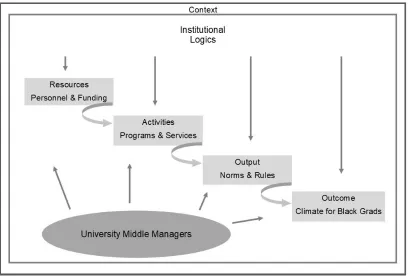
to organize the entire analysis, pointing to relevant contextual conditions to be described as well as explanations to be examined” (p. 136). This study was guided by three main arguments: the logics of an institution provide its actors with rules and norms for operating (Thornton & Ocasio, 1999); the daily operations of predominantly and
historically White institutions of higher education are influenced by a history of inequity and exclusion that misplaces the value of and responsibility for diversity (Brayboy, 2003); and institutions are embedded with multiple, and sometimes competing, logics through which individual actors must navigate (Dahlmann & Grosvold, 2017).
The third component of the research design for this study was an exploration of the units of analysis – the case(s) to be studied. In examining the logics of middle
managers, the researcher conducted an analysis of multiple sources of evidence: publicly available documentation such as letters and memoranda, news articles, announcements, and reports; archival data such as campus surveys; and interviews with university middle managers. Examining these sources not only captured the ways in which the university understands and represents its value of diversity, but this analysis shed light on the logics through which middle managers must operate to serve Black graduate students.
40
qualitative researchers intend to describe a phenomenon in rich detail rather than set against some prescribed criteria. In capturing logics, Reay & Jones (2016) described three qualitative methods: pattern deducing (counting and comparing words), pattern matching (matching types of words to logics), and pattern inducing (grouping behaviors according to logics).
For this study, I used pattern inducing to explore behaviors among middle managers within their university context. In this “bottom-up” method, common logics will surface and can be analyzed across cases (Dahlmann & Grosvold, 2017; Reay & Jones, 2016; Yin, 2014). Further, Reay & Jones (2016) described ways in which to collect “thick” descriptions:
researchers capture logics by showing as much of the raw data as they can; text segments taken directly from interview transcripts, observational field notes, or documents are grouped into meaningful categories that constitute a pattern or set of behaviors associated with one or more logics. (p. 449)
This process of pattern inducing, or capturing patterns in logics, connected the data to the original propositions of this study. An analysis of the institutional data revealed the existing logics within the university. Much like Dahlmann & Grosvold’s (2017) study, the interviews were used to capture “repeated insights” and managers’ continuing efforts to manage competing logics on a day-to-day basis.
41
allowed this researcher to gain insight into the attitudes and beliefs that shape how middle managers operationalize equity and inclusion when serving Black graduate students. The overarching proposition of this study was that the logics of university middle managers interact with those of the institution to shape how and why Black graduate students are served. However, several rival explanations existed: serving Black graduate students is the responsibility of some other person or program; serving Black graduate students is all of our responsibility; we haven’t quite figured out how to serve Black graduate students; of course, we serve Black graduate students through our diversity programs; meeting the needs of Black graduate students is a problem bigger than us; and, the state of the social climate affects how and why we serve Black graduate students.
Using a single, embedded case study design, this study entailed an exploration of the institutional logics (the case) within a university context, as well as, the middle managers (embedded units of analysis) who navigated them. Though some caution about the limitations of analysis in single case study designs (Fraenkel & Wallen, 2008; Yin, 2014), the “common case” rationale for employing this design was the need for capturing university middle managers’ daily navigation of logics “because of the lessons it might provide about the social processes related to some theoretical interest” (Yin, 2014, p. 52). In the case of each middle manager, their logics were sifted and juxtaposed with the broader institutional logics of serving Black graduate students.
Research Setting
The setting where this study was located is a large, public university in the US northwest. The campus is located near a large metropolitan area known for its
42
service mission and it dedicates many resources towards diversity, equity and inclusion. Recently launching an initiative to provide more support to Black students in its
institution, situating the study on this campus allowed for the exploration of the logics mid-level managers used in aligning programmatic efforts with this institutional charge. For the purpose of this study, the pseudonyms Global University, Global U, and GU, were used interchangeably to reference this research setting.
The research setting was of particular interest because of its structure and how students are served. While many of its programs are undergraduate-focused, the university has a division dedicated to serving graduate students. This division not only oversees admissions to the university, but it is also responsible for supporting graduate students throughout their experience in the university. With a targeted focus on graduate students, this study uncovered the dominant logics of serving Black graduate students in this university. An exploration of the logics of middle managers showcased the interplay between their logics and those of the university. Further, an exploration of the context in which these logics exist occurred in the data collection process.
Data Collection
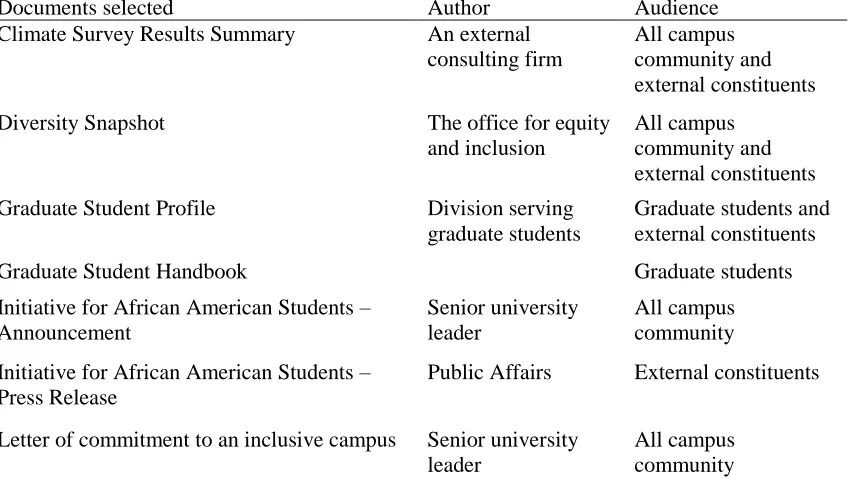
The data for this study was collected in two ways, corresponding to the different aspects of the case study. The first set of data (see Table 1) centered on establishing the context of the case. Accessing publicly posted institutional documents (i.e. on the
university website) and archival data, the researcher explored how the university presents its logics of valuing diversity and in what ways the university is equitable for and
43 Table 1
Documents Selected for Analysis
Documents selected Author Audience
Climate Survey Results Summary An external
consulting firm
All campus community and external constituents
Diversity Snapshot The office for equity
and inclusion
All campus community and external constituents
Graduate Student Profile Division serving
graduate students
Graduate students and external constituents
Graduate Student Handbook Graduate students
Initiative for African American Students – Announcement
Senior university leader
All campus community
Initiative for African American Students – Press Release
Public Affairs External constituents
Letter of commitment to an inclusive campus Senior university leader
All campus community
students, and institutional statements of commitment provided insight as to values the institution was trying to reflect. Archival data such as past climate surveys illustrated what has been examined and recorded at the institution, specifically, connected to ways of thinking and being within the institution. These sources of evidence demonstrated the institutional logics of serving Black students, answering the first research question of this study, How do the dominant logics of the university perpetuate inequity and exclusivity toward Black graduate students?
The second set of data attempted to reify the connection between emergent
themes in navigating logics within the university answering the second research question,
44
inclusion navigate the dominant logics of their institution to serve students?, and to validate this case study. Thus, the researcher conducted qualitative interviews with university managers. An analysis of the logics of university middle managers centered on the ways in which they navigate the university’s logics in serving Black graduate
students. Their logics in serving these students as the central phenomenon, Creswell’s (2012) advice for exploring participants’ experiences was considered. He provided that in qualitative research, interviews “permit participants to describe detailed personal
information…[and]…the interviewer can ask specific questions to elicit this
information,” (Creswell, 2012, p. 218). Kuntz (2016) added that qualitative research is a form of truth telling: “good qualitative inquiry does more than describe; it intervenes on multiple material levels” (p. 68). Conducting a series of interviews of middle managers not only provided a range of perspective on the logics used in meeting the needs of Black graduate students, but the responses from the interviews unveiled some ideas about what’s needed to instigate change. Through the analysis of the various sources of data, the researcher was able to validate the statements of middle managers and situate their logics within the existing framework of the institution.
45
values, ideas, beliefs, and understandings about the institutional logics at play. Similar to the qualitative study conducted by Dahlmann & Grosvold (2016), the interviews captured “repeated in sights” and managers’ continuing efforts to manage competing logics on a day-to-day basis. The protocol for this study (see Appendix B)was developed based upon the theoretical framing of this study as well as the institutional data analyzed in the first part of data collection. Questions posed covered perceptions of institutional values of diversity, thoughts and feelings towards individual responsibility, and ways in which middle managers navigate these two sets of ideals. The questions were continuously revised given what emerged from the institutional documents and interviews throughout the data collection process.
All interviews were recorded electronically. At the completion of the interviews, the researcher addressed any questions participants may have had.
Participants
Participants recruited for this study were chosen because of their level of
46
The data collection method used for the qualitative interviews with university middle managers in this study was purposeful sampling, specifically homogenous and snowball sampling. Using homogenous sampling, the researcher intentionally selected individuals based on their characteristics as middle managers in student services classifications. Participants were found from a list of managers on the institution’s website. To locate additional participants for this study, the researcher engaged snowball sampling. Creswell (2012) described snowball sampling as proceeding “after a study begins and occurs when the researchers asks participants to recommend other individuals to be sampled” (p. 209). Participants were queried about whom they might refer to provide insight about existing or alternative logics in serving Black graduate students. For the purpose of this inquiry, individuals interviewed were middle managers who oversaw a student services project or program, were responsible for managing a team of staff, worked in close proximity to students, and reported to a supervisor or senior administrator. In the first wave of this study, the researcher analyzed institutional documents and archival data from which programs that serve the university’s diversity and student support agendas were referenced. The managers in this study were
represented in those programs.
Data Analysis