Geschke Center
Doctoral Dissertations Theses, Dissertations, Capstones and Projects
2013
Effects of Academic and Non-academic
Instructional Approaches on Preschool ELLs'
English Language Development
Ivana Markova-Lama
Follow this and additional works at:https://repository.usfca.edu/diss Part of theEducation Commons
This Dissertation is brought to you for free and open access by the Theses, Dissertations, Capstones and Projects at USF Scholarship: a digital repository @ Gleeson Library | Geschke Center. It has been accepted for inclusion in Doctoral Dissertations by an authorized administrator of USF Scholarship: a digital repository @ Gleeson Library | Geschke Center. For more information, please [email protected].
Recommended Citation
Markova-Lama, Ivana, "Effects of Academic and Non-academic Instructional Approaches on Preschool ELLs' English Language Development" (2013).Doctoral Dissertations. 58.
The University of San Francisco
EEFECTS OF ACADEMIC AND NON-ACADEMIC INSTRUCTIONAL APPROACHES ON PRESCHOOL ELLs’ ENGLISH LANGUAGE DEVELOPMENT
A Dissertation Presented to
The Faculty of the School of Education International and Multicultural Department
In Partial Fulfillment
of the Requirements for the Degree Doctor of Education
by
Ivana Markova-Lama San Francisco
ii
UNIVERSITY OF SAN FRANCISCO
Dissertation Abstract
Effects of Academic and Non-academic Instructional Approaches on Preschool ELLs’ English
Language Development
The population of English Language Learners (ELLs) in the United States has
been growing at an increasingly rapid rate (U. S. Census Bureau, 2010), and nowhere is
this growth more evident than in U.S. public schools. As of school year 2010-11, nearly
25% of all students in the California public schools were English Language Learners
(California Department of Education, 2013).
The focus of this study was to explore to what extent this growing number of
ELLs was developing English language in different types of preschool activities. The
study investigated whether bilingual preschool children would engage more and use more
of their second language (English) during teacher–structured (academic) or free play
(non–academic) activities. In addition, the researcher investigated the perceptions of
preschool teachers and parents of bilingual preschool children regarding the effects of
academic and non-academic instructional approaches on student engagement and English
language development.
Study participants consisted of eight bilingual preschool children, twelve
preschool teachers, and eight parents of the children participants. The children were
between the ages of three and five. The ethnic background of the children varied and
iii
The researcher utilized both quantitative and qualitative research approaches in
this study. Data sources included 285 preschool observations made at one preschool in
Northern California, teacher and parent surveys, and teacher and parent interviews. Data
analysis consisted of descriptive statistics that included frequencies/percentages, means,
and standard deviations. In addition, children’s observed scores were also analyzed by
normative scales using standardized z-scores.
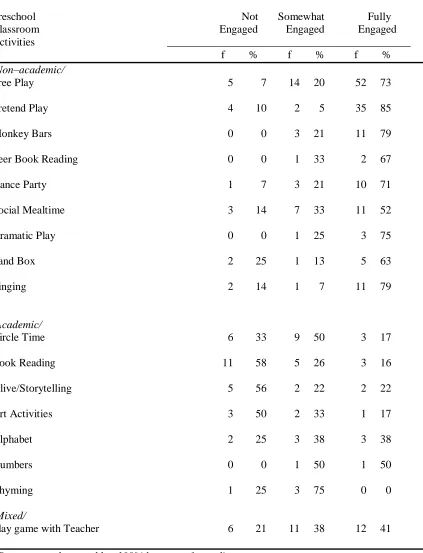
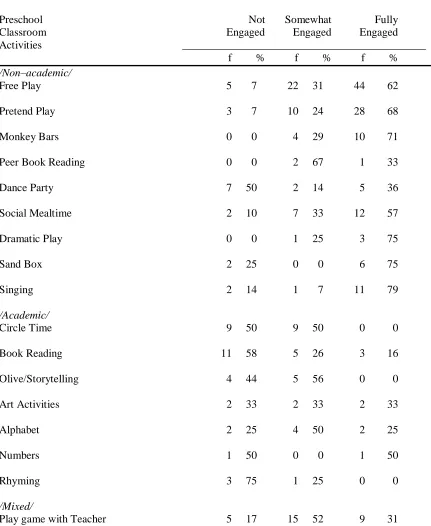
The findings of this study indicated that bilingual children engaged and interacted
dramatically more during free play (non–academic) preschool classroom activities than
during teacher–structured (academic) activities. The free play activities during which
children were the most engaged and used their second language, English, the most were:
pretend play, free play, and monkey bars. Results demonstrated that unstructured
free-play activities served as an affordance for building language, academic skills, and cultural
capital. The teacher and parent survey and interview findings indicated that preschool
teachers and parents perceive free play (non–academic) preschool activities as being
more beneficial toward children’s engagement and English language development than
academic (teacher–structured) activities.
The study's major implication is that free play (non–academic) activities may be
much more helpful in developing preschool ELL students' English language skills
compared to teacher-structured (academic) activities. Greater English language
development in the early preschool years may help students become more successful as
they enter Kindergarten. Moreover, the importance of free-play activities may extend
beyond preschool classrooms, and the researcher recommends that more unstructured
iv
This dissertation, written under the direction of the candidate’s
dissertation committee and approved by the members of the committee,
has been presented to and accepted by the Faculty of the School of
Education in partial fulfillment of the requirements for the degree of
Doctor of Education. The content and research methodologies presented
In this work represent the work of the candidate alone.
Ivana Markova-Lama 5/7/13
Author Date
Dissertation Committee
Stephen Cary 5/7/13 Chairperson
Sedique Popal 5/7/13
v
Acknowledgements
I want to express gratitude to my dissertation committee: Dr. Stephen Cary, Dr.
Sedique Popal, and Dr. Capitelli. In addition to my committee, I also want to say many
thanks to other University of San Francisco faculty, such as Dr. Benjamin Baab, from
whom I have learned such a great deal about research methodology, statistics, and SPSS
over my time as a student at USF; and Dr. Suzan Katz, whose courses are filled with
vi
TABLE OF CONTENTS
LIST OF TABLES ... x
LIST OF FIGURES ... xii
CHAPTER I: THE RESEARCH PROBLEM ... 1
Statement of the Problem ... 1
Background and Need for the Study ... 4
ELL Population in the U. S. ... 4
Simultaneous and Sequential ELLs ... 7
Second Language Development ... 9
Purpose of the Study ... 15
Research Questions ... 16
Theoretical Rationale ... 17
Second Language Acquisition Theory ... 17
Interaction Hypothesis ... 17
Input Hypothesis ... 19
Output Hypothesis ... 20
Sociocultural Theory Vygotsky ... 23
Social Learning Theory ... 28
Scope and Delimitation of the Study ... 30
Limitations of the Study ... 31
Significance of the Study ... 31
Definitions of Terms ... 32
CHAPTER II: REVIEW OF LITERATURE ... 35
SLA during Preschool Years ... 35
Oral Language Development ... 41
Language Use & L2 Oral Development ... 42
L2 Oral Development & Preschool Activities ... 43
Preschool Curriculum... 48
Child-Centered Approach... 48
Enhancing Children’s Development through Play ... 49
Peer Effect ... 58
Teacher-Structured Approach ... 64
Mixed Approach ... 74
Classroom Engagement ... 79
Engagement in Classroom Activity Settings ... 80
Classroom Engagement with Teachers ... 84
Positive Classroom Engagement with Tasks ... 88
Engagement & Activity Settings ... 90
Teacher Perceptions ... 94
vii
Parent Perceptions ... 108
Cross-Cultural Differences ... 117
Chapter Summary ... 127
CHAPTER III: METHODOLOGY ... 128
Restatement of Purpose ... 128
Restatement of Research Questions ... 129
Research Design ... 130
Qualitative Data Collection... 131
Quantitative Data Collection ... 132
Validity ... 133
Reliability ... 134
Conceptual Model ... 136
Operational Definitions ... 138
Research Setting ... 140
Sample ... 142
Instrument Development ... 143
Expert Review ... 145
Process of Data Collection ... 146
Preschool Classroom Observations ... 146
Surveys ... 146
Teacher Interviews ... 147
Parent Interviews ... 148
Data Analysis ... 149
Ethical Considerations ... 152
CHAPTER IV: FINDINGS ... 153
Brief Overview of Methodology ... 155
Overview of Students ... 155
Individual Student Profiles ... 156
Observations... 157
Section One: Analysis of Research Questions One and Two... 163
Subquestion 1A- Engagement Level with Peers ... 167
Subquestion 2A- Engagement Level with Teachers ... 168
Subquestion 1B-Language Use with Peers ... 173
Language Use-Quantity ... 173
Language Use-Quality-Speaking ... 174
Language Use-Quality-Listening ... 175
Subquestion 2B-Language Use with Teachers ... 175
Language Use-Quantity ... 176
Language Use-Quality-Speaking ... 176
Language Use-Quality-Listening ... 179
viii
Quantity of Language Use by Preschooler ... 185
Quality of Speaking and Listening by Preschooler ... 185
Standardized z-scores for Research Questions One and Two ... 190
Engagement Level ... 190
Quantity of Language Use ... 193
Quality of Language Use ... 196
Language Use-Speaking ... 196
Language Use Listening ... 197
Comparison of Academic, Non-academic and Mixed Activities ... 200
Overall Index Score ... 203
Section Two: Analysis of Research Questions Three and Four ... 205
Sample Demographics-Parents ... 206
Sample Demographics-Teachers ... 209
Teacher Perceptions-Research Question Three ... 211
Parent Perceptions-Research Question Four ... 213
Interview Data for Research Question Three and Four ... 215
Summary ... 220
CHAPTER V: DISCUSSION AND RECOMMENDATIONS ... 222
Section One: Research Questions One and Two ... 222
Free Play (Non-Academic) Activities ... 223
Teacher-Structured (Academic) Activities ... 225
Social Learning Theory in Preschool Activities ... 231
ZPD Sociocultural Theory ... 231
Section Two: Research Questions Three and Four ... 235
Teacher Perceptions... 235
Parent Perceptions ... 239
Recommendations ... 244
Recommendations for Educators ... 244
Recommendations for Policy Makers ... 254
Recommendations for Future Research ... 257
Conclusion ... 258
REFERENCES ... 261
APPENDIX A.1 ... 276
Observation Sheet APPENDIX A.2 ... 277
Operational Definitions APPENDIX B ... 278
ix
APPENDIX C .1 ... 281 Observation Schedule
APPENDIX C. 2... 282 Research Design Matrix Plan
APPENDIX D ... 283 Expert Review
APPENDIX E ... 284 Interview Protocol
APPENDIX F ... 285 Consent Letter for Preschool Coordinator
APPENDIX G ... 287 Consent Letter for Participants
x
LIST OF TABLES
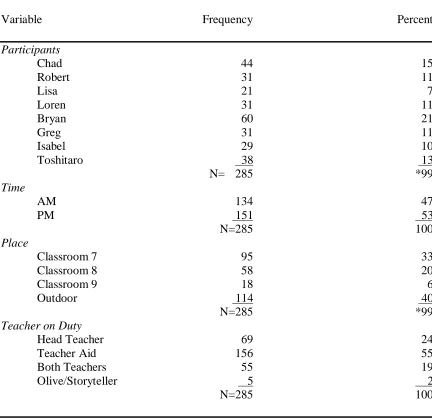
Table 1 Frequency of Preschool Observations... 159
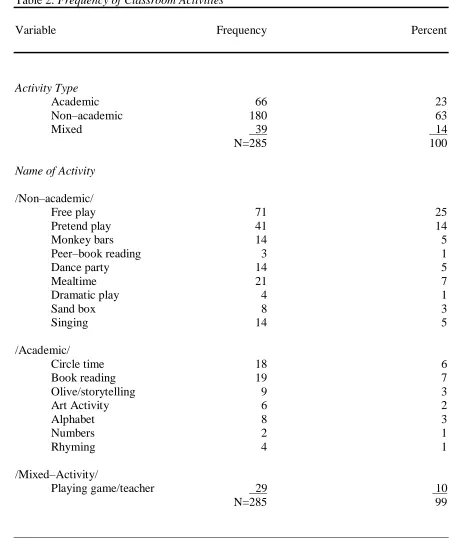
Table 2 Frequency of Classroom Activities ... 162
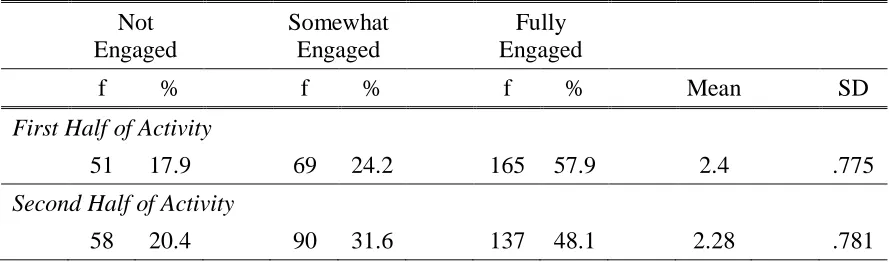
Table 3 Engagement Level ... 163
Table 4 Language Use - Quantity... 164
Table 5 Language Use - Speaking ... 166
Table 6 Language Use - Listening ... 166
Table 7 Cross tabulation of Engagement Level by Activity (first half) ... 170
Table 8 Cross tabulation of Engagement Level by Activity (second half) ... 171
Table 9 Cross tabulation of Engagement Level by Activity (combined) ... 172
Table 10 Cross tabulation of Language Quantity (first half of activity) ... 177
Table 11 Cross tabulation of Language Quantity (second half) ... 178
Table 12 Cross tabulation of Language Quality (first half) ... 181
Table 13 Cross tabulation of Language Quality (second half) ... 182
Table 14 Aggregate Scores by Preschooler ... 184
Table 15 Aggregate Scores for Language Use by Preschooler ... 188
Table 16 Aggregate Scores for Engagement Level by Activity ... 192
Table 17 Aggregate Scores Language Use/Quantity ... 195
Table 18 Aggregate Scores/Quality... 199
Table 19 Cross tabulation for Engagement Academic/Non-academic/Mixed ... 200
Table 20 Cross tabulation of Language Use-Quality by Activity Type ... 201
xi
Table 22 Parent Demographics ... 207
Table 23 Parent Demographics Continued ... 208
Table 24 Teacher Demographics ... 210
Table 25 Teacher Demographics Continued ... 211
Table 26 Preschool Activities-Survey Teachers Perceptions ... 213
xii
LIST OF FIGURES
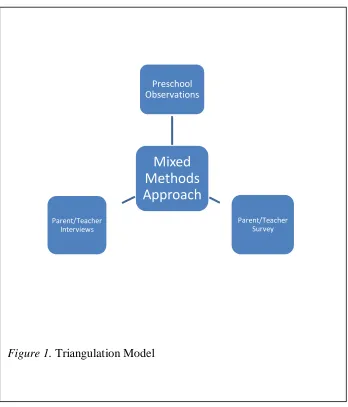
FIGURE 1 ... 135 Triangulation Model
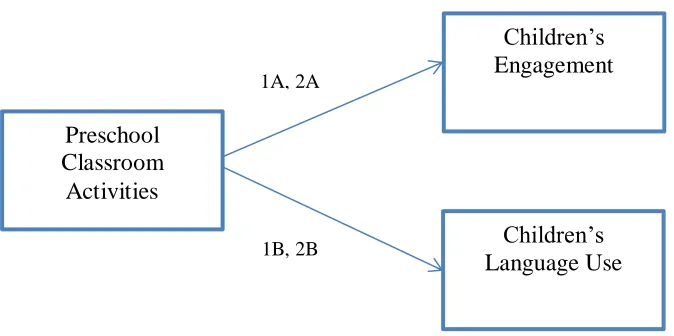
FIGURE 2 ... 136 Conceptual Model A. Research Questions One and Two
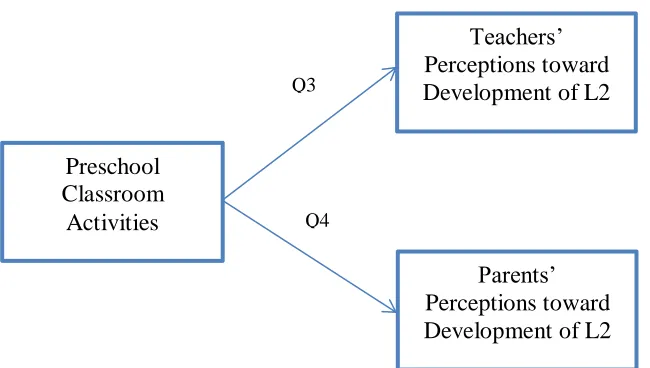
FIGURE 3 ... 137 Conceptual Model B. Research Questions Three and Four
Chapter I
The Research Problem
Statistics show that in recent years the number of English-language learners
(ELLs) in the United States has grown at an increasingly rapid rate. Over the last three
decades, while the overall U.S. population has increased by 34%, the subset of those who
speak a primary language other than English has increased by 140% (U. S. Census
Bureau, 2010; Kindler, 2002). Nowhere is this growth more evident than in U.S. public
schools, particularly at the preschool level where more than one-third of children speak a
language other than English at home (California Department of Education, 2009). This
growth is not projected to slow down in the future. Shonkoff and Philips (2000) have
predicted that in 20 years children under age five whose first language is English will
comprise less than half of the entire U.S. preschool-age population.
For many of these ELL children, preschool programs are the only avenue to
acquire, or become proficient in, the English language before entering kindergarten.
Thus, in recent years many education scholars have focused their efforts on finding new
ways to help foster the acquisition of a second language in the early stages of child
development. The potential benefits of such efforts are clear: research shows
convincingly that children with only basic English proficiency when entering preschool
experience greater cognitive growth from attending preschool programs than their more
English-proficient peers (Loeb, Bridges, Bassok, Fuller, & Rumberger, 2007). With
better English language skills, children do better in other academic areas, and continue to
academically they feel more confident about their future academic abilities, and are less
easily discouraged.
What is less certain, however, is what preschool program activities are best to
facilitate English language proficiency for these children. Generally speaking, preschool
activities may be categorized into two groups: academic and non-academic. On one hand,
academic (Fromberg, 2002; Stipek & Byler, 1997; Stipek, 2004) where the teacher is in
charge and children follow the teacher’s instructions. Such activities include: circle time,
library time, learning alphabet and numbers time, filling out worksheets, and storytelling
time. On the other hand, non-academic activities (Fromberg, 2002; Stipek & Byler, 1997;
Stipek, 2004) are child-centered and play-based, where the children are free to interact
and explore. Such activities include: free-play time, peer book-reading time, dramatic
play, pretend play, and outdoor and monkey bars time.
Gormley, Gayer, Philips, and Dawson (2005) and Magnuson, Meyers, Ruhm, and
Waldfogel (2004) found that academically-oriented teaching activities in preschools are
most beneficial for promoting children’s competency in math, letter recognition, and
spelling. Perhaps in part for this reason, academic-oriented instruction in preschools is
widely preferred among parents (Vail, 2003) and policymakers (Raver & Zigler, 2004;
Whitehurst, 2001) over non-academically oriented, or free-play, instruction (Bodrova &
Leong, 2003; Zigler & Bishop-Joseph, 2004). Academically-oriented preschools are
generally regarded as “high-quality” preschools, of which the most important elements
are considered to be teacher qualifications and an academic curriculum (Cardiff &
Stringham, 2006; Yamamoto & Li, 2012). These high-quality preschools have in fact
socially competent, and have less behavioral problems than their peers who attend other
types of schools (Burchinal, Vandergrift, Pianta, & Mashburn, 2010; Magnuson, Meyers,
Ruhm, & Waldfogel, 2004).
But the important question facing this present study is whether these
teacher-structured academic classroom activities also benefit the development of preschool
English-language learners. Elkind (2001) suggests that social interactions that occur in
children’s play (Elkind, 2001) and linguistic engagement, which are minimal in academic
oriented activities, are such crucial components in language learning and acquisition that
bilingual preschool children would benefit more from free-play, non-academic classroom
activities.
There is a significant gap in our understanding of this issue, as research studies in
second language acquisition do not normally focus on the youngest group of learners:
preschoolers. Indeed, Saunders and O’Brien (2006) have indicated a lack of empirical
research regarding second language development for preschools children as opposed to
older children. This is troubling, since so much of cognitive development and learning
occurs in the early years of life (Brown, 2007; Doidge, 2007). If U.S. children do not
acquire a solid foundation of English in their preschool years, they cannot hope to
progress successfully in elementary school (Scarborough, 2005).
Thus, the central issue that will be investigated is whether preschool
English-language learners benefit more from academic activities as opposed to non-academic
activities in attaining English language proficiency. Ultimately, this study will help
identify the most highly efficient classroom activities for bilingual learners’ development
Background and Need for the Study
The purpose of this section is to give a rich description of the diverse and growing
preschool population of English-language learners in the U.S. Their development as
ELLs is influenced by when they started acquiring the English language; thus, they may
be categorized as being either “simultaneous” or “sequential” bilingual learners. Finally,
this section will conclude with a discussion of how beneficial different pedagogical
approaches (teacher-structured and play-based) are toward these children’s English
language acquisition.
English-language Learner Population in the U.S.
English-language learners are defined as children whose native language is not
English, but who live in an English-speaking environment (Halle, Hair, Wandner,
McNamara, & Chien, 2012) and have difficulties in speaking, understanding, reading, or
writing in the English language (Espinosa, 2008; Wolf, Kao, Herman, Bachman, Bailey,
Bachman, Farnsworth, & Chang, 2008). Other terms have been utilized to describe ELLs,
such as: dual language learners, second language learners, linguistically diverse, or
language minority children.
The ELL population in the U.S. is very ethnically diverse, with 53% being
identified as Latino, 28% as Caucasian, 10% as Asian, and 6% as African American.
Over the last thirty years, the largest increase among ELLs occurred among the
Vietnamese-speaking population (511%), followed by the Spanish-speaking population
(211%). Overall, the latest breakdown of non-English speakers in the U.S. can be
expressed as follows: 62% speak Spanish, 19% speak a non-Spanish Indo-European
language, 15% speak an Asian or Pacific Island language, and 4% speak some other
home and five other languages – Tagalog, French, Vietnamese, German and Korean –
have a decent amount of speakers in the U.S. (U.S. Census Bureau, 2010). The degree of
language proficiency varies widely among ELL groups.
The states that have the largest numbers of ELL students are California, Texas,
Florida, New York, Illinois, and Arizona (Walf et al., 2008). In California, the child ELL
population comprises 40% of all kindergarten students (Children Now, 2012), and 39%
of children in California who are zero-to-five years of age have parents who do not speak
English well. In some states, the number of ELLs in the public school system has
increased dramatically by 300% to 400% in the past decade alone (Espinosa, 2008).
These ELL students tend to be situated in the lower grades, with almost half enrolled in
preschool through third grade (Walf et al., 2008). This younger group of ELL students is
the fastest growing population among all ELLs; in some states, more than 50% of
preschool children are ELL students.
These children face various obstacles that will influence how they learn the
English language. English-language learners are very likely to be taught by teachers who
are not qualified to teach them (Rumberger & Gandara, 2004). In a study conducted by
Gandara, Rumberger, Maxwell-Jolly, and Callahan (2003), where almost 5000 teachers
of ELL students in the state of California were surveyed, the teachers themselves
expressed concern about not being prepared to teach this subgroup of children. This
suggests one of the most important criteria of a high-quality preschool, one where ELL
children can successfully acquire English language proficiency, is teacher qualification.
Some other influencing factors for English proficiency besides teacher
age of the child, issues in the family’s immigration to U.S., the language spoken at home,
fluency in the language spoken at home, amount of exposure to English, and
socioeconomic circumstances (Espinosa, 2008). Socioeconomic status in particular is a
major indicator of ELL students’ poor language proficiency that eventually leads to poor
academic achievement in elementary school (Stipek & Ryan, 1997). Children who grow
up in low-income families tend to perform more poorly academically than children from
middle to high-income families, regardless of what language is spoken at home (Hair,
Halle, Terry-Humen, Lavelle, & Calkins, 2006).
Out of all ELLs, Latino ELLs are considered to be the most economically
disadvantaged, as almost 60% live in poverty; thus they are the most at-risk student
population for English proficiency and other academic issues. As of 2008, Latino
students accounted for 22% of all U.S. public school students (National Council of La
Raza, 2011) and 26% of the total U.S. population ages five years and under (Census
Bureau, 2010). Many of these Latino children are believed not to have access to high
quality preschools and therefore come less prepared for kindergarten than their peers
(National Council of La Raza, 2011). Only 48% of Latino four-year-olds attended
preschools in 2009, and they started kindergarten two months behind their White peers in
math and reading skills, indicating a large achievement gap that starts very early on.
Moreover, because most Latino families speak Spanish at home, the achievement gap in
English might exist early on (National Council of La Raza, 2011). Since, the largest
group of English language learners are Latino (Children Now, 2012) many researchers
development research, and this will be evident in the review of literature for the current
study.
No matter what the cause, ELL students have been struggling to become
proficient in English, and because of this struggle they lag behind their native
English-speaking peers in terms of academic achievement (Espinosa, 2008). The dropout rate of
ELL students is twice as those of native English speakers. Because the number of young
English-language learners is increasing at such a rapid rate (Kindler, 2002), it is critically
important to consider how these children can achieve the highest proficiency in English
during preschool years and before they enter kindergarten (Zepeda, 2008).
Simultaneous and Sequential ELLs
English-language learners are not all alike, especially in preschool classrooms.
Some enter a preschool program with partial knowledge of the English language, and
others with no knowledge of English at all. Thus, we can distinguish those for whom
English-language learning in the preschool years occurs “simultaneously” with their
home language from those for whom it occurs “sequentially.” Both types of bilingual
children, simultaneous and sequential, will be participating in this study.
Simultaneous language acquisition is when children go through the process of
acquiring two languages at the same time, from birth; this kind of bilingualism is also
referred to as infant bilingualism (Lanza, 1997). Simultaneous bilingualism is considered
to be complex because one language has not been fully developed before the
development of the second language begins. Interestingly, De Houwer (1990) argued that
the term “simultaneous” has been used with different meanings by other researchers and,
Language Acquisition (BFLA), to refer to situations where: a) a child is exposed to the
second language no later than a week after the child is exposed to the first language, and
b) the exposure to both languages is on a daily basis and regular.
Sequential language acquisition, on the other hand, occurs when a child learns one
language from birth and a second language at some point later. Sequential acquisition has
also been referred to as “consecutive” or “successive,” where in some instances the child
acquires his/her second language during the preschool age of three years old (Goldstein,
2004). Paradis and Genesee (1996) believe that simultaneous language acquisition is
more complex than sequential language acquisition. Acquiring two languages at the same
time involves two different linguistic systems (syntax, phonology, and morphology),
which is believed by some researchers to place a burden on a child’s brain. Paradis and
Genesee (1996) call this burden deceleration, which refers to the notion that a “double
burden of acquiring two languages slows down the process overall, or for particular
structures, in both languages.”
The acquisition of two languages may begin as simultaneous, but many studies of
simultaneous bilingual children have found that even though children may acquire two
languages from birth, the actual acquisition is not concurrent. Bilingual children typically
end up being more proficient in one of the two languages. The language in which they are
more proficient is sometimes called the “dominant” language, and the language in which
they are less proficient is called the “non-dominant” language (Genesee, Nicoladis, &
Paradis, 1995). These definitions of “dominant” language and “non-dominant” language
in simultaneous bilinguals are equivalent to those of “first” language (L1) and “second”
Preschool teachers should be aware of where ELL children stand in English
language proficiency when they enter a preschool program. If the child receives no
English language input at home, the preschool teachers can take measures to help the
child become more exposed to the English language in preschool. The previously
mentioned dominance in one of the two languages can change over time and is closely
related to the amount of input the ELL child receives in each language, since the input in
each language that the child receives is almost never equal (Genesee et al., 1995;
Nicoladis, 1995). The language acquisition of a bilingual child who is not exposed to
both languages from birth or who does not receive equal exposure to both languages,
might develop differently from that of a child who receives constant exposure to both
languages from birth (Goldstein, 2004). Without a sufficient amount of English language
input and exposure in preschool, the ELL child will not become proficient in English.
However, with sufficient amount of exposure to English language, which eventually
might become their language of instruction at school, they are very likely to weaken their
proficiency in their first language. Thus, in many cases English will become the child’s
dominant language (Nicoladis & Grabois, 2002) due to the varied exposure and input of
the two languages (Goldstein, 2004).
Second Language Development
Sequential bilingualism occurs when children are exposed to English for the first
time in preschool or begin preschool with very little English. Their English proficiency
will be poorer than that of their simultaneous bilingual peers, who have been learning
preparing preschool sequential bilingual children to acquire the English language so that
they can be ready to start kindergarten with their native-English speaking peers.
Zepeda (2008) examined bilingual children’s English language proficiency across
four different components: listening, speaking, reading, and writing. Among these four,
preschool children might be at different and uneven proficiency levels. For example,
some children might find it harder to attain proficiency in pronunciation and articulation
in speaking than in recognizing letters and words in the reading areas. Thus Zepeda
categorizes three basic levels of second language (L2) development in sequential
bilingual preschool children: the beginning, middle, and later levels.
At the beginning level, English language preschool learners should have
age-appropriate languages skills in their first language. These beginning level learners will
start acquiring the English language by developing receptive English skills, and are
already internally processing the elements of the English language such as vocabulary,
phonology, pragmatics, and grammar. Beginning-level ELL children do not usually speak
very much during this period; however, they actively listen, use gestures, draw, copy, and
partake in classroom routines. Indeed, most of their behaviors during this period are
nonverbal. In addition, these children will begin to understand the English language
based on their first language (L1). During this initial period, preschool children will
spontaneously use their home language even though they know that nobody understands
them.
Zepeda (2008) found that children move from the beginning level to the middle
level of English language development when they start using expressive language
increasing and they will start combining words and speaking in phrases. Besides the
increase in vocabulary, comprehension also increases during the second level of language
acquisition and children will use telegraphic and formulaic speech in English. What can
be further seen during this stage is children using their home language and inserting some
new English words into their utterances. This phenomenon is called code-switching.
However, though code-switching is considered to be natural in children’s second
language development (Bhatia & Ritchie, 1999, 2008; Muysken, 2000), some experts
believe it is detrimental to children’s development of both languages and that it is an
indicator of their low proficiency in the English language (Grosjean, 1982). Another
similar phenomenon to code-switching is called interlangauge. According to Selinker
(1972), interlanguage is a strategy in which the bilingual speaker, who is not proficient in
the second language, attempts to use it through language reduction, simplification,
transfer, substitutions and omissions. Duran (1994) explains the differences between
code-switching and interlanguage as the interlangauge notion being associated with the
earliest stages of second language development and code-switching notion being
associated with the middle and last stages of second language development. Thus,
“interlangauge is the language constructed before arriving at more ideal forms of the
target language, code switching may occur during and after the interlangauge phase” (p.
71). These two bilingual phenomena may be less distinguishable for children who are
simultaneously acquiring two or more languages from birth. However, both
code-switching and interlanguage are part of the stages of becoming bilingual.
As preschool children move to the third level of L2 acquisition, their
using the English language; their English grammar will improve and become
age-appropriate. Their English language acquisition might not be complete, but they are now
“able to engage in a majority of classroom activities in English” (Zepeda, 2008, p. 108).
These children are still acquiring the structure of the new language and therefore
mistakes are very common even at this third level of English language acquisition.
The time it takes for preschool children to acquire the English language varies
based on the quality of the preschool classroom environment and the amount of exposure
and input they receive from native English language speakers. According to MacSwan
and Pray (2005), it takes on average three years for children to acquire English as a
second language and five years to achieve a native-like proficiency in English. The input
comes from the interactions the child is provided within the preschool classroom and how
many opportunities the child gets to interact with native English language speakers while
at school.
According to Hamers (2004), all language development happens through
interactions that are embedded in the context of social environment. How many
opportunities the child gets to interact with other English language speakers depends on
the classroom activity the child is involved in. Preschool classroom activities are
designed for various purposes and thus provide different learning outcomes. The
classroom activities currently being implemented in U.S. public preschool classrooms are
more often than not academic-based tasks. This trend toward academic-based activities in
preschool classrooms began with the implementation of No Child Left Behind Act of
2001, which mandates that all public elementary and secondary schools that receive
No Child Left Behind schools are to focus on children’s cognitive development only
through literacy-based activities. In 2003, former U.S. president George W. Bush
additionally mandated that all children are to be able to read by the time they are in third
grade, and he talked about bringing this standard to preschool education as well (Zigler &
Bishop-Joseph, 2006).
According to Stipek (2006), the standards established by No Child Left Behind
and other accountability measures for preschool children’s academic performance could
result in serious harm. Children of preschool age learn through non-academic methods
such as playing and exploring; they do not learn through academic methods such as
sitting down and working on a vocabulary worksheet given to them by their teacher.
Indeed, these standards discourage children from learning, suppress child-initiated
learning, and make children less motivated to learn in the future (Chang, Stipek, & Garza,
2006; Stipek et al., 1995).
The best method of learning for preschool children is play (Elkind, 2007). “Play is
the dominant and directing mode of learning during this age period, and children learn
best through self-created learning experiences” (p. 7). In a non-academic classroom,
children are engaging in play, drawing and painting, experimenting with water and sand,
and listening to stories and songs (Elkind, 2001). These preschool classroom activities are
more developmentally appropriate for preschool children than academic-based activities.
Children are more engaged in play because it is more natural to them to do so than sit still
and listen to a one-hour lecture. Play allows children to be more engaged in things that
interest them, and by being more engaged they will learn more (Shonkoff & Phillips,
Just as important for preschool ELLs, play also allows them to interact with each
other and communicate and converse. This is important, as Cronin and Sosa Masso (as
cited in Jones & Cooper, 2006) suggest that preschool children learn a second language
by interacting with others and using language that they hear others speak; they do not
learn a second language by listening to drills and translations. Thus, ELLs need many
opportunities to converse to become proficient, and play provides them the opportunity to
hear the English language in a variety of contexts and pushes them to be actively engaged
in conversations. The development of their English language oral skills, in turn, will
provide a foundation for reading comprehension and coherent writing for later literacy
success (Jones & Cooper, 2006).
In contrast, proponents of academic preschool classroom curriculum maintained
that children benefit more from academic oriented preschool classroom activities than
from free play non-academic activities. According to Whitehurst (2001), preschools need
to get children ready for schools in an academic sense. Preschools need to focus on
academic activities which can be built on later in kindergarten. Preschool children are
ready and eager to learn about specific topics such as math, reading, and science and they
can learn these things only when adults/teachers take their time to teach them. A
longitudinal study conducted by The National Center for Educational Statistics provided
evidence of the benefits academic preschool programs provide. Around 22, 000 children,
from 1000 public and private kindergarten programs, were involved in this longitudinal
study of the kindergarten class of 1998-99. The results indicated that children who
attended more academically oriented preschools performed significantly better on math,
non-academic preschools. Another proponent of academic oriented curriculum (Senechal,
1996) found that children’s knowledge of sounds, letters, and writing can only be
accomplished by explicit teaching. Only those children in her study exhibited the
knowledge of sounds, letters, and writing whose teachers presented and taught the
alphabet and used books in their classrooms. Preschool programs which focus on
academic activities devote less time on play activities; however, this researcher maintains
that free-play non-academic activities will be more contributory for preschool students’
English language development than teacher-structured academic activities.
Purpose
The purpose of this study is twofold. The primary purpose is to investigate the
engagement level and English language usage of eight preschool bilingual children, ages
three to five, during two different types of classroom activities: academic
(teacher-structured) and non-academic (free-play). The research study took place in three separate
and distinct preschool classrooms. The researcher’s goal was to investigate which of the
two types of preschool classroom activities, academic or non-academic, will lead the
preschool bilingual children to higher levels of engagement in listening to and speaking
the English language. When researching second language development of preschool
children, researchers generally base their assumptions on the notion that language use
contributes to language development (Saunders & O’Brien, 2006). Thus, higher levels of
linguistic engagement and better quality and quantity of language use are likely to
contribute to English language development and linguistic growth of bilingual preschool
children.
The secondary purpose of this study is to examine eight parents and twelve
their perceptions of the effects that academic and non-academic preschool classroom
activities have on bilingual children’s English language development.
Research Questions
Through observations of bilingual preschool children and through dialogue with
preschool teachers and preschool parents, this research study will examine the following
questions:
1. What is the effect of free-play activities on second language (L2) development of
bilingual preschool children?
A. What is the level of engagement of bilingual preschool children while
interacting with peers?
B. What is the quality and quantity of L2 produced by bilingual preschool
children while interacting with peers?
2. What is the effect of teacher-structured time activities on L2 development of
bilingual preschool children?
A. What is the level of engagement of bilingual preschool children while
interacting with teachers?
B. What is the quality and quantity of L2 produced by bilingual preschool
children while interacting with teachers?
3. What are the preschool teachers’ perceptions of the effect of free-play vs.
teacher-structured activities on the English language development of bilingual preschool
children?
4. What are the preschool parents’ perceptions of the effect of free-play vs.
teacher-structured activities on the English language development of bilingual preschool
Theoretical Rationale
The researcher utilized second language (L2) acquisition theories and social
learning theories in this research study. The L2 acquisition theories will be discussed
first, in the following order: the Interaction Hypothesis (Long, 1981a, 1983a, 1983b), the
Input Hypothesis (Krashen, 1982), and the Output Hypothesis (Swain, 1985). Social
learning theories will be discussed second, and will include Vygotsky’s (1978)
Sociocultural Theory and Bandura’s (1986) Social Learning Theory.
Second Language Acquisition Theory
Interaction Hypothesis
The Interaction Hypothesis, developed by Long (1981a, 1983a, 1983b), suggests
that language acquisition is accelerated by the use of the language during interaction.
Long suggests that the role of conversation and comprehensible input are critical for
second language (L2) learning. He argues that when engaged in conversation, the learner
is linguistically interacting, and that this interaction enables language acquisition because
language modifications occur only through discourse where the learner receives much
needed input. Whether the received input is comprehensible or incomprehensible (White,
1987, 1991), the learner is pressed to negotiate for meaning during conversation.
A study conducted by Mackey (1999) tested the interaction hypothesis by
examining the relationship between conversational interactions and L2 development.
Participants of this study were 34 ESL learners with a large variety of linguistic
backgrounds. The researcher grouped participants into three groups: a first group of
learners who were participating in a conversation; a second group of learners who were
only observing (listening to) the conversation; and a third group, the control group, which
According to Mackey, “This study provides direct empirical support for the
claims of the interaction hypothesis” (p. 583). The findings of the study indicated that the
group of ESL learners who actually participated in the conversation through interactions
demonstrated definite evidence of language development when compared with the other
two groups of ESL learners. The second group of ESL learners who only observed the
conversation without active participation or negotiation exhibited only limited effects,
which did not result in gains of language development – though observing a conversation
was found to be a little bit more beneficial than nothing at all. Those who actively
participated in interaction, however, received examples of more advanced language
structures, and through interactions this group of ESL learners had to “repeat and
rephrase” (p. 577) these more advanced language structures, which ultimately resulted in
learning.
The research findings of Ellis, Tanaka, and Yamazaki (1994), however, did not
show support for the Interaction Hypothesis. The researchers tested the advantages of
non-modified, pre-modified, and interactionally modified input on vocabulary learning
and comprehension of 79 public high school English language students in Saitama, Japan.
An important goal of this research was to see whether actual participation in interaction
results in new English vocabulary learning and in better comprehension than does
observed participation. The results of this study indicated that the scores on new
vocabulary acquisition and comprehension were not significantly different between the
students who actively participated in the interaction and the children who only observed
the interaction. These results might be different from those of Mackey (1999) because the
1994) to ensure comprehension. The conversational interactions that utilize such input
appear not to be naturalistic and are not considered to be as challenging for students
because students do not have to negotiate for meaning.
Input Hypothesis
In attempting to explain how learners acquire a language, Krashen (1982) focused
on the input they receive. He believed that in order to move from the current stage of
language acquisition, which he called i, to the next stage, the language input must a little
bit beyond the current language competence. This little-bit-beyond he called +1. The
reason why learners can acquire language that includes grammatical language structures
that have not yet been acquired is because learners also “use context, our knowledge of
the world, our extra-linguistic information to help us understand language directed at us”
(p. 21). Therefore, the Input Hypothesis states that the input that learners receive must be
comprehensible and naturalistic. Comprehensiveness is the most important characteristic
of input. If the learner does not understand what has been said, language acquisition does
not occur. Thus, Input Hypothesis developed by Krashen (1981, p. 61) suggests that
comprehensive input is “the only true cause of second language acquisition.” According
to Krashen (1982), incomprehensible input does not help for language acquisition. He
adds that if the input is understood and there is a sufficient amount of it, i+1 is
automatically provided, and this is what he called successful communication. The best
way to communicate is to be involved in a naturalistic conversation because it is one of
the best ways to attain input.
Krashen’s hypothesis that comprehensive input is the cornerstone of language
pedagogical methods for ESL students’ English vocabulary acquisition. The sample of
this study consisted of 44 ESL students preparing for university entry who came from a
variety of linguistic backgrounds, as many of them spoke Japanese, Korean, and
Mandarin as their L1; a third of them were trilingual. As part of this study, some students
were exposed to a combination of reading and interactive vocabulary instruction whereas
others were exposed to their regular vocabulary instruction, which was based on rote
memorization and didactic instruction.
It was found that the group of L2 students who were exposed to the combination
treatment – which included guided instruction equivalent to Krashen’s comprehensible
input, and periods of reading – acquired more English vocabulary than those students
who had only reading instruction.
The input hypothesis also has critics such as McLaughlin (1987) who stated that
Krashen’s input hypothesis is inadequately explained. What is missing, according to
McLaughin, is the definition of i+1. If i+1 is not adequately defined, it cannot be tested
and proved or disproved. Such undefined i+1 will differ from child to child and cannot be
scientifically accepted.
Output Hypothesis
Swain (1985) expanded on the idea of interaction and conversation by examining
what the actual interactional process really entails besides comprehensible input
(Krashen, 1982). She has concluded that it is not only comprehensible input that the
second language learner needs when acquiring a second language, but that the second
language learner also needs what Swain (1985) called comprehensible output. Especially
responding to interlocutor feedback” (Gass et al., 1998, p. 301) and not only
comprehending the interlocutor’s input. It is through conversation that the learner is
pressured to produce a comprehensible output in which the complexity of language
grammar is applied (in utterances). In producing responses to interlocutor’s input, the
learner gets a chance to notice what he has said wrong and as a result learns the correct
form of language structure.
The Output Hypothesis, proposed by Swain, suggests that a meaningful output in
the target language is as important to language acquisition as meaningful input. The
reason is that the experience of producing language leads to more effective processing of
input.
To explore output, Swain and Lapkin (1998) examined dialogue as not only a
means of communication but also as a cognitive tool. They used one pair of students
(Kim and Rick) to work on a jigsaw task. Kim and Rick were eighth grade students who
had attended a French immersion program school since kindergarten. Swain and Lapkin
examined the participants’ strength of what they called language-related episodes (LRE),
which were occurring during their conversations as they were working on the jigsaw task.
They developed a story line together and wrote it out using language to construct and
express the meaning. Their ongoing dialogue did not only serve as a tool for
communication but also served for L2 learning. Kim was linguistically stronger than
Rick, and through their LRE Rick’s use of language shifted from incorrect to correct
usage as Rick was being pressured to generate more comprehensible output during the
In another more recent study, Baleghizadeh and Derakhshesh (2012) utilized task
repetition to see whether students would reproduce their oral stories after making a
mistake and seeing others react to the mistake. The sample consisted of four female
participants attending English language classes in Tehran, Iran. The participants made
many grammatical mistakes during their oral presentations, including those to do with
verb usage, grammatical morphemes, modals, and prepositions. Many of these mistakes
were believed to be caused by L1 interference. Since these participants were asked to
revise the output transcription of their oral presentations, they had to consider their
mistakes and repeat the task. This opportunity to revise their output led to a more positive
outcome during the second presentations, following which a comparison of erroneous
utterances between the first and second presentations was made. Thus, Baleghizadeh and
Derakhshesh (2012) have supported the Output Hypothesis by providing evidence that
more comprehensive output results in L2 acquisition.
To summarize: the three SLA hypotheses (the Interaction Hypothesis, the Input
Hypothesis, and the Output Hypothesis) suggest that during L2 acquisition, an English
language learner needs to receive comprehensible input – one that is only a little bit
beyond the learner’s language comprehension – followed by at least a small amount of
output in the target language. Moreover, to efficiently acquire a language, a learner must
be involved in negotiation of meaning that occurs during constant input and output. A
learner will produce an utterance based on what he hears; if he doesn’t understand the
utterance, he will not be able to effectively respond. This negotiation for meaning occurs
when both input and output are combined, which in turn occurs during an interaction.
In addition to second language (L2) acquisition theories, the researcher will also
utilize sociocultural theory (Vygotsky, 1978) and social learning theory (Bandura, 1986)
in this study. In this section, Vygotsky’s sociocultural theory, which describes learning a
second language within the zone of proximal development with the help of teacher or
peer scaffolding, will be explained. Next, the importance of learning within social
interaction will be explained through Bandura’s social learning theory, which mainly
focuses on imitation as learning. Bandura claimed that children learn a second language
through observing others in the classroom and then in turn imitating what they have
observed.
Sociocultural Theory
Vygotsky’s (1978) sociocultural theory was used to examine English language
development in the context of preschool classroom interactions in child-centered and
teacher-structured activities. It is essential to incorporate a social development theory in
the explanation of children’s development as language plays a central role in children’s
mental development (Vygotsky, 1978). Language development is a part of cognitive
development and occurs as a product of social interactions. Vygotskyan theory not only
suggests that human development depends on interaction with people (Frawley & Lantof,
1985), but also depends on the tools that their culture provides to help shape their own
view of the world (Vygotsky, 1978). These tools, called cultural artifacts (Lantolf, 2000),
are inherited from our ancestors; therefore, Vygotsky believed that any approach to the
study of higher mental functions must have a historical focus and be culturally analyzed
(Lantolf, 2000). A cultural example of artifacts used in a preschool classroom includes
“show-and-tell” modeling items (Cary, 2007, p. 108). These show-and-tell items are
a teacher starts pulling pumpkins out of a bag while singing a pumpkin song. This would
help the second-language learner to understand the new vocabulary word. Artifacts are
not necessarily old; they could be any items chosen by the teacher. Artifacts are crucial to
children’s learning because of their appeal of being hands-on and thus more engaging
(Cary, 2007).
A cultural tool, or artifact, can be passed from one individual to another in three
general ways. The first route is through imitation as learning. For instance, children will
imitate everyday actions that surround them; they will imitate brushing teeth, pouring
cereal into a bowl, or scolding a sibling. The second route is instruction as learning. In
the preschool environment, children can follow a teacher’s simple instructions when
completing tasks. Finally, the third route is collaborative learning. (Tomasello, Kruger, &
Ratner, 1993). Here children work together to complete a task. For example, in
a preschool classroom, children usually work in pairs or groups to build a structure out of
blocks.
Social interactions in preschool allow children to pass on these cultural artifacts.
Thus, social interaction generates an opportunity to initiate and develop higher mental
thinking and acquire complex skills (De Guerrero & Villamil, 2000; Nassaji & Cumming,
2000; Nassaji & Swain, 2000). Sociocultural theorists view learning “as a fundamentally
social act, embedded in a specific cultural environment” (De Guerrero & Villamil, 2000,
p. 52). However, de Guerrero and Villamil stressed that not all social interactions result
in development. Interactions only result in development when they operate within the
learner’s zoneof proximal development and when the interlocutors provide scaffolded
Before concluding this section on Vygotsky’s sociocultural theory, it is important
to discuss in greater depth three key terms: zone of proximal development (ZPD),
scaffolded assistance, and internalization of knowledge.
Zone of proximal development (ZPD), is the first key term defined as “the
distance between the actual developmental level as determined by independent problem
solving and the level of the potential development as determined through problem solving
under adult guidance or in collaboration with more capable peers” (Vygotsky, 1978, p.
86). ZPD is a setting in which a child is capable of executing a task or performing at a
higher level because of the assistance of a teacher or more skilled peer. Without the
assistance the child would not be able to perform at a higher level and thus would not
progress in his/her development. When in the ZPD, children build their knowledge in
their private speech or based on the interactions they have with their teachers and peers.
For example, in a preschool classroom a teacher introduces a new activity each
week that is a little bit more complex than the previous activity. Each new activity should
build on what the children already know. Therefore, it is a challenge for preschool
teachers to make an assessment of what all children’s current developmental level is at
the beginning of the school year. The language developmental level might vary among
children, as they come from varieties of backgrounds. Some children come from bilingual
homes and some do not. Regardless, children should not be given an activity that is too
challenging or complex for their current development level. After a few attempts they
might give up on that activity; thus, learning will not occur. Examples of overly
children to repeat rhymes with complex vocabulary when they cannot even pronounce
certain words in English.
Scaffolded assistance. The second concept of scaffolded assistanceis closely
linked to ZPD. Scaffolding is used to describe an adult or more capable peer adjusting the
complexity of a task to support a beginner achieve a higher level of performance. It is
through scaffolding that adults bring cultural meanings to children. For example,
modeling strategies are used when teachers tell stories as a strategy for new vocabulary
(Cary, 2007). In a preschool classroom children read books together in pairs, a
scaffolding technique called “pair reading” (Cary, 2077, p. 76). When taking turns
reading, the more capable peer (the child who is more proficient in English) will slow
down or explain a difficult word or phrase so that the second language learner can keep
up with the material. The significance is in the child’s social interactions and how
scaffolding provides impetus to language acquisition.
The concept of ZPD in second language acquisition was further developed by
Ohta (1995). In this context, Ohta’s describes ZPD as “the difference between the L2
learner’s developmental level as determined by the independent language use, and the
higher level of potential development as determined by how language is used in
collaboration with a more capable interlocutor” (p. 96). Ohta’s application of ZPD to
second language acquisition provides the opportunity for bilingual learners to engage in
collaborative activity that results in language development within the learner’s
environment.
Nassaji and Cumming (2000) applied ZPD to second language teaching and
between the student and the teacher was complementary, dynamic, sustaining, and
evolving, conditions that were all scaffolded by the teacher. Through student-teacher
interactions, the teacher exhibited a continuous sensitivity to Ali’s performance and she
got to understand Ali’s personal difficulties and capabilities as a student. The
instructional tool of scaffolding will be utilized in this study as part of the sociocultural
theory.
Internalization of knowledge.The third key term isthe process of internalization
of knowledge(which is the conjunction of thinking with culturally created meditational
artifacts) is the rebuilding of a goal-directed activity on the inner, psychological level of
socially mediated external forms (Lantolf, 2000). According to Lantolf (2000, p. 13),
internalization is the course through which higher forms of “mentation” are developed.
Internalization presupposes that consciousness exists outside of the human head and is
actually fixed in social activity. Activity is initially organized and regulated (or mediated)
by people around them, but ultimately, in normal development, we start “to organize and
regulate our own mental and physical activity through the appropriation of the regulatory
means employed by others” (Lantolf, 2000, p. 14).
Sociocultural theory argues that human psychological processes do not preexist
inside the individual’s head waiting to surface at just the right maturational point. When
children are learning to solve certain problems, for example a puzzle, they are first under
the meditational control of their parents. However, progressively, the control is passed
from parents to children as they appropriate the language used by their parents as a way
of mediating their own physical and mental activity (Lantolf, 2000). Learning
also learn from their surroundings. As little children spend more of their time in
preschools, the language input they are exposed to becomes increasingly important.
Therefore, the linguistic environment that preschool teachers and other children provide
will be one of the factors considered in this study.
Social Learning Theory
Vygotsky’s sociocultural theory is closely related to Bandura’s (1986) social
learning theory, which emphasizes learning within the social environment by observing
others and then, in turn, imitating that learned behavior. When observing others, a child
develops a new understanding of possible behaviors that “can be conveyed effectively
only by social cues” and through modeling (p. 20). Bandura strongly believes that
modeling is an essential aspect of learning, particularly in situations where children
acquire more complex skills, as in the case of language acquisition.
Adank, Hagoort, and Bekkering (2010) utilized Bandura’s social learning theory
to examine whether imitation of an unfamiliar behavior would improve understanding of
the behavior. The behavior in this study was the ability to speak with an English accent.
Some second language learners have difficulties distinguishing certain vowels – for
example, those in slip and sleep. For Japanese L2 learners these vowels are not
contrastive in their native language; therefore, it is very difficult to distinguish them in
English. The researchers wanted to find out whether L2 learners could imitate an
unfamiliar accent that would improve their spoken-language understanding. The results
of this study indicated that indeed imitating a speaker’s accent helped in reforming
interaction by advancing spoken-language comprehension. Participants only improved in
behavior in humans during social interaction plays a crucial role in improving
communicative level of L2 learners. ELLs must therefore be provided opportunities in
the preschool classroom for imitation. Imitation can simply occur by interacting in play
sessions with peers, as humans normally imitate each other during social interactions
(Chen, Chartrand, Lee-Chai, & Bargh, 1998).
Bandura’s social learning theory also describes human performance as a result of
continuous “triadic reciprocality,” where shared interaction of three determinants occurs
(Bandura, 1986, p. 18). These determinants are behavior, personal factors, and
environment. Behavior in L2 learners is the language production; personal factors include
attitude toward a certain language; and an environment encompasses a variety of
situations that encourages the child to use his second language. Human beliefs and
feelings are developed and changed by social influences present in the learner’s
environment. Bandura further pointed out that behavior, as one of the three determinants,
can be regulated by humans. Humans have a system of self-beliefs which allow them to
take control of their feelings, thoughts, and actions. According to Bandura (1997), how
humans think and feel will affect their behavior. One of the most influential beliefs,
self-efficacy beliefs appears to be the most powerful in human agency. Self-self-efficacy beliefs
help to determine why people’s behaviors differ tremendously even though they have the
same skills and knowledge. According to Bandura (1986), self-efficacy refers to one’s
beliefs in one’s capabilities to learn and to be able to recognize what needs to be done to
achieve certain types of performance. Thus, self-efficacy is a self-reflective thought that
affects the learner’s behavior. Mills, Pajares, and Herron (2007) applied Bandura’s
French language. The sample of this study consisted of 303 college students enrolled in
French courses. The majority of these students were native English speakers. The results
indicated that indeed self-efficacy for students’ self-regulation was a stronger determinant
of second language achievement. Those students who viewed themselves as more capable
of applying effective learning strategies to monitor their academic work effectively were
more likely to experience academic success in learning French than those who did not
perceive themselves as capable of monitoring their academic work. When examining
gender differences, female students showed a greater interest (efficacy for
self-regulation) in both French culture and values than did male students. However, both male
and female students had similar academic achievements in the acquisition of French
language.
Scope and Delimitation of Study
This research study focused on eight bilingual preschool children from different
linguistic and socioeconomic backgrounds. These children were observed during
academic and non-academic preschool activities to determine the effects the activities
have on L2 development. This study also determined the perceptions that eight parents
and twelve preschool teachers have of these effects. All participants were associated with
the Associated Students Inc. (ASI) childcare center of San Francisco State University
(SFSU).
The eight children were systematically observed in peer-to-peer interactions and
student-to-teacher interactions. Parents and teachers were both surveyed and interviewed.
All data collection took place at the ASI childcare center. Observations of the children
Children’s and teachers’ cultural characteristics, such as their ethnicity, socioeconomic
status, gender, and age, varied in the three preschool classrooms. During the preschool
observations, the researcher was conscious of cultural differences in order to avoid
making judgments based on any misunderstanding of the cultural norms of students and
teachers.
Limitation of Study
Because of the small sample size, the findings of this study cannot be generalized
to other bilingual preschool children acquiring English as a second language. To address
objectivity and validity of data, the researcher utilized concurrent triangulation strategy,
which employs both qualitative and quantitative methods to validate data and confirm
findings from five different sources: classroom observations, teacher interviews, teacher
survey assessment, parent interviews, and parent survey assessment (Creswell, 2003).
Significance of Study
This research study described the effects that academic and non-academic
preschool classroom activities have on L2 development. Because the early childhood
years are very important in language and bilingual development, educators in early
childhood development will benefit from this rich evaluation. As Stipek et al. (2006)
point out, “never before has there been such widespread recognition of the potential value
of early childhood education” (p. 462). Stipek et al. (2006) adds, “never before has there
been so much pressure to make it more academic” (p. 463). The significance of this study
lies in the urgency of providing evidence that even though the trend in education today is
toward an academic pedagogical approach in preschool classrooms, such an approach