Z b r o g , Z u z a n n a , ( e d s .) Te a c h e r e d u c a t o r s a n d t e a c h e r s a s
l e a r n e r s : i n t e r n a ti o n al p e r s p e c tiv e s. Wy d a w n i c t w o Lib r o n ,
Kr a k ów, Pol a n d , p p . 5 1-7 3 .
Do w n l o a d e d fr o m : h t t p ://i n si g h t . c u m b r i a . a c . u k /i d/ e p ri n t/ 1 9 8 7 /
U s a g e o f a n y i t e m s f r o m t h e U n i v e r s i t y o f C u m b r i a’ s i n s t i t u t i o n a l r e p o s i t o r y ‘I n s i g h t ’ m u s t c o n f o r m t o t h e f o l l o w i n g f a i r u s a g e g u i d e l i n e s .
Any it e m a n d it s a s s o ci a t e d m e t a d a t a h el d i n t h e U niv e r si ty of C u m b r i a ’s in s ti t u ti o n al r e p o si t o r y I n si g h t ( u nl e s s s t a t e d o t h e r wi s e o n t h e m e t a d a t a r e c o r d ) m a y b e c o pi e d , di s pl ay e d o r p e rf o r m e d , a n d s t o r e d i n li n e wi t h t h e JIS C f ai r d e a li n g g ui d eli n e s ( av ail a bl e h e r e) fo r e d u c a t i o n al a n d n o t-fo r-p r ofi t a c tiviti e s
p r o v i d e d t h a t
• t h e a u t h o r s , ti tl e a n d full bi blio g r a p h i c d e t ail s of t h e it e m a r e ci t e d cl e a rly w h e n a n y p a r t
of t h e w o r k is r ef e r r e d t o v e r b a lly o r i n t h e w ri t t e n fo r m
• a h y p e rli n k/ U RL t o t h e o ri gi n al I n si g h t r e c o r d of t h a t it e m is i n cl u d e d i n a n y ci t a ti o n s of t h e w o r k
• t h e c o n t e n t is n o t c h a n g e d i n a n y w a y
• all fil e s r e q ui r e d fo r u s a g e of t h e it e m a r e k e p t t o g e t h e r wi t h t h e m a i n it e m fil e.
Yo u m a y n o t
• s ell a n y p a r t of a n it e m
• r e f e r t o a n y p a r t of a n it e m wi t h o u t ci t a ti o n
• a m e n d a n y it e m o r c o n t e x t u ali s e it i n a w a y t h a t will i m p u g n t h e c r e a t o r ’s r e p u t a t i o n
• r e m ov e o r a l t e r t h e c o py ri g h t s t a t e m e n t o n a n it e m .
T h e full p oli cy c a n b e fo u n d h e r e.
editedby
Pete Boyd
universityofcumbria, carlisle, england
Agnieszka Szplit
thejankochanowskiuniversity, kielce, poland
Zuzanna Zbróg
thejankochanowskiuniversity, kielce, poland
and TEACHERS as LEARNERS
INTERNATIONAL PERSPECTIVESUsing ‘Modelling’ to Improve the Coherence
of Initial Teacher Education
Pete Boyd
UNIVERSITY OF CUMBRIA CARLISLE, ENGLAND
Abstract
Internationally, initial teacher education programmes usually include trainee teachers in formal taught sessions facilitated by a teacher educator. These formal taught sessions are intended to build on and to shape the more informal work-place learning gained by supported teaching experience in schools. The formal teaching provides opportunities to foreground the trainee teachers’ experiences as learners, but the pedagogy of teacher education is complex and the intentions of teacher educators and actual learning outcomes of these sessions is uncertain. Many teacher educators use an element of ‘modelling’ within their approach, although the frequency, nature and impact of this strategy is contested. Model-ling may also be used by school based teacher educators during more informal workplace learning, for example when being observed teaching and in the en-suing debrief with a trainee teacher. This chapter argues that explicit modelling of ‘being a learner’ by teacher educators may provide the ‘glue’ required to make the domains of knowing and the layers of purpose in the complex pedagogy of teacher educators more coherent for trainee teachers.
Key words: modelling; congruent teaching; teacher educator; practical wisdom;
public knowledge.
Introduction
the case where teacher educators have been appointed to their role on the basis of their previous successful practitioner experience as ‘school teachers’. As will become apparent, this modelling by teacher educators is a contested area of their pedagogy and there is only limited research evidence concerning its implementation and impact on student teachers. Modelling may be used by teacher educators in formal taught sessions for student teachers but also within their more informal workplace learning in schools and classrooms (van Velzen et al., 2012). I will argue that modelling is important and has the potential to provide the ‘glue’ by which a complex and layered pedagogy for teacher education may be made coherent.
In the first sections I propose a metaphor for understanding teachers’ pro-fessional learning and introduce the idea of a layered pedagogy for teacher education. A framework for understanding modelling is then developed and presented, based on the current literature and limited research evidence base. This framework is tested by application to the analysis of interview data from two studies of UK based teacher educators, one group were based in a case study University department and the other group worked in colleges of fur-ther education. Finally, the chapter adds some challenging prompt questions for teacher educators to the framework for modelling, and proposes its use for the further development of teacher education programmes.
Teacher learning
values, strategies and identities. This is because they will often have prior experience in school-teaching and ‘practitioner teacher’ is usually one ele-ment of their wider identity as an academic (Boyd & Harris, 2010; Swennen, Jones & Volman, 2010; Murray & Male, 2005).
Taylor (2008) investigates conceptions of ‘learning to teach’ held by student teachers, university based teacher educators, and school-based teacher men-tors, within a UK university-schools partnership. To some extent the study aligned the conceptions held with those identified in previous phenomeno-graphic research across a range of higher education students and lecturers (Kember, 1997). Her analysis of questionnaire and interview data identifies four ways of understanding ‘learning to teach’ but arguably the most sophis-ticated conception identified went beyond transmission and apprenticeship to consider the ‘student as teacher and learner’. This conception of learning to teach ‘focuses in a holistic way on student learning’ and is about ‘enabling students to think critically and originally, question existing practices and explore new principles’ (Taylor, 2008, p. 78). It is similar to Kember’s (1997) ‘conceptual change’ category that was identified more generally across higher education teaching and learning. The conception of a student teacher as teacher and a learner has resonance with Loughran’s idea of student teach-ers being involved in both ‘learning to teach’ and ‘teaching to learn’ (2006). However, this leaves a key challenge for teacher education programmes of building links between formal taught sessions and the workplace learning gained through teaching practice.
the workplace and to be social and situated (Lave and Wenger, 1991; Wenger, 1998) but formal learning also contributes (Fuller et al., 2005).
Metaphors, linguistic representations, are a powerful way by which we try to capture the ‘experience of human learning’ (Lakoff & Johnson, 1980). In a classic paper, Sfard proposed two metaphors for learning in higher education, ‘acquisition’ and ‘participation’, and these reflect transmissive and social constructionist theories of learning (1998). Language used by a teacher such as ‘I covered the topic thoroughly with the children’ might suggest their underlying use of the ‘acquisition’ metaphor for learning. In this way metaphors that are commonly used by teachers may powerfully reveal and influence their pedagogy.
However metaphors for learning may be misleading (Hager, 2008) and one such metaphor is paradigmatic in professional fields such as teacher education. To what extent do you personally hold and use the metaphor of a ‘gap’ between theory and practice? This metaphor might be revealed when a teacher educator makes comments such as ‘I need the trainee teachers to apply learning theory to their teaching’. A key problem with the ‘gap’ meta-phor is that it assumes that there are two distinct bodies of knowledge, one is ‘theory’ and one is ‘practice’. This is in line with assumptions made more widely in higher education that ‘propositional’ and ‘procedural’ knowledge may be considered as distinct bodies of knowledge (Biggs and Tang, 2011). From a sociocultural perspective this assumption is questionable and pro-fessional knowledge is better considered as propro-fessional ‘knowing’ that is mediated, situated, social, dynamic and contested (Blackler, 1995). To this list of the characteristics of professional knowing, and informed by Wenger’s work on practice and identity (1998) it is also useful to add that professional ‘knowing’ is developed in negotiation with identity. As teacher educators it is important for us to consider alternatives to the theory practice ‘gap’ metaphor because such underlying metaphors shape our pedagogy.
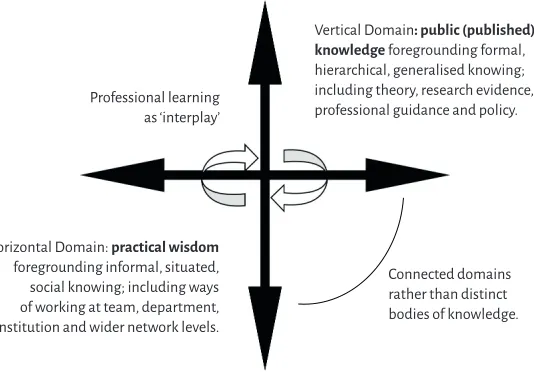
or teacher education departments in universities. This horizontal domain captures and values the situated and social nature of teachers’ knowing.
Figure 1. A situative metaphor for professional learning (Boyd & Bloxham, 2014; Boyd, 2014)
The metaphor of ‘interplay’ helps to capture the contested nature of teacher knowing and the power at play in pedagogical decision-making. For ex-ample, the everyday practice of a teacher will be influenced by how other teachers in the setting work but also by the published national policies on quality assurance and curriculum. It is important for teachers and teacher educators to critically reflect on the metaphors for learning they hold, in relation to their own professional learning and in relation to the learning of their students or pupils. A study undertaken in Spain, of the metaphors for children’s learning held by teachers, suggested that behaviourist metaphors dominate and that social constructivist metaphors were more widely held by trainees than by experienced practitioners (Martinez, Sauleda & Huber, 2001). In relation to their own professional learning, when reflecting on critical incidents at work, a busy teacher may privilege practical wisdom. This may constrain their engagement with research evidence or even with
alternative strategies proposed by relevant professional guidance.
Vertical Domain: public (published) knowledge foregrounding formal,
hierarchical, generalised knowing; including theory, research evidence, professional guidance and policy.
Connected domains rather than distinct bodies of knowledge. Horizontal Domain: practical wisdom
A layered pedagogy
The knowledge or professional knowing of teachers is complex and contested (Calderhead, 1988; Leach and Moon, 2000; Shulman and Shulman, 2004; Ellis, 2007) and the pedagogy of teacher education reflects that complexity. Figure 2. is an attempt to capture teacher knowledge diagrammatically. In this diagram the overlap between pedagogical knowledge and curriculum subject knowledge represents ‘pedagogical content knowledge’ which may be considered as the teacher’s understanding of the key concepts within a cur-riculum subject and their knowledge of how to teach these ideas effectively (Shulman, 1986). However, Figure 2 represents a sociocultural perspective by combining and overlaying ‘practice and identity’ as a teacher and by placing the whole conception of teacher knowledge within the wider social and policy framework.
Figure 2. A diagrammatic view of teacher knowledge
This view of teacher knowledge helps to explain the multiple purposes of teacher educators so that within a formal session they may introduce a key aspect of pedagogy but they might do this within the context of teaching a school curriculum subject. In this situation the student teacher is learning about teaching strategies and related learning theory but also aspects of the subject discipline and pedagogical content knowledge. In a particular learning
Curriculum subject knowledge
Wider context: learners, school, national curriculum, policy framework, community, society Pedagogy:
Approaches to teaching and supporting learning
activity the teacher educator may choose to foreground a particular element of this complex mixture but it may be helpful to consider these as multiple ‘layers of purpose’ within the pedagogy of teacher education (Boyd and Harris, 2010). The primary focus of the teacher educator is on the learning of the student teacher, but they are also concerned for their own continued learning as a higher education teacher and perhaps most importantly on the learning of the pupils (students) in the classes of the student teachers.
Combining Loughran’s ‘learning to teach’ and ‘teaching to learn (2006) with these multiple layers of purpose begins to capture the complexity of teacher education. A question arises as to what extent student teachers are able to handle this complexity. Both teacher educator and student teacher need to be aware of the layers of purpose within a formal session and explicit about which of them they are foregrounding at any one time. Of course discussion of a teaching and learning issue will often range across different layers and that is to be welcomed, but it may lead to confusion rather than clarity if the discussants are not aware of the richness and complexity of the session. For example, the use of artefacts in teacher education sessions may cause confusion for student teachers if they are unsure about the purpose (Ellis et al., 2011).
A central element of becoming a teacher is to learn to see teaching from the perspective of the learners. This is reflected in the pedagogy of teacher education through the adoption of enquiry based approaches. The com-pletion of small scale action research by student teachers usually includes gathering and analysis of pupil voice together with other evidence of learning. The critical analysis and engagement with literature that action research re-quires is intended to help student teachers become critical thinkers who are sufficiently confident to question current practice and their own embedded conceptions of teaching which often may be focused on teaching as telling and learning as transmissive. Modelling by teacher educators appears to offer a strategy that introduces an enquiry based approach to professional learning and it takes advantage of the fact that the student teacher is a learner.
Current views on modelling
edu-cators whilst it acknowledges that all teacher education experiences, many of them beyond intentional planning by the teacher educator, are likely to have some influence on the practice of student teachers.
The basic concept of modelling in teacher education is summarised by the statement that ‘How I teach IS the message’ (Russell, 1997) and more recently this has been referred to as ‘congruent teaching’ (Swennen, Lunenberg and Korthagen, 2008). Teaching is congruent when it models effective teaching and learning strategies that student teachers will be able to reconstruct in their own classrooms. The congruent teaching may also display values held by the teacher (Willemse, Lunenberg and Korthagen, 2005). A problem with using this basic concept is that the student teachers may not hear the message. They may be blissfully unaware that the teacher educator is modelling. In addition, this basic concept appears to be based on an uncritical acceptance of ‘good practice’, that there are effective teaching strategies and learning to teach is simply building a repertoire of those techniques and applying them in your classroom practice. In the proposed framework for modelling based on the literature and presented in Figure 3, the initial level of implicit modelling uses the term ‘congruent teaching’ (Swennen, Lunenberg and Korthagen, 2008) and relies on the student teacher working alone to experience and then unpack the approach of the teacher educator.
Korthagen and Swennen, 2007; Swennen, Lunenberg and Korthagen, 2008). An additional refinement of explicit modelling is to ask the student teachers to
consider their own classroom practice in relation to the teaching strategy mod-elled and to the points raised in the teacher educator’s reflection (Lunenberg, Korthagen and Swennen, 2007; Swennen, Lunenberg and Korthagen, 2008).
Figure 3. A framework for modelling based on the literature
Modelling in Teacher Education
LEVEL 1: Implicit modelling using congruent teaching that models strategies and values: the teacher educator uses strategies and demonstrates professional values
that reflect ‘good practice’ in facilitation of adult learning but that may have some relevance to the context within which the student teachers will be teaching. This ap-proach relies on the experience of that teaching to influence the emerging pedagogy of student teachers and subsequently their practice in classrooms. Within this level the teacher educator may facilitate metacognitive thinking by student teachers in the plenary of the formal taught sessions.
LEVEL 2: Explicit modelling of critical reflection on practice: the teacher educator
steps out of the session and thinks out loud about their approach to teaching. If another teacher educator is in the session then a reflective dialogue between the two teacher educators may take the place of this ‘think aloud’. The teacher educator aims to provide insight into the practical wisdom that underpins the design and facilita-tion of the taught session. They may refer to their underlying beliefs and values and will position the session as an example of adult education.
LEVEL 2a: Building from explicit modelling the teacher educator relates their practical wisdom to public knowledge: the teacher educator extends their explicit
modelling to make some connections from the choices they have made, representing their practical wisdom as a teacher, to public knowledge (published work including learning theory, research evidence, professional guidance and policy).
LEVEL 2b: Building from explicit modelling the teacher educator encourages reconstruction by student teachers: the teacher educator may introduce an activity
It should be noted that in the proposed framework set out in Figure 3. the refinements 2a and 2b are activities that build from explicit modelling, that is not to deny that they may also be used by teacher educators in other situations.
Modelling is a contested element of teacher education and the literature identifies a distinct strategy in teacher education of using a ‘lesson within a session’. For example, in their paper Wood and Geddis (1999) focus on a teacher education session within which an example school maths ‘lesson’ is being taught as a kind of role taking with the tutor playing the class teacher and the student teachers playing the role of pupils. Role taking involves switching to lessons pitched at the age phase of the pupils that the student teachers are being trained to teach. This distinguishes it from congruent teaching which is using strategies in teacher education, a subject discipline in higher education, that have a rationale based in learning theory and may be reconstructed for use in the school classroom. Using a ‘lesson within a session’ is an element of modelling in teacher education that adds com-plexity to the situation.
Much of the literature on modelling in teacher education is based on self study but a small scale empirical study argued that student teachers experience the teaching by their lecturer and modelling enables the teacher educator to act as a role model (Lunenberg, Korthagen and Swennen, 2007). These researchers argue that pedagogical innovation by teacher educators, made explicit through modelling, may be powerful in influencing change in the practice of their student teachers. The study used observation of teacher education sessions and then checking of the findings with the lecturer. They found only modest amounts of modelling in the practice of their sample of ten teacher educators. Another study focused on school-based teacher educators and found that congruent teaching appeared to be widespread but explicit modelling was rare (van Velzen and Volman, 2009).
One of the risks of explicit modelling is that in some ways it makes the teacher educator vulnerable by requiring them to reflect publicly on their practice including all its limitations (Loughran and Berry, 2005). Occasionally, students and even colleagues may take advantage of this in inappropriate ways, perhaps by citing mistakes admitted by the teacher educator as part of their explicit reflection. Accepting this measure of vulnerability does not appear to be an unreasonable demand on teacher educators as they clearly hold positions of power in relation to their student teachers. However, in many cases, including the UK, the quality assurance context and inspection regime of teacher education help to create a relatively high degree of account-ability and it would not be surprising if teacher educators felt constrained in the extent to which they are willing to make themselves vulnerable through explicit reflection on their practice during modelling.
Very little work has been done on the impact of modelling on the learning and practice of student teachers. One study investigated a large number of students completing a child development course using a quasi-experimental approach contrasting student responses to a course based on lectures versus activity based learning (Struyven et al., 2010). This study found that there was no simple link between the way student teachers were taught and their classroom practice and showed considerable critical reflection and recon-struction by the student teachers. However, this study appeared to focus on the impact of congruent teaching rather than explicit modelling.
Teacher educator conceptions
This section applies the analytical framework for modelling presented in Figure 3. to data from semi-structured interviews in two case studies of teacher educators based in different workplace settings within the UK. This exploratory qualitative analysis provides some insight into the practice of teacher educators and is used to inform an evaluation of the framework.
TWO CASE STUDIES
(HE) teacher education programmes but in Further Education College contexts. They will therefore be referred to as ‘HE in FE teacher educators’. The student teachers taught by this group are specialists in a wide range of subjects and may teach in the College or in the workplaces of partnership employer organisations. Many of these student teachers already have an established identity within their vocational area of work for example as a bricklayer, hairdresser, police officer and so on. The study of these HE in FE teacher educators used the semi-structured interviews of twelve lecturers with a range of professional experience in teacher education combined with prior vocational and teaching experience in colleges. The schedule for the semi-structured interviews included a prompt question asking about the place of ‘modelling’ within their approach to teaching student teachers and this provided a data source for the current paper.
The second group of teacher educators (n=9) were volunteer participants based in a case study university department who train teachers for early years and school age phases up to secondary school, which in England means 11 to 18 year olds. For the purposes of this paper these teacher ed-ucators are referred to as ‘University based teacher eded-ucators’. The student teachers in this group are a mixture of undergraduates on three year degree programmes and postgraduates on one year courses who are training to be school teachers. The study of these university based teacher educators used the semi-structured interviews of nine lecturers in a longitudinal case study of a large teacher education university department. The lecturers had between five and ten years of experience in higher education roles combined with prior teaching experience in schools. The interview process asked them to bring and discuss a session plan or teaching resource and to discuss the relevant teacher education session in relation to their chosen teaching strategies.
CONGRUENT TEACHING
‘…as a Teacher Educator I want to be using the best, up to date, current practice in my teaching. Anyone who comes into my class I would like to think will see examples of to coin a better phrase ‘Rolls Royce teaching’ so in every way using all the inclusive practice, differentiating where I can but also embracing the best current practice as regards technologies’
(HE in FE teacher educator)
HE in FE teacher educators training teachers for post compulsory phase hold one conception of modelling as demonstrating what is accepted in their institution as ‘good practice’ in teaching:
‘…College has its own Teaching and Learning Model [for Further Education] that, as teacher educators, we are expected to promote…’
(HE in FE teacher educator)
This model of ‘good practice’ is usually seen as a local set of College rules about how to teach well but it is acknowledged by the teacher educators that it is strongly influenced by the views and criteria of the government appoint-ed quality review body who observe and assess teaching during inspection visits. The review body have direct influence on teacher education practice, for example in one further education college:
‘[the programme’s teaching observation proforma was] designed with those [external quality review body criteria] in mind and there is a link…and part of that was feeling a responsibility to our Trainee Teachers that when they finish with us…and they’re cast out into the Institution that [exter-nal review body] type observations by…inter[exter-nal quality teams, isn’t then a shock and we’re not grading them in 1’s and 2’s and then the audit team come crashing in and say ‘well actually you’re inadequate’…’
(HE in FE teacher educator)
University based teacher educators, but in their workplace the institutional ‘rules’ for what constitutes good practice were more distinctly related to ex-pectations for higher education of adults. However, many of these University based teacher educators use role play and congruent teaching as occasions when they feel they are demonstrating the ‘good practice’ of school teachers as defined by the national quality review body for teaching in schools.
Although these teacher educators mainly see modelling in relation to teach-ing strategies some also claim to model values such as beteach-ing student-centred or supporting the diversity of learners. Some HE in FE teacher educators did not use the term ‘modelling’ but when probed they described elements of congruent teaching as part of their practice. Some HE in FE teacher ed-ucators considered modelling to be only appropriate to student teachers in the early stages of training. The teacher educators linked their constrained use of modelling to the fact that many of their student teachers are in voca-tional subjects and teach in practical workshops and workplaces. They did not consider their modelling of taught sessions to be directly relevant to these student teachers. In some ways this reflected their limited conception of modelling which was often focused on demonstrating ‘good practice’ in classroom teaching rather than emphasising critical reflection as a teacher.
University based teacher educators training teachers for school age phases often introduced the term ‘modelling’ unprompted into discussion of their taught sessions and were familiar with the term even if they did hold a varied range of conceptions of what it involves. These teacher educators frequently used a lesson within a session. In these cases to some degree they appear to take roles and treat the group of student teachers as a class of pupils in order to demonstrate school teaching and school classroom management:
‘...so I tended to model effective practice in secondary (school) classes, but I’m still wondering if modelling that is necessarily the right way that adults learn…’
(university teacher educator)
These teacher educators do not distinguish clearly in their descriptions of practice between modelling and role taking.
considered to be explicit modelling unless some kind of stepping out by the tutor is described in which the process of metacognition is reflected on as a teaching strategy. In other words there needs to be an additional layer to the tutor’s approach in order for the practice to become explicit modelling. In part this is related to the lack of distinction made by the teacher educators between their own higher education practice and the academic and age phase level of teaching by their student teachers. If this distinction is not made by the tutors in their description of modelling they are not considered to be using explicit modelling. This lack of distinction by tutors appears likely to confuse the student teachers because the purpose of the teacher educator within a complex pedagogy is not made clear to the learner.
EXPLICIT MODELLING
About half the members of both groups of teacher educators describe explicit modelling within their teacher education practice:
‘...it’s very easy to watch someone who knows what they’re doing and who’s good at it but not actually realise what they’re doing...so I try and make it as explicit as I possibly can...what I’m doing, how I’m doing it, why I’m doing it which is the most important thing…’
(university teacher educator)
These teacher educators claim that to different degrees they think out loud and unpack the session or a learning activity within it to explain to the student teachers the choices they made in planning and facilitation. This involves some degree of ‘stepping out’ of the taught session and some em-phasis on the impact on student teachers as learners.
‘The organisation [and] management of the session mirrors the content, so for example if I’m doing a session on Social Constructivism…to actually get the students to talk to each other to construct their own knowledge as part of the session…’
(university teacher educator)
Many of the teacher educators referred to ‘practice what we preach’ as an explana-tion of this common sense approach, this is really part of their practice of congruent teaching. For example many of the teacher educators would use assessment for learning strategies in a session whose content is assessment for learning. However, only one teacher educator, unprompted in the interviews, claimed that they would include reference to learning theory in their explicit modelling.
In the data there was little significant evidence of teacher educators finding time for activities in which the student teachers were required to use critical reflection and reconstruct (or reject) the modelled strategy in relation to their own classroom practice:
‘…it will either be through questioning…why do you think? - or it will be me actually explaining why I’m carrying out a particular task - it’s teacher education - I’m explaining the process and the advantages so that the group can not only get that those benefits which I’ve just alluded to but also in terms of perhaps applying it to their own teaching…’
(HE in FE teacher educator)
SUMMARY
This analysis of teacher educator perspectives may be summarized as follows:
– Congruent teaching appears to be widely used by teacher educators – Congruent teaching is sometimes blurred by use of role play – Explicit modelling is used by some teacher educators
– Teacher educators model teaching strategies but also professional values – The workplace setting and quality assurance context influences what
is modeled
– Teacher educators may struggle to ‘apply theory to practice’
– Teacher educators provide only limited time and support for
recon-struction by trainees
Clearly more research is required. It should include observation of teacher educators at work and also gather and analyse the voices of trainee teachers. However, despite the limitations of the interview based study it does provide some basis for developing the use of modelling by teacher educators.
Modifying modelling
Broadly speaking this analysis of UK based teacher educators supports the findings of European studies. The framework for modelling based on cur-rent literature and presented in Figure 3. provides a useful base to guide the pedagogy of teacher educators. However, as indicated by previous studies, there certainly seems to be a need for further development of modelling by teacher educators (Lunenberg, Korthagen & Swennen, 2007).
In refining explicit modelling teacher educators appear to struggle to ‘apply theory to practice’ although a small scale study found that coaching was useful (Swennen et al., 2008). It may be useful for teacher educators to adopt alternative metaphors for professional learning. Positioning teacher learning as interplay between vertical and horizontal domains of knowing may help to more highly value the practical wisdom of teachers but critically consider it in relation to public knowledge including policy. In facilitating this interplay teacher educators will need to be knowledgeable, confident and skilled in critically engaging with public knowledge as well as with practical wisdom. School-university partnership in teacher education brings together teacher educators who are likely to have different strengths in each domain. The level of scholarship required of teacher educators in school-based teacher education programmes where the input of a university is minimal is a contested issue (Boyd & Tibke, 2012; White, 2013). The refinement of reconstruction also deserves attention by teacher educa-tors. Students may reconstruct their learning experiences in different ways as they move across in to their own classrooms as beginner teachers (Struyven et al., 2010). Allowing time and providing support for reconstruction, following explicit modelling, may not always be necessary or feasible but it certainly seems worthy of some consideration and of further investigation by teacher educators. The analysis raises some questions for teacher educators in relation to their use of modelling and the framework based on the literature has been enhanced by including some prompt questions in Figure 4.
Figure 4. A framework for modelling, by teacher educators, in formal taught sessions
Teacher educator modelling in formal taught sessions
LEVEL 1: Implicit modelling using congruent teaching: the teacher educator deliberately
uses teaching and learning strategies and demonstrates professional values that reflect ‘good practice’ in facilitation of adult learning but that are also relevant to the student
teach-ers’ own approaches to teaching. This congruent teaching aims to influence the emerging pedagogy of student teachers and subsequently their practice in classrooms. Within this level the teacher educator may facilitate metacognitive thinking by student teachers about their own learning but does not explicitly ask them to consider how their own experience as learners might influence their approach to teaching.
In what ways is my teaching congruent with the workplace of the student teachers? To what extent am I distinguishing clearly between role play and congruent teaching? How does my context, including the quality assurance regime, influence my pedagogy?
Teacher educator modelling in formal taught sessions
LEVEL 2: Explicit modelling of critical reflection on practice: the teacher educator
steps out of the session and thinks out loud about their approach to teaching. If anoth-er teachanoth-er educator is in the session then a reflective dialogue between the two teachanoth-er educators may take the place of this ‘think aloud’. The teacher educator aims to provide insight into the practical wisdom that underpins the design and facilitation of the taught session. They may refer to their underlying beliefs and values and will position the session as an example of adult education.
To what extent am I prepared to explicitly and critically reflect on my teaching?
What impact is explicit modelling having on the emerging pedagogy of my student teachers?
LEVEL 2a: Building from explicit modelling the teacher educator considers how their practical wisdom relates to public knowledge: the teacher educator extends
their explicit modelling to make some connections from the choices they have made, representing their practical wisdom as a teacher, to public knowledge (published work including learning theory, research evidence, professional guidance and policy).
To what extent is it possible or helpful to relate my design choices to public knowledge? How does my modelling help student teachers to reflect on their own classroom practice?
LEVEL 2b: Building from explicit modelling, the teacher educator encourages recon-struction by student teachers: the teacher educator may introduce an activity that
requires student teachers to respond to the issues raised in the modelling by reflecting on their own classroom practice. The student teachers begin to consider how they may be able to reconstruct the approaches to teaching or professional values that have been modelled within their own classroom practice.
When and to what extent do my student teachers reconstruct their personal learning experi-ences to inform their own classroom teaching?
How does explicit modelling provoke such reconstruction?
Figure 5. A layered pedagogy for teacher education
Teacher educator learning to teach
(scholarship and research) Teacher educator teaching to learn (critical reflection / enquiry)
Teacher educator uses explicit modelling of being a teacher learning from practice
Trainee teacher learning to teach
(taught sessions) Trainee teacher teaching to learn (workplace learning)
Trainee teacher uses explicit modelling of being a learner
Pupil / student learning Pupil / student learning to learn
The proposal set out in Figure 5. suggests a more explicit acknowledge-ment by teacher educators of the domains of their complex and layered pedagogy. The teacher educator models ‘being a learner’ for the trainees. The trainees in turn model ‘being a learner’ for their pupils or students. The teacher educator is modelling being a learner and ways of knowing within the professional field of teacher education and development. The trainee teacher is modelling being a learner and ways of knowing within a particular curriculum subject discipline, for example modelling being a Historian or being a Scientist.
REFERENCES
Biggs, J. & Tang, C.S. (2011). Teaching for quality learning at university: what the student does. Maidenhead: Open University Press.
Blackler, F. (1995). Knowledge, knowledge work and organizations: An overview and interpretation, In D.J. Hickson and S.R. Clegg, Organization Studies, 6, 1021–1046. DOI: 10.1177/017084069501600605
Boyd, P. (2014). Learning Teaching. In H. Cooper (Ed.), Professional Studies in Primary
Education, London: Sage.
Boyd, P. & Bloxham, S. (2014). A situative metaphor for teacher learning: the case of university tutors learning to grade student coursework. British Educational Research
Journal, 40 (2), 337–352. DOI: 10.1002/berj.3082
Boyd, P. & Harris, K. (2010). Becoming a university lecturer in teacher education: Expert school teachers reconstructing their pedagogy and identity. Professional
Develop-ment in Education, 36, (1–2), 9–24. DOI 10.1080/19415250903454767
Boyd, P. & Tibke, J. (2012). Being a school-based teacher educator: developing pedagogy and identity in facilitating work-based higher education in a professional field.
Practitioner Research in Higher Education, 6 (2), 41–57. ISSN 1755–1382
Calderhead, J. (1988). The development of knowledge structures in learning to teach. In J. Calderhead (Ed.), Teachers’ professional learning, London: Falmer Press. Ellis, V. (2007). Taking subject knowledge seriously: from professional knowledge recipes
to complex conceptualizations of teacher development. The Curriculum Journal, 18, (4), 447–462. DOI: 10.1080/09585170701687902
Ellis, V., Blake, A., McNicholl, J. McNally, J. (2011). The work of teacher education: final
report. Higher Education Academy. Retrieved March 2012, from
http://www.ed- ucation.ox.ac.uk/wordpress/wp-content/uploads/2010/07/WoTE-Phase-2-Final-Report.pdf
Fuller, A., Hodkinson, H., Hodkinson, P., Unwin, L. (2005). Learning as peripher-al participation in communities of practice: a reassessment of key concepts in workplace learning. British Educational Research Journal, 31 (1), 49–68. DOI: 10.1080/0141192052000310029
Hager, P., Hodkinson, P. (2009). Moving beyond the metaphor of transfer of learning.
Brit-ish Educational Research Journal, 35 (4), 619–638. DOI: 10.1080/01411920802642371
Hager, P. (2008). Learning and metaphors, Medical Teacher, 30 (7), 679–686. DOI:10.1080/01421590802148899
Kember, D. (1997). A reconceptualisation of the research into university academics’ conceptions of teaching. Learning and Instruction, 7 (3), 255–275.
Lakoff, G., Johnson, M. (1980). Metaphors we live by. Chicago: Chicago University Press. Lave, J., Wenger, E. (1991). Situated learning: legitimate peripheral participation.
Cam-bridge: Cambridge University Press.
Lortie, D.C. (1975). Schoolteacher: A sociological study. Chicago: The Chicago University Press.
Loughran, J. (2006). Developing a pedagogy of teacher education: understanding teaching
and learning about teaching. New York: Routledge.
Loughran, J., Berry, A. (2005). Modelling by teacher educators. Teaching and Teacher
Education, 21 (2), 193–203. DOI: 10.1016/j.tate.2004.12.005
Lunenberg, M., Korthagen, F., Swennen, A. (2007). The teacher educator as a role model.
Teaching and Teacher Education, 23 (5), 586–601. DOI 10.1016/j.tate.2006.11.001
Martinez, M. A., Sauleda, N.,Huber, G. L. (2001). Metaphors as blueprints of thinking about teaching and learning. Teaching and Teacher Education, 17 (8), 965–977. DOI: 0.1016/S0742-051X(01)00043-9
Murray, J., Male, T. (2005). Becoming a teacher educator: evidence from the field, Teaching
and Teacher Education, 21 (2), 125–142. DOI: 10.1016/j.tate.2004.12.12006
Russell, T. (1997). Teaching teachers: How I teach is the message. In J. Loughran & T. Russell (Eds.). Teaching about teaching: purpose, passion and pedagogy in teacher
education. London: Falmer Press.
Sfard, A. (1998) On Two Metaphors for Learning and the Dangers of Choosing Just One.
Educational Researcher, 27 (2), 4–13. DOI: 10.3102/0013189X027002004
Shulman, L. S., Shulman, J.H. (2004). How and what teachers learn: a shifting perspective.
Journal of Curriculum Studies, 36 (2), 257–271. DOI: 10.1080/0022027032000148298
Struyven, K., Dochy, F., Janssens, S. (2010). Teach as you preach: The effects of stu-dent-centred versus lecture-based teaching on student teachers’ approach-es to teaching. European Journal of Teacher Education, 33 (1), 43–64. DOI: 10.1080/02619760903457818
Swennen, A., Lunenberg, M., Korthagen, F. (2008). Preach what you teach! Teacher educators and congruent teaching. Teachers and Teaching: theory and practice, 14 (5–6), 531–542. DOI: 10.1080/13540600802571387
Swennen, A., Jones, K., Volman, M. (2010). Teacher educators: their identities, sub-iden-tities and implications for professional development. Professional Development in
Education, 36 (1–2), 131–148. DOI: 10.1080/19415250903457893
Taylor, A. (2008). Developing understanding about learning to teach in a universi-ty-schools partnership in England. British Educational Research Journal, 34 (1), 63–90. DOI: 10.1080/01411920701491995
Van Velzen, C., Volman, M., Brekelmans, M., White, S. (2012). Guided Work-based Learning: Sharing practical knowledge of teaching with student teachers. Teaching
and Teacher Education, 28, 229–239. DOI: 10.1016/j.tate.2011.09.011
Van Velzen, C.,Volman, M. (2009). The activities of a school-based teacher educator: a theoretical and empirical exploration. European Journal of Teacher Education, 32 (4), 345–367. DOI: 10.1080/02619760903005831
Wenger, E. (1998). Communities of Practice: learning, meaning, and identity. Cambridge: University Press.
White, E. (2013). Being a teacher and teacher educator – developing a new identity?
Willemse, T. M., Lunenberg, M.L., Korthagen, F.A.J. (2005). Values in education: a chal-lenge for teacher educators. Teaching and Teacher Education, 21 (2), 205–217. DOI: 10.1016/j.tate.2004.12.009