Perspectives, 2 (2). pp. 107-117.
Downloaded from: http://insight.cumbria.ac.uk/id/eprint/4149/
Usage of any items from the University of Cumbria’s institutional repository ‘Insight’ must conform to the following fair usage guidelines.
Any item and its associated metadata held in the University of Cumbria’s institutional repository Insight (unless stated otherwise on the metadata record) may becopied, displayed or performed, and stored in line with the JISC fair dealing guidelines (available here) for educational and not-for-profit activities
provided that
• the authors, title and full bibliographic details of the item are cited clearly when any part of the work is referred to verbally or in the written form
• a hyperlink/URL to the original Insight record of that item is included in any citations of the work
• the content is not changed in any way
• all files required for usage of the item are kept together with the main item file.
You may not
• sell any part of an item
• refer to any part of an item without citation
• amend any item or contextualise it in a way that will impugn the creator’s reputation
• remove or alter the copyright statement on an item.
The full policy can be found here.
Citation
Hofer, C. (2015) The introduction of the singapore bar model in year 1 problem solving: a personal The Introduction of the Singapore Bar Model
in Year 1 Problem Solving: A Personal Reflection
The STeP Journal Student Teacher Perspectives
Copyright © 2015 University of Cumbria Vol 2 (2) pages 107-117
Claire Hofer
Canterbury Christ Church University
Abstract
M stud i ol ed e aluati g i flue e o hildre s lear i g, through i trodu i g the
Singapore bar model to a group of Year 1 children and the impact this had on their problem solving. Since this is such a new area of study, I felt that the effectiveness of the pedagogical approaches undertaken, in order to make this accessible and beneficial, for Year 1 pupils, needed to be explored and the implications for future practice to be analysed.
Key findings: The use of the bar to model problems and number sentences allowed specific links between addition and subtraction to be made and some of the children were able to identify patterns and apply their understanding, engaging in higher order thinking and deepening understanding. However, pictorial representations needed to be supported with concrete
experiences using manipulatives and scaffolded with questioning, in order for the children to access and benefit from the model.
Introduction
Due to what has been described as the United Kingdoms stag atio (DfE, 2015) of performance in mathematics, compared to the rest of the world, the government has spent recent years analysing mathematics teaching in high performing jurisdictions, to discover what makes these systems effective and how this can be implemented into our own education system. The recommendations of the Vorderman report (Vorderman et al. 2011), which highlighted the extent to which this country is apparently trailing its economic competitors, with regard to mathematics education, led to the development of the new national curriculum (DfE, 2013), with a strong focus on mastery, rather than accelerated learning. The mastery approach is a model used in the high performing Asian systems, such as Shanghai and Singapore, with a key emphasis on slow, deep learning. One significant pedagogical approach, which has started to be imported into the education systems of the UK and other Western countries, as a direct result of international comparative studies, is the use of the Singapore Bar Model. Using models to represent word problems and number
relationships has been a significant element of the mathematics curriculum in Singapore since the early 1980s (Clark, 2013). This visual approach to problem solving has been accredited as part of
“i gapore s su ess i glo al league ta les and, as a result, the government are hoping that
implementing the system into British classrooms will contribute towards close the gap in attainment. Although such bar modelling is first introduced to pupils, in Singapore, in Grade 3, where children are aged 8-9, research is currently being carried out in pilot schools across the UK, to introduce it in Year 1. Duri g this stud I ai to e aluate i flue e o hildre s lear i g, through i trodu i g the Singapore bar model to a group of Year 1 pupils, specifically regarding their approach to solving word problems.
Literature review
Government response to international data
over recent years (OECD, 2012; Mullis et al. 2012). Explaining and narrowing this gap has become an educational priority for the UK and other Western countries. Over the last decade, OFSTED have
o siste tl ide tified pupils la k of o eptual u dersta di g in mathematics, across all key stages, and a reliance on factual recall of knowledge and procedural efficiency (DCSF, 2008; DfE, 2012). The aims of the current national curriculum (DfE, 2013) are set out to overcome this problem, with an emphasis on fluency, reasoning and problem solving. Children are expected to consolidate their understanding of the basics of mathematics, and develop their ability to apply their knowledge, before moving onto the next aspect, developing what Skemp (1989) refers to as relational understanding as opposed to instrumental understanding. This can be identified in the setting of
o je ti es to spe ifi ear groups. ‘ather tha a elerati g o to the follo i g ear s o je ti es,
pupils are now expected to deepen their understanding within the parameters of their own year group. This forms the fundamental basis for the mastery curriculum, followed in the Asian systems, where, in the early years of primary school, children become secure with number before progressing onto the next stage. (NCTL, 2014). Formal practice and drill are embedded within the culture of teaching, in order for children to master the basics and become fluent in recalling number facts.
In addition to the introduction of the revised curriculum, the government have also established a network of 32 maths hubs across the country, which have been funded to implement and lead other schools in developing an Asian style approach to mathematics teaching and learning, including using specialised teachers in each subject and following Singapore style text books to plan lessons, which
pro ide a ohere t a d stru tured progra e. (DfE, 2015). Such consistency of using one variant model throughout schooling, like the bar model in problem solving, is fundamental to the design of the Singapore curriculum. The formation and purpose of the maths hubs is signified by the
government view that there is o reaso h hildre i E gla d a ot a hie e the sa e
sta dards i aths as those i Japa , “i gapore a d Chi a, DfE, 2014). The merits of the Asian
systems are evident for the world to see when comparing academic attainment in world league tables.
In order for the UK to progress through the world rankings, the government action of importing these proven successful approaches could appear to be the logical way forward. However,
Alexander (2014) questions the potential value of comparing global systems in league tables, such as PISA, since they do not consider the wider socio-cultural aspects that such systems are imbedded in. Countries are unique and distinct from one another. Therefore, what equates to a successful system in one country may not work as well in another. Eastern ideologies vary from those in the West and impact upon the way education is both valued and delivered. This is supported by the Vorderman report (2011, p29), which was central to the government education reforms in mathematics, advising that i ter atio al o pariso s ust e applied i the o te t of this ou tr .
Inconsistencies in adopting foreign approaches
their understanding. If English children are expected to do more than their Asian counterparts in Year 1, then it could be considered appropriate to introduce the bar modelling strategy earlier. However, this may be considered contradictory to the mastery approach to learning. Although teachers are not able to progress children onto the curriculum objectives of the following year, the objectives themselves have been set in a way which means more content is being covered at an earlier stage. This becomes evident when comparing the current national curriculum to the previous one (DfES, 1999). As a result, it could be argued that acceleration has been government-imposed and, therefore, implementing Asian mathematics systems, without the solid foundation needed to build upon, will not necessarily yield the desired improvement in conceptual understanding and subsequent academic attainment for UK pupils.
The significance of bar modelling
The structure of the Singapore curriculum dictates the delayed introduction of the bar, specifically, to model problems. Its approach follows Piaget s 9 ) constructivist theory that children construct their own knowledge, through experience – the assimilation and accommodation of ideas. The Curriculum is firmly based in representing mathematical concepts, as concrete, pictorial and abstract, according to childre s de elop e tal stage of thi ki g (Kheong, 2009) This links directly
to Bru er s (1966) suggested phases of development: enactive, iconic and symbolic. Bar modelling fits into, what Bruner describes as, the iconic phase of development, where children begin to represent mathematical concepts in a more abstract way, through pictorial representations. In Singapore, children are deemed to be ready for this step towards abstract understanding by Grade 3. However, as stated previously, in England, contrasting curriculum demands have led to children being expected to internalise abstract mathematics at a younger age than their Singapore
counterparts. In order to do so, introducing iconic representations, such as the bar model, may be beneficial at a younger age.
Personal response to the literature
Government trends towards the adoption of foreign policy could potentially conflict with the expectations of our own mathematics curriculum, in particular within Key Stage 1, where in Asia children are consolidating their understanding of number, while in the UK children are applying abstract thinking. However, adjusting practice to conform to imposed policy is not a new concept for education professionals and, therefore, finding ways to make it work for the children we teach should remain a part of our professional responsibility. As a result, this study aimed to investigate how I could introduce the Singapore bar model, to a group of Year 1 pupils, in a way which had a positive impact upon their learning. The bar model is just one aspect of the Singapore Mathematics curriculum and it is acknowledged that the methods adopted and context in which it took place, did not coincide with that of the Singapore curriculum. However, since this is such a new area of study, I felt that the effectiveness of the pedagogical approaches undertaken, in order to make this
accessible and beneficial, for Year 1 pupils, needed to be explored and the implications for future practice to be analysed.
Methodology
In deciding upon an appropriate framework in which to conduct my research, I first considered the purpose of my research, that is to say, what I was hoping to achieve through carrying it out. This
stud i ol ed i trodu i g the “i gapore ar odel a d e aluati g its effe t o hildre s lear i g,
through a self-study, refle ti g o i pa t o the hildre s lear i g. The research undertaken focused on my own personal development and a commitment to improve my own practice, in order to result in the improved learning outcomes of both the children who took part in the study and also those I teach in the future. McNiff and Whitehead (2011 p.18) refer to action research as being a
there is an end point or conclusion that can be drawn, through directly comparing sets of data, the purpose of my study was to reflect on the impact my actions and choices had on the children, at that point in space and time, and what to draw from this to take forward into future practice.
Hopkins (1993) suggests that the action research framework is most appropriate where a problem or scenario results in an intervention, the outcomes of which are then re-evaluated. This then proceeds onto another potential round of interventions. Had the research been longer, this would have formed the first cycle of action research, where my next cycle would have been informed through the reflection of this one, and so on. Le i 9 , ited i Tho as, refers to a ir le of
pla i g, a tio a d fa t fi di g resulti g fro the a tio , hi h i tur leads to so ial ha ge.
This cycle of action and reflection was central to the on-going teaching process over the course of the study. It is acknowledged that such reflections are personal and, as a result, will be biased, based on my own positionality within the system I was operating in.
In order to support and self-validate (McNiff and Whitehead, 2011) my reflections, the data
collected involved observing, marking and evaluating. This triangulation (Thomas 2013) provided me
ith opportu ities to refle t o differe t aspe ts of the hildre s lear i g a d ga e e a ore
accurate insight into their learning outcomes. Cohen et al. (2007) suggest that observation is powerful in gaining insight into situations. Being a participant observer allowed me to construct a
depth of k o ledge, regardi g the progressio of the hildre s u dersta di g, through
participating within their learning experience, which would not have been possible had I observed from outside the situation.
Method
I selected a focus group of seven Year 1 pupils. These were deemed, by the class teacher, to be high ability children in the class, based on a combination of their English and Maths abilities. I chose this group because the nature of the tasks I had prepared involved reading word problems and I felt that these children would be best suited, considering how young the children were and given the level of both maths and reading involved.
The children were given an initial problem solving activity sheet, Activity 1. This consisted of 10 questions with two of each type of problem: aggregation, augmentation, take away, counting back and find the difference. They had 15 minutes to answer the questions and had access to the
following resources: number lines, hundred squares, counting bears, multilink cubes and Cuisenaire rods.
I was a participant observer and conducted a semi-structured observation, recording their talk during the activity, approach to the task, engagement and choice of resources on an observation form. My role as the observer was to keep the children on task, read questions if they were unsure what it said and use questioning to help guide them if they were stuck. I did not give them the answers or indicate if their answers were correct or not.
and problems using a bar. The main focus was on aggregation, where the bar was representing the total of two groups that were combining. Representing take-away problems was also introduced to the top two groups, including the focus group. The sessions provided children opportunities to represent calculations using bars, through a range of manipulatives, as well as using iconic representations.
The focus group were finally given a problem solving sheet, Activity 2, in the same format to the initial activity. The same resources were available as before and they were given the same time limit. I recorded observations in the same format. My observing role was the same as it was previously.
Limitations
Because this was such a small study it would be inappropriate to make generalised conclusions based on these results. All of the children in the focus group are considered to be working at a high ability and are not representative of the class. Teaching problem solving over four lessons, prior to Activity 2, is likely to have impacted the result, despite the specific strateg ei g taught. Childre s choices of strategies and resources may have been impacted by their desire to please me, as I had been teaching and observing them. The time period to conduct the research was very short and, therefore, it was impossible to introduce the bar model at the pace intended in the Singapore curriculum.
I fully considered and complied with the ethical guidelines set out by Canterbury Christ Church University, gaining full consent of the school and ascent of the pupils involved. I was authorised by the Head Teacher to use audio recording equipment during my observations.
Results and analysis
In order to begin to understand the effectiveness of my teaching, with regard to helping children progress in their understanding of modelling problems using a bar, first the data collected from
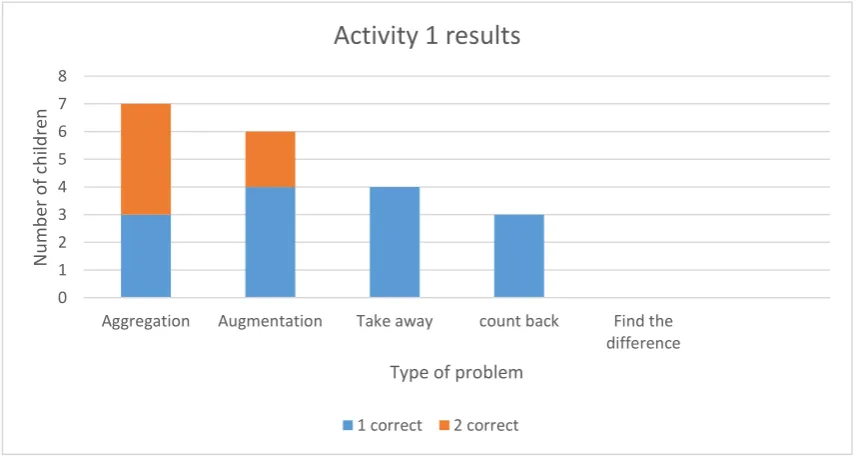
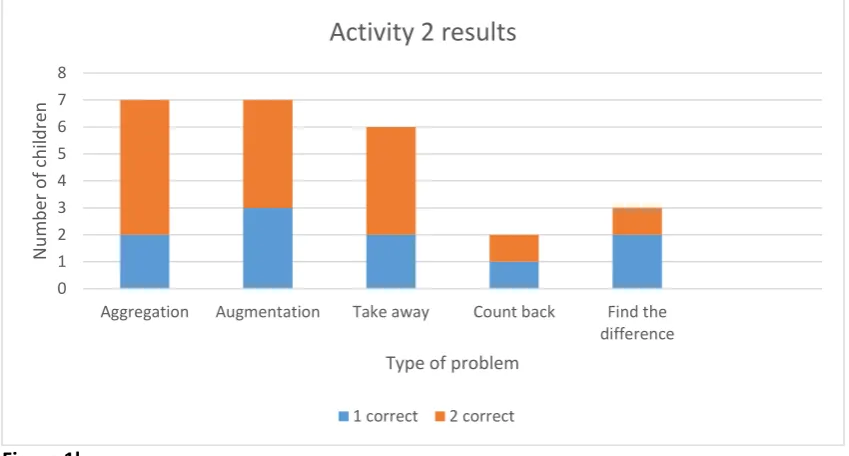
A ti ities a d as a al sed. The o pariso of hildre s scores from the activities undertaken pre and post teaching revealed surprising results. Figures 1a and b (below) show the overall increase in scores between Activity 1 and Activity 2.
Figure 1a. 0 1 2 3 4 5 6 7 8
Aggregation Augmentation Take away count back Find the difference
N
u
m
b
e
r
o
f
ch
il
d
re
n
Type of problem
Activity 1 results
Figure 1b.
At first glance, it is apparent that more questions were answered correctly in Activity 2, particularly those relating to the models of subtraction. This was to be expected after having four lessons involving problem solving, where some of the teaching specifically centred on take away problems. However, closer analysis of the data reveals that only three of the children actually improved their scores between the two tests. These children scored significantly higher on Activity 2, while the other four children scored the same on both activities. Figures 2a and b (below) show the
reakdo of ea h hild s s ore o ea h of the a ti ities.
Table 1a. Breakdown of Activity 1 results.
Name
Aggregatio n
Augmentat
ion Take away Count back Find
difference Total
GG 1 1 1 1 0 4
CC 1 1 1 1 0 4
MJ 2 0 0 0 0 2
AM 2 2 0 0 0 4
AB 2 2 1 0 0 5
ER 2 1 1 1 0 5
TR 1 1 0 0 0 2
Total 11 8 4 3 0 26
0 1 2 3 4 5 6 7 8
Aggregation Augmentation Take away Count back Find the difference
N
u
m
b
e
r
o
f
ch
il
d
re
n
Type of problem
Activity 2 results
Table 12b. Breakdown of Activity 2 results.
Name
Aggregatio n
Augmentati
on Take away Count back
Find
difference Total
GG 2 1 1 0 0 4
CC 2 2 2 1 1 8
MJ 2 2 2 0 1 7
AM 2 1 1 0 0 4
AB 1 2 2 0 0 5
ER 2 2 2 2 2 10
TR 1 1 0 0 0 2
Total 12 11 10 3 4 40
The possible reasons for these differences will be examined below:
Activity 1
Activity 1 revealed that most of the children added the numbers in the question, regardless of the problem. During the activity, the children appeared unsure of what the questions were asking and were unable to approach them in a way which would lead them to the correct answer. They lacked strategies to unpick the questions. As a result, adding the numbers could have seemed like the easiest option for most of them, as it was an operation they were confident using and it resulted in them making a meaningful mark in the answer space. Although most of the children used resources during the activity, they selected these prior to reading the questions and did not change them during the activity. Therefore, their choices were not informed by which was best placed to help them solve the problem. Consequently, the resources served little purpose, other than to distract them. Nickson (2000) argues that although interacting with concrete manipulatives can promote thinking, the child does not necessarily gain a deeper conceptual understanding. Resources are not always appropriate to embody a concept and children may not have the guidance and scaffolding to use them in a way which supports their transition towards the abstract.
ER was able to successfully reason a counting back question and, with some scaffolding through questioning, modelled the problem with multilink cubes to support her reasoning. However, on the following question she proceeded without using cubes and got it wrong. This could suggest one of two things: that she lacked confidence in using the manipulatives available, without adult guidance; or she felt that using resources to help her make sense of the question would be a sign of weakness and lack of understanding.
Activity 2
The second significant factor was their ability to apply this strategy to answer questions they were unfamiliar with. Previously, I discussed one of the limitations of this study as being that, through teaching problem solving all week, the children were more likely to be better at answering the questions, despite the method they used. However, the problems set during lessons focussed specifically on aggregation and take away. The children had received no prior teaching relating to find the difference. The scores from Activity 1 coincide with the children lacking the skills to decode these problems – none of them got either of the questions correct. Nevertheless, CC, MJ and ER were able to answer one or both of these questions correctly on Activity 2. Modelling comparison problems in 2 bars involves a different representation to the aggregation and take away problems involving one bar, which the children had been learning. Even so, the children were able to make connections with their existing learning and had the confidence to take risks in engaging with something they were unfamiliar with. Although they did not construct two separate bars and then compare the quantities, they were successful in adapting the strategy known to them for one problem and applying it to an unfamiliar problem. Through manipulating the cubes to make a bar, representing part of the problem, they were able to visualise and decode what the question was actually asking. This links to findings made through the Shanghai teacher exchange (NCTL, 2014),
here a ke feature of the Chi ese hildre as their o fide e a d illi g ess to atta k
problems by using, what was des ri ed as, their perso al toolkit of strategies.
GG also used multilink cubes and appeared to be attempting to model the problems in a bar. However, she was less successful and this could have been due to the lack of adult support to scaffold her reasoning. Although she knew the strategy she wanted to use, she struggled to link the
o rete a ipulatio of the u es to the a stra t u dersta di g of the pro le . AB, AM a d T‘ s
approaches were less systematic. They did not attempt to use the Singapore Bar Model, using concrete or pictorial representations. At the egi i g of A ti it , AM stated I just goi g to
add the all, irrori g hat a of the hildren had done during Activity 1. As with Activity 1, these children appeared to lack the skills to decipher what the questions were actually asking. They could not visualise the problems.
Surprises
AB s la k of i pro e e t et ee the 2 activities was unexpected, as he had shown evidence of making connections within his learning, in particular the relationship between adding and taking away, and applied his knowledge throughout the lessons. His surprisingly low score on Activity 2 could be attributed, in part, to his desire to finish first, whether or not his answers were correct. In addition, he was the only child who chose not to use any resources in either activity. On completing Activity 2, he commented I did t e e ha e to use a thi g. This could be indicative of his attitude to resources as being things that those who struggle need to use. It may have been that he did want to appear inferior by using the resources available to him.
AB s reluctance to use concrete resources could also be linked to his readiness to progress onto more iconic representations. This was also supported in his ability to use such representations during the taught sessions. Despite his ability to use iconic representations of the bar, during a teaching session, I introduced the multilink cubes to help him progress to an extension activity involving a take away problem. Through interacting with the concrete manipulatives, he was able to visualise the problem and move forward in his abstract understanding of what the question was asking, subsequently arriving at the correct answer. The choice of resource used to embody a concept and the point at which it is introduced are crucial to its effectiveness in progressing the
enabled him to internalise the concept. Working independently in Activity 2, AB lacked the necessary teacher intervention to help scaffold his learning.
During the teaching sessions, the children used information from the word problems to label pre-drawn bars. The bars were pre-pre-drawn because I felt it would take Year 1 children too much time to draw them themselves and that for some, a lack of fine motor skills could result in bars looking messy and causing confusion. However, in order to avoid influencing the children in their approach to solving the problems, I had not drawn any bars on either Activity 1 or 2. Because the children had not had the practice in constructing their own bars, some, particularly AB who preferred not to use resources, may not have associated using this method with these problems or may not have felt confident in constructing and labelling the bar without the template used during the lessons. None of the children used pictorial representations of the bar to help them solve the problems. Whereas ER, CC and MJ were able to use the multilink cubes to successfully model the problems in bars, some of the other children, like AB and GG, may have struggled linking the concrete to the abstract. Had such a template been drawn, it is possible that these children may have adopted this strategy more readily and scored much higher.
My personal learning journey
In this small scale study I have been able to reflect on my own practice and the impact of the pedagogical decisions I made in relation to introducing Year 1 children to the Singapore Bar Model. The use of the bar to model problems and number sentences allowed specific links between addition and subtraction to be made and some of the children were able to identify patterns and apply their understanding, engaging in higher order thinking and deepening understanding. It helped children to visualise problems and unpick questions. Some of the children gained confidence in attempting more difficult questions, since they developed strategies that they were able to apply. However, using iconic representations alone may not have been sufficient in supporting the children in their learning, especially when taking into account their level of cognitive development at age 5-6. It was through scaffolding the learning with the use of questioning, using manipulatives, and making key pedagogical decisions at specific moments of learning that the children were able to benefit from the model. The introduction of Asian textbooks could suggest that such decisions will be removed from the teacher in the future and simply following the instructions set out will lead to successful learning outcomes. However, I would hope that the government maintain their stance of supporting teacher autonomy (DfE, 2011). As a result, adjusting to the adoption of successful international strategies can be done in a way, where teachers respond to the learning needs of the children in their class and maximise the benefits for the children they teach, as in the case of any policy change, hence, maintaining professional integrity.
Through this study I have come to realise the importance of concrete experiences for children to gain conceptual understanding and the potential difficulties in bridging the gap between the concrete and abstract, particularly for young children. Children may be able to engage with model representations but they need to continue to revisit and consolidate with concrete experiences. Therefore, rather than viewing the bar model as the next step in progressing children s
References
Alexander, R. (2014) International Evidence, National Policy and Educational Practice: Making Better Use of International Comparisons in Education. Available at
http://www.robinalexander.org.uk/wp-content/uploads/2014/05/Alexander-Jerusalem_Canterbury.pdf (Accessed 3 May 2015)
Bruner, J. (1966) Toward a Theory of Instruction. Cambridge, Mass: Belknap Press.
Clark, A. (2013 “i gaporeMath: A Visual Approa h to Word Pro le s. Math in Focus. Available at
http://www.hmhco.com/~/media/sites/home/education/global/pdf/white-papers/mathematics/elementary/math-in-focus/mif_model_drawing_lr.pdf?la=en (Accessed 1 May 2015)
Cohen. L, Manion. L and Morrison, K. (2007) Research Methods in Education. London: Routledge. DCSF (2008) Mathematics: Understanding the Score. Available at:
http://www.ofsted.gov.uk/resources/mathematics-understanding-score (Accessed 30 April 2015)
DfE (2015) Nick Gibb Speech on Gover e t’s Maths Refor s. Available at:
https://www.gov.uk/government/speeches/nick-gibb-speech-on-governments-maths-reforms (Accessed 2 May 2015)
DfE (2014) Network of 32 Maths Hubs Across England Aims to Raise Standards. Available at:
https://www.gov.uk/government/news/network-of-32-maths-hubs-across-england-aims-to-raise-standards (Accessed 7 May 2015)
DfE (2013) The National Curriculum in England. London: DfE Publications. DfE (2012) Mathematics: Made to Measure. Available at:
https://www.gov.uk/government/publications/mathematics-made-to-measure (Accessed 30 April 2015)
DfE (2011) Michael Gove Speaks to the Royal Society on Maths and Science. Available at
https://www.gov.uk/government/speeches/michael-gove-speaks-to-the-royal-society-on-maths-and-science (Accessed 12 May 2015)
DfEE (1999) The National Curriculum Handbook for Teachers in England. London: DfEE Publications. Hanson, R. (2014) Fundamental Problems with the 2014 Primary National Curriculum for
Mathematics. Available at http://authenticmaths.co.uk/2014pnc/ (Accesses 13 May 2015) Kheong, F. H (2009) The “i gapore Approa h: The U derpi i g o ept. Math in Focus. Available
at
http://www.hmhco.com/~/media/sites/home/education/global/pdf/white-papers/mathematics/elementary/math-in-focus/mif_underpinning_concept_lr.pdf?la=en (Accessed 1 May 2015)
Hopkins, D. (1993) A Teachers Guide to Classroom Research: 2nd Edition. London: OUP. McNiff, J. & Whitehead, J. (2010) You and Your Action Research Project: 3rd Edition. Abingdon:
Routledge.
Mullis, I.V.S., Martin, M.O., Foy, P., & Arora, A. (2012). TIMMS 2011 International Results in Mathematics. Available at http://timss.bc.edu/timss2011/international-results-mathematics.html (Accessed 14 May 2015)
NCTL (2014) Report on International Maths Research Programme: China 2014. Available at
https://learn.canterbury.ac.uk/bbcswebdav/pid-711189-dt-content-rid- 1325431_1/courses/ED05BAPRIY2MA/report-on-international-maths-research-programme-china-phase-two.pdf (Accessed 3 May 2015)
Nickson, M. (2000) Teaching and Learning Mathematics 2ndEditio : A Teacher’s Guide to Rece t Research. London: Continuum.
OECD (2012) PISA 2012 Results. Available at http://www.oecd.org/pisa/keyfindings/pisa-2012-results.htm (Accessed 10 May 2015)
Vorderman, C., Porkess, R., Budd, C., Dunne, R. & Rahman-Hart, P. (2011) A World Class Mathematics Education for all our Young People Available at