© 2016 IJSRSET | Volume 2 | Issue 2 | Print ISSN : 2395-1990 | Online ISSN : 2394-4099 Themed Section: Engineering and Technology
Leach Protocol with Energy Efficient Packet Transfer in Wireless
Sensor Networks
Komathi. M
,
Rajanarayanan. S
Department of Computer Science and Engineering, Selvam College of Technology, Namakkal, Tamilnadu, India
ABSTRACT
A wireless sensor network (WSN) consists of a huge number of sensor nodes that are inadequate in energy, storage and processing power. One of the major tasks of the sensor nodes is the collection of data and forwarding the gathered data to the Base Station (BS). Hence, the network lifetime becomes the major criteria for effective design of the data gathering schemes in WSN. In this paper, an Energy Efficient LEACH (EE-LEACH) Protocol for data gathering is introduced. It offers an energy efficient routing in WSN based on the effective data ensemble and optimal clustering. In this system, a cluster head is elected for each cluster to minimize the energy dissipation of the sensor nodes and to optimize the resource utilization. The energy efficient routing can be obtained by nodes which have the maximum residual energy. Hence, the highest residual energy nodes are selected to forward the data to BS. It helps to provide better packet delivery ratio with lesser energy utilization. The experimental results shows that the proposed EE-LEACH yields better performance than the existing Energy-Balanced Routing Protocol(EBRP) and Low Energy Adaptive Clustering Hierarchy(LEACH) Protocol in terms of better packet delivery ratio, lesser end-to-end delay and energy consumption. It is obviously proves that the proposed EE-LEACH can improve the network lifetime.
Keywords : Clustering ; Cluster head; Energy-efficient routing; Low energy adaptive clustering hierarchy (LEACH); Wireless sensor networks.
I.
INTRODUCTION
A Wireless Sensor Network (WSN) consists of a large number of small-sensor nodes used to monitor areas, collect and report data to the BS. Due to the accomplishment in low-power digital circuit and wireless transmission, most of the applications of WSN are implemented and used in military applications, object tracking, habitat monitoring. A typical WSN is composed of a huge number of sensor nodes, which are randomly disseminated over the network. The signals are picked by all types of sensors and the data acquiring unit, processing and transmitting them into a node called sink node. The sink node requests for the sensor information by forwarding a query throughout the network. When the node discovers the data matching the query, the response message is routed back to the sink node. The energy conservation of the network can be minimized by allowing the porting of the nodes called cluster heads. The data gathered from the nodes are
gather sensing data from all sensors under the presence of interference. Performing the data-gathering function over CH still causes significant energy wastage. In case of homogenous sensor networks, CH will soon die and re-clustering needs to be initiated. It causes higher energy consumption.EE-LEACH Protocol is introduced. The proposed method focuses on defining an energy-efficient routing based on Low Energy Adaptive Clustering Hierarchy (LEACH) clustering and optimal Cluster Head (CH) selection. The EE-LEACH model is incorporated for the node deployment. The data are forwarded from the different sources to the BS based on the energy-efficient routing strategy.
II.
METHODS AND MATERIAL
2. Related Work
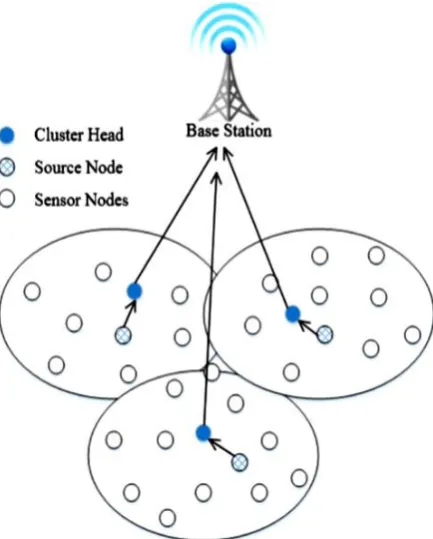
Many research activities have been carried out on the area of energy-efficient data gathering in WSN, since the basic task of the WSN is to effectively collect the data with lesser resource consumption. Most of the data-gathering algorithms are aimed to minimize the energy consumption problem. LEACH is a hierarchical protocol, in which the node details are handled by CHs. The CHs gather the data and compress them and forward to the base station (sink). The structure of the proposed LEACH Protocol is shown in Figure 1.
Figure 1. Structure of LEACH Protocol
The drawbacks of this protocol are as follows:
A sensor node is selected as the CH-using distributed probabilistic approach, whereas the non- cluster nodes calculate which cluster to join based on the signal strength. This approach assures lower message overhead, but cannot assure that CHs are uniformly distributed over the network. The entire network is divided into clusters and load imbalance among the CHs may lead to minimum network lifetime.
It is assumed that all nodes are isomorphic and all nodes have similar amount of energy capacity in each election round. Such a supposition is impractical in most application circumstances. Hence, LEACH should be enhanced to report for node heterogeneity.
LEACH involves source nodes to send data to CHs directly. However, if the CH is extremely far away from the source nodes, they might expend excessive energy in data transmission. Further, LEACH requires CHs to transfer their aggregated data to the sink node over a single-hop link. Nevertheless, single-hop transmission may be quite costly when the sink appears far away from the CHs.
LEACH also holds an assumption that all sensor nodes have sufficient power to reach the sink node if necessary, which might be resistant for energy- constrained sensor nodes.
3. Literature Survey
data aggregation scheme for WSNs, called Designated Path (DP) scheme.
Yanwei Wu; Xiang-yang Li; Mo Li; and Wei Lou[8] A sensor in WSN periodically produces data as it monitors its area. The fundamental operation in such a network is the systematic gathering (with or without in-network aggregation) and transmitting of sensed data to a base station for further processing. A key major challenge in WSNs is to schedule nodes activities to reduce energy consumption. This research work focused on designing energy-efficient protocols for low-data-rate WSNs, where sensors consume various energy in various radio states (receiving, transmitting, sleeping, listening, and keep idle) and consume energy for state transition. With the use of TDMA as the MAC layer protocol and schedule the sensor nodes with consecutive time slots at various radio states while reducing the number of state transitions.
Arabi, Z[9] Data dissemination is an significant task performed by WSNs. The algorithms of this system depend on a number of factors such as application areas, practice condition, power, and aggregation factors. With respect to these parameters, various algorithms are recommended. An algorithm for hybrid energy efficient routing in WSN, which used two algorithms, i.e. EF-Tree (Earliest-First EF-Tree) and SID (Source-Initiated Dissemination) to disseminate data, and employs a fuzzy method to choose group head, and to toggle between two methods, SID and EF-Tree.
Katiyar, V.; Chand, N.; Gautam, G.C.; and Kumar [6] The LEACH protocol is a hierarchical clustering protocol that provides an elegant solution for such protocols. One deficit that affects the presentation of the procedure is endurance of very large and very small clusters in the network at the similar time. This leads to reduce in life span of WSNs. This research work focused to analyze a new energy proficient clustering protocol (FZ-LEACH) that eliminates the above problem by forming Far-Zone. It is a group of sensor nodes, which are placed at locations where their energies are less than a threshold. The results and study show that planned FZ-LEACH algorithm outperforms FZ-LEACH in terms of energy consumption and network existence.
Chand, K. K.; Bharati, P.V.; and Ramanjaneyulu, B.S [5] A new routing protocol named Optimized Energy Efficient Routing Protocol (OEERP) that improve the
lifetime of WSN. It is a cluster based protocol in which the node that acts as cluster-head is changed in each time period. This way enhances the lifetime of the WSN for two reasons primarily. The first cause is the consistent battery drain of the nodes and the second reason is that no node depends on beacon- based transmissions for long time to reach the contact point. Data sensing and performing data aggregation are also carried out in such a way to reduce the number of transmitted messages to the entrance point. This procedure can be use for any sporadic monitoring application using WSN.
Tyagi, S.; Gupta, S.K.; Tanwar, S.; and Kumar, N[7] An Enhanced Heterogeneous LEACH (EHE-LEACH) Protocol for Lifetime Enhancement of Sensor Networks. A preset distance based threshold is used for the bifurcation of direct communication and cluster based communication in the planned scheme. WSNs near to the BS be in touch straight and those which are distant from the Base use group based communication. To assess the act of the proposed system two key parameters known as: Half Nodes Alive (HNA) and Last Node Alive (LNA) are selected. By selecting the distance based threshold with the ratio of 1:9 between direct communication and cluster based communication it has been observed that EHE-LEACH has better network lifetime with respect to various parameters in comparison to the other well-known proposals such as LEACH and SEP.
4. Proposed Method - EE-LEACH: energy-efficient LEACH Protocol
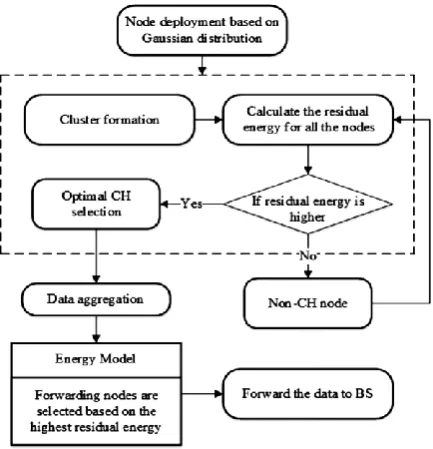
Figure 2. Flow of the EE-LEACH Protocol
4.1 Node deployment based on EE-LEACH
Random method:
In the random deployment, the nodes are randomly scattered with respect to the radial and angular directions from the BS. Sensors in the field have equal probability of being positioned independently of the other sensors. Though the sensor nodes are homogenous, they have some equal parameters like energy, bandwidth etc., but uneven distance among them creates problem. This introduces data latency and uneven energy dissipation throughout the network.
4.2 Optimal cluster formulation
Sensor nodes typically use irreplaceable power with the limited capacity, the node’s capacity of computing, communicating, and storage is very limited, which requires WSN protocols need to conserve energy as the main objective of maximizing the network lifetime. An energy-efficient communication protocol LEACH, has been introduced which employs a hierarchical clustering done based on information received by the BS. The BS periodically changes both the cluster membership and the CH to conserve energy. The CH collects and aggregates information from sensors in its own cluster and passes on information to the BS. By rotating the cluster-head randomly, energy consumption is expected to be uniformly distributed. However, LEACH possibly
chooses too many cluster heads at a time or randomly selects the cluster heads far away from the BS without considering nodes residual energy. As a result, some cluster heads drain their energy early thus reducing the lifespan of WSN. In each round of the cluster formation, network needs to follow the two steps to select cluster head and transfer the aggregated data. (i)Set-Up Phase, (ii) Steady-State Phase, which provides data transmission using Time Division Multiple Access (TDMA).
4.2.1 Cluster formation steps
Step 1: neighbor information retrieval
The neighbor node information are sensed by broadcasting the beacon messages throughout the network.
Step 2: perform selection algorithm
The selection algorithm is performed to retrieve the list of all neighbor nodes about its hop distance. All nodes in the network are arranged in decreasing order of residual energy. Initially all nodes in the network are unclustered.
Step 3: candidate for cluster
When its two- hop neighbor node is not enclosed, analyze all the members of stage 2 one-by-one and crown any one two-hop neighbor for being as a candidate for the cluster.
Step 4: calculate the residual energy of neighbor nodes
Finally, the selection algorithm is executed based on the residual energy of the neighbor nodes.
4.3 CH Selection
There are two steps of phases to perform cluster formation operation are setup phase and steady state phase.
In the setup phase, every node decides to become a cluster head or not. In LEACH protocol, each node elects itself as a cluster head on the basis of the desired percentage of the cluster heads for the network and number of times a node has been a cluster head. Each node chooses a random number from zero to one and then calculates the threshold T(n). The node then compares the random number with T(n). If the random number is less than or equal to T(n), the node becomes a cluster head for the current round. The threshold for cluster head selection is calculated by using Equation.
Where Pd is the desired percentage of cluster heads, A is
the group of nodes which are not selected as cluster heads in previous 1/p rounds and r is the current round. After several rounds, the energy of nodes in the network will become uneven, and nodes with high energy and low energy will have the same probability of becoming the cluster heads, so there will be an inappropriate cluster head selection. Unlike LEACH, our proposed protocol follows a different approach for cluster head selection. From each rectangular cluster, the node with the highest remaining energy will be selected as the cluster head. The current cluster head will decide the next cluster head for the next round in its cluster. All the nodes send their remaining energy information along with data packets to the cluster head. From this information, the current cluster head selects the node with the highest remaining energy as the cluster head for the next round.
4.3.2 Steady State Phase
After cluster heads selection and TDMA slots allocation, the steady state phase starts. The steady state phase of EE-LEACH is almost similar to LEACH. Based on TDMA protocol, the communication starts between the cluster head and their respective CHs in their allocated time slots. The cluster node can only communicate with its respective CH in a predefined time slot. All cluster nodes remain in sleep mode during unallocated time slots. This leads to better energy efficiency of the protocol.
4.3.3 Benefits for optimal CH selection
The selection of CH nodes in the sensor networks can provide the following three benefits:
Prolonging network lifetime - In the form of heterogeneous networks,
The average energy utilization for transmitting the data from the sensor node to the BS will be much lesser than the energy utilized for homogenous networks.
Improving reliability of data forwarding - It is generally known that the links tend to be low reliability. Each hop significantly minimizes the packet delivery rate. In heterogeneous nodes, there will be lesser hops between the nodes and the BS. Hence, the heterogeneous sensor networks can achieve a much better packet delivery ratio than the homogenous networks.
Decreasing latency for data transmission - Computational heterogeneity can minimize the latency in immediate nodes. The heterogeneity among the links can minimize the waiting time in the forwarding queue. Choosing lesser hops among the nodes to BS will reduce the forwarding latency.
4.4 Data Aggregation based on data ensemble
Data aggregation is the process of collecting and aggregating the useful data. Data aggregation is considered as one of the fundamental processing procedures for saving the energy. In WSN data aggregation is an effective way to save the limited resources. The main goal of data aggregation algorithms is to gather and aggregate data in an energy efficient manner so that network lifetime is enhanced. Data aggregation is a widely used technique in WSN. A cluster of nodes is replaced with a single node without changing the underlying joint deployment of the network. During node aggregation, the data ensemble process also takes place. It is essential to identify the macro node for data aggregation.
The procedure includes two steps:
Path definition and
Pair of combinable nodes.
component nodes. Consider the following network in Figure 4.
Figure 3. Network to compute the conditional probability.
If the nodes B, C, and D are combined into a macro node M, then the condition probability is given by:
Pc(M|A)=P(B,C,D|A)=P(B|A)P(C|A)P(D|B,C)
The conditional probability of a macro node’s successor is equivalent to the conditional probability of the successor given all the component sensor nodes in the macro node, except the nodes that are not linked directly to the successor node. Here, E is the successor and the above statement is given as:
Pc(E|M)=P(E|B,C,D)
By aggregating the sensor nodes using the above equations, the data also gathered for transmission.
4.5 Energy-Efficient Data Routing
Energy Efficient Routing is a hierarchical cluster based protocol which achieves a good performance in terms of lifetime by minimizing energy consumption for in-network communication and balancing energy load among all nodes. After gathering the data from different clusters, the CHs need to forward the data to the BS. Hence, the forwarding nodes are selected based on the highest residual energy among the nodes. Residual energy is defined as the remaining power of a sensor node whenever topology changes, which can be an indicator of the stability of a link and the survival time of a node. The nodes which are having the highest energy are selected to forward the data to the BS. It
helps to improve the packet delivery ratio from the packet loss.
III. RESULTS AND DISCUSSION
In this study, table 1 to 4 and figure 4 to 7 shows
the result table and graph for average end to end
delay, packet loss rate, number of nodes alive and
remaining energy in joules respectively.
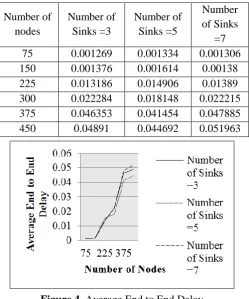
Table 1. Average End to End Delay
Number of nodes
Number of Sinks =3
Number of Sinks =5
Number of Sinks
=7
75 0.001269 0.001334 0.001306
150 0.001376 0.001614 0.00138
225 0.013186 0.014906 0.01389
300 0.022284 0.018148 0.022215
375 0.046353 0.041454 0.047885
450 0.04891 0.044692 0.051963
Figure 4. Average End to End Delay
From table 1 and figure 4 it is observed that the average end to end delay is measured with different number of sinks such 3, 5 and 7. Result show that the delay reduced for number of sinks=3 by 4.99% and 2.87% than number of sinks=5 and 7 respectively at node 75. Also at node 450, the delay reduced for number of sinks=5 by 9.01% and 15.05% than number of sinks=3 and 7 respectively.
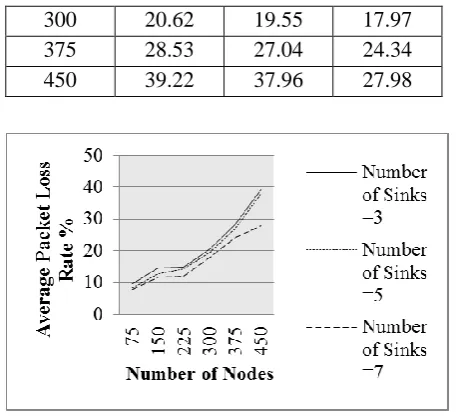
Table 2. Average Packet Loss Rate %
Number of nodes
Number of Sinks
=3
Number of Sinks
=5
Number of Sinks
=7
75 9.58 8.52 7.98
150 14.59 12.89 11.86
300 20.62 19.55 17.97
375 28.53 27.04 24.34
450 39.22 37.96 27.98
Figure 5. Average Packet Loss Rate %
From table 2 and figure 5 it is observed that the average packet loss rate is measured with different number of sinks such 3, 5 and 7. Result show that the packet loss rate reduced for number of sinks=7 by 18.22% and 6.54% than number of sinks=3 and 5 respectively at node 75. Similarly at node 450, the delay reduced for number of sinks=7 by 33.45% and 30.27% than number of sinks=3 and 5 respectively.
Table 3. Percentage of Nodes Alive
Figure 6. Percentage of Nodes Alive
From table 3 and figure 6 it is observed that the percentage of nodes alive is better for number of sinks=7 in the range of 0 to 200% than number of sinks=3 and 5.
Table 4. Remaining Energy in Joules
Number of rounds
Number of Sinks
=3
Number of Sinks
=5
Number of Sinks
=7
0 0.5 0.5 0.5
100 0.46 0.51 0.48
200 0.26 0.36 0.39
300 0.2 0.32 0.36
400 0.21 0.3 0.34
500 0.12 0.19 0.29
600 0 0.11 0.25
700 0 0 0.11
800 0 0 0
Figure 7. Remaining Energy in Joules
From table 4 and figure 7 it is observed that the remaining energy in joules is better for number of sinks=7 in the range of 0 to 200% than number of sinks=3 and 5.
Number of rounds
Number of Sinks
=3
Number of Sinks
=5
Number of Sinks
=7
0 100 100 100
100 100 100 100
200 91 93 99
300 70 86 95
400 74 78 82
500 23 55 66
600 3 19 22
700 0 0 4
IV. CONCLUSION
The EE-LEACH Protocol is presented to improve the lifetime of the sensor network. The coverage probability is derived with respect to the EE-LEACH. A selection algorithm based on the residual energy of the neighbor nodes is executed to obtain the list of neighbor nodes. Data ensemble also takes place while aggregating the nodes. Data ensemble can save considerable energy while the source nodes forming one cluster are deployed in a relatively small area when the sink node is far away from the source nodes. An election weight is determined by taking account of the concentration degree of SNs and their residual energy for optimal CH election. The EE-LEACH Protocol results in a better packet delivery ratio, lesser energy consumption and lesser E2E delay than the EBRP and LEACH Protocols. The experimental results shows that the proposed EE-LEACH yields better outcomes than the existing EBRP and LEACH Protocols. This paper only focuses on reducing the energy consumption. But it lacks to provide the confidentiality and integrity of data. We extend this work with the security concepts, which analyses the traffic flow among the sensor nodes. Hence, in the future, the proposed EE-LEACH Protocol is integrated with the security mechanisms to protect the network from security attacks.
V.
REFERENCES
[1] Ahluwalia Prashant, Virender Rana, Survey of
Leach based Protocol using WSN, SSRG International Journal of Computer Science and Engineering (SSRG-IJCSE) – EFES April 2015.
[2] Alakesh Braman, Umapathi G. R, A Comparative
Study on Advances in LEACH Routing Protocol for Wireless Sensor Networks: A survey (IJARCC) Engineering Vol. 3, Issue 2, February 2014.
[3] BS Mathapati, SR Patil, VD Mytri, Energy
efficient reliable data aggregation technique for wireless sensor networks, in 2012 International Conference on Computing Sciences (ICCS), (Reykjavík, Iceland), pp. 153-158.
[4] Bista, R. Yong-ki Kim, Jae-Woo Chang, A New Approach for Energy-Balanced Data Aggregation in Wireless Sensor Networks, Computer and Information Technology, CIT '09.Ninth IEEE International Conference on ,Oct. 2009.
[5] Chand, K.K., Bharati, P.V., Ramanjaneyulu, B.S.,
Optimized Energy Efficient Routing Protocol for
life-time improvement in Wireless Sensor
Networks, Advances in Engineering, Science and
Management (ICAESM), International
Conference on , vol.,no., pp.345,349, 30-31 March 2012.
[6] Katiyar, V., Chand, N., Gautam, G.C., Kumar, A.,
Improvement in LEACH protocol for large-scale wireless sensor networks, Emerging Trends in Electrical and Computer Technology (ICETECT), International Conference on ,March 2011.
[7] Tyagi, S. Gupta, S.K. Tanwar, S. Kumar, N., EHE-LEACH: Enhanced heterogeneous LEACH protocol for lifetime enhancement of wireless SNs, Advances in Computing, Communications
and Informatics (ICACCI), International
Conference on , vol., no., pp.1485,1490, 22-25 Aug. 2013.
[8] Yanwei Wu, Xiang-yang Li, Mo Li, Wei Lou,
Energy-Efficient Wake-Up Scheduling for Data
Collection and Aggregation, Parallel and
Distributed Systems, IEEE Transactions on , vol.21, no.2, pp.275,287, Feb. 2010.
[9] Z. Arabi, HERF: A hybrid energy efficient routing
using a fuzzy method in Wireless Sensor Networks, Intelligent and Advanced Systems (ICIAS), International Conference on , vol., no., pp.1,6, 15-17 June 2010.