Available online on 15.06.2019 at http://jddtonline.info
Journal of Drug Delivery and Therapeutics
Open Access to Pharmaceutical and Medical Research© 2011-18, publisher and licensee JDDT, This is an Open Access article which permits unrestricted non-commercial use, provided the original work is properly cited
Open Access
Research Article
Phytochemical Screening and Immunomodulator Activity of
Mimusops
elengi
Linn.
Nandlal Singh
1*, Raghuveer Irchhaiya
2, Rishikesh Gupta
2, Ram Narayan Prajapati
2, Vihangesh Dixit
21 School of Pharmacy, Monad University, Hapur (U.P.), India
2 Institute of Pharmacy, Bundelkhand University, Jhansi, (U.P), India
ABSTRACT
Aim. Phytochemical screeningscreening and investigation for immunomodulatory activity of ethanolic extract of leaves of Mimusops elengi using different parameters like carbon clearance, albumin globulin ratio, delayed type hypersensitivity reaction, total leukocyte count and estimation of immunoglobulin etc.
Material and Methods. Ethanolic extract of the plant leaves was prepared. Preliminary phytochemical screening has been conducted. 1g of carragenan was dissolved in 100ml. of water for injection. 1% w/v suspension of carbon black as Indian ink. 2% PVP solution is prepared in water for injection. Four sets (A,B,C and D) of the animals were taken. Each set contains five groups and each group has six animals. After that different parameters of imunomodulation were performed.
Result and Discussion. Phagocytic index was determined by measuring the concentration of Indian ink at different time intervals. The rate of Carbon clearance is a measure of Phagocytic activity, The result ( table 2 and and fig 1) Suggested that in the case of control animals, the concentration of Indian ink obtained after 12 minuts of experimental time was decreased nearly 52% of its initial value as co mpared with the value recorded initially at 3 minuts. this decreased could be described of the natural course of phagocytosis to the particle s by liver macrophages. on the other hand the ethanolic extract of the mimusops elengi showed Significant immunostimulant activity as reflected by lower recovery of carbon particles as compared against that obtained by the control. the same trend was followed even after increasing the dose and the result were found to be directly influence by the increase in dose.
Conclusion. The results of this study clearly indicate that the Ethanolic extract of M. elengi linn.leaves can be used as promising immunostimulating agents. The activity may be due to the presence of phytochemicals reported through phytochemical screening.
Keywords: Mimusops elengi, solvent extraction, carbon black as Indian ink.
Article Info:Received 20 April 2019; Review Completed 22 May 2019; Accepted 27 May 2019; Available online 15 June 2019
Cite this article as:
Singh N, Irchhaiya R, Gupta R, Prajapati RN, Dixit V, Phytochemical Screening and Immunomodulator Activity of Mimusops elengi Linn., Journal of Drug Delivery and Therapeutics. 2019; 9(3-s):131-137 http://dx.doi.org/10.22270/jddt.v9i3-s.2809
*Address for Correspondence:
Nandlal Singh, School of Pharmacy, Monad University, Hapur (U.P.), India
INTRODUCTION
Medicinal plants have been used to cure human illness since time immemorial. Certain of these drugs are believed to promote positive health and maintain organic resistance against infections by reestablishing body equilibrium and conditioning the body tissues1. Immunomodulation is any procedure which can alter the immune system of an organism by interfering with its functions. It is results in an enhancement of immune reactions, it is named as immunostimulation and primarly implies stimulation of non – specific system i.e. stimulation of the function and efficiency of granulocytes, macrophages, certain T-
lymphocytes and different effector substances.
Immunosuppression implies mainly to reduce resistance against infections, stress and may be because of environmental or chemotherapeutic factor 2. Immuno-suppression is needed in transplantation to prevent the rejection of a transplanted and histoincompatible but life-saving organ as well as to induce remission and to prevent relapse in auto aggressive or immune disease3.
Mimusops elengi, native species of uttar Pradesh,has been selected for this study. the genus mimusops comprises about 35 species4. Various parts of the plant used for various diseases5.The bark, flowers, fruits and seeds are
astringent,cooling,anthelmintic,tonic and febrifuge6.
chemical studies on this species reported that Leaves,bark,fruits and flowers contain, Alkaloids, flavonoids, volatile oils, saponins and tannins 8,9.
MATERIAL AND METHODS
Plant Materials. The leaves of Mimusops elengi were
collected from a local form house during the month of December and were authenticated by Dr Gaurav nigam, asstt. Professor, department of Botany, Bundelkhand university Jhansi (u.p.). A voucher no. BU/Bot./Sep/Phar/05-2015/02 was submitted at botany department, Bundelkhand university, Jhansi, u.p.
Animals. Albino rats ( Either sex ) Procured from the animal
house, Institute of Pharmacy, Bundelkhand University, Jhansi with reference no. of BU/Pharm/IAEC/13/26 .The rats were fed a standard diet and water.
Preparation of Extract. The leaves of Mimusops elengi Linn.
were air dried & make coarse powder with grinder. The coarsely powdered leaves were packed in Soxhlet apparatus & continuously extracted with petroleum ether at temp. 100°- 120° till all fat constituents were separated out then extract with ethanol at temp. 60°-80°C till all the constituents were separated out.
Table 1: Extractive Value of Mimusops elengi Linn. Plant
Extract Powder weight Extractive value %
Ethanolic Extract 150 gm 13.70%
Phytochemical screening. Phytochemical screening of
ethanolic extract of Mimusops elengi reveals the presence of flavonoids, Triterpenes, Glycosides, Steroids, Alkaloids, Saponins, Carbohydrates, Proteins, and Tannins and Phenolic compounds.
Thin layer chromatography.
For TLC the best solvent system was found to be Toluene:
Ethyl acetate: Acetic acid in a ratio 80: 10: 10.
Shows the presence of 8 spots with different Rf values. The HPTLC of ethanolic extract also shows 11 peaks which give confirmation that the compounds may be present in the extract.
Pharmacological screening. Four sets (A,B,C and D) of the
animals were taken. Each set contains five groups and each group has six animals. After that different parameters of imunomodulation were performed.
1g of carragenan was dissolved in 100ml. of water for injection. 1% w/v suspension of carbon black as Indian ink. 2% PVP solution is prepared in water for injection.
Immunomodulator activity.
1. Phagocytic index.
Adult albino rats of either sex (100-150 g) were selected for
this study and divided in to five groups. Group 1st served
animals served as control and were administered 0.5 ml of
5% dextrose normal saline. Animals of group 2nd, 3rd, 4th and
5th received Ethanolic extract of Mimusops elengi leaves 100,
200, 300, and 400 mg/kg body weight for seven days. Set A
animals treated with Indian ink 1ml I.V. on 8th day. To
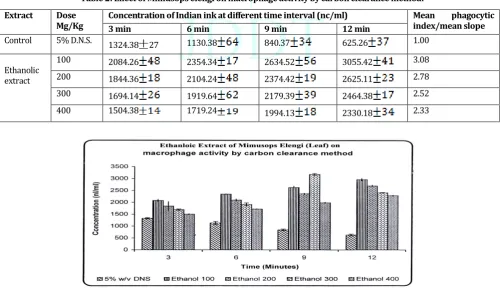
perform carbon clearance studies and to determine the Phagocytic index. Blood samples were collected at 3, 6, 9, and 12 minutes intervals and absorbance was measured at 650 nm. And plotted against the time.fig 1. the slope of line denotes the rate of carbon clearance which is a measurement of phagocytic activity of RES and termed as phagocytic index.table 2..(De et al.,1998)
Table 2: Effect of Mimusops elengi on macrophage activity by carbon clearance method.
Extract Dose
Mg/Kg Concentration of Indian ink at different time interval (nc/ml) 3 min 6 min 9 min 12 min Mean index/mean slope phagocytic
Control 5% D.N.S. 1324.38 27 1130.38 840.37 625.26 1.00
Ethanolic extract
100 2084.26 2354.34 2634.52 3055.42 3.08
200 1844.36 2104.24 2374.42 2625.11 2.78
300 1694.14 1919.64 2179.39 2464.38 2.52
400 1504.38 1719.24 1994.13 2330.18 2.33
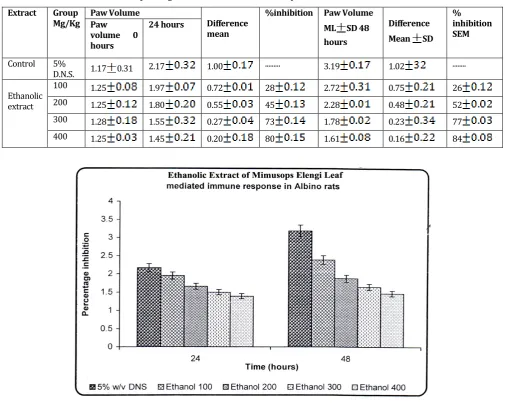
2. Delayed type of hypersensitivity reaction. After immunization of set B animals, 0.1 ML of carrageenan solution (1% W/V) was injected subcutaneously in to the
right footpad to all seven groups on 10th day. After 24 and 48
hours, thickness of footpad was measured by
Plethisomometer and results are recorded into the table 3. and fig 2. Difference in the foot pad thickness in control and treated groups has been taken as the measure of the DTH reaction. (Ray et al., 1984)
Table 3: Effect of Mimusops elengi on cell mediated immune response in Albino rats.
Extract Group
Mg/Kg Paw Volume Difference
mean
%inhibition Paw Volume ML SD 48 hours
Difference Mean SD
% inhibition SEM Paw
volume 0
hours
24 hours
Control 5%
D.N.S. 1.17 0.31 2.17 1.00 ... 3.19 1.02 ...
Ethanolic extract
100 1.25 1.97 0.72 28 2.72 0.75 26
200 1.25 1.80 0.55 45 2.28 0.48 52
300 1.28 1.55 0.27 73 1.78 0.23 77
400 1.25 1.45 0.20 80 1.61 0.16 84
Fig. 2; Ethanolic extract of Mimusops elengi leaves on cell mediated immune response
3. Albumin : Globulin ratio. Albumin to globulin ratio was
measured on set D animals on 8th day. Blood samples were
collected from retro-orbital plexus and the concentration of albumin and total protein were determined by ERBACHEM
PRO-C5. Difference in the concentration of total protein and albumin was recorded as a globulin concentration ( Globulin = Total protein – Albumin). Based upon the albumin globulin ratio were calculated and presented in table 4. and fig 3.
Table 4: Effect of Mimusops elengi leaf on protein level
Extract Dose mg/kg b.w. Protein level (g/dl)
Albumin Globulin
Control 5% w/v D.N.S. 4.432 2.256
Ethanolic Extract
100 4.436 2.580
200 4.433 3.118
300 4.510 3.900
Fig.3; Ethanolic extract of Mimusops elengi leaves on protein level
4. Sheep red blood cell agglutination test. During
immunization period with extract, set C animals were further immunized on second day by injecting 20 µl of 3 X
109 SRBC per ml. subcutaneously into the right hind foot pad
except group 1st which served as a control. The same volume
of SRBC was administered intradermally into left hind foot
pad on 8th day. Blood samples were collected from individual
albino rats via retro-orbital plexus on 8th day(before
secondary challenge) for primary antibody titre and on 15th
day for secondary antibody titre. Antibody levels were determined by haemagglutination technique repoeted by Nelson and Molden hall, 1967. The blood samples were centrifuged to collect the serum. Equal volumes of individual
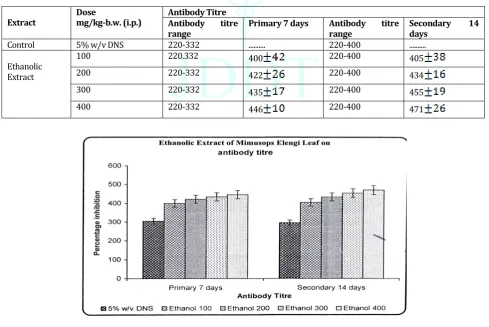
serum samples were pooled 20 µl of 0.1% suspension of SRBC in BSA saline was added to serial two fold dilution of pooled serum samples made in 20 µl volume of normal saline containing 0.1% BSA saline in V- bottomed micro titration plates. After mixing, the SRBC were allowed to settle at room temperature for 60 to 90 minutes until control wells showed on unequivocally negative pattern ( a small button). The value of the highest serum dilution causing visible haemagglutination was taken as the antibody titre. Each pooled serum samples was titrated in five parallel doubling dilutions and the mean titre of these determinations was calculated. Results are presented in table 5 and plotted as fig. 4.(Atal et al.,1986)
Table 5: Effect of Mimusops elengi (Leaf) on antibody titre.
Extract Dose mg/kg-b.w. (i.p.) Antibody Titre Antibody titre
range Primary 7 days Antibody range titre Secondary days 14
Control 5% w/v DNS 220-332 ... 220-400 ...
Ethanolic Extract
100 220.332 400 220-400 405
200 220-332 422 220-400 434
300 220-332 435 220-400 455
400 220-332 446 220-400 471
5. ESTIMATION OF IMMUNOGLOBULIN
Estimation of immunoglobulin was carried on Set D animals after 7 day immunization with extract; 1ml. 1% w/v BSA was administered intravenously to all above groups.
After 24 hours blood samples were withdrawn and allowed to coagulate at room temperature. These were than centrifuged at 2000 rpm for 10 minutes. Than level of IgM and IgG was estimated in each sample (Ansari et al., 1998). Results were presented in table 6. and figure 5.
Table 6: Effect of Mimusops elengi leaf on humoral immune responses in albino rats, immunized with BSA.
Extract Dose mg/kg b.w. Immunoglobulin levels
IgG IgM
Control 5% w/v DNS 1740.52 18.0 750.12 4.32
Ethanolic Extract 100 2450.03 315.18
200 2500.50 340.11
300 2525.40 355.16
400 2536.16 380.12
Fig.5; ; Ethanolic extract of Mimusops elengi on humoral response in albino rats, immunized with BSA.
6. Total Leukocyte Count
Total leukocyte count was measured on group animals of set D.
Leukocytes were counted using Haemocytometer on 8th day.
0.5ml of blood was withdrawn from teh retro-orbital plexus immeadtely into the W.B.C. pipette, then diluted up to mark with
W.B.C. dilution fluid (Qualigens fine chemicals) and it was shaken by rotation using hand palms. A drop of sample was put down on a Neuber’s chamber and numbers of leukocytes were determined by observing under the microscope. Same procedure was applied for all the groups (Subramoniam et al., 1996) Total leukocytes are representing in table 7 and fig 6.
Table 7: Effect of Mimusops elengi leaf on Total Leukocyte count
Extract Dose Mg/Kg b.w. (I.P.) Total leukocytes
Control 5% w/v D.N.S. 10790.62 410.11
Ethanolic Extract
100 11735.12
200 12914.32
300 14290.43
400 15210.14
Fig. 6. Ethanolic extract of Mimusops elengi leaves on leukocyte.
RESULT AND DISCUSSION
Phagocytic index was determined by measuring the concentration of Indian ink at different time intervals. The rate of Carbon clearance is a measure of Phagocytic activity.
The result (Table 2. and fig.1.) Suggested that in the case of control animals, the concentration of Indian ink obtained after 12 minuts of experimental time was decreased nearly 52% of its initial value as compared with the value recorded initially at 3 minuts. This decreased could be described of the natural course of phagocytosis to the particles by liver macrophages. on the other hand the ethanolic extract of Mimusops elengi showed Significant immunostimulant activity as reflected by lower recovery of carbon particles as compared against that obtained by the control. the same trend was followed even after increasing the dose and the result were found to be directly influence by the increase in dose.
Cell mediated immunoresponse was determined by measuring the footpad thickness of albino rats at different time intervals. This was performed to assess delayed type of hypersensitivity reaction. The result reveals that in case of control the percent inhibition of thickness of foot pad was not increased significantly. But in case of Ethanolic extract at the dose of 100, 200, 300, 400. Mg/kg body weight intraperitoneally the thickness was decreased significantly and directly proportional to dose.
The humoral antibody response was determined after immunization of the animals with SRBC. This was performed by SRBC agglutination test after primary and secondary immunization with ethanolic extract of Mimusops elengi. It was found that after immunization with SRBC, the ethanolic extract of Mimusops elengi statistically significant increase ( in all the doses level) in the antibody titre in the SRBC agglutination test. Total numbers of leukocytes were determined by using Haemocytometer. The result suggests that the total number of leukocytes in control were normal. On the contrary, in the case of animals treated with Ethanolic extract of Mimusops elengi, the number of leukocytes was increased. Maximum production was seen at the dose of 400 mg/kg b.w. (P< 0.05).
Albumin and globulin are the serum components where the later also take part in immune system. The ratio was determined in all the groups, the concentration of albumin was found normal but globulin concentration was significantly increased and this production was directly proportional to the
dose of ethanoic extract (P < 0.05) as calculated in all groups by T-test.
Immunoglobulin was estimated by Immuno – turbidometric assay. On administration of ethanolic extract of Mimusops elengi, the IgM and IgG levels were determined and compared with control. It was observed that the IgG level was increased significantly by the extract at all doses. On the other hand, the IgM level was increased significantly by the extract. It can be concluded that IgG and IgM levels were influenced by ethanolic extract of Mimusops elengi.
The results obtained with various experiments suggest that the Ethanolic extract of Mimusops elengi exhibited satisfactory Immunostimulation.
CONCLUSION
From above experimentation, we can conclude that extracts of
Mimusops elengi have Immunomodulation and
immunistimulation activities. Further study is required to isolate, elucidate and study the pharmacological behaviour of potent phytochemicals eluted through GC- MS towards their immunostimulant activity.
REFERENCES
1. Atal C.K., Sharma M.L., Kaul A., Immunomodulating agents of plant origin. J. Ethanopharmacology, 1986; 18:131.
2. Singh N., Verma P., Mishra N., Nath R., A comparative evaluation of some anti- stress agents of plant origin. Indian J. Pharmacy., 1991; 23:99.
3. Weiner M., Piliero S.J., Nonsteroidal Anti- inflammatory agents, Annual Review of Pharmacology, 1970; 10:171.
4. Kirtikar KR., Basu BD., Indian medicinal plants, International book Distributors, Dehradun, 1987, 343.
5. Raghunathan K., Mitra R., Pharmacognosy of Indigenous Drugs, Government of India;Central council for Research in Ayurveda and sidda, 2000; 1.,158-183.
6. Basavaraj CK, Purnima A., Diuretic activity of extracts of mimusops elengi Linn. Bark. Int. J. Green. Pharm.2010; 90-92. 7. Sakshi S., Vineet G., Rajiv G., Shubhini A.S., Analgesic and
Antipyretic activity of Mimusops elengi Linn., pharmacologyonline, 2011; 3, 1-6.
8. Mishra G., Mitra CR., Constituents of Bark, Fruit, seed of Mimusops elengi linn., Phytochem.1967;6,453.
9. Akhtar N., Ali M., Alam MS., Pentacyclic triterpenes from the stem bark of mimusops elengi linn., Acta. Pol.Pharm., 2009; 66(5):549-552.
11. Ray A.B., Chattopadhyay S.K., Kumar S., Kanno C., Kisho Y.,Hiniko H., Structures of cleomiscosins,Coumarinolignoids of cleome viscosea seeds.Tetrahedron, 1984; 41(1):209.
12. Atal C.K., Sharma M.L., Kaul A., Immunomodulating agents of plant origin. J. Ethanopharmacology, 1986; 18:131.
13. Ansari K.U., Kastury N., Tewarson S.L., Singh S., Pandey R.C., An audit of prescription for rational use of fixed dose drug combinations. Ind. J. Pharmacol., 1998; 30:90.
14. Subramoniam A., Rajasehkaran S., Latha P.G., Evans D.A., Pushpangandan P. Preliminary studies on the
immunomodulatory and antioxidant agents. Fitoterapia.1996; 65(1):34-37.
15. Shailajan S, Gurjar D, Wound Healing Efficacy of Mimusops elengi L. Flowers in Albino Wistar rats using Excision wound mode Pharmacogn. Commn. 2016; 6(2):72-79.
16. Varshney I.P., Badhawar G., Saponins and Sapogenins of Mimusops elengi .,Proc.Nat. Aca. Sci. Uni. Stat. Ameri., 1972; 41:21-23.
17. Zahid Hina, Rizwani Ghazal Hafeez, Shareef Huma, Shaukat Mahmud, Ali Tahir.; Hypoglycemic and Hypolipidaemic effects of Mimusops Elengi Linn. Flowers and leaves methanolic extract, International journal of Pharma and Bio science. 2012; 3(1):56-62.
18. Sakshi S., Vineet G., Rajiv G., Shubhini A.S., Analgesic and Antipyretic activity of Mimusops elengi Linn.,
pharmacologyonline, 2011; 3, 1-6.
19. Saxena V.K., Shrivastava K., A new steroidal saponins from the root of mimusops elengi., Fitotrepia; 1988; 59(5):418. 20. Shah P.J., Gandhi M.S., Goswami S.S., Santani D., Study of
Mimusops elengi bark in experimental gastric ulcers. , J. Ethanopharmacol., 2003; 89(2-3):305-311.
21. Shahwar D., Raza M.A., In-Vitro Antibacterial activity of extracts of Mimusops elengi Against gram positive and gram negative bacteria.,Afr. J. Microbio. Res. 2009; 3(8):458-462.
22. Nithya N., Rohini S., Arun D., Balakrishnan K.P., Antityrosinase and Antioxidant activities of various parts of Mimusops elengi : A comparative study . int. J. Res. Cosm. Sci. 2011; 1(1):17-22. 23. Gupta N, Jain UK., Investigation of Wound Healing Activity of
Methanolic Extract of stem bark of Mimusops elengi linn.Afr J Tradit Complement Altern Med. 2011; 8(2):98-103.
24. Mail R.G., Mahajan S.G., Mehta A.A., In-vitro anthelmintic activity of stem bark of Mimusops elengi Linn. Phcog Mag. 2007; 3(10):73-76.