BIOSCIENCES BIOTECHNOLOGY RESEARCH ASIA,December 2011. Vol. 8(2), p. 783-787
* To whom all correspondence should be addressed.
Studies on Fruit Rot Pathogens in
Grapes and its Control by
Trichoderma
Spp
N. Uma Maheswari* and R. Saranya
PG and Research Department of Microbiology, Sengamala Thayaar Educational Trust Woman’s College, Mannargudi - 614 001 (India).
(Received: 25 September 2011; accepted: 18 November 2011)
Biological control of plant pathogens utilizes one microorganism to eliminate or reduce the disease caused by another. A Grape (Vitis vinifera L) is a one of the most economic fruit crops. The grapes are mostly infected by fungal pathogens. In grapes fruit rot disease caused by Botrytis cinerea and A.niger. The present study was undertaken to isolate and identification of fruit rot pathogens. The T.viride and T.harzianum were used to control the pathogens by in vitro method and compared with chemical fungicide. Among this study T.harzianum showed high inhibitory property against A. niger (52mm in 288 hours) and T.viride (63mm in 288 hours) showed high inhibitory property against Botrytis cinerea. In culture filtrates of T.viride and T. harzianum (5%, 10%, and 15%) were tested against pathogens. The maximum growth inhibition percentage of test pathogens was at 15% culture filtrate of T.harzianum (24.86%) and T.viride (27.10%). In disc diffusion method, Thiophanate methyl was used as chemical fungicide against test pathogens. B.cinerea was produced clear zone within 72 hrs. The A. niger does not inhibited by chemical fungicides. The growth of test organisms in PDA medium with different pH concentrations (4, 5, 6, 7 and 8) were also tested. In that, the optimum growth of test pathogen such as B. cinerea were noticed in pH5 (35mm) and A. niger pH6 (53mm). Application of bio control agent’s was sprayed in grapes to control these pathogens.
Key words: Chemical fungicide, Fruit rot pathogen, Grapes, Thiophanate methyl, Trichoderma spp.
A grape is a non-climatic fruit that grows on the perennial and deciduous woody vines of the genus vitis. Grapes are small round or oval berries that feature semi- translucent flesh encased by a smooth skin. Some contain edible seeds while others are seedless. Grapes are covered by a protective, whitish bloom. Grapes can be eaten raw or they can be used for making jam, juice, jelly, vinegar, wine, grape seed extracts, rasins, and
molasses and grape seed oil. Approximately 71% of world grape production is used for wine, 27% as fresh fruit, and 2% as dried fruit. Grapes excellent sources of manganese and good sources of vitamin B6, thiamin (vit B1), potassium, vitamin C 1.
pre and post harvest decay caused by Aspergillus niger 4. It is a post harvest disease. High storage
temperature and humid conditions favour the development of the disease. The fungus enters the berries through the injuries caused due to poor post harvest handling operations
Chemical control of soil borne pathogens provides certain degree of control but at the same time have adverse effect on environment affecting the beneficial soil microorganisms. Biological control using either natural products or antagonistic microorganisms proved to be successful for controlling various plant pathogens in many countries 5. Trichoderma is the most commonly used fungal biological control agent and have long been known as effective antagonists against plant pathogenic fungi.
The present study was aimed at
Trichoderma species namely T.viride and
T.harzianum was tested against the fruit rot pathogens of grapes.
MATERIAL AND METHODS
Sample collection
The sample was collected from fruit stall of Thanjavur district, Tamil Nadu, India. The sample was brought to the laboratory and stored in refrigerator at 4°C for further biological analysis.
The Trichoderma viride and Trichoderma
harzianum were collected from Sri Amman Biocare. A production of biofertilizer and biocontrol unit. Thirukkanurpatti, Thanjavur.
Isolation and identification of fungi from grape samples
After sample collection, serial dilution was performed for isolating microbial growth from the collected samples. Isolated fungi were identified based on cultural and morphological characteristics using lactophenol cotton blue staining 6,7.
Culture filtrate method
Antibiotic interaction was carried out the culture filtrate of T.viride and T.harzianum and added separately to the cooled PDA medium to give the concentration of 5%, 10% and 15%. The PDA medium was dispersed in petriplates and allow to solidify. After solidification the pathogens were cut (6 mm) and inoculated at the centre of the plates. The plates were incubated at 27°C for 7 days 8.
The percent inhibition of growth was calculated as follows.
Growth in control-growth in treatment % of inhibition of growth 100
Growth in control ×
Antagonistic activity
The bio control agent Trichoderma viride
and Trichoderma harzianum were selected to
study the antagonistic activity against Botrytis cinerea and Aspergillus niger isolated from test sample. The Potato dextrose agar medium was prepared and poured in to the Petriplate. After solidification 6mm diameter of pour culture of Trichoderma viride against Botrytis cinerea and Aspergillus niger was placed on the PDA medium in opposite direction. Another set of plates Trichoderma harzianum against Botrytis cinerea and Aspergillus niger was placed on the PDA medium in opposite direction. The plates were incubated at 27± 20 C for 15 days and the results were noted at every 72 hours on 3, 6, 9, 12 and 15th days respectively 9.
Disc diffusion method
The PDA medium was prepared and sterilized at 1210 C for 15 minutes and allow it to cool approximately 500C. Then the medium was poured into the sterile Petriplate. After solidification the isolated pathogens Botrytis cinerea and Aspergillus niger were swabbed on the agar plate with help of sterile cotton buds 10.
Effect of pH
The PDA medium was prepared and pH was set at different level such as 4, 5, 6, 7 and 8 respectively by adding 1% NaOH and concentrated HCl. Then the media was autoclaved and poured into Petriplates. The pathogen nearly 6 mm diameter range was inoculated and incubated at 270 ±20Cfor 72hours 7.
Application
The 2% of Trichoderma viride and
Trichoderma harzianum solution was prepared
and foliar spray over the harvested grapes and stored in 30°C.Control was maintained separately. The results were observed and recorded 11.
Statistical analysis
RESULTS
Isolation and identification of fungi from infected Grapes
The infected grape sample was collected from fruit stall of Thanjavur district, Tamil Nadu, India. The infected grape sample was inoculated into potato dextrose agar medium and incubated. After incubation period, the plates were examined for the fungal colonies were observed and identified based on the morphological and spore characters by Lacto phenol Cotton Blue staining method.
Culture filtrate method
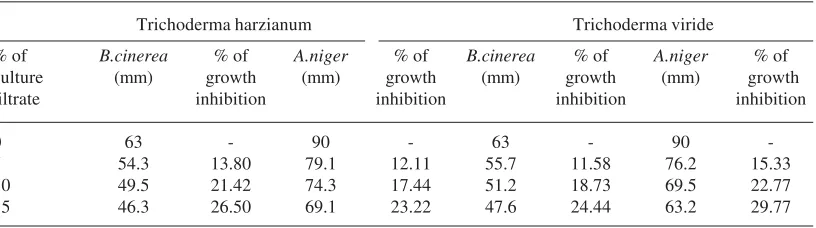
The sterilized culture filtrate of Trichoderma viride and Trichoderma harzianum was used to determine the potential to inhibit the mycelia growth of Aspergillus niger and Botrytis cinerea. The culture filtrates (non volatile) from two Trichoderma species inhibit the growth of test microorganisms. Trichoderma harzianum which is inhibitory the growth of test fungi (Botrytis cinerea) by 26.50% and Aspergillus niger by 23.22% at 15% concentration. Trichoderma viride
which inhibitory the growth of test fungi Botrytis cinerea by 24.44% and Aspergillus niger by 29.77% at 15% of concentration.( Table-1)
Antagonistic activity
Trichoderma viride and Thichoderma
harzianum were growing quickly and dominate the pathogen Botrytis cinerea within 12 days. After 15 days the pathogens completely inhibited by antagonist of Trichoderma viride and
Thichoderma harzianum. T. harzianum wa
inhibited the growth of A.niger within 21 days.(Table-2)
Disc diffusion method
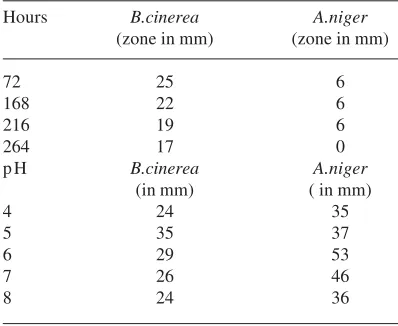
After incubation period, the plates were examined the pathogen Botrytis cinerea inhibited in disc diffusion method by commercially available systemic fungicide Thiophanate methyl 70%WP. The 25mm clear zone was observed in 72 hrs, the zone was maintained till 120 hrs but the pathogen tolerate the chemical fungicide and grew on the zone respectively 3mm on 168 hours, 6mm on 216 hours and 8mm on 264 hours. The A.niger was does not inhibited by chemical fungicide. The results were recorded. (Table 3)
Table 1. Culture filtrate method
Trichoderma harzianum Trichoderma viride
% of B.cinerea % of A.niger % of B.cinerea % of A.niger % of culture (mm) growth (mm) growth (mm) growth (mm) growth iltrate inhibition inhibition inhibition inhibition
0 63 - 90 - 63 - 90
-5 54.3 13.80 79.1 12.11 55.7 11.58 76.2 15.33 10 49.5 21.42 74.3 17.44 51.2 18.73 69.5 22.77 15 46.3 26.50 69.1 23.22 47.6 24.44 63.2 29.77
· Values are mean.
·The experiment was performed by maintaining three replicate pertreatment
Table 2. Dual culture method
hours T.viride (in mm) T.harzianum (in mm) B.cinerea (in mm) A.niger (in mm)
72 24 24 26 26 16 17 47 45
144 46 37 49 37 23 25 53 49
216 60 45 66 49 25 25 45 35
288 63 51 69 52 21 22 39 34
· Values are mean.
Effect of pH
The organisms were cultivated in various concentration of pH like 4, 5, 6, 7 and 8. Maximum mycelial growth of B.cinerea was noticed in pH5 (35mm) and minimum growth in pH 4 and 8 (24mm).Maximum mycelial growth of A.niger was noticed in pH 6 (53mm) and minimum growth in pH 4 (35mm) (Table-3).
Application
The bio control agents Trichoderma viride and Thichoderma harzianum treated grapes and control grapes were stored separately upto 12 days. The treated post harvested grapes were observed without fungal infection and spoilage. Whereas the untreated control grapes were observed fungal infection and spoiled with sour smell on 7th day.
suppression of plant pathogen13. The volatile compounds from T.viride suppress the mycelial growth of B.cinerea and control the A.niger. This work is in conformity with 14 .
In culture filtrate method, the maximum percentage of inhibition of the growth of the test pathogens were at 15% culture filtrate of T.viride and T.harzianum. In our study similar to B.cinerea was suppressed by Pseudomonas antimicrobica in vitro and strawberry leaves. Antifungal compounds were detected in cell-free filtrates of the bacterium 15.
In disc diffusion method, both the test pathogens B.cinerea and A.niger resistant the chemical fungicides thiophanate methyl 70% WP. The present research was correlated with disease management has been dependent upon synthetic chemicals, with new compounds replacing old chemical groups as fungicide resistance develops16.
Biological control of post harvested diseases (BCPD) has emerged as an effective alternative. Because wound – invading necrotrophic pathogens are vulnerable to biocontrol, antagonists can be applied directly to the targeted area (fruit wounds), and a single application using extending delivery systems (drenches, line sprayers, on-line dips) can significantly reduce fruit decays 17.
Finally it was concluded that T. viride and T. harzianum used to control the fruit rot disease causing fungal species from grapes. Trichoderma isolates reduce the growth of the pathogens significantly and, therefore, can be incorporated for integrated disease management of plant pathogens. The degree of antagonism was varied between and within species of Trichoderma against the tested plant pathogens.
CONCLUSION
Biological control is a promising tool to maintain current level of agricultural production while reducing the release of polluting chemical pesticides to the environment. It is a complex process made up from several successive steps generally initiated by a remote sensing of host which stimulates directed growth, subsequently contact is made between fungal antagonist and host (pathogen) surface. The mechanisms
Table 3. Disc diffusion method (Thiophanate methyl 70% WP) and effect of pH
Hours B.cinerea A.niger
(zone in mm) (zone in mm)
72 25 6
168 22 6
216 19 6
264 17 0
p H B.cinerea A.niger
(in mm) ( in mm)
4 24 35
5 35 37
6 29 53
7 26 46
8 24 36
· Values are mean.
· The experiment was performed by maintaining three replicate per treatment
DISCUSSION
In our study findings Trichoderma harzianum and Trichoderma viride were used as a biocontrol agent against fruit rot pathogens of Aspergillus niger and Botrytis cinerea.
employed by biocontrol agents to effect biological control of plant diseases are many and complex, and their use varies with the kind of biocontrol agent, pathogen and host plant involved in the interaction. As with so many other aspects of science, basic knowledge about the mechanisms involved in the biocontrol process will be of immense value to those intent on developing new methods for utilizing biocontrol agents.
ACKNOWLEDGEMENTS
The authors are thankful to Dr. V. Dhivaharan, Dean, Department of Life Sciences for providing tireless help for the course of the study.
REFERENCES
1. (http:// en. Wikipedia.org)
2. Ciccarone, A.. Current knowledge about
B.cinerea Per on grape. Vine academia Italiana Della vite e Del vino. 22:3-33 (1970).
3. McClellan, W.D and Hewitt, W.B.. Early Botrytis Rot of Grapes:Time of infection and latency of Botrytis cinerea Pers in Vitis vinifera
L. Phytopathology. 63: 1151-1157 (1973). 4. Zahavi, T.,.cohe,L.,weiss,B.,Schena, L., Dalls,
A., Kaplunou, T., Zutkh,. J., Ben- Arie, R and Droby, S. Biological control of Botrytis, Aspergillus and Rhizopus rots on table and wine grapes in Israel. Postharvest Biology and technology. 20: 115-124 (2000).
5. Papavizas, G.C and Lumsden, R.D. Biological control of soil borne fungal propagules. Ann. Rev. Phytopathol., 18: 389-413(1980). 6. Gilman, J.C. A manual of soil fungi, Revised 2nd
edition, Oxford and IBH publishing company (Indian Reprint) Calcuta, Bombay, New Delhi. 450 (1957).
7. Aneja, K.R. Experiments in Microbiology, Plant pathology and Biotechnology. New age
international publishers, New Delhi. 119- 228 (2002).
8. Narasima Rao, S., Anahasur, K.H and Naik, K.S. Effect of culture filtrates of antagonists on the growth of Sclerotium rolfsii. Indian J. Plant production29:127-130 (2001).
9. Dennis,C., Webster,S. Antagonistic properties of species group of Trichoderma II production of non- volatile antibiotics. Trans. Br.Mycol.Soc.
57:41-48 (1971).
10. Kirby Bauer, A.W., Kirby,W.M.M., Serris, J.C and Turek., M. Antibiotic susceptibility testing by a standardized single disc method. Am. J. clinic. Pathol. 45: 493-496 (1966).
11. Krishan Chandra, Greep,S and Srivathsa, R.S.H. Biocontrol agents and biopesticides (liquid formulations). Published by: Regional Director, Regional centre of organic farming, No:34, 5th
main road, Hebbal, Bangalore. 19-20 (2005). 12. Gupta, S.P.. Statistical methods. Sulthan Chand
and Sons, Educational publishers, New Delhi 180-181 (2004) .
13. Gupta, V.K and Utkhede, R.S.. Factors affecting the production of antifungal compounds of
Enterobacter aerogenes and Bacillus subtilis,
antagonists of Phytophthora cactorum. J. Phytopathol. 177:9-16 (1986).
14. Maheswari, D.K., Drobey, R.C and Sharma, V.K. Biological effects of Trichoderma virens on
Macrophomina phaseolina causing charcoal rot of peanut. Indian J Microbial.41:251-256 (2001).
15. Walker, R., Emsile,K, A and Allan, E.J. Bioassay methods for the detection of antifungal activity by Pseudomonas antimicrobica against the gray mould pathogen Botrytis cinerea. J.Appl. Bacterial.81:531-537 (1996).
16. Janisiewicz, W.J and Korsten, L. Biological control of post harvest diseases of fruits.
Ann.rev. Phyto pathol. 40: 411-441 (2002). 17. Rosslenbroich, H.J and Stuebler, D. Botrytis
cinerea history of chemical control and novel fungicides for its management. Crop protection.