Challenges
in
Emission Control
Catalysis
for
the
Next
Decade
1997 (LEV)
1997-2003 (ULEV)
By
B. J.
Cooper
0.075 0.040
-
Johnson Matthey Catalytic Systems Division
F t h new automobile emission standards going into effect i n Europe, and even tougher standards ready for implementation in California and the rest of the United Stares, automotive emission control systems are required to perform even better, i n the ongoing effort to reduce vehicle emissions. Catalyst manufactur- ers, i n collaboratioii with vehicle producers, have spent several years on the research, design, development and cesting of catalytic systems to meet the emis- sion standards through to the end of this decade. This paper highlights key technical developments taking place i n emission control catalyst technology.
In 1994 an ambitious programme will begin in California which specifies emission standards for transitional low emission vehicles (TLEV), low emission vehicles (LEV) and ultra low emis- sion vehicles (ULEV); this emission reduction programme will extend into the next century.
Emission Standards
In the last few years several important changes in emission legislation have taken place which will define the requirements of the automotive industry for emission control technology. By far the most significant of them is the adoption, in California, of new, extremely stringent stan- dards, see Table I. These standards call for reductions, kom current levels, by the year 2000,
of 90 per cent in the emission of hydrocarbons,
50 per cent in the emission of carbon monox- ide and 80 per cent in the emission of nitro- gen oxides. United States federal standards are taking a similar firm position on emissions, but with a longer time frame. Similar stringent emis- sion standards have been introduced in Europe, and in 1992 the first widespread, mandated use of catalytic converters came into effect. The California Ultra Low Emission Vehicle
standards are more than twice as severe as the possible future European standards, and cur- rently represent the most stringent legislation worldwide for catalytic converter technology.
A second impact on the design of emission control systems is from legislation on the U.S. Corporate Average Fuel Economy standard, and also the proposed carbon dioxide standards
Table I
U.S.
and California Emission StandardsI
Pollutant, g/mileYear and standard
1
HydrocarbonsI
Carbon monoxideI
Nitrogen oxides1990
us.
1994 U.S.1993 California
1994 (TLEV)
0.41 0.25 0.25 0.125
3.4 3.4 3.4 3.4
1
.o
0.40 0.40
i
0.403.4 0.20
1.7
I
0.20in Europe. From this perspective, the use of a leaner burning engine with significantly improved fuel economy is extremely desirable and has significant impact on the design of emis- sion systems and catalytic converters. As a result, the leaner burn diesel engine is expected to con- tinue as a serious contender in the European Market, and as such has its own specific cata- lyst requirements ( l ) , and will be the subject of
a future article in Platinum Metals Review. The lean burn gasoline engine, and the two-stroke engine are also likely to have some effect on emission control technologies towards the end of this decade.
Engines,
Emission Control
and Catalysts
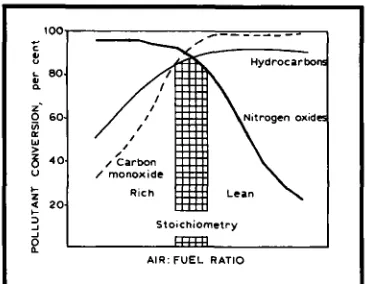
Since the early 1980s, the primary emission control system for four-stroke passenger car gasoline engines has consisted of the three-way catalytic converter, which is capable of simul- taneously reducing hydrocarbons, carbon monoxide and nitrogen oxides emissions, see Figure 1. The three-way converter reaches max- imum efficiency close to the stoichiometric airfuel ratio. Therefore the engine has to func- tion at around the stoichiometric airfuel ratio, and is controlled by means of a feedback sys- tem containing an oxygen sensor placed in the exhaust system. In addition, mass air sensors together with electronic fuel injection systems, which allow much more precise air:fuel meter- ing, are now common on modern emission con- trolled vehicles.
Lean burn versions of the four-stroke engine have been under development for some years. But because of the need to meet nitrogen oxides emission standards, a vehicle having an engine which operates at stoichiometry with a three- way catalytic converter is currently favoured. However, there is no doubt if an effective cat- alyst technology emerges, which could reduce nitrogen oxides under lean air:fuel ratios, that
it would give a significant impetus to the devel- opment of the technology of lean burn four- stroke and two-stroke engines.
Advanced two-stroke gasoline engines, capa- ble of meeting current emission control stan-
A I R : FUEL RATIO
Fig. 1 The effect of the air:fuel ratio on the catalyst performance for conventional three-way catalysts, demonstrating optimum pollution control at the stoichiometric air:fuel ratio
dards, are now under development. In contrast to the four-stroke engine, the two-stroke is a lean burn engine operating at air:fuel ratios between 20: 1 to 40: 1. It is clear that for these types of engines, the conventional three-way cat- alyst system would be incapable of reducing nitrogen oxides emissions, thus an alternate approach to control nitrogen oxides is required.
Fuel Effects
In addition to the complexities of producing new types of engine, further complications are emerging due to the proposed use of reformu- lated gasolines. Those gasolines with reduced sulphur content offer advantages in meeting lower emission targets, due to the removal of the inhibition of the catalyst by sulphur. Figure 2 shows the emissions from a vehicle measured over the U.S. Federal Test Procedure (FTP) using gasoline containing three different fuel sulphur levels (87, 355 and 735 ppm). Tests were conducted over palladium, palladium/ rhodium and platinumlrhodium catalyst sys-
tems.
Fig. 2 The effect of fuel con- taining 87, 335 and 735 ppm sulphur on the amount of pol- lutants remaining after the exhaust has been passed through, from left to right al- ladium, palladiumlrhodium and platiuumlrhodium cata- lysts. These results are from the U.S. FTP
l!
HYDROCARBONS CARBON MONOXIDE NITROGEN 0x1 DES
P d - 8 7 P d - 3 5 5 P d - 7 3 5
a
P d l R n - 8 7 P d l R h - 3 5 5a
P d l R h - 7 3 5 P t l R h - 8 7 F ? / R h - 3 5 5 P t l R h - 7 3 5catalysts, for hydrocarbon control. The hydro- carbon control capability of palladium-only catalysts is currently attracting attention as an aid to meeting the stringent California hydro- carbon emission limits.
Systems Design
The most immediate need, both in Europe and the United States, is for catalysts that are more thermally durable. In the United States the achievement of the future emission stan- dards is contingent upon increasing the effi- ciency of the catalytic converter system. The simplest approach to achieve that objective con- sists of mounting the catalyst close to the exhaust manifold so that the catalyst warms up faster.
As a result, catalyst temperatures can be expected to be significantly higher, thus an improvement in the thermal durability of the catalyst is needed.
In Europe, a similar requirement has emerged due to the use of smaller capacity, high revolu- tion engines, which are used at much higher vehicle speeds. This, together with aiming to achieve stoichiometric calibration at all engine speeds, is resulting in a significant rise in the temperature of the exhaust and catalyst system.
The requirement for a reduction in hydro- carbon emissions promulgated in the California standards has focused serious attention on con- trolling vehicle emissions during cold start. Under these conditions, large quantities of hydrocarbons can be emitted prior to the cat- alytic converter attaining its light-off tempera- ture.
To overcome this problem, several alternate technologies are under development. Catalyst research has concentrated on developing fast light-off catalysts, which minimise the time before which the catalyst becomes active. Electrically heated substrates are also available which heat the catalyst to above its light-off tem- perature either prior to or immediately after starting the engine.
downstream to combust the emissions desorbed from the hydrocarbon trap.
Thus, a broad picture emerges where the major thrust in catalyst development is towards pro- ducing catalysts capable of+eacting extremely quickly after vehicle operation under cold start conditions. This results in an additional require- ment for catalyst coatings of high thermal dura- bility, for use in close coupled positions to the engine, and which can withstand harsh oper- ating environments for up to 100,000 miles.
Catalyst Substrate
Designs
Virtually all emission control catalysts in use today are based on a monolith substrate design. The monolith may be either a ceramic or metal- lic construction, with cordierite being the pre- ferred ceramic material, and femtic steels being the preferred metallic material. The former is designed for low thermal expansion in order to maintain structural integrity and resistance to thermal shock. The latter is designed for oxi- dation resistance under high temperature con- ditions. Both substrates have a high surface area coating incorporating both base metals and noble metals to achieve the desired catalytic perfor- mance.
Moving a converter close to the manifold often produces space constraints within the vehicle, with the result that small converter shapes are being installed ahead of the main catalytic con- verter. The installation of small converters with smaller frontal areas produces flow constriction in the exhaust system and higher pressure drop.
This results in power loss fkom the engine, which is often unacceptable to the automotive designer. One approach to reduce the power loss is to develop thin walled substrate systems, which reduce the pressure drop. A significant increase in the intrinsic strength of the ceramic body is a necessary requirement for these thin walled substrates, so that they can withstand the can- ning pressures required during the insertion of the catalyst into the converter shell. This, in turn, requires a modification to the basic struc- ture of the ceramic, especially with respect to its porosity, and also the development of adher- ent coatings for the new ceramic structure. All
Detaik of Hills lard2
Wdrocarbon Tailpipe Emissions, ppm
I
Hill 1 Hill 2
V 0
e
2 i 6 8 I0 1; 14 1 6 Is 2-0 22HILL NUMBER
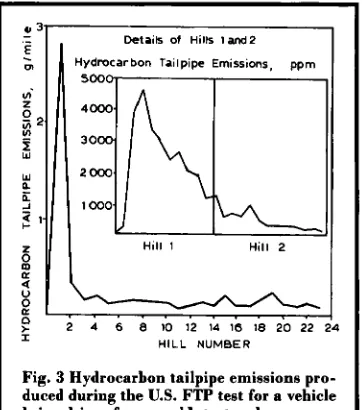
Fig. 3 Hydrocarbon tailpipe emissions pro- duced during the U.S. FTP test for a vehicle being driven from a cold start and run over a
number of hills
this has been successfully achieved, so that the efficiency of a thin walled substrate catalyst is comparable to that of a conventional catalyst.
Early problems with the mechanical integrity of metal substrate systems have now been largely resolved, by improvements in fabrication tech- nology. Metal substrates are now finding appli- cation, particularly on vehicles with small engines, where space is at a premium. The inher- ent benefit of using metal supports of thin walled structure has been in the lower pressure drop, and this has helped metal substrates to be accepted for such applications.
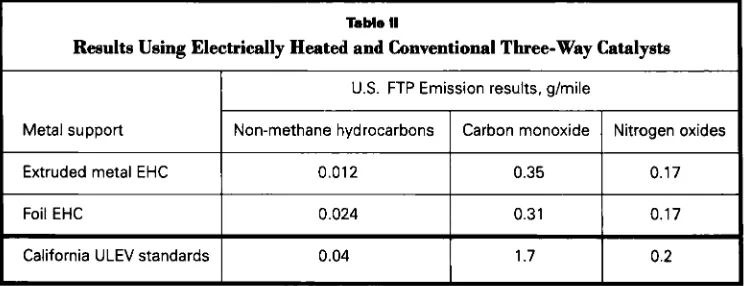
At present, attention is focused on developing metal substrates as electrically heated supports. These may be used to treat emissions during vehicle cold start, when hydrocarbon emissions are high, see Figure 3. Two principal types of metal support structures are under develop- ment.
Table II
Results Using Electrically Heated and Conventional Three-Way Catalysts
US. FTP Emission results, g/mile Metal support
Extruded metal EHC
Foil EHC
California ULEV standards
Non-methane hydrocarbons Carbon monoxide Nitrogen oxides
0.012 0.35 0.17
0.024 0.31 0.17
0.04 1.7 0.2
conventional three-way catalytic converters. Emission levels at or below those required for the California ULEV standards have been achieved on prototype systems, as Table I1 shows, and the durability of the systems are cur- rently being evaluated. Future developments in this area are concentrating on reducing the power consumption required for electrical heating and on optimising battery and alternator systems.
Advances
in
Catalyst Design
The most prominent three-way catalyst sys- tem in use today typically consists of platinum and rhodium as the active catalyst ingredients supported on a stabilised alumina coating con- taining cerium oxide as an oxygen storage com- ponent. Nickel oxide can also be added to sup- press the formation of hydrogen sulphide, which is produced from sulphur in the exhaust under rich air:fuel ratio conditions. It should be noted, however, that the use of nickel oxide in cata- lyst systems is generally avoided in the European market due to concerns over health hazards asso- ciated with nickel. In contrast, nickel oxide is used extensively in the U.S. market, as there is no evidence to support a loss of nickel from emission control catalysts.
Thermally Stable Catalysts
As previously mentioned a major challenge, for future catalyst systems, is to develop more thermally stable catalyst materials. This is due
to the sintering of catalyst materials being sig- nificantly enhanced under typical close coupled
operating conditions. In the design of future emission systems it is desirable that the maxi- mum operating temperature of the catalyst sys- tem is increased to around 950°C. Under such conditions it is expected that there will be sig- nificant loss of surface area and some crystal- lite growth. Thus, extensive research and devel- opment is being undertaken into methods of dispersing and stabilising the key catalytic mate- rials for operation at higher temperatures. Incorporating these materials into new cata- lyst systems has given a significant improvement in high temperature durability when the system is aged at temperatures up to 1O5O0C, as is shown in Figure 4.
Palladium Catalysts
In general the techniques described above, for enhancing the thermal durability of a catalyst, are most beneficial in improving the efficiency of platindrhodium three-way catalysts for con- trolling emissions of carbon monoxide and nitro- gen oxides after high temperature ageing. Although the platinum/rhodium catalyst gen- erally retains good efficiency for hydrocarbon control, it is desirable to enhance it because of the future severe standards for hydrocarbons.
Developments in palladium catalyst technol-
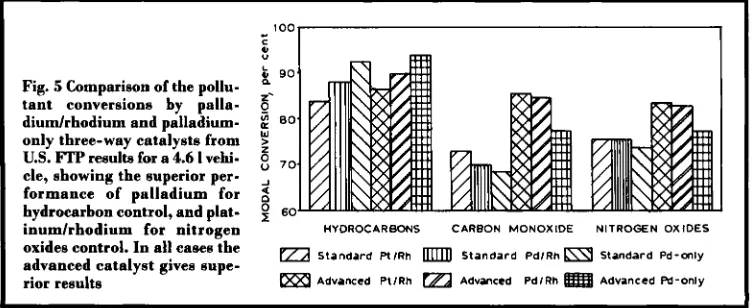
ogy have resulted in a significant improvement in hydrocarbon control, see Figure 5. Palladium catalysts will see application in close coupled converter systems, either as a single palladium catalyst, or as a palladium catalyst in combi- nation with a platinudrhodium catalyst. Table
Fig. 4 Conversion of hydrocar- bons, carbon monoxide and nitrogen oxides a t the stoi- chiometric air:fuel ratio by a standard platinumlrhodium three-way catalyst, aged at 900
and 1050°C, and by a n advanced platinumlrhodium catalyst aged at 1O5O0C, show- ing that the advanced catalyst has much greater high tem- perature stability
c
8 90
80
f
7 0 eW
> 60
50
e
STANDARD 900 STANDARD 1050 ADVANCSD 1050
CATALYST TYPE
Hydrocarbons Carbon monoxide
a
N i t r o g e n oxidesI11 shows a comparison of the relative perfor- mance of several converter combinations in two vehicles, employing palladium only and plat- inumkhodium catalysts in close coupled and underfloor converters. The optimum converter system design on these test vehicles appears to be a combination of palladium-only and plat- i n d r h o d i u m converters, to take advantage of the superior hydrocarbon control capability of palladium and the superior control of nitro- gen oxides by platinudrhodium, Figure 5 .
Low
Light-off Catalysts
In the absence of further enhancements to the thermal durability of catalyst systems, the sec- ond option is to design catalysts that are much more effective under low temperature exhaust conditions. In this case the emission system designer would then have the option of locating the converter in an exhaust position which is
more remote from the engine, thus avoiding excessively high exhaust temperatures. Substantial enhancements in catalyst light-off must also be achieved to produce a significant effect during the emission test.
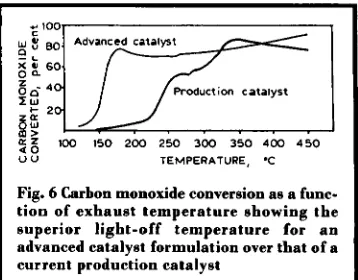
New catalyst formulations under development in the Johnson Matthey laboratories have demonstrated a potential for significantly low- ering the light-off temperature, when compared to a conventional platinudrhodium three-way catalyst. In Figure 6 the improvement in light- off achieved with a new catalyst formulation is
shown, when measured in a laboratory reactor operating a t a gas hourly space velocity of
90,000. Installation of this catalyst on a vehi- cle has shown promising advantages for cold start control of emissions of hydrocarbons and carbon monoxide.
As a result of such new formulations, other options have emerged, for instance low light-off
Fig. 5 Comparison of the pollu- tant conversions by palla- diudrhodium and palladium- only three-way catalysts from U.S. FTP results for a 4.6 I vehi- cle, showing the superior per- formance of palladium for hydrocarbon control, and plat- inumlrhodium for nitrogen
u u
a
2'
0
e
W
B
J
8
I.
HYDROCARBONS CARBON MONOXIDE N I T R O G E N OXIDES
D
Standard P t l R h Standard P d l R h m Standard Pd-mly
oxides control. In all cases the advanced catalyst gives supe-
Table 111
Comparison of Palladium-only and Platinudhodium Catalyst Efficiencies in Underfloor and Close-Coupled Positions
Pollutant
Hydrocarbons
Carbon monoxide
Nitrogen oxides
U.S. FTP 2.2 I vehicle
I
US. FTP 2.5 I vehicle Catalystpositions Underfloor
catalysts could be used to improve the effec- tiveness of converters under the low speed por- tion of the European driving cycle, or could be utilised to improve the effectiveness of con- verters in meeting TLEV and LEV standards in California. They might also be used in con- junction with electrically heated catalysts or hydrocarbon traps to meet the ULEV standards in California, which are due for implementa- tion a t the end of the decade.
Non-Regulated Emissions
of Hydrogen Sulphide
The decision to eliminate the use of nickel in catalyst formulations for the European market has presented a diEcult technical challenge to the catalyst designer, who must maximise the reduction of nitrogen oxides to nitrogen while minimising the reduction of sulphur dioxide to hydrogen sulphide. Tackling this selectivity problem has generally resulted in some lower- ing in catalyst performance for nitrogen oxides reduction, as hydrogen sulphide formation is suppressed.
The advantage which nickel oxide provided was its ability to absorb hydrogen sulphide and release the stored sulphur as sulphur dioxide in
oxidising conditions. This allowed the catalyst designer to formulate a catalyst composition to achieve maximum activity for the reduction of nitrogen oxides.
However, it is necessary to find an effective substitute for nickel, to suppress hydrogen sul-
phide emissions, for the European market. The progressive improvements in catalyst technol-
ogy, which have been achieved by research and development in the Johnson Matthey laborato- ries over the past five years, for hydrogen sul-
phide suppression are shown in Figure 7. The formulations that have currently been developed
c 100,
Product ion catal yst
s$
_ _
1 0 0 150 200 2 5 0 300 3 5 0 4 0 0 4 5 0u u TEMPERATURE, .C Fig. 6 Carbon monoxide conversion as a func- tion of exhaust temperature showing the superior light-off temperature for an advanced catalyst formulation over that of a current production catalyst
Catalyst
Pd-only
1 1
:E3::1
87.71
Pt/Rh1
85.11
::::
coupled Pd-only 91.0 Pd-only 92.8
Pt/Rh 90.9 91 .I Pt/Rh 91.9 89.6
Close- ‘‘1’’
Pd-only Pt/Rh Catalyst Pd-only Pt/Rh
90.1 87.8 Pd-only 90.5 89.0
I
Pd-only1
84.5I
86.9I
Pd-onlyI
91.4I
95.0I
Pt/RhI
93.0I
93.5I
Pt/RhI
94.2I
93.7Fig. 7 Hydrogen sulphide emis- sions from an unsuppressed three-way catalyst, and two sup- pressed catalysts produced in 1990, and 1993 demonstrating the progressive reduction in hydrogen sulphide emissions in non-nickel three-way catalysts
1400,
-16 0 16 32 4 8 64 80 96 112 128
TIME AFTER START OF DECELERATION, 5
are effective in suppressing emissions of hydro- gen sulphide, while still maintaining a high converter efficiency.
Catalysts to Control Nitrogen Oxides under Lean Conditions
Emerging engine technologies have designs that operate at air:fuel ratios leaner than stoi- chiometric, giving benefits in fuel economy and a reduction in emissions of carbon dioxide, which is considered to be a serious contribu- tor to global warming. In addition to lean burn four-stroke gasoline engines, diesel and two- stroke engines also operate at air:fuel ratios greater than 20: 1. Conventional three-way cat- alysts can control the carbon monoxide and hydrocarbon emissions at these airfuel ratios, but there is little ability to control emissions of nitrogen oxides. As a result, there is a tremen- dous interest in catalyst systems that can reduce nitrogen oxide emissions at lean calibrations.
A new range of catalyst materials has been
Copper1 zeolite
4
2 0Hr
- L
t O 150 200 250 300 350 4 0 0
Z V
TEMPERATURE, 'C
Fig. 8 Nitrogen oxides conversion by an advanced platinum catalyst compared to a copperlzeolite catalyst under lean exhaust conditions, as a function of the exhaust temperature
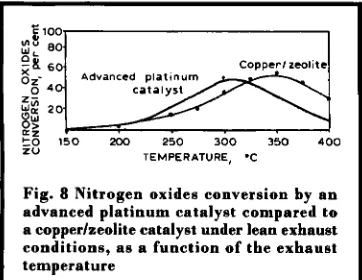
developed which shows activity for removal of nitrogen oxides under lean operating conditions. The new "Lean NOx" catalysts are based on zeolites containing active metals exchanged within the zeolite structure. One of the most active materials evaluated to date is copper- exchanged ZSM-5 zeolite, but this material has shown limited durability. More active and durable materials - including the platinum group metals - are being sought as catalysts for nitro- gen oxide control under lean conditions, see Figure 8.
Current "Lean NOx" catalyst systems are inef- fective for controlling carbon monoxide and hydrocarbons and, therefore, future systems utilising such catalysts would have to operate in conjunction with a platinum group metal cat- alyst to control the carbon monoxide and hydro- carbons. Measurable reductions in nitrogen oxides have been demonstrated by lean burn gasoline, diesel, and two-stroke engines using the new "Lean NOx" catalyst systems. This sug- gests that there will be a new approach to cat- alytic emission control towards the latter half of the decade, once issues of durability are solved.
Conclusions
Significant progress is being made in the devel- opment of emission control catalysts to meet the challenges arising from tightening emission leg- islation. These challenges will lead to new devel- opments in emission control catalysts through- out the rest of this decade.
durability of catalysts is improving and enhance- ments in light-off temperature are being achieved with new catalyst formulations. It is likely that platinum and rhodium will continue to be the primary ingredients for controlling carbon monoxide and nitrogen oxides and that palla- dium will continue to emerge as an important contributor to control hydrocarbon emissions.
New horizons are now being opened for con- trolling nitrogen oxides under lean operating conditions, and it is felt that the most likely mar-
ket for such catalyst systems will be the lean burn diesel engine, and possibly the lean burn two-stroke engine. Both copper and platinum catalysts are under development, but problems with the durability of such catalyst systems remain to be resolved. However, this area gives the most challenging and intriguing possibili- ties for the design of future emission systems.
References
1 B. J. Cooper and S . A. Roth, Platinum Metals Rev.,
1991, 35, (4), 178-187
Nitric
Oxide Catalysis
as
Applied
to
Vehicles
A recent review paper by Kathleen C. Taylorof General Motors covers the technical litera- ture on nitrogen oxides automotive emission control published during the period 1982-1991
(Catal. Rev.-%. Eng., 1993,35, (4), 457-481). The paper concentrates on three-way catalysts applied on gasoline engine vehicles, but a brief summary is also presented of recent work on lean nitrogen oxides catalysts for lean burn engine vehicles. T h e requirement for further reduction in nitrogen oxides emissions from vehicles is highlighted by reference to the recent tightening of standards in the United States; as outlined in the above Platinum Metals Review
article. The paper considers the fundamentals of three-way catalyst operation and describes rhodium as the preferred metal for nitrogen oxides control, due to its high activity for their reduction and high selectivity to form nitro- gen rather than ammonia.
The paper states that wide adoption of rhodium replacements such as palladium or copper appears unlikely at this stage due to the stricter control standards coming into force. It refer- ences the use of platinum in three-way cata- lysts together with ceria, and describes basic work on the role of ceria and its operation in con- junction with platinum and rhodium. Ceria is shown to be capable of extending the time for nitric oxide decomposition over platinum/ rhodiudceria catalysts due to the fact that the ceria absorbs oxygen from nitric oxide decom- position. Thus, ceria prevents the noble metal cat- alyst becoming deactivated by the accumulation of surface oxygen. Ceria is also claimed to alter favourably the reaction kinetics of carbon monox- ide oxidation and nitric oxide reduction, and to decrease the apparent activation energy of the car- bon monoxiddnitric oxide reaction, so favouring high conversion at low temperatures. Lower ceria particle size enhances the reduction of nitric oxide over platindceria catalysts and this is attributed
to the increased platinum-ceria interaction. The paper addresses the recent interest in the substitution of palladium for rhodium as a cost reduction move. It describes palladium as hav- ing a narrower air:fuel operating range for the control of nitrogen oxides emissions compared to platinum/rhodium, particularly under rich air:fuel conditions. This has been ascribed to poisoning of palladium sites by hydrocarbons in the exhaust, which can be alleviated by the addition of lanthanum and other additives.
The reduction mechanism for nitrogen oxides removal is described as a nitric oxide decom- position process over the noble metals, followed by the removal of oxygen from the noble metal surface via reaction with a reducing agent. Surface chemistry studies of reactions over rhodium surfaces have clearly identified the ele- mentary steps necessary to complete this reac- tion process. Rhodium is found to be struc- ture sensitive with particle size having a major effect, but crystallographic orientation only a moderate effect, on sensitivity.
The recent Auto/Oil Quality Improvement Research Program has clearly shown that fuel sulphur level can have a dramatic impact on nitrogen oxides emissions from a vehicle. During this study an increase of fuel sulphur from 49 ppm to 466 ppm showed a 9 per cent increase in the emissions with the higher sulphur con- tent fuel. Laboratory studies have confirmed these results. Platinum and rhodium show rapid reversibility when the fuel sulphur level is low- ered back to 49 ppm; however, palladium is slower to recover. The presence of ceria in the catalyst prolongs the recovery process due to sulphur adsorbed on the ceria surface.