Spatial Function in A nim als and R obots
Kenneth D. Harris
Doctor of Philosophy
University College London
ProQuest Number: 10610567
All rights reserved INFORMATION TO ALL USERS
The qu ality of this repro d u ctio n is d e p e n d e n t upon the q u ality of the copy subm itted.
In the unlikely e v e n t that the a u th o r did not send a c o m p le te m anuscript and there are missing pages, these will be note d . Also, if m aterial had to be rem oved,
a n o te will in d ica te the deletion.
uest
ProQuest 10610567
Published by ProQuest LLC(2017). C op yrig ht of the Dissertation is held by the Author.
All rights reserved.
This work is protected against unauthorized copying under Title 17, United States C o d e M icroform Edition © ProQuest LLC.
ProQuest LLC.
789 East Eisenhower Parkway P.O. Box 1346
A bstract
This thesis describes work aimed at discovering com putational processes th at could underlie the performance of spatial tasks, both in animals and artificial systems.
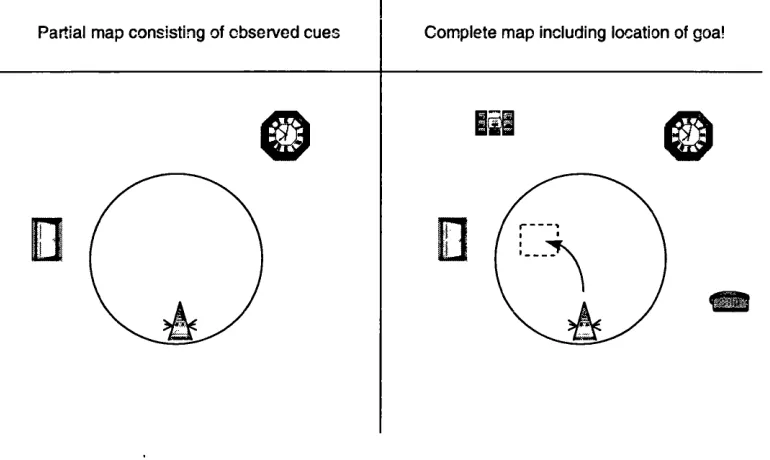
In the mammalian brain, the hippocampus is believed to play an impor tan t role in spatial function but is also often said to be a storage place for general memories. The first section of the thesis describes a model of mam malian spatial function in which the neocortex processes sensory information to build an egocentric m ap of the environment, and the hippocampus acts as an autoassociative memory which stores and recalls snapshots of neocortical activity, providing the animal with the ability to recall a complete egocentric map from a few observable landmarks. The model was implemented on a mobile robot equipped with a sonar sensor. The addition of a modelled hip pocampus to previously developed map-making software allowed the robot to perform a task similar to the Morris water maze.
The remainder of the thesis describes two novel methods for map construc tion from sonar sensory data. The first is a neural-network mapping system inspired by models of visual cortex. In this system, the activity of a cell repre sents the occupancy of a region of space, and lateral connections between cells enforce prior knowledge about probable m ap configurations. This m ethod pro duces good results in comparison to other grid-based mapping systems, but is based on heuristics, rather than m athem atical principles, and contains many free param eters.
I have composed this thesis myself and it reports original research th a t has been conducted by myself unless otherwise indicated.
A cknow ledgem ents
There many people I need to thank for making this thesis possible.
First and foremost is my supervisor, Michael Recce. Michael gave me not only good scientific advice, but also enthusiasm, patience, personal kindness, and generosity, making him not ju st a good supervisor, but also a good friend.
I have benefited greatly from discussions with the other members of the lab: Giorgio Grasso, Hajime Hirase, David Jack, Adrienne James, Charles King, Asaur Rahm an, and John Taylor. Also a big thank-you is due to David Lee, whose work serves as foundation for a large part of the research in this thesis. David Edwards has been very helpful w ith mechanical and practical issues. David Lee and Neil Burgess very kindly agreed to read my thesis.
On a personal note, I would like to thank my parents, my sister Becky, my girlfriend Helen, and Man Barefoot.
C on ten ts
I
8
1 Introduction 9
1.1 Spatial F u n ctio n ... 9
1.2 Types of Spatial A b i l i t y ... 9
1.2.1 C h e m o ta x is ... 10
1.2.2 Stimulus-Response B e h a v io u r ... 11
1.2.3 P ath Integration ... 13
1.2.4 L o c a lisa tio n ... 13
1.2.5 M a p p in g ... 14
1.2.6 P ath p la n n in g ... 15
1.2.7 Behavioural s e le c tio n ... 16
1.3 Aim of the t h e s i s ... 16
1.4 Structure of the t h e s i s ... 18
2 Spatial function and the brain in mammals 19 2.1 The spatial abilities of m am m als... 19
2.2 The effect of brain lesions on spatial ability... 20
2.3 The hippocampal th eta r h y t h m ... 21
2.4 Properties of hippocampal place cells... 22
2.5 Head direction c e l l s ... 24
3 Theories of hippocam pus 26 3.1 Explicitly spatial theories ... 26
3.1.1 The cognitive map t h e o r y ... 26
3.1.4 The model of Brown and S h a r p ... 30
3.1.5 The models of Redish and Touretzky ... 31
3.2 Non-spatial th eo rie s... 32
3.2.1 Episodic m e m o ry ... 32
3.2.2 Sequence m em o ry ... 33
3.2.3 Conditioning m o d e l s ... 34
3.3 D iscussion... 35
4 Spatial function in mobile robots 37 4.1 Mobile robot h a r d w a re ... 37
4.2 Early approaches to mobile ro b o tic s ... 39
4.3 Behaviour-based ro b o tic s ... 40
4.4 Modern te c h n iq u e s ... 41
4.4.1 Sonar-based m a p p in g ... 41
4.4.2 Sonar-based lo c a lis a tio n ... 43
4.5 The system of Lee and Recce ... 45
4.5.1 ARNE the r o b o t ... 47
4.5.2 Sonar preprocessing... 47
4.5.3 The feature m a p ... 48
4.5.4 The free-space m a p ... 50
4.5.5 L o c alisatio n ... 51
4.5.6 Map quality m e t r i c ... 51
4.6 S u m m a r y ... 52
II
54
5 A framework for spatial function in the mammalian brain 55 5.1 Egocentric and allocentric m a p s ... 565.2 Role of the hippocampus: localisation as a form of pattern com pletion ... 56
5.4.1 The water m a z e ... 62
5.4.2 Short-cut ability ... 62
5.4.3 Latent le a r n in g ... 63
5.4.4 Entorhinal place c e lls ... 64
5.4.5 The effect of environmental manipulations of place cell f ir in g ... 65
5.4.6 Non-spatial determinants of place cell f i r i n g ... 67
5.5 Suggestions for new experim ents... 68
5.5.1 The effect of lesions on path integration a b ility ... 68
5.5.2 Instantaneous t r a n s f e r ... 68
5.6 Summary ... 68
6 Instantiation o f the framework on a m obile robot 70 6.1 The simulated n e o c o rte x ... 71
6.1.1 Line m e r g i n g ... 71
6.1.2 Goal representation... 72
6.1.3 Coordinate c o n v e rs io n ... 72
6.2 The simulated h ip p o c a m p u s ... 72
6.2.1 Simulated place c e l l s ... 75
6.3 Behavioural m o d e s ... 77
6.4 Experimental r e s u l t s ... 79
6.5 D iscu ssio n ... 83
6.5.1 Implications for n e u ro b io lo g y ... 85
III
88
7 A neural network system for grid-based sonar mapping 89 7.1 In tro d u c tio n ... 897.2 Certainty grids and neural n etw o rk s... 90
7.3 The n e tw o rk ... 91
7.3.3 Behaviour of individual n e u r o n s ... 93
7.3.4 Sensory i n p u t ... 93
7.3.5 Recurrent c o n n e c tio n s ... 96
7.3.6 Execution c y c l e ... 97
7.4 Experimental Verification ... 98
7.5 D iscu ssio n ... 100
8 Probabilistic m odelling of the sonar sensor 103 8.1 In tro d u c tio n ... 103
8.2 Collection of Experimental D a t a ... 105
8.2.1 Reflections from rough and specular walls ... 105
8.2.2 Reflections from sharp e d g e s ... 105
8.3 Results and M o d e ls... 107
8.3.1 General form of probabilistic m o d e l s ... 107
8.3.2 Rough w a lls ... 108
8.3.3 Specular w a lls ... 112
8.4 Sharp E d g e s ... 116
8.5 D iscu ssio n ... 116
8.5.1 Summary of Models ... 116
8.5.2 Inter-system v ariab ility ... 119
8.5.3 Application to sensor sim u latio n ... 120
9 A Bayesian system for feature-based sonar mapping 122 9.1 In tro d u c tio n ... 122
9.2 Probabilistic M odelling... 123
9.2.1 General F o rm a lis m ... 123
9.2.2 Similarity to statistical model f i t t i n g ... 128
9.3 Implementational d e t a i l s ... 128
9.3.1 Physical M o d e l ... 129
9.3.2 Mean-field a p p ro x im a tio n ... 131
t / A V l l l 1 V / U U U 1 * • » A W
9.3.5 Filtering of input d a t a ... 141
9.4 Q uantitative a s s e s s m e n t ... 141
9.4.1 Generation of a free-space m a p ... 141
9.4.2 L o c alisatio n ... 142
9.4.3 D ata sets u se d ... 142
9.5 R e s u lts ... 144
9.5.1 Example maps produced by the a lg o r ith m ... 144
9.5.2 Quantitative comparison to previous m e th o d ... 146
9.5.3 Influence of step size on map q u a l i t y ... 147
9.6 D iscu ssio n ... 148
9.6.1 Improved performance in early stages of exploration . . 148
9.6.2 Improved asymptotic quality in the walls and empty en vironments 149
9.6.3 Worse asymptotic quality in the columns environment . 150 9.6.4 Suitability of Bayesian m e th o d s ... 151
9.6.5 Execution sp e ed ... 152
9.6.6 Ramifications for choice of exploration strategy . . . . 152
9.7 Directions for future work ... 153
9.7.1 L o c alisatio n ... 153
9.7.2 L e a rn in g ... 153
9.7.3 Relation to neural information processing... 154
IV
161
10 Conclusions and future work 162 10.1 Framework for spatial function in the mammalian brain . . . . 16210.2 Neural network grid-based mapping sy ste m ... 164
10.3 Probabilistic models of time-of-flight s o n a r ... 165
10.4 Bayesian feature-based mapping sy ste m ... 166
— _ . _ — - - - - - - - - . . .
10.5.2 Sensor s im u la to rs ... 167
10.5.3 Grid-based m a p p i n g ... 168
10.5.4 Feature-based m a p p in g ... 168
A Glossary o f biological term s 170
B N otation for chapter 9 173
C hapter 1
In trod u ction
1.1
Spatial Function
The aim of this thesis is to contribute to the understanding of computational
processes th a t could underlie spatial function, in both animals and artificial
systems.
Spatial function will be taken to mean the ability of an agent to control
its own movement through space in order to perform useful tasks. This thesis
will not be concerned with control of locomotion (the mechanism by which the
agent physically moves) although this can be a challenging research problem,
particularly in the case of walking. Instead we will concentrate on computa
tional functions necessary for locomotion to be put to a useful purpose.
It is a working hypothesis of this thesis th a t discovery of computational
mechanisms used by the brain to perform spatial functions will facilitate the
construction of more useful robots, and conversely, th a t discovery of techniques
th a t allow better spatial function in robots may shed light on mechanisms of
the brain.
1.2
T ypes o f Spatial A bility
This section will present a list of different types of spatial ability. One must be
cautious when trying to divide a cognitive ability into separate sub-abilities.
It is possible to break down spatial abilities in different ways, and indeed the
di-the di-thesis, and furdi-thermore, di-the abilities listed below are sufficiently differ
ent th at one might expect them to be carried out by different computational
mechanisms.
The following sections will define a list of spatial abilities in an approxi
mately hierarchical order, with those listed first being in some sense easier, or
necessary for performance of those listed later.
1.2.1
C hem otaxis
Chemotaxis, the motion of a single cell along a chemical gradient, is the sim
plest form of spatial behaviour, and has been extensively studied. There are
quite a variety of mechanisms of chemotaxis, and in particular bacterial and
eukaryotic cells seem to employ very different mechanisms.
The mechanisms of bacterial chemotaxis are very well understood, both at
a molecular level (see e.g. Alberts et al. 1994), and at a computational level
(see e.g. Schnitzer 1993, Strong et al. 1998), and are fascinating because they
are so simple. The mechanisms of chemotaxis have been best studied in the
bacterium E. Coli. In E. Coli, locomotion is produced by flagella, extracel
lular spiral filaments th a t can rotate either clockwise or anti-clockwise. The
structure of the flagella is such that, when rotating anti-clockwise, the different
filaments line up, and produce a coherent thrust, propelling the bacterium in
a forward direction. But when rotating clockwise, the filaments do not align,
and the bacterium rotates chaotically. The bacterium’s motion alternates be
tween 2 phases: the “run” phase in which the flagella rotate anti-clockwise,
and the bacterium moves forwards, and the “tumble” phase, during which the
flagella rotate clockwise and the cell spins at random.
The bacterium ’s cell membrane contains chemoreceptors which detect the
rate of change in time of the concentration of beneficial or harmful substances.
When the concentration of a beneficial substance is increasing in time, or the
concentration of a harmful substance is decreasing, the probability of a tumble
is high. Therefore, if the bacterium is heading towards a beneficial substance
it will continue to do so, but if it is heading away from one, it change direction
to a new, random direction. Notice th at the bacterium makes no attem pt
to measure concentration gradients. In m athem atical terms, the bacterium is
performing a Monte Carlo search.
Chemotaxis in eukaryotic cells happens by very different mechanisms. For
example, amoeba of the slime mould Dictyostelium discoideum have chemore-
ceptors on their surface th at detect the concentration of the chemotactic at-
tractant, cyclic AMP. Where the attractan t concentration is high, it causes
intracellular actin to polymerise, making the cell extend in th at direction. If
there is a high concentration on one side of the cell, but a low concentration
on the other, the cell will move towards the higher concentration. One might
therefore say th a t the amoeba are performing a gradient ascent search, rather
than Monte Carlo.
A study of robots which behave by mechanisms akin to chemotaxis has
been given by Braitenberg (1987). Rather than following the traditional en
gineering methodology of identifying a problem and then devising a solution,
Braitenberg follows an approach he calls synthetic psychology. He constructs
various simple machines, with a small number of sensors and actuators, and
examines their behaviour for different patterns of connectivity between the sen
sors and actuators. The behaviour of these simple machines can be described
by words used to describe human behaviour, such as “restless,” “cowardly,”
and “aggressive.” This research provides insight into the way th at very simple
machines may produce complex behaviours; however it also seems clear th at
machines th a t are controlled only by simple chemotactic-style mechanisms are
unlikely to perform a useful function in the real world.
1.2.2
Stim ulus-R esponse B ehaviour
A slightly more advanced form of spatial ability than chemotaxis would involve
For example a mole navigating through a network of tunnels might turn
left when it comes to a junction with a particular smell, but turn right at
the next junction, which has a different smell. Alternatively, an agent may
perform a given action in response to the observation of certain visual cues.
For example, a PhD student navigating through the tunnels of the anatomy
department at University College London might know to turn right when he
sees the grey lockers, turn left at the top of the stone stairs, and then exit
through the glass door.
Following O ’Keefe and Nadel (1978), we will refer to the system of navi
gating along fixed routes by a chain of stimulus-response associations as the
taxon system. The taxon system is egocentric, meaning th a t for each stimulus-
response association the agent performs a motion relative to its current posi
tion and orientation, in response to local cues such as a smell, or the presence
of a landmark at a certain egocentric position. O ’Keefe and Nadel describe
the kind of trajectories obtained by this kind of navigation as routes.
One might distinguish between two types of stimulus-response association.
An association like “When moving fast towards a large rock, stop” might
be innate, or acquired very early in life and fixed from then on. However
the associations required to follow a route must be learned by experience of
traversing th at route. The type of learning required is associative learning,
and has been studied extensively since the early part of this century (Pavlov
1927). There is now considerable evidence for molecular mechanisms th at
could underlie such learning in both vertebrates and invertebrates (see e.g.
Hawkins et al. 1993).
A problem with simple stimulus-response behaviour as a navigational strat
egy is its inflexibility. If just one of the cues along the route changes, then
the entire route is no longer useful. Once off a route, an agent can only find
its way back on by random wandering. Furthermore, if a lost agent finds a
familiar landmark it will not necessarily be heading in the same direction as
Stimulus-response association is a general mechanism thought to underlie
many different types of behaviour. However, for a task as fundamental as
spatial navigation, one might expect techniques to be used th at take advan
tage of special features of the task at hand, such as the Euclidean geometry of
space. One such ability is path integration or dead reckoning. Path integration
is the ability to keep track of the total distance and direction moved, even if
the animal has followed a complicated or curved path. By requiring animals
to leave and return to a nest in the absence of visual or olfactory cues, path
integration ability has been demonstrated in insects (Wehner et al. 1996) and
mammals (M ittelstaedt and M ittelstaedt 1980).
P ath integration is easy to implement in robots - one simply has to keep
track of all the movements and turns made by the robot, and perform a vector
summation to find the total distance travelled and angle turned. However,
for both animals and robots, inaccuracies will build up because the move
ments and turns cannot be specified with arbitrary precision. Furthermore,
because the movement vectors for subsequent movements must be added, er
rors will increase in time without bound. For robots, the rate of accumulation
of path-integration errors can be reduced by using mechanically precise parts,
and indeed many robots are designed to be very precise for this reason. But
however precise a robot is, path-integration errors will eventually accumulate
unless there is some mechanism to reset them.
1.2.4
L ocalisation
To overcome errors in path integration, an animal must be able to produce
or correct an estimate of its position based on the observed location of en
vironmental features. We will call this ability localisation, and it has been
demonstrated in insects (Cartwright and Collett 1982), and mammals (Morris
1981).
One can distinguish two different types of localisation: incremental local
^/UIU AI UIA1U U / V C / V V IS V t v v \/KJ XJUV V \ S t V TV A1V11 A1V X. ViXlliAU W V*' V k / VAAAXVUUV iU
available. One might expect incremental localisation to be the easier of the
two abilities. W hether this is the case in animals has not yet been addressed
experimentally, but it does seem to be the case in robotics, as we shall see
later on.
In robotics, localisation is a difficult problem which does not have a general
solution in all circumstances. In industrial robot applications, the difficulties of
localisation are usually circumvented by artificially enhancing the environment
th at the robot operates in. For example, routes taken by the robot could
be marked by lines painted on the floor th at the robot must follow, or the
environment could be enriched with artificial beacons or easily identifiable
landmarks such as bar-codes.
Unfortunately, this approach leads to a loss of flexibility. A line-following
robot can only follow a small number of pre-determined paths, and if new paths
are required, new lines must be painted. Artificial beacons do not necessarily
limit the paths th a t the robot can take; but the process of setting up the
beacons and programming the robot with their location is time-consuming,
and must be done every time the robot is deployed in a new environment.
1.2.5
M apping
In this thesis, a map will mean a description of the nature and location of a
set of environmental features, or landmarks. We will use the term mapping or
landmark identification to mean the determination of the nature and locations
of environmental features from sensory information. Mapping might be better
classified as a problem of perception and sensory processing than of spatial
function, but it is so clearly relevant for performance of spatial tasks th at it is
included in this section.
One can make a distinction between two classes of landmark. The first class
consists of environmental features which are behaviourally relevant, such as
goals or obstacles. The identification of these landmarks is directly necessary
vance, such as a distant mountain. While the identification of this second type
of landmark is not directly necessary for performance of the task, it could still
be useful, for example in localisation.
It is clear th at higher vertebrates can perform landmark identification, but
not so clear for insects. One argument th a t insects can perform landmark
identification might be th at they are capable of localisation, and localisation
requires landmark identification. However, it has also been argued th at insects
localise by simply by memorising entire visual scenes in retinotopic coordi
nates, rather than memorising the position of identified landmarks (Judd and
Collett 1998).
In the case of artificial systems, landmark identification by vision has
proved very difficult. Determining the type of an environmental object re
quires image segmentation and object recognition, and determining its posi
tion requires other techniques such as stereo matching. These are all difficult
open problems, and most successful robot systems avoid visual landmark iden
tification altogether. W ith simpler sensors such as sonar, the problem is easier
(Leonard and Durrant-W hyte 1992; Lee and Recce 1997). However, with these
sensors, the number of identifiable landmark types is small.
1.2.6
P ath planning
Once an animal knows its own position, the positions of obstacles in the en
vironment, and the location of a goal, it must plan a route to the goal. In
an open field, the animal can simply head along a straight line towards the
goal, but in an environment cluttered with obstacles, path planning is a non
trivial problem. There has been a lot of work done on path planning in mobile
robotics (see McKerrow 1991, section 8.3.3), most of which makes use of clas
sical techniques such as recursive search.
In animals, there has been much experimental and theoretical research on
path planning of limb movements (see e.g. Flash and Hogan 1985) but to my
other aspect (such as the role of the hippocampus), and make do with an
ad-hoc model of path planning.
1.2.7 B ehavioural selection
The abilities listed above give an agent the ability to move to a particular
location in space. However, before the agent goes anywhere it must decide
where, if anywhere, to go.
For an animal, the choice of destination is going to be influenced by many
factors such as the internal state of the animal (e.g. whether it is hungry or
thirsty), the presence of stimuli (such as a predator or a visible source of food),
or even the time of day. Because so many factors are involved, is very hard
to characterise neurobiological processes underlying behavioural selection, but
for some recent reviews see Kristan and Shaw (1997) and Owen (1997).
For robots, two approaches to behavioural selection have been in common
use. The first approach could be called top-down control. W ith this approach,
an executive control module combines the task the robot must perform with
a world model to derive an appropriate action for the robot to perform. This
approach is natural to computer programmers used to working with reliable
digital machines, but when used to control robots in the real world, it can lead
to a lack of robustness. In order to overcome this, a second approach, called
behaviour-based robotics, was developed. In this approach, there is no executive
control module, and several different modules all contribute to the robot’s
behaviour in parallel. Behaviour-based robotics will be discussed further in
chapter 4.
1.3
A im o f th e thesis
The aim of this thesis is to clarify some of the computational processes th at
could underly spatial function. These will be studied by computational mod
elling of neuronal structures thought to be necessary for spatial function in
spatial tasks by mobile robots. This thesis will not have anything to say about
the question, interesting though it is, of spatial function in lower animals.
The previous section listed a set of spatial abilities, in increasing order
of difficulty. For the early ones, the computational processes needed to per
form the tasks are clear: no one questions the computational mechanisms of
chemotaxis, the molecular mechanisms underlying chemotaxis are well under
stood, and robots have been constructed th at perform similar tasks reliably.
Stimulus-response behaviour and path integration are also usually regarded as
areas in which not much more research is required. But for the more difficult
spatial functions, little is known about how animals perform these functions,
or how they might be successfully implemented on mobile robots. One might
argue th at is is necessary to solve the simpler spatial problems before attem pt
ing the more difficult ones (Brooks 1986). In this thesis, we concentrate on
the intermediate problems of localisation and mapping.
The research described in this thesis falls into two parts. In part II, the
focus is on biology. We present a theory for the performance of absolute locali
sation in mammals with the aim of unifying two apparently conflicting previous
ideas about hippocampal function. The theory is qualitatively discussed with
respect to previous biological experiments and models, and predictions are
made for new experiments. The theory is then tested by implementation on
a mobile robot, and implications for the problem of absolute localisation in
mobile robots is discussed.
In part III, the focus is on engineering. We describe two new techniques
for map building by sonar-equipped mobile robots. The aim here is not to
model any particular biological systems or brain structures, but to produce
a mapping algorithm th a t makes maximum use of the available sensory data.
The first technique is a neural network based system, inspired by models of
visual cortex. The second is derived purely from probability theory, without
any reference to biology. However, the resulting algorithm turns out to have
1.4
Structure o f the thesis
Chapters 2 to 4 are literature review. In chapter 2, we discuss experiments
aimed at revealing what spatial functions animals are capable of, and how these
functions may be performed by the brain. In chapter 3, we discuss models of
the hippocampus, a brain structure thought to be centrally involved in spatial
function. In chapter 4, we describe approaches which have been taken to the
problem of giving spatial abilities to mobile robots.
In chapter 5, we describe a new theory for how spatial functions may be
executed by the brain, concentrating particularly on the role of the hippocam
pus. In chapter 6, we describe how this theory was tested by implementation
on a mobile robot.
Chapters 7 to 9 describe new methods for mapping in the case of sonar-
equipped mobile robots. Chapter 7 describes a neural network based system
inspired by models of visual cortex. Chapters 8 and 9 describe a second system
derived from probability theory. Chapter 8 describes the production of a
probabilistic model of the sonar sensor necessary for the mapping algorithm.
Chapter 9 describes the algorithm itself, and gives the results of experiments
testing the algorithm with real data.
Finally, in chapter 10, we summarise the conclusions of the investigations
C hapter 2
Spatial function and th e brain
in m am m als
This chapter will describe previous experiments which have tried to find out
precisely what spatial functions animals are capable of performing, and how
they are carried out in the brain. The literature on this subject is vast, and
we can only touch on some of it. Due to constraints of space, we must leave
invertebrates behind and concentrate on mammals. In particular most of the
experiments described here involve rodents.
When describing biological research, it is necessary to use biological terms.
Appendix A contains a glossary of some of the more obscure biological and
psychological terms used in this chapter, for readers who may not be familiar
with them.
2.1
The spatial abilities o f m am m als
Mammals appear to be capable of all the spatial abilities listed in chapter
1. They are clearly capable of finding the source of an odour, which may be
interpreted as an analog of chemotaxis. Early experiments have also clearly
shown th at they are capable of producing spatial responses to stimuli, and
using stimulus-response chains to navigate using routes (e.g. Watson 1907).
However, early experiments also showed th at rodents can perform tasks not ex
plainable by stimulus-response behaviour alone. For example, Tolman (1948)
The ability of rodents to perform path integration was dem onstrated by
M ittelstaedt and M ittelstaedt (1980), in an experiment where a mother gerbil
was required to leave her nest to retrieve a pup in darkness, and would return
to the nest along a straight line path even if her trajectory in finding the pup
was highly non-linear.
Localisation ability in rats was demonstrated by Morris (1981) using a
task known commonly, if bizarrely, as the water maze. In this task, a rat
is placed in a pool of opaque milky water in which there is a submerged
platform, which is invisible to the rat. After repeated trials the rat learns
to head directly to the platform from any of several starting points on the
edge of the pool. In order to solve this task, the rat must use environmental
features to decide its location, remember the location of the goal, and move
along a vector from this starting point to the goal. Morris initially claimed
th at localisation was possible from parts of the environment th a t the animal
had not previously visited (Morris 1981; see also Sutherland and Linggard
1982), and called the ability to transfer spatial knowledge gained in one place
to another instantaneous transfer. Recently, however, the suggestion th at
animals can perform instantaneous transfer has become more controversial
(Sutherland et al. 1987; Keith and McVety 1988; Chew et al. 1989; Keith
1989; Whishaw 1991; Alyan 1994).
2.2
T he effect o f brain lesions on spatial abil
ity.
Lesions to the neocortex in rats have been shown to have a serious effect on
spatial ability, disrupting the ability to travel to both visible and memorised
goals at fixed egocentric and allocentric locations (e.g. Kolb et al. 1994;
Save and Moghaddam 1996). D ata suggest that the cortical areas involved
in spatial function include the posterior parietal cortex and medial prefrontal
a review), a condition in which the patient has an impaired ability to attend
to stimuli in the contralateral hemisphere. The deficit seems to be one of
egocentric, rather than allocentric, spatial representation, and effects mental
imagery as well as the perception of physical stimuli (Bisiach and Luzzatti
1978). A general consensus is th a t the posterior parietal cortex is necessary
for explicitly spatial functions, such as the determination and representation
of object locations relative to the body (in the language of chapter 1, we would
say it is necessary for mapping), and th at the prefrontal cortex is necessary
for more general high-level planning and behavioural functions not only in a
spatial context (see e.g. Kolb and Whishaw 1995).
Hippocampal lesions in rats have been shown to impair performance in the
water maze task described above (Morris et al. 1982). Recent PE T studies
have confirmed th a t the hippocampus is also involved in spatial function in
humans (Maguire et al. 1998). However the most obvious effect of human
hippocampal lesions is strikingly different - the syndrome of “global antero
grade amnesia” (Scoville and Milner 1957). In this syndrome, the patient is
able to retain information for a small length of time, for a few minutes or
until distracted, but not for longer. Only declarative or episodic memories,
which involve the recall of specific events or facts seem to be affected, whereas
procedural memories, such as motor skills acquired through practice are not.
Also, episodic memories formed a long enough time before the hippocampal
damage are not affected.
2.3
T he hippocam pal th eta rhythm
In rats, the EEG activity of the hippocampus falls into two distinct states,
depending on the behaviour of the animal.
During locomotion, hippocampal EEG shows an approximately sinusoidal
7-12 Hz rhythm, called theta (Vanderwolf 1969). While the animal is awake,
the correlation between th eta and motion is very strong, and there is also
F igu re 2.1: T h e firing ra te m ap of a typical hipp ocam p al place cell, rep rin ted from M uller et al. (1991). T he shading represents th e average firing ra te of a single CA1 cell a t each position in a cylindrical arena.
of th e anim al (Recce 1994). T he th e ta rhy thm is also observed d uring R EM
sleep.
D uring slow-wave sleep and w aking behaviours th a t do n o t involve move
m ent (such as resting, feeding, or groom ing), the h ip p o cam p al E E G shows a
p a tte rn called large irregular a ctivity, which consists of a b road er ranger of frequencies, and is p u n c tu a te d by sh o rt-d u ratio n sharp waves.
2.4
P ro p e rtie s of h ip p o cam p al place cells.
R ecordings in ra t hip po cam pu s have revealed th e existence of place cells (see figure 2.1), which fire when the ra t is in a specific p a rt of an environm ent
(O ’Keefe an d D ostrovsky 1971; O ’Keefe 1976; M uller et al. 1987). N orm ally
place cells have a stab le activity p a tte rn , corresponding to a single region, or
place field, in an environm ent. In a single environm ent, place cells have been recorded over m any days and ap p ea r to have stab le place fields (T hom pson
an d B est 1990). W hen ra ts random ly search for food in an open field en
vironm en t, th e firing of place cells is largely ind ep en den t of head direction.
However, w hen a r a t is constrained to move back an d forth along a fixed one
dim ensional trajecto ry , place cell firing is also m o d u lated by th e d irectio n of
Several studies have dem onstrated th at the firing of place cells is driven by
visual sensory input. For example, if all cues in an environment are rotated,
the firing areas of place cells rotate with it (O’Keefe and Conway 1978; Muller
and Kubie 1987). Place cells can also be controlled by senses other than vision,
and indeed normal place cells are found even in blind and deaf rats, provided
th at the environment is sufficiently rich in tactile cues to allow for localisation
(Hill and Best 1981; Save et al. 1996).
If a rat is placed in a well-explored environment, and the lights are switched
off, the place cells continue to fire in their usual place fields, although the place
fields become slightly broader (Quirk et al. 1990). This broadening may be
attributable to a build up of path-integration errors th at, in the absence of
visual input, cannot be corrected by localisation. If the lights are switched off
before the rat is placed in the familiar room, a new set of place cells begins to
fire, and the new pattern of activity persists after the lights have been switched
back on.
When a rat is allowed access to a previously unreachable part of a familiar
environment, previously silent place cells begin to fire with place fields in the
previously unreachable area. However, place fields in the familiar part of the
environment are unchanged (Wilson and McNaughton 1993).
Finally, neurons in other areas near the hippocampus, such as the dentate
gyrus (Jung and McNaughton 1993), the subiculum (Sharp and Green 1994),
and the entorhinal cortex (Quirk et al. 1992) also show place-dependent firing.
The size of spatial firing field of the cells varies among these regions (Barnes
et al. 1990). Neurons of the entorhinal cortex show broad place fields, but
in contrast to hippocampal place cells, the firing patterns medial entorhinal
cells are topologically transformed when the shape of the environment changes
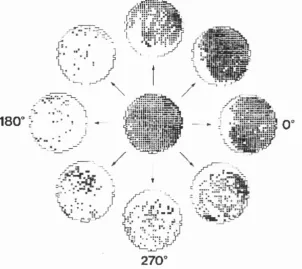
F igu re 2.2: A typical head-direction cell, rep rin ted from T aube et al. (1990a). T h e cen tral circle shows firing ra te as a function of position, averaged over all head directions. It can be seen th a t th e cell has little positional preference. T he p erip h e ral circles show firing ra te as a function of position when th e r a t ’s head is p o in tin g in th e a p p ro p ria te direction. T he firing ra te is strongly m o d u lated by head d irectio n, b u t no t by position.
2.5
H ead d ire c tio n cells
R ecordings in th e p ostsubiculum of ra ts have identified head direction cells
(R anck 1985; T au be et al. 1990a) whose firing rates are tun ed to th e anim als
allo centric head direction, b u t largely in depend ent of th e anim als po sition in
space (see figure 2.2). Since th e initial discovery of head direction cells in th e
p o stsu b icu lu m , th ey have also been found in the antero do rsal nucleus of th e
a n te rio r th a lam u s (T aube 1995), th e latero d o rsal th alam ic nucleus (M izum ori
an d W illiam s 1993), the retrosp lenial and p arie tal cortical areas (C hen et al.
1990; M cN aughton et al. 1991) and th e s tria tu m (W iener 1993).
Like place cells, th e firing of head direction cells is determ ined by visual
in p u t (T aube et al. 1990b). Also like place cells, if th e lights are sw itched o ut
tial firing directions begin to drift (Mizumori and Williams 1993). This may
again be ascribed to the build-up of path-integration errors in the absence of
localisation.
If the positions of significant landmarks are changed during an exploration
session, the directional preference of head direction cells may follow either the
landmarks positions, or path-integrated ideothetic information. In general,
it appears th a t rats use landmarks preferentially over ideothetic input, pro
vided experience has proved those landmarks to be stable (Taube and Burton
1995; Knierim et al. 1995). Multiple cell recordings have shown th a t the head
direction and place cell systems are coupled, in th a t an environmental manip
ulation causes a consistent rotation in the preferred directions of all recorded
head direction cells (Taube and Burton 1995), as well as causing a rotation in
C hapter 3
T heories o f hippocam pus
In this chapter we will describe some previous theories of hippocampal function
in mammals. Again, the literature is vast, and we can only mention some of
the many theories.
As described in the last chapter, the evidence from rats points to an explic
itly spatial role for the hippocampus, but the evidence from humans points to
a more general memory function. This chapter will be in two parts, the first
describing explicitly spatial theories and the second more general theories.
3.1
E xplicitly spatial theories
3.1.1
T h e cogn itive map theory
The first and most influential theory of hippocampal involvement in spatial
function is the cognitive map theory of O ’Keefe and Nadel (1978). O ’Keefe
and Nadel distinguished two separate systems involved in navigation: the
taxon system, previously described in chapter 1 of this thesis, which allows
for route following by stimulus-response association; and the locale system
which involves the use of a cognitive map, for which the proposed substrate
is the hippocampus. The cognitive map is like a geographical map, in th at
the location of the animal and the external cues are represented in an fixed,
world-centred frame. An im portant feature of the locale system is th a t goals
are treated in exactly the same way as other environmental features. This
is in contrast to taxon navigation, where goals act as reinforcers of learned
o
on/off synapses
1 0 0%
) w l 5 ^ o s \ > n goal cells „ — ' (north, south, east & west)
on/off s y n a p s e s ^ —
lateral
inhibition on/off synapses
50% connectivity
o o o o p o o p
O Q Q O O O O O O P O O subicularcells
O O O O O Q O O O O O O place cells
on/off synapses 50% connectivity
Q O O O O O O O O O O entorhinal cells
hard-wired connection of a pair of inputs to each
O O O O ‘sensory input’
E cell
tuning curve responses to distances
o f environmental cues
Figure 3.1: The model of Burgess e t a l, reprinted from Burgess et al (1996),
figure 6. Cells in the input layer code for the distance, but not bearing, from the rat to identified landmarks, and cells of the output layer determine which direction the rat should move in to reach the goal.
During the twenty years since its publication, the cognitive map theory
has received wide-ranging experimental support, including data from lesion
experiments in rats (see Jarrard 1993 for a review), and the properties of
place cells.
The cognitive map theory is a qualitative theory. It ascribes, in words, a
function to the hippocampus, but says little about how this function might be
computed by the cells of the hippocampus. O ’Keefe and Nadel (1978, section
4.8) did also tentatively sketch a neural model which could act as a spatial
map, but it their own words, it was “far off the mark” and would be “hopefully
modified or rejected in the near future.” Nevertheless, the cognitive map
theory has been vastly influential on later computational models, and many
computational models of hippocampal function propose an explicitly spatial
Burgess et al. (1994) describe a computational model of hippocampal involve
ment in rat navigation based on visual cues. At the heart of the model is
a layered neural network containing cells corresponding to various areas of
the hippocampal formation - the entorhinal cortex, hippocampus, subiculum,
head-direction system, and another, unspecified area one synapse downstream
from the subiculum which contains goal cells which code for the location of a
goal relative to the position of the rat (see figure 3.1). There is also a popula
tion of “sensory cells,” each of which codes for to the distance to an identified
landmark in the environment. No sensory cell codes for more than one land
mark, and no cell codes for the angular bearing to its associated landmark.
Activity is propagated from the sensory layer to the entorhinal layer by
fixed connections, and from the entorhinal to the hippocampal and subicular
layers by connections which are trained by competitive learning. An impor
tant feature of the model is th at the firing of cells from the entorhinal cortex
onwards is phase coded (O’Keefe and Recce 1993). The phase of firing of en
torhinal cells (with respect to the theta rhythm) depends on the average angle
from the r a t’s heading direction to the cues to which it responds, with cues
ahead of the rat making the cell fire at a late phase, and cues behind the rat
making it fire at an early phase. However, a neural mechanism by which this
entorhinal phase phenomenon could be generated was not given.
The goal cells are trained by a type of reinforcement learning: when the
rat reaches a goal, it looks around in 8 directions (north, northeast, east, etc.),
and for each direction, the goal cell corresponding to th at direction receives
a reinforcement signal at the late phase of the theta rhythm, and all active
input synapses are strengthened. After training, the output of the goal cells
forms a population vector which points in the direction of the goal from any
location.
A notable way in which this model differs from the cognitive map theory
en-population of goal cells, and other environmental objects possessing a popu
lation of sensory cells. Furthermore, goal cells have yet to be identified in the
mammalian nervous system.
3.1.3
T he hippocam pus as th e su bstrate for path-integration
McNaughton et al. (1996) have proposed th a t the hippocampus is the sub
strate for path-integration ability in mammals.
In their model, recurrent excitatory connections within the hippocampus
(specifically, in the CA3 field) are pre-configured in a way th a t implicitly
defines a set of two-dimensional surfaces. The two-dimensional surfaces do
not map directly to the two-dimensional CA3 cell layer, but are an abstract
construct th a t arises from the pattern of synaptic weights. The synaptic weight
between two neurons is proposed to be an approximately Gaussian function
of distance on the abstract surface. As a result, given appropriate global
inhibition, each neuron defines the centre of an “attractor” , i.e. a fixed firing
pattern th a t is kept active by the recurrent connections.
McNaughton et al. (1996) also propose th a t connections between these
abstract surfaces and another area, possibly the subiculum, allow the animal
to perform a path integration function. The cells in this second area fire in
relation to the r a t’s position and current heading direction, and project to the
hippocampus with synapses biased towards the r a t’s current heading direction.
In this way, the location of hippocampal activity pattern moves in the correct
direction during linear motion. Modifiable connections between the hippocam
pus and neocortex allow the animal to record the positions of environmental
landmarks, in the reference frame described by the abstract surfaces of the
hippocampus. When the ra t is then introduced to a familiar environment,
these connections allow the rat to localise using visual information.
McNaughton et al. (1996) explain the results of many experiments in the
framework of this model. However, at a conceptual level, many questions
synap-v ^. ^ .1* l l * r y V V U U * F U U
the more difficult because the abstract surfaces do not map onto the two-
dimensional arrangement of the cells. No mechanisms are given by which the
synapses might be trained, or formed during development.
Whishaw et al. (1995) show th at rats with fimbria-fornix lesions are able to
find a hidden platform in a water maze if they are originally (and extensively)
trained to swim to a visible platform in the same location, but not if they
are originally trained with a hidden platform. They take this as evidence
th at the hippocampus is responsible not for spatial memory, but for some
motor function such as path integration. However, recent preliminary evidence
suggesting th at the hippocampus is not necessary for path integration (Alyan
et al. 1997) would appear to deal path-integration theories a fatal blow.
3.1.4
T he m od el of Brown and Sharp
Brown and Sharp (1995) describe a computational model of the involvement
of hippocampus, postsubiculum, and nucleus accumbens in the performance
of the water maze task.
Like Burgess et. al., they assume a population of sensory cells which code
for the egocentric location of identified stimuli, and a population of place
cells which receive input from the sensory cells and are trained by competitive
learning. However, they differ on the way in which the place cell output is used.
In Brown and Sharp’s model, the place cell output, along with head direction
cell output, is the input to a reinforcement learning system located in the
nucleus accumbens. The nucleus accumbens network contains two populations
of cells, whose output produces left and right turns, and the input synapses of
these cells are trained by a type of temporal-difference rule (Barto and Sutton
1981).
This model is essentially a stimulus-response system, and the fact th a t it
can solve a water maze style task casts doubt on the commonly held belief
th at a locale system is necessary. A stimulus-response system would certainly
Nucleus
Taxon navi
Motor Output Sensory
tnput
R outes Alignment
Consolidation ECd
DG
PerRh ECs
PI- } re se t1
Local View
CM
PoS Sub
LMN
HD i n P F C
Goal
ttm yg
VTA lAcb
ATN
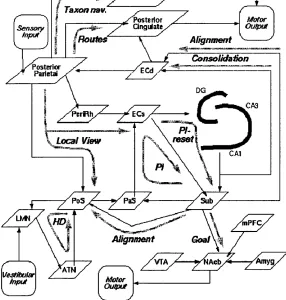
Figure 3.2: The models of Redish and Touretzky, reprinted from Redish (1997), figure 3.15. Specific roles are proposed for a total at least 16 separate brain areas, and different types of spatial function are processed by 11 different functional pathways (shown in grey).
the evidence for instantaneous transfer is not clear. However a model such
as this one cannot explain the ability of animals to take short-cuts across
unexplored regions, as this would require the animal to pass through areas of
space in which no place cells had been formed, and therefore no output could
be produced.
3.1.5
T h e m odels o f R edish and Touretzky
In a series of papers, Redish and Touretzky (Touretzky and Redish 1995;
Touretzky and Redish 1996; Redish and Touretzky 1997) propose a very de
tailed theory of rodent navigation including specific functions for the hip
pocampus, subiculum, postsubiculum, parasubiculum, basal ganglia, amyg
VVUUVvlXWX X \ s tUl j j ill^UlUl ^/UVJUtCll UilU |/V>IXXlilllUil V>VI
tices, as summarised in figure 3.2. They propose th at the hippocampus has
three functional modes: A storage mode, during which LTP occurs in the hip
pocampal formation but those synapses undergoing potentiation show little
or no transmission; a recall mode in which no LTP occurs, and the dentate
gyrus is silent, although direct connections from entorhinal cortex to CA3 and
CA1 are active; and a replay mode in which all inputs to the hippocampus
are silent, and the activity of hippocampal cells is due only to internal dynam
ics. A key feature of their model is the path integrator module, whose job is
to update the position of the animal in an allocentric coordinate frame, and
whose proposed anatomical substrate is a loop consisting of the subiculum,
parasubiculum, and superficial entorhinal cortex. Notably, this loop does not
include the hippocampus.
To make such a detailed model of neural function might be considered
premature, given the very large number of brain structures modelled, and the
level of experimental knowledge at the present time. However a model this
detailed makes a great many experimental predictions which should be easily
verifiable or falsifiable. For example, it predicts th at while the superficial
entorhinal cortex, parasubiculum, and subiculum are all necessary for path-
integration, the hippocampus and the remainder of the neocortex (including
the deep layers of the entorhinal cortex) are not.
3.2
N on-spatial theories
3.2.1
E pisodic m em ory
Another school of thought, derived from the effects of hippocampal lesion in
humans, does not give the hippocampus an explicitly spatial function, but
instead a more general memory function.
This theory was first put forward in a computational form by Marr (1971).
M arr proposed th a t the archicortex functions as a simple memory, th at tem
ar-memory), and mapped this architecture onto the anatomy of the hippocampal
formation. One of the crucial mechanisms of this model, called the collateral
effect, uses the activation of the recurrent collaterals between hippocampal
pyramidal cells to produce a completed pattern from a partial or corrupted
input. The auto-associative function th a t Marr proposed for the hippocam
pus can be contrasted with his earlier theory of the cerebellum (Marr 1969),
which he proposed learns stimulus-response pairs (acts as a hetero-associative
memory).
Subsequent papers have re-examined and refined M arr’s ideas on the cel
lular basis and mechanisms of auto-associative memory in the hippocampus
using modern simulation and analytical techniques (Gardner-Med win 1976;
Willshaw and Buckingham 1990; Treves and Rolls 1994).
3.2.2
Sequence m em ory
M arr’s original theory was th at hippocampus stored “snapshots” of cortical
activity, i.e. memorised the cortical firing pattern active at one particular in
stant in time. Later theories, however, have proposed th a t the hippocampus
actually stores sequences of cortical activity patterns (Buzsaki 1989; Wallen
stein and Hasselmo 1997) - thus the hippocampus is not ju st recording a single
event, but a whole sequence of events, like a cinema film as opposed to a still
picture.
It has also been proposed th at such a sequence memory, acting as a se
quence predictor, could play a role in spatial function (Levy 1996). By memo
rising a sequence of places traversed along a route, the hippocampus could, on
subsequent visits, recall the sequence of places travelled and thereby provide
the animal with the ability to traverse the same route again. It is also claimed
th a t the animal may be able to eliminate loops in previously travelled routes
using such a mechanism - however a role for sequence memory in more general
Yet another school of thought for hippocampal function derives from classical
conditioning experiments.
Although the hippocampus is not necessary for acquisition of the sim
ple rabbit eyeblink conditioned response (Schmaltz and Theios 1972) there
are other, more complicated types of classical conditioning which cannot be
learned by hippocampal animals. Sutherland and Rudy (1989) proposed that
the types of conditioning th at are hippocampal-dependent are those th a t re
quire the learning of a response to a configuration of stimuli, as opposed to
a simple response to a single stimulus. They also claimed th at the learning
of such configural associations could also underlie many of the locale spatial
tasks th a t are dependent on the hippocampus. However, the learning of a
response to a set of stimuli in a spatial context is precisely what O ’Keefe and
Nadel said did not require a hippocampus! Also, the type of memory required
is heteroassociative, which requires a different neuronal structure than the
autoassociative architecture proposed by Marr (1971).
Gluck and Myers (1993) describe a high-level connectionist model of hip
pocampal involvement in classical conditioning, in which the function of the
hippocampus is modelled by a predictive autoencoder. The predictive autoen
coder is simulated by a 3 layer neural net th a t is presented with an input and
trained by backpropagation on a vector composed of the desired output and
a copy of the original input. The representations formed in the hidden layer
of this net are then used to train the hidden layer of another three-layer net,
which symbolises the cortex. The authors do not claim th at backpropagation
is actually used in the brain, but th at the learning system th at does exist
in the hippocampus produces similar effects. This model, and its extensions,
show good agreement with a wide variety of conditioning experiments under
various manipulations (Myers and Gluck 1994; Myers et al. 1995; Myers et al.
1996), but appears to have less bearing on a role for the hippocampus in spatial
Ideally, a single hippocampal model would describe a single computational
function th a t is necessary for the performance of all the tasks th at the hip
pocampus seems to be necessary for, in all problem domains. An ideal model
would also describe how this function is performed by the cells of the hip
pocampus, making reference to the anatomy of the hippocampus and the
physiology of hippocampal cells. And finally, an ideal model would make
predictions for new experiments, either behavioural of physiological, which
could confirm or disprove the model.
Such a model is clearly a long way off. Most of the models described in
this chapter restrict their attention to a single problem domain, such as spatial
function, memory, or conditioning, and either propose th a t the experiments
suggesting hippocampal involvement in other problem domains are wrong, or
simply do not address the issue of hippocampal function in other domains.
Many of the qualitative models describe a type of task th at the hippocam
pus is required for (e.g. “the hippocampus is required for spatial function”)
rather than describing a computational function (e.g. “the hippocampus func
tions as an autoassociative memory” ) and explaining how it may be performed
at a cellular level. Furthermore, the roles proposed by the different models are
very diverse, and at first sight seem incompatible.
Of the models described above, only Sutherland and Rudy attem pt to pro
vide a synthesis, proposing a single computational function which could unify
the apparently different roles for the hippocampus. However, they do not say
how this function could be performed a a cellular level, and the heteroassocia-
tive memory function they propose requires a different neuronal architecture to
the autoassociative memory architecture which appears to match the cellular
structure of the hippocampus better.
Those models th at are described at a cellular level, on the other hand, are
always concerned with the role of the hippocampus in a single problem domain,
within their own problem domains, but make no reference to other domains.
A model th at could be described at a cellular level, and which provided a
synthesis of the different problem domains, would be a step forward.
In chapter 5 we will propose a framework for performance of spatial func
tions in the brain in which the hippocampus functions as an autoassociative
memory. Many modellers have already proposed th at the hippocampus is an
autoassociative memory, described how this function may be achieved at a
cellular level, and described the role of autoassociative memory in episodic
memory function. By giving evidence th at autoassociative memory may also
be involved in spatial function, we hope we have moved closer to a unified
C hapter 4
Spatial fu nction in m obile
robots
It is a working hypothesis of this thesis th a t the discovery of computational
mechanisms underlying spatial function in animals will be useful for the con
struction of better robots, and th a t the discovery of com putational mechanisms
useful for robots may shed light on the mechanisms of spatial function in the
brain.
The type of robots for which spatial function is necessary are those th at
are free to move around in space, or mobile. In this chapter we will describe
the hardware from which mobile robots are constructed, give a brief history of
mobile robot research from its beginnings after the second world war, and then
describe some more modern techniques of mobile robot control, concentrating
mainly on the problems of localisation and mapping, with which this thesis is
concerned.
4.1
M obile robot hardware
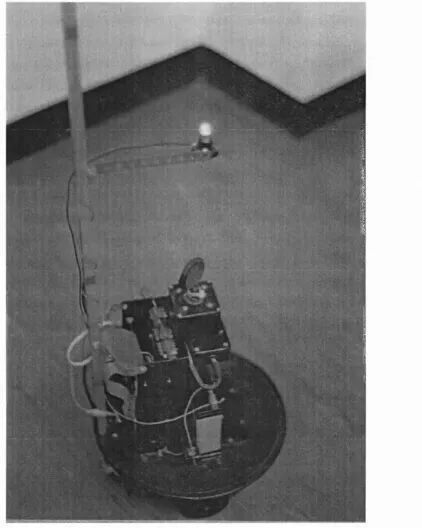
A mobile robot is a robot th a t can locomote, i.e. move from place to place.
For mobile robots, there are two practical methods of locomotion - walking or
wheels. While walking has several advantages over wheeled locomotion, such
as the ability to deal with uneven terrain, there are many difficulties involved
in the control of walking machines. For this reason, most mobile robots used