Licensed under Creative Common Page 590
http://ijecm.co.uk/
ISSN 2348 0386
EVALUATION OF OPERATIONS MANAGEMENT AND ITS
IMPACT ON IMPROVED LOGISTICS CONTROL
Onwuka Ebele Mary
Department of Business Administration,
Nnamdi Azikiwe University Awka, Anambra State, Nigeria [email protected]
Ugwu Kelechi Enyinna
Department of Financial Management Technology, Federal University of Technology Owerri, Imo State, Nigeria
Ndife Chinelo Franca
Department of Business Administration and Management, Federal Polytechnic Oko, Anambra State, Nigeria
Abstract
The study critically evaluates the effects of operations management on enhanced logistics
control. The specific objectives were: To critically analyze the impact of process design on
logistic control; to review the effect of production planning on logistic control; and to ascertain
the effect of maintenance management on logistic control. The study adopted descriptive
research design. The population studied consists of 400 staff of the selected logistics company
based in Lagos State Nigeria; made up of 12 managers, 30 Supervisors, 58 Operators and 100
technicians. The simple random sampling technique was used. Sample size of 200 was
obtained using the Taro Yamane sample size formula. The analysis led to the acceptance of the
hypothesis that process design, production planning and maintenance management have
significant effect on logistics control. The results led to the conclusion that all aspects of
operations management affect logistics control of the selected logistics company. To increase
productivity in the logistics industry, study recommends that employees should upgrade their
technological skills and logistical skills to be able to maximize efficiency in the workplace.
Licensed under Creative Common Page 591 INTRODUCTION
Operations management is the management function that is responsible for planning, controlling and coordinating the resources needed in the production of goods and service. It is that function of management that deals with the core capabilities of an organization.Morash, (2001) defines operations management as that function of an organization that is concerned with the design, planning and control of resources for the production of goods or provision of services. It encompasses the management of systems or processes that create goods and/or provide services.
The concept of logistics was originally introduced in military operations. Today, many organizations use logistics as a strategy to obtain competitive advantage. Logistics refers to the flow of incoming and outgoing goods, services, and information, as well as their storage, within and among organizations, emphasizing the physical distribution and storage of the goods produced by one organization. Logistics also deals with the distribution channels – manufacturer, wholesale, retail, and final consumer. Its evolution adds value, quality, and information to the supply chain. Logistics contributes to the improvement of service levels in organizations.
Adriane (2011), noted that Logistics is a managerial system that ensures that the right product or service is delivered to the final customer, at the right place, on time, in the right quantity. This meets the desire of customers to get a large variety of products customized to their needs, in a short lead time, at lower prices, and in high quality. If logistics objectives for cost and service are to be met over time, then the logistical performance must be kept in line with the planned performance.
According to Novaes (2004), logistics starts with the study of the process to be implemented, encompassing planning, implementation, operation, and control. The process according to the author, should be undertaken in an economical, efficient, and effective manner, so as to satisfy customer needs and preferences. The flows associated with logistics involve raw material storage, products under processing, finished products, information, and money, going through the suppliers, through manufacturing to the retailer, who will make the product available to the final consumer, the target of every supply chain. The flow can also be reversed, beginning at the consumer and flowing back to the suppliers of components and raw materials (Adriane, 2011).
Licensed under Creative Common Page 592
Mulcahy (2008), argued that logistics and logistics control form a vital aspect of efficient operations management. The author argues that the control process is one of the most complex aspects of logistics operations management and is key to client satisfaction. Control systems are the key to ensuring that performance is consistent with the management's operational plans. Author further noted that Logistics serves numerous functions; firstly, it measures the performance of any firm through audit, observation and reports; secondly, it compares the actual to planned performance; finally, it identifies corrective actions. Mulcahy argues that with increase in global competition, logistics’ function can be exploited to make a company gain competitive advantage. Researchers have repeatedly neglected the importance of overall operations management on Logistics control which could be another means of gaining competitive advantage. Several studies have been done on logistics control and operations management (Ramírez & Morales 2011, Puapairoj & Triumlertlum, 2009, Mulcahy & Sydow2008, Greenet al 2008 and Chieh-Yu 2009) without the intention of finding the relationship that exist between them.
The problems of logistics control usually arise as result of organizational functions such as: as production, purchasing marketing, and also between the logistical tasks. The major problems common in logistics management are: delayed and inaccurate information, inefficient and slow operations, incomplete services, and higher rates of products damage. The potential consequences are seen in the failure of organizations to provide related services, high cost of operation and high inaccuracy rate. Due to the above problems identified, objective of study is necessitated which focus on the following;
i. To critically analyze the impact of process design on logistic control ii. To critically review the effect of production planning on logistic control. iii. To ascertain the effect of maintenance management on logistic control
In attempt to fulfill study objective, research questions are formulated in the following; i. What impact does process design have on logistic control?
ii. Is there any significant relationship between logistics control and production management?
iii. Does maintenance management have significant effect on logistic control?
In view of this, research hypotheses are formulated to guide the study in the following; Hypothesis 1
1. H0: There is no significant relationship between process design and logistic control.
Licensed under Creative Common Page 593
Hypothesis 2
1. H0: There is no significant relationship between logistic control and production planning.
2. H1: There is significant relationship between logistic control and production planning.
Hypothesis 3
1. H0: There is no significant relationship between maintenance management and logistic
control.
2. H1: There is significant relationship between maintenance management and logistic
control.
REVIEW OF LITERATURES
This study applies Goldratt’s (1997) theory of constraint. The theory was introduced by Goldratt, in 1986. The concept of the theory was adopted by Goldratt in his book Critical Chain, published 1997.The basis of theory of constraints is evaluation of organizations and control of changes in three measures: inventory, throughput and operational expense. Throughput is the pace by which organization generates money through sales. Inventory refers to all investments in form of money invested by the system in things it needed.
The argument of the constraints theory is that the rate at which goals are being achieved by any goal-oriented system has at least one constraint as a limit. Assuming that a system’s goal has been measured and articulated, the Overall throughput can be increased only by increasing flow through the constraint as follows:
Identification of the system's constraint(s), that is the constraints of which organizations are prevented achieving more goal per unit time: Decision on utilization of the existing constraints in the system so as to get the best from the constraints; Subordinating any other thing on the decisions above decision, that is, making the whole organization and systems there in to support the decisions; Make other changes that is needed to increase the capacity of the constraint. Here constraints refer to everything preventing the organization or systems from achieving its goals. These constraints range from one to some few in any organization and can be either external or internal. The internal is seen when the demand is higher than what the system can deliver. In this case the organizational focus is to discover the constraints and then follow the steps listed above to redirect the constraints. An external constraint exists when there is production of one market bears by the system. If this happens, the system or organization focusing on strategies that stimulate demand should be a possible solution.
Licensed under Creative Common Page 594
internal factors are specific to the organization. The author also argues that competitive advantage can be seen also as any advantage that a firm has in relation to its competitors; that every organization looks out for efficiency in its processes and reduction of cost in every action it performs, and one of them is logistics control.
Many organizations also manage to gain competitive advantage through reduction of logistics cost, by improving supply chain management strategy and by opting for marketing channels that are more competent and at the same time faster and easily accessible in terms of financial costs to the firm. By these, organizations differentiate themselves from their competitors, keep their customers and gain new ones (Adriane 2011).
According to Adriane (2011), time is another important factor in logistics management, adding that the positioning of firms within the industrial sector is a major factor that determines the failure or success in a competitive scenario. With regards to competitive strategy, Porter explains that it is imperative for the organization to find a good position in the industrial structure, to know how to protect itself from competitive forces and even use them in its favor.
The theory of logistics has started gaining new ground since 1966. Since then, many businesses have developed, putting the cost of logistics currently to between 10 to 25 percent of the total cost of an international procurement. The two major phases that are very vital in the movement of products are: physical distribution and material management. Material management deals with early movement of raw materials as well as supplies while the physical distribution is the movement of finished products to the final consumers.
Blecker et al, (2008) noted that logistics and operation management in a business environment entails implementation, management of systems, and design, that focuses on efficient deployment of raw materials, point consumption, physical facilities, in-process inventory, personnel deployment, as well as finished goods information. Hence, the three components of transport, warehousing and packaging are essential in logistics and operations management. This is because of simple fact that logistics cover the entire supply chain from: acquisition of raw material, production process, to consumption. In logistics and operation management warehousing and transportation is the main contributor in a successful supply chain in the world. Perhaps, the employment of ICT systems in this process has made it easy to coordinate and communicate efficiently using communication, transport, and warehousing systems.
Licensed under Creative Common Page 595
in the place of work while corporate logistics includes supply, production, sales, reverse, and disposal logistics.
Shroeder et al (1986) as cited in The Nigerian Open University MBA 801productions and operations management guide defines operations’ strategy as “being made up of four aspects: distinctive competence, Mission, policies and objectives, and that these components help in defining what and how operation goals should be achieved. The decision making in all phases of operations should then be guided by the resulting strategy”.
Hayes & Wheelwright (1984) as cited in The Nigerian Open University MBA 801productions and operations management guide gave another definition of strategy as a “steady pattern of decision making in operations management; and that the greater the consistency of the decision making, the more the degree to which the business strategy is supported.
Another definition as cited by Osotimehin and Onwe (2006) is from Skinner (1985), who in his definition noted that operations strategy serves as a link that connects decision making and business strategy. The author argue that decision making in operations are most time not consistent and short range especially when operations are out of place with the corporate strategy, as a result, operations are separated from the business hence weakening the linkage with business strategy. In order to resolve this problem, Skinner (1985) in his recommendation suggested that developing an operations strategy from the business strategy and provision of a consistent set of policies should guide decision.
Hill (1989) added to the definitions already examined, also developed an innovative way of developing and defining strategy of operations. Hill shows how to connect operations related decisions. The approach is customer oriented aimed at focusing operations on the customer needs. Based on this point of view, workforce, process, capacity, inventory and quality decisions are then made based on customer needs.
Osotimehin & Onwe (2006) argue that business strategy gives general direction for the organization, and that operations strategy has a broader scope than productions strategy. Operations strategy on the other hand is narrow and deals basically with the aspects of operations in the organization. Operations management concerns methods, products, processes, operating resources, cost, quality, etc
Licensed under Creative Common Page 596
infrastructure, choice of process, external and internal consistency, contingency approaches, internal and external consistency, choice of process, process and infrastructure and focus. In the best practice paradigm, Voss (2006) included process re-engineering benchmarking, world class manufacturing and Total Quality Management (TQM). Voss (2006) revisited the paradigms and stressed that because of increased distribution of manufacturing and increased complexity that it is necessary to add more dimension to the strategic role of manufacturing, following the increased distribution of manufacturing and increased complexity.
Hayes and Pisano (1994) argue that manufacturing strategy deals with choosing and creation of capabilities for the future needs of any organization as well as aligning operations to existing priorities of competition. In effect, the role of any manufacturing function starts to change. Not just in carrying out their assigned mission, but also in having the authority to redefine that mission (Hayes & Pisano 1996).
As Adriane (2011) argued that distribution channels and logistics create competitive advantage for firms. The author noted that some companies have been using marketing channels as a strategic tool and as a way of satisfying customer needs successfully and competitively and further argues that marketing channels are responsible for placing the products at the time and place where they are needed.
Such marketing channels represent a value chain, where organizations bring products from their point of production to the final consumer. The producer through marketing channels gains access to the market. The distribution channels are a essential element in business strategy.
According to Coughlan et al. (2002) as cited in Adriane, (2011), a marketing or distribution channel is a group of inter related companies that engage in production of goods and services available to the final consumer.
Licensed under Creative Common Page 597 Empirical Review
Some of the research done in the areas of operations management and logistics control are reviewed as follows.
Ramírez, & Morales, (2011) in their study on the effects of reverse logistics and flexibility on organizational performance, focused on development of how the Reverse Logistics affects the flexibility of information distribution and organizational performance. they establish that due to the fact that the companies currently operates in changing, complex and highly competitive environment; organizations with practical attitude towards Reverse Logistics enhance the importance of Reverse Logistics; the more importance of Reverse Logistics the more important is Flexibility of Information Distribution; the Reverse Logistics and Information flexibility Distribution improve performance of organizations; organizations should be since reverse logistics implies greater effects on organizational performance and flexibility.
The analysis conducted by Carvalho and Malaquias (2012) on Brazilian small and medium scale enterprise was aimed at determining the interaction between internal logistics, external communication and internal information processing in the financial control of Brazilian small and medium scale enterprises. The authors employed applied the confirmatory factor analysis and structural equation models on a based on a sample of 183 companies and found that there is a positive and significant relationship between internal information processing with internal logistics and financial control. Also, internal logistics have significant correlation with external communication.
The study of Green, Whitten and Inman (2008) on the impact of logistics performance on organizational performance in a supply chain context was aimed at theorizing and assessing a logistics performance model. Their study incorporated logistics performance as the focal point of supply chain management strategy as a requirement to organizational performance. The authors used a sample of 142 plant and operations managers in the study and the data was analyzed using a structural equation model. Green, Whitten & Inman, (2008) found that there is a positive and significant relationship between logistics performance and supply chain management strategy and that both have positive impact on marketing performance, which in turn has positive impacts on financial performance. They also found that both supply chain management strategy and logistics performance do not have direct impact on financial performance.
Licensed under Creative Common Page 598
quality of human capital, organizational support for innovation, company size and organizational knowledge accumulation are significantly and positively associated with the adoption of RFID.
Adriane, (2011) analyzed the aspects of logistics used in distribution and network of fuel stations. They used qualitative techniques and document analysis. Their article details aspects such as modal, amount of inventory, number of customers, strategic partnerships, etc. Their results show that the organization has efficient logistics and creates competitive advantage. Hence their conclusions that the Group has competitiveness strategies, seeking integration, speed, flexibility, service quality and cost management.
The study Morash and Clinton (1998) illustrated models that identify logistics as the unifying link internal between production and marketing functions and externally, between suppliers and customers. The authors analyzed data from about 2,000 firms in the Australia, USA, Japan, and Korea, and found that well-organized supply chains exhibit operational excellence and responsive supply chains demonstrate collaborative closeness. They argues that Korean and Japanese logistic firms were more likely to incorporate supply chains based on operational excellence, while US and Australian logistics firms were more likely to incorporate supply chains on the basis of collaborative closeness.
Lai and Cheng (2003) analyzed the importance of a supply chain on transport logistics service providers since their functions link seller, suppliers, manufacturers and customers throughout the supply chain. The authors argue that transport logistics service firms must focus on supply chain performance as well as organizational performance.
Menor and Mason (2001) examined empirically, how capacity, specific technology and human resource choices differed for retail banks characterized by their degree of operating agility. Operating agility was defined as the ability of the provider to excel concurrently on service delivery, quality, flexibility and low cost (Linz & Fallon, 2008).
Roth and Jackson (1995) also studied the capabilities–service quality–performance harmony. They found that generic operations capabilities such as People and process capabilities, factor productivity, and technology leadership have significant impact on service quality and market performance.
Licensed under Creative Common Page 599
Chen and Paulraj (2004) proposed a supply chain management research framework based on the “collaborative advantage” paradigm. Their framework incorporates strategic purchasing, supply network structure, environmental uncertainty, information technology, and logistics integration as impacting buyer-seller relationships and consequently resulting in improved buyer-seller performance.
Managers have usually focused on improvement of organizational performance for which they are directly responsible. Management of supply chain requires an external focal point for which managers must consider the effect of organizational strategies on supply chain partners. Attempts to optimize organizational performance may negatively result in overall supply chain performance, hence damaging the competitive advantage of the chain (Chopra & Meindl, 2 004; Meredith & Shafer, 2002).
Several studies have been identified on the area of operations management and logistics control, although a research gap has been identified on both theoretical and methodological limitations. For instance, previous studies adopted qualitative research approach to explore research objectives, while this present research undertakes quantitative approach to test the hypothesis using one-way analysis of variance (ANOVA) to compare different population of mean existing within the groups and between the groups or determine the existence of differences among several population means at 5% significant level using Scientific Package on Social Science (SPSS) version 20 software. On theoretical limitations, study also adopted selected logistics firm based in Nigeria to identify problem of logistic control and fulfill study objectives. The above gap demarcates this research from previous studies.
RESEARCH METHODOLOGY
The study adopts descriptive research design. The descriptive study is to portray accurately the characteristics of a particular individual, situation or group and also in determining the frequency of a particular event or characteristics. This study describes the characteristics in the selected logistic company as it relates to operations management and logistics control.
Licensed under Creative Common Page 600
The population studied consists of 400 staff the selected logistics company based in Lagos State Nigeria; this is made up of 12 managers, 30 Supervisors, 58 Operators and 100 technicians. The simple random sampling technique was employed in the selection of the population units used as sample. Sample size of 200 was obtained using the Taro Yamane sample size formula.
EMPIRICAL FINDINGS & DISCUSSION
This work was to determine the effect of operations management on logistics control. The specific objectives are to determine the effects of process design, production planning and maintenance management on logistic control in selected logistics companies in Nigeria. The Analysis of Variance (ANOVA) was used to test the hypothesis of interest.
Hypothesis 1
1. H0: There is no significant relationship between process design and logistic control.
2. H1: There is significant relationship between process design and logistic control.
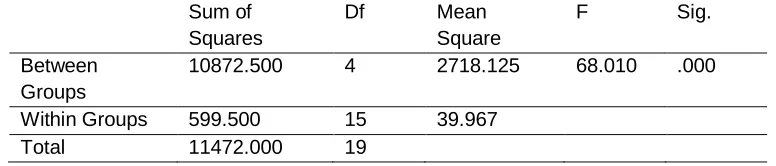
Table 1 shows the result of analysis of variance on the effect of process design on logistics control. The p-value (sig) of less than 0.05 leads to the rejection of the null hypothesis and the conclusion that production planning has significant effect on logistics control.
Table 1: ANOVA table for the effect of Process Design on Logistics Control
Sum of Squares
Df Mean
Square
F Sig.
Between Groups
10872.500 4 2718.125 68.010 .000
Within Groups 599.500 15 39.967
Total 11472.000 19
Licensed under Creative Common Page 601
Hypothesis 2
1. H0: There is no significant relationship between logistic control and production planning.
2. H1: There is significant relationship between logistic control and production planning.
Table 2 shows the ANOVA result for the effect of production planning and logistics control Production planning was found to have significant relationship with logistics control as the p-value (=0.00) is less than 0.05.
Table 2: ANOVA table for the effect of Production planning on Logistic control
Sum of Squares
Df Mean
Square
F Sig.
Between Groups
11759.000 4 2939.750 16.672 .000
Within Groups 2645.000 15 176.333
Total 14404.000 19
Planning production especially in the areas of division of labor which ultimately leads to specialization aids logistics control. This is because of the fact that specialization of duties saves time which invariably increases productivity and service delivery. This according to Adriane (2011), is the main objective of logistics is to satisfy the clients- make sure the product is in their hands when desired.
Hypothesis 3
1. H0: There is no significant relationship between maintenance management and logistic
control.
2. H1: There is significant relationship between maintenance management and logistic
control.
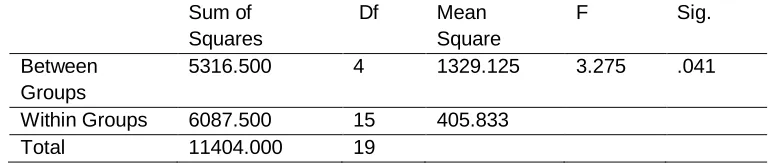
The result of the analysis of variance for the effect of maintenance management on logistics control is presented in table 3 above.
Table 3: ANOVA Table for the effect of Maintenance management on logistic control
Sum of Squares
Df Mean
Square
F Sig.
Between Groups
5316.500 4 1329.125 3.275 .041
Within Groups 6087.500 15 405.833
Total 11404.000 19
Licensed under Creative Common Page 602
Maintenance management was found to have significant relationship with logistics control. A routine checks and maintenance is required for the smooth running of the production process. It is important to check the statues of the machines frequently as well as routine maintenance of worn out parts. It is pertinent to note that failure to carry out routing maintenance on facilities may cause breakdown of production systems and hence impede service delivery and consequently, reduce logistics competencies.
CONCLUSION AND RECOMMENDATIONS
The analyses presented in this study have led to the acceptance of the hypothesis that process design, production planning and maintenance management have significant effect on logistics control. The results have led to the conclusion that not all aspects of operations management studied have significant effect on logistics control of the selected logistics company.
The following recommendations will help improve the effects of operations management on logistics control of in logistics management: Upgrading and improving logistical skills of employees in the logistics industry will boost productivity in the sector; decisive political efforts should be made in such areas as road transport in order to attain better equality in the working conditions in transport sectors and that of other sectors; minimizing the breakdown of equipments and to keep facilities in safe and better working condition at the least cost possible; making the machines and other facilities to perform in optimal capacity without interruption; ensuring that there is optimal returns on investments resulting from the availability of existing buildings, machines, and services needed by other sections of the organization.
STUDY LIMITATIONS AND FURTHER RESEARCH
The geographic scope of this study focused on selected logistic company in Lagos State, Nigeria. The result of this study cannot be generalized with other locations in Nigeria or African countries. The essence of study is to fulfill study objective and generate knowledge through research gap. Based on the above reasons, study is delimited. The authors recommend other researchers to identify problems from another dimension such as; vendor management and its effect on logistics activities; effect of enterprise resource planning (ERP) on logistic functions.
REFERENCES
Adriane, S.S. (2011).“Analysis of Aspects of Logistics Used By Grupo Mime: Study of Distribution and Network of Fuel Stations”. POMS 22nd Annual Conference Reno, Nevada, EUA.
Licensed under Creative Common Page 603 Chen, I.J., & Paulraj, A. (2004). “Towards a Theory of Supply Chain Management: The Constructs and Measurements”. Journal of Operations Management, 22 (2), 119-50.
Chieh-Yu, L, (2009). “An Empirical Study on Organizational Determinants of RFID Adoption in the Logistics Industry”. Journal of Technology Management & Innovation 4 (1), 1-7.
Chopra, S & Meindl, P,(2007). “Supply chain management: strategy, planning, and operation” (3rd
ed). Upper Saddle River, N.J: Prentice Hall, cop.
Christopher, M., & Towill, R. D. (2002). “Developing Market Specific Supply Chain Strategies”.
International Journal of Logistics Management, l13 (1), 1-14.
Goldratt, E. M., & Cox, J. (1986). The goal: A Process of Ongoing Improvement. North River Press.
Goldratt, E.M. (1997). Critical Chain. Great Barrington, MA: North River Press.
Green, K W., Whitten, D., & Inman, R. A. (2008).“The Impact of Logistics Performance on Organizational Performance in a Supply Chain Context”. International Journal of Supply Chain Management: 13, (4), 317–327.
Igweze, A. H & Etaga, H. O. (2011). “Statistical Analysis with Excel, Minitab and SPSS”. Tualas Publishers, Asaba.
Morash, E.A. (2001). “Supply Chain Strategies, Capabilities, and Performance”. Transportation Journal, l41(1), 37-54.
Morash, E. A & Clinton, S. R, (1998). “Supply Chain Integration: Customer Value through Collaborative Closeness versus Operational Excellence”. Journal of Marketing: Theory and Practice, 6 (4), 104-20.
Morash, E. A., Dröge, C.L.M., & Vickery, S. K. (1996). “Strategic Logistics Capabilities for Competitive Advantage and Firm Success”. Journal of Business Logistics, l17 (1), 1-22.
Mulcahy, D. E., & Sydow, J. (2008). A supply Chain logistics program for warehouse management,(9th ed.). Boston : McGraw-Hill/Irwin.
Neuman, W. L, 2006. “Social Sciences Research Methods: Qualitative and Quantitative Approaches”, (6th
ed.). Boston: Pearson/Allyn & Bacon.
Nigel S, Chambers, S & Johnston, R, (2010). “Operations Management, Sixth Edition Edinburgh Gate Harlow Essex, England: Pearson Education Limited.
Oyeka, ICA (2009).“An introduction to Applied Statistical Methods”. Nobern Avocation Publishing Company, Enugu
Ramírez, A. M., & Morales, V. J. G. (2011). “Effect of Reverse Logistics and Flexibility on Organizational Performance”. Journal of Economics and Management, l16.
Srivastava, SK,(2006), “Logistics and supply chain practices in India”. The Journal of Business Perspective, 10 (3), 69-79.
Tracey, M, Lim, JS& Vonderembse, MA,(2005). “The Impact of Supply-chain Management Capabilities on Business Performance”. Journal of Supply Chain Management, 10 (3/4), 179-191.
Waller, M., Johnson, M.E & Davis, T,(2001). “Vendor-managed inventory in the retial supply chain”. Reprinted with permission of Journal of Business Logistics.
Whipple, JM, & Russell, D,(2007). “Building supply chain collaboration: a typology of collaborative approaches”. International Journal of Logistics Management, 18 (2), 174-196.
Yin, R. K. (1994). “Case study research: design and methods” (2nd ed.). Thousand Oaks, Calif: Sage
Zikmund, W. G. (2000). Business Research Methods, (6th ed.). Dryden Press: Fort Worth, Tex.
Menor, L. J., & Mason, C. H. (2001), “Agility in Retail Banking: A Numerical Taxonomy of Strategic Service Groups”. Journal of Manufacturing and Service Operations Management, 3 (4), 273–292.
Roth A.V& Jackson, WJ, (1995), “Strategic Determinants of Service Quality and Performance,”
Licensed under Creative Common Page 604 Hayes, D. R., & Wheelwright, S. C. (1984). “Restoring Our Competitive Edge”: Competing Through Manufacturing. New York: John Wiley and Sons.
Schroeder, RG., Anderson, JC& Cleveland, G,(1986), “The Content of Manufacturing Strategy: An empirical Study”. Journal of Operations Management, 6 (4), 405-415.
Skinner, W, (1985). “Manufacturing: The formidable Competitive Weapon”, John-Wiley, New York.
Osotimehin, K. O., & Onwe, O. J. (2006). MBA 801: Production and Operations Management Course Guide, National Open University Of Nigeria, DOI: Retrieved on January 04, 2015, from: http://www.nou.edu.ng/noun/NOUN_OCL/pdf/SMS/MBA%20801%20Production%20and%20Operations% 20Management.pdf
Skinner, W, (1974), “The focused factory”, Harvard Business Review, May- June, pp113-121
Leonard-Barton, D, (1995). “The factory as a learning laboratory. Sloan Management Review, Fall, 23-38.
Voss, C. A. (1995). “Alternative paradigms for manufacturing strategy”, International Journal of Operations & Production Management, 15, (4), 5-16.
Voss, C. A. (2006). “Paradigms of manufacturing strategy revisited”. International Journal of Production and Operations Management, Vol. 25, No. 12, pp. 1223-1227.