3389
Dance Gesture Recognition Using Space
Component And Effort Component Of Laban
Movement Analysis
Joko Sutopo, Mohd Khanapi Abd Ghani, Burhanuddin Mohd Aboobaider, Zulhawati
Abstract: Dance is a collection of gestures that have many meanings. Dance is a culture that is owned by every country whose every movement has beauty or meaning contained in the dance movement. One obstacle in the development of dance is to recognize dance moves. In the process of recognizing dance movements one of them is information technology by recording motion data using the Kinect sensor, where the results of the recording will produce a motion data format with the Biovision Hierarchy (BVH) file format. BVH motion data have position compositions (x, y, z). The results of the existing dance motion record will be extracted features using Laban Movement Analysis (LMA), where the LMA has four main components namely Body, Shape, Space, and Effort. After extracting the features, quantization, normalization, and classification will be performed. Using Hidden Markov Model (HMM). In this study using two LMA components, namely Space and Effort in extracting features in motion recognition patterns. From the results of the test and the resulting accuracy is approaching 99% for dance motion data.
Index Terms: Dance, Movement, Laban Movement Analysis, Gesture, Hidden Markov Model, Motion Capture —————————— ——————————
1
INTRODUCTION
Dance is a movement that is very broad in various styles and has many peculiarities [1]. Considering today, there are still many people who do not understand the type of dance that moves both classical and traditional dances and has the meaning of each dance, so it needs a study of the introduction of the type of dance motion attitude that can be used for research in many other fields namely, learning and assessment in [2-4] preserving the arts and culture of Indonesia's assets. Research on introducing this type of dance motion attitude receives more attention throughout the world [2] and has a significant impact on our daily lives [3]. However, the amount of research on the introduction of dance types is still minimal. The introduction of dance movements that have been carried out in previous studies includes classical Indian dances [4], traditional Kazakh dances [3], traditional Greek dances [1], Bharatanatyam dances [4] and dances [5]. An introduction to the practice of dance moves is an expression that means dancers of dance movements with different attitudes [2]. Each type of dance is marked by the most prominent or emphasizing the movements of body parts such as hand movements, facial expressions, body, and head movements [3-4]. The Wayang Golek Menak dance is a form of transformation from the Menak shadow puppet show. Where the Menak puppet is a puppet show that uses Serat Menak as the source of the story [6]. Then Sultan Hamengkubuwono IX combined the puppet show with classical Javanese dance, which was later named Beksa Golek Menak or Menak dance [7].
The purpose of this research is to detect and recognize the type of dance in the puppet dance Golek Menak. Where the Golek Menak puppet dance is generally divided into three parts: Forward Gending (opening), Enjer (middle of a conversation between dancers), and Closing (closing).
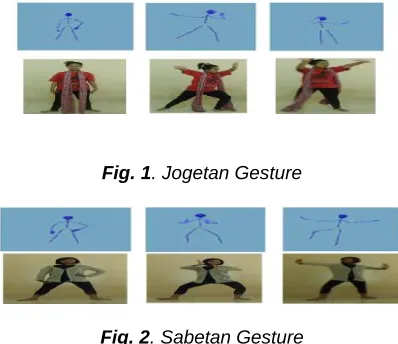
Fig. 1. Jogetan Gesture
Fig. 2. Sabetan Gesture
In each part of the dance has a different type of gesture. The types of gestures of Golek Menak dance include Sabetan, Jogetan, Sahan Sahan, Ulap-Ulap, Muryani Busana, Sekah Sekar, Pencak Silat, and War. This paper uses two types of motion because it will be recognized (Figure 1 and Figure 2).
2
RELATED
WORD
The beginning of the research process begins with the arrest of the dance attitudes that exist in the Wayang Golek Menak dance using a Kinect camera. Motion capture produces data and position of the dancers' frame of motion. Wayang Golek Menak dance data from the results of motion capture with the Kinect sensor has three or more coordinate points (x, y, z). Kinect cameras are often used to capture human movements [8] and dance [1], [2], [3], [9]. The introduction and classification of Wayang Golek Menak dance types go through two stages: 1) extracting features using Laban Movement Analysis (LMA), and 2) dance classification using the Hidden Markov Model (HMM). The combination of these two phases is ————————————————
• Joko Sutopo. Student PhD Faculty of Information and Communication Technology, Universiti Teknikal Malaysia Melaka (UTEM). Also Depart. of Information Universitas Teknologi Yogyakarta, Indonesia. E-mail:[email protected]
• Mohd Khanapi Abd Ghani. Biomedical Computing and Engineering Technology (Biocore) Apply Research Group Faculty of Information and Communication Technology, Universiti Teknikal Malaysia Melaka. E-mail: [email protected]
• M.A. Burhanuddin. Biomedical Computing and Engineering Technology (Biocore) Apply Research Group Faculty of Information and Communication Technology, Universiti Teknikal Malaysia Melaka E-mail: [email protected]
3390 IJSTR©2020
expected to produce movement recognition and classification of Jogetan attitudes and gestures with high accuracy. Research on the introduction of dance movements is a particular case of general recognition of human movements. Therefore, many researchers use various methods and techniques. One input device is the Kinect motion capture [10]. Kinect is an input device to detect the motion produced [11]. Kinect has an RGB camera facility [12] and a depth sensor (depth sensor). The advantages of Kinect compared to other devices that can capture and track movements or actions of 3D objects accurately [12], the price of Kinect is quite affordable (cheap) [8], resistant to interference (non-intrusive) and can work even if the lighting is lacking [12 ] But the Kinect motion capture system requires distance calibration to capture the correct object [15-16]. In this study, using a Kinect camera calibration range of about 1.5 to 2 m. Kinect usually produces a data frame consisting of 20 joints [5,14]. In this study, skeleton data consisting of 18 joints were used. Kinect provides detailed information about body parts, especially those including hands and feet. At the classification stage, researchers can use various classification methods such as K-Means [3], Neural Network [17,18], Bayes Network [8], Hidden Markov Model [3], Support Vector Machine or SVM [11,14] Fuzzy [13], KNN [2,7], and others. In this study, using the HMM classification for feature extraction, the Hidden Markov Model to carry out the classification and introduction of Wayang Golek Menak. Previous researchers used Hidden Markov [3]. The HMM method for Kazakh dance gesture gestures, based on the results of research obtained with an introductory rate of 90.82%. HMM method (27 directions) to recognize the results of 85% battle motion [14]. Researchers use HMM to classify and identify types of data dance attitudes based on skeletal movements in the form of time series and dance recognition requires methods that can detect in all directions.
2.1 Laban Movement Analysis
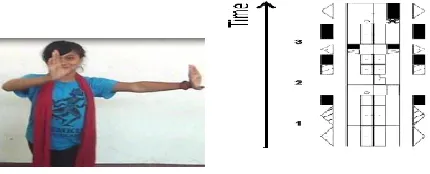
Rudolf Von Laban developed Laban Movement Analysis (LMA) with the theory of motion notation. This development is expected to help to discuss, document, and describe human movements in recording dance choreography [18]. Laban notation is not related to specific dance movements but refers to natural human movements, and every change in the movement must be symbolized using a labanotation score, this is written in the form of vertical staff where each column represents each part of the human body [21].
Fig. 3. Laban Notation
Laban Movement Analysis (LMA) offers documentation with the quality of dance movements produced in the same way as professional dancers, research conducted by [20], using motion analysis of the entire human body based on the principles of the LMA which aims to identify the factors that describe dancer's movements. LMA has four main components, namely body, space, shape, and effort. The Body
and space component is a kinematic system that describes body changes in time and space, while Shape and Effort is a non-kinematic system that provides qualitative aspects of the movement. In this study, researchers focused on the LMA component [19]. Space and effort component of each of the two components produces a low accuracy, by combining the two components the level of accuracy obtained is better. The space component in the LMA interacts between the human body and the surrounding space and has a differentiating spatial pattern of direction and movement path by presenting a description of the trajectory that arises from the movement which results in different definitions in several aspects of Labanotation [17], [22].
(1)
From equation (1) it is known that is the number of frames and is the position of the left / right hand in three-dimensional space and is the connection of the hands in the frame. The effort component in the LMA how the body focuses on how to make movements with the dynamic quality of texture, feelings to enable one's emotional state, and how energy is used for each movement. The effort has four supporting sub-components, namely: space, weight, time, and flow [22], [23].
(2)
The effort is derived from the movement of the skeleton that produces speed, the body component calculates all the skeleton in the body by using the component body equation and the derivation of the equation gets results for the component effort.
2.2 Hidden Markov Model
The Markov chain is usually used to calculate the probability of observable state sequences. However, there is a sequence that wants to be known but cannot be observed. So to find out the order, a new method is developed namely Hidden Markov Chain or Hidden Markov Model (HMM) with cases where observation is a probabilistic state function [15]. Hidden Markov Model (HMM) is the learning of stochastic limited automa and specific forms of dynamic Bayesian networks. HMM consists of two stochastic processes. The first process is a stochastic Markov chain which is characterized by transition and state probabilities. Status on the outer chain is not visible, in other words, hidden. The second stochastic process produces observations of emissions at any time, depending on the state probability distribution [16].
3 METHOD
3391 seconds for each dance move.
Fig. 4. Flowchart recognition and classification Wayang Golek
Menak dance
The result is the capture of dance movements has the format Biovision Hierarchy (* BVH) and then processed using the Brekel Kinect V.0.50 software that aims to obtain position data of the motion (skeleton, bones, and joints). Position data consisting of x, y, z coordinates that have 61 joints (body points), but only 12 significant joints are taken. In the extraction process, only 12 joints will be taken consisting of 6 left joints and 6 right joints. Then by using HMM as a quantization vector that will be used for the dance movement classification process with the HMM method. Introduction to flowchart and Golek Menak puppet dance classification can be seen in Figure 4.
4 RESULT
AND
DISCUSSION
The results of the capture of Golek Menak dance movements obtained from the Kinect sensor form the skeleton motion data by having coordinates x, y, z. The types of wayang Golek dances will be classified where the Sabetan and Jogetan movements, each movement consists of 61 joints, of which 61 joints are to process data in order to discard incomplete data (missing values) to get the joints main joints leaving 12 joints including left / right-hand joints, left / right elbow joints, left / right shoulder joints, left / right knee joints, left / right leg joints, and left / right hip joints / right. The BVH skeletal structure is in the form of dots and solid lines that show the movement of bones and joints of the body. Each dance movement has dominant joints standing, where the joints are the difference between each other's dance movements. Based on the capture of the Wayang Golek Menak dance movement, the
recorded data of the dance movement lasts four to six seconds and has 140 to 200 frames. In this study, using Sabetan, Jogetan, Sembahar, Ulap and Pencak cues, which have x, y, z coordinate points of each type of dance movement, then the dominant movements will be performed together with other movements. In this study, the left-hand position was taken with different frames as shown in Table 1.
Table 1. Data of Sabetan and Jogetan Gestures
In the introduction and classification of the Wayang Golek Menak dance movement using the Hidden Markov Model (HMM), through two training and testing processes. HMM consists of phi, transition matrices, and matrix emissions. In the dance movement model using HMM with two states and fifteen observations that have 2x1 phi, 2x2 transition matrix (state), and 2x15 emission matrix (state × observation) for 2 states (Figure 5).
Fig. 5. Architectural model HMM with 2 states and 15
observation
Table 2. The result of Component Space Feature Extract
Joints Hand Hand Left 10.8751 Hand Right 19.0014
In table 2 it can be seen that the results of calculations using the component space equation described in the previous chapter, the results of the space equation representing three-dimensional space.
Table 3. The result of Component Effort Feature Extract
Joints Part 1 Part 2 Part 3 Left Foot 1.0086 67.3047 133.6009 Right foot 0.0423 0.0493 0.0562
Left hand 0.2625 67.4266 134.5907 Right hand 16.6660 66.9635 117.2610
Table 4. The result of Component Effort Feature Extract
Joints Part 1 Part 2 Part 3 Left Foot 132.5923 132.5923 132.5923 Right foot -0.0139 -0.0139 -0.0139
Left hand -134.3282 -134.3282 -134.3282 Right hand 100.5950 100.5950 100.5950
3392 IJSTR©2020
Table 5. Normalization of Space Components
Joints Hand Hand Left 0.5400
Hand Right 0.5702
Table 6. The result of Component Effort Feature Extract
Joints Part 1 Part 2 Part 3 Left Foot 0.5033 0.7498 0.9963 Right foot 0.4997 0.4997 0.4997
Left hand 0.5005 0.7502 1.0000
Right hand 0.5615 0.7485 0.9356
Table 7. The result of Component Effort Feature Extract
Joints Part 1 Part 2 Part 3 Left Foot 0.9926 0.9926 0.9926 Right foot 0.4995 0.4995 0.4995
Left hand 0 0 0
Right hand 0.8736 0.8736 0.8736
Normalization is used to normalize the results of space component equations and effort derivatives because the value generated by space components and effort derivatives is very large, to get smaller results the results of the space component
equations and effort derivatives must be normalized. The results of normalization can be seen in tables 5, 6, and 7. where each normalization result represents each component of space and effort component.
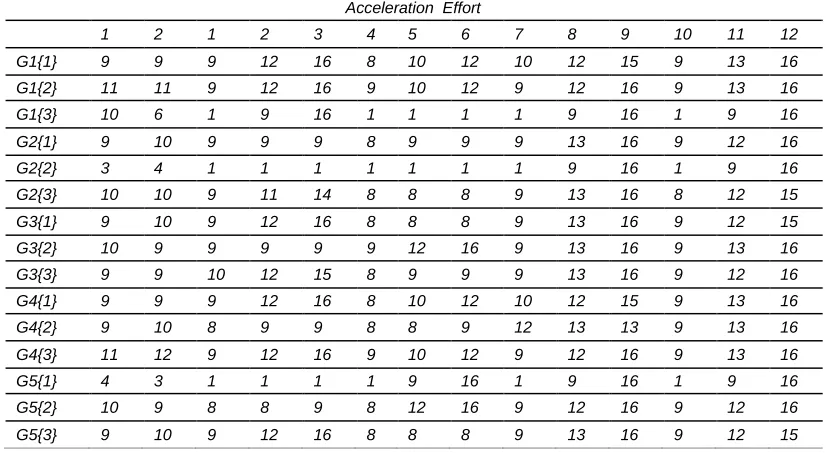
Table 8. Results of Component Space Quantization and Effort Quantization
Acceleration Effort
1 2 1 2 3 4 5 6 7 8 9 10 11 12
G1{1} 9 9 9 12 16 8 10 12 10 12 15 9 13 16 G1{2} 11 11 9 12 16 9 10 12 9 12 16 9 13 16 G1{3} 10 6 1 9 16 1 1 1 1 9 16 1 9 16
G2{1} 9 10 9 9 9 8 9 9 9 13 16 9 12 16 G2{2} 3 4 1 1 1 1 1 1 1 9 16 1 9 16 G2{3} 10 10 9 11 14 8 8 8 9 13 16 8 12 15
G3{1} 9 10 9 12 16 8 8 8 9 13 16 9 12 15 G3{2} 10 9 9 9 9 9 12 16 9 13 16 9 13 16 G3{3} 9 9 10 12 15 8 9 9 9 13 16 9 12 16 G4{1} 9 9 9 12 16 8 10 12 10 12 15 9 13 16 G4{2} 9 10 8 9 9 8 8 9 12 13 13 9 13 16 G4{3} 11 12 9 12 16 9 10 12 9 12 16 9 13 16 G5{1} 4 3 1 1 1 1 9 16 1 9 16 1 9 16 G5{2} 10 9 8 8 9 8 12 16 9 12 16 9 12 16 G5{3} 9 10 9 12 16 8 8 8 9 13 16 9 12 15
Table 9. Component Speed Effort Quantization Results
Speed Effort
1 2 3 4 5 6 7 8 9 10 11 12 G1{1} 1 1 1 12 12 12 3 3 3 1 1 11 G1{2} 1 1 1 11 11 11 2 2 2 1 1 1
G1{3} 1 1 1 1 1 1 1 1 1 1 1 1 G2{1} 9 9 9 9 9 9 1 1 1 1 1 1 G2{2} 1 1 1 1 1 1 1 1 1 16 16 16
3393 G4{1} 1 1 1 12 12 12 3 3 3 1 1 1
G4{2} 8 8 8 9 9 9 7 7 7 1 1 1 G4{3} 1 1 1 11 11 11 2 2 2 1 1 1 G5{1} 1 1 1 16 16 16 16 16 16 16 16 16 G5{2} 7 7 7 16 16 16 16 16 16 1 1 1
G5{3} 16 16 16 8 8 8 1 1 1 14 14 14
G1 is the first gesture namely Jogetan with three variants or three people doing different movements, each gesture has three variants so that each gesture is balanced with other gestures. In table 8 and table 9, the acceleration and speed data on effort aspect are presented. Get the results of integers, quantization must be done on the results of the normalized component of space and effort, quantization is done so that the HMM method used is a discrete HMM that can only read discrete numbers or integers, if the results of the BC equation
are still in the form of normalization then the HMM is not will recognize the extracts of the space and effort component features, therefore quantization must be carried out so that the results of the space and effort component feature extracts can be recognized by the HMM. If quantization has been carried out, then the next step is to enter the training phase before testing using HMM.
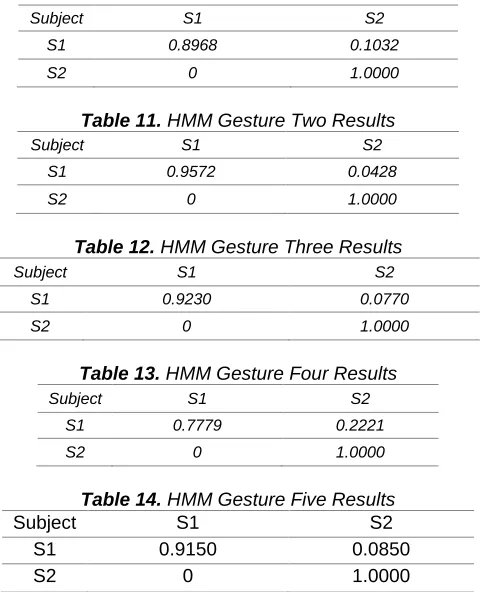
Table 10. HMM Gesture One Results
Subject S1 S2
S1 0.8968 0.1032
S2 0 1.0000
Table 11. HMM Gesture Two Results
Subject S1 S2
S1 0.9572 0.0428
S2 0 1.0000
Table 12. HMM Gesture Three Results
Subject S1 S2
S1 0.9230 0.0770
S2 0 1.0000
Table 13. HMM Gesture Four Results
Subject S1 S2
S1 0.7779 0.2221
S2 0 1.0000
Table 14. HMM Gesture Five Results
Subject S1 S2
S1 0.9150 0.0850
S2 0 1.0000
In this study initially using the 2x3 matrix because S2 was forbidden to return to S1 but because the results obtained by the 2x3 matrix were greater than the 2x2 matrix with S1 value for itself valued at 0, S1 to S2 was 1,0000, S2 for itself was 1,0000, and S2 to S1 has a value of 0. The results are seen in the HMM process in tables 10, 11,12,13 and table 14. HMM will look for the largest value to be stored in training before testing the same movement, whether, during testing, the movement being trained is the same as the movement being tested.
The results of the training using the HMM method and utilizing the main components of the LMA are the space and effort components, which are trained and tested using digital BVH data, with five movements with three variants, each movement will be tested whether the movement tested is the same as the movement being trained, from Figure 6 showing some wrong moves, especially in the jogetan movement, the error rate is 0.66666, in some movements such as Jogetan, Sabetan, and Pencak there are no errors when tested with the same movement, the average obtained from the whole movement obtained a value of 0.8000, Only with two main components, the results obtained are close to 0.90 accuracy.
3394 IJSTR©2020
5
CONCLUSION
The conclusion obtained from this study is to utilize two LMA components, namely Space and Effort. Space and Effort component was developed to perform a feature extraction process on the dance motion recording data before the dance motion classification process was carried out. In the dance motion training and test (BVH) of the dancers' data recording results, the accuracy rate that gets close to 99% with only two primary components of the 4 main components of the LMA, namely Body, Space, Shape, and Effort. So it is recommended in the future to use all major components of the LMA so that the level of accuracy obtained is better. Dance moves are used with a short duration of about + - 1 minute. The future development of this research, if using dance moves with a duration of more than 1 minute, how will the impact on the accuracy of the recognition of motion.
6
ACKNOWLEDGMENT
The author would like to thank the Biocore Laboratory of the Faculty of Information and Communication Technology (FTMK), Universiti Teknikal Malaysia Melaka for the support of its facilities.
7
REFERENCES
[1] Katsuras, S.Karanikolos, N.Nikolaidis et al. Feature Comparison and Feature Fusion for Traditional Dances Recognition. Communications in Computer and Information Science. ISBN: 642-41012-3, 978-3-642-41013-0. 2013.
[2] Devi, Mampi, Sarat Saharia, and D.K.Bhattacharyya. Dance Gesture Recognition: A Survey. 2015. DOI: 10.5120/21696-4803.
[3] Nussipbekov, a K, Amirgaliyev, E N Hahn, and Minsoo. Kazakh Traditional Dance Gesture Recognition. Journal of Physics: Conference Series. 2014. DOI: 10.1088/1742-6596/495/1/012036.
[4] S.Saha, S.Ghosh, A.Konar, et al. A study on leg posture recognition from Indian classical dance using a Kinect sensor. 2013 International Conference on Human-Computer Interactions (ICHCI). 2013. DOI: 10.1109/ICHCI-IEEE.2013.6887795.
[5] Heryadi, Y., Fanany, M.I., and Arymurthy, A.M. 2013. Stochastic Regular Grammar-based Learning for Basic Dance Motion Recognition. Cloud2.Snappages.Com. [6] Sukistono, Dewanto. Pengaruh Karawitan terhadap
Totalitas Ekspresi Dalang dalam Pertunjukan Wayang Golek Menak Yogyakarta. Resital Vol 15 No 2, Desember 2014. 179-189.
[7] Susiyanto. 2010. ―Cerita Menak : Warisan Budaya Islam di Indonesia.‖ [online],http://susiyanto.com, diakses 1 Oktober 2013.
[8] O. Patsadu, C. Nukoolkit, B.Watanapa. Human gesture recognition using the Kinect camera. Computer Science and Software Engineering (JCSSE), 2012 International Joint Conference on. 2012. 10.1109/jcsse.2012.6261920. [9] Saha, S, Ghosh, S. Konar, A. and Janarthanan, R. 2013. Identification of Odissi dance video using Kinect sensor. In Advances in Computing, Communications, and Informatics (ICACCI), 2013 International Conference on, pages 1837–1842. IEEE.
[10]Aitpayev, Kairat, and Jaafar Gaber. 2012. ―Creation of 3D Human Avatar Using Kinect.‖ Asian Transactions on
Fundamentals of Electronics, Communication & Multimedia (AT ECM)(AT ECM ISSN: 2221-4305) Volume 1.
[11]Obdrzalek, S., G. Kurillo, F. Ofli, R. Bajcsy, E. Seto, H. Jimison, and M. Pavel. 2012. ―Accuracy and Robustness of Kinect Pose Estimation in the Context of Coaching of Elderly Population.‖ in 34th Annual International Conference of the IEEE EMBS San Diego, California USA.
[12]Saha, S., Ghosh, L., Konar, A. and Janarthanan, R. Fuzzy l membership function based hand gesture recognition for Bharatanatyam dance. In Computational Intelligence and Communication Networks (CICN), 2013 5th International Conference on, pages 331–335. IEEE, 2013.
[13]S.Saha, S.Ghosh, A.Konar et al. Gesture Recognition from Indian Classical Dance Using Kinect Sensor. 2013 Fifth International Conference on Computational Intelligence, Communication Systems and Networks.2013. DOI: 10.1109/CICSYN.2013.11.
[14]Han Changho, Oh. Choonsuk, Choi B.W. Recognition of Fighting Motion using a 3D Chain Code and HMM, 2010, Journal of Institute of Control, Robotics, and Systems [15]Blunsom, Phil. (2004). Hidden Markov Models.
[16]Dymarski, P. (2011). Hidden Markov Models, Theory and Application, In Tech.
[17]Ajili, I., Mallem, M., & Didier, J. Y. (2017). Robust human action recognition system using Laban Movement Analysis. Procedia Computer Science, 112, 554–563. https://doi.org/10.1016/j.procs.2017.08.168
[18]Choensawat, W., Nakamura, M., & Hachimura, K. (2015). GenLaban: A tool for generating Labanotation from motion capture data. Multimedia Tools and Applications, 74(23), 10823–10846. https://doi.org/10.1007/s11042-014-2209-6 [19]dos Santos, L. C. G. F. (2013). Laban Movement
Analysis : A Bayesian Computational Approach to Hierarchical Motion Analysis and Learning, (September 2013), 198.
[20]Senecal, S., Cuel, L., Aristidou, A., & Magnenat-Thalmann, N. (2016). Continuous body emotion recognition system during theater performances. American Journal of Neuroradiology, 23(6), 1038–1048. https://doi.org/10.1002/cav
[21]Wang, J., Miao, Z., Guo, H., Zhou, Z., & Wu, H. (2017). Using automatic generation of Labanotation to protect folk dance. Journal of Electronic Imaging, 26(1), 011028. https://doi.org/10.1117/1.JEI.26.1.011028
[22]Aristidou, A., Charalambous, P., & Chrysanthou, Y. (2015). Emotion Analysis and Classification: Understanding the Performers’ Emotions Using the LMA Entities. Computer Graphics Forum, 34(6), 262–276. https://doi.org/10.1111/cgf.12598