Input Scheme for Hindi Using Phonetic Mapping
Nisheeth Joshi and Iti Mathur
Apaji Institute, Banasthali University, Rajasthan Email: [email protected], [email protected]
Abstract
Written Communication on Computers requires knowledge of writing text for the desired language using Computer. Mostly people do not use any other language besides English. This creates a barrier. To resolve this issue we have developed a scheme to input text in Hindi using phonetic mapping scheme. Using this scheme we generate intermediate code strings and match them with pronunciations of input text. Our system show significant success over other input systems available.
Keywords:
Transliteration, Text Input, Hindi, Phonetic Mapping, Human Computer Interaction.1.
Introduction
Text input research has been going on since 1970s [1] and keyboard has been the most important device, as far
as input is concerned and for a foreseeable future, is going to dominate the input system domain. Although we
have alternatives like speech inputs and hand writing recognition systems, but their usage and performance has
to undergo a lot of improvement. As of now, Text Input Systems rule the Input Domain. Hindi and most of the
languages in South and South East Asian perspective have more characters then are available in English. So,
trying to develop a text input system in these languages require a lot of processing and mapping. In this paper,
we present an approach based on phonetic mapping where we try to input text for Hindi, using English. Here our
work was two fold, firstly to develop a user friendly and efficient input system for Hindi based on phonetic
mapping. Secondly, to evaluate the performance of the system developed as compared to other systems.
Hindi is the official language of India and enjoys the status of Raj Bhasha. It is the world’s third most spoken
language[2] (After Chinese and English). The language has been categorized under European:
Indo-Iranian: Indo-Aryan family of languages[3]. It is also an official language of Republic of Fiji and Republic of
Mauritius. It is the descendant of Sanskrit and Prakrit. In seventh century it started to emerge as a new language
called Apabhramsha and by the end of tenth century it became stable and matured to a complete language.
In the eleventh century, during the invasion of Turks, the language was re-christened by them as Hindvi i.e. the
language of the people of Hindukush valley for Hind. Due to the rule of the Turks on Hind, this language then
came in contact with Persian (The language spoken by Turks) and through Persian, took some words of Arabic.
This new fusion of language which was somewhat broken and mixed became the communication medium
between the new inhabitants and the natives of Hind. Then, during eighteenth century, in the colonial rule of
British Empire this language become the national language, because the British started to promote it as the
time was given two names Hindi which was written in Devnagari Script which was taken from Sanskrit and
Urdu which was written in Perso-Arabic Script.
As Hindi owe its origins from Sanskrit. It is an extremely logical and straight forward language. Perhaps this is
the quality which makes it easier to learn. Pronunciation of Hindi is also very easy and is written in the same
way as it is pronounced. Unlike English, this language does not have any capital letters and supports three forms
of honorifics, making conversations either formal or familiar or intimate. Thus, the politeness expressed in
English using words like ‘Please’, ‘Thank you’ etc. is already inherent in the language.
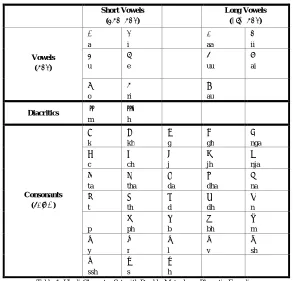
Short Vowels (ह व वर) Long Vowels (द घ वर) Vowels ( वर) अ a इ i आ aa ई ii उ u ए e ऊ uu ऐ ai ओ o ऋ ri औ au
Diacritics ◌ं
m ◌ः h Consonants (यंजन) क k ख kh ग g घ gh ङ nga च c छ ch ज j झ jh ञ nja ट ta ठ tha ड da ढ dha ण na त t थ th द d ध dh न n प p फ ph ब b भ bh म m य y र r ल l व v श sh ष ssh स s ह h
Table 1: Hindi Character Set with Double Metaphone Phonetic Encoding
As shown in Table 1, Hindi language has 11 vowels also known as वर and 33 consonants also known as
यांगन and 2 diacritics. Vowels can further be classified as short vowels and long vowels. Moreover vowels
when used with consonants change their structure and become vowel symbols and are known as grapheme
clusters, as shown in Table 2. A grapheme cluster is described as “what end users usually think of as
character”[4]. As an exception, only one consonant ‘र’ can be transformed as a symbol and can take two forms
as shown in the following table.
2.
Review of Literature
We have witnessed great improvements in local language computing, since Government of India has put in
crores of rupees into research in the area1. We can broadly classify all the research done in Input Method
Vowel Symbol
Consonant अ
आ ◌ा
इ ि◌
ई ◌ी
उ ◌ु
ऊ ◌ू
ए ◌े
ऐ ◌ै
ओ ◌ो
औ ◌ौ
ऋ ◌ृ
Consonant Before
र
Consonant After
र
क क का क क कु कू के कै को कौ कृ क
च च चा च ची चु चू चे चै चो चौ चृ च
ट ट टा ट ट टु टू टे टै टो टौ टृ ट
र र रा र र रे रै रो रौ रृ र
ल ल ला ल ल लु लू ले लै लो लौ लृ ल
Table 2: Example of Some Grapheme Clusters for Hindi
2.1 Direct Input Method
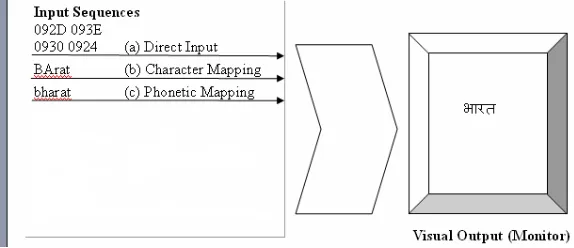
In this method an ASCII value is assigned to each Hindi alphabet/symbol. Central Institute of Indian Languages
has also developed a coding scheme which is also based on the same lines and is named Indian Standard for
Coded Information Interchange (ISCII). As shown in Figure 1(a), Users either have to input these codes or have
to remember the mapping of each key on the keyboard to the corresponding character, making it very difficult to
input text for new or first time users of Hindi on Computers. At present there are fonts like Mangal, Shruti etc.,
which are available in Unicode but they too suffer with the same drawbacks.
Figure1: Different Input Methods
2.2 Transliteration
Transliteration is a process of writing text of a language in some other language. Transliteration of English to
other languages have been a popular research areas. Work on English to Hindi transliteration began in late
1980s, when an application named ITRANS[5] was developed to input text in Hindi using English. This scheme
is also known as phonetic mapping, as shown in Figure 1(c). There is another form of transliteration where a
character of English is mapped to a Hindi character, as shown in Figure 1(b). Since basis of ITRANS like
systems is English spellings and pronunciations, it hits a bottleneck as Hindi has a series of characters which are
phonetically same. A detailed discussion on these system can be referred in our previous work[6].
Although it takes care of ambiguity to some extent, it does not, at times give a intuitive sequence of inputs as
sometimes the user has to write some text in fairly rigid manner. For example, If we wish to transliterate “jaipur
rajasthan ki rajdhani hai”. The phonetic transliteration of this text is “जैपुर रज थन क रजध न है”. In order to
get correct text i.e. “जयपुर राज थानक राजधानी है”, we have to write “japura raajasthana kee raajadhaanee
hai”. As it is clearly visible form the example that by using this Input Method we panelize the beauty and
elegance of the target language.
1
3.
Proposed System
In our phonetic mapping system, we use phonetic transliteration as the basis, but improved it by using a
phonetic lexicon based system. The first step was to encode each word on the basis of lexicon. Due to Hindi’s
complex orthographic rules, this task was highly cumbersome. Using double Metaphone approach we resolved
these issues. The entire process is explained as follows:
3.1 Creation of Lexicon Database and Character Table
As shown in table 1. we modified each character by associating an additional character to the vowels, as in ‘u’
for ‘उ’ and ‘uu’ for ‘ऊ’ and associated an additional h to consonants, as in ‘c’ for ‘च’ and ‘ch’ for ‘छ’. This
resolved the ambiguity of using character with similar phonemes. Once the entire character table was generated,
our second work was to encode the sequences of characters as given by different people. We conducted this
study because, many times while chatting or reading mails in Romanized Hindi, we encountered the variations
in spellings of different individuals. So, it was a general assumption that different people tend to spell same
words differently.
We conducted a study on 50 subjects, where we gave them a three page document in Hindi and asked them to
convert the same in Romanized Hindi. They were given a half an hour time, so that a more spontaneous and
intuitive spelling could be captured, as a little time was given to them to think for what would be the correct
spelling of a word. Once this was done, we studied, how each Hindi character is written in English. Using this
we generated a new table where we could map all the possible sequence of a Hindi characters. This allowed us
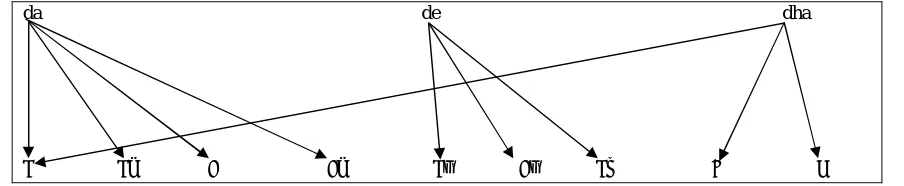
to map many to many correspondence between characters of English and characters of Hindi. Some of the many
to many mapped characters are shown in Figure 2.
da de dha
द दा ड डा दे डे द ढ ध
Figure 2: Many to Manny Correspondence between Hindi and Roman Alphabets
Once we have a table of all such correspondences, we created our lexicon database. We used the archives of
Danik Bhaskar2 (Hindi Daily Newspaper) for creating our lexicon database. We took the individual Hindi words
and provided their English transliterations. We also calculated the frequencies of all these words. In all we
created a database of 20,000 words.
3.2 Working
When the user enters the text, his input sequence is divided into characters using the character table and the right
sequence of word, which can be matched in the database, is constructed internally. Once this is done the
complete word or partial word is searched in the database. The matched words are ranked based on their
frequencies. If there is only one word for the sequence then it is displayed in place of input sequence. If there are
multiple matches then the top five matches (ones which have higher frequencies are displayed). If in case we do
not get any word from the database then the characters are transcribed using direct mapping of character table.
The entire algorithm is shown in figure 3.
1. Generate phonetic codes for all Hindi words and create character table.
2. Input Hindi word using Roman (English) characters.
3. Generate phonetic code string of the input using character table.
4. IF input is phonetic code constructed through character table, then.
a. If matches only one word in the lexicon, then
i. Convert input to that Hindi word
b. If matches to multiple words in the lexicon, then
i. Produce suggestions of all relevant Hindi words and let the user select
5. if phonetic code does not match, then
a. Use direct mapping of character table and provide the output
Figure 3: Algorithm for Hindi Input
4.
Evaluation
We evaluated our system for user friendliness and efficiency. User Friendliness was calculated on ease of
remembrance of words.
We asked a group of 60 people to write English equivalent of Hindi characters. The users were given a two
column list, where in one column there was a Hindi character and in the other the user had to fill in English
alphabet(s), based on their knowledge. Then we provided about an hour training to the users and gave sample
exercises for Direct Input and Transliteration. Next, we gave two column list for both these schemes. We
calculated edit distance based on each given encoding scheme, we calculated the given edit distance the user’s
transliteration and the scheme’s transliteration.
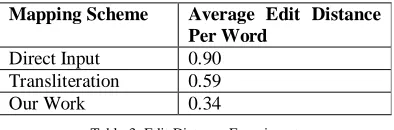
The results are presented in Table 3. As shown, our predictive input system performed better then the two input
schemes.
Mapping Scheme Average Edit Distance Per Word
Direct Input 0.90 Transliteration 0.59
Our Work 0.34
Table 3. Edit Distance Experiment
Here average edit distance was calculated based on the following formulae:
1. Avg_edit_dist(char) =
Subs
subs
char subs proposed char
seq inp dist edit Subs
#
1
)) , ( ),
( _ ( _ #
2. Average =
Char
Char
char
dist
edit
avg
char
freq
#
1
)
(
_
_
)
(
We calculated average edit distance between input key sequence and proposed text of each character. The
average edit distance was calculated using the above equations. The results show that there is big difference
between our system and Direct Input. Our average edit distance was far lesser then this input system. On the
other hand difference between Transliteration and our system is very small. This is because people onto whom
these tests were conducted tried to generate Romanized Hindi word which resembled English words i.e. they
tried to avoid long vowel combinations like ‘ii’, ‘uu’, ‘aa’.
5.
Conclusion and Future Work
We have shown a methodology of taking input from a user who is not required to learn any input sequence. The
use can input text as they deemed it correct. The system would understand the sequence and will try to predict
the desired input by the user. We also experimentally proved that this method is user-friendly and efficient. This
method can further be extended to other languages where there is no one to one correspondence with the roman
key sequences.
As future directions for our work, we look forward to improve our system in many areas. First, we need to have
a morpho-syntactic dictionary instead of the one that we are currently using. The dictionary then would take
only the root word and when the input sequence is provided, the system would be able to generate the correct
sequences from that root word. This would reduce the size of the dictionary as similar derivational words will be
removed (eg. ‘पु तक’, ‘पु तक’, ‘पु तके’ can all be captured using the same root word ‘पु तक’). Further we
would like to improve our system to provide more optimized predictions and adaptability of user and evaluation
of linguistic contexts as discussed by Hasselgren et al [7]. We are under process of developing a system which
can readjust itself and predict user’s natural preference of input, thus making the system more user friendly.
References
1. I. S. MacKenzie, Introduction to This Special Issue on Text Entry For Mobile Computing, Human-Computer Interaction, Vol.17, pp.141-145, 2002.
2. M. Paul Lewis, Ed., Ethnolouge: Languages of the World, Sixteenth Edition. SIL International, 2009.
3. Hans H. Hock, Principles of Historical Linguistics, Walter de Gruyter, Berlin–New York, 1991. 4. M. Davis, Unicode Text Segmentation, Unicode Standard. www.unicode.org/reports/tr29, 2006.
5. Itrans Website. http://www.aczoom.com/itrans/, 2006.
6. N. Joshi, I. Mathur, Text Based Input System for Hindi using Zipf’s Law. In Proc. of National Conference on Recent Developments in Engineering Mathematics and Information Technology, 2009.