IJSRR, 7(4) Oct. – Dec., 2018 Page 2162
Research article Available online www.ijsrr.org
ISSN: 2279–0543
International Journal of Scientific Research and Reviews
Sensitivity of Two Acacia Species on Some Resistant Isolates
Patel Jeni
1* and Gohil T. G.
21
P. G. Science College, Bardoli-394601 D: Surat, Gujarat, India.
2
B. K. M. Science College, Valsad, Gujarat, India.
ABSTRACT:
Almighty God already planned to create the plants before human being in this world. Human
has been depending totally on plants till their ends. In India about 17000 plants have good medicinal
value. Majority of the world population cannot afford the allopathic drugs and have to depend upon
the use of traditional medicines. Plants have variety and huge source of phytochemicals with proven
potential of treating communicable infection with lesser side effects compared to the
chemotherapeutic agents. The aim of the present investigation was to evaluate and determine the
sensitivity of crude extracts of two acacia species - Acacia auriculiformis and Acacia mangium
against some clinical isolates byagar-well diffusion method. Antibacterial potential of crude extract
of leaves was determined by measuring the zone of inhibition. It was concluded from the results that
methanolic leaf extracts of both the acacia species were significant antibacterial activity. Therefore,
the leaf extracts of these plant has very good sensitivity against clinical isolates and can be selected
for further investigation to determine their pharmacological and therapeutic potential.
KEYWORDS:
traditional medicines, crude extracts, agar well diffusion, zone of inhibition._______________________________________________________________________________
*
Corresponding Author:
DR. JENI R. PATEL
Associate Professor,
Biology Department,
The P. G. Science College, Bardoli-394601, D: Surat, Gujarat, India.
IJSRR, 7(4) Oct. – Dec., 2018 Page 2163
INTRODUCTION
Almighty God already planned to create the plants before human being in this world. Human
has been depending totally on plants till their ends. In India about 17000 plants have good medicinal
value. However, approximate 8000 species are used for their medicinal values in traditional systems
of medicines. Natural products have been an integral part of the ancient traditional medicine systems,
e.g. Chinese, Ayurveda and Egyptian.1 About 3.4 billion people in the developing world depend on
plant based traditional medicines. This represents about 88 % of the world’s inhabitants, who rely
mainly on traditional medicine for their primary health care. Majority of the world population cannot
afford the allopathic drugs and have to depend upon the use of traditional medicines. Antimicrobial
properties of many plants have been investigated extensively.2 More than 30% of the entire plant
species were used for medicinal purposes.3
There are so many evidence from the different countries around the world indicates an overall
decrease in the total stock of antibiotic effectiveness: resistance to all the first line of drugs and last
resort antibiotics is increasing.4 Escherichia coli, Klebseilla pneumoniae and Staphylococcus aureus
are most recent worldwide estimated global antibiotic resistance, which are of the greatest concern,
associated with both hospital and community acquired infections.5
Plants have enormous and huge variety of chemical substances with proven potential of
treating infectious diseases with lesser side effects compared to the allopathic drugs. Recently much
more emphasis has been given to biologically active compounds from plants used in the alternative
medicine.6 Increasing in antibiotic resistance & emerging the new threats throughout the world
forced the scientists to search for new alternative cheap, safe and green drugs. The aim of the present
investigation was to evaluate and determine the sensitivity of crude extracts of two acacia species -
Acacia auriculiformis and Acacia mangium against some clinical isolates by agar-well diffusion method.
MATERIALS AND METHODS
Preparation of leaf extracts
Fresh and diseased-free leaves (Phyllodes) of Acacia auriculiformis and Acacia mangium
were collected from local area in and around Vyara, Gujarat. The leaves of these plants were washed
thoroughly under running tap water and then dry at in an oven at 55 + 2 oC for 24 hours. The dried
plant material was pulverized to fine powder in a grinder, and then stored in an air tight bottle. A 5
gm of each dried powder was soaked in 50 ml of chloroform and methanol in flask. The flasks were
covered with aluminum foil and allowed to stand in a dark for 72 hrs for extraction. These extracts
were filtered through Whatmann filter paper no. 1 in a preweighted test tubes and filtrate was
IJSRR, 7(4) Oct. – Dec., 2018 Page 2164
4°C prior to use. These crude extract was further dissolved in DMSO to prepare the stock solution
of 100 mg/ml.
Sources of clinical isolates
Sensitivity of crude extract of leaves of two Acacia species were tested against some clinical
isolates i.e. Escherichia coli, Enterobacter aerogenes, Klebseilla pneumoniae, Proteus mirabilis, Proteus vulgaris, Pseudomonas aeruginosa and Staphylococcus aureus. These common pathogens were isolated from urine and pus sample of a patient suffering from urinary tract infection & wound
infection by standard microbiological procedure & identified biochemically.9, 10 Antibiotic sensitivity
testing of clinical isolates was carried out by WHO recommended Kirby-Bauer, NCCLS modified
disc diffusion technique. More than thirteen antibiotics (1st line, 2nd line & 3rd line) were tested.
Antibiogram were prepared.
Sensitivity of leaf extracts
Sensitivity of leaf extract (chloroform and methanol) of Acacia auriculiformis and Acacia mangium were evaluated by agar well diffusion method.11 A nutrient agar plate was inoculated with 100 μl of standard inoculums of clinical isolate, spread uniformly over a plate by spread plate
technique. After 10 - 15 minute, wells were prepared in each plate by a sterile stainless steel borer (8
mm in diameter). These wells were inoculated with 20 μl of respective chloroform and methanol
extract. N. agar plates kept at 2 - 8˚ C for 15 - 30 minutes. After prediffusion plates were incubated at
37 + 1˚ C for 24 hours. After overnight incubation results were recorded by measuring the diameter
of zone of inhibition in mm.
Minimum inhibitory concentration of the crude extracts of Acacia auriculiformis and Acacia mangium were also determined against three most important resistant isolates i.e. Escherichia coli, Staphylococcus aureus and Pseudomonas aeruginosa by two fold dilution of crude extract followed by well diffusion method.12 The stock solution of 100 mg/ml of crude extract which showed
antibacterial potential were diluted two fold and 20 μl of respective diluents were transferred into
well in a previously seeded N. agar plates with standard inoculums of these resistant isolates. Then
plates were kept for prediffusion & incubated at 37 + 1˚ C for 24 hours. After overnight incubation
diameter of zone of inhibition was measured in mm. MIC is defined as – the lowest concentration of
crude extracts that will prevent the growth of tested clinical isolates.
Total activity (TA) was also determined. TA is the volume or amount at which the tested
crude extract can be diluted without losing their antimicrobial activity. The quantity of material
extracted from one gram of dried plant material is divided by the minimal inhibitory concentration
value to give the total activity of the plant. It is calculated by dividing the amount of extract from 1
IJSRR, 7(4) Oct. – Dec., 2018 Page 2165
RESULTS AND DISCUSSION
There were 21 urine specimens and 3 pus samples were examined microbiologically for
clinical isolates. On the basis of Gram staining, colony morphology on selective media, hemolytic
pattern on Blood agar and result of various biochemical tests, seven clinical isolates were identified
& confirmed. Antimicrobial susceptibility test were performed with more than twelve antibiotics
were studied against seven clinical isolates. Antibiogram of all the isolates were tabulated with the
reference range of antibiotics given in Performance standards of Antimicrobial Disc Susceptibility
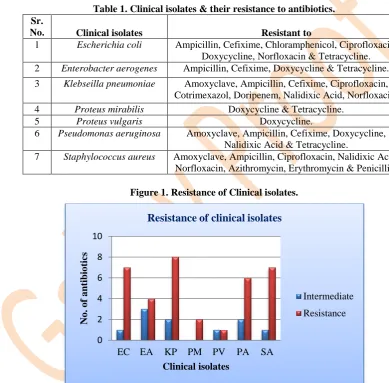
Tests.14 Clinical isolates & their resistance to the total no. of antibiotic is showed in the Table 1 and
Figure 1.
Table 1. Clinical isolates & their resistance to antibiotics. Sr.
No. Clinical isolates Resistant to
1 Escherichia coli Ampicillin, Cefixime, Chloramphenicol, Ciprofloxacin, Doxycycline, Norfloxacin & Tetracycline. 2 Enterobacter aerogenes Ampicillin, Cefixime, Doxycycline & Tetracycline.
3 Klebseilla pneumoniae Amoxyclave, Ampicillin, Cefixime, Ciprofloxacin, Cotrimexazol, Doripenem, Nalidixic Acid, Norfloxacin.
4 Proteus mirabilis Doxycycline & Tetracycline.
5 Proteus vulgaris Doxycycline.
6 Pseudomonas aeruginosa Amoxyclave, Ampicillin, Cefixime, Doxycycline, Nalidixic Acid & Tetracycline.
7 Staphylococcus aureus Amoxyclave, Ampicillin, Ciprofloxacin, Nalidixic Acid, Norfloxacin, Azithromycin, Erythromycin & Penicillin.
Figure 1.Resistance of Clinical isolates.
Note: EC : E. coli, EA : Enterobacter aerogenes, KP : Klebseilla pneumoniae, PM : Proteus mirabilis,
PV : Proteus vulgaris, PA : Pseudomonas aeruginosa, SA : Staphylococcus aureus.
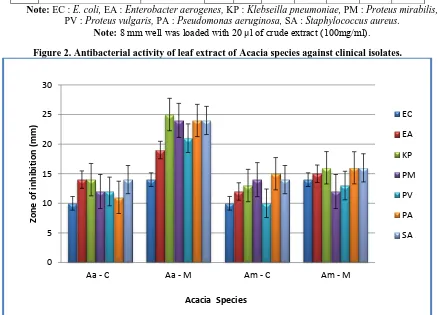
Chloroform and methanol extract of both the Acacia species were effective against all the
clinical isolates. Methanol extract of Acacia auriculiformis showed very good sensitivity against all the clinical isolates compare to Acacia mangium. Antimicrobial activity of leaf extracts of two Acacia species are shown in the Table 2 andFigure 2.
0 2 4 6 8 10
EC EA KP PM PV PA SA
No
.
o
f
a
ntibio
tics
Clinical isolates
Resistance of clinical isolates
Intermediate
IJSRR, 7(4) Oct. – Dec., 2018 Page 2166
Table 2. Antimicrobial activity of leaf extracts of Acacia species. Sr.
No. Acacia species Extract
Zone of inhibition (mm)
EC EA KP PM PV PA SA
1 Acacia auriculiformis Chloroform 10 14 14 12 12 11 14
Methanol 14 19 25 24 21 24 24
2 Acacia mangium Chloroform 10 12 13 14 10 15 14
Methanol 14 15 16 12 13 16 16
Note: EC : E. coli, EA : Enterobacter aerogenes, KP : Klebseilla pneumoniae, PM : Proteus mirabilis,
PV : Proteus vulgaris, PA : Pseudomonas aeruginosa, SA : Staphylococcus aureus.
Note: 8 mm well was loaded with 20 μl of crude extract (100mg/ml).
Figure 2. Antibacterial activity of leaf extract of Acacia species against clinical isolates.
Note: Aa :Acacia auriculiformis, Am : Acacia mangium, C : Chloroform extract, M : Methanol extract
Note: EC : E. coli, EA : Enterobacter aerogenes, KP : Klebseilla pneumoniae, PM : Proteus mirabilis,
PV : Proteus vulgaris, PA : Pseudomonas aeruginosa, SA : Staphylococcus aureus.
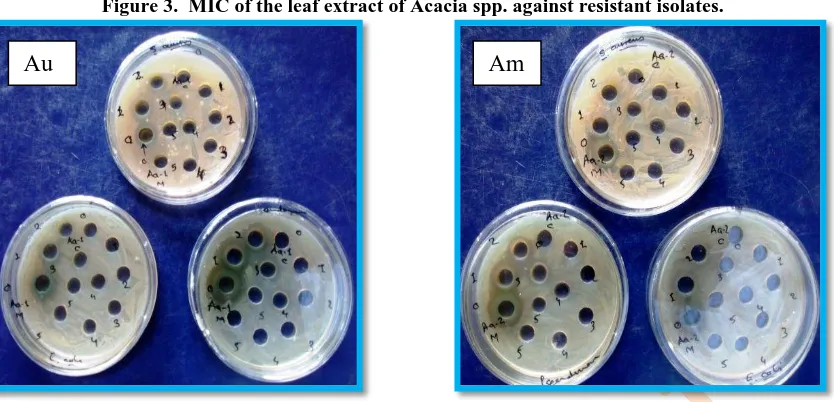
MIC of chloroform and methanol extracts of both the Acacia species against three most
important common pathogenic bacteria & resistant isolates i.e. Escherichia coli, Staphylococcus aureus and Pseudomonas aeruginosa are given in the Figure 3 and Table 3.
0 5 10 15 20 25 30
Aa - C Aa - M Am - C Am - M
Zo
n
e
o
f i
n
h
ib
ition
(
m
m
)
Acacia Species
EC
EA
KP
PM
PV
PA
IJSRR, 7(4) Oct. – Dec., 2018 Page 2167
Figure 3. MIC of the leaf extract of Acacia spp. against resistant isolates.
Note: In all Plates for MIC determination, two fold dilution of crude extract; 0 – 100 mg/ml, 1 – 50 mg/ml, 2 – 25
mg/ml, 3 – 12.5 mg/ml, 4 – 6.25 mg/ml and 5 – DMSO. Au :Acacia auriculiformisAm :Acacia mangium
Note: 8 mm well was loaded with 20 μl of respective dilution of crude extracts.
Table 3. MIC of leaf extracts of Acacia species. Sr.
No. Plants Extract
MIC mg/ml EC PA SA
1 Acacia auriculiformis Chloroform 100 100 100
Methanol 12.5 6.25 12.5
2 Acacia mangium Chloroform 100 50 100
Methanol 6.25 6.25 6.25
Note: EC : Escherichia coli, PA : Pseudomonas aeruginosa, SA : Staph. aureus
MIC of methanolic extract of both the Acacia species showed significant antibacterial activity
against all three resistant isolates, which is shown in the Figure 4.
Figure 4. MIC of the methanolic leaf extract of Acacia species against resistant isolates.
Note: Aa :Acacia auriculiformis, Am : Acacia mangium, M : Methanol extract
Note: EC : Escherichia coli, PA : Pseudomonas aeruginosa, SA : Staph. aureus
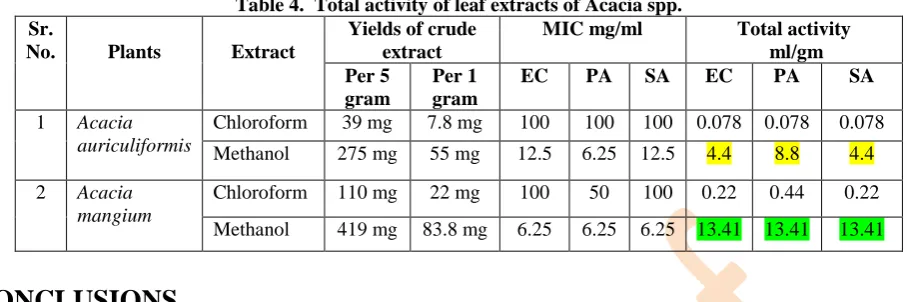
Total activity indicates the largest volume to which the biologically active compounds in one
gram can be diluted and still inhibit the growth of bacteria. Result revealed that methanol extract of
Aa M Am M
12.5
6.25
6.25 6.25
12.5
6.25
M
IC
m
g
/m
l
EC
PA
SA
IJSRR, 7(4) Oct. – Dec., 2018 Page 2168
both the Acacia showed high total activity. Total activity of leaf extracts of Acacia spp. shown in
Table 4.
Table 4. Total activity of leaf extracts of Acacia spp. Sr.
No. Plants Extract
Yields of crude extract
MIC mg/ml Total activity ml/gm Per 5
gram
Per 1 gram
EC PA SA EC PA SA
1 Acacia auriculiformis
Chloroform 39 mg 7.8 mg 100 100 100 0.078 0.078 0.078
Methanol 275 mg 55 mg 12.5 6.25 12.5 4.4 8.8 4.4
2 Acacia mangium
Chloroform 110 mg 22 mg 100 50 100 0.22 0.44 0.22
Methanol 419 mg 83.8 mg 6.25 6.25 6.25 13.41 13.41 13.41
CONCLUSIONS
It is concluded from the results of antibiogram of clinical isolates that Escherichia coli, Staphylococcus aureus and Pseudomonas aeruginosa are most common multidrug resistant prevalent in community acquired and hospital acquired infection. It is concluded that both the
Acacia species showed very good sensitivity activity against common clinical isolates. On the basis
of total activity, it is also concluded that Acacia mangium possessed good sensitivity against all the three multidrug resistant clinical isolates than Acacia auriculiformis. It is clear evidence that methanolic extracts of both the Acacia species have potential as an antibacterial compound against
resistant isolates and they can be further evaluated for bioactive natural product. This investigation
would help to formulate a new, cheaper and alternative antibacterial drug.
REFERENCES
1. Sarker, S. D., Nahar, L. and Kumarasamy, Y. Microtitre plate-based antibacterial assay
incorporating resazurin as an indicator of cell growth and its application in the in vitro
antibacterial screening of phytochemicals, Methods, 2007; 42: 321-324
2. Adamu, H. M., Abayeh, O. J., Agbo, M. O., Abdullahi, A. L., Uba, A., & Dukku, H. U.
Journal Ethan Pharmacology , 2005; 99(1): 1-4.
3. P. P. Joy, J. Thomas, Samuel Mathew and Baby P. Skaria. Medicinal plants. Aromatic and medicinal plants research station, Kerala agricultural university1998; 3-9.
4. O’Neill, J. Antimicrobial resistance: Tackling a crisis for the health and wealth of Nations.
Review on Antimicrobial Resistance, London, 2014.
5. WHO. Antibiotic resistance - A report on infectious diseases, 2014.
6. Nair, R. and Chanda, S. In vitro antimicrobial activity of Psidium guajava L. leaf extracts against clinically important pathogenic microbial strains. Brazilian Journal of Microbiology,
IJSRR, 7(4) Oct. – Dec., 2018 Page 2169
7. Harborne J B. Phytochemical methods. A Guide to Modern Techniques of plant analysis,
Chapman and Hall, International edition, 1974.
8. Prashant Tiwari & et. al. Phytochemical screening and extraction: A Review, Internationale Pharmaceutica Sciencia, 2011; 1(1): 98-106
9. WHO. Basic procedure in clinical bacteriology, 2nd edition, 1991
10.American Society for Microbiology, Washington D. C. Manual of Clinical Microbiology, 7th
Edition, 1999; 1526-1543.
11.Perez, C., Pauli, M. and Bazerque, P. An Antibiotic Assay by Agar Well Diffusion Method.
Acta Biologiae et Medicinae Experimentalis, 1990; 15: 113-115.
12.Esimone, C.O., Adiuku, M.U. and Okonta, J.M. Preliminary Antimicrobial Screening of the
Ethanolic Extract from the Lichen Usnea subfloridans (L). J. Pharmaceutic Res. Dev. 1998; 3(2): 99-102
13.Eloff J. N. A proposal on expressing the antibacterial activity of plant extracts - a small first
step in applying scientific knowledge to rural primary health care in South Africa. South African Journal of Science. 1998; 96, 116-118
14.NCCLS. Performance Standards for Antimicrobial disc susceptibility tests; 8th Edition,