United Kingdom Vol. V, Issue 4, April 2017
Licensed under Creative Common Page 451
http://ijecm.co.uk/
ISSN 2348 0386
THE EXTENT OF EXTERNAL AUDITORS’ RELIANCE ON
INTERNAL AUDIT FUNCTION: CASE OF THE UAE
Ali N. Azad
Professor of Accounting, Abu Dhabi University, Abu Dhabi, UAE [email protected]
Abstract
The reliance on the work of internal auditing function (IAF) in developed countries has a three
decades history. In spite of advances in Internal Auditing profession and the numerous
benefits, the reliance on the work of IAF in developing countries seems to be non-existent. The
primary purpose of this study was to ascertain the extent of reliance of external auditors (EAs)
on IAF in the context of the United Arab Emirates (UAE) - one of the countries in the Gulf
Cooperation Council (GCC) that has embraced internal auditing for over two decades. The other
objectives of the study were to identify the IAF’s necessary conditions to warrant reliance on its
work and also to identify the audit areas most suitable for such reliance. To achieve the
research objectives, the study collected data from the audit managers working in public
accounting (CPA) firms using survey instrument. The test of hypotheses revealed, for the most
part, EAs do not relay on IAF. For other research objectives, the findings revealed that practical
independence of IAF was the most important necessary condition to facilitate such reliance and
the most suitable area for reliance was the evaluation of the system of internal control.
Keywords: External auditing, internal auditing, reliance on the work of internal auditors, audit
efficiency, audit fees
INTRODUCTION
Licensed under Creative Common Page 452 using the expertise it has to enhance effective and efficient discharge of management’s responsibilities.
Today, the profession of internal auditing serves both government and non-government entities in a variety of roles which includes financial auditing, compliance auditing, operational auditing, risk assessment, risk management, detection of fraud, etc. Today, the profession of Internals Auditing has all hallmarks of being a “true” profession. Among other distinguishing
features, it has Standards of Professional Practice, it possesses a well-defined body of knowledge, it enjoys professional Code of Ethics, it has a well-established professional association – the Institute of Internal Auditors (IIA), and it awards professional certification -- Certified Internal Auditors (CIA) -- to eligible members.
The mission, expertise, and size of IAF vary widely and depend on the needs of the organization it serves. While not mutually exclusive, some organizations establish in-house IAF as a part of their overall system of both internal control and corporate governance structure, while others establish IAF for the purpose of having readily available access to needed expertise in assisting management in highly specialized areas.
In spite of rapid growth of the IA profession in the UAE, and in the other member nations of the GCC, there seems to be inadequate interaction between the EAs and their internal counterparts, particularly in the area of reliance on the work performed by IAF. For the purpose of this study, the reliance on the work of internal auditors does not refer to instances where IAF provides direct assistance to the EAs under the direction and supervision of EAs. Rather, the reliance on the work of IAF refers to instances where the EAs accept the work that was performed by IAF (subject to review) in a “constructive and complementary manner” (ISA 610, 2013, page 4) and accept them as their own.
With this introduction, the first part of this article presents the significance of the study. An overview of the literature, a description of the study, and the research hypotheses are presented in the subsequent sections followed by the presentation of methods of data analysis and the study’s findings. The article ends with discussing the implication of the findings, limitations of the study, suggestions for future research, and a summary.
Significance of Study
Licensed under Creative Common Page 453 The reliance on the work of IAF has many advantages to both the CPA firms and the clients. The highlights of the benefits that CPA firms (along with the client) can enjoy include improved efficiency of the audit, benefits received from the expertise of the IAF, reduced need for seasonal employees, containment of audit cost, speedy completion of the audit, and more timely delivery of audit report. The list of advantages that is more exclusively enjoyed by the client company includes reduced audit fees, optimal use of human capital (i.e., the personnel of IAF), and improved competencies of IAF through working with the EAs, and establishing positive relationship and trust with the CPA firms.
The significance of this study, aside from being the first of its kind in this part of the world, lies in the important and ever-widening role that auditing plays in today’s economy of the
UAE. In addition, once the reliance on the IAF becomes a familiar practice in the UAE, it can find its way to other neighboring countries leading to an eventual narrowing of the existing gap between the developed and developing countries.
AN OVERVIEW OF THE LITERATURE
The subject of the external auditors’ reliance on the work of IAF has been studied for over three decades and many studies have investigated different dimensions of the issue (e.g., Whittington and Margheim, 1993; Gramling et al., 2004; Cohen et al., 2004). Among the well-researched areas in this domain is the identification of the conditions that are necessary to warrant the reliance of external auditors on the work of internal auditors.
The widely used professional standards governing the conduct of EAs in relation to their reliance on the work performed by the IAF in this region are either the International Auditing Standards (IAS) or Statement on Auditing Standard (SAS). The ISA 315 and ISA 610 (both revised in 2013) are published by the International Auditing and Assurance Standard Board of International Federation of Accountants (IFAC) and SAS 128 (superseded SAS 65 and revised in 2013) is published by the Auditing Standard Board of the American Institute of Certified Public Accounts (AICPA).
According to both ISA and SAS, the final responsibility for the audit of financial statements rests with EAs, irrespective of reliance on the work performed by IAF (i.e., in the event of reliance, the responsibility of EAs for the audit cannot be shared with the IAF). That being said, both standards set forth frameworks for such reliance and stipulate different attributes that IAF must possess to warrant reliance on its work (ISA 315 and 610, 2013; SAS 128, 2013).
Licensed under Creative Common Page 454 reliance of the EAs on IAF. Both standards introduce the concept of a systematic and disciplined approach, among others, as a prerequisite to enable reliance on the work of IAF. Furthermore, both standards set forth conditions for the use of IAF and identify the attributes that IAF must possess before EAs can rely on its work. These attributes, among others, include objectivity and competence (SAS 128; ISA 315 and 610, pp. 5-9).
Along the line of the professional standards stipulating the attributes of internal auditors, Moeller & Witt (1999, p. 14-15) identify series of attributes as the prerequisite to the success of internal auditors. They state that in addition to technical and professional qualifications, IAF ought to possess basic fairness and integrity, dedication to the organization’s interests, role consistency, critical attitude, alertness, and ability to make sound judgments (Moeller & Witt, 1999, page 14-15).
Among other determinants of reliance, Lois Munro and Jenny Stewart (2009) examined the difference that outsourcing of IAF (as opposed to in-house IAF) can have on the reliance decision of EA on IA function. In addition, their study investigated the audit areas where the EAs are inclined to rely on the work of IAs. As for the former, they concluded outsourcing the IAF (as opposed to the IAF service being provided in-house) does not generally influence the reliance decision. With regard to the latter, they concluded that EAs are more likely to rely on IAF in evaluation of the system of internal control, rather than substantive test of accounts’ balances (Munro and Stewart, 2009).
In a similar line of research, and in a 2011 study, Desai et al. also investigated the impact of IA sourcing on the EAs’ reliance decision. Their study had predicted the external
auditors will assess the objectivity and professional competence of the non-in-house IAF less favorably than the outsourced or co-sourced IAF, and accordingly, will be more inclined to rely on the work of the latter categories. The findings of their study supported their predication and indicated that EAs placed a higher degree of reliance on the work of outsourced or co-sourced IAF as compared with in-house IAF.
Licensed under Creative Common Page 455 In another line of research, Cohn (2011) investigated the Public Company Accounting Oversight Board’s recommendation that external auditors “rely on the work of others” to contain the
additional cost resulting from the audit of compliance with Section 404 of the Sarbanes-Oxley Act (SOX). In addition, the study investigated a series of internal and environmental factors that influence EAs’ reliance on the work performed by IAF. Similar to other related studies, the findings of Cohn’s study supported the conclusion that EAs are likely to rely on the work of IAF
in audit areas where the perceived risk is low and when pressured by management of the client company. Other noteworthy findings of Cohn’s study were that the prior experience of EAs in
dealing with internal auditors had an influence on their reliance decision. Cohn also found that the work style of EAs was another important factor that influenced the reliance decision – i.e., auditors seeking to avoid conflict with the auditee’s management may indeed be more inclined to rely on the IAF as compared to the EAs with a more “activist work style” (Cohn, 2011).
One of the few studies carried out in the context of developing countries was by Suwaidan and Qasim (2010). The aim of this study was to examine the extent of reliance of EAs on the work performed by IAF and ascertain the influence of number of factors on the perceptions of Jordanian external auditors’ regarding such reliance. The study also investigated if the reliance on IAF was related to audit fees. The study found the attributes of objectivity, competence, and work performance of internal auditors to influence EAs’ reliance decision. Further, the results of the study showed the client’s size to be a significant determinant of audit
fees, rather than the reliance on the work of IAF (Suwaidan and Qasim, 2010).
The other study carried out in developing countries was that of Mihret and Admassu (2011). The study was done of Ethiopia and examined the relationship between the external and internal auditors from corporate governance prospective. According to the findings of the study, the issue of the reliance on the work of IA that originated from the West did not result in a meaningful level of reliance on the work of IAs in developing countries. According to the study’s
results, the quality of the work performed by IAF is the overriding factor in determining whether EAs rely on IAF, and if so, to what extent. Furthermore, and regardless of the issue of reliance, the study’s findings suggest that enhancing the quality of IAF in an organization will lead to a
more effective and improved corporate governance and will strengthen the relationship between the external and internal auditors (Mihret and Admassu, 2011).
RESEARCH METHODOLOGY
Licensed under Creative Common Page 456 IAS and SAS. The second objective of the study was to identify the necessary attributes of the IAF to warrant EAs’ reliance. Lastly, the study attempted to ascertain the audit areas where the
EAs would rely on the work of their counterparts.
To achieve the first objective, the study formulated the following two hypotheses:
H1: During the conduct of an independent audit of financial statements, my firm relies on the
work performed by Internal Auditing Function of the client.
H2: Within the guidelines of the applicable International Auditing Standard and/or applicable
Generally Accepted Auditing Standard, my firm would rely on the work performed by the Internal Auditing Function of the client.
To collect the data, and out of necessity, the study used an anonymous survey despite of its well-documented limitations. First, the use of the survey preserved the confidentiality of information (Raghunathan, 1991). Second, the use of survey was most practical than field study which would have required disclosure of otherwise clients’ confidential information – an
unacceptable proposition to both CPA firms and their clients (unlike the USA and some other developed countries, the unaudited financial information in this region is not available in public domain). Third and last, the use of anonymous survey could have provided the opportunity of an increased response rate (Otley and Pierce, 1996; McNamara and Liyanarachchi, 2008).
After piloting and making the necessary revisions, the survey instruments were sent to 165 audit managers working for the local, regional and international CPA firms in the UAE. Due to lack of publicly available membership directory of practicing CPAs in the UAE (like the membership directory of the AICPA in the USA), the identification of the survey sample entailed three steps. First, the list of accounting firms in the UAE was obtained from the Accountants Business Directory. Second, the list was screened to exclude firms that did not provide auditing services. In the final phase, the survey instruments were sent to the accounting firms engaged in providing auditing services.
A total of 59 usable questionnaires were received yielding almost 36 percent response rate. The selection of audit mangers as respondents to their survey, notwithstanding exceptions, was based on their ultimate responsibility for fieldwork including the choice of reliance on work performed by IAF - a responsibility that may be even more pronounced in the UAE and other member countries of the GCC.
ANALYSIS
Licensed under Creative Common Page 457 Table 1. One-Sample T Test of Hypotheses
Test Value = 4
T df Sig. (2-tailed) Mean Difference
95% Confidence Interval of the Difference
Lower Upper H1 -27.087- 57 .000 -2.39655- -2.5737- -2.2194-
H2 -.191- 57 .849 -.01724- -.1981- .1637
Based on the statistics provided in Table 1, the result of the one sample t-test for H1 is as follow:
t(57) = -27.087,
p = 0.000.
The sample mean of H1 is far away from the population mean and its p-value is less than
0.05. Thus, H1 is rejected.
The result of the one sample t-test for H2 is as follow:
t(57) = -0.191,
p = 0.849.
The sample mean of H2 is very close to the population mean and its p-value is greater
than 0.05. Therefore, H2 cannot be rejected.
Accordingly:
1. During the conduct of independent auditing, EAs do not rely on the work of IAF, and 2. EAs would rely on the work performed by IAF, within the guidelines of the applicable
professional standards.
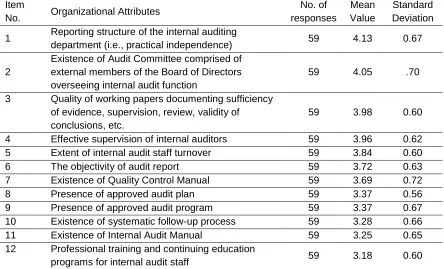
The second objective of this research was to identify attributes of IAF (and those of the internal auditors) that would facilitate EAs reliance on IAF. For this purpose, the relevant attributes were divided into two sections of organizational and personal. The organizational attributes are based on the established policies and procedures that govern the IAF. In contrast, the personal attributes are characteristics identifiable with IAF personnel.
Organizational Attributes: As stated earlier, the organizational attributes are unique to each client and typically within the direct control of client’s management. These attributes are
Licensed under Creative Common Page 458 Table 2. Organizational Attributes of Internal Audit Function
Please indicate the degree of your agreement with the importance of the following items as they relate to reliance on the work of internal auditors*
Item
No. Organizational Attributes
No. of responses
Mean Value
Standard Deviation
1 Reporting structure of the internal auditing
department (i.e., practical independence) 59 4.13 0.67
2
Existence of Audit Committee comprised of external members of the Board of Directors overseeing internal audit function
59 4.05 .70
3 Quality of working papers documenting sufficiency of evidence, supervision, review, validity of conclusions, etc.
59 3.98 0.60
4 Effective supervision of internal auditors 59 3.96 0.62 5 Extent of internal audit staff turnover 59 3.84 0.60 6 The objectivity of audit report 59 3.72 0.63 7 Existence of Quality Control Manual 59 3.69 0.72 8 Presence of approved audit plan 59 3.37 0.56 9 Presence of approved audit program 59 3.37 0.67 10 Existence of systematic follow-up process 59 3.28 0.66 11 Existence of Internal Audit Manual 59 3.25 0.65 12 Professional training and continuing education
programs for internal audit staff 59 3.18 0.60 * A Likert-type scale was used with response options of Strongly Disagree (1), Disagree (2), Neutral (3), Agree (4), and Strongly Agree (5).
As shown in Table 2, the organizational/practical independence (represented by the reporting structure of the IAF) was the most important attribute followed by the presence of audit committee comprised of external members of the Board of Directors (another attribute contributing to the organizational/practical independence of internal audit function). Since by the virtue of an employee and employer relationship, the IAF cannot be independent of the entity it serves, these two attributes ensure a maximum level of IAF’s “independence” within an organization (Casler and Crokett, 1982; Manahan, 1976; Sawyer, 1973; and Smith 1970). The third important attribute was the quality of working papers for the reason of being the foundation of an audit opinion.
Licensed under Creative Common Page 459 Personal Attributes: As stated previously, personal attributes are characteristics identifiable with each internal auditor and inherently outside the direct control of client’s management.
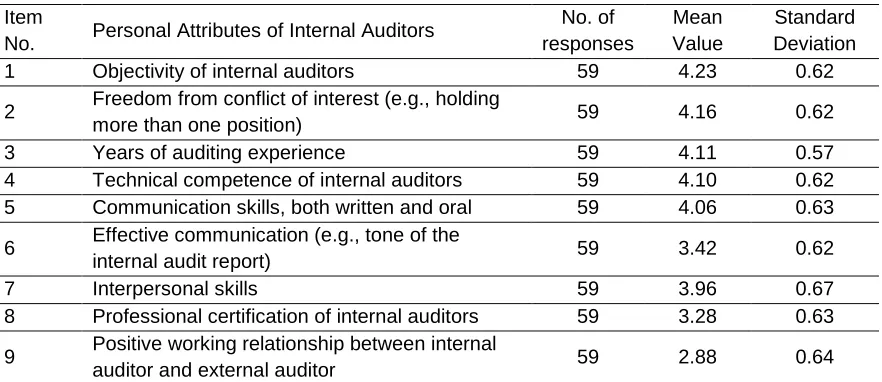
These attributes, therefore, are not tenable to an entity-wide policies, procedures, or practices. Table 3 shows the list of nine attributes that were provided to the respondents to express their degree of agreement with the importance of each in relation to the reliance on the work performed by the IAF.
Table 3. Personal Attributes of Internal Audit Function
Please indicate the degree of your agreement with the importance of the following items as they relate to reliance on the work of internal auditors*
Item
No. Personal Attributes of Internal Auditors
No. of responses
Mean Value
Standard Deviation 1 Objectivity of internal auditors 59 4.23 0.62
2 Freedom from conflict of interest (e.g., holding
more than one position) 59 4.16 0.62
3 Years of auditing experience 59 4.11 0.57 4 Technical competence of internal auditors 59 4.10 0.62 5 Communication skills, both written and oral 59 4.06 0.63
6 Effective communication (e.g., tone of the
internal audit report) 59 3.42 0.62
7 Interpersonal skills 59 3.96 0.67
8 Professional certification of internal auditors 59 3.28 0.63
9 Positive working relationship between internal
auditor and external auditor 59 2.88 0.64 * A Likert-type scale was used with response options of Strongly Disagree (1), Disagree (2), Neutral (3), Agree (4), and Strongly Agree (5).
As shown in Table 3, the first two items that received the highest mean values were related to objectivity and freedom from conflict of interest -- the attributes most closely related to freedom from systematic bias in the work performed by the IAF personnel. Frank De Marco (1982) defined objectivity as a “… mental trait enhancing the ability to a detached approach from a task
despite personal feelings (page 24). De Marco further noted that despite the practical difficulties in maintaining objectivity, internal auditors must exercise judgment based on professional opinions, and not on personal views. In his view, if such separation cannot be achieved, internal auditors must withdraw from a particular engagement (De Marco, 1982).
While the next two attributes that received high mean values were years of auditing experience and technical competence, the following three were related to “soft skills.” This finding is consistent with the widely held belief that the attribute of “soft skills” is necessary for
Licensed under Creative Common Page 460 personal attributes received mean values higher than 3.00, and their standard deviations did not exceed 0.67 showing a high degree of consensus among the perceptions of respondents.
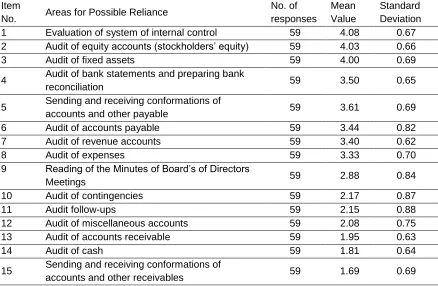
The final objective of this study was to identify the audit areas that were perceived by EAs as suitable for reliance on the work performed by IAF. For this purpose, the respondents were provided a list of 15 common audit areas and requested to indicate their agreement with the suitability of each area for reliance. The results of the analysis are presented in Table 4.
Table 4. Audit Areas for Reliance on the Work Performed by Internal Audit Function Please indicate the degree of your agreement with the suitability of the following areas as they relate to reliance on the work of internal auditors*
Item
No. Areas for Possible Reliance
No. of responses
Mean Value
Standard Deviation 1 Evaluation of system of internal control 59 4.08 0.67 2 Audit of equity accounts (stockholders’ equity) 59 4.03 0.66
3 Audit of fixed assets 59 4.00 0.69
4 Audit of bank statements and preparing bank
reconciliation 59 3.50 0.65
5 Sending and receiving conformations of
accounts and other payable 59 3.61 0.69 6 Audit of accounts payable 59 3.44 0.82 7 Audit of revenue accounts 59 3.40 0.62
8 Audit of expenses 59 3.33 0.70
9 Reading of the Minutes of Board’s of Directors
Meetings 59 2.88 0.84
10 Audit of contingencies 59 2.17 0.87
11 Audit follow-ups 59 2.15 0.88
12 Audit of miscellaneous accounts 59 2.08 0.75 13 Audit of accounts receivable 59 1.95 0.63
14 Audit of cash 59 1.81 0.64
15 Sending and receiving conformations of
accounts and other receivables 59 1.69 0.69 * A Likert-type scale was used with response options of Strongly Disagree (1), Disagree (2), Neutral (3), Agree (4), and Strongly Agree (5).
A careful examination of Table 4 reveals that with the exception of evaluation of the system of internal control that received the highest mean value, the respondents’ perceived suitability for
reliance were inversely related to the audit risk and/or the information content of the area. Those items considered to pose a higher audit risk or contain potentially valuable information were considered less suitable for reliance (e.g., audit of cash and accounts receivables or audit of the minutes of the meetings of the Board of Directors or contingencies).
Licensed under Creative Common Page 461 highest mean value indicating strong suitability lies in IAF’s in-depth knowledge of the system. This is to say the seeming irony is justified on the ground of trade-off between accepting a higher risk and gaining access to detailed knowledge of IAF in this area.
SUMMARY
This study had three objectives. The first objective was to investigate the extent to which the external auditors rely on the work of internal auditors in the UAE. Related to this objective, the study attempted to address the issue of future reliance within the framework of applicable professional standards. The second objective of the study was to identify the necessary conditions of IAF that would warrant external auditors’ reliance. The third and last objective was
to identify the audit areas where the external auditors would rely on the work of their internal counterparts. To achieve the first objective, the study formulated the following two hypotheses: H1: During the conduct of an independent audit of financial statements, my firm relies on the
work performed by Internal Auditing Function of the client.
H2: Within the guidelines of the applicable International Auditing Standard and/or applicable
Generally Accepted Auditing Standard, my firm would rely on the work performed by the Internal Auditing Function of the client.
To test the hypotheses, a survey instrument was used to collect data from audit mangers working for local, regional, and international CPA firms in the UAE. The study used one-sample T test to analyze the data using SPSS 20. The test of hypotheses revealed that, for the most part, external auditors do not rely on the work of internal auditors during the independent audit of financial statements. The analysis of data also showed that within the guidelines set by the applicable auditing standards, the CPA firms would rely on the work of IAF.
As for the second objective of this study, the respondents were provided a list of attributes of the clients’ IAF that would influence the EAs reliance decision. These attributes
were divided into two groups of organizational and personal. The organizational attributes were unique to each client and within the control of client’s management. The personal attributes were, however, identifiable with the internal auditors.
As for the organization attributes, practical independence of the IAF was perceived as the single most important determinants of EAs’ reliance decision, followed by the quality of
working papers. Among the personal attributes, objectivity of IAF, technical competency, and possessing soft-skills (e.g., communication skills) were perceived as the top attributes considered by EAs for deciding whether to rely on the work of IAF or not.
Finally, and concerning the third objective, the surveys’ results showed the evaluation of
Licensed under Creative Common Page 462 the perceived suitability of other areas was inversely related with the audit risk and/or information content of the given area. For example while the audit of fixed asset (low risk area) was perceived as suitable, the audit of cash, accounts receivable, or reading the minutes of the meeting of the Board of Directors (high risk areas or area with valuable information content) were considered as the least suitable for reliance .
The results of this study can have far-reaching implications for both the public accounting firms and the clients. These implications include, among others, lowering audit fees, minimizing the duplication of efforts, optimizing the use of human resources, producing timely audit reports, and benefiting from the expertise of IAF.
IMPLICATIONS OF THE RESULTS
The results of this study can have important implications for the benefit of both CPA firms and their clients. These implications include:
1. Lowering audit fees, 2. Optimizing the use of IAF, 3. Eliminating duplication of efforts, 4. Improving audit efficiency, 5. Enhancing the quality of IAF,
6. Reducing seasonal fluctuations in the staff needs of CPA firms,
7. Benefiting from the expertise of IAF with most familiarity with the intricacies of client’s operation, and
8. Producing timelier audit report.
The above list of implications is not intended to be all-inclusive. There may be other benefits unique to a given entity or there may be valid reasons for an entity to forego the benefits of reliance.
LIMITATIONS OF THE STUDY
The first two limitations of this study are related to sampling and the use of survey questionnaire. Both of these limitations constrain generalizability of the results. The other constraint on generalizability of results is the non-respondents. Finally, the generalizability of the results may be limited only to those CPA firms that participated in the study. In spite of the above limitations, the overwhelming similarities in the socio-economic environments of the GCC countries may be a ground for cautious extension of the study’s findings to those member
Licensed under Creative Common Page 463 SUGGESTIONS FOR FUTURE RESEARCH
The potential benefits of this study are multi-faceted and cover both economic and social dimensions. For this reason, the replication of this study for other GCC countries could be a logical extension of this research.
Another logical extension of this research is to investigate the issue from the perspective of IAF in both the UAE and other member nations of the GCC, particularly those countries that embrace internal auditing and enjoy a local chapter of IIA. The results of such study can assist the IAF to acquire the necessary attributes and skills needed to enable EAs’ reliance on its
work.
REFERENCES
Casler, D. J., & Crockett, J. R. (1982). Operational auditing: an introduction. Altamonte Spring, FL: The Institute of Internal Auditors.
Clark, M. W., T. E. Gibbs, and R. G. Schroeder. (1980). Evaluating internal audit departments under SAS No. 9: Criteria for judging competence, objectivity, and performance, The Woman CPA, 22, 8-11.
Cohen, J., G. Krishnamoorthy & A. Wright. (2004). The corporate governance mosaic and financial reporting quality. Journal of Accounting Literature, 23, 87-152.
Cohn, Michael. (2011). External auditors sometimes will rely on internal auditors. Accounting Today. Retrieved on December 10, 2016 from: http://www.accountingtoday.com/opinion/external-auditors-sometimes-will-rely-on-internal-auditors
Desai, Naman K., Gregory J. Gerard, and Arindam Tripathy. (2011). Internal audit sourcing arrangements and reliance by external auditors. AUDITING: A Journal of Practice & Theory, 30(1), 149-171.
Gramling, A., M. Maletta, A. Schneider, and B. Church. (2004). The role of the internal audit function in corporate governance: A synthesis of the extant internal auditing literature and directions for future research. Journal of Accounting Literature 23, 194-244.
International Auditing Standard. (2013). ISA 610: Using the Work of internal auditors. International Federation of Accountants.
Manahan, R. A. (1975). The importance of internal auditing in state higher education. The Internal Auditor, 59-63.
Margheim, L. (1986). Further evidence on external auditors’ reliance on internal audit. Journal of Accounting Research, 24, 194-205.
McNamara, S. M. & G. A. Liyanarachch. (2008). Time budget pressure and auditor dysfunctional behavior within an occupational stress model. Accountancy Business and the Public Interest, 7(1), 1-43. Mihret, Dessalegn G. and Mengistu Amare Admassu. (2011). Reliance of external auditors on internal audit work: a corporate governance perspective. International Business Research, 4(2).
Moeller, R., and H. N. Witt. (1999). Brink’s Modern Internal Auditing, 5th Ed. John Wiley & Sons, Inc., New York.
Munro, Lois and Jenny Stewart. (2009). External auditors’ reliance on internal audit: the impact of sourcing arrangements and consulting activities. Griffith Business School Working Paper Series, Griffith University.
Licensed under Creative Common Page 464 Otley, D. T. & Pierce, B. J. (1996). Audit time budget pressure: Consequences and antecedents. Accounting, Auditing and Accountability Journal, 9(1), 31-58.
Raghunathan, B. (1991). Premature signing- off audit procedures: An analysis. Accounting Horizons, 5(2), 71-79
Sawyer, L. B. (1973). Just what is management auditing? The Internal Auditor, 10-21.
Schneider, A. (1985). The reliance of external auditors on the internal audit function. Journal of Accounting Research, 23, 911-919.
Smith, R. J. (1970). The merits of certifying internal auditors. The Internal Auditor, 14-23.
Suwaidan, Mishiel Said and Amer Qasim. (2010). External auditors' reliance on internal auditors and its impact on audit fees: an empirical investigation. Managerial Auditing Journal, 25(6), 509-525.
Statement on Auditing Standards. (2013). SAS 128: Using the Work of Internal Auditors. American Institute of Certified Public Account. John Wiley & Sons, Inc., New York.