Application Of Materials Management
Construction Project (Case Study In Central
District Sumba)
Agus Bambang Siswanto, Kemmala Dewi, Hari Setijo Pudjihardjo, Aris Krisdiyanto, Edwyn Boloe
Abstract: The application of good management and proper materials are very useful for the smooth running of a construction project .. This study aims to determine the inhibiting factors, the impact and the best solution application materials management problems in Central Sumba Regency in addition to determine the quality of construction management in the region. This research was conducted by distributing questionnaires to companies contracting in Central Sumba District. Then the data is analyzed to obtain an average value (mean) and standard deviation values (standard deviation). The analysis is the analysis of the range of average value (mean range analysis), analysis of the rating value of the average (mean rank analysis) and the value of regressionBased on the survey results revealed that the main obstacle in the implementation of material management in Central Sumba District is the geographic location that requires the distribution of the material relied on maritime transport impact on the delivery time becomes longer, in addition to the means of transport and the selection of suppliers of material can also be an obstacle to the management of materials in the District Central Sumba. Although there are these constraints but based on the results of the analysis of data processing with an average range of values (mean range analysis) can be seen that the application of material management in Central Sumba Regency \ already well underway.
based research note value regression Y = 1.827 - 0,135X1 + 0,359X2 + 0,296X3If the reduction constraints (X1), the increasing impact of (X2) and the solution (X3), the application of the material management would be much better
Keywords : Materials management, constraints, impact, solutions, contracting, construction service, Sumba
—————————— ——————————
1.
INTRODUCTION
1.1.Background
Central Sumba is one of the districts on the island of Sumba, located in NTT, which is growing especially infrastructure development as meeting the needs of society. The development of today's construction is growing rapidly create construction service providers are mushrooming, therefore the competition is very tight construction service providers are no exception in Central Sumba District. All construction service providers competing to provide the best services from the fields of architecture, structure to the management fee, time and materials. Central Sumba District condition does not have a manufactured construction materials resulting in limited stock of material, due to be supplied from outside the island of Sumba .. Geographical conditions islands should be by means of sea transport for the distribution of goods in quantity insufficient resulting in increased material prices, it is also an obstacle in the development of Central Sumba Regency.
The biggest problem by the contractor in this area is the delay of construction materials and construction material delivery times are long, and therefore contributes to the smooth construction project. In addition to limited capital is also one of the materials management constraints in Central SumbaMaterials management an important role in the construction process because the material is the largest cost component in the construction process. Material management is done to support the accuracy of the time the construction is done, the timeliness, accuracy the number and the precise costs.
1.2.Formulation of the problem
Based on the above background, can be adjusted formulation of the problem as follows:
1. Is the limiting factor in the application of materials management and their impact?
2. How does the solution contracting company in addressing the problem of limited construction material?
3. How the application of the construction material management in construction projects in Central Sumba District
1.3.Scope of problem
In this research, problem definition that will be examined as follows:
1. Construction of the service in question is a contractor 2. The only study discusses the material management in
construction projects
3. The materials of construction projects that mean the material manufacturer
1.4.Research purposes
Based on the formulation of the problem above, the purpose of writing is as follows:
1. Knowing the inhibiting factors and the impact of delays in construction materials in Central Sumba District 2. Obtaining the best solution to overcome the problem of
providing construction materials in Central Sumba District
__________________________
Agus Bambang Siswanto1
, Kemmala Dewi1, Hari Setijo Pudjihardjo2 , Aris Krisdiyanto1 , Edwyn Boloe1
1Civil Engineering Program of 17 August 1945 University ( UNTAG) in Semarang
2
Civil Engineering Study Program, Engineering Faculty The University of Semarang
1062 3. Knowing the achievement of material management in
Central Sumba District 1.5.Benefits of research
For the Owner, Contractor and Construction Management: From the results of this study are expected to be one of the references in the application of material management at the impending development.
2.LITERATURE REVIEW
2.1.Basic conceptsThe construction project is a series of activities carried out only once and are generally short-term. In a series of activities, there is a process that processes of project resources into a result of activities such as construction. (Ervianto, 2007)
2.2.Material
Material is an important component in determining the cost of a project is absorbed by the material used (Nugraha, 1985). Construction materials in a project can be divided into two, namely the material that would become a fixed part of the structure (permananen materials) and materials required contractors to construct the project. But will not be a permanent part of the structure (temporary material) (Ervianto, 2007).
2.3.Materials management
Material management is defined as a management system needed to plan and control the quality of the material, the amount of material and placement of equipment on time, good prices and the amount corresponding to the needs (Bell and stukhart 1986). Material management can also be defined as a system that coordinates the activities to plan and monitor the volume and timing of the procurement of materials through the reception / acquisition, transformation and transfer of raw materials, materials in process and finished (Stonebraker, 1994).
2.4.Functions and Uses of Materials Management
According Bel and Strukhart (1986), influence the selection of good materials management system can be seen from: 1. The rise in the value of productivity, workers can plan
their work, the material can be obtained when needed. 2. Reducing excessive reservations.
3. Improve the performance of a supplier of material delivery, quality and cost savings
4. Reduce material inventory in the warehouse, the volume of warehouse space, material removal, material treatment, the risk of material damage and material damage before use.
2.5.Material costs
Inventory procurement costs are costs incurred to have an inventory of goods in the warehouse, covering the costs started at the time of booking up to the charges for storing in warehouses. The costs can be specified as follows (PMBOK, 2002):
1. Cost of purchase (Purchase Cost) 2. The booking fee (Order Cost) 3. haulage
4. Storage costs (Holding Cost) 5. The cost of capital (Capital Cost) 6. Risk of damage (Detorioration)
2.6.Management Implementation Phase mateial
To ensure the proper management of materials, each of the following process should be completely implemented effectively. Failure to execute one or more processes will lead to complete failure of materials management and will result in a costly construction project. The processes in material management are as follows (Siswanto, 2014): 1. material selection
2. Selection of suppliers of goods 3. purchase of materials
4. Shipping materials 5. reception material 6. storage of materials 7. spending materials
2.7.Material Field business
Business material must maintain good communication with project implementers to avoid mistakes in ordering material required. Allocating the optimal material not only saves costs but also speed implementation time. By creating a schedule for the use of materials (Materials schedules) can be seen the magnitude of the planned use of the material by the construction work to be carried out.
3.RESEARCH METHODOLOGY
3.1.Method of collecting data
In this study, the data collection method used is the questionnaire distributed to contractors in Central Sumba DistrictThe contents of the questionnaire, which is as follows: a. Questionnaire A, contains initial data needed for
general explanation:
Part 1, is a statement about the general data contractor.
Part 2, the general data questionnaire respondents filler.
b. Questionnaire B contains statements that are divided into four sections, namely:
Section 1, of the perception of the contractor on factors inhibiting and supporting the provision of construction materials.
Section 2, of the contractor on the impact of delays in the delivery and the limited amount of construction material
Section 3, of the perception of the contracting company regarding the best solution in dealing with construction material supply constraints. Section 4, of the views of the contractor on the
material conditions in the field.
3.2. Data analysis method
After the data collected from all respondents, then the next step is to analyze the data.
3.2.1. Statistical Methods Value Percentage
This method is used on questionnaires A Section 1 (Data Company Construction Services) and Part 2 (Data Charger questionnaire respondents).
This analysis is to determine the extent of the application of materials management at contracting companies.
3.2.3. Standard Deviation (Standard Deviation)
To measure the size of the irregularities that occurred ..
3.2.4. Analysis of the average ranking of the value (means the ranking analysis)
This analysis is done by ranking (rankings) are used to rank the obstacles in the implementation of material management and appropriate solutions are used by contractors to address these constraints. Data analysis tool used to simplify the process of using the existing data with WINDOWS SPSS 17.0 and Microsoft Office Excel 2007.
DATA ANALYSIS AND DISCUSSION
4.1 General
The data used for the analysis and discussion in answering the formulation of the problem, by distributing questionnaires to the companies contractors in the area Sumba central. Questionnaires distributed as many as 40 copies, questionnaires were successfully restored and filled with complete as many as 32 copies. General data of the company respondents will be presented in a variety of characteristics, namely: competence and qualifications of companies by Construction Services Development Board Regulation No. 10 of 2013 on Business Registration construction services, corporate ownership status, and the status of the company organizational level.
4.1.1Kualifikasi Company Competency
Competence and qualifications contracting company respondents are presented in Table 4.1.
Table 4.1 Competency Qualification Contracting Company
Respondents
Small company (K1, K2, K3)
Medium (M1, M2)
Large companies
(B1, B2)
Total
amount 15 12 5 32
Percentage
(%) 46.87 37.5 15.63 100
Source: Construction Services Development Board Regulation No. 10 of 2013 on Business Registration construction services.
4.1.2. Corporate Ownership Status
All respondents contracting company is a private company, namely 32 companies with a percentage of 100%.
4.1.3. Company Status
Most of the respondents contracting company is the parent company, which amounted to 27 companies with a percentage of 84.37%. While the contracting company which is a branch company respondents are 5 companies with a percentage of 15.63% which is headquartered in Waikabubak and Waingapu
4.1.4. age Company
Age of the company or work experience the company is based on how long the respondents involved in the world of
construction. Age of the company will be presented in Table 4.2.
Table 4.2 Age Company
age company Total Company Percentage (%)
<5 years 6 18.75
5-10 years 16 50
> 10 years 10 31.25
amount 32 100
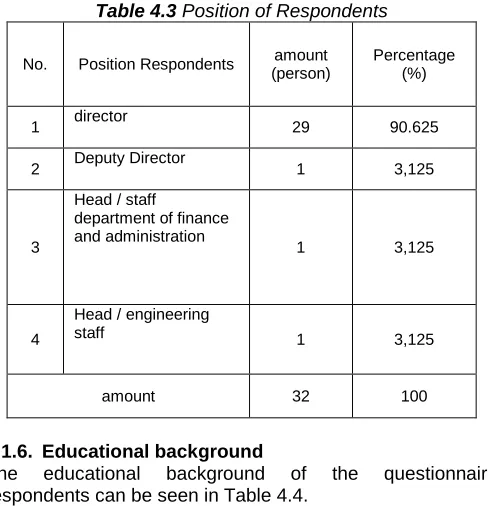
4.1.5. Position Respondents
Position respondents in the contracting company better is the one who directly handle project financing. In Table 4.3 respondents mentioned distribution of positions in the contracting company respondents.
Table 4.3 Position of Respondents
No. Position Respondents amount (person)
Percentage (%)
1 director 29 90.625
2 Deputy Director 1 3,125
3
Head / staff
department of finance and administration
1 3,125
4
Head / engineering
staff 1 3,125
amount 32 100
4.1.6. Educational background
The educational background of the questionnaire respondents can be seen in Table 4.4.
Table 4.4 Educational Background
Educational background
amount
(Person) Percentage SMA / SMK / STM 9 28 125%
D3 6 18.75%
S1 17 53 125%
amount 32 100%
4.1.7. Number of employees
The number of employees in the contracting company can be seen in Table 4.5.
Table 4.5 Number of Employees
Number of
employees Total Company Percentage (%)
<5 17 53 125
5-10 people 11 34 375
> 10 people 4 12.5
amount 32 100
4.2. Constraints Analysis of Material Management Application
1064 sequentially through the ranks (rank) the mean and standard
deviation.
A description of the factors inhibiting material management application according to the rank (rank) provided:
1. Geographically, the average of 4.37
2. Means of Transport Material, an average of 4.29 3. Material suppliers, average 3.98
4. Limitations of Natural Resources and Human Resources, the average of 3.88
5. Against Regional Economy System Procurement, an average of 3.81
6. Contractor yet implement Materials Management with Good, average 3.70
7. Lack of cooperation between the government and the contractor, an average of 3.59
4.3. Delivery Delays Impact Materials and Limitations Number of Construction Materials
Based on the results of statistical data processing of the questionnaire can be seen the impact of material management in a sequence based on ranking (ranking) the mean and standard deviation.
A description of the impact of material management with rank (rank) that is given.
1. Become Longer time, an average of 4.21
2. Increased Cost of Construction, the average 4.15 3. Use of Devices Construction Become Inefficient,
average 4.12
4. Regional Economy, the average of 3.90
5. Inhibiting Progress of Regional Development, the average of 3.87
6. The delay in the procurement of material impact on quality of construction, the average of 3.46
4.4. Addressing Enterprise Solutions Contractors In Construction Material Management Issues
The results of statistical data processing of questionnaires regarding the comparison of value - average (mean) and standard deviation values (standard deviation) can see the order of the material management solutions to problems in Central Sumba Regency based on ranking (ranking) the mean and standard deviation.
A description of the materials management problem solutions in Sumba with rank (rank) that is given.
1. Improved Means of Transportation, the average 4.11 2. Implementation of the Right Material Management
System, an average of 4.07
3. Strict sanctions Giving Up Delay Project, an average of 3.77
4. Repair Local Economic Value, average 3.74
5. Cooperation of the Government party and Contracting Company, an average of 3.74
6. The development of Natural Resources and Human Resources, the average of 3.70
4.5. Application of Material Management
Based on questionnaire data processing results can be seen that the material has been applied to the management of both the contracting company in Sumba. No one has yet to apply and no one has implemented very well. In addition, it is known that the value of the average (mean) parameter management application material is above the
neutral line 2.5 indicating that all respondents have implemented good management.
4.6. Multiple Linear Regression Test
Multiple regression analysis in this study to determine how much influence the application of the constraints of material management, the impact of delays in delivery of materials and contracting company solution to addressing the issue of the application of materials management. Regression analysis was performed with SPSS statistical computer program ,.
Based on the results of multiple linear regression analysis, the regression equation generated in this study are as follows.
Y = 1.827 - 0,135X1 + 0,359X2 + 0,296X3 The regression equation can be explained as follows:
1. Constant of 1.827 indicates that the effect of the application of material management in the absence of independent variables namely the application of material constraints, the impact of delays in material and enterprise solutions to addressing the issue amounted to 1,827.
2. The regression coefficient material application constraints (X1) is -0.135, these results indicate that the variable constraint management application. Negative regression coefficient means that whenever there is an increase in material constraints, the application of material management will be not good.
3. The regression coefficient dampak delay material (X2) is 0.359, the results can be interpreted that the higher the impact arising from the delay in the implementation of material management material can be applied properly. 4. The regression coefficient sOLUTION companies in
addressing the problem (X3) of 0,296, the results can be interpreted that the better the company's solutions in addressing the problem then the management application can be applied with good material.
CONCLUSIONS AND RECOMMENDATIONS
1.1. Conclusion
After doing research on materials management on construction projects in Central Sumba Regency with 32 respondents, can take the following conclusion:
1. Based on the calculation of average value (mean) and standard deviation values (standard deviation) respondents' perceptions of the constraints of material management application of the most influential is the geographic location, followed by limited transportation facilities and material supplier selection.
2. The main impact of the adoption of the lack of proper material management is the time and expenses to be not well controlled.
1.2. Suggestion
Based on research on materials management on construction projects in Sumba, can be given sran as follows:
1. Improved means of transport, in order to minimize delays in delivery of materials.
material, avoiding repetitive ordering, and shipping materials do not experience delays.
3. Cooperation and communication should be established with well between all parties in order to form a solid team and support each other in the smooth construction project.
REFERENCE
[1] Barrie, D.S, Boyd C. Paulson, ―Manajemen Konstruksi Profesional,‖ terj Sudinarto, (Jakarta : Erlangga, 1984)
[2] Bell, L. Stukhart, G, ―Cost and Benefit of Materials Management System,‖ University of Texas at Austin, 1986
[3] Ervianto, W. I., ―Teori – Aplikasi ManajemenProyek Konstruksi ‖, (Yogyakarta : PT. Andi, 2007)
[4] Gray, Clive; dkk. ―Pengantar Evaluasi Proyek,‖ Edisi Kedua, (Jakarta : PT. Gramedia Pustaka Utama, 1993)
[5] Johnston, J. E., ―Site Control of Material Handling, Storage, and Protection,‖ Butterworths, London, 1981
[6] Paulus Nugraha, Ishak Natan, R. Sutjipto, ―Manajemen Proyek Konstruksi 1,‖ Kartika Yudha, 1985
[7] Plossl, G. W., ―Materials Requirements Planning,‖ McGraw-Hill, New York, 1994, pg 74-75
[8] PMBOK, P. M. F. C, ―Labor, Material and Equipment Utilization‖, http//www.ce.cmu.edu, 2002 [9] Siswanto, A. B., et. All. ―Analysis of Implementation
of Standard Operating Procedure Execution Management System K3 on Toll Roads Development to Prevent Accidents Happen in Pasuruan - Probolinggo, East Java‖, International Journal of Civil Engineering and Technology, 9(11), 2018, pp. 580–587
[10]Stonebraker, et. all. ―Operations Strategy,‖ Massaachusetts, Allyn and Bacon, 1994
[11]Stukhart, G., ―Construction Materiials Management,‖ (New York, Marcel Dekker, Inc,1995)
[12]Thomasonan Lutfie, Agus B Siswanto, Rahma Nindya A, and Pipit Skriptiana P, Dredging is a Work to Change the Basic Form of Water, Towards Shipping