Project Management In Era Of Agile And Devops
Methodlogies
Prixit Raj, Dr. Parul Sinha
Abstract: This paper deals with the impact of Agile and DevOps on project management practices and team structure in Software development projects . Project Management practices determine the success of the project. Agile and DevOps are essentially changing the rules on h ow the software projects are being executed and delivered. Specifically, the objective of agile processes is to fulfill the customer requirements at t imely manner and with lower defect rate. The findings of this study indicate that, the Agile and DevOps methodologies have impac t on scope management, quality management and estimation which impacts the project management practices. It is also evident from the review of literature that, Agile and D evOps methodologies have impact on shared responsibility, automation and feedback which organizes team structure. The present paper proposes the conceptual framework and prepositions and in future that could be tested empirically by the researchers to study the impact on holistic basis. In addition to these, this paper also provides recommendations to the sectors that wish to adapt Agile and DevOps methodologies as a part of the strategy to enhance project manag ement practices and team structure.
Index Terms: Agile, DevOps, Project management practices, Team Structure.
—————————— ——————————
1.
INTRODUCTION
A software project is execution of activities to create an outcome or adding value. Project management would be planning, executing and monitoring these activities. Nowadays, business environment is more dynamic and changing frequently in terms of software & product development. Jones (2010) did an analysis of approximately 250 large software projects between 1995 and 2004 and compared successful projects with projects (failed) which experienced overrun & schedule delays. The common challenges observed were related to project planning, estimation, Managing changes and quality management. Agile methodologies are implemented and used widely around the world (Rasnacis and Berzisa, 2017). More and more software teams are focusing towards the agile development and this is to increase the efficiency of their projects and also to meet the customers’ competitive requirements. Agile methodology was developed in order to deal with the issues, where the traditional model faced challenges and also it provides various opportunities to the project teams throughout the development lifecycle. Agile and DevOps methodologies are changing approach how software is being developed and thus impacting how changes are managed, developing application in short timeframes (Sprints) and differently engaging team members.
Gee (2016) in his article in CIO states how Agile and DevOps are shaking up the management and managers are not clear about their roles in new world. Briciu et al (2016) in their paper concluded that estimation models to adjust to the new
know-hows and upcoming systems and will depend largely by the chosen software development process. Estimation is key management activity under Software project management and would be largely depend upon the software development method. Project management practices are vital to the success of the project and hence any impact or changes in the practices need to be carefully studied and understood.
3. RESEARCH METHODOLOGY
Through the literature survey, the research methodology used to establish the conceptual framework for the effect of Agile and DevOps methodologies on project management. We collected primary literature through journals in the software project management fields, software development and software engineering. Agile methodologies have been deployed in Software development area for some time but concept of DevOps is new and is being explored in terms of its deployment, challenges and impact. To make the content comprehensive books, online literature, PMBOK, Agile/DevOps related content from Subject matter experts has also been referred. Table 1 shows the list of journals and the number of articles from each of these journals.
Table 1 : Journals vs the number of articles.
Title of Journal
Numbe r of Articles
Industrial engineering & management 1
Journal of Computing and Information Technology, 1
ACM SIGSOFT Software Engineering Notes 1
Agile processes in software engineering and extreme programming , Springer 1
Agile Software Development, Springer 1
______________________________
• Prixit Raj, Research Scholar, School of Management GD Goenka University, Sohna, Gurgaon
1025
Economics and Applied Informatics 1
IEEE 9
Information Systems Management, 1
Information Systems Research, 1
Innovations in Systems and Software Engineering 1
International Conference on Information Science and Control Engineering. 1
International Conference on Software Engineering 1
International Conference on Software Engineering 1
International Journal of Advance Research in Computer Science and Management 1
International Journal of Project Management 1
Journal of Computer Science 1
Journal of Software Maintenance and Evolution Research and Practice 1
Journal of Systems and Software 1
Procedia Computer Science 1
Project Management Journal 4
Small Group Research 1
Software Process: Improvement and Practice 1
Technovation 1
XP '18 Proceedings of the 19th International Conference on Agile Software Development 1
XP '18 Proceedings of the 19th International Conference on Agile Software Development 1
Research Gate 1
International conference on engineering, computing & information technology 1
The Journal of Defense Software Engineering 1
International Conference on Applied Sciences 2015 1
Full Scale Software Engineering 1
Product-Focused Software Process Improvement 1
International Journal of Project Management 1
UNIVERSITY OF OULU 1
Information and Software Technology 1
Journal Total 45
Publishing House/Book
Project Management Institute, PMBOK 1
Addison Wesley : Agile Project Management 1
Jossey–Bass : eXtreme Project Management 1
John Wiley & Sons : Effective project Management 1
Multi–Media Publications Inc. : Managing agile projects 1
Cengage Learning : Group Dynamics 1
IT Revolution Press : DEVOPS handbook - how to create world-class agility, reliability, and security in technology
organizations 1
AMACOM : Agile project management: how to suceed in the face of changing project requirements 1
Pearson Press edition : Agile Project Management: Creating Innovative products 1
Addison Wesley : Balancing Agility and Discipline: A Guide for the Perplexed 1
Harvard Business Press : Reinventing project management: The diamond approach to successful growth and
innovation 1
Addison Wesley : Scaling software agility: Best practices for large enterprises 1
Book Total 12
Computer 1
PM World Today 2
Magazine Total 3
WhitePaper
Organization Website 1
Innovation Value institute 1
WhitePaper Total 2
Online Publications/SME Blog
Agile Manifesto 1
Van Haren Publishing DevOps - in 3 minutes 1
Computer publication by IEEE 1
CIO 1
Online Publications/SME Blog Total 4
Grand Total 66
3.1 Classification of literature
In this section, the selected literature has been classified into broad areas. The objective is to have consistent understanding of Agile, DevOps and Project Management. Then the literature has been classified into need for Agile and DevOps and the comparison between agile and existing project management practices. Further classification has been done to study the impact of Agile and DevOps on project management and team management.
3.1.1 Agile Methodology - An Overview
This section will clarify the agile approach briefly. The various facets of the agile conceptual model, a mix of algorithmic and gradual system models, Agile's need to focus on process adaptability and customer requirements prioritization is complemented by fast delivery of working software product.
3.1.2 DevOps Methodology - An Overview
This section will provide a brief understanding of the DevOps Methodology. To study the objectives of DevOps is Changing and strengthening the relationship by better communication and cooperation between two business segments.
3.1.3 Project Management Practices and Team structure
Define Project management and how traditionally it has been integrated with Waterfall software development process. Discuss the applications, advantages and disadvantages of the PM methodologies and also discuss about traditional team structures and their hierarchy.
3.1.4 Agile versus Traditional Project Management approach
This section reviews the literature on comparison between Agile methodology and traditional project management practices, what is difference in approach than traditional approaches, Possible hybrid approaches employing both traditional and agile methodology, flexibility of an agile approach.
3.5 Agile and its implementation
Challenges in Large Organizations to Implement Agile Approaches The Project management practices are considered essential for making larger projects successful.
This section reviews the literature on success and challenges in scaling and scope of Agile implementation. Organizational issues such as conflicts with current processes and project management organisations, existing standardized rules and regulations, organizational culture and problems relevant to customers. Many organizations have adopted Agile and hence must have made changes in the approach to be successful.
Autonomous agile teams and their barriers
Agile propagates self-managed teams and this section reviews existing work done on understanding self-managed teams and implementation experiences.
3.6 Modern DevOps: Bridging the gaps and its implementation
This section will provide a brief introduction to modern DevOps and it potentiality in optimizing software development. Including information on DevOps Culture, DevOps Maturity, Goal of DevOps, Challenges that can be solved by DevOps. Mention the scope and contribution of DevOps to aid in improvement of communication and collaboration within organization.
3.7 Impact of Agile and DevOps methodologies on Project Management Practices and Team structure
The section aims to study the impact of Agile and DevOps on Project Management practices and team structure by review of research papers and literature review papers .
4. REVIEW OF PREVIOUS RESEARCH
4.1 Agile Methodology - An Overview
1027
i.) Individuals and system connections and methods ii.) Code of practice for detailed records
iii.) Client coordination on the conclusion of contracts iv.) Reacting to a transition implementing a project
With the technology accessible to current business, there are various tools to enable people to work in new and distinctive ways, to meet customer needs, diminish costs, increment profitability and improve manageability. Agile mechanism is an asynchronous technique wherein customer satisfaction is most impressive as the customer contributes directly to the software assessment (Boehm and Turner, 2003). Agile by nature encourages change and frequent deployments to production. Agile is a transformational tool to enable associations to work more astute by dispensing with all barriers to working proficiently (The Agile Organization, 2013). Lehman et al (2011) stated that, Agile application systems are an iterative and gradual creation in which requirements can be modified as the consumer needs suggest. It helps to organize mobility, iterative progression and time boxing. It is a system that throughout the development cycle advances anticipated associations. The software development activities that should be carried out, such as planning, analysis, structure, coding, testing and support, are in the customer's interest. Design activities depend on various environmental factors to pick a specific model (Ahmed et al, 2010).
4.2 DevOps Methodology - An Overview
DevOps rose as a reaction to challenges being looked by web based companies, for example, Netflix, Amazon, and Google. From their beginning’s as new businesses in the late 1990s, by the late 2000s, they, and other web specialist organizations, were working on large-scale complex framework to help their large and developing client base. From one viewpoint, the Operations endeavor is to ensure nonstop client service by giving a steady and dependable working condition. On the other, the Development objective is to keep enhancing and releasing new enhancements in the production or in existing services by agile way of working. These targets present a test: how to deploy latest changes rapidly and every now and again, without compromising the quality of the output. This is not a new challenge. In any case, the need to discover answers for the challenge has strengthened as agile advancement practices and complex versatile foundation setups have gone to the fore throughout the most recent decade (Ahmed and Caprets, 2011). The DevOps approach is to unite Development and Operations to address this challenge. Penners and Dyck (2016) describe DevOps as a philosophy, promoting bridge-functional collaboration among groups inside a software development organization, particularly design and IT operations, to operate robust systems and accelerate change delivery. Lwakatare (2017) describes DevOps as a concept to drive change in attitude and is accompanied by activities to ensure collaboration between the team of design and operations. The approach resounded with the IT people team and was expanded after some time to include the effectiveness of the delivery chain, just as the quality of the output in terms of enhancements or services. DevOps is about aligning everyone in process of delivering software . Agile practices include iteratively creating and releasing frequent enhancements and changes based on the business need (Highsmith and Cockburn, 2001). This
recurrence makes a requirement for framework Operations to have hearty and repeatable approaches to re-design and refresh its arrangements with negligible administration impacts (Herpen, 2015). DevOps was supposed to be solution to improve cooperation between Development and Operations teams to meet this challenge (Kim et all, 2016). While the standard DevOps execution is conducive in conditions where agile software project management procedures are utilized (Highsmith, 2010), it has been demonstrated that DevOps practices can likewise be effectively implemented in controlled ventures (Fitzgerald et al, 2013).
4.3 Traditional Project Management Practices and Team structure
Project management provides organisations (and individuals) with resources (in terms of knowledge, processes, etc.) for project scoping, scheduling, resource utilization and risk minimisation. The IT industry has witnessed large complex projects adopt the classic ‘Waterfall’ lifecycle approach. The development of waterfall software is a concurrent, stage of life-wise system in which all the specifications are collected at the outset, the whole design is performed next, and the layout is eventually applied in the application construction. It should be realized that the project progresses to next stage only after finishing and validation of that stage and the issues in the finished stage can upset the whole project. This technique has following two as often as possible reasons for project disappointment: a) does not permit a dynamic methodology and b) performs testing of the whole system simply in the wake of finishing all stages (Mishra and Dubey, 2013). Project Management (PM) practices has to remain in tune and updated to cater to requirement for developing software products which became progressively complex and with the demand to launch them in short time. From the traditional techniques progression has been to towards Agile methodology (2001), after which, in 2009, another major step was recorded by presenting the idea of DevOps (Development Operations). Because of the advantages that DevOps could convey to the ventures as far as proficiency and agility in software project management, DevOps is placed on the top of the 2015 Gartner's Hype Cycle for application services. (Menzel and Macaulay, (2015). Nonetheless, toward the finish of 2016, DevOps is yet thought as an expansion of Agile approach, rising up to the need to approve and quickly delivering software enhancements/releases.
4.4 Agile vs Traditional Project Management Approaches
and project time limitations. Most of the challenges to the conventional project management approach, along with the increasing demands for ongoing development which have influenced all organizations and with the focus on reduced costs, have culminated in the emergence of new solutions to project management (Conforto and Amaral, 2010). Nevertheless, modern methodologies are strongly connected with those of the domain of application design and software development (Agile Manifesto, 2001), and new ideas to project management and new ways of dealing with technology advancement appear. Such modern methodologies have emerged under a few distinct names, both showing the disparity even with the title of conventional methodology. The term often used is agile technique (Highsmith, 2004), Underneath the terms of minimal technique, intense methodology and adaptive methodology, almost similar thinking and approach could be found (Virine, 2008). According to DeCarlo (2004), adaptability is the key qualities significantly more important than consistency, which is the premise of traditional methodology. Change is inevitable, but modern methodologies welcome changes and understand that it is literally difficult to comprehend the overall project strategy before the project starts. In addition, modern methodologies seem to be about system changes and coordination among project team members and coordinated effort. Team members are much more dedicated to practice management, and contact is both formal and informal. The majority of the above requires change in a state of mind and subsequently changes inside the specific organization that endeavors to grasp any of the new methodologies (Leffingwell, 2007). Subsequently, Wysocki (2007) states that run of the mill agile project would be the one that will be portrayed with extraordinary measure of vulnerability, and will be compelled to implement quick, significant changes amid project execution. To be progressively practically identical to traditional methodology, authors generally set up agile methodology in a few stages, like traditional project lifecycle stages. As indicated by Dalcher and Benediktsson (2006) project scope could be switched up to 30% amid every important change. In addition to the fact that iterative methodology helps in the creation of project scope, it can aid in the faster execution of the project by communicating early impact and improving the control of uncertain projects. Aguanno (2004) correspondingly expresses that primary favorable circumstances of utilizing agile methodology are decreasing risk of not characterizing project scope and subsequently risk of output quality and better project control. However, of late, there are more proof from the empirical research of effective use of agile methodology (Fogelstrom, Gorschek, Svahnberg and Olsson, 2010). One of such research Chow and Cao, (2008) has discovered that Basic success indicators for agile technique include the use of agile delivery techniques, a deeply committed project crew and the appropriate engineering technique, whilst the correct management system, organizational situation and client association that contribute to project efficiency. Correspondingly, Boehm and Turner (2005) express that presumably the most vital difficulties of agile usage are hierarchical limitations, and subsequently recognize deterrents in the areas of development processes, business processes, and individual management. In any case, many of them are not technical and can be effectively managed by understanding contrasts among traditional and agile methodologies, via watchful readiness, persistence and by
work. A few authors prescribe a decent blend of plan-driven traditional project management and an agile approach to overseeing projects, expressing that the adaptability of an agile approach to be blended with traditional approach through a risk-based investigation.
4.5 Agile and its implementation
4.5.1 Agile use of large projects and large organizations
Agile was envisaged to help organizations deal with current business world requirements and to have energetic and innovative work environment. In the literature on the interaction between Agile strategies and the progress with Organizational Process Improvement Plans, very little was reported (Kettunen, 2007). Notwithstanding, Kettunen (2009) suggests that further technology innovation improvements could be guided by, for example, organization-oriented business models, simultaneous design, multi-project management, and proactive development. At the 2010 XP meeting in Trondheim, Norway, professionals were asked what they felt was the most important research topic in their fields. The top of the list was the position of agile and large ventures (Freudenberg and Sharp, 2010). In 2013, the operation was rehashed and Scaling Agility was among the strongest excitement points by and by (Dingsoyr and Moe, 2013). This is consistent with the evaluation of Ågerfalk, et al. (2009), which suggested two of the best developments in adaptable and distributed information structure (IS) research points should be: (1) hierarchical commitment, acquisition and modification of agile techniques and (2) authoritative aspect deftness.
4.5.2 Challenges in Large Organizations to Implement Agile Approaches:
Although agile technique seems ideal for small teams in which the customer can be directly involved, there are multiple barriers to the implementation of these procedures in large multi-site, multi-customer and multi-project partnerships. Boehm and Turner (2005) differentiated a portion of the complexity of the practitioner's conventional way of working in implementing agile processes. The result was a list of difficulties related to transition and a list of nearly 40 clear obstacles to agile use in large associations. Many of these difficulties have been identified with degree or size, but some have been identified with the tension between agile and conventional societies; for example, design process conflicts, subsystem variations built up that are impossible to manage effectively, unique life cycles, and difficulties in using agile heritage frameworks. Mahanti (2006) found comparative difficulties embracing agile practices in large organizations and blend of agile and traditional model works for them. Agile way of working is to be customized into organization’s current processes.
4.5.3 Autonomous agile teams and their barriers:
1029
progressively mixed evaluation; they can be difficult to carry out and there is a chance of failure if used in wrong circumstances or without adequate authority and support (Langfred, 2000). The actual execution of an autonomous agile team depends not only on the team's ability to supervise and carry out its work, but also on the management's hierarchical environment (Hoda and Noble, 2017). At the point when there is vagueness about the course and what to accomplish, individuals inside and outside the team invest energy endeavoring to make sense of what should be cultivated, decreasing the organized activities in the team. At the point when there is an absence of trust inside the team, team individuals don't focus on the team objectives. At the point when there is an absence of trust between the team and directors, leadership demands additional detailing and control while the team decreases their take-up of duty. Change in requirements, in fixed-cost and fixed-scope add to this issue (Lindsjorn, 2018). If the team needs to achieve an assentation or synchronize expectations with an excessive number of specialists, directors, partners, and different teams, their power to settle on choices in regard to the improvement procedure, technology, design, and item is decreased (Gundelsby, 2018). Autonomous teams are not made basically by urging popularity based beliefs, by tearing down hierarchical chains of command, or by founding one-individual one-vote basic leadership processes. Further, teams regularly don't have the sufficient resources and experience to manage daily issues while maintaining a strategic distance from unnecessary worry for the people. Managers cannot mentor teams for independence. Standards are the casual tenets that control the team and direct team individuals' conduct (Forsyth, 2018). If standards are left to defined by individuals, they will frequently not bolster strategic thinking that is fundamental for autonomous teams.
4.6 Modern DevOps: Bridging the gaps and its Implementation
Cois et al (2014) in the paper talks about hte importance of proficient and instantaneous communication and how it is critical to sucess of the project. Communication between architects, specialists team members and customers is fundamental component of an effective project. Requirements or understanding of the work must be successfully exchanged from customer to design, must be progressed from modeler to build, and consistent communication between project team members and customers all through the project life cycle is basic to the accomplishment of projects of any intricacy. To prevail in this present reality where advancements, prerequisites, thoughts, tools, and timelines are always showing signs of change, data must be precise, promptly accessible, effectively found, and preferably conveyed continually, progressively, to all team members. To meet these difficulties, present day software development has developed to include key ideas of versatility to change and information driven project management. An emerging development named DevOps has endeavored to utilize computerized frameworks to connect the data gap between project team units and to implement thorough processes to guarantee continuous communication. In this paper, the authors outline this problem as a communication issue which can be resolved by the usage of autonomous framework and processes. Fruitful execution of such an approach will empower productive, powerful, and prompt information gathering, and exchange of data between
every element inside the software project. The paper includes an analysis of hypothesized model of DevOps, offering a formalization of the interactions and roles (project team members) essential to any viable software advancement process. These ideas will be additionally explored to represent the system and human interactions, and investigate how this model can be utilized to enhance the processes of a software development team to augment profitability and quality of output. DevOps helps in designing an automated framework through which the information and data is passed by the system and overall efficiency is improved. Erich et al (2014) are of the view that Devops is significant transfromation in Software development approach and it narrows the gap between the development team and opertaions team. Organization need to change and transform to adopt to practices of Devops and the author has recommended a series of steps to make it effective. Lwakatare (2017) observed at organization Level change is responsibilities between Software development and operations. Practitioners perceive benefits of improvements in the rate of rolling out software changes, the quality of deliveries, and collaboration amongst the teams. These changes are more successful when agile practices are also deployed in conjunction. In order to solve how to assess the advantages and disadvantages of various risk assessment methods, Luo et al (2015) in their paper gave the definition and execution of blend assessment strategy. In the first place, we utilize the DEA technique dependent on extensive assessment to choose the current risk appraisal methods and identify the best suitable method. After that DEA strategy will assess the weighted outcomes to get an exhaustive evaluation results, so to dodge the inadequacies of a solitary strategy and blend best practices of the different evaluation techniques, the appraisal results have higher validity and scientific value, and accomplished great outcomes in the real usage of the risk evaluation. The DevOps Effectiveness Assessment (DEA) is another IVI appraisal drawing on the IT Capability Maturity Framework (IT-CMF). The appraisal gives an all-encompassing assessment of an association's DevOps implementation progress, and distinguishes the key important IT-CMF Critical Capabilities (CCs) to help further progress. Project Management and IT leadership & governance are among the Critical Capabilities (Crowley et al 2018). DevOps allows enhanced productivity and capability of conveying business needs into creation, through improved communication and joint effort between business, development, and IT activities. The benefits of Devops can be fructified if the challenges in terms of culture, team structure are addressed.
4.7 Impact of Agile and DevOps methodologies on Project Management Practices and Team structure
authority of project managers have in traditional projects (Gandomani et al, 2013). An Agile project depends on a product backlog which is delivered over several iterations called sprints. Every one of them passes through all periods of software development: necessities definition, examination, plan, advancement and testing (Hass, 2007). Toward the end is conveyed a model that is assessed by the configuration team and customers and output reviewed with respect to the project advancement. The study was based on joint project exceuted by Chinese and german teams. Haider (2007) say that One of the key objectives of a project is to convey the project on time and budget regardless of requirements, scope and, time changes. Cost estimation unquestionably has been a difficult task in software development and a lot of research is done on traditional cost estimation systems yet little is looked into on agile procedures. Agile provides a way to maintain cost and time along with consistently changing business condition and prerequisites. This investigation decides the effect of agile approaches on cost estimation procedures in software advancement industry by concentrating on various sort of agile methodologies being utilized in software development industry in few projects in the region. This examination uncovers how cost estimation toward the start of every cycle makes a difference organization in making more effectively and precise gauge than traditional cost estimation methods. The most well-known estimation methods are estimates provided by specialist or domain expert in the software development organization. The utilization of agile methodologies in software development industry for cost estimation objects is still new concept. For the concept to be propagated in future on large scale, a detailed examination on agile techniques is required
all together to quantify careful effect on cost estimation. The Agile methodology in software project management includes a few risk’s, risk alludes to the surpassing of project deadline and budget, because of the inexperienced team and, particularly, to an unrehearsed team leader. Smeds et al, 2015 in the paper has summarized the challenges the organizations face while implementing and unless the challenges related to team and management approach are addressed, it would be difficult for it to succeed. Nazir et al (2017) found in their survey that the effect of agile DSDM approach on various information areas that are scope, time, cost, quality, Human resource and risk and they found the general positive effect of DSDM on Software projects if approach pursued by association viably. DSDM is not quite the same as traditional methodologies so as to accomplish business objectives. We found that DSDM is more project-situated. This agile strategy supports iterative advancement that is the principle focal point of agile methodology. DSDM needs an early establishment of project at a beginning time so it causes association and customers to be focused on their business needs. The study is based out survey from different software companies. Karvonen et al (2017) through extensive literature review concluded Agile practices lead to better communication but had challenges in terms of acceptance from the stakeholders. Riungu-Kalliosaar et al (2016) in their paper found that DevOps boosts collaboration between functions which improves communication and employee benefit. The study was based on multiple case studies and three software organization in Finland. Summary of the Project Management Practices impacted versus the research papers
in given below in Table 2
Table 2: Project Management practices impacted vs journals S.no Practices impacted Author
1 Team management, Shared responsibility Gandomani et al (2013), Lwakatare (2017), Erich et al (2014), Gundelsby, J.H. (2018)
2 Estimation Hass( 2007), Haider (2007), Briciu et al (2016)
3 Change Management, Estimation, Quality Management Nazir et al (2017)
4 Communication , tools,Collobration Karvonen et al (2017), Riungu-Kalliosaar et al (2016), Menzel and Macaulay (2015), Cois et al (2014), Brockmann and Thaumuller, 2009
5. FINDINGS AND DISCUSSION
Even the PMBOK® (Project Management Book of Knowledge), a known project management standard is being perceived as complex and more procedural. Both Agile and DevOps methodologies have ability to provide more flexibility and faster delivering projects and organizations are adopting the practices for their perceived benefits. Project Management practices to an extent depend upon the software methodology used and hence would be impacted. Due to advantages of agile methods, software companies are adopting the same but they should consider challenges in implementing the same. Since values in agile methods are very different from traditional methods, activities, practices and roles are also different. It will certainly bring changes in how the project planning, estimation, milestone tracking and change control is being done in projects. The change will lead to evolution of the Project Manager role, who must have insight into the technology and understanding of the customers' business instead of just preparing schedules and tracking tasks,
1031
combined effect of Agile & DevOps development methodologies impact and relation to project management are not sufficiently represented. As part of future direction of
research blending of approaches of PMBOK® and Agile methods is suggested which indicates the need for such a
study to be done.
6. CONCEPTUAL FRAMEWORK
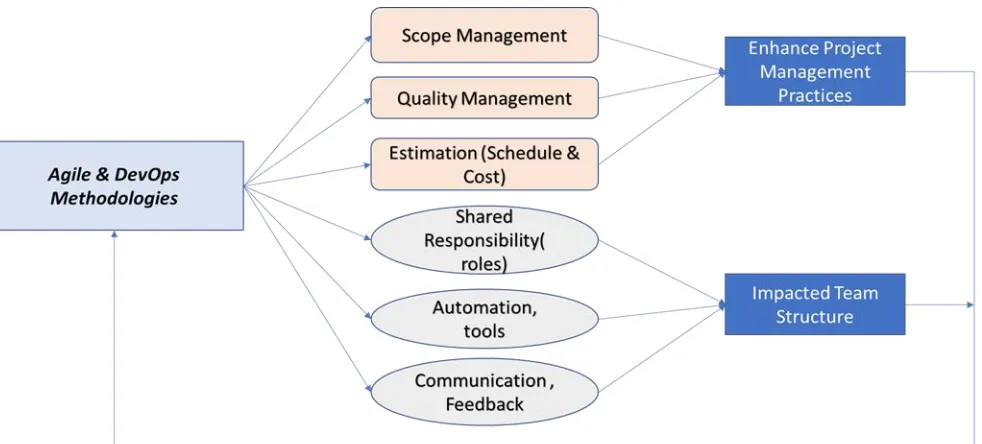
Figure 1: The conceptual framework for the impact of Agile, DevOps methodologies on Project Management Practices and Team structure
In this section, a framework has been presented for studying the impact of Agile, DevOps methodologies on Project Management Practices and Team structure. Review of literature has helped in identifying the Key project management areas and team areas being impacted.
Prepositions:
The following are the prepositions that could be derived from above conceptual framework:
• P1: To identify the impact of Agile and DevOps methodologies in enhancing project management
• P2: To identify the impact of Agile and DevOps methodologies in organizing team structure
Thus, it is evident from the existing reviews, the Agile methodology provides impact on scope management, quality management and estimation management. Based on studies on shared team structure, collaborations, Agile and DevOps methodologies do impact on shared responsibility, automation and feedback which constitutes team structure but these are also done at case to case level. The limitations have already been discussed in earlier section. None of the studies specially from DevOps perspective have been done at holistic level to give complete view of impact on project management practices. Studies on evolution of hybrid model (A mix of Agile , DevOps and traditional project management ) or the changes in project management practices at organization level are missing . Several studies have been conducted regarding the implementation of Agile in software development practices and at the same time, there were no researches particularly focused on the impact of Agile and DevOps methodologies (in combined manner) on multiple project management areas and team structure. Therefore, this research tries to bridge the gap
between these researches by reviewing about the how Agile and DevOps create impact on the project management practices and team structure.
7. CONCLUSION, RECOMMENDATIONS AND
FUTURE WORK
The present study has illustrated about the impact of Agile and DevOps methodologies on Project Management Practices and Team structure. Although the literature survey is not exhaustive but it provides broad overview about studies done on the impact created by Agile and DevOps and its comparison with the existing project management practices and team structure. Hence this research provides new insights for the future researchers to understand the Agile and DevOps and how it significant impacts on the industry. This research has both theoretical as well as practical implications. The theoretical implications of this research from the detailed review of existing study indicates that, in future the present research can be extended by hypothesized and tested empirically by collecting and analyzing the primary data through quantitative research. The practical implications of this research indicate that, software sectors can implement Agile and DevOps methodologies for their software development process which can enhances their project management practices and also organizes team structure. The following are the recommendations for sectors that wish to implement Agile and DevOps methodologies for their software development process:
from the existing project management practices
• Agile and DevOps practices are more aligned to the requirements of clients and perceived to be beneficial as it can improve the software development process by earlier fault deduction, increased communication, time and cost consumption and improved quality.
• Agile and DevOps helps in providing faster and updated information for the project team to manage and teams are more self-managed. Thus, have impact of how the teams are organized and skilled.
• During implemention the challenges related to team and management approach should be addressed for making the implementation succesful.
This paper by reviewing existing researches finds that that, by adopting the Agile and DevOps methodologies will have an impact on the project management practices and team structure.In future, the work can be extended by conducting the experimental study in the proposed area and it can be achieved by conducting the quantitative research through hypothesizing and testing it by collecting the primary data.
REFERENCES
[1] Ahmed, A., Ahmad, S., Ehsan, N., Mirza, E., and Sarwar, S. Z. (2010). "Agile software development: Impact on productivity and quality," 2010 IEEE International Conference on Management of Innovation & Technology, Singapore, 2010, pp. 287-291
[2] Ahmed, F. and Capretz, L.(2011). ‘An architecture process maturity model of software product line engineering’, Innov. Syst. Softw. Eng., vol. 7, no. 3, pp. 191–207, Sept, 2011.
[3] Ågerfalk, P. J., Fitzgerald, B., & Slaughter, S. A. (2009). Introduction to the special issue: Flexible and distributed information systems development: State of the art and research challenges. Information Systems Research, 20(3), 317–328.
[4] Aguanno, K. (2004). Managing agile projects. Lakefield, Canada: Multi–Media Publications Inc. [5] Andersen, E. S. (2016). Do project managers have
different perspectives on project management?. International Journal of Project Management, 34 (2016) 58–65, Canada.
[6] B. Fitzgerald B., K.J. Stol, R. O’Sullivan, and D. O’Brien, (2013) ‘Scaling agile methods to regulated environments: an industry case study’, in Proceedings of the International Conference on Software Engineering, pp. 863–872, 2013.
[7] Boehm, B. & Turner, R. (2003). Balancing Agility and Discipline: A Guide for the Perplexed. Addison-Wesley.
[8] Boehm, B. & Turner, R. (2005). Management challenges to implementing agile processes in traditional development organizations. IEEE Software, 22(5), 30–39.
[9] Brockmann, P.S., Thaumuller, T. (2009) Cultural Aspects of Global Requirements Engineering: An Empirical Chinese- German Case Study, 4-th IEEE International Conference on Global Software Engineering, pp. 353–357
[10] Briciu, C. V, Filip, I., & Indries, I. I. (2016). Methods for cost estimation in software project management. IOP
Conference Series: Materials Science and
Engineering, 106(1), 012008.
https://doi.org/10.1088/1757-899X/106/1/012008 [11] Chow, T., & Cao, D. (2008). ‘A survey study of critical
success factors in agile software projects’. Journal of Systems and Software, 81, 961-971.
[12] Cois, A,C., Yankel, J, and Connell, A. (2014). Modern DevOps: Optimizing software development through effective system interaction. IEEE 2014.
[13] Conforto, E. C. & Amaral, D. C. (2010). Evaluating an agile method for planning and controlling innovative projects. Project Management Journal, 41(2), 73 - 80. [14] Crowley, C., Veling, L., and Beckett, L., and Clarke,
G., and Kelleher, E., and McHale, J., and McQuillan, L., and Percival, S., (2018) A DevOps Capability - The IVI DevOps Effectiveness Assessment. White Paper. Innovation Value Institute.
[15] Dalcher, D. & Benediktsson, O. (2006). Managing software development project size: Overcoming the effort–boxing constraint. Project Management Journal, 37(2), 51–58.
[16] DeCarlo, D. (2004). eXtreme Project Management. San Francisco: Jossey–Bass.
[17] Dingsoyr, T., & Moe, N. B. (2013). Research challenges in large-scale agile software development. Paper presented at the ACM SIGSOFT Software Engineering Notes.
[18] Erich, F., Amrit, C., Daneva, M., (2014). Report: DevOps Literature Review
[19] Fogelstrom, N. D., Gorschek, T., Svahnberg, M. & Olsson, P. (2010). The impact of agile principles on market–driven software product development. Journal of Software Maintenance and Evolution Research and Practice 22(1):53-80
[20] Forsyth, D.R., (2018) Group dynamics. 2018: Cengage Learning.
[21] Freudenberg, S., & Sharp, H. (2010). The top 10 burning research questions from practitioners. Software, IEEE, 27(5), 8–9.
[22] Gandomani, T. J., Zulzalil, H., Ghani, A.A., Sultan, A.B., & Nafchi, M.Z. (2013). Obstacles in Moving to Agile Software Development methods; at a Glance. Journal of Computer Science, volume 9, Issue 5, pp. 620-625.
[23] Gee, D. (2016). Agile and DevOps shaking up Management. CIO Retrived on October 6, 2016 , from http://www.cio.com.au/article/599283/why-agile-devops-shaking-up-management
[24] Gundelsby, J.H. (2018) Enabling autonomous teams in large-scale agile through architectural principles. in Proceedings of the Scientific Workshops of XP2018. 2018. Porto, Portugal: ACM.
[25] Haider, A., (2007) Impact of agile methodologies on cost estimation techniques in software industry of Pakistan, Industrial engineering & management, 6(3), pp. 1-9.
[26] Herpen D. V. (2015) ‘DevOps - in 3 minutes’, Van Haren Publishing [online], 30 Nov, 2015.
https://www.vanharen.net/blog/it-management/devops-in-3-minutes/ (Accessed 18 March 2019)
1033
[28] Highsmith, J. (2010) Agile project management. Boston, MA 02116, U.S.A.: Pearson Education, Inc., 2010.
[29] Highsmith, J. and Cockburn, A. (2001) ‘Agile software development: the business of innovation’, Computer, vol. 2001, Sept, 2001.
[30] Hoda, R. and Noble, J. (2017) Becoming Agile: A Grounded Theory of Agile Transitions in Practice. in 2017 IEEE/ACM 39th International Conference on Software Engineering (ICSE). 2017.
[31] Hass, K. (2007) The Blending of Traditional and Agile Project Management, PM World Today, volume IX,
Issue V, retrieved from
http://cs.anu.edu.au/courses/COMP3120/local_docs/r
eadings/the-blending-oftraditional-and-agile-projectmanagement, 2007.
[32] Jones, C. (2010). Software Project Management Practices: Failure Versus Success. CrossTalk: The Journal of Defense Software Engineering, 5–9. [33] Karvonen T., Behutiye W. Oivo M., Kuvaja
P.(2017).Systematic literature review on the impacts of agile release engineering practices. Information and Software Technology 2017 vol: 86 pp: 87-100 [34] Kim, G., Humble, J., Debois, P., and J. Willis, J. (2016)
The DEVOPS handbook - how to create world-class agility, reliability, and security in technology organizations, 1st ed. 25 NW 23rd Pl, Suite 6314, Portland, OR 97210: IT Revolution Press, LLC, 2016. [35] Kettunen, P. (2007). Extending software project agility with new product development enterprise agility. Software Process: Improvement and Practice, 12(6), 541–548.
[36] Kettunen, P. (2009). Adopting key lessons from agile manufacturing to agile software product development: A comparative study. Technovation, 29(6/7), 408. [37] Langfred, C.W. (2000) Work-Group Design and
Autonomy: A Field Study of the Interaction Between Task Interdependence and Group Autonomy. Small Group Research, 2000. 31(1): p. 54-70.
[38] Lehman, T.J. and Sharma, A. (2011). ‘Software Development as a service: Agile Experiences’, in annual SRII Global Conference, pp. 749 – 758 [39] Leffingwell, D. (2007). Scaling software agility: Best
practices for large enterprises. Boston, MA: Addison– Wesley, Pearson Education Inc.
[40] Lindsjorn, Y. and R. Moustafa, R. (2018) Challenges with lack of trust in agile projects with autonomous teams and fixed-priced contracts. in Proceedings of the Scientific Workshops of XP2018. 2018. Porto, Portugal: ACM.
[41] Luo, H., Liu, R., & Wang, Y. (2015, 04). DEA Model for Effectiveness Evaluation of Risk Assessment Methods. 2015 2nd International Conference on Information Science and Control Engineering.
[42] Lwakatare, L.E. (2017). DevOps adoption and implementation in software development practice : concept, practices, benefits and challenges
[43] Mahanti, A. (2006). Challenges in enterprise adoption of agile methods— A survey. Journal of Computing
and Information Technology, 14(3), 197–206.
[44] Manifesto for Agile Software Development (2001). http://www.agilemanifesto.org (31/03/2010)
[45] Mishra, A., Dubey D. (2013). A Comparative Study of Different Software Development Life Cycle Models in Different Scenarios, International Journal of Advance Research in Computer Science and Management, volume 1, Issue 5, 2013, pp.64-69
[46] Menzel, G., and Macaulay, A. (2015). DevOps – The Future of Application Lifecycle Automation.
https://www.de.capgemini.com/resourcefile- access/resource/pdf/devops_pov_2015-12-18_final_3.pdf 2015.
[47] Nazir, K.A., Zafar, I., and Abbas, M.(2017). The impact of agile methodology (DSDM) on software project management. International conference on engineering, computing & information technology, pp 1-6.
[48] Penners R. and Dyck A. (2015), Release Engineering vs. DevOps-An Approach to Define Both Terms.
Full-scale Software Engineering, 2015.
https://www2.swc.rwthaachen.de/docs/teaching/semin ar2015/FsSE2015papers.pdf#page=53
[49] PMI, 2014. A Guide to the Project Management Body of Knowledge (PMBOK® Guide). Fifth ed. Project Management Institute, Newton Square, PA
[50] Rakitin, S. (2001). Manifesto elicits cynicism. Computer, 34(12), 4.
[51] Rasnacis, A. and Berzisa, S. (2017): Method for Adaptation and Implementation of Agile Project Management Methodology, Procedia Computer Science 104 ( 2017 ) 43 – 50
[52] Riungu-Kalliosaari L., Mäkinen S., Lwakatare L.E., Tiihonen J., Männistö T. (2016) DevOps Adoption Benefits and Challenges in Practice: A Case Study. Product-Focused Software Process Improvement. PROFES 2016. November 22-24, 2016, LNCS 10027, pp. 590- 597. Springer, 2016
[53] Shenhar, A. J. & Dvir, D. (2007). Reinventing project management: The diamond approach to successful growth and innovation. Boston, MA: Harvard Business Press.
[54] Smeds, J., K. Nybom, K. and Porres, I. (2015) ‘DevOps: a definition and perceived adoption impediments’, In Agile processes in software engineering and extreme programming, Springer, pp. 166–177, 2015.
[55] Vinekar, V., Slinkman, C.W., & Nerur, S.P. (2006). Can Agile and Traditional Systems Development Approaches Coexist? An Ambidextrous View. IS Management, 23, 31-42.
[56] Virine, L. (2008). Adaptive Project Management. PM World Today – May 2008, 10(5).
[57] Williams, T. (2005). Assessing and moving on from the dominant project management discourse in the light of project overruns. IEEE Transactions on Engineering Management, 52(4), 497–508.