2630
An Enhancement Of Cluster Wrapper In Grid
Computing Environment To Support Internet Of
Things (Iot)
S.Bhuvaneswari, V.Deepa, V.Nisha Devi, A.Indhuja
Abstract: The term Internet of Things (IoT) includes everything associated with the internet; however, it is progressively being utiliz ed to characterize objects that discuss one another. It is possible to accumulate data, evaluate it to build an achievement to support a precise task. To gain process, IoT allows devices on private internetto communicate with each other. By joining these integrated devices with computerized frameworks, IoT brings those networks together. An argument has arisen because something that can be associated with the internet doesn't mean it should be. However, every device gathers information for a particular reason that might be helpful to a client and affect the more extensive economy. A n Operating System (OS) intended for IoTs devices based on their structural design, scheduling techniques, networking methods, programming methods, control and memory control process together with different functions which essential for real-time IoTs.
Index Terms: IoT, Operating System, Real-Time OS, Grid Computing, Memory Mapping, IPC.
—————————— ——————————
1.
INTRODUCTION
IN every part of our lives, the Internet has changed practically: how we think, teach, and engage ourselves for IoT. IoT will associate a more device and influence our life more than some other part of the previous digital generation. IoT signifies mobile advancement and embedded frameworks. Such a development will make the smart world for individuals since the objects have better information on preferences, necessities, and requirements. Each IoT device should have a physical layer, device interface, and Internet Protocol (IP) [1. When these devices are resource sharing to the cloud for analyzing and transform our business lives in countless ways — Iot involved in raising an economy. Since the IoT has grown enormously when started in the 1990s exists more in the future. It will fix the WWW today with the devices supporting ranging from smart phones, ATMs, products ,and shipping industries [2].. The veracity of IoT guaranteed by a device associated should have an opportunity to communicate with the world. For this reason, wireless technology is the principal decision. The primary job of the framework is hiding the device details lightly. Linux and Berkeley Software Distribution (BSD) is an example of an Old-versioned OS [3]. OSs for small devices should give administrations, for instance, the organization resources while the processor has perfect scheduling policies. The objectives accomplished by an IoT incorporates by OS by performing various multitasking, protection, and communication.
At present, IoT is perplexed because of operability absence between the many inconsistent results [4For the IoTs and its OS, some significant arrangements required. In contrast to personal PCs, the IoTs requests many nodes. These nodes linked with gateways. Besides, devices connected with a remote cloud platform. The sensor node Functions [5]
f x
( )
, structure factors, and their target applications fluctuate impressively and create a context for the appropriateness of a particular OS for IoTs executions. In this way, fundamentals for the IoTs OS has less memory management, real-time, energy competence, hardware functionality, etc2
LITERATURE
SURVEY
2.1 Motivation of OS
The IoT results in elaborates chiming and framework development for the adequate OS requirement. A device associated should have the decision to communicate with the rest of the world. The first option for IoT guaranteed veracity iswireless technology. The principal system work is to hide minor device details. Old-versioned OSs is limited, for example, Linux and BSD. OS for small devices should give administrations for the external managing resources while the inter-processor should also have available development procedures [6].
2.2 Contributions of IoT
This examination tends to the IoTs imperatives in terms of its OS regarding its hardware platform, design option, networking, and communication methods.
It presents gathered data about the solutions for IoTs applications, seeing how innovations utilized in the IoTs for created OS.
It gives an outline of IoTs correspondence and networking technologies.
2.3 Communication Mapping
With regards to its hardware support, this review on IoT OS communication, networking systems innovations and applications unique in concerning earlier research study that broadly embedded the OS area for IoT. The broad writing of ————————————————
S.Bhuvaneswari is currently working as an Assistant Professor in Computer Science and Engineering at Easwari Engineering College.Chennai, India,, E-mail: [email protected]
V.Deepa is currently working as an Assistant Professor in Computer Science and Engineering at Mahendra College of Engineering Salem, India, E-mail: [email protected]
V.NishaDevi is currently working as an Assistant Professor in Computer Science and Engineering at Mahendra College of Engineering Salem, India, E-mail: nishadeviit @gmail.com
2631 previous studies prior attention on OS for IoTs low-end
devices. Research surveys disagree about OS with its features. As far as we could know, there is no earlier exact review that extensively covers the discussion of OS with regards to its real-time [7] process and communication systems. There is an extensive investigation study on OS for IoT. The multiple characteristics of OS organize into different categories.
Step 1:The key attributes are that the design part should be either monolithic, micro-kernel.
Step 2: The rule for mainframe OS. Step 3: The PRG model is multi-threaded.
Additionally, PRG decides the PRG language for the OS. Furthermore, Re-PRG devices are significant devices located far-away. Data goes through every framework using a node-by-node; these nodes typically low power devices. SMG (Shared Memory Grids) [8] presents Open MP perfect DSM framework utilization for inter-process communication library, which executes in the different grid atmosphere. Due to the use of the MPI library, this DSM framework not much useful when compared to DSM kernel-level implementation. These multithreaded applications don't support the usage of MPI [9] [10].SMG application environment runs with low precedence in the Grid system. Utilization and installation in SMG are simple. This model structures for a homogeneous LAN atmosphere in Grid Computing (GC) [11] [12].Moreover, GC doesn't support various WAN conditions. This system ran on the Linux OS and described in Table 1.
TABLE 1. LINUX PLATFORM
SuportTool GC DissimilarOS MPI DSM MPICH-G2 Disagree Agree Disagree Disagree
VMRC Disagree Agree Disagree Disagree Dual Boot
Oscar
Disagree Agree Disagree Disagree
WWM &LWM Agree Disagree Agree Agree
3 THE
PROPOSED
CGUW
A CGUW (Cluster Grids Universal Wrapper) [13]system proposed for effective communication between processes that run on distributed HPC such as GC conditions that contain Windows/Linux OS. In an HGE, the distributed shared memory mechanism implemented — researcher structures PRG with CGUW library and Re-PRG model. We use DSM to give easy-to-use programming (PRG) atmosphere so commonly acknowledged between numerous technologies in GC.A procedure that runs on Linux and Windows can communicate. Also, it is simple for the use r to build up their application in the grid environment by utilizing CGUW. The distributed IPC method [14][15] is implemented to provide high-performance computing at the kernel level of Linux.
3.1PRIMITIVE MAPPING OF RPC
Remote Procedure Call (RPC) is a method for IPC and utilized by the PRG. On the Linux OS [16],we can't map Windows OS to shared memory. For assembling, RPC framework calls have
frequent shared memory system calls; however, the mapping is complicated that system calls approaches on one side don’t
have the same or more than one equivalent on another hand.
TABLE 2. RPC B FROM STRINGBINDING (SB)
f x
( )
The RPC B From SB
f x
( )
builds a server-binding handle given in Table 2.RPCBFree()f x
( )
used to release handle. To returns, a string-restricting handle RPCB To SB ()f x
( )
is used. PCSB Compose()f x
( )
consolidates binding handle components into the string, and RPCB Import Nex()f x
( )
returns a binding handle. Shared memory main
( )
f x
operation on Unix System OS has appeared in Table 3.TABLE 3.MUTUAL MEMORY ORGANIZATION IN LINUX
ShmGet Generates New Shared Memory ShmAT Attaches segment to VM of related process ShmDT Shared memory segment detached ShmCTL Deletes Shared memory
The shmGET
f x
( )
makes or opens the shared memory segment, shmATf x
( )
joins segment to process address space, shm DTf x
( )
segregates segment from the process, and shm CTLf x
( )
erases segment given in Table 3. In Table 4,the mainf x
( )
of the shared memory process on Windows OS revealed.TABLE 4.MUTUAL MEMORY ORGANIZATIONIN WINDOWS
Handling
f x
( )
f x
( )
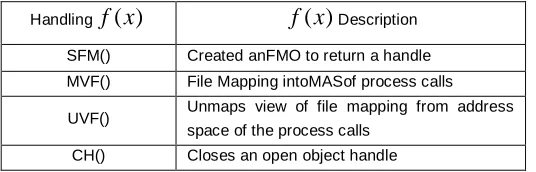
Description SFM() Created anFMO to return a handle MVF() File Mapping intoMASof process calls UVF() Unmaps view of file mapping from addressspace of the process calls CH() Closes an open object handle
In Table 4,Set File Mapping (SFM)
f x
( )
Creates /Opens FMO, MapView o fFile(MVF)f x
( )
used to Map view of a file into task Memory Address Space (MAS), To un map an illustration of a file Unmap View of File(UMF)f x
( )
used. To closes an object handle, Close Handle(CH)f x
( )
used.Handling
f x
( )
f x
( )
ExplanationRPCB inding (RPC B) From SB
Gets string and proceeds server -data binding
RPC BFree By using server -data binding for memory release
2632 3.2 CGUW Structure
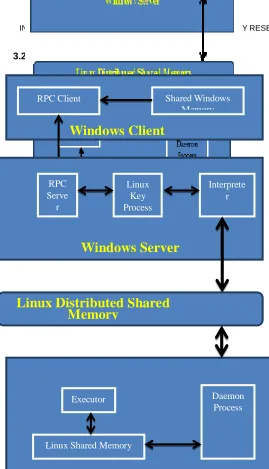
Figure 1.Proposed Operating System Architecture of CGUW
The two principle modules in the Wrapper structure are Microsoft Converter and Executor. The Migration module takes RPC from the RPC server then changes to shared memory. To execute the Windows Client(WC)application, the executor mode runs on the Linux kernel. WChas WS ID directorto discover client-server demand. Our wrapper mechanism described in Figure. 1. The WC, WS, and Linux DSM are the three sections of CGUW. In WC, a program distributed by the user utilized windows shared memory. On the other phase, the file-mapping object name to open doesn't exist; our wrapper gets a signal trap and sent to RPC client function. RPC is a model to support Windows communication. In a grid environment ,RPC sets up a link established between WC and possible WS by Server unique ID administrator and sends the name of file mapping requested by DP in WC to WS. RPC Server sends object name to process with Linux Key in WS, and this procedure finds appropriate Linux to DSM communication. The Migration Module accepts the RPC server framework calls, and converts to proportional System shared
address memory system calls. In Linux DSM, the Daemon Process (DP) is executing and process holding for a connection from WS. DP calls proper File Mapping Object (FMO) when the link is built up. The executor is running the user program at Kernel level professionally. The DP can run on Windows / Linux communication with DSM in a GC.
3.3 The Algorithm Described For Server And Client In
Pseudocode Below
SEVER: Dynamic Data Decomposition, Static Data Distribution Input :Data
Generate :Data Set Initialize Client
For Each Client
Send one Dataset to Client End For
While not all results received for existing Client Accept msg from Client
IF msg is REQ
Send one Dataset to Client Else If msg is outcome
Route result IF required
Create freshClient End If
End If End While For Each client
Send STOP msg to Client End If
Collect final Output
CLIENT: Static Data decomposition, Static Data Distribution Repeat
Direct request for Client to Server Accept msg from master
If msg is Client
Complete Client Direct Output to Server End If
Until msg is stop
4
RESULT
AND
DISCUSSION
To build Grid program execution regarding an HGE. Our proposed Wrapper utilizes RPC and DSM. DSM shares keys Windows Client
RPC Client Shared Windows
Memory
Windows Server
RPCServe r
Linux Key Process
Interprete r
Linux Distributed Shared
Memory
Executor
Linux Shared Memory
2633 and processes when initializing for performance. We need
servers for the secured key by OSs. These Servers have memory addresses of one another. Centralize mechanism used in this approach. Consequently, it loses its program efficiency when scalability occurred. Servers with a list of DSM keys are restricted access for support openness in our proposed framework. Projects in computing have these properties refer to table 1 and table 2:
(1) The abstract system of PRG DP (2) The program resource method for DP.
(3) Present efficient function set up for the communication process in GC.
By utilizing the Linux server and Windows, programs use features and resources of the wrapper in GC. DP runs on HGE and supporting different functions.
TABLE 1. TIME INTERVAL OF INITIALIZATIONS RPC
Server Config
RPC Setup
(sec)
HostConnectionName (sec)
EchoReply (sec)
g-hosts( ) 1.30 0.013 0.0011
g-mxio-hosts( )
1.25 0.071 0.0016
ssh-hosts ( ) 0.37 0.008 0.0011
ssh-mxio-hosts( )
0.42 0.217 0.1113
rsh-hosts( ) 0.07 0.012 0.0013
TABLE 2. KNAPSACK PROBLEM WITH
EXECUTION TIME
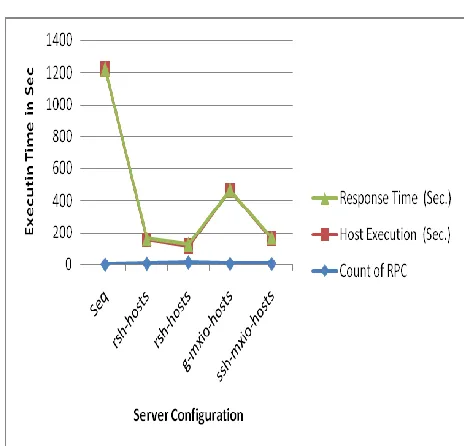
Server Config Count ofRPC Host Execution (Sec)
Response Time (Sec)
Seq ( ) 2 1220.12 1.10
rsh-hosts( ) 7 145.89 6.91
rsh-hosts( ) 15 98.19 11.88
g-mxio-hosts( ) 7 455.19 2.98
ssh-mxio-hosts( )
6 156.91 6.11
Figure 2.Performance analysis of RPC
Figure 3. Performance analysis of Knapsack Problem
We utilized Kernel level investigations for higher performance as a replacement for user-level and referred to in Figures 2 and 3; we use DSM and wrapper. The wrapper creates a message between closed/open OS in GC that supported PRG on heterogeneous distributed frameworks. DSM makes inter-process communication transparent to end-clients intheresult; we chose DSM as a reasonable communication method. Our method comprises of RPC for generating programs on Windows and DSM for programming in Linux. RPC calls from WC to the server are changed over into equal DSM calls for the Linux server by utilizing a function mapping table.
5
CONCLUSION
AND
FUTURE
WORK
2634 avoid system failure, to deal with the framework, and to
provide security for communication. We concluded, there are different zones for the use of IoT, and OS proposed. In any case, they should choose by the particular application prerequisites. The wrapper is establishing a link for the closed/open-source OS in GC that supports PRG on distributed heterogeneous systems.In our future works, we planned to utilize our methodologies on the IoT. Android OS hasless speed and memory than Linux servers for program execution.
REFERENCES
[1] L. Alawneh, A. Hamou-Lhadj, J. Hassine, "Segmenting large traces of inter-process communication with a focus on high performance computing systems," Systems and Software, 2016
[2] A. Hammar, Analysis and Design of High-Performance Inter-core Process Communication for Linux, Uppsala University, 2014
[3] E. MousaviKhaneghah, N. OsouliNezhad, S. LeiliMirtaheri, M. Sharifi and A. Shirpour, "An Efficient Live Process Migration Approach for High-Performance Cluster Computing," International Conference on Innovative Computing Technology, 2011
[4] S. L. Mirtaheri, E. MousaviKhaneghah, M. Sharifi, "A Case for Kernel Level Implementation of Inter-Process Communication Mechanisms," Information and Communication Technologies: From Theory to Applications, 2008.
[5] M. Sharifi, E. MousaviKhaneghah, M. Kashyian, S. L. Mirtaheri, "A platform-independent distributed IPC mechanism in support of programming heterogeneous distributed systems," J Supercomput, 2012.
[6] D. Sankar Banerjee, K. Hamidouche, D. K. Panda, "Designing High-performance Communication Runtime for GPU Managed Memory: Early Experiences," General Purpose Processing using Graphics Processing Unit Processing using Graphics Processing Unit, 2016
[7] S. Shah, S. Mahajan, "Resource Optimization in a LAN Environment Using SMIG-Shared Memory Integrated with Grid," International Conference and Workshop on Emerging Trends in Technology, 2011
[8] V. Chaudhary, H. Jiang, "Techniques for migrating computations on the grid," Communications of the ACM, 2006.
[9] W. Hu, W. Shi, Z. Tang, "JIAJIA: A Software DSM System Based on anew Cache Coherence Protocol," in HPCN Europe ’99: Proceedings of the 7th International Conference on High-Performance Computing and Networking, 1999.61
[10] S.Sudhakar, N.Satheesh, S.Balu, AmireddySrinish Reddy, G.Murugan, Optimizing Joins in a Map-Reduce for Data Storage and Retrieval Performance Analysis of Query Processing in HDFS for Big Data, International Journal of Advanced Trends in Computer Science and Engineering, 8(5), 2062-2067, 2019.
[11] L. Li, X. Hu, K. Chen, and K. He, ―The applications of Wi-Fi-based Wireless Sensor Network in the Internet of Things and Smart Grid, ―Proceedings of the 2011 6th IEEE Conference on Industrial Electronics and Applications, ICIEA 2011, pp. 789–793, 2011.
[12] R. Oliver, C. Science, and U. Kingdom, ―Reprogramming Embedded Systems at Run-Time,‖ pp. 2–4, 2014
[13] A. M. R. V. A. Phani, D. J. Kumar, and G. A. Kumar, ―Operating systems for wireless sensor networks: A survey technical report,‖ pp.1–30, 2007
[14] L. Coetzee and J. Eksteen, ―The Internet of Things - a promise for the future? An introduction,‖ IST-Africa Conference Proceedings, 2011, pp.1–9, 2011
[15] Y. Liu and G. Zhou, ―Key Technologies and Applications of Internet of Things,‖ 2012 Fifth International Conference on Intelligent Computation Technology and Automation, pp. 197–200, 2012.