© Universiti Tun Hussein Onn Malaysia Publisher’s Office
IJIE
Journal homepage: http://penerbit.uthm.edu.my/ojs/index.php/ijie
ISSN : 2229-838X e-ISSN : 2600-7916
The International
Journal of
Integrated
Engineering
Finite Elements Method Simulation of P(VDF-TrFE)
Piezoelectric Sensor for Internet of Things Application
Khoon-Keat Chow
1,2*, Ali Mohammed Abdal-Kadhim
1, Swee Leong Kok
1,
Kok-Tee Lau
3,1Advanced Sensors and Embedded Control System Research Group,
Center for Telecommunication Research & Innovation,
Fakulti Kejuruteraan Elektronik dan Komputer, Universiti Teknikal Malaysia Melaka, Hang Tuah Jaya, 76100 Durian Tunggal, Melaka, MALAYSIA
2Electrical Technology Program, Unit for Research, Innovation and Commercialization,
Kolej Komuniti Sungai Siput
Kampung Sungai Sejuk, Postbox 390, 31100 Sungai Siput (U), Perak, MALAYSIA
3Carbon Research Technology Research Group, Advance Manufacturing Center,
Fakulti Teknologi Kejuruteraan Mekanikal dan Pembuatan, Universiti Teknikal Malaysia Melaka, Hang Tuah Jaya, 76100 Durian Tunggal, Melaka, MALAYSIA
*Corresponding Author
DOI: https://doi.org/10.30880/ijie. 2019.11.01.010
Received 14 May 2018; Accepted 08 August 2018; Available online 30 April 2019
1.
Introduction
Nowadays, Internet of things, (IoT) paradigm is spreading rapidly across different applications such as for consumer, smart home, enterprise, infrastructure, manufacturing and etc. IoT is a technology employing the self- organized interconnectivity of physical objects, enabling the objects to connect and exchange data with minimum human intervention. Thus, the technology requires the usage of low-cost and efficient sensors and actuator for connectivity function. Furthermore, some applications even require the devices to be wearable and safe. For example,
Abstract: This paper presents finite element method (FEM) simulation using P(VDF-TrFE) as piezoelectric
material for Internet of things application. The simulation was conducted using COMSOL Multiphyisc 5.1 to study the resonance frequency, stress, displacement and load dependence for the P(VDF-TrFE) piezoelectric as a batteryless sensor whenever there is mechanical vibration present on the piezoelectric material. The simulation results obtained with maximum displacement and stress are 0.3 mm and 1.01×10⁷ N/m2 at resonant frequency of 131 Hz. Electrical properties with maximum voltage of 24.2 mV power output of 3.2 nW was obtained at 18 6 kΩ under the acceleration of 1 g at resonant frequency. The optimized design of P(VDF-TrFE) piezoelectric sensor was applied in the step monitoring application via internet of things (IoT) system.
many studies on wearable device sensors for patients in rehabilitation and other medical purposes have been reported [1–4].
Consumer industry in which safety and environmental consciousness are a top priority, the sensor devices need to be safe and environmental friendly during and after disposal. For example, e-commerce retailer Amazon launched dash button based on IoT system to support their goods such as detergent, toilet papers, and carbonated drinks where the consumers can place order by pressing the brand button wireless connected over the internet [5]. Chuang et al., demonstrated i-Logistic system at the cargo management to support the transportation process based on IoT by using the piezoelectric PVDF force sensor [6-7]. Polymeric poly(vinylidene fluoride) trifluoroethylene P(VDF-TrFE) is a piezoelectric polymer which potential replaces lead zirconate titanite (PZT) as sensor materials because the PVDF has a high piezoelectric performance, superior mechanical flexibility, lower fabrication cost and nontoxicity as compared to PZT [8-10].
There are several challenges of fabrication of a high performance flexible substrate-supported P(VDF-TrFE)-based sensor, fabricated using low cost process. One of them are optimization of materials and fabrication process parameters. Using the finite element approach, a parametric analysis can be conducted to predict and analyze piezoelectric performance of the composite structure.
In this research paper, we aim to validate the piezoelectric PVDF sensors by using batteryless concept to be applied in the IoT application for steps monitoring system. This study presents the finite element method simulation for P(VDF-TrFE) piezoelectric sensor as a self-powering sensor and evaluation of the IoT application of step monitoring for P(VDFD-TrFE) sensor.
2.
Piezoelectric Theory (Direct Effect)
In 1880, the brothers of Pierre Curie and Jacques Curie are the first observed piezoelectricity effect from the quartz crystal where it is having ability to generate a voltage when a piezoelectric material is subjected of mechanical stress. The effect is called the direct piezoelectric effect. Indirect effect of piezoelectric when an external field applied on the piezoelectric material, the material gets extended from its initial condition [11-12].
The electrical piezoelectric charge density can be calculated by using the constitutive equations:-
D dT orTE
S sET dT E
(1)
(2)
where E is the electric field, T is the stress, S is the strain, and D is the electric displacement field. The other material parameters sE, d, and εrT correspond to the material compliance, coupling properties, and relative permittivity at constant stress. ε0 is the permittivity of free space [13]
2.1 Material of Interest
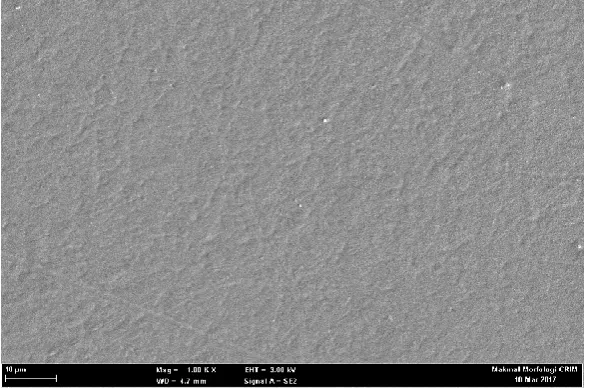
Synthesized P(VDF-TrFE) film’s surface morphology was observed using field emission scanning electron (FESEM) at accelerating voltage 3kV as shown in Fig 1. The microstructure of the P(VDF-TrFE) thick film shows an optimize crystalline structure where it is suitable for piezoelectric materials usage in energy harvesting sensor applications.
3.
Simulation using COMSOL 5.1
The finite element method (FEM) simulation of 2D model was conducted using COMSOL Multiphysics 5.1 to analyse electrical and mechanical properties. In this COMSOL 2D model was simulated by using structural mechanics and electrostatics interfaces. In order to obtain optimum piezoelectric sensor, the frequency domain interface was used to obtain the resonance frequency at difference length of piezoelectric sensor.
In the final work, frequency parameter analyses were performed of frequency dependence and load-frequency dependence for the piezoelectric sensor.
3.1 Design of P(VDF-TrFE) and domain setting
The fabricated P(VDF-TrFE) piezoelectric sensor were sandwiched of three layers on the PET (Melinex) substrate. The P(VDF-TrFE) is a piezoelectric active layer in between of top and bottom of polymer electrodes with the dimension as reported in the previous paper [14-15]. Fig 2 (a) shown the schematic diagram of P(VDF-TrFE) piezoelectric sensor structure whereas the piezoelectric sensor was designed using COMSOL as shown in Fig 2 (b). Table 1 shown the material properties and parameters were used in the FEM simulation.
Table 1 - Material properties for FEM simulation [16-19] Material parameter Values PET (substrate) Young’s Modulus (GPa) 4 Poisson ratio 0.3 Density
(kg/m3) 1250
Thickness (µm)
75
P(VDF-TrFE)
Elastic CE=
0
0 0 0.6901
stiffness 3.613 1.6135 1.4210 0 0
constant 0
(GPa) 1.4210 1.3106 1.6303 0 0
0 0 0 0
0 0.5900
0 0 0 0 0
Coupling
0 0 0
matrix, C/m2
e= 0 0 0 0 0.0159
0.0127 0
0.321 0.0040 0.0212 0 0
Poisson ratio
0.33
Density (kg/m3)
1790 Thickness (µm) 50 Electrode (Ag) Young’s Modulus (GPa) 76 Poisson ratio 0.37 Density (kg/m3)
3650
Thickness (µm)
(a)
(b)
Fig 2 - (a) P(VDF-TrFE) piezoelectric sensor design structure; (b) Schematic view of the model using COMSOL Multiphyics
3.2 Meshing
Fig 3 - 2D meshed geometry
The 2D model was meshed using quadrilateral geometry with 1050 fine elements and minimum meshing size of 0.012, as shown in Fig 3.
4.
Results and Discussion
The optimum resonance mode was shown in Fig 4 where the blue shaded area indicates of the minimum displacement of the piezoelectric device whereas the red shaded area shows maximum displacement is generated of the piezoelectric when the fixed end of the device has been set up.
In the mechanical properties, the maximum displacement was 0.3mm and the maximum von Mises stress generated about 1.01×10⁷ N/m2 at the resonance frequency of 131 Hz which its shown in the Fig 4. Then, frequency
domain analysis was able to generate voltage output about 20.2mV at 131Hz as shown in Fig 5.
Fig 5 - Electrical properties: Voltage output at resonance frequency
Fig 6 - Electrical properties : voltage and power output with respect to load resistance
In Fig 6 shown the peak in power generated from the sensor with electrical load resistance of 18kΩ at an acceleration of 1 g oscillating at 131Hz is about 3.2 nW.
4.1. IoT Application
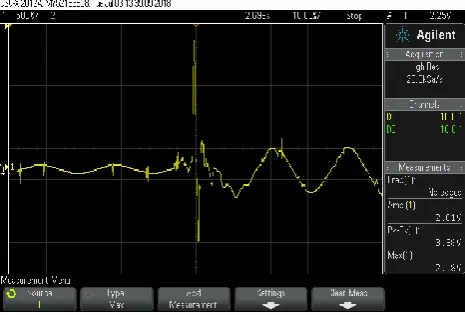
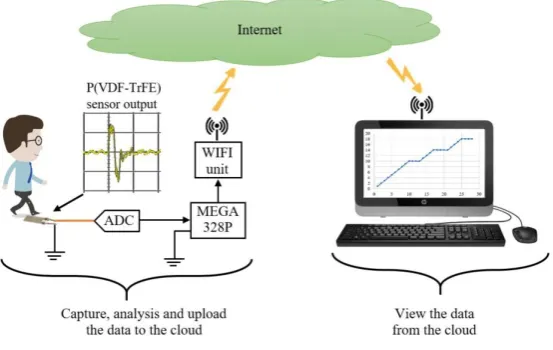
Nowadays, IoT applications are widely used with battery-less piezoelectric sensor materials such as zirconate titanate (PZT), poly (vinylidene fluoride) trifluoroethylene P(VDF-TrFE) and zink oxide ZnO [20]. Therefore, an IoT based step monitoring system was developed to illustrate the functionality of the proposed sensor. An 8-bit MEGA328P MCU with a wifi module used to read the signal from the attached sensor and upload it in to the cloud whenever someone step on the device. The single step of output voltage peak-to-peak about 3.38V was captured using digital oscilloscope act as sensor signals as shown in Fig 7. Since the sensor produces an AC form of signals, therefore its attached to the ADC channel of the mentioned MCU. An algorithm developed to continually check the ADC channel for an incoming signal and digitize it. The step detection is based on a preset threshold inside the algorithm. The system sensitivity will be varied in according to the threshold value. After that it will upload the step counting number to the system database. Once the database got an update from the system, it will automatically notify the end user of a human present with an alarm. Moreover, it will display a history graph of all the step activities as shown in the Fig 8 for system prototype setup.
5.
Conclusion
Fig 8 - P(VDF-TrFE) Piezoelectric sensor in IoT application
The finite element simulation of P (VDF-TrFE) piezoelectric sensor is successfully performed and applied in IoT application as shown in the step monitoring system application. The proposed sensor is able to be operated at low frequency (Hz range) 1 g. The simulation results show maximum displacement and stress was obtained 0.3 mm and 1.01×10⁷ N/m2 at resonant frequency of 131 Hz. Based from the sensor, maximum voltage of 24.2 mV power output of
3.2 nW was obtained at 18 6 kΩ under the acceleration of 1 g at resonant frequency of 131 Hz.
Acknowledgement
The authors would like to express sincere appreciation to the Ministry of Higher Education of Malaysia for the scholarship and research grant of PRGS/1/2016/TK10/FKEKK-CETRI/02/T00016 and UTeM-Industry Matching GLUAR/IMPRESSIVE/2017/FKEKK-CETRI/I00024 and also the support facility provided by Advanced Sensors and Embedded Control Systems Research Group (ASECs), UTeM.
References
[1] Patel Shyamal, Park Hyung, Bonato Paolo, et al., A review of wearable sensors and systems with application in rehabilitation, Journal of NeuroEngineering and Rehabilitation, (2012), Vol 9.(1).21.
[2] Lee, M.; Lee, M.R. Beyond the Wearable Hype. IT Prof. (2015), 17, 59–61.
[3] Pustiek, M.; Beristain, A.; Kos, A. Challenges inWearable Devices Based PervasiveWellbeing Monitoring, In Proceedings of the 2015 International Conference on Identification, Information, and Knowledge in the Internet of Things (IIKI), Beijing, China, 22–23 October 2015; pp. 236–243.
[4] Luana Persano et al, High performance piezoelectric devices based on aligned arrays of nanofibers of poly (vinylidenefluoride-co-trifluoroethylene) Nature Communications volume 4, (2013), Article number: 1633. [5] Torsten J Gerpott Sebastian May , Integration of Internet of Things components into a firm’s offering portfolio – a
[6] C. H. Chuang, D. H. Lee, W. J. Chang, W. C. Weng, M. O. Shaikh and C. L. Huang. Real-Time Monitoring via Patch-Type Piezoelectric Force Sensors for Internet of Things Based Logistics. IEEE Sensors Journal, (2017) vol. 17, no. 8, pp.2498-2506.
[7] Jian-Ping Su, Cheng-An Wang, Yu-Ching Mo, Yu-Xiang Zeng, Wan-Jung Chang, Liang-Bi Chen, Da-Huei Lee, Cheng-Hsin Chuang, i-Logistics: An intelligent Logistics system based on Internet of things, Proceedings of the 2017 IEEE International Conference on Applied System Innovation IEEE-ICASI 2017, (2017), pp.331-334. [8] Khaled S Ramadan et al, A review of piezoelectric polymers as functional materials for electromechanical
transducers, Smart Mater. Struct. 23(2014) 033001.
[9] Dragan Damjanovic, Naama Klein, Jin Li And Viktor Porokhonskyy, What Can Be Expected From Lead-Free Piezoelectric Materials? Functional Materials Letters Vol. 3, No. 1,(2010), pp 5–13.
[10] L. Capineri, L. Masotti, V. Ferrari, D. Marioli, A. Taroni, and M. Mazzoni, Comparisons between PZT and PVDF thick films technologies in the design of low-cost pyroelectric sensors, Review of Scientific Instruments 75,(2004), pp. 4906-4910.
[11] Mason WP, Piezoelectricity, its history and applications. The Journal of the Acoustical Society of America. (1981); 70(6), pp.1561–1566.
[12] Jacob Jaicy, More Namdev, Kalia, Kiran and Kapusetti, Govinda, Piezoelectric smart biomaterials for bone and cartilage tissue engineering, Inflammation and Regeneration,(2018).Vol38(2),pp.1-12.
[13] IEEE Standard on Piezoelectricity. 1987. ANSI/IEEE, Std. 176.
[14] Chow Khoon-Keat, Kok Swee-Leong, Lau Kok-Tee. Design and Characterization of Piezoelectric P (VDF-TrFE) Thick Film on Flexible Substrate for Energy Harvesting. Journal of Telecommunication, Electronic and Computer Engineering, Vol. (10)1, (2018), pp63-68.
[15] Chow Khoon-Keat, Kok Swee-Leong, Lau Kok-Tee. Flexible piezoelectric micro-power generator based on P(VDF-TrFE). Proceedings of Mechanical Engineering Research Day, (2016), pp. 98-99.
[16] Xiaoliang Chen, Hongmiao Tian, Xiangming Li, Jinyou Ding, Yucheng Shao, Ningli An, and Yaopei Zhou. A high performance P(VDF-TrFE) nanogenerator with self-connected and vertically integrated fibers by patterned EHD pulling,
[17] Nanoscale, (2015)7, pp.11536-11544.
[18] Wang, B., Chen, P., & Chen, R. Finite Element Model Verification for the Use of Piezoelectric Sensor in Structural Modal Analysis. Journal of Mechanics,(2006) 22(2), pp.107-114.
[19] Wang H, Zhang QM, Cross LE, Sykes AO. Piezoelectric, dielectric, and elastic properties of poly (vinylidene fluoride/trifluoroethylene). J Appl Phys (1993)74, pp3394–3398.
[20] Datasheet of Melinex 725 Available: http://usa.dupontteijinfilms.com/wpcontent/uploads/2017/01/725- Datasheet.pdf [26/04/2018].
![Table 1 - Material properties for FEM simulation [16-19] Material Values](https://thumb-us.123doks.com/thumbv2/123dok_us/8436523.1699689/3.595.179.410.253.769/table-material-properties-for-fem-simulation-material-values.webp)