A framework for usable end-user privacy control
in social software systems
Maryam Najafian Razavi
*, Denis Gillet
Ecole Polytechnique Fe´de´rale de Lausanne (EPFL), 1015 Lausanne, Switzerland
Abstract
Recent studies have shown that many users struggle to properly manage selective sharing of the diverse information artefacts they deposit in social software tools. Most tools define privacy based on the ‘network of friends’ model, in which all ‘friends’ are created equal and all relationships are reciprocal. This model fails to support the privacy expectations that non-technical users bring from their real-life experiences, such as enabling different degrees of intimacy within one’s network and providing flexible, natural means of managing the volatile social relationships that social software systems confront. Furthermore, the model suffers from lack of empirical grounding and systematic evaluation. This paper presents a framework for building privacy management mechanisms for social software systems that is intuitive and easy to use for the average, non-technical user population of these systems. The framework is based on a grounded theory study of users’ information sharing behaviour in a social software tool. Results inform the design of OpnTag, a social software prototype that facilitates personal and social information management and sharing. Preliminary empirical data suggest that our proposed privacy framework is flexible enough to meet users’ varying information sharing needs in different contexts while maintaining adequate support for usability.
Keywords: grounded theory, people tagging, privacy, social software, usability, Web 2.0 Received on 15 February 2011
CopyrightÓ2011 Razavi and Gillet, licensed to ICST. This is an open access article distributed under the terms of the Creative Commons Attribution licence (http://creativecommons.org/licences/by/3.0/), which permits unlimited use, distribution and reproduction in any medium so long as the original work is properly cited.
doi: 10.4108/trans.sesa.2011.e4
1. Introduction
Social software systems are a family of Web 2.0 appli-cations, characterised by their primarily user-driven con-tent and the ability to mediate personal and social informa-tion across collectivities such as teams, communities, and organisations. The advent of the ‘Social Web’ has made users producers as well as consumers of information, result-ing in publishresult-ing and distributresult-ing huge amounts of user-created data. Examples of social software systems include social authoring tools (e.g. wikis), social bookmarking tools (e.g. del.icio.us), and social networking tools (e.g. LinkedIn and Facebook). Users are widely adopting these tools for personal and social information management because they provide significant enhancements in utility and cost over similar desktop tools, in the sense that not only they allow their users to create personal information spaces that are easily accessible from anywhere on the Web, but also give them the tools to share their various
information artefacts with others and take advantage of others’ shared artefacts. These two advantages are in many cases so strong that users are either explicitly willing to give up control of that information or do so without any real awareness of the degree to which they are doing so. Recent research in the area of knowledge management (KM), how-ever, has recognised the need to improve people’s ability to control who sees what from the information they deposit in their online personal spaces (Erickson, 2006). Neverthe-less, the topic of personal privacy—how people manage pri-vacy of their own information with respect to other individuals (as opposed to organisational privacy (Iachello and Hong, 2007)—remains largely unexplored in the research literature.
Current state of the art with privacy management in social software is that most tools either define access con-trol as a private/public dichotomy, not accounting for the various other shades of privacy in between (e.g. del. icio.us), or they need users to self-administer fine-grained privacy control on their data through a privacy setting *Corresponding author. Email:[email protected]
page (e.g. Facebook), which is complicated and cumber-some for the average, non-technical users. These two approaches pretty much present the two ends of the spec-trum for privacy management in social software systems, with most tools falling somewhere in between. While mechanisms at one end of the spectrum do not provide sufficient control over privacy of one’s information, mechanisms at the other end are not usable enough for the average, non-technical user population of social soft-ware systems.
The purpose of this work is to present a usable frame-work for providing end-users with better control over selective sharing of information they deposit in a social software system. The objectives of the work fall into three general areas:
(i) Developing a better understanding of users’ per-spectives on personal privacy in social software domain, in terms of the extent of the problem, spe-cific privacy needs and concerns, and strategies that users employ in order to achieve their desired levels of personal privacy.
(ii) Identifying factors that impact users’ information sharing behaviour in this domain, in order to build a conceptual model of personal privacy that matches users’ mental models.
(iii) Devising guidelines for building privacy manage-ment mechanisms in this domain that satisfy users’ varying privacy needs, and yet, are usable for the average, non-technical user population of social software systems.
In order to meet these objectives, we first employed a grounded theory study to develop an understanding of the information sharing process in the context of social software systems. Based on the results of the study, we pro-pose a set of design heuristics for privacy management in social software, and consolidate those heuristics into a framework for privacy in this domain. Our proposed frame-work supports per-artefact privacy management as opposed to per-category privacy management supported by most other tools, and enables definition of social contacts of non-equal weights through creation of egocentric groups. In order to create a test bed where the suitability of the proposed principles can be tested, we next introduce OpnTag, a social tool we developed whose privacy man-agement mechanism instantiates the proposed frame-work, and present the results of an empirical evaluation that provide initial validation that the framework is flexi-ble enough to meet users’ varying privacy needs and indi-cate areas for future enhancements.
2. Related work
In recent years, use of social software has moved from niche phenomenon to mass adoption (Gross et al.,
2005;Millenet al., 2006). This increase in use has been accompanied by diversity of purposes and access patterns. As a result, researchers have studied several issues that pertain to these tools, including people’s attitudes towards disclosing personal data. Gross et al. (2005)
report on a study of patterns of information revelation in online social networks and their privacy implications. Their results are based on actual field data from more than 4000 users of Facebook. They report that patterns of information revelation depend on a number of factors, including pretence of identifiability, type of information revealed or elicited, and the degree of information visibil-ity. Along the same line, Darrah et al. (2001) observes that people tend to devise strategies to restrict their own accessibility to others while simultaneously seeking to maximise their ability to reach people, and Westin (2003)argues that privacy management is the continuous act of balancing the desire for privacy with the desire for communication and disclosure.
Researchers have also studied users’ attitude towards revealing information in several other contexts, including workplace and location-aware mobile services. Olson
et al.(2005)took a quantitative approach in conducting an in-depth survey of people’s willingness to share a range of everyday information (such as web sites they visit or their health status) with various others, including family members or co-workers. They pointed out that whether data are anonymised or can be tied directly to people play a major role in people’s willingness to disclose. Other rel-evant factors reported include general attitude towards privacy based on Westin privacy indexes (privacy uncon-cerned, pragmatist, or fundamentalist) (Westin, 1991), and personal judgement regarding ‘appropriateness’ (i.e. relevance) of sharing certain information with certain groups.
In another work, Patil and Lai (2005) conducted a study on the privacy vs. awareness trade-off to identify the kinds of information that users of an awareness application are willing to share with various others (team-mates, family, friends, managers, etc.) for various purposes in the context of the workplace. They identified which clusters of awareness information are more likely to be shared with whom and in what context (i.e. ‘team members’ received comparable levels of awareness sharing with ‘family’ during work hours).
Whalen and Gates (2005) reported on a small-scale study of the type of personal information that users would be willing to disclose in open online environments, pri-marily focussing on uncontrolled spaces such as search engines. Their results, although limited in scope, point to the existence of consistencies in the way people treat certain classes of information, which suggests it might be possible to group related information into clusters that are treated similarly.
personal information.Erickson (2006)explored the cept of personal information management in group con-text, by arguing that when personal information is to be shared with a group, the way it is used, and managed changes. In that article, he defined Group Information Management and identified many research questions that need to be explored, including how personal information is shared within a networked group, the norms of per-sonal information sharing within groups, and the way those norms are negotiated in the group.
Palen and Dourish (2003) clarified the difference between the problem of personal information privacy and that of access control, by arguing that privacy is a continuous process of negotiating boundaries of disclo-sure, identity, and time, rather than a definitive entitle-ment. They observed that people in social software systems might act simultaneously in different spaces: as individuals, as members of a family, members of some occupational group, etc. In each of these affiliations, they may choose to disclose different information to different audiences. Palen and Dourish then exposed the unsuit-ability of existing access control models for privacy man-agement since the conventional separation of one’s network into ‘roles’ (as done by existing access control models) fails to capture the fluid nature of these various genres of disclosure in which one acts.
We therefore follow Palen and Dourish’s lead and adopt the term ‘privacy management’ to mean the user-centred expression of personal (and organisational) con-straints on information sharing. This is distinguished from ‘access control’, which is the means by which sys-tems enable and enforce these choices. The main problem of privacy management in social software systems then is how to reconcile the co-presence of various groups that one identifies with, by providing users with flexible, non-overwhelming means to control what to share with whom when, which is the focus of this work.
3. A study of information sharing behaviour
in social software
As a first step in this research, we performed a grounded theory study to understand end-users’ information shar-ing behavior in social software systems and to identify specific privacy needs and concerns in this domain. This section describes the study and the theory that was derived from it.
3.1. Methodology
The research method adopted in the study was grounded theory (Glaser, 1978,1998;Glaser and Strauss, 1967). It is a primarily inductive investigation process in which the researcher aims to formulate a small-scale, focussed theory that is derived from the continuous interplay between data analysis and data collection. Rather than starting
with a preconceived theory that needs to be proven, the researcher begins with a general area of study and allows the theory to emerge from the data. Such theory has been claimed to have a better chance at resembling reality, compared to theory that is derived by putting together a series of concepts from solely speculation on how one ‘thinks’ things should work (Glaser, 1992).
3.2. Locating the study
Since a grounded theory method looks for emergence of theory from the data, grounded theory researchers are advised to choose samples in a way that maximises access to the phenomenon under study by selecting selecting most evident cases (Glaser, 1992,1998). Informants cho-sen for study must be expert participants with rich and extensive prior experience with the phenomenon in order to be able to provide the researcher with a valid account of their experiences. For these reasons, we needed to adhere to three criteria in locating our study:
Finding the right tool. Firstly, we needed to choose a social software tool that provides some form of privacy management, preferably at an advanced level. After an extensive review of the existing tools, we chose Elgg (Tosh and Werdmuller, 2004), an open source social soft-ware system with integrated blog, wiki, social bookmark-ing, and social networking functionality. The two key features that motivated our choice of environment were its support for the creation ofad hocgroups and commu-nities where privacy issues potentially arise, and its strong emphasis on its permission architecture, which had resulted in reasonable support for privacy control at a fairly granular level that other tools simply did not have.
Finding the right users. Secondly, we needed to find a sit-uation where the tool was used extensively, preferably over a long period of time, so that users were properly familiar with it and were not novice users. While explor-ing various options to identify such user community among the general user population of Elgg, we came across a community of high school students enrolled in a special program for gifted kids called Trans, who were using Elgg for over a year as a requirement for their cur-riculum. This provided us with a user community for our selected tool who were using it on an ongoing basis for a reasonably long period of time.
access (i.e. make it visible to only oneself, the instructor, a specific community, or everyone). Since active use of the environment was part of the their curriculum, these stu-dents had in fact a rich experience in using various fea-tures of the tools, which was an essential requirement for the emergence of the issue of privacy preferences and selective disclosure of information.
Confirmation of the suitability of the context of use was the final step in the process of locating this study. It must be noted, though, that even though the study is situated in the context of Elgg, constant effort has been made not to limit the discussions to the specifics of the application. Instead, we treated Elgg just as a focal point to ensure that the subjects had the experience with a system that allowed them to manage their privacy directly.
3.3. Data collection
Our initial set of participants included nine students from the Trans community. The participants’ ages ranged from 15 to 17, and the gender balance was rather evenly split (five females and four males). All nine participants were quite confident with the tool and with the Web in gen-eral. We selected semi-structured, in-depth interviews as our data gathering strategy, suggested as one of the best fits with the grounded theory methodology (Glaser, 1998;Glaser and Strauss, 1967). Unlike structured inter-views, semi-structured interviews have a flexible and dynamic style of questioning directed towards under-standing the significance of experiences from the infor-mants’ perspectives. Our interview strategy involved asking open-ended questions to allow informants to dis-cuss what would be important from their perspective. We then used both planned and unplanned probing to uncover details and specific descriptions of the infor-mants’ experiences. The interviews were structured around a list of topics based on the research questions that needed to be answered, including questions about sharing preferences with regard to the type of informa-tion, the person or group with whom the information was shared, and the purpose and incentive behind sharing or holding information. Although we started with the same set of questions with each informant, because of the open nature of semi-structured interviews, each inter-view took a different turn based on the specific ideas and experiences of the participant in question. When that hap-pened, we followed the participant’s lead, allowing for new and important issues to uncover. Each interview was between 30 and 40 min in length. All interviews were tape-recorded with the informants’ permissions and later transcribed to provide accurate records for analysis. Stan-dard procedures were followed to maintain the confiden-tiality of the interview data and the anonymity of the informants.
The analysis of the data gathered from our initial inter-views with the nine participants resulted in identifying the
basic social processes (BSPs), which are the core concepts around which the grounded theory is built. After identi-fying the BSPs, we used a procedure called theoretical sampling (Glaser, 1978) to develop new insights and refine the insights we had already gained. For this stage, we consciously selected three more participants from the same group (one female and two males) who had extensive experience with other social software applica-tions in addition to Elgg (i.e. other ePortfolios, forums, and weblogs). We also redirected the interview questions in a way to reflect our new goal of verifying the emerging theoretical themes and their relationships. The experi-ences of these three participants particularly helped in identifying places where the current privacy mechanism was considered insufficient and users felt the need to switch to other platforms in order to achieve their goal.
After analysing the data from all 12 interviews, we rea-lised we could identify interchangeable examples showing the same phenomenon in different instances, and there were not any new concepts and/or relationships being developed. This was an indicator of theoretical saturation (Glaser and Strauss, 1967), the point at which we ceased data collection.
3.4. Data analysis
Our grounded theory was formulated from data using a constant comparative method of analysis with three stages: the first stage of analysis, called open coding, involved breaking the interview transcripts down into discrete inci-dents (i.e. ideas, events, and actions) which were then clo-sely examined and compared for significant concepts. These concepts were abstractions in the sense that they rep-resented an aggregated account of many participants’ story. We used the qualitative analysis software NVivo at this stage to label incidents in the data with code words and to write theoretical notes that captured momentary thoughts.
The second stage of analysis, called theoretical coding, involved taking the concepts that emerged during open coding and reassembling them with propositions about the relationships between those concepts. The relation-ships, like the concepts, emerged from the data through a process of constant comparison. Neither the concepts nor the relationships were preconceived or forced upon the data.
The third stage of analysis, called selective coding, involved delimiting coding to only those concepts and relationships that related to the core explanatory concept reflecting the main theme of the study. At the end of this stage, we were able to produce a more focussed theory with a smaller set of high-level concepts.
4. The grounded theory
2. Tendency for Long term Use 1. Potential
Benefits of the Tool 1a. Convenience
1b. Facilitating Information
Sharing
include
lead to
6. Selective Artefact Sharing
3. Tool
Characteristic include
3a. Contain a Wide Variety of Artefacts
3b. Target Different Audiences
3c. Store Information Permanently
happens by
6b. Sharing Some Artefacts 5. Unmet Privacy
Needs
include 5b. More
Fine Grained
Privacy Control 5a. Discretely
Concealing Exclusions
4. Privacy Concerns 4a. Out of
context Interpretation
4b. Lack of Reciprocity,
Benefit, or Appreciation
4c. Impropriety
is affected by
8. Privacy Factors
include
is affected by Current
Stage in Artefact’s Life Cycle
Relevance
Context of Sharing
consists of
Kind of Trust Stage
of Trust 8a. Change
of Preference
8b. Trust in the Receiver
8c. Group Dynamics
include
Group Size
Group Visibility
Membership Model 6a. Not Sharing
some Artefacts
is achieved by
7b. Putting it in Another
Tool
7c. Encrypti ng Private
Content
7d. Hiding Private Content 7a. Not putting it
online
7. Privacy Strategies include
lead to lead to
include
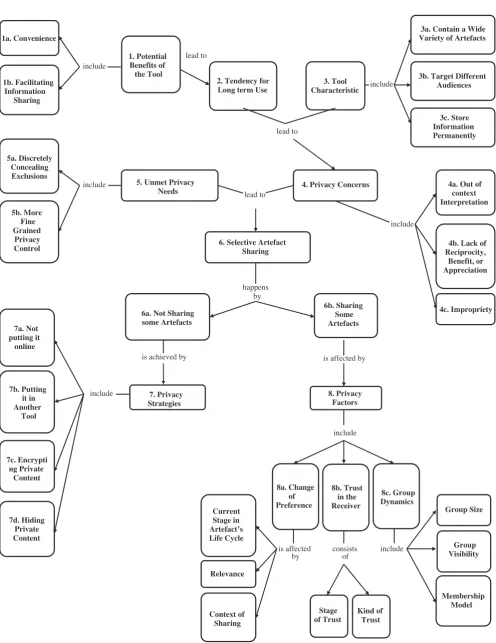
the map have been marked by numbers so that they can be referred to in the following description by their corre-sponding numbers (used in brackets), thus making navi-gation of the map easier. In summary, the theory suggested that because of the many potential benefits of the tool [1], such as convenience [1a] and ease of infor-mation sharing [1b], participants were willing to use it over a long period of time. However, there were certain inherent characteristics of the tool [3] that in combina-tion with users’ willingness for long-term use [2] gave rise to privacy concerns [4]. First, the artefacts contained in social tools cover a wide spectrum, ranging from personal to professional to social information [3a]. Second, various information artefacts may be targeted to different groups of audiences that are not necessarily static [3b], and finally, information disposed in social tools is persistent and permanently searchable [3c]. Some of the privacy concerns mentioned by our participants included out-of-context interpretation [4a]; lack of reciprocity, benefit, or appreciation [4b]; and impropriety (considering cer-tain content inappropriate for some audiences) [4c]. We also observed that there were certain privacy needs of users that the tool failed to support [5], including the need to control privacy at a more fine-grained level [5b] and the need to discretely conceal exclusions [5a].
The combination of privacy needs and concerns gave rise to the need for selective information sharing [6], which happens by sharing certain artefacts with selected lead to individuals [6b] while holding back form sharing others [6a]. To withhold from sharing, users were employing certain strategies [7], including using other platforms with better privacy management mechanisms for their more private content [7b]; refraining from deploying certain content in an online environment because of lack of acceptable privacy levels [7a]; putting the more sensitive content somewhere (i.e. a web page or weblog), but not providing a link to it from places where their real identity was known [7d]; and finally, writing their more private content in some sort of a ‘code
language’ so that it is meaningless to anyone other than the user him/herself [7c].
Deciding on sharing an artefact on the other hand was affected by a set of privacy factors [8]. One such factor was change of preference [8a]. The study showed that rather than a binary scale of public vs. private, users’ judgements of privacy of resources often reflected a tran-sition from private, to semi-private/restricted share, to public, depending on the state of the artefact, the rela-tionship between the owner and the receiver of artefact, and the context of sharing. We also found out that users’ assessment of the persons or groups who will be the receivers of information played a strong role in making decisions about information sharing [8b]: users tended to share less with people/groups with whom they were in the initial stages of trust, and as their trust moved towards a more mature level over time, they began to feel more comfortable and share more. Furthermore, their decision was affected by both the kind of trust they had in the receiver (e.g. cognitive or emotional) and the stage of their trust with the receiver (e.g. initial, intermediate, or mature).
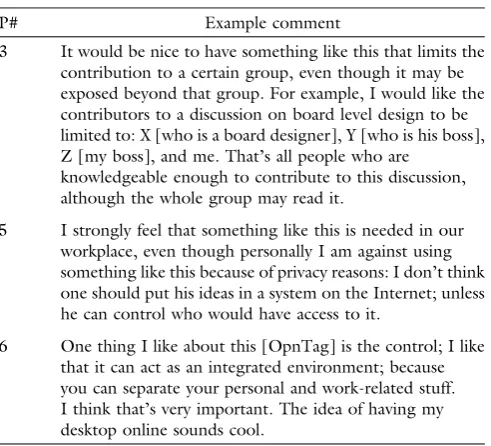
And finally, our results indicated that users’ willingness to share something they have vested interest in also depends on their perception of how it will be used, with the dynamics of the groups or communities where the information is going to be shared being the most influen-tial factor in deciding about information sharing [8c]. Our study revealed that users often hold back from shar-ing information in anticipation of lack of reciprocity, ben-efit, or appreciation, and loss of credit for their work. The theory suggested that when group/community dynamics are clear enough to convey to the users how their infor-mation will be used within the group, users are better equipped to make informed decisions regarding how much they want to share within the group. Moreover, this predictability may be critical to making the decision to share information in the given context at all.Tables 1–8
provide examples of users’ comments that led to various
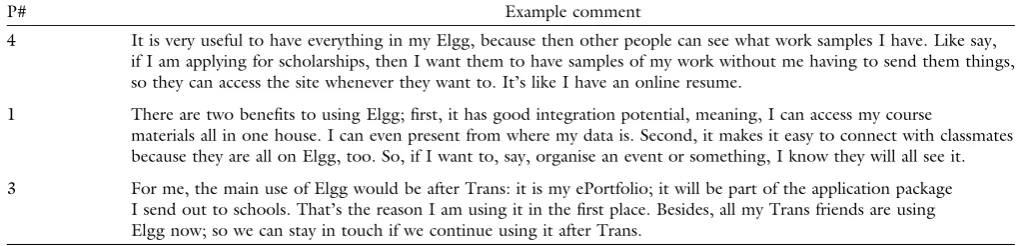
Table 1.Sample user quotes on the benefits of Elgg and tendency for long-term use.
P# Example comment
4 It is very useful to have everything in my Elgg, because then other people can see what work samples I have. Like say, if I am applying for scholarships, then I want them to have samples of my work without me having to send them things, so they can access the site whenever they want to. It’s like I have an online resume.
1 There are two benefits to using Elgg; first, it has good integration potential, meaning, I can access my course
materials all in one house. I can even present from where my data is. Second, it makes it easy to connect with classmates because they are all on Elgg, too. So, if I want to, say, organise an event or something, I know they will all see it.
theory constructs. A more detailed description of the grounded theory process can be found inRazavi (2009).
5. Study limitations
The unified demographics of our particular sample might raise a question as to whether the results were affected by
the specific characteristics of this group. Particularly, an argument can be made as to whether the fact that this group of participants was under age 18 had any effect on the results. While there were certain categories of arte-facts that our participants would not share because of their age (e.g. none of them were allowed to post a real photograph of themselves on their profile), we did not
Table 2.Sample user quotes on privacy concerns.
P# Example comment
1 . . .I don’t always share information on scholarships; because they are highly competitive, by sharing I would just put myself in a less advantaged position. I know other people don’t share such stuff, either; so. . .
12 I usually prefer people not to know that I am coming to this program because that sort of affects the way that people think about me. By keeping my educational and social information from certain people who really don’t know a lot about me, I am treated more like an equal.
5 . . .even though that is an important part of my identity [referring to a certain interest], I just decided to take that off my ePortfolio, because although I don’t mind my fellow Trans students know that, I don’t want to find people who don’t know me think I am weird. . .
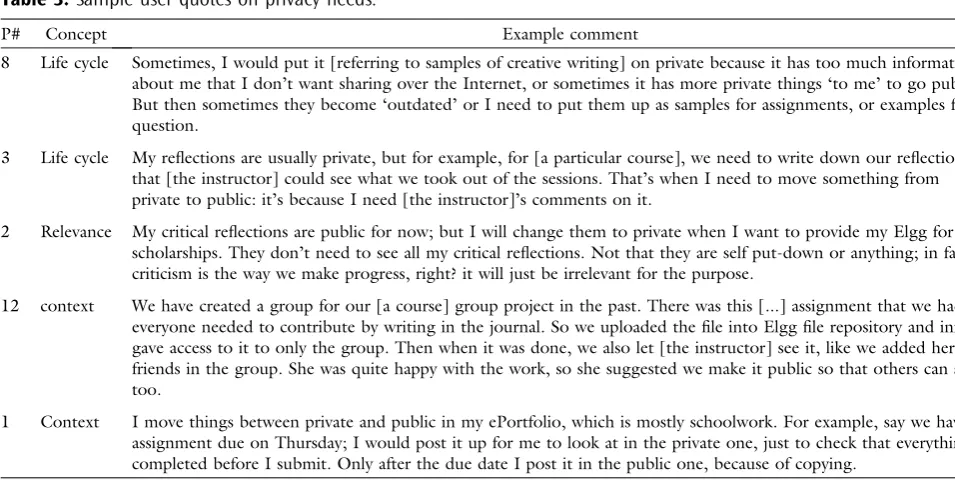
Table 3.Sample user quotes on privacy needs.
P# Concept Example comment
8 Life cycle Sometimes, I would put it [referring to samples of creative writing] on private because it has too much information about me that I don’t want sharing over the Internet, or sometimes it has more private things ‘to me’ to go public. But then sometimes they become ‘outdated’ or I need to put them up as samples for assignments, or examples for a question.
3 Life cycle My reflections are usually private, but for example, for [a particular course], we need to write down our reflections so that [the instructor] could see what we took out of the sessions. That’s when I need to move something from private to public: it’s because I need [the instructor]’s comments on it.
2 Relevance My critical reflections are public for now; but I will change them to private when I want to provide my Elgg for scholarships. They don’t need to see all my critical reflections. Not that they are self put-down or anything; in fact, criticism is the way we make progress, right? it will just be irrelevant for the purpose.
12 context We have created a group for our [a course] group project in the past. There was this [...] assignment that we had and everyone needed to contribute by writing in the journal. So we uploaded the file into Elgg file repository and initially, gave access to it to only the group. Then when it was done, we also let [the instructor] see it, like we added her to the friends in the group. She was quite happy with the work, so she suggested we make it public so that others can see it, too.
1 Context I move things between private and public in my ePortfolio, which is mostly schoolwork. For example, say we have a lab assignment due on Thursday; I would post it up for me to look at in the private one, just to check that everything is completed before I submit. Only after the due date I post it in the public one, because of copying.
Table 4.Sample user quotes on privacy factors—change of preference.
P# Example comment
9 The problem I have with that [current privacy mechanism in Elgg] is that when I let some people see something, other people can see that there is something, but they don’t have access to that. So they are like: oh, can I look at it? and then sometimes, you just don’t know whether you want to share with them or not, and it’s kind of weird to say no right away. So, then sometimes, I just rather keep it all private or all public so not to have to make that decision.
8 What would have been nice to have, is for people who don’t have access to it to see a blank page instead of a message like, sorry, you don’t have access to this.
focus on this group of artefacts. Rather, we tried to stay away from these obvious cases, and focus on the more general area of sharing information they had vested inter-est in. Also, although this study is situated in the context of an educational environment, our participants used it for managing and sharing many more varieties of personal and social information in different contexts. As such, their experiences reflected diverse information sharing habits in
various contexts, as evidenced by the fact that none of the privacy factors that emerged in the study (the changing nature of users’ privacy preferences, the effect of trust on information sharing decision, and sharing differently in group of different dynamics) were specific to the edu-cational context. As such, we believe that even though our study has well-defined boundaries in terms of the user population, types of information artefacts, the intended
Table 5.Sample user quotes on privacy factors—trust.
P# Concept Example comment
11 Kind of trust Right now I am on a forum and I remember in the beginning I was really careful about exposing personal information, such as where I go to school or posting a picture. I would just ignore and leave myself out of it. After a while, you sort of trust them a bit more. I haven’t been as far as putting a picture on, but I would say oh, I would get my license in a couple of years or something like that. But I won’t make a reference to the fact that I am not old enough—I would just say I will get it in a couple of years. So, I am still pretty cautious about it; because after all, my trust just comes from interacting with these people over time. I mean, I just ‘feel’ more comfortable after being in the group for a while.
2 Stage of trust After interacting in a group for a while I would feel more comfortable sharing with the group but its not always very comfortable, just more comfortable than before; Like, from ‘not very comfortable’ to ‘sort of comfortable’. I am not the kind of person who gets too comfortable over the net.
6 Stage of trust If you participate in an online community and you talk to people and they begin to give their opinions about something, you feel you begin to know who that person is by what they say are their ideas and what they like, and you develop a sense of knowing who they are, and they are no longer unknown; because we fear what we don’t know and so if we get to know what that person stands for, maybe we can trust them some more.
10 Kind of trust I am not the kind of person who makes friends over the Internet easily and I don’t really connect with forums well; but once that happened, though, I actually had my friend who had visited the forum for a long time. So, it was easier to connect because I had a really strong connection there.
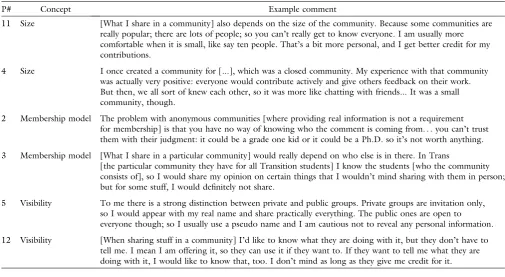
Table 6.Sample user quotes on privacy factors—group dynamics.
P# Concept Example comment
11 Size [What I share in a community] also depends on the size of the community. Because some communities are really popular; there are lots of people; so you can’t really get to know everyone. I am usually more comfortable when it is small, like say ten people. That’s a bit more personal, and I get better credit for my contributions.
4 Size I once created a community for [...], which was a closed community. My experience with that community was actually very positive: everyone would contribute actively and give others feedback on their work. But then, we all sort of knew each other, so it was more like chatting with friends... It was a small community, though.
2 Membership model The problem with anonymous communities [where providing real information is not a requirement for membership] is that you have no way of knowing who the comment is coming from. . .you can’t trust them with their judgment: it could be a grade one kid or it could be a Ph.D. so it’s not worth anything.
3 Membership model [What I share in a particular community] would really depend on who else is in there. In Trans
[the particular community they have for all Transition students] I know the students [who the community consists of], so I would share my opinion on certain things that I wouldn’t mind sharing with them in person; but for some stuff, I would definitely not share.
5 Visibility To me there is a strong distinction between private and public groups. Private groups are invitation only, so I would appear with my real name and share practically everything. The public ones are open to everyone though; so I usually use a pseudo name and I am cautious not to reveal any personal information.
audiences, and the context of use, it does provide mean-ingful insights into users’ privacy needs and strategies in the social software system domain.
6. From grounded theory to design Heuristics
The second phase of the work involves translating the social requirements (which were identified through the study) into technical requirements (which are the actual technical structure of a privacy system to support those requirements). The main objective of the grounded the-ory study was to improve understanding of information sharing phenomenon, in order to identify guidelines that can inform design. To achieve such goal, we next developed a set of heuristics for the design of privacy management mechanism based on the results of the grounded theory, and then consolidated these heuristics into a privacy framework for social software. Here is a description of these heuristics.
Heuristic 1: Privacy control must be available on a fine-grained basis. The first heuristic suggests that control of the pri-vacy of information must be defined in terms of individual artefacts as well as their collections, and is based on the observation that many of our participants in the grounded theory study expressed the need for fine-grained privacy control. Although this is a confirmation of the long-stand-ing model that access rights should be associated with indi-vidual objects (e.g. files) and collections (e.g. folders), the higher granularity and incremental object creation model in social software suggests that the way in which these rights are managed to protect privacy and facilitate sharing needs to be different in some essential ways: the diverse nature of content and audiences in the social software domain implies that different artefacts in the same category might have dif-ferent privacy requirements (i.e. landscape photographs made visible to public, but family photographs restricted to friends). Moreover, often times users need to grant or
deny access rights other than just the read action to their artefacts (i.e. colleagues may view, but not modify), which suggests that social software systems need to support fine-grained privacy management not only for resources, but also for target audiences and actions.
Heuristic 2: Privacy preferences must be defined in context. Research shows that while non-technical users seem to have a good idea of what their personal pri-vacy preferences are, often times they have difficulty artic-ulating them in terms of a set of rules (Egelman and Kumaraguru, 2005). Personal preferences are also con-text-sensitive, which makes it even harder to enumerate specific privacy rules. Enabling privacy preferences at a fine granular level makes this problem even bigger. This is supported by the fact that while the need for manag-ing privacy at a fine-grained level has been recognised by other social software systems as well, it has often found to pose a trade-off with usability. In Facebook, for example, users have to go to a separate privacy setting page and set privacy preferences for each of their various profile and public search visibility items individually. Pri-vacy-related options for individual applications are found with the application and users have to be aware of the features to find the options and visit separate privacy pages for each. Although fine-grained, the result is a completely unintuitive system where non-technical users are highly unlikely to be able to set sensible privacy pref-erences or understand the ramifications of their choices. Interestingly, all this effort is needed for just regulating visibility of one’s various artefacts (i.e. the read action). Facebook currently does not provide any mechanism for regulating other types of action; for example, who can edit an artefact or leave a comment, etc. To the best of our knowledge, neither do any of other existing heav-ily used social software systems.
Thus, our second heuristic is a direct follow-up to the previous one and suggests that a privacy management
Table 7.Sample user quotes on privacy strategies.
P# Example comment
11 [What I share in a community] also depends on the size of the community. Because some communities are really popular; there are lots of people; so you can’t really get to know everyone. I am usually more comfortable when it is small, like say ten people. That’s a bit more personal, and I get better credit for my contributions.
11 Besides Elgg, I have two other ePortfolios, and a couple of weblogs. One is private and one is public. On the private ePortfolio, I have things that are actually more private, like it has information about me, that sort of stuff. The purpose of that is that I just want to write some stuff down, so that it is sort of ‘said’ somewhere. Sometimes I don’t want to keep stuff in my mind, like for example, a journal or something, I would put it on the private one.
10 I use [another platform] for more private stuff because there are settings for public or friends-only or you get to choose who gets to see it. If it is something you want the teacher to see but not anyone else, you can just set it that way.
9 [my private blog] is open, but it’s sort of hidden, it’s not obvious how to find the page. I have not provided a link to it from anywhere. So, it’s open, but it’s sort of hard to find.
approach that requires users to indicate their privacy pref-erences to the systema priori(i.e. through a privacy set-ting page) may not work; rather, we propose that any attempt to support fine-grained privacy management must be paired with enabling users to express their privacy preferences in context (e.g. at the time an artefact is cre-ated or modified) when they have a better idea of whom they want to share the artefact with.
Heuristic 3: Privacy mechanisms must provide control over ownership. Another deduction that followed from our grounded theory study was that users have a fundamental assumption that when they put something in the tool, they should have control over its ownership as well as its visibility. Our study suggested that one reason behind users’ reluctance to share information was the tool’s inflexibility in providing them with the ability to control the transactional aspects of knowledge sharing activities (e.g. getting proper credit for their contribution or ensur-ing reciprocity). This heuristic suggests that in order for social software systems to properly support information sharing needs, they must provide a complete, persistent sense of the degree to which information that an individ-ual creates or consumes is his/her own, the amount of control s/he has over the use of that information, and the ability to properly assess or exploit its value. In other words, in addition to providing the means for users to control access rights at different degrees between the extremes of private and public, tools need to also allow users to maintain personal ownership control over their shared information.
Heuristic 4: Privacy mechanisms must support various group models. From a user’s point of view, the primary concern in managing information sharing is in the ability to define and/or understand the audience that will have access to a particular information artefact. Generally, the choice of audience for a particular artefact or personal attribute is expressed in terms of a group of others who one trusts with that particular piece of information, so we suggest that a privacy mechanism must enable users to understandably model their trust into groups in a flex-ible and dynamic way. We therefore propose that group management in social software must support various group models rather than a generic unified form, and that groups must be defined and controlled by users, rather than the system.
Heuristic 5: Privacy mechanisms must provide control and/or awareness over group dynamics. Privacy in social software is also affected by the semantics of social network relations. For example, membership in a group with pub-lic membership visibility may thereby disclose interests, preferences, or other personal information regarding group members. This means that if a group member dis-closes information about him or groups including him-self, he (whether willingly or inadvertently) might also
be disclosing information about someone else. In other words, one member’s treatment of his/her privacy has a direct effect on another member’s privacy. This suggests that awareness of group dynamics is an essential need for a privacy management system; meaning, such dynam-ics must be both controlled by and clearly articulated to users.
Heuristic 6: Privacy mechanisms must allow definition of groups that reflect interpersonal relationships. This is a fol-low-up to the previous two heuristics, and suggests that one group model that must be supported in social soft-ware is the egocentric group that is defined based on users’ interpersonal relationships. This follows from the observation that in social software domain, one’s personal and social information are not always shared with identi-fiable, accountable individuals or groups, and sharing may happen in a variety of contexts, for example, competitive as well as collaborative. Moreover, people may act simul-taneously in several contexts, holding multiple potentially conflicting relationships simultaneously. As such, a lot of users’ information sharing needs is better described in terms of the relationship that exists between the owner of the artefact and the person or group with whom the information may be shared, specially since new intricacies have blurred the boundaries between public and private.
Boyd (2006), for example, points out that US teenagers feel strongly about preserving a certain form of privacy: they want to be visible and searchable for their friends but not their parents. In terms of rights management, these observations strongly imply that the potential audience for some artefacts or attributes is likely defined in user’s own terms, based on a variety of kinds of relationships that more closely resemble real-life privacy boundaries (e.g. one-sided and short-term relationships) and not in terms of any organisational ‘roles’ or groups. This will enable users to control the release of their personal information in the same manner they would control it in the real world, based on their relationship with the data receiver, rather than some externally imposed constraint such as the recei-ver’s organisational role.
switching to a different project groups or changing affili-ations). We thus propose that a privacy model that stati-cally assigns access rights based on these factors at the time of an artefact’s creation or modification will be insuf-ficient. Rather, privacy mechanisms need to be flexible enough to accommodate frequent changes in users’ pri-vacy preferences in a non-labour-intensive way.
Heuristic 8: Action possibilities and their consequences must be clearly presented to users. Our last design heuristic emphasises the importance of interface clarity. Our study confirmed the intuition that users can be reluctant to share personal information when they are not sure how exactly to do things, or when the consequences of a shar-ing decision are unclear. A counterintuitive consequence of this is that some users might be more willing to share personal information in a space that affords virtually no privacy control (e.g. blogs or Myspace pages) than one which offers them an unclear set of privacy management tools. In our study, users were made aware that they could have some control of privacy and should manage the audience for their personal information by the prom-ise of an access control system. However, many found it inadequate because either they could not perceived how to do something they wanted to do (i.e. users did not know they could make something visible only to one per-son, even though such functionality was supported by the tool), or they were not sure what the consequences of a sharing decision were (i.e. even though the tool provided different information sharing models through supporting both groups and communities, users were not clear on how they differed). As a result, they were not able to take advantage of certain aspects of the privacy management mechanism, because of the inability of the tool to convey their existence or consequences.
7. A framework for privacy in social software
systems
The overall goal of the proposed design heuristics was to identify a minimal set of requirements (both technical and social) for privacy management in social software systems. While heuristics Heuristic 1 to Heuristic 7 describe what kinds of privacy control are necessary for managing and sharing personal artefacts, Heuristic 8 pertains to how these controls must be built and incorporated in order to be usable. We now consolidate these requirements into a framework for user-centred privacy in social software domain that describes privacy in terms of required con-trols over artefacts, audiences, relationships, and change; with an emphasis on the clear presentation of those con-trols to users.
Artefact control. The principle of artefact control is a con-solidation of Heuristic 1, Heuristic 2, and Heuristic 3, and essentially reflects the finding that privacy manage-ment in social software must be defined on a per-artefact
level as opposed to per-category; and that the access rights need to be applied in context (meaning, at the time of artefact creation or modification) as opposed toa priori (through a privacy setting page). Furthermore, in addi-tion to control over visibility (the read acaddi-tion), users also need the ability to control other rights over their artefacts, for example, modification or deletion (the write action), and over further delegation of such rights.
Audience control. The principle of audience control is a consolidation of Heuristic 3, Heuristic 4, and Heuristic 5, and reflects the need to restrict both the visibility and ownership of artefacts to certain user-defined groups. Although most existing social software systems support some group functionality, we suggest that social software systems must provide the means not only for creation of these user-defined groups, but also for definition and control over various aspects of these groups (sizes, mem-bership models, and visibility), and for controlling changes in those aspects. Furthermore, these controls need to be in the hands of users, rather than pre-defined by the system.
Relationship control. The principle of relationship control is a reiteration of Heuristic 6, and reflects the need for the ability to define information sharing based on a user’s self-defined relationships with others. In essence, this emphasises that users need the ability to define groups of friends or collaborators in their own terms, and to use this model of their relationships with others as the basis for audience control.
Change control. The principle of change control is a reit-eration of Heuristic 7 and is something of a cross-cutting concern within the other three controls. This principle reflects the observation that in the social software domain, the artefacts, the audiences, and the relationships used to define privacy and sharing patterns are all dynamic. A pri-vacy and user interaction model must thus take into account that artefact life cycle and categorisations will change, that a user’s requirements to share classes of arte-facts with certain audiences will change, and that a user’s relationships and trust patterns within those relationships will change, and that users come to expect their tools to provide flexible support for these changes in their privacy preferences when the social parameters that define the sharing model change.
advantage of the extra control over privacy that these user-centred controls are supposed to provide.
In order to illustrate the suitability of our proposed pri-vacy framework for design, our next step was to design a system that instantiates the framework. As an example, and to provide an environment in which we can test these principles, we have developed an experimental system called OpnTag. We next present the technical structure of OpnTag, along with a discussion of how our frame-work as embodied in this system supports each of the five user-oriented privacy controls.
8. OpnTag
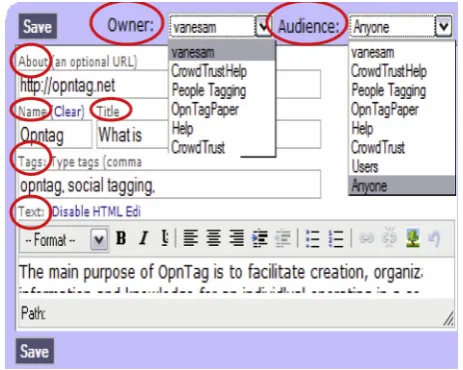
OpnTag (Iverson et al., 2008) is an open source web application for note taking and bookmarking that we developed to address the information management needs of an individual performing in various social contexts. The fundamental unit of information storage in OpnTag is the memo, a tagged textual annotation that may optionally link to a web resource. Memos can function as book-marks, notes, or wiki pages and are organised based on their intrinsic metadata (e.g. who owns or created them and when) and the tags applied to them by various users (Figure 3). Each memo has an owner, which presents who creates the memo and thus can edit and delete it, and a potentially restricted audience, which controls who can see that the memo exists and read it. Both the owner and the audience can either be an individual or defined as a group (Figure 4). Also, groups can be defined either by inviting other individuals or by applying people tags to individuals in one’s network, thus categorising them into a group. Two types of groups exist in OpnTag: classic groups (Figure 5), with collectively-controlled visibility, size, and membership model; and egocentric groups (Figure 6), created through applying people tags to other
individuals in the system, thus resulting groups with com-pletely owner-controlled dynamics. For a more detailed description of the group functionality in OpnTag, see
Razavi and Iverson (2008,2009).
With individuals, classic groups, and egocentric groups, OpnTag’s privacy control centres on the joint concepts of ownership and audience management, which ensure indi-vidual users retain control and credit over the artefacts they dispose in the system. Although a group can be spec-ified as the designated owner of a memo, each memo is also visibly attributed to its individual creator, thus ensur-ing that each group member gets proper credit for the contributions s/he makes to the group’s shared informa-tion space. Only a memo’s creator can modify ownership, but any member of the owning group can change a memo’s audience. This design choice allows the creator Artefact Control (fine grained, in context control over
both ownership and visibility)
Audience Control (user control over definition, dynamics, and change in groups)
Relationship Control (group definition based on interpersonal relationships)
Clarity
(compa tibility with users’ mental model)
Change Control (making change in the above aspects light weight and straight forward)
Figure 2. A framework for usable privacy control in social
software. Figure 3.shared in a group.Memos in OpnTag: public, private, and selectively
Figure 4. An individual memo in OpnTag with owner and
of a memo to decide whether access restrictions of a memo should be controlled collectively or individually. The latter case supports situations when there is a need to ensure that the access restriction policies stay with the shared data; i.e. it is not possible to make a memo vis-ible beyond the intended audience set by its creator.
Audience restriction is the fundamental mechanism for selective sharing in OpnTag: at the time of creating or editing a memo, the creator has access to both his/her classic and egocentric groups and can thus adjust the audience of the memo to be either the owner himself (whether an individual or a group), a classic group that
the owner is a member of (with its collective membership dynamics), or one of the owner’s egocentric groups (over which s/he has complete control). Figure 7 presents a screenshot of how this choice is made.
9. Satisfying privacy requirements
OpnTag’s privacy management mechanism has been designed based on the five user-centred privacy controls. Artefact control in OpnTag is supported by providing ownership and audience management at the level of indi-vidual memos. For each memo, the user specifies the memo’s owner (who can edit it), with the default owner of a memo set to the creator (either the individual or a group). By enabling context-sensitive ownership manage-ment at the memo level, OpnTag’s privacy system sup-ports definition of fine-grained privacy policies any time an artefact is created or modified, as opposed to providing a separate privacy page for defining general privacy poli-cies on collections as most current tools do. In addition to fulfilling the fine-grained privacy management require-ment, this also allows users to define their own privacy policies when they have a clear idea of their preferences. This is quite important in terms of adhering to the prin-ciple of artefact control, as the prinprin-ciple emphasises pair-ing fine-grained privacy control with in-context policy definition to alleviate difficulties that users often have with administrating such fine-grained privacy control. Moreover, with OpnTag’s ownership management, pri-vacy policies stay with the data, meaning, no one other than the memo’s owner can change its audience; i.e. it is not possible for someone who is not an owner of a memo to make it visible beyond the intended audience set by its creator.
Audience control in OpnTag is supported through deep visibility management via user-defined groups and relationships. Every memo in Opntag has restricted visi-bility; meaning, it can only be seen by members of a des-ignated group. OpnTag enables users to control various aspects of the classic groups they define, including size, visibility, and membership. The relationship dynamics of
Figure 5. Classic group definition page with group and
member list visibility menus.
Figure 6. Egocentric group definition in OpnTag through
applying tags to users.
Figure 7. Selective sharing of a memo in OpnTag, with both
such groups is then determined by variations of these parameters; i.e. open/limited number of members, pub-lic/private visibility, and open/moderated/closed mem-bership. This clear model of group characteristics highlights the potential trade-offs between risks and benefits of information sharing in a particular group and gives users a high-level overview of the effects of their sharing decisions. Knowing how a particular resource could potentially be used in a particular group, users can then tune their sharing decisions accordingly (e.g. one would be less likely to share sensitive information with an ‘open’ group that anyone could join than in a ‘closed’ group where new members must be invited). In addition, through people tagging, users can take com-plete control of the audiences for their artefacts.
Relationship control in OpnTag is supported through people tagging, which enables categorising one’s network into user-defined, egocentric groups that may represent various kinds of relationships. Since egocentric groups are controlled entirely by the creator (the acts of creating or deleting a tag on a user, and controlling the visibility of the tag are solely controlled by the tagger), the act of tag-ging a person via their profile page is equivalent to assert-ing their membership in a group whose membership is entirely under tagger’s control. As such, people tagging provides a lightweight and flexible mechanism for han-dling volatile relationships that frequently show up and fade out in natural social environments, but are often hard to manage in online world.
The combination of artefact, audience, and relationship control in OpnTag allows fine categorisation of resources, audiences, and actions, provides advanced group func-tionality, and enables users to define privacy preferences based on their often changing relationships. The fourth principle, change control, is supported by ensuring that ownership and visibility management (modifying owner and/or audience of memos and tags), group management (creating, managing, joining, and leaving user groups), and people tagging are all handled in a flexible and straightforward way and that all the settings are modifi-able at any time, making it easy for users to make frequent changes to their information space.
Finally, we have followed some of the known principles of usable design to achieve clarity. One such principle is to make privacy features (as secondary functionalities) highly visible and seamlessly available to users in the con-text of their primary actions (De Paulaet al., 2005). This is derived from the fact that privacy features often act as barriers to action, while usability principles aim to remove such barriers (Dourish et al., 2004). Supporting proper visibility can thus help achieve the right balance between the two seemingly conflicting goals and ensure that pri-vacy management features complement existing actions rather than inhibiting it. In OpnTag, relevant action pos-sibilities for each privacy control are graphically clustered and presented together, while irrelevant or rarely used
information are omitted in order to reduce clutter: owner and audience selection for a memo (OpnTag’s privacy controls options for artefacts) are visibly presented at the top of the memo edition page, and are the only func-tionalities presented at this level, separated from other functionalities that deal with the content of the memo (Figure 3). Likewise, group visibility, member list visibil-ity, and people tag visibility (OpnTag’s privacy control options regarding audience and relationship) are pre-sented in the same context that classic or egocentric groups are created or modified. While this makes these features visibly and seamlessly available to users in the context of defining information artefacts, audiences, or relationships, it still gives them the option to skip such configuration and accept the defaults, if they would rather focus on their primary task.
Another usability principle is consistency (Nielsen, 1992). In OpnTag, various choices for each privacy con-trol feature (owner and audience for memos, group and member list visibility for classic groups, and visibility of people tags) are consistently presented by drop-down menus, as a learned convention that is successfully and frequently used by people at all skill and experience levels. Designers of privacy systems are also advised to use feedback mechanisms to help users understand the impli-cations of their privacy decisions (Bellotti and Sellen, 1993; Lederer et al., 2003). OpnTag supports this through the combination of providing visualisation and pairing configuration with action. For both memos and people tags, the choice of audience causes the back-ground colour to change accordingly. Such immediate visualisation of visibility and the choice that triggered it will help users understand how to generate rules that reflect their preferences, or to notice when the results of their actions do not correspond with their intended goal.
10. Usability evaluation
focus of the evaluation study was mainly on finding out what aspects of the framework work and what aspects do not, an equally important objective was to ensure that the extra control over privacy is not to achieve at the price of sacrificing usability.
10.1. Participants
OpnTag target users are individuals operating in various personal, professional, and social group environments, meaning, our sample pool was practically general public and there were no salient characteristics to look for in participants to assert their suitability for participation in the study. As such, a participation request was distributed via email to mailing lists and social connections of existing OpnTag users. Ten people (six male, four female) who responded to the invitation were recruited for participa-tion in the study. Our participants came from diverse backgrounds, including both technical and non-technical users, which was appropriate since OpnTag is designed
for personal and social information management
across a wide variety of usage contexts. All participants had some university education, with seven participants having a graduate degree and three an undergraduate degree.
10.2. Procedure
The procedure we employed for the purpose of evaluation was a laboratory study consisted of three stages: first, par-ticipants were asked to fill out a survey questionnaire con-sisting of 10 questions covering general areas of users’ demographics (sex, age, and education level), profession, expertise with computers and the Internet, plus specific questions on their familiarity with popular social software systems and the privacy management features in them. The survey also included questions aimed at identifying users’ privacy attitudes, i.e. what information they feel comfortable to reveal about themselves in social applica-tions they use and whether they have ever experienced privacy violation problems in the past. All of our partici-pants had some familiarity with social systems (i.e. at least using one other social system for a prolonged period in the past) and some concern for privacy (i.e. at least con-sidering some artefacts private and some sharing uncom-fortable). These two criteria ensured that they had an idea of the subject of the study and can relate to it, and that their answers were not affected by lack of knowledge or concern about the topic of investigation.
None of our participants had used OpnTag before. On average, participants reported using various social systems for 6 hours per week. None had any special expertise related to privacy; however, when reflecting on their experiences with privacy management in applications they used, seven participants said they find the feature useful and have used it at some point. Six said although they
consider privacy management mechanisms necessary, they often find them too difficult and/or time consuming to use. Five said they do not trust social systems to put their private information there. Only two participants said they think social systems provide adequate privacy manage-ment. Seven out of 10 participants reported experiencing privacy violation at some point while using social systems, either as a result of their own action or others.
In the second stage, participants were asked to login to OpnTag as an imaginary persona and perform a set of pre-defined tasks, each involving creating memos of various degrees of sensitivity and sharing them with various people in the imaginary persona’s social and/or professional net-work. For each task, participants needed to decide on the appropriate owner and audience for the memo they cre-ated, and on whether to assign their target audience to a classic or egocentric group. Participants were allowed to make any changes to the persona’s information space that they felt necessary for the purpose of carrying out the tasks; including creating, modifying, or deleting groups and/or people tags, or changing the visibility of their groups/ group members/people tags. The tasks were designed in a way to cover information sharing situations across a vari-ety of privacy-sensitive contexts, ranging from inherently private, to semi-private, to public; and to require a mixture of visibility and ownership control.
In the third stage and upon completion of the tasks, we engaged each participant in a semi-structured interview. We used participants’ actions during tasks as a starting point and tried to gather feedback on the reasons behind their actions and why they did things a certain way. We particularly looked for errors and signs of confusion and/or frustration, as well as comments on the strengths and weaknesses of the privacy management mechanism. This combination of methodologies allowed us to make detailed first-hand observations of how first-time users interacted with OpnTag’s privacy management scheme and how they reflected on its utility and usability.
10.3. Results
unassisted (10 participants each doing five tasks), we only witnessed five errors. Furthermore, all five errors were results of improper understanding of the task in question; for example, making a memo visible to team members rather than colleagues, as mentioned in task description.
Overall, the concept of setting the owner and the audi-ence for access management seemed to be fairly under-standable to users: none of the users showed any signs of confusion or frustration. Also, the majority of our partici-pants seemed to grasp the difference between granting ‘write’ vs. ‘read’ access: nine out of 10 users correctly cre-ated a group memo for the tasks that involved some form of collective contribution. Since this distinction is not sup-ported by most of the existing tools, it was encouraging to see users quickly picking up and using a fairly new feature.
Usability. Traditionally, usability of a software application is measured based on four quality components: speed, accuracy, success rate, and overall user satisfaction (Nielsen, 2001). However, researchers have often considered differ-ent criteria for measuring usability of a security or privacy mechanism. The reason is that privacy management is often a secondary goal in most systems, and therefore does not get the same consideration that many other aspects do (Egelman and Kumaraguru, 2005), which makes it difficult to set particular metrics for usability of privacy aspects (i.e. what exactly should be measured?). Whitten and Tygar (1998)were the first to propose a working definition of usability for security software based on the special charac-teristics of the usability problem for security, and to suggest several criteria for evaluating usability of a security system. A number of other researchers have also proposed similar and/or complementing guidelines for evaluating usability of security or privacy mechanisms (Chiassonet al., 2006;
Clarket al., 2007;Cranor, 2005;Karatet al., 2005). We found these criteria suitable for the purpose of our study. Here we reflect on the usability of OpnTag’s privacy frame-work based onWhitten and Tygar’s (1998)four usability criteria, plus the two complementary criteria suggested by Chiasson (2006).
(1) Users must be reliably made aware of the steps they have to take to perform a task
This is a restatement of the first guideline of (Whitten and Tygar, 1998) and suggests that the application must provide user with enough cues as to how to start the process for each task, and to identify the intermediate steps that are required to complete the task. In OpnTag, the acts of setting a memo’s owner and audience are fairly straightforward, because those action possi-bilities are associated and presented with memo creation/modification functionality. Also, the fact that privacy management in OpnTag happens on a per-artefact basis made it easy for participants to
figure out that the owner and audience are the two attributes of a memo that they need to set in order to share something with a certain audience.
(2) Users must be able to determine how to success-fully perform the steps
Whitten and Tygar’s second usability guideline suggests that once the user is made aware of what intermediary steps are necessary for each task, s/ he must be able to figure out how to perform these steps. (Wharton et al., 1994) suggest that users develop a mental model of how a system works, and that in order for users to be successful in performing the necessary steps required to complete a task, the model behind the system must match user’s mental model.
In our study participants employed different pri-vacy management strategies based on their pripri-vacy attitude and concerns (e.g. one participant would consider a memo private, while another one would make it public). Regardless of their privacy attitudes, our subjects were successful in achieving their desired level of privacy, properly disposing the created memo to the right audience. More-over, OpnTags’ privacy management system seemed to have a fast learning curve: after a short, initial training session, our subjects all seemed at ease with creating memos, defining or modifying groups and/or group members, tagging other users, and choosing the appropriate owner and audience for their memos.
(3) Users should not make dangerous errors from which they cannot recover
Since OpnTag is an information management sys-tem, the most dangerous error that can happen is exposing a memo to the wrong audience. However, in OpnTag memos are created in the current work space, meaning the default value for both a memo owner and audience is the user himself (if in user space) or the group (if in group’s shared space). As such, even if users miss to set the right owner/audience, having rather conservative values as defaults helps decrease the chance of accidentally making a memo visible to a too large audience (e.g. public). Also, the differ-ent background colour-codes that reflect various levels of visibility for a memo provide a powerful visual cue to the user as to whether the memo is set to have the right visibility.
(4) User should know when they have completed a task