on Scalable Information Systems
Research Article
Concurrent Operations of
O
2
-Tree on Shared
Memory Multicore Architectures
Daniel Ohene-Kwofie
1,†, E. J. Otoo
1,∗, Gideon Nimako
21School Of Electrical and Information Engineering, University Of the Witwatersrand, South Africa 2School of Public Health, University Of the Witwatersrand, South Africa
Abstract
Modern computer architectures provide high performance computing capability by having multiple CPU cores. Suchsystemsarealsotypically associatedwithvery largemain-memorycapacities,therebyallowingthemtobeused for fast processing of in-memory database applications. However, most of the concurrency control mechanism associatedwiththeindexstructuresofthesememoryresidentdatabasesdonotscalewell,under high transaction rates. This paper presents the O2-Tree, a fast main memory resident index, whichis alsohighly scalableandtolerant of high transaction rates in a concurrent environment using the relaxed balancing tree algorithm. The O2-Tree is a modifiedRed-Blacktreeinwhich theleafnodesareformedintoblocksthatholdkey-valuepairs,whileeachinternal nodestoresasinglekeythatresultsfromsplittingleafnodes.Multi-threadedconcurrentmanipulationoftheO2-Tree outperformspopularNoSQLbasedkey-valuestoresconsideredinthispaper.
Keywords: Pessimistic Concurrency, Indexing, In-Memory Databases,Performance, Algorithms
1. Introduction
Indexes in database managements system (DBMS) facilitate fast query processing. Tree structured indexes in particular, are critical to database processing systems since they allow for both random and range query processing. Today’s data processing tasks in transaction processing, scientific data management, financial analysis, network monitoring, data analytics, etc., handle large volumes of data which require fast accesses and very high throughput.
Recent advances in memory architectures, with 64-bit addressing, now allow for memory sizes of the order of hundreds of gigabytes and beyond at a reasonable cost. It is, therefore, feasible to have sufficiently large shared memory such that the entire index of either, a memory resident or disk-resident database, can be
∗
Corresponding author. Email:[email protected] †
Corresponding author. Email:[email protected]
maintained in main memory. For instance, the latest Oracle Exadata X3-8 system ships with 4TB of main memory [25]. This has, therefore, motivated much research to exploit memory as well as the many-cores available on such architectures to provide fast application processing for main-memory databases.
Recently, there has been a flood of developments and implementations of in-memory data stores with associated index schemes. These are characterised in general as NoSQL databases. They are also referred to as key-value pair index structures [21]. Notably in this pack are index schemes such as BerkeleyDB [26], LevelDB [12], Kyoto Cabinet [10], RedisIO [30] and MongodB [1]. Such in-memory indexes, optimized for in-memory databases and running on multi-core processors, can support very high query processing rates. The challenge with such systems is how to efficiently ensure that the concurrently executing processes are isolated from each other in such an
1
Received on 14 September 2013, accepted on 1 February 2014, published on 27 May 2014
Copyright © 2014 Daniel Ohene-Kwofie et al., licensed to ICST. This is an open access article distributed under the terms of the Creative Commons Attribution licence (http://creativecommons.org/licenses/by/3.0/), which permits unlimited use, distribution and reproduction in any medium so long as the original work is properly cited.
doi: 10.4108/ sis.1.3.e
6
6
EAI
for InnovationEuropean Allianceenvironment. Current DBMS typically rely on locking but in a traditional implementation with a separate lock manager, the lock manager becomes a bottleneck and results in much overhead cost, especially at high transaction rates [17].
In this paper we present an in-memory index structure, referred to as O2-Tree with emphasis on its implementation in a shared memory multi-core architecture. Such achitectures have a common shared memory that can be accessed by multiple programs running concurrently on several cores, as a result of the multiprocessing design capability, on the same node. We address primarily its concurrency control and fault recovery mechanism. TheO2-Tree is essentially a Red-Black Binary Search Tree in which the leaf nodes are data blocks that store multiple records of "key-value" pairs. The internal nodes contain copies of the keys that result from splitting the blocks of the leaf nodes in a manner similar to the B+-Tree. However, theO2-Tree is structurally different from the minimal order of a B+ -Tree also called the 2−3-Tree. A 2−3-Tree is a tree in
which each internal or non-leaf node has either 2 or 3 children, all leaf nodes are at the same level, and every node may contain 1 or 2 keys. On the other hand, all leaf nodes of theO2-Tree may not necessary be at the same level but the leaves containm>2 keys. One could question whether the AA-Tree [2] could not be used in place of the Red-Black-Tree (or RB-Tree) that the O 2-Tree uses for the internal nodes. The answer is yes and this leads to a generalization of theO2-Tree where the internal nodes could be organized as an AVL-Tree [?], a 2−3-Tree [?], an AA-Tree [?] or a SkipList [?].
In the O2-Tree, internal nodes are simply binary placeholders or routers to facilitate and guide the tree traversal. The tree index is fault tolerant in the sense that it is easily reconstructed by reading only the lowest key values of each leaf node that is always made persistent. It is inherently persistent and scales well in highly concurrent environment.
We use a pessimistic concurrency control, but allow multiple readers to proceed without blocking internal nodes except for leaf nodes where an updater needs to hold a lock. This allow us to reduce the lock overhead due to blocking of concurrent interleaved
gains by using the following mechanisms; search operations are interleaved using the hand-over-hand (also referred to as lock-coupling) locking technique; and mutations perform rebalancing separately which encompasses smaller fixed sized atomic regions.
We use the relaxed balance algorithm for Red-Black Tree presented by Hanke et al.[13], to maintain the invariants of the O2-Tree. We have explored and evaluated the O2-Tree, and done extensive experimental evaluations and comparisons with some of the well known key-value storage schemes, in multi-core environment under high contentions and index workloads. The experiments confirmed that the concurrent O2-Tree has a superior performance compared to popular NoSQL key-value stores (Tuple Store category) which are often used as in-memory database indexes. These include the BerkeleyDB key-value store (BerkeleyDB), the TreeDB of Kyoto Cabinet and Google’s LevelDB.
The major contribution being reported in this paper is the development, implementation and comparative experimental tests of the O2-Tree main memory index structure. This is usable as a NoSQL key-value store for database systems that require a high performance concurrent access in shared memory multi-core architectures. We present results which show that the O2-Tree in-memory index has high scalability in highly shared concurrent environment, and performs comparatively better than most popular
NoSQLkey-value storage schemes.
2. Related Work
Tree structured index operations are fundamental in database management systems (DBMS). These provide for fast transaction processing in the DBMS. They allow for both efficient random as well as sequential processing of keys and are therefore widely used in DBMS. Recent advances in main memory technology and the availability of configured systems with memory sizes of the order of hundreds of gigabytes and tens of terabytes have motivated several research in developing main memory index schemes [4,15,18,20]. The usage is such that the index of a main memory resident database or a disk-resident database is kept entirely in memory for high transaction throughput. Some of the widely used tree-based index structures include the B+-Tree, and the T-Tree. However, recently a number of such index-driven databases have emerged under the banner ofNoSQLdatabases.NoSQLstores consist basically of a key-value pair and and as such these databases are able to scale easily.
The B+-Tree [3,8] is one of the well studied and well understood index structure for database systems. It is generally characterised as a multi-way search tree of ordermin which each node holds at leastdm/2e −1 and
at mostm−1 data item. B+-Tree was specially designed
to speed-up index searches on disk-based DBMS. In such DBMS the number of disk accesses to retrieve a record, is proportional to the heighthof the tree, where h≤logd
m/2eN for a tree of ordermorfanoutofm. B+ -Tree therefore has a significantly low height for a high
fanout.
An alternative to the B+-Tree, designed specifically for main-memory indexing, is the T-Tree [18]. It was proposed as the preferred index structure for main-memory databases. Though the T-Trees has less storage overhead than the B+-Tree, research in [27, 28] has shown that the B+-Tree is able to efficiently utilise the cache line in modern processors to provide a better performance. Another index structure which has been widely studied is the Red-Black binary Tree (or RB-Tree) [9]. It is noteworthy that in the use of an RB-Tree as main-memory index, each internal node stores a key-value pair while external nodes are represented as NULL values. The RB-Tree provides an efficient scheme
for main memory indexing. However, the performance deteriorates as the datasets become very large. This is due to the fact that, the height of the tree increases greatly and hence traversals and restructuring after updates become expensive especially in concurrent environment with high contention. Further, the CPU cache-line is poorly utilised since each node, either internal or leaf, is visited once for a single key-value access.
Restructuring of the RB-Tree after insertions and deletions can be done during the top-down traver-sal before the operation or bottom-up after the oper-ation. One would expect that the concurrency con-trol in RB-Tree would be efficiently implemented with
top-down insertions and deletions algorithms. Unfor-tunately standard top-down restructuring algorithm, does not scale well with the RB-Tree and other index structures in general. The process of restoring the tree’s invariant becomes a bottleneck for concurrent tree implementations. The mutating operations must acquire not only locks to guarantee the atomicity of their operations, but also locks to guarantee that no other mutation affects the balance condition of any nodes or the sub-tree that will be involved in the restoration process. The strict standard top-down algo-rithm limits the amount of concurrency of the index since every update will proceed with several top-down balancing steps before exiting. This difficulty led to the idea of relaxed balance trees [13,16,22].
The relaxed balance techniques, effectively uncouple the mutating operations from the restructuring oper-ations by allowing the invariants to be violated but restored by separate rebalancing operations [5, 6, 13, 14,16, 22,23]. These separate rebalancing operations involve only local changes. Larsen [16], showed that for a relaxed RB-Tree the number of restructuring changes after update is bounded by O(1) and the number of color changes by O(log n), where n is the size of the tree. The process of restoring the invariants in relaxed RB-Tree has an amortized constant ofO(1) [16].
Concurrent control algorithm for relaxed balance tree implementations based on fine-grain read-write
3
EAI
for InnovationEuropean Alliancelocks provide good scalability for tree-indexes. Opti-mistic concurrency control (OCC) schemes using ver-sion numbers are also attractive for concurrency con-trol especially for in-memory index. They naturally allow readers to proceed without locks, and thus avoid the coherence contention inherent in read-write locks. The readers simple read version numbers updated by writers to detect concurrent mutations since readers assume that no mutation will occur during access to a critical region. They retry if that assumption fails i.e if a mutation occurs. This could however, lead to spu-rious retries and wasted work. Software transactional memory (STM) provides a generic implementation of optimistic concurrency control. STM groups shared-memory operations into transactions that appear to succeed or fail atomically. The aim of STM is to deliver a simple parallel programming at an acceptable perfor-mance. However, performance gains and scalability are amongst the most important goal of a data structure library, and not just simplicity [7]. In practice STM sys-tems also suffer a performance hit relative to fine-grain lock-based systems on small numbers of processors (1 to 4 depending on the application) [7].
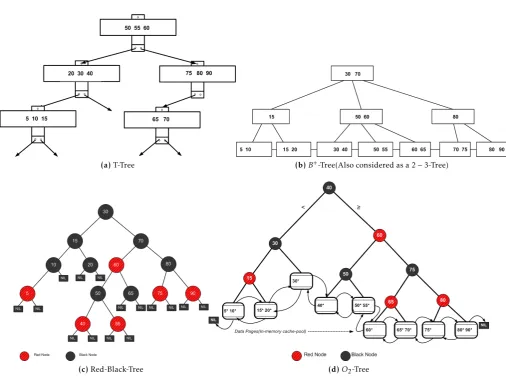
In this paper, we present the concurrent operations of the O2-Tree memory resident index structure that can be used also as a persistent key-value store. It utilizes an in-memory cache for the leaf nodes and a fine-grain relaxed balance concurrent algorithm in a manner similar to the approach in [16]. This effectively allows for greater degree of concurrency in theO2-Tree. We discuss this in detail in Section 3. The distinctive differences in the T-Tree, B+-Tree, RB-Tree and theO2 -Tree are clearly illustrated in Figure1. The approach we advocate here where the RB-Tree is used as the memory resident index can easily be generalised to replace the internal RB-Tree with any of the following: a 2-3-Tree, an AA-Tree and a SkipList.
3. The
O
2-Tree In-memory Index
3.1. Structure of the
O
2-Tree
The O2-Tree is basically a binary search tree, managed
are organised as index blocks, data pages, or chunks that store records of “key-value” pairs of the formhkey,
valuei. The “value” may also represent a pointer to the
location where the record is held in memory. In which case we could also denote it as “hkey, recptri”, where
“recptr" denotes the record pointer.
The internal nodes contain copies of only the keys of the middle “key-value” pairs that split the leaf nodes when they become full. These internal nodes are formed into a simple binary search tree that is balanced using the RB-Tree rotation algorithms. Let Ks be the search
key and let Kp be key stored at a node p. During a
traversal from the root node to a leaf node, a left branch of the nodepis followed ifKs< Kpand the right branch
is followed ifKs≥Kp. The process continues until a leaf
node is reached.
(a)T-Tree (b)B+-Tree(Also considered as a 2−3-Tree)
(c)Red-Black-Tree (d)O2-Tree
Figure 1. Diagram of the various tree structures
are simply binary place holders that facilitate or guide the tree traversal to reach a leaf node. All successful or unsuccessful searches always terminate at a leaf node. This is reminiscent of the search process in a B+-Tree except that now internal nodes hold only single key values as opposed tomkey values. Figure1d illustrates the schematic layout of theO2-Tree of orderm= 3. We show only the keys in the leaf nodes. The corresponding equivalent Red-Black-Tree is shown side-by-side in Figure 1. Detailed explanation of the RB-Tree can be found in [9].
The properties of theO2-Tree index include all of the RB-Tree [9] properties, plus the following:
1. Each internal node holds a single key value which is a copy of the minimum key value at the leaf node. These keys are equivalent to the middle keys after a leaf node splits.
2. Leaf-nodes are blocks that have between dm/2e
andm“key-value” pairs.
3. If a tree has a single node, then it must be a leaf which is the root of the tree, and it can have between 1 tomkey values.
4. Leaf nodes are doubly-linked in forward and backward directions. These links provide easy mechanism to traverse the tree in sorted order for key range searches.
We implemented the O2-Tree index structure as a persistent key-value store by reading and writing the leaf-nodes using an in-memory cache pool in which the leaf nodes of blocks of key-values pairs are managed by theBerkeleyDB Mpoolfilesubsystem. The BerkeleyDB Mpool subsystem is a general-purpose shared memory buffer pool which can be used for page-oriented, shared and cached file access. The BerkeleyDB Mpool library
5
implementation uses the same on-disk format as its in-memory format as well. This provides a simple mechanism to flush cached pages since a page can be flushed from the cache without format conversion [21]. The internal nodes of theO2-Tree provide simply binary place-holders for fast tree index traversal. New internal nodes are only added when leaf-nodes split as a result of overflows. The index tree may grow in height after a split of a leaf-block. The reverse occurs when there is an underflow resulting in the merging of leaf-nodes and the subsequent removal of the parent of the nodes that are merged. It should be noted here that this does not constitute an implicit use of BerkeleyDB Tree search. Only the cache functionality of theMpoolsubsystem is used.
3.2. Some Analytical Results
We state some analytical properties of the O2-Tree without formal proofs.
Proposition 3.1.In theO2-Tree, the black leaf-nodes of blocks of “key-value" pairs remain as leaf nodes under all rotations of the internal nodes which are structured as a Red-Black tree.
Figure 2. Single and double rotations in a Red-Black Tree
Proof. In a Red-Black Tree, the two rotations used to restore the tree’s invariant after update operations are the single and double rotations. Rotations basically swap (using pointer manipulations) the roles of the
of the binary tree. Single and double rotations are illustrated in Figure 2. Only leaf-nodes affected by the rotation are indicated. A single rotation betweenPand
Grestores the tree’s balance after insertion ofXcaused a violation. It is evident from the illustration that, all leaf-nodes (NIL) remain leaves even after the single rotation. Similarly, leaf-nodes in a double rotation still remain leaf-nodes. Though nodeX, has become the new parent of the sub-tree, its leavesN1andN2still remain leaves but with different parents and the binary search order is still maintained.
Proposition 3.2.AnO2-Tree withnblack leaf-nodes will still maintain its n black leaf-nodes after single or double rotations.
Proposition 3.3.The O2-Tree, supports the query operations of Put(), Delete(), and Get() in time O(log2N /dm/2e), where N is the number of
“key-value” pairs in the structure.
Proof. This follows from the fact that the number of leaf-node blocks is at mostnb=N /dm/2e. The number
of nodes of supporting internal RB-Tree is nb−1.
The height h of the internal RB-Tree is given by h≤
log2nb [9]. This implies that a search (given byGet()),
and insertion (given byPut()) and a deletion (given by
Delete()) is each computed in timeO(log2N /dm/2e).
Proposition 3.4.Assuming the response set of key-value pairs retrieved in a range search iss, such a range search can be carried out in anO2-Tree of ordermandN key-value pairs in timeO(log2N /dm/2e+s).
Proof. Given a lower bound kl and an upper bound
ku values of keys, a range search retrieves the set of
key-value pairs whose keys lie in the interval [kl, ku].
Using the key kl the search for the leaf node bucket
Bl that should contain the key kl is first retrieved.
This takes time O(log2N /lceilm/2e). Once the bucket
Bl is retrieved, the forward pointer from this bucket,
and all subsequent buckets, can followed to retrieve all the key-value pairs whose their keys are less than ku.
The process stops when the maximum key valueku is
range search. The total time to conduct the range search is thereforeO((log2N /lceilm/2e) +s).
3.3. Concurrency Control in the
O
2-Tree
We present our concurrent control scheme based on the relaxed balance RB-Tree algorithm by Larsen [16], but we manage our index structure such that the number of restructuring steps after mutation operations is further reduced. To achieve maximum concurrency, we implement the thread-safe algorithm with page-level or node-level locking. In this case, each node can be locked and unlocked. This simple fine-grain lock-coupling technique ensures that multiple threads can proceed concurrently as long as they don’t interfere with each other at the same node. We use three locks as in [23,24] which we denote asrlock, wlock, and xlock. Several user processes canrlocka node at the same time, whereas, only one process canwlocka node at a time but can coexist with other processes withrlockon the same node.xlock on the other hand ensures exclusive access to a node and cannot coexist with any other process.
The entire process of handling contentions in the tree is also handled by a rebalancing process which we denote as the rebalancer() process and runs in the background. The rebalancer() process locates nodes in the tree with conflicts and resolves them appropriately. We adopt theproblem queueapproach to manage contentions instead of random traversal by the rebalancer() which could result in several interferences with other query processes and causes degradation in the performance of the index. Let a user operation intending to insert/delete a “key-value” pair be denoted as anupdater()process. In the problem queue approach, when a lock conflict situation is created in the tree, a pointer to the parent of the node involved is placed in the problem queue. The rebalancer() continuously reads the queue and purposefully proceeds to the exact location to fix the imbalance. The tree is balanced if the problem queue is empty. We implemented a concurrent problem queue to allow for simultaneous
push() and pop() operations such that neither the
rebalancer() nor the updater() processes are blocked while traversing and manipulating the O2-Tree. An
updater() appends requests to the tail of the problem
queue, while the rebalancer() pops these request from the head of the queue. This prevents interference as much as possible and guarantees consistency between updaters() and therebalancer() processes. The problem queue is temporarily locked and released both by an
updater() and a rebalancer() during times that they access the problem queue only.
Before presenting the algorithm for the concurrent operations, we first define the following notations. Let T denote anO2-Tree. The root node will be designated asRoot(T) whose parent is theheaderof the index. Ifz denotes an Internalnode in T, thenz.lef t and z.right refer to the left and right child respectively of z. Let z.parentdenote the parent ofzand letz.siblingrefer to the sibling ofzsuch thatzandz.sibling have the same parent (i.e., ifzis a left child of its parents thenz.sibling will be the right child of the parent and vice versa). Also z.key is the value of the key in z, if z is an internal node (i.e., nodeT ype,leaf). In addition, z.key[i] and z.value[i] refers to the key and value respectively in the ith position of z given that z is a page block (i.e., nodeT ype=leaf).
Exact-Match Search Algorithm: Get(x, T). TheGet(key x) function returns the exact-match key-value pair
hx, valxiassociated with the key xfrom the data store
T, if x exist, otherwise a null value is returned. The search traverses nodes from the root by lock-coupling with rlocks until the the leaf page with the given x is found. Once the leaf-page z, in which the search key x resides, is located, we utilise a binary search function binarySearch(x, z) to locate the “key-value” pairhx, valxifromz. Unlike the T-Tree and theB+-Tree,
the search proceeds with only one key comparison in the internal node. The T-Tree and theB+-Tree do on the average m/2 comparisons before continuing with the search for a given key. The thread-safe search algorithm for theO2-Tree is given in Algorithm1.
Range Search Algorithm(Get N ext, Get P revious). The range search traverses nodes from the root by lock-coupling with rlocks just as in the exact-match search query. The search begins by locating the minimum key, xminin the given range e.g.,xmin≤x≤xmax, wherexmax
is the maximum key in the range. The search returns the range of key-value pairs hx, valxi within the specified
7
EAI
for InnovationEuropean AllianceAlgorithm 1:Get(key x)
Data:key x, T
Result: correspondinghx, valxipair iff ound,
otherwisenull 1 begin
2 /* node is the current node pointer for traversal*/
3 node←−root(T)
4 node.rlock()
5 whilenode.nodeT ype,leaf do 6 ifx < node.keythen
7 node.lef t.rlock()
8 node.unlock()
9 node←node.lef t
10 else
11 node.right.rlock()
12 node.unlock()
13 node←node.right
14 done←binarySearch(x, node) 15 node.unlock()
16 returndone
range. Once the leaf page with key xmin is located,
the algorithm proceeds with a sequential scan of the leaf node until the last key in that node is reached. If the maximum keyxmax is still not located, the scan
continues with an rlocks to the next leaf following the forward-link pointer between the leaf nodes. This continues until the last keyxmaxin the range is found.
The algorithm is illustrated in Algorithm2.
Insert and Update Algorithm: P ut(x, valx, T). The P ut()
operation proceeds with a traversal similar to that of the Get(). However, a much more elegant approach is to use a wlock, which allows several rlock by other threads on the resource but not another wlock or xlock. This allows for interleaved Get() operations to overtake updater() operations if necessary and not be blocked. To insert the key-value pair hx, valxi, the leaf
page ( denoted as node) in which the key-value pair belongs is first located. Once the page is located, it is locked exclusively with an xlock and if there is room,
Algorithm 2:Range Scan(key xmin,key xmax)
Data:key xmin, key xmax
Result: corresponding key-value for each existing key in the range
1 begin
2 x←−xmin
3 node←−root(T)
4 node.rlock()
5 whilenode.nodeT ype,leaf do 6 ifx < node.keythen
7 node.lef t.rlock()
8 node.unlock()
9 node←node.lef t
10 else
11 node.right.rlock()
12 node.unlock()
13 node←node.right
14 returnrangeScan(xmin, xmax, node)
15 ∗Range search starting from the min key in the
range from the currentleaf
16 ∗Continue scan in the nextleaf if the maximum
key in the range is not encountered
by the function insertInOrder(x, valx, node) into the
page, based on the value of the key x. If the page is already full, then a split is performed using the function splitInsert(x, valx, node) (see Algorithm4), wherenode
is the leaf-node to be split. A split basically allocates a new page in the in-memory cache pool and assigns half of the key-value pairhx, valxifrom the overflow page to
the new page. Thepreviousandnextpage pointers are updated appropriately. After the split, a new internal node is inserted which becomes the parent of the two page blocks. The new internal node is colouredRed. The tree may grow in height only when a page (leaf-node) overflows. If the operation results in the violation of the invariant condition, the parent of the new parent node is pushed to the problem queue. The thread-safe P ut algorithm is presented in Algorithm3.
Algorithm 3:Put(key x, value valx, T)
Data:key x, value valxT
Result:truefor successf alseotherwise 1 begin
2 /*node is the current node pointer for traversal */ 3 parent←−header
4 node←−root(T)
5 parent.wlock() 6 node.wlock()
7 whilenode.nodeT ype,leaf do 8 ifx < node.keythen
9 node.lef t.wlock()
10 parent.unlock()
11 parent←node
12 node←node.lef t
13 else
14 node.right.wlock()
15 parent.unlock()
16 parent←node
17 node←node.right
18 /* Upgrade both node and parent locks to xlock */
19 parent.xlock() 20 node.xlock()
21 if!(node.isf ull)then
22 done←insertInOrder(x, valx, node)
23 else
24 done←splitInsert(x, valx, node)
25 Update problem queue if invariant is violated
26 parent.unlock() 27 node.unlock() 28 returndone
this case, either key-value pairs hx, valxiare borrowed
from adjacent pages (previous or next pages) or pages are merged with the leaf-node that underflowed and the other page is deallocated or released into the cache pool. A merger of pages also results in the the subsequent removal of the parent node. If this results in the violation of the invariant condition, the grandparent of the new parent node is pushed to the problem queue. The thread-safe delete algorithm is as given in Algorithm5.
Algorithm 4:splitInsert(Key x,value valx,O2node
node)
Data:key x, value valx, O2node node
Result:truefor successf alseotherwise 1 begin
2 newP age←−new leaf P age() 3 newN ode←−new internalN ode()
4 midpoint←− m
2
5 wheremis the order of the tree */
6 j ←−0
7 fori←midpointtom−1do
8 newP age[j+ +]←−node.remove(i)
9 /* insert "key, value" into the appropriate leaf page
*/
10 newN ode.key ←−newP age.key[0] 11 newP age.parent←−newN ode 12 node.parent←−newN ode
13 /* reset forward and backward links of leaf nodes */
3.4. Correctness
The concurrent protocol presented guarantees linearis-ability as well as deadlock freedom. This ensures cor-rectness of all transactions. The algorithm does define lock order for traversals such that all request are made in the same top-down approach. This ensures freedom from deadlock. For instance, a request by one thread for a lock on a child node can only be granted after a lock request on the parent node has been granted. Each critical region preserves the binary search tree property. The lock ordering ensures that there is no deadlock cycle loop where a thread,T1waits on a lock by another thread,T2whilesT2waits on a lock held by T1. Since no such loop exists in the tree structure, and all parent-child relationships are protected by the required locks to make them consistent, the concurrent protocol algorithm is deadlock free.
In order for the algorithms to behave as expected in a concurrent environment, they require that their implementations be linearisable. This implies that operations for a particular key produce results consistent with sequential operations on the tree-index structure. Atomicity and ordering is trivially provided between Put() and Delete() operations by the wlock hand-over-hand tree traversal. This ensures that no
9
EAI
for InnovationEuropean AllianceAlgorithm 5:Delete(key x, T)
Data:key x T
Result:truefor successf alseotherwise 1 begin
2 /* minKeys ensures that node is at least half full */
3 minKeys←− m2 4 parent←−header
5 node←−root(T)
6 parent.wlock() 7 node.wlock()
8 whilenode.nodeT ype,leaf do 9 ifx < node.keythen
10 node.lef t.wlock()
11 parent.unlock()
12 parent←node
13 node←node.lef t
14 else
15 node.right.wlock()
16 parent.unlock()
17 parent←node
18 node←node.right
19 /* Upgrade both node and parent locks to xlock */ 20 parent.xlock()
21 node.xlock()
22 done←removeKey(x, node) 23 ifdoneandnode.underf low()then 24 sibling.xlock()
25 ifnode.sibling.keys > minKeysthen 26 /* Borrow from sibling to keep occupancy
*/
27 done←node.appendKeyFrom(sibling)
28 else
29 /* Merge leaf and sibling into the left node;
release page block and delete parent node */
30 done←mergeLeaf(node, node.sibling)
31 sibling.unlock()
32 parent.unlock() 33 node.unlock() 34 returndone
two of such operations overtake or interfere with each other. It is not possible for two threads, T1 and T2, to lock the same node resource simultaneously. This
each critical region during a mutation operation, only changes child and parent links after acquiring all of the required locks, hence guaranteeing the atomicity of the transaction.
3.5. Storage Utilisation
The expected storage utilisation the O2-Tree, from the fact that it grows and shrinks from block splitting and merging respectively, isO(ln 2). It can easily be shown using a similar approach as in the approximate storage utilisation of B-Trees [19]. LetN be the total number of keys in the tree and letndenote the number of index blocks at the leaves of the tree. Letmbe theorderof the tree. Each leaf block has at leastdm/2eandmkeys. The
storage utilisation denoted byµis the total number of keys stored divided by the total storage capacity of all the nodes.
µ= N
m×n
The expected storage utilisation is
E(µ) =N mE
1 n
To evaluate E(1/n) we note that nlies in the interval [N /m,2N /m]. By approximating the distribution as a continuous random rectangular distribution over the interval, we have
E(µ)≈ N
m Z 2N /m
N /m
dn n = ln 2.
4. Persistence and Recovery
state from which normal processing can resume. The faster the index can be restored or recovered, the less impact it will have on the performance of the entire database recovery process. Generally, transactional logging, check-pointing and reloading techniques are employed. Logging maintains a log of transactions that occur during normal execution, whereas check-pointing takes a snapshot of the database periodically and copies it onto persistent storage for backup purposes. After a system failure, the persistent copy of the database is reloaded into main memory. The indexes are rebuilt and the database is then restored to a consistent state by applying information in the undo and redo logs to the reloaded copy.
Since disk (persistent storage) reads are expensive, reducing the disk overhead during recovery from persistent dumps is very crucial in designing the recovery techniques for in-memory databases. TheO2 -Tree in-memory key-value store ensures persistence by accessing the leaf-pages through the in-memory cache pool. A separate thread periodically flushes dirty pages to the persistent store asynchronously.
TheO2-Tree persistent store provides an efficient and simply approach for index recovery. The reason being that rebuilding the index structure of theO2-Tree from persistent store, unlike the B+−T ree and the T-Tree structures, requires reading only the first key values in each of the leaf-page. This eliminates the performance bottleneck of traversing the entire “key-value” pairs of data in the leaf-pages. In systems where the index data is too large to fit into available memory, pages are paged-in and paged-out of the in-memory cache using a cache replacement policy such as the least recently-used protocol. In addition, bulk-loading the index from the persistent pages provides a much faster approach to restoration as the amount of restructuring is minimal.
Besides storing the leaf-pages by a background process, such that the entire RB-Tree structure can be rebuilt from the minimum key values of each leaf-page, the internal-nodes of the O2-Tree that form the RB-Tree can be occasionally dumped onto disk during checkpoint or after each session of usage. Just before a session starts and as part of the initialisation phase, the RB-Tree can be restored from the persistent store.
5. Performance Evaluation
We evaluated the performance of the O2-Tree index as a key-value persistent store, on the Intel Xeon E5630 CPU machine. We enabled hyper-threading for all performance evaluations. We conducted all the implementations and code compilation with the GNU GCC/G++ compiler on a 64-bit machine having a
72GBof RAM and running the Scientific Linux release 5.4 Operating system. We generated 32-bit uniform distributed keys with which we formed key-value pairs where the values were also uniform random generated values. We also performed some experiments with live data read from the flight statistics datasets [11] as well as the records of the Order table generated from the TPC-H dbgen data generator [31].
5.1. Sequential Evaluations
For completeness, we present the comparative results of the performance of the O2-Tree with the basic index structures such as the B+-Tree, T-Tree, AVL-Tree, and the Top-Down Red-Black-Tree. Figure3shows the performance of the five data structures for a simple build of the index. We performed up to 50M unique key insertions. Theorderof the T-Tree, B+-Tree, and the O2-Tree used wasm= 512. The graphs show the times for building the respective data structures in memory. As can be observed from the graphs, T-Tree performed worst among the index structures considered while the O2-Tree had the best performance. The Top-down Red-Black Tree also performed better than the AVL-Tree. AVL’s strict balancing requirement accounts for its worst performance. The O2-Tree on the other hand, required fewer splits and rotations which accounts for its superior performance. The B+-Tree performed better than the T-Tree due to its significant low depth and less complexity in restoring the tree’s invariants.
The O2-Tree, however, outperformed the B+-Tree from the simple fact that the B+-Tree makes multi-way-decision during its traversal down the tree while the O2-Tree makes single data comparison to determine the search path during traversal. Splitting and redistribution of keys in the nodes of a B+-Tree may continue all the way to the root of the tree. In
11
EAI
for InnovationEuropean Alliancethe O2-Tree only colour changes may propagate to the top. These operations are less expensive compared to the splitting and redistribution in B+-Trees. The poor performance of the T-Tree and the B+-Tree, compared to the O2-Tree, is due to the fact that several data comparisons are required to locate a bounding node for child node to be visited during traversals.
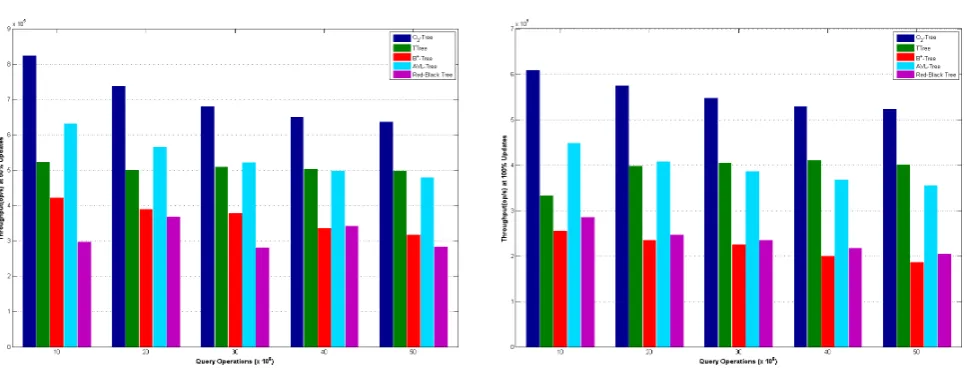
Figure 4 illustrates the performance evaluation of these structures when subjected to interleaved mix of insertions, deletions and searches with different percentage of each operation for a total of 50 million (50M) query operations with a single thread. Figure 5 shows the operational throughput (query operations per second) for varying workloads with 50% updates. The query mix operations involved generating either an update (insertion or deletion) and conducting a lookup with varying probabilities. We refer to the probability of generating an update multiplied by 100 as the update ratio. Thus, a 0% update ratio indicates only data look-ups whiles a 100% update ratio indicates only update operations. Each update ratio consist of 30% deletions and 70% insertions. The preliminary results from the graphs indicates that the O2-Tree clearly outperforms all the basic structures considered.
We however observed that for lower update ratios such as 0% and 10% , the T-Tree and the B+-Tree provided better and comparable performance to the O2 -Tree. Figures5and6show the operational throughput (query operations per second) for varying workloads with 50% and 100% updates respectively. We observed a general decline in throughput as the workload and update ratios increase. However, the O2-Tree index provided the best operational throughput in all cases.
We also present the results with the single threaded persistent implementation of the O2-Tree index structure, where the key values and their associated data are kept persistent through an in-memory cache, with some NoSQL(key-value) data stores such as the BerkeleyDB [29], the Kyoto Cabinet TreeDB [10] and LevelDB [12]. These experiments were conducted primarily to compare the O2-Tree index structure to other popular NoSQL(key-value) data stores that use tree structured access methods and have been reported in the literature as being extremely fast. The data
written through the memory resident cache. The leaf nodes are then written to disk using the Least Recently Used (LRU) cache replacement algorithm. At the end of a session, the cache is flushed so that all memory resident leaf-nodes are written to disk and the overall time to complete the operation is reported. We repeated this for varying data sizes.
We refer to the persistent O2-Tree implementation asO2-Tree-KV. This scheme was compared with other popular NoSQL key-value stores. Each key-value store was initialised with a page size of 4K, as well as a 2.5GB in-memory cache size. We applied the tuning mechanisms to the NoSQL databases as indicated and recommended in their respective documentations. Furthermore, we did not enable compression. The TPC-H generated dataset from theOrdertable was used for all experiments involving the persistent key-value stores.
Our results indicate that the O2-Tree, using BerkeleyDB Mpool subsystem as a cache, outperformed the BerkeleyDB and the Kyoto Cabinet when using the TreeDB, by several orders of magnitude. However, O2-Tree-KV performance is very comparable to that of the LevelDB. We actually did run the LevelDB in asynchronous mode in which a separate thread concurrently flushed the cache contents to disk. Even though in comparing the LevelDB and the BerkeleyDB with with O2-Tree, the O2-Tree had the disadvantage that it does not have asynchronous back-end persistent store. Our objective however, was to evaluate how the O2-Tree-KV, in writing to disk through an in-memory cache, compared with these popular industry-standard NoSQL key-value stores without multi-threading.
The O2-Tree-KV with a cache support however, performed over 5Xfaster than the Kyoto Cabinet when using the TreeDB access method of the Kyoto Cabinet and about 1.5Xas fast as BerkeleyDB using theB-Tree
Figure 3. Index build with randomly generated keys Figure 4. Mixed Operations of Searches, Inserts and Deletes
Figure 5. Operational Throughput with 50% Updates for Basic Indexes using TPC Dataset
Figure 6. Operational Throughput with 100% Updates for Basic Indexes using TPC Dataset
theO2-Tree, when reading and writing through a cache shows performance characteristics that are superior to the NoSQL databases considered. It outperformed the LevelDB and the Kyoto Cabinet that used the TreeDB access method, by several orders of magnitude.
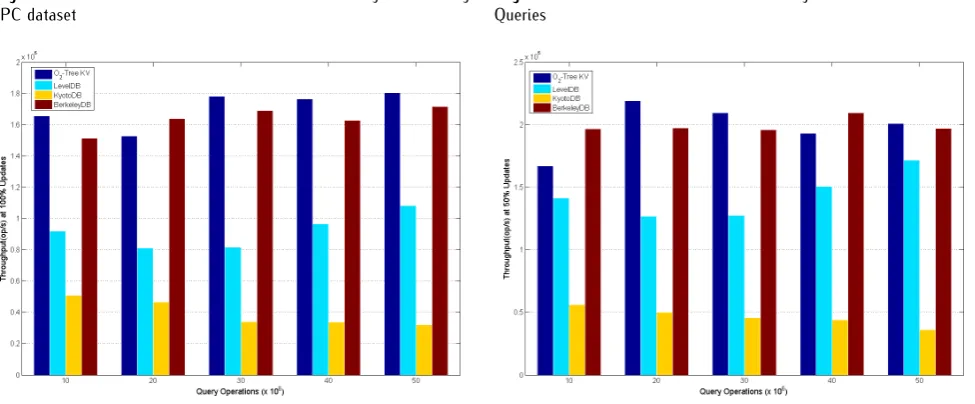
Figure9and Figure10show the corresponding oper-ational throughput results for mixed query operations on the NoSQL data stores with varying data sizes from 10M to 50M operations for 100% and 50% updates respectively. TheO2-Tree-KV demonstrated a superior operational throughput at high update ratio and large dataset. The efficient index mechanism of theO 2-Tree-KV accounts for its superior performance.
5.2. Multi-threaded Evaluations
We evaluated the average time for a multi-threaded insertion of “key-value” pairs of generated data into each of the following storage schemes: the O2-Tree persistent store, which we refer to as O2-Tree-KV, the BerkeleyDB and Kyoto-Cabinet TreeDB using the B−
T ree access method as well as the LevelDB NoSQL key-value store. These experiments were conducted primarily to compare the performance ofO2-Tree with these key-value stores where the data blocks are written and read through an in-memory cache to a disk file using multiple threads. We evaluated the average time it takes to perform 20 million (20M) insertions of “key-value” pairs concurrently with the number of threads
13
EAI
for InnovationEuropean AllianceFigure 7. Persistent store: Insertions With In-Memory Cache using TPC dataset
Figure 8. Persistent store: With In-Memory Cache and 50M Mixed Queries
Figure 9. Operational Throughput for Persistent Storage with 100% Updates
Figure 10. Operational Throughput for Persistent Storage with 50% Updates
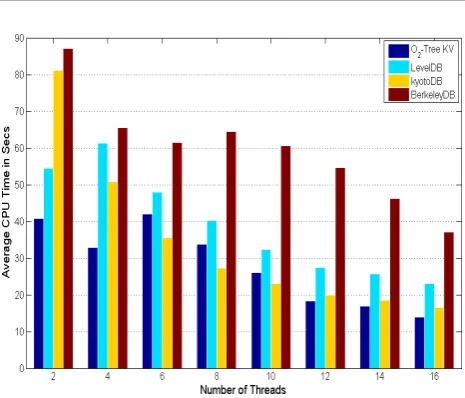
varying from 2 to 16. The page size as well as the in-memory cache size for each key-value store was set to 4k and 2.5GB respectively for all experiments in this group. We ensured that the operations were performed with the index tree in memory while the data pages were maintained in the in-memory cache pool. The data pages were read and written to disk according to the Least Recently Used (LRU) cache replacement policy of theMpool. The results are shown in Figure11. The general observation was that the average time to perform insertions decreased with increasing number of threads. This was due to the fact that the degree of access contentions increased as the number of threads increased. Threads must block to ensure correctness
Figure 11. Index Construction with Varying Number of Threads
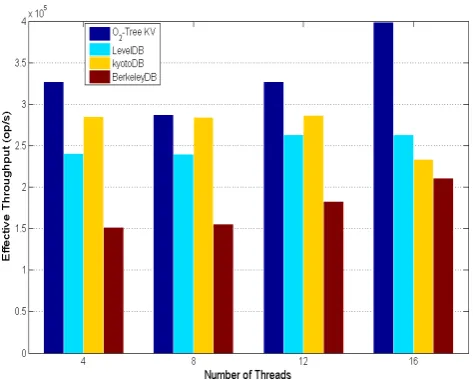
Figure12shows the operational throughputs of each of the key-value stores under different workloads. Each workload consisted of a mix of look-ups, insertions and deletions referred to as update ratio from the previous discussion. For each update ratio, we interleaved all operations such that a thread performed either an update or a lookup. All operations were performed by a maximum 16 threads we had on the machine. We observed a general decrease in throughput as the update ratio increased. This was due to the fact that, updates require restructuring of the index which affects the overall performance. TheO2-Tree-KV did record the highest throughput which was about1.9M operations per second (op/s). This rate later dropped to1.3M op/s
at 100% updates. A similar trend was observed for all the other key-value stores considered.
Figure 12. Operational Throughput for Different Mix of Workloads
We also compared the average time to conduct a search or lookup for all key-value stores. One objective of NoSQL key-value store is to provide effective lookup without the bottlenecks of traditional Relational database systems (RDBMS). We conducted the experiments with 20M 32−bit keys. We gradually
increased the number of threads to ascertain the effect of shared memory multi-threaded concurrent access of these different data storage systems. The results show that, as the number of threads increased, the lookups proceeded faster since there was relatively little work per thread. During lookups, threads do not block and thus, can proceed immediately with expected linearisable results. Though the O2-Tree-KV outperformed all the key-value stores considered, it rather exhibited a poor performance gain as the number of worker threads increased. This could be due to the cache coherence problem associated with single node traversals. We anticipate a much better performance with a lock-free protocol such as Software transactional memorySTM.
Figure 13. Concurrent Look-ups for 20M “key-value” using Varying Workloads
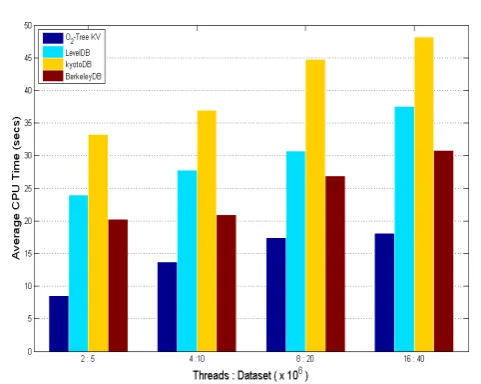
Additionally, we performed multi-threaded scalabil-ity evaluations on theO2-Tree-KV as well as the Berke-leyDB, Kyoto-Cabinet TreeDB and the LevelDB NoSQL key-value stores. We adopted the strong scalabilitytest approach in which we doubled the dataset as well as the number of threads for each run of the experiment. The dataset was varied from 5M with 2 threads and doubled for each run to 40M with 16 threads for the last run.
15
EAI
for InnovationEuropean AllianceThe first set of scalability test shown in Figure14 illus-trated the results with only insertions (Puts). Figure15 however, indicates similar experiment but this time for a mix of query operations in which 50% were look-ups and 50% updates (of which 70% were insertions and 30% deletions). We observed a comparable and even better performance for theO2-Tree-KV which exhibited a high level of scalability. Generally, a gradual increase in CPU times for all the key-value stores considered was observed as the number of threads and datasets were doubled.
We also evaluated the total size of theproblem queue
which is used by the relax balance algorithm of theO 2-Tree. We varied the data size as well as the number of threads in each run of the experiment. We observed that the total problem queue size was a function of the size of the dataset used to build the index. Large datasets resulted in larger problem queue size. Figure16shows the graph for the total problem queue sizes for the tree index. We observe a rapid increase in the problem queue size given a small increase in the dataset. For instance, the queue increases rapidly from about 6X10⁴ when the dataset is 3Mto an average of about 12X104 (double the previous size) when the dataset is increased by 1M.
However, a series of experiments conducted indicated that the average problem queue size was comparatively small at any instance using a singlerebalancerthread. Since, therebalancerthread does not traverse the index from the root but goes directly to the offending node, it is able to process problem queue items faster than the update threads. This accounts for the minimal average problem queue size observed in the experiment. Further, as the number of the rebalancer threads increases, the problem queue size reduces significantly as more threads are able to concurrently process the queue with minimal interference to ensure that the tree is balanced.
Finally, we evaluated the performance of each key-value store using real life flight statistics data [11] that consisted of 32bit keys and their corresponding data values. The physical size of the file was about 600MB. We loaded 10M keys and their corresponding values into each key-value store using varying concurrent
Figure 16. Total Problem Queue size for Varying Data sizes and Threads
to load the data from the persistent dump was then reported. The primary objective of this experiment was to measure the performance with real life data besides the synthetic data used in the previous experiments. We observed a comparable performance between all the key-value stores considered. TheO2-Tree-KV exhibited a much better throughput even though the others were comparable. Figure17illustrates the results.
Figure 17. Concurrent Loading of Real-life Persistent data
6. Conclusion and Future Work
Figure 14. Scalability Test with 100% Insertions Figure 15. Scalability Test with 50% Update Ratio
scalability while being tolerant of contention. We have also presented a concurrent access protocol based on the relax balance tree technique which allows the scheme to attain high performance as well.
We compared our index persistent O2-Tree implemented through an in-memory cache against popular high performance and widely used NoSQL
key-value stores such as the BerkeleyDB, Google’s LevelDB and Kyoto-Cabinet TreeDB. Our experiments show that O2-Tree key-value store outperforms both BerkeleyDB, and Kyoto-Cabinet TreeDB by 2−3X.
It also performs comparatively well against Google’s LevelDB for many access patterns. More importantly, the experimental results show that O2-Tree index structure exhibit a good scalability and tolerates contention. It also exhibit superior performance especially during high updates. It’s therefore the index structure of choice in applications with frequent updates such as Online Transaction Processing (OTP).
Future work anticipated involves using optimising techniques to make the structure much more cache aware using blocking techniques to improve CPU cache usage as well as bulk loading techniques for greater throughput. We are also exploring the use of GPU traversals for O2-Tree for even higher throughput. Other future work include replacing the RB-Tree internal structure of the O2-Tree with other
tree structures such as the AA-Tree, 2−3-Tree and the SkipList, and compare their performance measures.
6.1. Acknowledgements
This work was supported with funding from the Centre For High Performance Computing (CHPC), and the Department of Science and Technology (DST), South Africa.
References
[1] 10gen, Inc (2011) Mongodb: High-performance, open source NoSQL database.,http://www.mongodb.org//. [2] Andersson, A. (1993) Balanced search trees made
simple. InIn Proc. 3rd Workshop on Algorithms and Data Structures(Springer): 60–71.
[3] Bayer, R.andMcCreight, E.M.(1972) Organization and Maintenance of Large Ordered Indices.Acta Inf.1: 173– 189.
[4] Bohannon, P. et al. (1997) The Architecture of the DALA Main-Memory Storage Manager .Multimedia Tools Appl.4: 115–151.
[5] Boyar, J., Fagerberg, R. and Larsen, K.S. (1995) Amortization results for chromatic search trees, with an application to priority queues. InProceedings of the 4th International Workshop on Algorithms and Data Structures, WADS ’95 (London, UK, UK: Springer-Verlag): 270–281. [6] Boyar, J.andLarsen, K.S.(1993) Efficient rebalancing of chromatic search trees.Journal of Computer and System Sciences49: 667–682.
[7] Bronson, N.G., Casper, J., Chafi, H. and Olukotun,
K. (2010) A Practical Concurrent Binary Search
17
EAI
for InnovationEuropean Alliancetree. In Proc. of the 15th ACM SIGPLAN symposium on Principles and practice of parallel programming, PPoPP ’10 (New York, NY, USA: ACM): 257–268. doi:http://doi.acm.org/10.1145/1693453.1693488. [8] Comer, D. (1979) Ubiquitous B-Tree.
ACM Comput. Surv. 11: 121–137. doi:http://doi.acm.org/10.1145/356770.356776. [9] Cormen, T.,Leiserson, C.,Rivest, L.andStein, C.(2009)
Introduction to Algorithm, 1(Cambridge, Massachusetts London, England: MIT Press), 3rd ed.
[10] FAL Labs (2011) Kyoto cabinet: a straightforward implementation of dbm, http://fallabs.com/
kyotocabinet/.
[11] FlightStats: (2005) FlightStats Database, http://dl.flightstats.us/,http://dl.flightstats.us/. [12] Google.com (2011) Leveldb: A fast key-value storage
library written at google,http://code.google.com/p/
leveldb/.
[13] Hanke, S., Ottmann, T. and Soisalon-Soininen, E. (1997) Relaxed balanced red-black trees. InProc. of the Third Italian Conference on Algorithms and Complexity, CIAC ’97 (London, UK: Springer-Verlag): 193–204. [14] Hanke, S.(1998)The Performance of Concurrent Red-Black
Tree Algorithms. Tech. rep.
[15] Kong-Rim, C.andKyung-Chang, K.(1996) T *-Tree: A Main Memory Database Index Structure for Real Time Applications. InProc. IEEE Real-Time Computing Systems and Applications(South Korea): 81 – 84.
[16] Larsen, K.S.(1998) Amortized constant relaxed rebal-ancing using standard rotations.Acta Informatica35: 35– 10.
[17] Larson, P.A., Blanas, S., Diaconu, C., Freedman, C.,
Patel, J.M.andZwilling, M.(2011) High-performance
concurrency control mechanisms for main-memory databases.Proc. VLDB Endow.5(4): 298–309.
[18] Lehman, T.J. andCarey, M.J.(1986) A Study of Index Structures for Main Memory Database Management Systems. InProc. of the 12th International Conference on Very Large Data Bases, VLDB ’86 (San Francisco, CA, USA: Morgan Kaufmann Publishers Inc.): 294–303. [19] Leung, C.H.(1984) Approximate storage utilisation of
B-trees: a simple derivation and generalisations. Inf. Process. Lett.19: 199–201.
[20] Lu, H., Ng, Y.Y. andTian, Z. (2000) T-Tree or B-Tree: main memory database index structure revisited. In
Proc. of the Australasian Database Conference, ADC 2000 (Washington, DC, USA: IEEE Computer Society): 65– 73. [21] Marcus, A. (2012) The architecture of open source applications: Chapter 13. the NoSQL ecosystem,http: //www.aosabook.org/en/NoSQL.html.
[22] Nurmi, O.,Soisalon-Soininen, E.andWood, D.(1987) Concurrency control in database structures with relaxed balance. In Proc. of the sixth ACM SIGACT-SIGMOD-SIGART symposium on Principles of database systems, PODS ’87 (New York, NY, USA: ACM): 170–176. doi:http://doi.acm.org/10.1145/28659.28677.
[23] Nurmi, O.andSoisalon-Soininen, E.(1991) Uncoupling updating and rebalancing in chromatic binary search trees. InProceedings of the tenth ACM SIGACT-SIGMOD-SIGART symposium on Principles of database systems, PODS ’91 (New York, NY, USA: ACM): 192–198. [24] Nurmi, O.andSoisalon-Soininen, E.(1996) Chromatic
binary search trees: A structure for concurrent rebalanc-ing.Acta Informatica33: 547–557. 10.1007/BF03036462. [25] Oracle (2013) Oracle exadata database machine x3-8 datasheet, http://www.oracle.com/us/products/
database/exadata/database-machine-x3-8/
overview/index.html.
[26] Oracle.com (2011) Oracle berkeleydb 11g,
http://www.oracle.com/technetwork/products/
berkeleydb/overview/index-085366.html.
[27] Rao, J.andRoss, K.A.(1999) Cache Conscious Indexing for Decision-Support in Main Memory. In Proc. of the 25th International Conference on Very Large Data Bases, VLDB ’99 (San Francisco, CA, USA: Morgan Kaufmann Publishers Inc.): 78–89.
[28] Rao, J. and Ross, K.A. (2000) Making B+-trees cache conscious in main memory. In Proc. of the 2000 ACM SIGMOD international conference on Management of data, SIGMOD ’00 (New York, NY, USA: ACM): 475–486. doi:http://doi.acm.org/10.1145/342009.335449. [29] Seltzer, M. and Bostic, K. (2012) The Architecture
of Open Source Applications: Chapter 4. BerkeleyDB,
http://www.aosabook.org/en/bdb.htm.
[30] Sponsored by VMWARE(2011) Redis: An open source, advanced key-value store.,http://redis.io/.
[31] TPC-H(2001) Transaction Processing Council,http://