X-Ray, Crystal Structure and Solution Phase Studies
of a Polymeric Sr
II
Compound
Aghabozorg, Hossein*+
Faculty of Chemistry, Islamic Azad University, North Tehran Branch, Tehran, I.R. IRAN
Firoozi, Najmeh; Roshan, Leila
Faculty of Chemistry, Tarbiat Moallem University, Tehran, I.R. IRAN
Mirzaei, Masoud*+
Department of Chemistry, Ferdowsi University of Mashhad, P.O. Box 91779-1436 Mashhad, I.R. IRAN
Shokrollahi, Ardeshir; Aghaei, Roghayyeh
Department of Chemistry, Yasuj University, Yasuj, I.R. IRAN
Aghlmandi, Ziba
Faculty of Chemistry, Islamic Azad University, North Tehran Branch, Tehran, I.R. IRAN
ABSTRACT: In the crystal structure of the title polymeric compound, [C42H38N6O33Sr5.2(H2O)]n,
five independent metal atoms (Sr1-Sr5) have different coordination environments. The Sr1 and Sr5 atoms are nine coordinated and feature distorted tricapped trigonal-prismatic and capped square-antiprismatic geometries, respectively. The rest SrII atoms have eight coordination numbers.
These units are connected via the carboxylate O atoms of mono- and di anionic forms of pyridine-2,6-dicarboxylic acid, (pydcH2), and bridging water molecules that resulted in the formation of
polymeric layers in 3-D. In the crystal structure, non-covalent interactions consisting of hydrogen bonds (O—H···O and C—H···O), – [interplanar distances of 3.413(2); 3.601(2) Å] and C O··· [O··· distances of 3.249(3); 3.275(3) Å] stacking interactions play an important roles in stabilizing the structure. The protonation constants of propane-1, 2-diamine (1, 2-pn) and pyridine-2,6-dicarboxylate ion (pydc)2–, the equilibrium constants for the pydc-1,2-pn proton transfer
system and the stoichiometry and stability of this system with Sr2+ ion in aqueous solution were
investigated by potentiometric pH titrations. The stoichiometry of one of the most abundant complexed species in solution was found to be the same as that of the crystalline SrII complex.
KEY WORDS: Crystal structure, SrII complex, Hydrogen bonding, – interactions, C—H··· , and C O··· stacking interactions.
*To whom correspondence should be addressed.
INTRODUCTION
Metal-based coordination polymers have been extensively studied due to their intriguing topological structures [1-3] and unique functions, such as ion-exchange, adsorption, separation, sensor, and molecular recognition [4]. In this regard, the rational design and construction of coordination polymers with unique structural motifs and unique chemical and physical properties have attracted extensive interest in supramolecular chemistry and materials chemistry [5]. The framework structure of the coordination polymers is primarily dependent upon the coordination preferences of the central metal ions and the functionality of the ligands. Aside from the coordination bonding interactions, the hydrogen bonding and
– stacking interactions, the solvent molecules, counter-ions and the ratio of metal salt to organic ligand also influence the formation of the ultimate architectures [6-10].
We have recently reported a proton transfer system, prepared using pyridine-2,6-dicarboxylic acid and propane-1,3-diamine (pnH2)(pydcH)2·2(pydcH2)·8H2O
and (pnH2)(pydc)·(pydcH2)·2.5H2O [11,12].
Also complexes of SrII with pyridine-2,6-dicarboxylic
acid [Sr(C7H3NO4).4H2O] and [Sr(C7H3NO4)(H2O)4]n and (C10H10N2)[Sr(C7H3NO4)2(H2O)3]·3H2O have been
reported [13-15]. We have recently reported a proton transfer system, prepared using
pyridine-2,6- dicarboxylic acid and
propane-1,3-diamine (pnH2)(pydcH)2·2(pydcH2)·8H2O
and (pnH2)(pydc)·(pydcH2)·2·5H2O [11,12]. Also
complexes of SrII with pyridine-2,6-dicarboxylic acid
[Sr(C7H3NO4)·4H2O] and [Sr(C7H3NO4)(H2O)4]n and
(C10H10N2)[Sr(C7H3NO4)2(H2O)3]·3H2O have been
reported [13-15]. Recently, a novel cocrystal compound in the 2:1 stoichiometric ratio of 6-methyluracil (6mu) and pydcH2 formulated as [6mu]2[pydcH2], for the first
time [16]. PydcH2 which is incorporated in many
biologically important systems, are subject of many experimental or/and theoretical studies. It is the body's prime natural chelator of vital trace elements: chromium, zinc, manganese, copper, iron and molybdenum. 6mu is a common and naturally occurring uracil derivative. Uracil itself has also very important roles in many biological processes. In this study for better understand of coordination behavior of this ligand, we planned a reaction in which pydcH2 molecules self-assemble with SrII atoms affording
crystals with a polymeric structural motif.
EXPERIMENTAL SECTION
Synthesis of the title polymeric compound, [C42H38N6O33Sr5.2(H2O)]n
The title compound was prepared by the reaction of 1,2-pn, (241 mg, 1 mmol), pydcH2, (380 mg, 2 mmol) and
Sr(NO3)2 (241 mg, 2 mmol), in water (20 ml) in a 1:2:2 molar
ratios, respectively. Colorless crystals were obtained by slow evaporation of the solvent at room temperature.
The X-ray data was collected on a Bruker SMART APEX II CCD Area Detector (MoKα radiation,
= 0.71073 Å) at 100 K. The crystal data and experimental parameters are given in Table 1. The crystal was solved by direct methods (SHELXS-97) and a refinement was carried out with full-matrix least-squares methods based on F2 with SHELXL-97 [17,18].
Solution studies equipment
A 794 Metrohm Basic Titrino Model was attached to an extension combined glass-calomel electrode mounted in an air-protected, sealed, thermostated jacketed cell maintained at 25.0 ± 0.1 °C by circulating water, from a constant-temperature bath (home made thermostat), equipped with a stirrer and a 10.000-mL-capacity Metrohm piston burette. The pH meter-electrode system was calibrated to read -log [H+].
Solution studies procedure
The details are described in references [19, 20]. The concentrations of 1,2-pn and pydc were 2.50 ×10⁻³ M,
for the potentiometric pH titrations of pydc, 1,2-pn and pydc + 1,2-pn, in the absence and presence of 1.25×10⁻³
Sr2+ ion. A standard carbonate-free NaOH solution (0.105
M) was used in all titrations. The ionic strength was adjusted to 0.1 M with KNO3. Before an experimental
point (pH) was measured, sufficient time was allowed for the establishment of equilibrium. Ligands’ protonation constants and stability constants of proton transfer and their metal complexes were evaluated using the BEST program described by Martell and Motekaitis [21]. The value of Kw = [H+] [OH–] used in the calculations
according our previous works.
RESULTS AND DISCUSSION
The crystal structure of the title polymeric compound, [C42H38N6O33Sr5.2(H2O)]n, is presented in Fig. 1.
Table 1: Crystallographic data for [C42H38N6O33Sr5.2(H2O)]n.
Formula = C42H38N6O33Sr5. 2(H2O)
Formula weight = 1628.92
Crystal system = Monoclinic T = 100(2) K
Space group = Pn Z = 2
a = 14.0874(4) Å
b = 6.8492(2) Å = 97.4530(10) °
c = 28.0545(8) Å
V = 2684.04(13) Å3
Absorption coefficient = 5.05 mm-1
F(000) = 1612
Crystal dimensions (mm) = 0.25×0.14×0.12
R[F2 > 2 (F2)] = 0.034
Rint = 0.044
Absorption Correction Tmin, Tmax Multi-scan 0.302, 0.547
Rw(F2) = 0.063 -19 h 19
range for data collection = 2.79 to 31.65° -9 k 9
Goodness to fit = 0.98 -39 l 39
max = 0.64 e Å−3
min = -0.50 e Å−3
Data collection = Bruker SMART APEX II CCD Area Detector
Absorption correction: APEX2
No. of measured reflections = 33930
No. of independent reflections = 15483
No. of reflections collected with I > 2 (I) = 13553
No. of parameters = 794
Structural determination = SHELXL-97
Refinement = full-matrix least-squares methods based on F2
CCDC Number: Crystallographic data for this structure has been deposited with the Cambridge Crystallographic Data Centre, CCDC
number 787053. Copies of the data can be obtained free of charge on application to the Director, CCDC, 12 Union Road, Cambridge CB2 1EZ, UK (Fax: int.code (1223)336-033; e-mail for deposition:
Table 2: Selected bond lengths (Å) for [C42H38N6O33Sr5.2(H2O)]n.
Sr1—O1 2.646 (2) Sr1—O27 2.609 (2)
Sr1—O3 2.591 (3) Sr1—O17i
2.686 (3)
Sr1—O7 2.698 (2) Sr1—O18i 2.957 (3)
Sr1—O25 2.603 (3)
Sr2—N2 2.648 (3) Sr2—O28 2.694 (3)
Sr2—O3 2.485 (3) Sr2—O29 2.666 (3)
Sr2—O5 2.626 (2) Sr2—O16ii 2.478 (3)
Sr2—O7 2.745 (2) Sr2—O22i 2.601 (3)
Sr3—N3 2.686 (3) Sr3—O28 2.648 (3)
Sr3—O9 2.640 (2) Sr3—O29 2.726 (2)
Sr3—O11 2.649 (3) Sr3—O4iii 2.500 (2)
Sr3—O15 2.509 (3) Sr3—O20 2.628 (3)
Sr4—N4 2.659 (3) Sr4—O30 2.606 (3)
Sr4—O13 2.640 (2) Sr4—O31 2.576 (2)
Sr4—O15 2.578 (3) Sr4—O32 2.587 (2)
Sr4—O11 2.591 (2) Sr4—O23 2.679 (3)
Sr5—N5 2.710 (3) Sr5—O23 2.655 (3)
Sr5—N6 2.710 (3) Sr5—O12 2.689 (2)
Sr5—O17 2.537 (3) Sr5—O33 2.654 (3)
Sr5—O19 2.785 (3) Sr5—O8iv
2.619 (2)
Sr5—O21 2.704 (3)
Symmetry codes: (i) x−1/2, −y+1, z−1/2; (ii) x, y+1, z; (iii) x, y−1, z; (iv) x+1/2, −y+1, z+1/2.
Table 3: Selected Hydrogen bond geometry (Å, ˚) of [C42H38N6O33Sr5.2(H2O)]n.
D–H···A d(D–H) d(H···A) d(D···A) <(D–H···A)
O1W—H1WA···O18i 0.88 1.93 2.786 (4) 164
O1W—H1WB···O6v 0.83 2.15 2.900 (4) 150
O2W—H2WA···O10vi
0.86 2.57 3.263 (4) 138
O2W—H2WA···O13iii 0.86 2.34 3.011 (4) 135
O2W—H2WB···O24 0.97 1.91 2.841 (4) 160
O2—H2···O6v 0.89 1.66 2.544 (4) 174
O14—H14···O10vii 0.91 1.57 2.469 (4) 174
O25—H25A···O9 0.87 2.01 2.787 (4) 149
O25—H25B···O27iii
0.83 1.92 2.697 (4) 155
O26—H26A···O33viii 0.77 2.17 2.885 (4) 155
O26—H26B···O1W 0.84 1.94 2.764 (4) 167
O27—H27A···O26ii 0.83 2.11 2.823 (4) 143
O27—H27B···O21i 0.99 1.66 2.650 (4) 175
O28—H28A···O22viii 0.79 2.09 2.846 (4) 159
O28—H28B···O25 0.79 2.00 2.782 (4) 177
O29—H29A···O31 0.80 2.00 2.760 (4) 157
O29—H29B···O20ii 0.85 2.11 2.943 (4) 170
O30—H30A···O12 0.85 2.31 2.935 (4) 131
O30—H30B···O2Wii 0.83 2.00 2.824 (4) 169
O31—H31A···O5 0.93 1.85 2.746 (4) 161
O31—H31B···O32ii 0.82 1.88 2.667 (4) 160
O32—H32A···O24 0.86 2.05 2.868 (4) 159
O32—H32B···O19 0.85 1.92 2.737 (4) 161
O33—H33A···O12iii 0.74 2.22 2.826 (4) 139
O33—H33B···O8ix 0.80 2.05 2.774 (4) 151
C3—H3A···O24x 0.95 2.41 3.103 (5) 130
C9—H9A···O1Wvii 0.95 2.48 3.399 (5) 163
C17—H17A···O1Wiv 0.95 2.52 3.295 (5) 139
C24—H24A···O1Wxi 0.95 2.49 3.323 (5) 146
Symmetry codes: (i) x−1/2, −y+1, z−1/2; (ii) x, y+1, z; (iii) x, y−1, z; (iv) x+1/2, −y+1, z+1/2; (v) x−1, y, z; (vi) x+1, y−1, z; (vii) x+1, y, z; (viii) x−1/2, −y, z−1/2; (ix) x+1/2, −y, z+1/2; (x) x−1, y+1, z; (xi) x+1/2, −y, z−1/2.
Also hydrogen bond geometries are given separately in Table 3.
This compound crystallized in the monoclinic system, space group Pn with two formula in the unit cell. The final R value was 0.034 for 33930 measured reflections.
According to the Fig. 1, five (Sr1-Sr5) atoms in the crystal structure have different coordination environments. The two Sr1 and Sr5 atoms are nine coordinated and feature distorted tricapped trigonal-prismatic and capped square-antitrigonal-prismatic geometries, respectively (Fig. 2). The rest SrII atoms have eight
coordination numbers. Indeed, the bridging role of the carboxylic group of (pydc)2− ligand in the title
polymer leads to a neutral complex which does not allow the propane-1,3-diaminium cation as a Lewis base to incorporate along the metallic complex and, thus, is crystallized in the produced network.
Sr2 and Sr3 atoms are bridged by two water molecules (O28 and O29), Sr5 is chelated by two (pydc)2– ligands. Both mono and di anionic forms of the
pyridine-2,6-dicarboxylic acid, (pydcH)– and (pydc)2–,
are seen in the crystal structure. These units are connected via the carboxylate O atoms of pyridine-2,6-dicarboxylic acid in order to form 3-D polymeric layers of the title compound. The range of Sr—O bond distances fall between 2.478(3) and 2.957(3) Å, and the mean Sr—N bond distance is 2.694 (3) Å.
The sum of O1—Sr1—O7, O1—Sr1—O27 and O7— Sr1—O27 bond angles for Sr1 equals to 359.83(8)° indicates that Sr1 atom is located in the center of O1O7O27 plane. For the Sr5 atom, the four O8, O12, O19 and N6 atoms form one square and O17, O21, O33 and N5 atoms create the second square which is twisted about 45 degrees respect to the first plane with a deviation of about 7 degrees, introducing square-antiprismatic geometry and O23 atom is located outside and forms a capped structure.
A noticeable feature of the title compound is the presence of C O··· stacking interactions between C O and aromatic rings of (pydc)2– units. The O··· distances
(measured to the centre of phenyl ring) are 3.275 (3) Å for C13 O6···Cg1 (x, y, z) and 3.249 (3) Å for C20 O10···Cg2 (x, y, z), [Cg1= N4/C22-C26 and Cg2= N1/C1-C5 rings].
Also a considerable - stacking interaction between aromatic rings of pyridine-2,6-dicarboxylate fragments with distances of 3.413(2) Å for Cg3···Cg4 (x, y, z) and
Fig. 3: C O· Stacking interactions between C O and aromatic rings of (pydc)2– units. O··· Distances are 3.275 (3) and 3.249 (3) Å. – Stacking interactions between aromatic rings of pyridine-2,6-dicarboxylate fragments with distances of 3.413(2) Å and 3.601(2) Å.
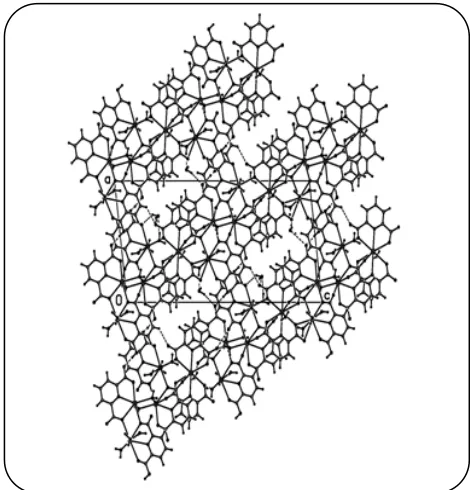
Fig. 4: Crystal Packing of the [C42H38N6O33Sr5.2(H2O)]n along b crystal axis. Hydrogen bonds are shown as dashed lines.
3.601(2) Å for Cg5···Cg6 (-1/2+x, 1-y, -1/2+z) [Cg3, Cg4,
Cg5 and Cg6 are centroids for N3/C15-C19, N5/C29-C33, N2/C8-C12 and N6/C36-C40 rings, respectively] are observed in the compound (Fig. 3).
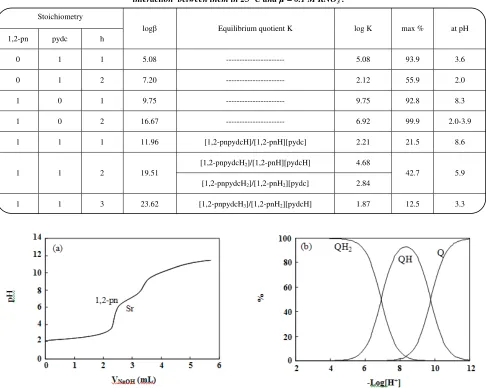
Table 4: Overall and stepwise protonation coststants for pydc and 1,2-pn and recognition constants of interaction between them in 25 ˚C and µ = 0.1 M KNO3 .
Stoichiometry
log Equilibrium quotient K log K max % at pH 1,2-pn pydc h
0 1 1 5.08 --- 5.08 93.9 3.6
0 1 2 7.20 --- 2.12 55.9 2.0
1 0 1 9.75 --- 9.75 92.8 8.3
1 0 2 16.67 --- 6.92 99.9 2.0-3.9
1 1 1 11.96 [1,2-pnpydcH]/[1,2-pnH][pydc] 2.21 21.5 8.6
1 1 2 19.51
[1,2-pnpydcH2]/[1,2-pnH][pydcH] 4.68
42.7 5.9 [1,2-pnpydcH2]/[1,2-pnH2][pydc] 2.84
1 1 3 23.62 [1,2-pnpydcH3]/[1,2-pnH2][pydcH] 1.87 12.5 3.3
Fig 5: Potentiometric titration curves for 1,2-pn in the absence and presence of Sr2+ ion with NaOH 0.105 M at 25 °C and =0.1 M KNO3 (a) and distribution diagram of 1,2-pn(Q) (b).
compound is shown along b crystal axis in Fig. 4, in which hydrogen bonds are presented by dashed lines. In comparison of van der Waals interactions presence in the crystalline network of the title polymeric compound on the basis of their strength the following series is derived: O—H···O and C—H···O > C O··· > –
In preliminary experiments, the fully protonated forms of pydc (L) and 1,2-pn (Q) were titrated with a standard NaOH aqueous solution (Fig. 5a), in order to obtain some information about their protonation constants as building blocks of the pydc–1,2-pn adduct.
The protonation constants of pydc [19, 20] and 1,2-pn were calculated by fitting the potentiometric pH data to
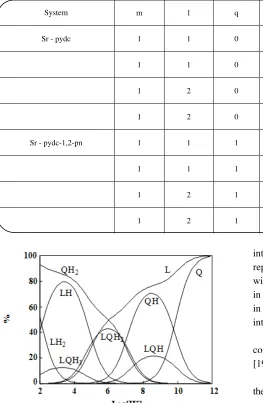
Table 5: Overall stability constants for 1,2-pn/ pydc/ Sr2+ binary and ternary systems at 25 ˚C and µ = 0.1 M KNO3.
System m l q h Log Max % at pH
Sr - pydc 1 1 0 0 5.61 70.2 5.0
1 1 0 1 9.53 64.6 2.0
1 2 0 0 8.43 34.8 >7.8
1 2 0 2 17.65 38.8 3.0
Sr - pydc-1,2-pn 1 1 1 1 17.51 15 8.4-8.7
1 1 1 2 25.12 39.2 5.7
1 2 1 2 26.59 Negligible
1 2 1 3 33.32 22.8 4.3
Fig. 6: Distribution diagram of proton transfer interaction between 1,2-pn (Q) and pydc (L).
(logK = 2.21), 1,2-pnH2pydc(logK = 2.84) or
1,2-pnHpydcH (logK = 4.68) and 1,2-pnH2pydcH (logK = 1.87).
Thus, the solution studies provide additional evidence of association between 1,2-pn and pydc, supporting the evidence from the solid state studies
In order to determine the stoichiometry and stability of the Sr2+ complexes with pydc-1,2-pn proton transfer
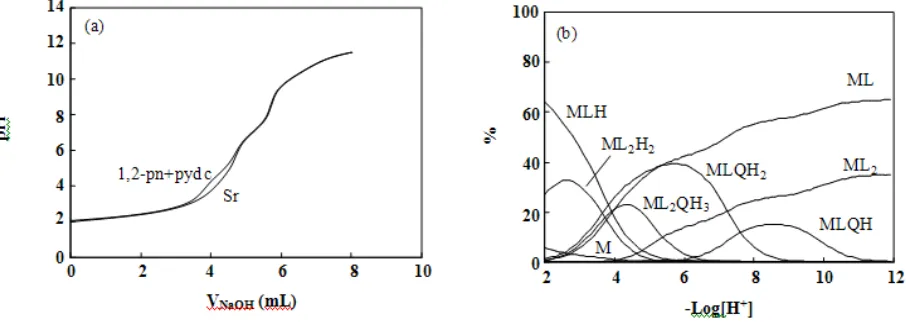
system in aqueous solution, the equilibrium potentiometric pH titration profiles of 1,2-pn, pydc and their 1:1 mixture were obtained in the absence and presence of the Sr2+ ion
(Figs. 5a, 7a and 8a). It was found for 1,2-pn-Sr system no
interaction between 1,2-pn and Sr2+ ion, while it was
reported insignificant interaction between this ligands with some metal ions such as Cu2+, Ni2+, Hg2+, and Zn2+
in literature [22, 25-27]. As it is seen from Fig. 3a and 4a in the case of pydc and pydc-1,2pn relatively significant interaction with Sr2+ ion was observed.
The cumulative stability constants of MmLlQqHh,
complexes mlqh, are defined in our previous publication
[19, 20].
The cumulative stability constants were evaluated by fitting the corresponding pH titration curves to the BEST program and the resulting values for the most likely complexed species in aqueous solutions are also included in Table 5. The corresponding species distribution diagrams for pydc and pydc-1,2-pn in the presence of Sr2+ ions
are shown in Figs.7b and 8b. As it is seen from Table 5 and Fig. 7b for pydc-Sr system most likely binary species are: SrL, SrLH, SrL2 and SrL2H2.
From Table 5 and Fig. 8b, it is readily seen that for the pydc-1,2-pn-Sr system, most likely ternary species are: SrLQH, SrLQH2 and SrL2QH3, but in these systems,
the binary species such as SrL, SrLH, SrL2 and SrL2H2
Fig. 7: Potentiometric titration curves for pydc in the absence and presence of Sr2+ ion with NaOH 0.105 M at 25 °C and =0.1 M KNO3 (a) and distribution diagram of pydc (L)/M binary system. M=Sr2+ (b).
Fig. 8: Potentiometric titration curves for pydc+1,2-pn in the absence and presence of Sr2+ ion with NaOH 0.105 M at 25 °C and =0.1 M KNO3 (a), and distribution diagrams of pydc(L)/1,2-pn(Q)/M ternary systems. M = Sr2+ (b).
CONCLUSIONS
In conclusion, it is clear that molecular plymer design, considering the many possible weak interactions as well as coordinative bonds, is imperative in crystal engineering of this category of compounds. In the crystal structure of the title polymeric compound, [C42H38N6O33Sr5.2(H2O)]n, there are five (Sr1-Sr5) atoms
having different coordination environments. Comparing van der Waals interactions strength presence in the crystallling network of the polymeric compound on the following series may derive: O—H···O and C—H···O > C O··· > – . In order to determine the stoichiometry and stability of the Sr2+ complexes with pydc-1,2-pn,
pydc and their 1:1 mixture were obtained in the absence
and presence of the Sr2+ ion. Results show the
stoichiometry of one of the most abundant complexed species in solution was found to be same as that of the crystalline SrII complex. Further studies are in progress
to prepare same complexes containing polycarboxylic ligands, for clarification of metal centre and/or ligands influence along with the van der Waals interaction in the final obtained coordination geometries [28].
REFERENCES
[1] Yi L., Din B., Zhao B., Cheng P., Liao D.-Z., Yan S.-P., Jiang Z.-H., Novel Triazole-Bridged Cadmium Coordination Polymers Varying from Zero- to Three-Dimensionality, Inorg. Chem., 43, p. 33 (2004).
[2] Withersby M.A., Blake A.J., Champness N.R., Cooke P.A., Hubberstey P., Li W.S., Schroder M., Solvent Control in the Synthesis of 3,6-Bis(pyridin-3-yl)-1,2,4,5-tetrazine-Bridged Cadmium(II) and Zinc(II) Coordination Polymers, Inorg. Chem., 38, p. 2259
(1999).
[3] Shin D.M., Lee I.S., Chung Y.K., Lah M.S., Synthesis and Characterization of Novel Grid Coordination Polymer Networks Generated from Unsymmetrically Bridging Ligands, Inorg. Chem., 42, 5459 (2003).
[4] Hagrman D., Hammond R.P., Haushalter R.P., Zubieta, J., Organic/Inorganic Composite Materials: Hydrothermal Syntheses and Structures of the One-, Two-, and Three-Dimensional Copper(II) Sulfate−Organodiamine Phases [Cu(H2O)3 (4,4‘-bipyridine) (SO4)]·2H2O,
[Cu(bpe)2] [Cu(bpe)(H2O)2(SO4)2]·2H2O, and
[Cu(bpe)(H2O)(SO4)] (bpe = trans-1,2-Bis(4-pyridyl)
ethylene), Chem. Mater., 10, 2091 (1998).
[5] Xu H.B., Li X.F., Yan D., Crystal Structure and Photo- and Electroluminescent Properties of a "Sandglass" Terbium Cluster, Inorg. Chem. Commun.,
11, p. 1187 (2008).
[6] Aghabozorg H., Attar Gharamaleki J., Parvizi M., Derikvand Z., Diacridinium Trans-Diaquabis (Pyrazine-2,3-Dicarboxylato) Cobaltate(II) Hexahydrate,
Acta Cryst. E66, m83 (2010).
[7]Attar Gharamaleki J., Aghabozorg H., Derikvand Z., Yousefi, M., Hydroxonium Creatininium Bis(Pyridine -2,6- Dicarboxylato -κ3O2,N,O6) nickelate(II)
trihydrate, Acta Cryst. E65, m824 (2009).
[8]Aghabozorg H., Derikvand Z.,Attar Gharamaleki J., Yousefi M., Hydroxonium Creatininium Bis(Pyridine -2,6- Dicarboxylato -κ3O2,N,O6) cobaltate(II)
trihydrate, Acta Cryst. E65, m826 (2009).
[9] Aghabozorg H., Attar Gharamaleki J., Olmstead M.M., Derikvand Z., Hooshmand S., Hydroxonium Hydrate Tris(2,4,6-Triamino-1,3,5-Triazin-1-Ium) Bis[Bis(Pyridine-2,6-Dicarboxylato)Cuprate(II)] Pyridine-2,6-Dicarboxylic Acid Hexahydrate, Acta Cryst. E65, m186 (2009).
[10] Aghabozorg H., Ramezanipour F., Soleimannejad J., Sharif M.A., Shokrollahi A., Shamsipur M., Moghimi A., Attar Gharamaleki J., Lippolis V., Blake, A.J., Different Complexation Behavior of a Proton Transfer Com pound Obtained from Pyridine-2,6-di Carboxylic Acid and Creatinine with Tl(I), Cu(II), Fe(III) and Bi(III): Synthesis, Characterization, Crystal Structures and Solution Studies, Polish J. Chem.,82, p. 487 (2008).
[11] Soleimannejad J., Aghabozorg H., Motyeian E., Ghadermazi M., Attar Gharamaleki, Adams, J.H., Propane -1,3- Diaminium -2- Carboxypyridine -6-Carboxylate-Pyridine-2,6-Dicarboxylic Acid-Water (1/2/2/8), Acta Cryst., E64, o231 (2008).
[12] Aghabozorg H., Ghadermazi M., Ramezanipour F., A Proton Transfer Compound: Propane-1,3-Diaminium -Pyridine -2,6- Dicarboxylate -Pyridine-2,6-Dicarboxylic Acid-Water (2/2/2/5), Acta Cryst.,
E62, o1143 (2006).
[13] Palmer K.J., Wong R.Y., Lewis J.C., The Crystal Structure of Strontium Dipicolinate Tetrahydrate, Sr.C7H3NO4.4H2O, Acta Cryst., B28, p. 223 (1972).
[14] Aghabozorg H., Manteghi F., Sheshmani S., A Brief Review on Structural Concepts of Novel Supramolecular Proton Transfer Compounds and Their Metal Complexes, J. Iran. Chem. Soc., 5,
p. 184 (2008). and Refs. [31–140] therein.
[15] Soleimannejad J., Aghabozorg H., Hooshmand S., Adams H., 4,4'-Bipyridinediium Triaquabis (Pyridine-2,6-Dicarboxylato)Strontium(II) Trihydrate,
Acta Cryst., E63, m3089 (2007).
[16] Eshtiagh-Hosseini H., Aghabozorg H., Mirzaei M., Beyramabadi S.A., Eshghi H., Morsali A., Shokrollahi A., Aghaei R., Hydrothermal synthesis, experimental and theoretical characterization of a novel cocrystal compound in the 2:1 stoichiometric ratio containing 6-methyluracil and dipicolinic acid, Spectrochim. Acta., 78A, p. 1392
(2011)
[17] "Bruker APEX2 Softwarwe Package", Bruker AXS Inc., 5465, East Cheryl Parkway, Madison, WI 5317 (2005).
[19] Aghajani,Z., Aghabozorg H., Sadr-Khanlou E., Shokrollahi A., Derki S., Shamsipur M., Chromium(III) and Calcium(II) Complexes Obtained from Dipicolinic Acid: Synthesis, Characterization, X-Ray Crystal Structure and Solution Studies,
J. Iran. Chem. Soc.,6, p. 373 (2009).
[20] Aghabozorg H., Daneshvar S., Motyeian E., Manteghi F., Khadivi R., Ghadermazi M., Shokrollahi A., Ghaedi M., Derki S., Shamsipur M., Synthesis and Crystal Structure of Mn(II) and Hg(II) Compounds and Solution Studies of Mn(II), Zn(II), Cd(II) and Hg(II) Compounds Based on Piperazinediium Pyridine-2,3-dicarboxylate, J. Iran. Chem. Soc.,6, p. 620 (2009).
[21] Martell A.E., Motekaitis R.J., “Determination and Use of Stability Constants”, 2nd ed., VCH, New York, (1992).
[22] Nasanen R., Merilainen P., Butkewitsch O., Suomen Kemistilehti, B35, p. 219 (1962).
[23] English J.B., Martell A.E., Motekaitis R.J., Murase I., Molecular Interaction of Pyrophosphate with 1,13-Dioxa-4,7,10,16,20,24-Hexaazacyclohexacosane (OBISDIPEN) and Its Mononuclear and Dinuclear Copper(II) Complexes, Inorg. Chim. Acta., 258,
p. 183 (1997).
[24] Sharif M.A., Aghabozorg H., Shokrollahi A., Kickelbick G., Moghimi A., Shamsipur M., Novel Proton Transfer Compounds Containing 2,6-Pyridinedicarboxylic Acid and Melamine and Their PbII Complex: Synthesis, Characterization, Crystal
Structure and Solution Studies, Polish J. Chem., 80,
p. 847 (2006).
[25] Nasanen R., Merilainen P., Lukkari S., Stability of the Mixed Copper Complex of 1,2-Diaminopropane and 5-Sulphosalicylic Acid in Aqueous Sodium Perchlorate Solutions, Acta. Chem. Scand., 17, p. 2384 (1962).
[26] Roe D.K., Masson D.B., Nyman,C.J., Thermodynamic Constants of Complex Ion Formation between Mercury(II) and Three Alkylamines, Anal. Chem., 33, p. 1464 (1961).
[27] Nasanen R., Merilainen E., Heinanen E., Suomen Kemistilehti, B35, p. 15 (1962).
[28] Mirzaei M., Aghabozorg H., Eshtiagh-Hosseini H., A Brief Review on Structural Concepts of Novel Supramolecular Proton Transfer Compounds and Their Metal Complexes Part(II), J. Iran. Chem. Soc.,
![Table 2: Selected bond lengths (Å) for [C42H38N6O33Sr5.2(H2O)]n.](https://thumb-us.123doks.com/thumbv2/123dok_us/8450123.1704735/4.595.57.544.420.667/table-selected-bond-lengths-a-c-h-sr.webp)
![Fig. 2: Different coordination numbers around the central atoms in [C42H38N6O33Sr5.2(H2O)]n .](https://thumb-us.123doks.com/thumbv2/123dok_us/8450123.1704735/5.595.56.543.97.505/fig-different-coordination-numbers-central-atoms-c-sr.webp)