[Nyakora * et al., 5(2): February, 2018]
ISSN: 2349-5197
Impact Factor: 3.765
I
NTERNATIONAL
J
OURNAL OF
R
ESEARCH
S
CIENCE &
M
ANAGEMENT
DEVELOPMENTAL MODELS THAT FACILITATE THE DEVELOPMENT OF OD
SYSTEMS TO
IMPROVE
OR
CHANGE
SOCIO-CULTURAL
SYSTEMS
THROUGH UTILIZATION OF VALID KNOWLEDGE TO DEPICT SOME
PHENOMENON
Prof. Nyakora, Musa O., ( PhD, MKIM, MIHRM, AKISM, SHRM, GIODN)*
*Full Professor and Director, PhD and MA in Leadership Programs. Adventist University of Africa,
School of Postgraduate Studies
DOI: 10.5281/zenodo.1168820
Keywords
:
Developmental models, Organizational Development (OD), Planned Change, Theories, Socio-cultural Systems, Resistance to change, Force Field.Abstract
Organizational development (OD) is planned change in an organizational context. Planned charge according to Bennis is: "the conscious deliberate and collaborative effort to improve the operations of a human system whether it be a self-system, social system, or cultural system, through the utilization of valid knowledge." The development of models of planned change is known to have facilitated the development of OD. Models and theories that depict, in words or pictures, the important features of some phenomenon, describe those features as variables and specify the relationships among variables. French and Bell (3) acknowledge the role of planned change theories in identifying the important variable involved in change. The theories of change increase our understanding of what happens and how it happens in planned change, French and Bell have explored several models from the literature for thinking about planned change.
Furthermore, organizations are not mechanistic, rational, problem solving entities. They are also messy, contradictory and ornery. Therefore, paying attention to people and to their needs and feelings is essential. There are a number of theories of organizational change based on different ideas about what organizations are, some focus on structure and formal relationships. Others on culture and how individuals interpret and relate to change
Introduction
Background of the Study
Theories of change are best when one need to:
• Design a complex initiative and want to have a rigorous plan for success. • Evaluate appropriate outcomes at the right time and the right sequence.
• Explain why an initiative worked or did no: work and what exactly went wrong.
Managing change is not solely a "management Issue". Change involves everyone in the organization, not just leaders. The collective experience, knowledge, and needs of participants are the raw material for change. Collective ownership of outcome is the best guarantee of success.
As open systems, organizations are permeable to external influence. Managing change involves paying attention to the organizational environment, both immediate and large scale first to understand it, then to figure out how to deal with it.
[Nyakora * et al., 5(2): February, 2018]
ISSN: 2349-5197
Impact Factor: 3.765
I
NTERNATIONAL
J
OURNAL OF
R
ESEARCH
S
CIENCE &
M
ANAGEMENT
As we approach the 21st Century the pace and scale of change demanded of organizations and those who work within them are enormous. Global competition and the advent of the information age, where knowledge is the key resource, have thrown the world of work into disarray. Just as we had to shed the processes, skills and systems of the agricultural era, so we are now having to shed ways of working honed for the industrial era to take advantage of the opportunities offered by the information age.
Organizations are attempting to recreate themselves and move from the traditional structure to a dynamic new model where people can contribute their creativity, energy and foresight in return for being nurtured, developed and enthused. (Jones et al 1996). (6)
Most people agree that organizational life is becoming ever more uncertain as the pace of change quickens and the future becomes more unpredictable. This is echoed by academics and business people alike. For example, looking ahead into the future, Drucker, writing in 1988 maintained that 20 years hence (i.e. 2008) organizations would be almost wholly information based.
Whether all that is predicted will come to be. or not may be arguable. What seems uncontestable is that the organizational world is changing at a fast rate - even if the direction of change is not always predictable. Consequently, it is crucial that organizational managers and decision makers are aware of, and understand, more about the environmental winds which are blowing to disturb organizational life, in other words to be able to analyze the factors which trigger organizational change.
Review of Existing Literature
French and Bell (i) have acknowledged that the knowledge base of OD is extensive and is constantly growing, they have highlighted what they believe are the most important underpinnings for the field, in their examinations of the following concepts:
Models and theories of planned change.
Systems Theory
Participation and empowerment.
Parallel learning structures
A normative - re-educative strategy of changing
Applied behavioral science
Action Research
In many textbooks, theories and models are used interchangeably. Theory describes a set of systematically interrelated concepts or hypothesis that purports to explain or predict phenomena.
In this I will mainly examine the models and theories of planned change.
Major Findings from existing Literature of Models and Theories of Planned Change
Kurt Lewin and Friends
Kurt Lewin is known to have introduced two ideas about change that have been influential since the 1940s. (4) The first idea states that what is occurring at any point in time is a resultant in a field opposing forces. That is, the status quo - whatever is happening right now - is the result of forces pushing in opposing directions. For example, we can think the production level of a manufacturing plant as a resultant equilibrium point in a field of forces, with some forces pushing toward higher levels of production and some forces pushing towards lower levels of production. The production level tends to remain fairly constant because the field of forces remains fairly constant.
[Nyakora * et al., 5(2): February, 2018]
ISSN: 2349-5197
Impact Factor: 3.765
I
NTERNATIONAL
J
OURNAL OF
R
ESEARCH
S
CIENCE &
M
ANAGEMENT
Barbara Senior
Barbara Senior, writing on obstructing and facilitating processes for change has illustrated some of the factors which facilitate or obstruct change as given in the illustration here below. The forces for change listed in Illustration 2.1 below are categorized into individual responses and organizational responses. Yet another distinction which could be made is between those forces which -
• prevent a new perspective being formed and
• prevent implementation of change once the intentions for change are known (Ginsberg and Abramson; 1991) (6)
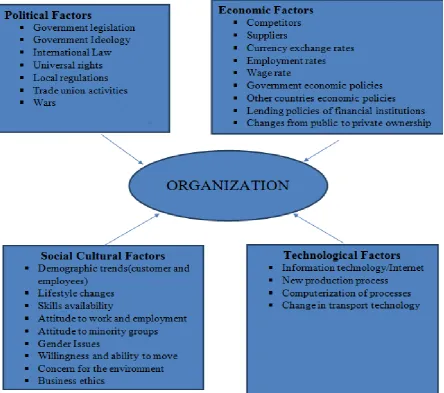
Some analytics have found it useful to group different environmental factors into categories under the mnemonics PEST (Johnson and Schools, 1999 and STEP) (Goodman, 1995), both of which refer to the Political, Economic, Technological and Socio-cultural factors which influence organizations, their strategies, structures and means of operating, including their human resource practices. Figure 1 below illustrates the PET'' factors which exist as part of an organizations environment. All, at some time, will impact upon an organization's formal and informal subsystems and their components as well as which products or services it offers and in which markets.
[Nyakora * et al., 5(2): February, 2018]
ISSN: 2349-5197
Impact Factor: 3.765
I
NTERNATIONAL
J
OURNAL OF
R
ESEARCH
S
CIENCE &
M
ANAGEMENT
External and internal Forces Associated with change
Barbara Senior quoting Jones, Palmer, Osterweil and Whitehead (1996) has come up with the following Forces for and against change model:
Table1:(adapted from senior, organizational change pp 252). Driving forces for change Driving forces against change
External Forces:
• Role of the State
• Social pressures
• Changing Technology
• Constraints from Suppliers
• Stakeholder demands
• Competitor behavior
• Customer needs
Internal Forces:
• Organizational growth
• Pressures for increased
Performance
• Managerial aspirations
• Political Coalitions
• Redesign of jobs • Restructuring
Individual Resistance:
• Fear of the unknown
• Dislike of the uncertainty and
ambiguity surrounding change
• Potential loss of power base.
• Potential loss of rewards
• Perceived lack of skills for new
situation.
• Potential loss of current skills
Organizational resistance
• Inertial Forces deriving from
systemic nature of Organizations
• Interlocking aspects of structure, control systems,
rituals, and routines, signs and symbols
• Inertial forces deriving from group norms. ■ Potential loss of group power Basis
■ Entrenched interests of Stakeholders
■ Lack of organizational capability ■ Lack of resources
■ Threat to resource allocation
The forces originating from external environment together with internal forces, such as the need for new product development or restructuring to accommodate new technological processes are likely to facilitate change in that they are the triggers for change. However, these forces may be counteracted by other forces which resist change; For instance, those listed in the illustration.1. Which, themselves, may be externally or internally generated. However, the role of leading change is more likely to be concerned with resistance from inside the organization (which can be from individuals or be organizationally generated), this being the type of resistance most immediately manageable.
[Nyakora * et al., 5(2): February, 2018]
ISSN: 2349-5197
Impact Factor: 3.765
I
NTERNATIONAL
J
OURNAL OF
R
ESEARCH
S
CIENCE &
M
ANAGEMENT
The theory, upon which the technique is based, implies that when the balance of the two sets of forces is equal, no change will occur. Thus it is argued that, if change is desired, the forces supporting change need to be strengthened and those opposing change weakened.
Table 2above is a generic representation of a force field diagram. Barbara Senior highlights an outline of the steps necessary for carrying it out as explained by Camel! (1995). (9)
Main Recommendations
Force Field Analysis
The following steps are recommended by Senior:
Step 1: involves defining the problem in terms of the present situation, with its strengths and weaknesses, and the situation you would wish to achieve. The target situation should be defined as precisely and unambiguously as possible.
Step 2: Involves listing the forces working for and against the desired change. These can be based on people, resources, time, external factors, and corporate culture.
Step 3: Is about rating each of the forces for and against change in terms of strength; high, medium or low. Giving the strength ratings numerical value; 5 for high, 3 for medium, and 1 for low; this allows totals for driving and resisting forces to be calculated.
Step 4: Involved using a diagram such as that in illustration1 to draw lines of different lengths to indicate the different strengths of the forces.
Step 5: Labeling each line to indicate whether that force is very important (VI, important
(I)
or not important (Nl)Step 6: for each very important (VI) and important (I) force supporting the change, indicate how you would attempt to strengthen the force. Then do the same for those forces opposing the change, but in this case, indicate how you would weaken the force.
Step 7: Agree on those actions which appear most likely to help solve the problem of achieving change.
Step 8: Identify the resources that would be needed to take the agreed actions and how these resources may be obtained.
Step 9: Make a practical action plan designed to achieve the target situation which should include: Timing of events
Specified milestones and deadlines Specific responsibility who does what.
Organizational Change and the Environment
Organizational change is defined as the adoption of a new idea or behavior by an organization, as defined by Richard Daft.
He emphasizes that in today's highly complex world, organizations need to continuously adapt to new' situations if they are to survive and prosper. The current trend is toward development of the learning organization, which is the epitome of continuous organizational change and growth. The learning organization engages everyone in problem solving and continuous improvement based on the lessons of experience.
The external environment
Daft writing on the external environment defines it to include all elements existing outside the boundary of the organization that have the potential to affect the organization. The environment includes competitors, resources, technology and economic conditions that influence the organization.
[Nyakora * et al., 5(2): February, 2018]
ISSN: 2349-5197
Impact Factor: 3.765
I
NTERNATIONAL
J
OURNAL OF
R
ESEARCH
S
CIENCE &
M
ANAGEMENT
Source: Daft: Management (2001) PP 73
The general environment is the outer layer that is widely dispersed and affects organizations indirectly. It includes social, demographic and economic factors that influence all organizations about equally. These events do not directly change day-to-day operations, but they do affect all organizations eventually.
The task environment is closer to the organization and includes the sectors that conduct the day-to-day transactions with the organization and directly influence its basic operations and performance. It is generally considered to include competitors, suppliers and customers.
The organization also has an internal environment, which includes the elements within the organization's boundaries. The internal environment is composed of current employees, management and especially corporate culture, which defines employees' behavior in the internal environment and how well the organization will adapt to the external environment.
Planned and emergent change
[Nyakora * et al., 5(2): February, 2018]
ISSN: 2349-5197
Impact Factor: 3.765
I
NTERNATIONAL
J
OURNAL OF
R
ESEARCH
S
CIENCE &
M
ANAGEMENT
Barbara senior (12) observes that while it could be speculated that in an ideal world organizational sensing of the environment would be so effective as to render frame breaking change unnecessary, he is quick to point out that in practice it does not happen. Change therefore does not emerge naturally and phenomenon have been described by such writers as Tushman et al (1988) whereby managers and other organizational personnel become so comfortable with "how we work here" and "what we hold important here" that they also become impervious to warning signs of impending difficulties from the environment.
Both fine-tuning and incremental adjustments to environmental shifts allows organizations to perform more effectively and optimize the consistencies between strategy, structure, people and processes. Yet Tushman et al. acknowledge that as organizations grow, they become more successful and develop internal forces for stability. These same forces eventually produce resistance when, for whatever reason, an organization's strategy must change. Thus at times of a major change in an organizations environment, incremental adjustment will not bring about the major changes in strategy, structure, people and processes which might be required. At times like these most organizations according to Tushman et al. will be required to undergo discontinuous or frame-breaking change. Such change springs from one or a combination of the following:
• Sharp changes in the legal, political or technological conditions which shift the basis of competition e.g. deregulation, substitute product technologies.
• Product lifecycle shifts • Internal company dynamics • Reformed mission and core-values • Altered power and status
• Reorganization
• Revised interaction patterns • New executives
Frame-breaking change is revolutionary in that the shifts reshape the entire nature of the organization. It requires discontinuous shifts in strategy, structure, people and processes concurrently. Reasons for the rapid, simultaneous implementation of frame-breaking change include:
• Synergy - the need for all pieces of the organization to pull together.
• Pockets of resistance - have a chance to grow and develop when frame-breaking change is implemented slowly.
• Pent-up need for change: - when constraints are relaxed, change is in fashion.
• Riskiness and uncertainty - the longer the implementation period, the greater the period of uncertainty and instability.
Forces for organizational change (according to Daft 2001) exist both in the external environment and within the organization.
An overall model for planned change is prescribed below as figure 2.2.
Four events make up the change sequence.
(1) Internal and External forces for change exist.
[Nyakora * et al., 5(2): February, 2018]
ISSN: 2349-5197
Impact Factor: 3.765
I
NTERNATIONAL
J
OURNAL OF
R
ESEARCH
S
CIENCE &
M
ANAGEMENT
Fig.3: Model of change sequence of events: (Adopted from Daft PP 365)
Need for Change
As indicated in Fig. 3 above, external or internal forces translate into a perceived need for change within the organization. Managers sense a need for change when there is a performance gap - a disparity between existing and desired performance levels. The performance gap may occur because current procedures are not up to standard or because a new idea or technology could improve current performance. Managers try to establish a sense of urgency so that others will understand the need for change.
Managers in every company must be alert to problems and opportunities because the perceived need for change is what sets the stage for subsequent actions that create a new product or technology. Big problems are easy to split. Sensitive monitoring systems are however needed to detect gradual changes that could be deceptive to managers making them think their company is doing fine and thus fail to trigger an organizational response. Failing to use planned change to meet small needs can place the organization in hot water as illustrated by the following passage:
"When frogs are placed in boiling pail of water, they jump out they don’t want to boil to death. However, when frogs are placed in a cold pail of water and the pail is placed or} a stove with the heat turned very low, over time the frogs will boil to death."
Daft portends that after the need for change has been perceived and communicated, the next part of the change process is initiating change, a truly critical aspect of change management. This is where the ideas that solve perceived needs are developed. According to Daft responses that an organization can make are to search for or create a change to adopt as explained here below:
Search
Search is the process of learning about current developments inside or outside the organization that can be used to meet the perceived need for change. Managers talk to friends and colleagues read professional reports or hire consultants to learn about ideas used elsewhere
[Nyakora * et al., 5(2): February, 2018]
ISSN: 2349-5197
Impact Factor: 3.765
I
NTERNATIONAL
J
OURNAL OF
R
ESEARCH
S
CIENCE &
M
ANAGEMENT
Creativity
Creativity is the generation of novel ideas that may meet perceived needs or respond to opportunities for the organization. Creativity is the essential first step in innovation, which is vital to long-term organizational success.
Creative people are often known for originality, open mindedness, curiosity, and a focused approach to problem solving, persistence, a relaxed and playful attitude and receptivity to new idea.
Creativity can also be designed into organizations. Managers are responsible for creating a work environment that allows creativity to flourish.
Daft defines the characteristics of creative organizations demonstrating how they correspond to those of individuals as per the illustration below:
Idea champions and New - Venture Teams
If creative conditions are successful, new ideas will be generated that must be carried forward for acceptance and implementation. An idea champion is very relevant at this stage. An idea champion - a person who seas the need for and champions productive change within the organization. A good example is Bonnie McKeever of Federal Express who championed the idea of a coalition of companies to combat mounting medical fees. The Memplus Business Group on Health was created, saving its members estimated tens of millions of dollars through competitive bidding and discounts.
[Nyakora * et al., 5(2): February, 2018]
ISSN: 2349-5197
Impact Factor: 3.765
I
NTERNATIONAL
J
OURNAL OF
R
ESEARCH
S
CIENCE &
M
ANAGEMENT
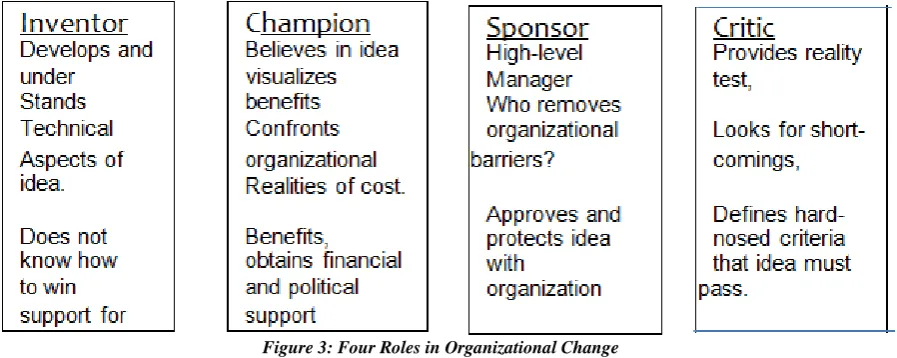
Championing an idea successfully requires roles in organizations as illustrated in figure 1.3. Sometimes a single person may play two or more of these roles, but successful innovation in most companies involves interplay of different people, each adopting one role:
Figure 3: Four Roles in Organizational Change
Source: (Based on Harold L Angle and Andrew H. Van de Ven, "Suggestions for Managing the
InnovationJourney" as quoted by Daft PP. 370).
Review Findings
A recent idea for facilitating corporate innovation is known as new-venture team. This is a unit separate from the rest of the organization and is responsible for developing and initiating a major innovation. New venture teams give free reign to members' creativity because their separate facilities and location free them from organizational rules and procedures. These teams typically are small, loosely structured and flexible reflecting the characteristics of creative organizations described in illustration 1 above.
According to Peter Drucker, organizations that wish to innovate should use a separate team or department:
Tor the existing business to be capable of innovation, it has to createa structure that allowspeople to be entrepreneurial. This means, first, that the entrepreneurial, the new, has to berecognized separately from the old and the existing. Whenever we have tried to make an existing unit the carrier of the entrepreneurial project, we have failed".
[Nyakora * et al., 5(2): February, 2018]
ISSN: 2349-5197
Impact Factor: 3.765
I
NTERNATIONAL
J
OURNAL OF
R
ESEARCH
S
CIENCE &
M
ANAGEMENT
Fig: 4. Horizontal Matrix
Recommendations and Conclusions
In the matrix - structure employees remain members of their everyday departments and simply work on a project part-time while reporting to their regular boss. Under the new venture team concept, employees no longer report through the normal structure. New venture teams are kept small and separate to ensure that no bureaucracy will intrude.
Creative culture, idea champions, and new venture teams are ways to facilitate the initiation of new ideas. 7 he other step to be managed in the change process is implementation. A new creative idea will not benefit the organization until it is in place and being fully utilized. One frustration from managers is that employees seen) to resist change for no apparent reason.
To effectively manage implementation process, managers should be aware of the reason for employee resistance and be prepared to use techniques for obtaining employee cooperation.
The mobility of people to adapt to change is not new. Neither is the failure of management to sufficiently lay the groundwork to prepare employees for change. Harvard Professor John P. Kotter established an eight-step plan for implementing change that can provide a greater potential for successful transformation of an organization.
References
[1] Noel M. Tichy and Mary Anne Devanna, The Transformational Leader – The Key to Global Competitiveness, (1990).
[2] French W. L and Bell CH Jr. Organizational Development Behavioral Science Intervention for Organizational Improvement, 6th d. (Prentice Hall India, 2005)
[3] Barbara Senior, Organizational Change, 2nd Ed. FT Prentice Hall, 2002.
[4] Daft R.L., Management, Harcourt College Publishers, 301 Commerce Street, Suit 3700, Forth Worth, TX 76102.
[5] Robins, Stephene P., Organizational Behavior, PP 345.
[6] Wendell L. French, Cecil H. Bell, Jr.and Robert A. Zawacki, Organization Development and Transformation – Management Effective Change - Irwin McGraw- Hill, 2000
[7] B.J Hodge, William P. Anthony and Lawrence M. Wales, Organization Theory – A Strategic Approach- 5th Ed.(1996). Prentice Hall International Inc.
[8] Dave Francis and Don Young, Improving Work Groups: A practical Manual for Team Building -Revised- (1992)