program design and professional practice
in CMCC’s undergraduate chiropractic program
Ron Saranchuk,
PhD*
Terry Watkins,
DC, FCCSS (Hons)**
This study examines the linkage between education and professional practice. Using a consumer-based
retrospective survey, alumni from the 1993 to the 1998 CMCC graduating classes were asked to evaluate how well they believed that their undergraduate program had prepared them for professional practice. Alumni
responses were collected under the overall category of
preparation for practice, and also under the more specific
categories of appropriateness of course content,
appropriateness of time allocation, and ‘unnecessary’ repetition of content. Findings from this study showed
that, overall, the CMCC undergraduate chiropractic program prepared its students well for professional practice and, where more specific program concerns were identified, modifications may be called for across a multitude of data variables. This study shows that a retrospective analysis based on the experiences and reflections of the CMCC alumni of their program presents a reliable and valid method for curriculum review. The data collected support the assumption that a linkage exists between undergraduate education and professional practice.
(JCCA 2000; 44(4):230–244)
K E Y W O R D S: professional, alumni, program, curriculum, content, time, repetition, continuous improvement.
La présente étude vise à analyser le lien entre la formation et la pratique professionnelle. Dans une enquête rétrospective fondée sur les consommateurs, on a demandé aux diplômés du CMCC des cohortes de 1993 à 1998 d’évaluer la qualité du programme de premier cycle du point de vue de la préparation à la pratique professionnelle. Les réponses ont d’abord été classées dans la catégorie générale de la préparation à la pratique, puis dans des catégories plus précises, soit la pertinence du contenu des cours, l’attribution du temps et les répétitions « inutiles » de contenu. Dans
l’ensemble, les résultats de l’enquête montrent que le programme de premier cycle du CMCC prépare
adéquatement les étudiants à la pratique professionnelle; quant aux points laissant à désirer, des modifications pourraient être apportées à une foule de variables. L’étude montre qu’une analyse rétrospective reposant sur l’expérience et les réflexions des diplômés du CMCC constitue une méthode fiable et valable de révision du programme. La collecte de données étaye l’allégation selon laquelle il existe un lien entre la formation au premier cycle et la pratique professionnelle.
(JACC 2000; 44(4):230–244)
M O T S C L É S : professionnel, diplômé, programme, programme d’études, contenu, temps, répétitions, amélioration continue.
* Assistant Professor, Coordinator of Curriculum and Evaluation, CMCC.
** Associate Professor, Chair – Department of Chiropractic Principles and Practice, CMCC. 1900 Bayview Avenue, Toronto, Ontario, Canada M4G 3E6. Tel. 416-482-2340.
© JCCA 2000. Introduction
Researcherssuch as Friedson, Doyle, Cruess & Cruess1–3 describe a profession as an occupational group that claims not only to have expertise in a particular sphere of practice, but which benefits also from the legitimacy provided through public acceptance of what the occupation asserts
expertise.4 Thus, one might reasonably infer that profes-sions are characterized by the nature of preparation they provide to their members.
Accordingly, this enquiry probes the foundation of this preparation for practice at the Canadian Memorial Chiro-practic College (CMCC) by asking the alumni to report on the degree to which they have been prepared to prac-tice as professionals. Other researchers5–8 have com-mented on the positive relationship they believe needs to exist between chiropractic education, patient care, and professional credibility. Nevertheless, there remains a dearth of knowledge and research on the relationship be-tween chiropractic education and professional practice.
In turn, this study is designed to extend the research and knowledge base concerning the relationship between chiropractic education and professional practice. It is an evaluation that is consumer-based,9,10 and is grounded in a number of concerns fundamental to the undergraduate educational program. In addition to the ‘preparation for practice’ variable, the authors believed it important to ask
How can the needs of the alumni be utilized to influence changes in their professional program? This study also
relates to another question that underlies professional edu-cation more generally: How can professionals help
de-velop the professional education program which helped prepare them for practice? Accordingly, the main and
supporting questions investigated in this study are:
How well does the undergraduate chiropractic program prepare the students for professional practice?
i How appropriate was the program’s course content in preparing the students for professional practice? ii How appropriately was instructional time allocated in
the chiropractic program?
iii How much “unnecessary” repetition of course content exists in the program?
CMCC has a group of curriculum competencies that serve as a basis for fulfilling its goal of “providing an educational program that helps develop competent doctors of chiropractic”. The CMCC Alumni Curriculum
Develop-ment Survey is designed to gather data from those who not
only have been the recipients of the undergraduate chiro-practic program and who have applied it in professional practice, but who also have had the opportunity to reflect
on how well the program has prepared them as profes-sional practitioners.
In this inquiry it is assumed that there is a direct and meaningful relationship between the academic and clinical experiences students receive in their undergraduate chiro-practic program and how well these experiences prepare them for professional practice. Second, the variables of content, time and “unnecessary” repetition in the program individually, and in combination, are assumed to prepare our graduates for professional practice. It is also assumed that knowledge which is competency-based, integrated, and relevant to chiropractic practice has a positive influ-ence in preparing the students for professional practice; that time dedicated to components of the curriculum that are characterized by effective and diverse instructional delivery, and is on-task contributes to classroom learning; and that some repetition in the knowledge delivered might be acceptable because of a need to help reinforce concepts, skills, and/or attitudes, and because of their core impor-tance to practice. However, we also assume that in contrast to “necessary” repetition, there may be “unnecessary” rep-etition in knowledge delivered, and that this “unneces-sary” repetition may have an unfavorable impact on preparing the students for professional practice.
Preparation for Practice refers to how well each
course/skill category in the curriculum contributed to a student’s overall preparation for practice. Course Content refers to knowledge and skill categories which were deemed suitable in preparing students for practice. Time refers to the time allocated in the timetable for the delivery of each course/skill category in order to prepare students for practice. Unnecessary Content Repetition refers to the delivery of knowledge, attitudes and skills that are re-peated either within or between courses, but which do not have a positive effect on preparation for practice. Program refers to the entire combination of academic and clinical experiences students receive at CMCC as a prelude to be-ginning professional practice while curriculum refers more specifically to separate components of the chiroprac-tic curriculum. Course and Skill Categories refers to the eighteen course and the seventeen skill categories perti-nent to, and specified in the program tables presented.
Division refers to the faculty of Undergraduate Studies
The context
The Canadian Memorial Chiropractic College is a pri-vately owned institution chartered under the Corporations Act of Ontario. The program admits students who, mini-mally, have acquired at least three full years of under-graduate university study, an appropriate grade point average, verbal and written facility with the English lan-guage, and a standard of character suitable to the chiro-practic profession. The current program lasts for four years, i.e., for 36 months, which includes academic as well as clinical training in the College’s Out Patient Clinic as part of the Clinic internship requirements.
The CMCC undergraduate program is the combination of cognitive, affective and psychomotor domains of areas of knowledge, attitudes, and skills that help to make up its chiropractic competencies. The CMCC Competency Document,11 completed in 1997 outlines foundational knowledge, diagnostic, treatment, and management com-petencies critical to patient care. Students experience the program through lecture, tutorial, clinical rounds, self-directed instructional, and clinical internship formats. Four administrative departments (i.e., Biological Sci-ences, Chiropractic SciSci-ences, Clinical SciSci-ences, and Clini-cal Education) are included in the management of the overall undergraduate program. The main goal of the un-dergraduate program is to prepare students to apply what they learn in their program to professional practice. The knowledge and skill categories in the CMCC chiropractic program are intertwined in order to help fulfill this goal.
The sample
The data from this inquiry come from CMCC alumni who
have completed all of their program requirements. Re-sponses were received from 325 alumni (52% rate of re-turn) who graduated from CMCC between the 1993/94 and 1997/98 school years. Table 1 illustrates the distribu-tion of responses of the sample according to year of graduation.
The number of respondents by year varies from a low of 58 (18%) to a high of 71 (22%). As a result, responses shown in Table 2 were fairly evenly divided according to experience in practice.
From Table 2 it can be seen that the numbers of respond-ents according to experience in practice vary from a low of 54 (with five years) to a high of 76 (with two years). How-ever, in percentage terms, the range of variance is from 17% to 24% for these years. Table 3 identifies the area of respondents’ residences.
It can be seen that most of the respondents reside in Ontario (57%) and in British Columbia (13%). All of the other respondents make up the remainder (30%) of the sample.
Study design, data, and data collection
The descriptive survey used in this study has a five-point Likert Scale. The survey was separated into two formats for the purpose of accuracy in data collection. A five-point sliding scale was used in collecting data about the catego-ries of Amount of Time in the Curriculum and Content
Repetition, where 1 = too little, and 5 = too much. For
the categories of Preparation for Practice and Content of
Courses, a scale where 1 = poor, 2 = fair, 3 = good,
4 = very good, and 5 = excellent was used. The results from these two groups of categories need to be interpreted Table 1 Yearly Distribution of Sample Responses
1993 1994 1995 1996 1997
18% 21% 21% 22% 19%
(N = 58) (N = 67) (N = 68) (N = 71) (N = 61)
Table 2 Respondent Practice Experience by Number of Years
1 Year 2 Years 3 Years 4 Years 5 Years
17.6% 24% 20% 22% 17%
in terms of their own contexts (e.g., a ‘5’ denoting ‘too much’ time in Physiology is not comparable to a ‘5’ denot-ing ‘excellent’ in Preparation for Practice for Physiology). This survey provided the respondents with opportunities to respond to open-ended statements.
Although both advantages and disadvantages are asso-ciated with this research design,12 the advantages are seen to outweigh the disadvantages. This survey design permit-ted wide coverage of our population at minimum expense in terms of money and time. It afforded an international scope, and reached people who would otherwise have been difficult to interview. The wide coverage of our sample contributed to a greater validity and reliability through a larger and more representative sample. The detailed tex-tual survey permitted the authors to receive data on more considered responses. The same textual format provided our sample with greater uniformity in the manner in which the questions were posed. Not only did it lessen the inter-viewer effect, but it also gave our respondents a sense of privacy. Finally, it set up a simple means of continual reporting over time. However, the problem of non-returns must be addressed since those who answered the survey may differ significantly from the non-respondents, thereby biasing the sample. However, a response of 325 returns out of a possible 620 (52%) helps to ensure that the data col-lected is statistically reliable.
The survey was designed in May and June of 1998. It was critiqued by twelve CMCC faculty members, and was then pilot-tested with twelve resident students, and faculty. Feedback from these trials was incorporated into the re-finement of the survey. It was then mailed out in the third week of September, 1998 to 620 alumni. Responses were
received from 325 (52%) of these alumni by December of 1998. The results were inputted on SPSS (Version 9.0), and Corel WordPerfect (Version 9) for data organization, statistical analyses, and graphic presentation.
Presentation of data
The data in this study is displayed through tables contain-ing lower and upper confidence intervals of course and skill areas. All means are presented in relation to the five point Likert Scale of the survey. The confidence interval (CI) takes into account the variance around the mean for each score collected. Therefore, the estimation approach to our analyses with the CI presents degrees of certainty as well as of uncertainty regarding the strength of the vari-ables.13 It offers more information for making inferences about the entire alumni and chiropractic population. To-gether, the lower and upper limits that define the range of the CI are the ‘confidence limits’ of that CI. The CIs in the tables in this study are at the 95% level of confidence, i.e., we can be 95% confident that the true population value lies within our confidence limits. (In turn, a ‘significant’ p-value of p < .05 will correspond to a 95% CI). Because the CIs elaborate (rather than merely indicate) the significance or insignificance of a variable, the strength of evidence14 about courses and skills offer more robust data for the continual improvement of CMCC’s undergraduate chiro-practic program.
Finally, the entire range of course and skill categories is presented for all four administrative departments within CMCC. As a result, data may be compared within and between administrative departments.
Table 3 Respondent Residence by Geographic Area
British Columbia 13% (N = 41) Nova Scotia 3.2 (N = 10)
Alberta 6.1% (N = 20) New Brunswick 1.9% (N = 6)
Saskatchewan 3.6% (N = 12) Prince Edward Island .3% (N = 1)
Manitoba 1.3% (N = 4) Newfoundland 1.6% (N = 5)
Ontario 57% (N = 186) United States 1.35 (N = 4)
Significance of the study
Two strategies4 have been undertaken by professional schools to ameliorate tension between organizing theoreti-cal and practitheoreti-cal knowledge. The first of these is to codify knowledge, and to give students as much understanding as possible about every conceivable situation they might ever encounter. The alternative strategy is to give students the kind of reasoning skills and strategies that will allow them to adapt to a wide variety of situations they are likely to encounter as licensed practitioners. As documented by the American Association of Medical Colleges (AAMC),15 the trend to balancing the theoretical with the practical in health science programs is now commonplace. However, balancing the theoretical and the practical is not necessar-ily synonymous with integrating knowledge in these pro-grams. But since the design of this study assumes a positive and direct relationship between education and professional practice, this study offers rich potential for integrating as well as balancing the theoretical with the practical.
CMCC is in the midst of a Curriculum Transformation Project (CTP) with the objectives of integrating knowl-edge, and of relating education to professional practice. As a result, the data from this survey might be applied to the CMCC context. Cronbach16 argued that, for a maximum benefit, evaluation needs to focus on the ways in which refinements and improvements could occur while a pro-gram was in the process of development. Other re-search17,18 clarifies how it is within the design of the curriculum that we need to acknowledge intentions for educational change. The findings strongly suggest that educational and conceptual change is not simply a techni-cal problem, but intricately a cultural problem that requires incorporation of the contexts and shared meanings of the participants involved in the design during the program planning process.
Evaluation has as many purposes as people have inter-ests.19 There is a growing need for evaluation in order to focus not only on program improvement, but also on
con-tinuous program improvement! The data gathered from
this survey can help to evaluate “whether or not the deliv-ery of services is reaching the appropriate target popula-tion and whether or not the delivery of services is consistent with program design specifications”.20 As a consequence, the data collected might be used for account-ability purposes in the present, and also might be
consid-ered useful for monitoring ongoing delivery with a view to program improvementin the future. Unless programs have a demonstrable impact, it is hard to defend their implemen-tation and continuation.
Perhaps contributing most to professional cohesiveness is the alumni empowerment issue. Interests aimed at ‘so-lidifying’ any profession, helping it evolve into a ‘commu-nity’, and increasing this community’s participation in educational affairs is a growing priority for educational institutions across North America. The CMCC alumni who have been asked to voice their experiences with the program are also given the opportunity to improve it.
Limitations
This study was limited to the last five years (1993/94 to the 1997/98 school year) of CMCC graduates. In turn, the clarity, scope and depth of data received from the alumni were influenced by the time elapsed since their graduation. In addition, there existed changes made to parts of the program throughout this five-year period. As a result, the perceptions of the program may not be standardized amongst alumni surveyed across this period of time. How-ever, changes made to the overall program were not con-sidered to alter significantly the clarity, scope and depth of the data collected. Nevertheless, research21,22 establishes that conceptual and behavioral change based on program reform occurs slowly.
As well, the responses given from alumni may vary according to the specific relationships they had with their professors in specific years of study. That is, there may exist data bias from not separating the issue of personal relationship with their instructors and that of the course material in preparing them for professional practice.
Results
1. Preparation for practice
Table 4 shows how the CMCC alumni reported how the course categories within the Biological Sciences prepared them for professional practice. The overall mean for this group is 3.34 (‘good’). As well, the lower and upper confi-dence intervals for this group are 3.27 and 3.41 respec-tively. The standard deviation for this group is .6089.
Table 4
Preparation – Biological Sciences
Of the nine course categories in the Biological Sciences, three deviate significantly from the overall confidence in-terval for this group. Embryology and Histology both fall well outside the lower limit of the group confidence inter-val, and are both in the ‘fair’ category. Anatomy falls well above the upper confidence interval for the entire group. The remaining six course categories fall within the group and are all rated as ‘good’ in relation to preparation for practice.
Table 5 lists the four general Chiropractic Sciences course categories and their ratings in terms of preparation for practice. The overall alumni mean for this group is 3.2 (‘good’). The lower and upper confidence intervals re-spectively for the entire group are 3.19 and 3.39 with a standard deviation of .8881.
The two categories of Chiropractic Principles (mean of 2.92), and Practice Management (mean of 2.54) fall below the group mean and are rated by our alumni as ‘fair’.
An-other two – Jurisprudence (mean of 3.87), and Applied Chiropractic (mean of 3.84) fall above the group mean and are rated from ‘good’ to ‘very good’ in preparing students for professional practice.
Table 6 identifies the results for the course categories in the Clinical Sciences. The overall alumni mean for this group is 3.84 (‘good’). The lower and upper confidence interval limits for the group are 3.77 and 3.92 with a stand-ard deviation of .6656.
Table 5
Preparation – Chiropractic Sciences
The confidence interval of Psychology (mean of 3.00) Table 6
Table 7
Preparation – Clinical Education
falls outside that for the group though still falls within the ‘good’ range. The remaining four Clinical Science course categories are all rated highly: Clinical Diagnosis with a mean of 3.91 (‘good’ to ‘very good’), Neurodiagnosis with a mean of 4.04 (‘very good’), OrthoRheumatology with a mean of 3.95 (‘good’ to ‘very good’), and Radiology with a mean of 4.32 (‘very good’).
Table 7 represents how the alumni have rated the skill categories in the Clinical Education Department. The alumni mean for this group is 3.48. While the standard deviation is .6840, the lower and upper confidence inter-vals for all scores in this group are 3.41 and 3.56 respec-tively.
Three categories, Clinical Lab Exam, Risk Manage-ment, and Spinal Manual Therapy are located close to the group mean and confidence intervals. Another seven, His-tory Taking, Professional Conduct, Physical Exam, Neuromusculoskeletal Exam, Spinal Exam, Radiological Exam, and Diagnosis and Clinical Impressions all fall above the upper confidence interval for the total group and were rated from ‘good’ to ‘very good’. Alternatively, the Psycho-Social Exam, Case and Review Reporting, Plan of Management, Non Spinal Manual Therapy and Auxiliary Therapy fall below the group’s lower confidence interval but still near to a mean of 3 (‘good’). Another two, Practice Development and Management with a mean of 2.14, and Referral and Consultation with a mean of 2.55 are both rated as ‘fair’.
Summary – Preparation: Tables four to seven repre-sent the combination of the Preparation for Practice vari-able across all CMCC departments. The overall alumni mean for the course and skill categories in Tables 4 to 7 that pertain to Preparation for Practice is 3.49 (‘good’). The ratings have a standard deviation of .5772 while the lower and higher confidence intervals for this variable are 3.42 and 3.55.
Overall, five (14%) of the total course and skill catego-ries (Embryology, Histology, Practice Management, Prac-tice Development & Management, and Referral and Consultation) of the Preparation for Practice variable are below the lower confidence interval for the entire group. Alternatively, another eight (23%) are rated as ‘very good’ with Anatomy rating very close to ‘excellent’. The remain-ing twenty-two (63%) of the course and skill categories are rated between ‘good’ and ‘very good’.
2. Content
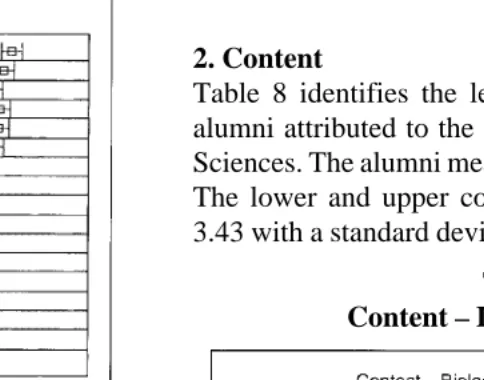
Table 8 identifies the level of appropriateness that the alumni attributed to the course content in the Biological Sciences. The alumni mean for this group is 3.36 (‘good’). The lower and upper confidence intervals are 3.28 and 3.43 with a standard deviation of .6652.
Of the nine course categories in this section, two (Embry-ology and Hist(Embry-ology) with respective means of 2.43 and 2.63 are below the lower confidence interval for the group and are both rated as ‘fair’. Anatomy with a mean of 4.68 is
Table 8
ranked above the upper confidence interval for the group as ‘very good’ approaching ‘excellent’. The remaining six course categories (Microbiology, Pathology, Lab Diagno-sis, Biochemistry, Nutrition, and Physiology) are close to the alumni mean of 3.36, and have been rated as ‘good’.
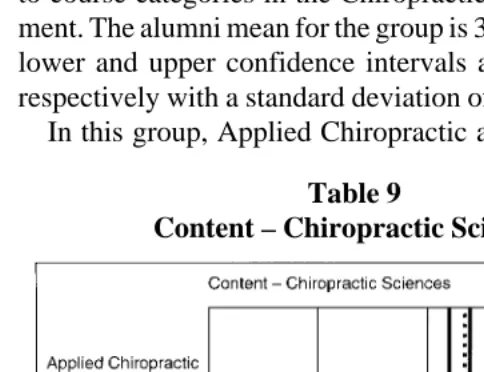
Table 9 concerns the appropriateness of content allotted to course categories in the Chiropractic Sciences depart-ment. The alumni mean for the group is 3.35 ( ‘good’). The lower and upper confidence intervals are 3.19 and 3.40 respectively with a standard deviation of .9403.
In this group, Applied Chiropractic and Jurisprudence
(both with means of 3.83) were placed above the upper confidence interval for the group, and were both rated very close to ‘very good’. The other two course categories (Chiropractic Principles with a mean of 2.92, and Practice Management with a mean of 2.60) were both rated as ‘fair’ by the alumni in terms of their content material. Neverthe-less, the upper confidence interval for Chiropractic Princi-ples falls within the range of ‘good’ for this department.
Table 10 portrays the results for how well the Clinical Science courses were rated in terms of appropriateness of content. The alumni mean for the group is 3.84 ( ‘good’). The lower and upper confidence intervals are 3.76 and 3.92 respectively with a standard deviation for all scores of .6970.
Neurodiagnosis and Radiology with means of 4.09 and 4.33 respectively (both ‘very good’) ranked above the up-per confidence interval of 3.92 (‘good’ and near to ‘very good’) for this group. As well, Clinical Diagnosis and OrthoRheumatology with means of 3.94 and 3.98 respec-tively (both extremely close to ‘very good’) fall within the group’s confidence intervals. Psychology with a mean of 2.85 (‘fair’) fell below the lower confidence interval of 3.76 for the group. The overall alumni mean of 3.84 for the composite of Clinical Science courses is extremely close to ‘very good’.
Table 11 identifies the appropriateness of content in the Clinical Education department. The alumni mean for this section is 3.54 (‘good’). The lower and upper confidence intervals are 3.46 and 3.62 respectively with a standard deviation of .7414.
Seven (41%) of the skill categories (History Taking, Professional Conduct, Physical Exam, Neuromusculo-skeletal Exam, Spinal Exam, Radiological Exam, and Di-agnosis & Clinical Impressions) are all rated just above ‘very good’. Of the 17 skill categories in this group, six (35%) fall below the lower confidence interval of 3.46. These six skill categories are the Psycho-Social Exam, Case Review & Report, Plan of Management, Auxiliary Therapy, Practice Development & Management, and Re-ferral & Consultation. The first four are rated as ‘good’ while the latter two are rated as ‘fair’. Another four (24%) Table 9
Content – Chiropractic Sciences
Table 10
of the skill categories (Clinical Lab Exam, Risk Manage-ment, Spinal Manual Therapy, and Non Spinal Manual Therapy) were also rated as ‘good’, and are ranked more closely to the group mean of 3.54.
Summary – Content: Tables eight through eleven com-bine the scores from all of the undergraduate departments with regard to the appropriateness of content throughout the entire CMCC undergraduate program. The overall alumni mean for this group is 3.51 (‘good’). The lower and upper confidence intervals are 3.44 and 3.58 respectively with an overall standard deviation of .6259.
The overall mean of 3.51 for content amongst all CMCC course and skill categories is at the midpoint be-tween ‘good’ and ‘very good’. Of the total thirty-five course and skill categories, 14 (40%) are ranked as either ‘very good’ or near to it. Anatomy has an overall mean of 4.68 (‘very good’ nearing ‘excellent’). Another seven (20%) of the course and skill categories (Pathology, Nutri-tion, Physiology, Clinical Lab Exam, Risk Management, Spinal Manual Therapy, and Non Spinal Manual Therapy) are all rated as ‘good’. As well, Microbiology, Lab Diag-nosis, Biochemistry, Psycho-Social Exam, Case Review & Report, Plan of Management, and Auxiliary are rated as ‘good’ even though they fall below the lower group CI of 3.44. However, the last seven (20%) course and skill cat-egories (Embryology, Histology, Chiropractic Principles, Practice Management, Psychology, Practice Development & Management, and Referral) are all rated as ‘fair’.
Table 11
Content – Clinical Education
3. Time
Table 12 identifies the appropriateness of time allotted to the course categories in the Biological Sciences. The overall mean for this variable for the Biological Sciences is 3.25 (‘satisfactory’). The lower and upper confidence intervals are 3.21 and 3.30 respectively with a standard deviation of .3916.
Nutrition is identified as having ‘too little’ time devoted to its delivery. Although Embryology and Histology are identified as having ‘too much’ time in this regard, (Micro-biology, Pathology, Lab Diagnosis, and Biochemistry) are identified as ‘satisfactory’ in terms of the time apportioned to their deliveries. While Anatomy and Physiology are both below the lower confidence interval for acceptable limits of time apportioned, both are ranked by the alumni as ‘satisfactory’.
Table 13 portrays the appropriateness of time devoted to the course categories in the Chiropractic Principles depart-ment by the alumni. The overall mean for this group is 2.2 (‘too little’). The lower and upper confidence intervals are 2.15 and 2.27 respectively with a standard deviation of .5203.
All course categories in this department are identified as having ‘too little’ time allotted to them in terms of prepar-ing the alumni for professional practice. In particular, Practice Management with a mean of 1.60 is the lowest rated while Jurisprudence with a mean of 2.78 is the
high-Table 12
est rated course category in this group. Finally, Applied Chiropractic and Chiropractic Principles with means of 2.17, and 2.29 respectively are also identified as needing more time allotted to them.
Table 14 portrays the appropriateness of time devoted to the course categories in the Clinical Science department. The mean for this group is 2.77 (slightly below ‘satisfac-tory’). The lower and upper confidence intervals are 2.73 and 2.80 respectively with a standard deviation for the group of .675.
The confidence intervals for this group are both near to ‘satisfactory’. As well, the course categories of Clinical Diagnosis, Neurodiagnosis, and Radiology are also ranked as near to ‘satisfactory’. The two exceptions in this group are OrthoRheumatology with a mean of 2.37 (indicating somewhat ‘too little’ time) and Psychology with a mean of 3.23 (indicating somewhat ‘too much’ time) devoted to their deliveries.
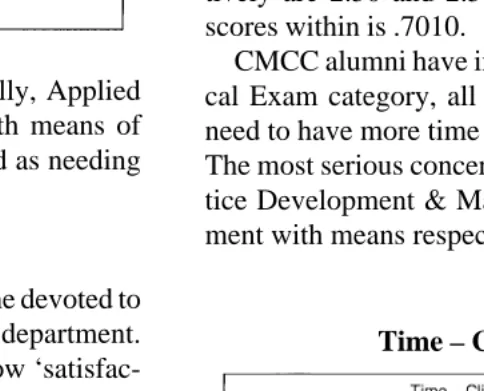
Table 15 indicates the appropriateness of time devoted to the skill categories in the Clinical Education depart-ment. The overall mean for this group is 2.54 (‘too little’) while the lower and upper confidence intervals respec-tively are 2.50 and 2.58. The standard deviation for all scores within is .7010.
CMCC alumni have indicated that, except for the Clini-cal Exam category, all of the remaining skill categories need to have more time devoted to them in their delivery. The most serious concerns indicated here are that of Prac-tice Development & Management, and Plan of Manage-ment with means respectively of 1.64 and 2.06 (both ‘too Table 13
Time – Chiropractic Sciences
Table 14
Time – Clinical Sciences
little’). The position of the mean and confidence intervals for this department indicate that the CMCC alumni believe more time ought to be allotted to the delivery of the Clini-cal Education skill categories.
Summary – Time: Tables twelve through fifteen provide an overview of all of the departments within the CMCC
Table 15
Table 16
Repetition – Biological Sciences
undergraduate program according to the appropriateness of time allotted to the course and skill categories. The overall mean for this variable is 2.72 (somewhat ‘too lit-tle’) with lower and upper confidence intervals of 2.68 and 2.76 respectively. The standard deviation for all scores in this group is .3546.
Nearly half of the total number of course and skill cat-egories in the undergraduate program require at least some remediation. For example, Practice Management, and Practice Development & Management are identified as having ‘too little’ time in the program. Another nine, (Nu-trition, Physiology, Chiropractic Principles, Ortho Rheu-matology, Case Review & Report, Plan of Management, Spinal Manual Therapy, Non Spinal Manual Therapy, and Referral) fall somewhat below the mean for the under-graduate program. On the other hand, Embryology and Histology are identified as having ‘too much’ time allotted to them while Microbiology, Pathology, Lab Diagnosis, Biochemistry, and Psychology are identified as having somewhat ‘too much’ time. The remaining seventeen course and skill categories have been identified as having an appropriate amount of time devoted to them.
4. Repetition
Table 16 indicates the amount of ‘unnecessary’ repetition that alumni reported to exist in the Biological Science courses. The mean for this group is 2.98 (extremely close to ‘satisfactory’) with lower and upper confidence
inter-vals respectively of 2.94 and 3.48. The standard deviation for scores in this group is .717.
The main course category identified as not having enough ‘necessary’ repetition for the Biological Sciences is Nutrition (mean of 2.31). To a lesser extent, the alumni included Anatomy in this category. Again, Embryology, and Histology with means respectively of 3.32 and 3.42 have been identified as having somewhat more ‘unneces-sary’ repetition than was seen to be appropriate. The re-maining course categories in the Biological Sciences were reported to be satisfactory.
Table 17 identifies the degree of ‘unnecessary’ repeti-tion perceived by the alumni in course categories in the Chiropractic Principles department. The overall mean for this group is 2.38 (‘too little’) with lower and upper confi-dence intervals of 2.31 and 2.45 respectively. The standard deviation for this group of scores is .8600.
All course categories in this group were seen by the alumni as having ‘too little’ repetition in their deliveries. Practice Management, Applied Chiropractic and Chiro-practic Principles are reported as having ‘too little’ repeti-tion of course material. Jurisprudence is closest in terms of repetition that is perceived to be ‘satisfactory’.
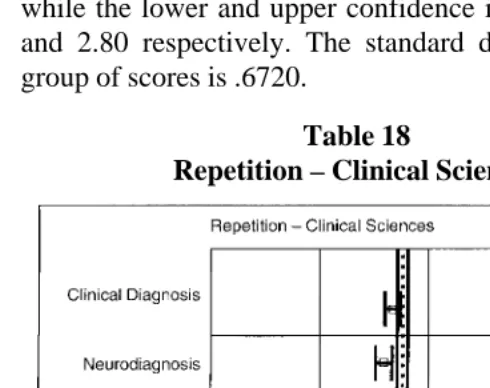
Table 18 portrays the degree of ‘unnecessary’ repetition Table 17
that alumni perceived to exist in the Clinical Sciences de-partment. The mean for this group is 2.75 (‘too little’) while the lower and upper confidence intervals are 2.71 and 2.80 respectively. The standard deviation for this group of scores is .6720.
Three out of five course categories in this group (Clini-cal Diagnosis, Neurodiagnosis, and Radiology) are seen by the alumni as ‘satisfactory’ in terms of the repetition associated with their deliveries. OrthoRheumatology (mean of 2.34) is the only course category in this depart-ment that is identified as having a degree of ‘too little’ repetition while Psychology (mean of 3.20) is rated as having slightly ‘too much’ repetition.
Table 19 portrays the degree of repetition in the skill categories in the Clinical Education department. The over-all mean for the group of scores within this table is 2.60 (‘too little’). The lower and upper confidence intervals are 2.56 and 2.64 respectively while the standard deviation is .717.
All skill categories in this department are seen by the alumni as having ‘too little’ repetition associated with them. However, the six out of seventeen skill categories (35%) most noted are Case & Review Report, Plan of Management, Spinal Manual, Non Spinal Manual, Prac-tice Development and Management, and Referral and Consultation. The remaining eleven (65%) of the skill cat-egories are also identified as having ‘too little’ repetition
although to a much lesser degree than the above men-tioned. No categories were seen to have ‘too much’ repeti-tion in the Clinical Educarepeti-tion department.
Summary – Repetition: Tables sixteen through nineteen show all of CMCC’s undergraduate departments accord-ing to the degree of repetition perceived by the alumni in the course and skill categories. The overall mean for scores within this table is 2.68 (‘too little’). The lower and upper confidence intervals are 2.64 and 2.98 respectively while the standard deviation is .2889.
In summary, a total of fourteen out of thirty five (40%) course and skill categories are identified as concerns in terms of repetition. Four of these course and skill catego-ries are perceived to have too much repetition, and are located in the Biological Sciences (Embryology, Histol-ogy, MicrobiolHistol-ogy, and Biochemistry). The remaining ten course and skill categories were reported to have a degree of ‘too little’ repetition. One of these courses is in the Biological Sciences (Nutrition), three are in the Chiroprac-tic Sciences (Applied ChiropracChiroprac-tic, ChiropracChiroprac-tic Princi-ples, and Practice Management) while six are located within Clinical Education (Case Review & Report, Plan of Management, Spinal Manual Therapy, Non Spinal Manual Therapy, Practice Development & Management Skills, and Referral & Consultation). The remaining twenty one course and skill categories (60%) are identified as ‘satisfactory’ in terms of repetition.
Table 18
Repetition – Clinical Sciences
Table 19
Overview
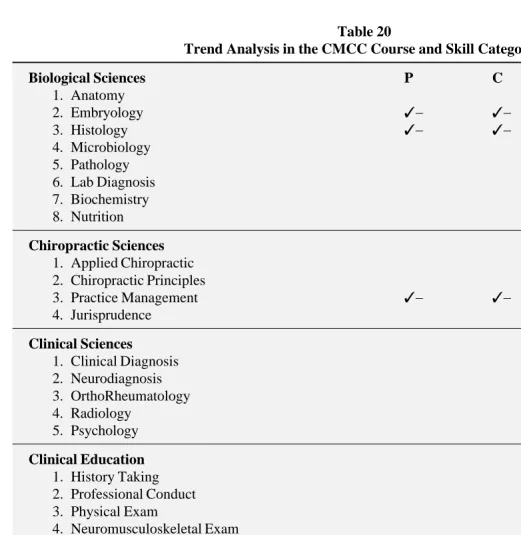
Table 20 serves comprehensively to identify and organize those course and skill categories, that have been found to merit attention according to the four variables of Prepara-tion (P), Content (C), Time (T), and RepetiPrepara-tion (R). A minus (-) beside each checkmark indicates below ‘good’ while a plus (+) indicates above ‘good’ for each variable. Table 20 identifies aspects of the 35 course and skill categories associated with the CMCC undergraduate chi-ropractic program that merit at least some attention in terms of their continual improvement. This table does not list those course and skill categories that have been per-ceived by the alumni to be of positive benefit. It can be observed that while the concerns associated with some of the course and skill categories are of an ‘excess’ (i.e., noted by a +) nature (e.g., Time in Psychology), others have concerns that are of a ‘deficiency’ (i.e., noted by a -) nature (see Preparation, Content, Time, and Repetition for the course and skill categories in Clinical Education). All of the check marks represent concerns that are statistically significant. Each check mark represents a deviation from the mean that is beyond the lower and/or upper limits of the confidence interval (i.e., due to factors other than chance alone).
Discussion
Alumni reported that all of CMCC’s departments in the Undergraduate Studies program prepared them well for practice. Although one department (Clinical Sciences) was rated above, and three departments (Biological Sci-ences, Chiropractic SciSci-ences, and Clinical Education) were rated below the overall CMCC mean of 3.49, alumni responded with an overall rating of ‘good’ for the
Prepara-tion for Practice variable.
Two departments (Biological Sciences, and Chiroprac-tic Sciences) were rated below, and the other two (Clinical Sciences, and Clinical Education) were rated above the overall CMCC mean of 3.51 (‘good’) for appropriateness
of content in the CMCC undergraduate program referred
to in this study.
The overall CMCC mean for appropriateness of time allotted to the program is 2.70 which is below the (3.00) mean of ‘satisfactory’. Of the four departments, three were rated below the mean (Chiropractic Sciences, Clinical Sci-ences, and Clinical Education) while Biological Sciences was rated by the alumni as having ‘slightly’ too much time
allotted to its department.
The alumni gave the overall undergraduate program a rating of 2.68 (‘somewhat’ too little) for the level of
repetition that they thought to be necessary. Of the four
departments, two (Chiropractic Sciences, and Clinical Education) were identified by the alumni as in most need of more repetition of course material. The remaining two (Biological Sciences, and Clinical Sciences) were reported to have close to a ‘satisfactory’ rating for repetition of course material.
In a comparison of the four departments, the alumni have rated Clinical Sciences and Clinical Education as providing them with the highest preparation for practice, and with the most appropriate content for professional practice. With the exception of the Clinical Exam skills, they identified all other skill categories in the Clinical Edu-cation department as having ‘too little time’, and ‘too little repetition’ associated with their deliveries. In addition, the Chiropractic Sciences department was also identified as having ‘too little time’, and ‘too little repetition’ associated with its delivery.
All standard deviations associated with the responses from the alumni are less than 1.000. This result helps to confirm the ‘tightness’ or ‘consistency’ in responses across the sample with regard to how the course and skill categories studied related to Preparation, Content, Time, and Repetition.
Conclusion
This study has shown that a linkage exists between educa-tion and professional practice. The CMCC Alumni
Cur-riculum Development Survey is an instrument that may be
used as a reliable method for analysing the CMCC under-graduate chiropractic program. Data collected through this survey provides not only a ‘snapshot’ view of how well the CMCC program is preparing its graduates for professional practice, but also a reliable foundation for program devel-opment, evaluation, and improvement. This foundation can serve as a meaningful referent in evaluating the results of future program efforts. Consequently, ongoing deci-sions and efforts for change may be supported by data about how the program is achieving its mission of prepar-ing its students for professional practice.
Acknowledgements
Table 20
Trend Analysis in the CMCC Course and Skill Categories
Biological Sciences P C T R
1. Anatomy ✓- ✓
-2. Embryology ✓- ✓- ✓+ ✓+
3. Histology ✓- ✓- ✓+ ✓+
4. Microbiology ✓+ ✓+
5. Pathology ✓+
6. Lab Diagnosis ✓+
7. Biochemistry ✓+ ✓+
8. Nutrition ✓- ✓
-Chiropractic Sciences
1. Applied Chiropractic ✓- ✓
-2. Chiropractic Principles ✓- ✓
-3. Practice Management ✓- ✓- ✓- ✓
-4. Jurisprudence ✓- ✓
-Clinical Sciences
1. Clinical Diagnosis ✓- ✓
-2. Neurodiagnosis ✓- ✓
-3. OrthoRheumatology ✓- ✓
-4. Radiology ✓- ✓
-5. Psychology ✓+ ✓+
Clinical Education
1. History Taking ✓- ✓
-2. Professional Conduct ✓- ✓
-3. Physical Exam ✓- ✓
-4. Neuromusculoskeletal Exam ✓- ✓
-5. Spinal Exam ✓- ✓
-6. Radiological Exam ✓- ✓
-7. Clinical Lab Exam ✓- ✓
-8. Psycho-Social Exam ✓- ✓
-9. Risk Management ✓- ✓
-10. Diagnosis and Clinical Impressions ✓- ✓
-11. Case Review and Reporting ✓- ✓
-12. Plan of Management ✓- ✓
-13. Spinal Manual ✓- ✓
-14. Non-Spinal Manual ✓- ✓
-15. Auxiliary Therapy ✓- ✓
-16. Practice Development and Management ✓- ✓- ✓- ✓
-who provided us with their data, without which, this study could not have been carried out. Thank you also to Dr. Judy Waalen and Ms. Carol Hagino of the Division of Research at CMCC for assistance in clarifying the statisti-cal, and computer applications for the data collected. The authors also gratefully acknowledge the financial support received for this study from the Office of the Dean of Undergraduate Studies at CMCC.
References
1 Freidson E. Profession of medicine: A study in the sociology of applied knowledge. New York: Dodd, Mead, 1970.
2 Doyle W. Curriculum and pedagogy. Handbook of research on curriculum. New York: Macmillan Publishing, 1992.
3 Cruess R, Cruess S. Teaching medicine as a profession in the service of healing. Academic Medicine. 1997; 72(11):941–952.
4 Kennedy L. Patterns of professional education. Handbook of Research on Teacher Education, J Sikula (Ed.). New York: MacMillan Publishing, 1996; 148–149.
5 Winterstein J. Philosophy of chiropractic: a contemporary perspective. Part 2. ACA J Chiro Pr. 1994; 5:64–71. 6 Good C. Defining quality in chiropractic education.
Journal of Chiropractic Education. 1995; 9(1);27–38. 7 Adams A, Gatterman M. The state of the art of research on
chiropractic education. J Manipulative Physiol Ther 1997; 20(3):179–184.
8 Chastonay P. The need for more efficacy and relevance in medical education [Editorial]. Medical Education. 1996; 30:235–238.
9 Stake R. An interview with Robert Stake on responsive evaluation. In R.Stake (ed.), Evaluating the arts in
education: A responsive approach. Columbus, OH: Merrill, 1975; 33–38.
10 Scriven M. Consumer-based evaluation. Evaluation Thesaurus (4th ed.) 1991; 98–99.
11 Canadian Memorial College of Chiropractic (CMCC). CMCC Curriculum Competency Document (Abbreviated Version) 1998.
12 Calder J. Survey research methods. Medical Education 1998; 32:636–652.
13 Rothman K, Yankauer A. Confidence intervals vs. significance tests: Quantitative interpretation. American Journal of Public Health 1986; 76:587–588.
14 Sackett D, Richardson W, Rosenberg W, Haynes R. Evidence-based medicine: How to practice and teach EBM. Toronto, ON: Churchill Livingstone, 1998. 15 American Association of Medical Colleges (AAMC).
Curriculum Directory. Washington, DC: AAMC, 1999. 16 Cronbach L. Evaluation for course improvement. In R.
Heath (ed.), New Curricula. New York, NY: Harper & Row, 1964; 231–248.
17 Saranchuk R. The assessment-curriculum relationship: Consequences for teacher instruction and student
assessment. Unpublished doctoral dissertation. University of Toronto, 1998.
18 Posner G, Strike K, Hewson P, Gertzog W.
Accommodation of a scientific conception: Toward a theory of conceptual change. Scientific Education 1982; 66:211–227.
19 Shadish W, Cook T, Leviton L. Foundations of program evaluation: Theories of practice. Newbury Park, CA: Sage Publications, 1991.
20 Rossi P, Freeman H. Evaluation: A systematic approach. Beverly Hills, CA: Sage, 1985.
21 Briscoe C. Using cognitive referents in making sense of teaching: A chemistry teacher’s struggle to change assessment practices. J Research in Science Teaching 1993; 30(8):971–987.