Smart City as an Integrated Enterprise: A Business Process Centric Framework
Addressing Challenges in Systems Integration
Vahid Javidroozi, Hanifa Shah, Ardavan Amini, Adrian Cole
Technology, Engineering, and the Environment (TEE) FacultyBirmingham City University (BCU) Birmingham, UK
{Vahid.Javidroozi, Hanifa.Shah, Ardavan.Amini, Adrian.Cole}@bcu.ac.uk
Abstract—Smart city is emerging as a response to mitigate the problems of fast urbanization and unpredictability of standards, policies, and citizens’ needs in urban areas. For a city to be smart, integration of city systems is essential in order to provide flexibility and access to real-time information for creation and delivery of efficient services. Business Process Change (BPC) is essential for systems integration in smart city development. Similar to BPC in Enterprise Systems Integration (ESI) for the private sector, changing business processes for smart cities encompasses a number of challenges and opportunities. This research-in-progress considers a city as an enterprise and attempts to develop a framework to address the business process-centric challenges in smart city development. ESI approaches, techniques, and tools will be utilized in this context. Thus, the proposed framework will identify and address BPC challenges in all steps of BPC for smart cities, using BPC tools, techniques, and approaches in ESI.
Keywords-Enterprise systems integration; ESI; Smart city; Business process change; BPC; Smart city challenges.
I. INTRODUCTION
More than half of the world’s population now lives in cities [1]. Around 70 per cent of the world’s populations is likely to live in cities by 2050 [2]. Livability of these fast growing cities depends upon our ability to address the challenges that include human health, transport, infrastructures, waste management, and air pollution [1]. In order to address these challenges and respond to changing citizens’ needs, all systems of a city should communicate with each other accurately and use each other’s resources timely and speedily [3].
Similarly, today’s unpredictable and competitive business environment needs real-time information to make timely decisions by enterprises. This is achieved by integration of all systems, applications, and information, normally referred as Enterprise Systems Integration (ESI), which includes a massive change within the enterprise [4]. ESI is the most important and useful change within the organization to provide real-time information, make timely decisions, and provide cheaper, quicker, and high quality services [5]. One of the most imperative actions for ESI is Business Process Change (BPC) that is defined as analyze, redesign, and improve existing business processes to achieve a competitive advantage in performance [6].
Hence, ESI and smart city development have very similar characteristics especially in their aim and objectives. This
research-in-progress considers a city as a large-scale enterprise and focuses on challenges and approaches in changing business processes within city systems. Therefore, similar to enterprise systems, integrating all city systems is necessary, and this will be accomplished during the development of a so-called smart city [7][8].
This section describes the research gap, contribution to knowledge, and the aim and objectives of the proposed research. The next section provides an overview of the context in both areas of ESI and smart city. Then the methodology for undertaking the research will be explained.
A. Research gap
By considering a city as an enterprise and the necessity of systems integration in this large-scale enterprise, BPC will be the main meta-process in smart city development. Similar to BPC in ESI, developing a smart city by integrating city systems and processes/services comprises a number of challenges and opportunities that have been discussed by some researchers. For instance, Vojdani [8] argued that flexibility and agility of BPC for smart city, are two challenges in dealing with the unpredictability of the urban environment. These challenges also strengthen the necessity of systems integration for smart city. Moreover, Nam and Pardo [9] have discussed the business process related challenges for smart city by analyzing service delivery in two cities. They have explained the challenges like interoperability of technology, budgetary constraints, and interdepartmental collaboration in the three categories of technology, organization, and cross-organization.
started filling the knowledge gap regarding the challenges of smart city development by providing a framework for the principles and success factors of smart city initiatives, but they have focused more on the technology perspective. This study will continue the previous attempts and will take a step forward closing the gap in the literature regarding BPC for smart city. Thus, more findings especially from primary research are required. This research will also benefit from exploring the BPC challenges and potential solutions in ESI, in order to address the BPC issues for smart city.
B. Aim and objectives of the research
The aim is to explore and address the BPC challenges in smart city development using tools, techniques, and approaches of BPC in ESI.
The proposed objectives are as follows: • Identify the challenges of BPC in ESI • Identify the challenges of BPC for smart city • Compare and prioritize identified challenges in
ESI and smart city development
• Examine process change solutions, tools, and techniques for ESI and assessing (qualitatively) their usefulness and effectiveness for smart city in order to address the challenges
• Develop a framework to address BPC challenges in smart city development
II. CONTEXT
This section demonstrates the empirical foundation of the research-in-progress including the two main fields of ESI and smart city, as well as the relationships between them, by critically analyzing the previous investigations leading up to our proposed aim and objectives.
A. Enterprise Systems Integration (ESI)
ESI represents a progressive and repetitive unification of technologies, human performance, operations, and knowledge of the enterprise as a whole [12]. Thus, it is critical to improve all aspects of the business key drivers, which are processes, people, technology, and flow of information amongst them. Technology is only an enabler and allows people to manage BPC [13]. The flow of information through all of these elements is also necessary especially when technology is inserted for BPC [14]. Therefore, BPC is the main area of activities in ESI, and enterprises should shift from functional-oriented integration to process-oriented integration [22][23]. In addition, BPC addresses some issues in other areas of ESI.
BPC is a complex task and includes many challenges, such as inter-dependencies between processes, departments, stakeholders, their attributes, and applications [16]. Moreover, redesigned and new business processes should deal with continuous change. Therefore, flexibility and complexity are two imperative issues of BPC that can be addressed by effective Business Process Management (BPM) [13]. Additionally, BPM as a systematic approach can address inter-relationship issues in BPC [18]. Furthermore, choosing an accessible Business Process Modeling (BPMo) tool, such as Event driven Process chain Mark-up Language
(EPML) addresses the issues of interoperability in BPC [19]. In addition, BPC challenges are involved with “people” and “technology” aspects of business change. For instance, “ability of employees to learn” and “cultural readiness” are major factors in BPC that are directly related to People. Moreover, “IT influence in BPC” is a technology related challenge that needs to be tackled by an appropriate systems integrator [17].
B. Smart city
Liu and Peng [7] signify that two factors of “Urbanization” and “Industrialization” cause today’s so-called “city disease”. Birmingham city council [20] has classified urbanization related issues into six categories of economic, well-being, mobility, environmental, digital inclusion, and the need for an integrated approach (“Joined-Up approach”). Unpredictability of a city’s environment and continuous change in city policies, standards, and residents’ needs are the main urbanization related challenges for local governments. Thus, access to real-time data and flexibility in city systems is required in order to create and deliver services [8]. To promote sustainable living, it is necessary to change the traditional urban activities and functions. In other words, the managers and authorities have to manage their cities in a smarter way [1]. In addition, local governments face issues related to different sectors, such as multiple stakeholders, high interdependency, cross-sectoral cooperation, and inter-departmental coordination [9]. Moreover, Liu and Peng [7] present interconnectivity through various sectors of a city as a significant issue for city leaders. As a result, full integration of city systems is required in order to enable access to real-time data by all sectors [9].
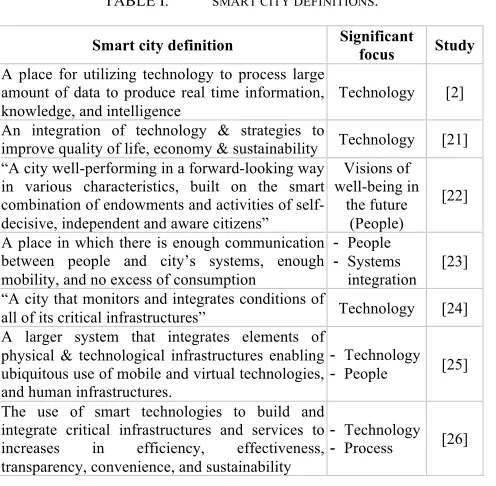
Table I provides some definitions for smart city in various aspects:
TABLE I. SMART CITY DEFINITIONS.
Smart city definition Significant focus Study
A place for utilizing technology to process large amount of data to produce real time information, knowledge, and intelligence
Technology [2]
An integration of technology & strategies to
improve quality of life, economy & sustainability Technology [21] “A city well-performing in a forward-looking way
in various characteristics, built on the smart combination of endowments and activities of self-decisive, independent and aware citizens”
Visions of well-being in
the future (People)
[22]
A place in which there is enough communication between people and city’s systems, enough mobility, and no excess of consumption
- People
- Systems integration [23] “A city that monitors and integrates conditions of
all of its critical infrastructures” Technology [24] A larger system that integrates elements of
physical & technological infrastructures enabling ubiquitous use of mobile and virtual technologies, and human infrastructures.
- Technology
- People [25]
The use of smart technologies to build and integrate critical infrastructures and services to increases in efficiency, effectiveness, transparency, convenience, and sustainability
- Technology
These explanations emphasize some principles, such as “systems integration”, “efficiency of services”, and “access to real time information”, but they mostly concentrate on technology perspectives. This research, adapts these principles by focusing on the business process viewpoint and defines “smart city” as an integration of the systems within a city and change their business processes in order to provide access to real time information and knowledge by all sectors and enhance communication between them. In this environment, agile and efficient services are delivered at real time and with a lower cost.This is a process-centric definition and indicates that the integration of city systems and their services is a necessity for a city to be smart. C. City as an enterprise
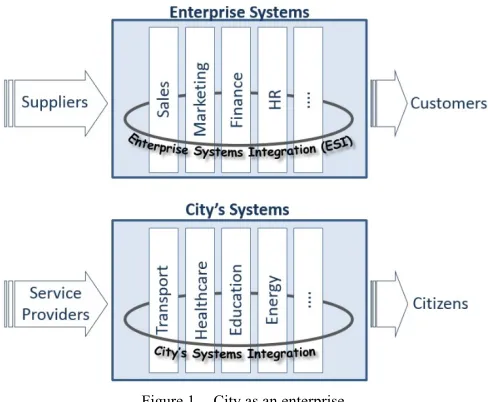
In order to address the challenges for local government in creation and delivery of smart services, this research-in-progress considers a city as a large-scale enterprise, which includes all of its elements (Figure 1).
Figure 1. City as an enterprise.
As shown in this figure, service providers are considered as suppliers, citizens are customers, and local government/authorities are the managers and leaders of the enterprise. Moreover, any enterprise consists of systems such as finance, human resources, and sales. Likewise, a city encompasses a number of sectors/systems such as transport, health care, energy, and education.
III. RESEARCH METHODOLOGY
The methodology to undertake the proposed research is based on a mixture of gathering data from literature, questionnaire, and interview; discussion and comparison of gathered data; as well as development and evaluation of the main research outcome, which is a framework to address BPC challenges for smart city.
Firstly, following datasets (combination of secondary and primary data), must be collected for this research:
• Dataset-1: Challenges of BPC in ESI and prioritization
• Dataset-2: BPC tools and techniques to address BPC challenges in ESI
• Dataset-3: Challenges of BPC in smart city development and prioritization
The first two datasets will be gathered through a comprehensive literature review to identify the challenges related to changing business processes for ESI. These data collection phases will be supported by some theories such as system thinking theory [27] and systems theory [28] to underpin the concepts of system, enterprise systems, and ESI; business process change management theory [29], which identifies and categorizes some BPC challenges in various ways; and contingency theory, which emphasizes that a variety of challenges need to be addressed for a successful change [30].
Then, primary research through questionnaire is carried out to prioritize the BPC challenges in ESI. The questionnaire will be responded by enterprises that have already implemented an ESI solution (e.g. government agencies and commercial organizations), as well as ESI implementers and solution providers for enterprises. These data groups will help to generate information and knowledge to address BPC challenges in smart city development.
Dataset-3 will be predominantly gathered through primary research by undertaking interviews as a way to properly understand the specific issues, which are faced by smart city developers in real-life. City authorities, which are initializing smart city projects, as well as, solution providers for Smart Cities will be interviewed for this data collection phase. The prioritization part will be performed during interview and by utilizing prioritization results from dataset-1.
By considering smart city as an integrated enterprise, the results from dataset-3 will be compared with dataset-1, in order to apply tools, techniques, and approaches for addressing BPC challenges in smart city development. This is also underpinned and upheld by complexity theory [31] and organization as system theory [32]. At the end of this phase, a preliminary framework for service transformation in smart city development will be formulated and will be incrementally adjusted to achieve the research outcome. All theories outlined above as well as the BPC model that has been theorized by Kettinger et al. [32] and the business process improvement model developed by Lodhi et al. [16], will be utilized in order to design and develop the framework, which demonstrates tools, techniques, and approaches for addressing the challenges in every BPC step.
The final updated framework will be evaluated and possibly modified through an expert discussion in three areas as follows:
• Contents and structure of the framework
• Identified solution(s), tools, and techniques to address the BPC challenges in smart city development
• Implementability of the framework
authorities (smart city developers), and industry (smart city solution providers).
IV. CONCLUSION
From the literature, it has been demonstrated that very few researchers have discussed the concept and the challenges of smart city development, especially in BPC perspective. In addition, there is no academic research regarding usability of ESI approaches, tools, and techniques to address the BPC issues for smart city. Likewise, no academic literature has set priorities for all BPC challenges in ESI and smart city development. Hence, comprehensive research including gathering data from secondary and primary sources is necessary to close the gap in the literature and in response to the increasing demand with respect to the above subjects.
This research proposes that BPC is essential in the integration of city systems for smart city development. Similar to ESI, there are many challenges in BPC for smart city. The proposed research considers a city as an enterprise and attempts to develop a framework to explore and address BPC challenges in smart city development, using BPC tools, techniques, and approaches in ESI.
REFERENCES
[1] H. Chourabi et al., “Understanding Smart Cities: An Integrative Framework,” in 2012 45th Hawaii International Conference on System Sciences, 2012, pp. 2289–2297. [2] H. Schaffers, N. Komninos, and M. Pallot, “Smart Cities as
Innovation Ecosystems Sustained by the Future Internet,” 2012.
[3] T. M. McCarthy-Byrne and J. T. Mentzer, “Integrating supply chain infrastructure and process to create joint value,” Int. J. Phys. Distrib. Logist. Manag., vol. 41, no. 2, Mar. 2011, pp. 135–161.
[4] J. Motwani, D. Mirchandani, M. Madan, and A.
Gunasekaran, “Successful implementation of ERP projects: Evidence from two case studies,” Int. J. Prod. Econ., vol. 75, 2002, pp. 83 – 96.
[5] M. Hobday, “Systems integration: a core capability of the modern corporation,” Ind. Corp. Chang., vol. 14, no. 6, Aug. 2005, pp. 1109–1143.
[6] P. Harmon, Business Process Change: A Manager’s Guide to Improving, Redesigning and Automating Processes. San Francisco: Morgan Kaufmann Publishers, 2003. [7] P. Liu and Z. Peng, “Smart Cities in China,” Computer
(Long. Beach. Calif)., vol. PP, no. 99, 2013, pp. 1–1. [8] A. Vojdani, “Smart Integration,” IEEE Power Energy Mag.,
vol. 6, no. 6, 2008, pp. 71–79.
[9] T. Nam and T. A. Pardo, “Building Understanding of Municipal Service Integration: A Comparative Case Study of NYC311 and Philly311,” in 2013 46th Hawaii International Conference on System Sciences, 2013, pp. 1953–1962. [10] M. Al-Mashari, “Business process management – major
challenges,” Bus. Process Manag. J., vol. 8, no. 5, Jan. 2002, pp. 411–412.
[11] T. Nam and T. A. Pardo, “Smart city as urban innovation,” in Proceedings of the 5th International Conference on Theory and Practice of Electronic Governance - ICEGOV ’11, 2011, p. 185.
[12] J. M. Myerson, Enterprise Systems Integration, Second Edition (Best Practices). Auerbach Publications, 2001. [13] D. R. Shaw, C. P. Holland, P. Kawalek, B. Snowdon, and B.
Warboys, “Elements of a business process management system: theory and practice,” Bus. Process Manag. J., vol. 13, no. 1, Feb. 2007, pp. 91–107.
[14] N. Berente, B. Vandenbosch, and B. Aubert, “Information flows and business process integration,” Bus. Process Manag. J., vol. 15, no. 1, Jun. 2009, pp. 119–141.
[15] H.-H. Hvolby and J. H. Trienekens, “Challenges in business systems integration,” Comput. Ind., vol. 61, no. 9, Dec. 2010, pp. 808–812.
[16] A. Lodhi, V. Köppen, and G. Saake, “Business Process Improvement Framework and Representational Support,” in Proceedings of the Third International Conference on Intelligent Human Computer Interaction, 2013, vol. 179, pp. 155–167.
[17] J. Motwani, “A business process change framework for examining lean manufacturing: a case study,” Ind. Manag. Data Syst., vol. 103, no. 5, Jan. 2003, pp. 339–346. [18] M. Segatto, “Business process management: a systemic
approach?,” Bus. Process Manag. J., vol. 19, no. 4, Jul. 2013, pp. 698–714.
[19] D. D. Vaziri and D. DeOliveira, “Accessible Business Process Modelling,” Int. J. Soc. Hum. Sci., vol. 6, 2012, pp. 205–216.
[20] Birmingham City Council, “Birmingham Smart City,” Birmingham, 2012.
[21] Steria.com, “Smart Cities will be enabled by Smart IT,” 2011. [Online]. Available: http://goo.gl/RaFhuK. [Accessed: 25-May-2014].
[22] R. Giffinger and G. Haindlmaier, “Smart cities ranking: an effective instrument for the positioning of the cities?,” ACE Archit. City Environ., vol. 4, no. 12, Feb. 2010, pp. 7–26. [23] J. Mortensen, F. J. Rohde, K. R. Kristiansen, M.
Kanstrup-Clausen, and M. Lubanski, “Danish smart Cities: sustainable living in an urban world,” Copenhagen, 2012.
[24] R. E. Hall, B. Bowerman, J. Braverman, J. Taylor, H. Todosow, and U. von Wimmersperg, “The vision of a smart city,” Sep. 2000.
[25] T. Nam et al., “Smart cities and service integration,” in Proceedings of the 12th Annual International Digital Government Research Conference on Digital Government Innovation in Challenging Times - dg.o ’11, 2011, p. 333. [26] A. Aldama-Nalda et al., “Smart cities and service integration
initiatives in North American cities: Astatus report,” in Proceedings of the 13th Annual International Conference on Digital Government Research - dg.o ’12, 2012, p. 289. [27] P. Checkland, Systems Thinking, Systems Practice: Includes
a 30-Year Retrospective. {John Wiley & Sons}, 1999. [28] M. Rhydderch, “Organisational change theory and the use of
indicators in general practice,” Qual. Saf. Heal. Care, vol. 13, no. 3, Jun. 2004, pp. 213–217.
[29] W. J. Kettinger and V. Grover, “Toward a theory of business process change management - ProQuest,” J. Manag. Inf. Syst., vol. 12, no. 1, 1995, p. 9.
[30] D. Schniederjans and S. Yadav, “Successful ERP
implementation: an integrative model,” Bus. Process Manag. J., vol. 19, no. 2, Dec. 2013, pp. 364–398.
[31] P. Anderson, “Perspective: Complexity Theory and