Restless legs syndrome in a primary contact
setting: a case report
Maja Stupar
BSc, DC, MSc candidate*
Objective: To describe the diagnostic features of a patient who presented to a chiropractor with restless legs syndrome (RLS), a common but often under-diagnosed condition.
Clinical Features: A 42-year-old male patient presented with twitching and deep pressure in the legs bilaterally; described also as an uncomfortable urge to move the legs that followed a circadian rhythm occurring in the evening. The symptoms were initiated after periods of rest and they were relieved by movement. Physical examination was non-contributory which is common in RLS except in secondary forms of the condition.
Discussion: The pathophysiology of RLS is still unknown but several treatments have been studied. Non-pharmacologic treatment options include education on improving sleep hygiene, decreasing alcohol and caffeine intake, moderate exercise and supplements.
Pharmacological treatment options are available, with L-dopa being the most effective.
Conclusion: The symptoms of RLS were 65% resolved in the case presented in one month. Awareness and proper diagnosis by all primary contact practitioners is necessary for effective management of RLS.
(JCCA 2008; 52(2):81–87)
k e y w o r d s: restless leg, chiropractic, primary contact
But : Décrire les caractéristiques diagnostiques d’un patient qui s’est présenté à un chiropraticien avec un syndrome des jambes sans repos (SJSR), une condition commune, mais souvent sous-diagnostiquée.
Caractéristiques cliniques : Un patient de 42 ans a présenté des secousses musculaires et une forte pression bilatérale dans les jambes. Il a également décrit une forte envie désagréable de bouger les jambes suivant un rythme circadien se produisant dans la soirée. Les symptômes ont commencé après des périodes de repos et ont été soulagés par le mouvement. Un examen physique s’est révélé non contributif, ce qui est commun avec le SJSR, à l’exception des formes secondaires de la condition.
Discussion: La pathophysiologie du SJSR est encore inconnue, mais plusieurs traitements ont été étudiés. Les options de traitement non pharmacologique comprenant des renseignements pour l’amélioration de l’hygiène du sommeil, la réduction de la consommation d’alcool et de caféine, les exercices modérés et les suppléments. Il existe des options de traitement pharmacologique, L-dopa étant la plus efficace.
Conclusion : Les symptômes du SJSR ont été résolus à 65 % en un mois pour le cas présenté. La sensibilisation de tous les praticiens de soins de santé primaires et un diagnostic exact de leur part sont nécessaires à la gestion thérapeutique du SJSR.
(JACC 2008; 52(2):81–87)
m o t s c l é s : jambe sans repos, chiropratique, soins de santé primaires
* Department of Health Policy, Management and Evaluation, Faculty of Medicine, University of Toronto.
Centre of Research Expertise in Improved Disability Outcomes (CREIDO), University Health Network, Rehabilitation Solutions, Toronto Western Hospital, 399 Bathurst Street 4 Fell-144, Toronto, ON M5T 2S8. Tel: (416) 581-7715.
email: [email protected]
Introduction
Restless legs syndrome (RLS) is a common sensorimotor disorder that can have a profound effect on sleep, cogni-tive function and quality of life.1–3 The symptoms of this condition have been described for some time, but search and clinical interest has only increased in the re-cent years. Diagnostic criteria, based on the clinical interview questions, were developed in 1995 and modi-fied in 2003.1 Although RLS is common with a general population prevalence of 5–15%,4–8 it is frequently undi-agnosed or misdiundi-agnosed in primary medical settings.9,10 Studies have not been performed to determine the preva-lence of RLS diagnosis in non-medical primary contact settings; nevertheless, it is essential that all primary con-tact practitioners be aware of this condition to ensure proper and efficient management. A case report of a pa-tient presenting to a chiropractor in a multidisciplinary clinic is presented with a discussion of current diagnostic and treatment options.
Case Presentation
A 42-year-old male presented to a chiropractic clinic with a complaint of twitching in his legs. He reported nightly discomfort for the past two years. He noted that it occurred once he was in a semi-reclined supine position watching television in bed for a period of time. Other ini-tiating factors were sitting on the chairlift when going skiing and sitting in the movie theatre for 2–3 hours. The discomfort was described as a “pressure” without pain or paresthesia, occurring more frequently in his right leg. This feeling occurred with an associated urge to move the limb that resulted in a twitch or the leg moving on its own if he did not move it voluntarily. He reported that it was difficult to describe the sensation except that it was a deep pressure. The presenting complaint sometimes caused him to wake up at night and roll over in bed. He denied progression of the condition except that he had noticed an increase in the frequency of symptoms. Re-lieving factors included shifting positions and “shaking out the leg.” The location was described to start in the buttocks and to “accumulate” down the leg. He denied having cold feet, oedema, erythema or cramps in the legs. He denied taking any medications.
Past medical history revealed that he had psoriasis, a slightly elevated blood pressure and an appendectomy. He reported mild low back pain but no other medical
con-ditions and no diabetes in the family. He had prior chiro-practic treatment directed at the psoas muscle and sacroiliac joints. His lifestyle included skiing on week-ends occasionally; otherwise, he described his lifestyle as mainly sedentary. He had a 15 pack-year smoking history but had been a non-smoker for the past 12 years.
On physical examination, he had a normal gait, tandem gait and heel- and toe-walking bilaterally. Rhomberg’s test was unremarkable. Upper and lower limb neurological ex-amination was within normal limits with no loss of vibra-tion sense in the big toes and a down-going plantar reflex bilaterally. Calf girth was equal bilaterally. The cranial nerve screen was unremarkable. Straight leg raise did not produce any nerve root tension signs and the Herron-Pheasant test produced no changes in the Achilles reflexes. The patient was referred to his medical doctor for fur-ther investigation and management. He was lost to fol-low-up and no information was obtained on the medical treatment administered. No treatment was provided by the chiropractor. The patient also self-initiated naturo-pathic therapy two weeks after initial presentation. The naturopathic treatment was based on a dietary assessment and included magnesium supplementation and dietary advice. He reported that after taking magnesium supple-ments, decreasing coffee and increasing protein intake, his leg symptoms improved approximately 65% at the two week follow-up.
Discussion
Restless legs syndrome is a sensorimotor disorder char-acterized by the urge to move the legs.1 It is common in the general population with a prevalence of 10–15% that increases linearly with age4–8 and has a female prepon-derance.3–6,8 The exact pathophysiology of this condition is still largely unknown but theories and new knowledge are developing with the recent increased research inter-est. While studies have demonstrated a lack of awareness among primary medical practitioners,9,10 65% of patients with RLS also reported using complementary and alter-native services in one report.11 Although studies have not determined the prevalence of RLS awareness within oth-er health care disciplines, it is important that all primary contact practitioners be aware of this common disorder.
Diagnostic Criteria
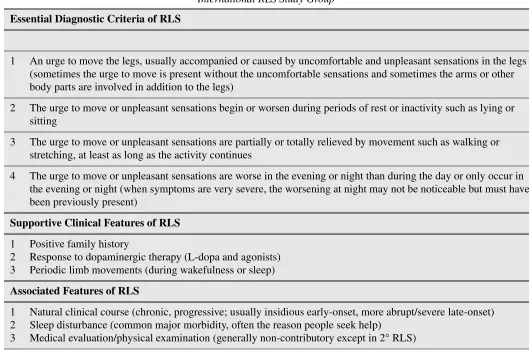
symptoms identified through the clinical interview. The International Restless Legs Syndrome Study Group (IRLSSG) has recently updated the criteria for restless legs syndrome (see Table 1).1 The first of four essential criteria include the urge to move the legs. The patient in this case report presented with the complaint of having a discomfort in his legs that requires him to move in order to experience relief. The sensation would occur most consistently once in bed watching television in a semi-re-clined supine position for a period of time. Without vol-untary movement to relieve the sensation, his legs would move involuntarily. The second, third and fourth essential criteria include the discomfort occurring at rest, at night or evening, and relief occurring with movement, as this patient experienced. Although it is more common in the
lower limbs, the symptoms of restless legs syndrome can occur in the upper limbs and very rarely in the torso; therefore, more appropriate terminology would be rest-less limbs syndrome.12,13 Patients often experience diffi-culty describing their symptoms but commonly they describe them as deep in the leg and having a sense of movement within the leg. Some of the other terms often used to describe the sensation include creepy-crawly, ants crawling, jittery, pulling, worms moving, electric current and soda bubbling in the veins.1 The location of the sen-sation in the leg and the progression patterns vary consid-erably among patients.1
While historical interview questions are diagnostic of RLS, special investigations may contribute to the clinical presentation but none have been found to be necessary or Table 1 Diagnostic Criteria for Restless Legs Syndrome (RLS) developed and modified by the
International RLS Study Group1
Essential Diagnostic Criteria of RLS
1 An urge to move the legs, usually accompanied or caused by uncomfortable and unpleasant sensations in the legs (sometimes the urge to move is present without the uncomfortable sensations and sometimes the arms or other body parts are involved in addition to the legs)
2 The urge to move or unpleasant sensations begin or worsen during periods of rest or inactivity such as lying or sitting
3 The urge to move or unpleasant sensations are partially or totally relieved by movement such as walking or stretching, at least as long as the activity continues
4 The urge to move or unpleasant sensations are worse in the evening or night than during the day or only occur in the evening or night (when symptoms are very severe, the worsening at night may not be noticeable but must have been previously present)
Supportive Clinical Features of RLS
1 2 3
Positive family history
Response to dopaminergic therapy (L-dopa and agonists) Periodic limb movements (during wakefulness or sleep)
Associated Features of RLS
1 2 3
Natural clinical course (chronic, progressive; usually insidious early-onset, more abrupt/severe late-onset) Sleep disturbance (common major morbidity, often the reason people seek help)
conclusive in the diagnosis of RLS.14 Along with the es-sential criteria, the IRLSSG has developed supportive and associated clinical features (Table 1). In this patient’s case, he was not questioned about the supportive clinical features that would help resolve any diagnostic uncertain-ty. Supportive clinical features include a positive family history, response to dopaminergic drugs and periodic limb movement.1,15,16 A positive family history with an autosomal dominant inheritance17 is common and should be assessed in insidious early-onset cases of RLS. Late-onset RLS is less associated with a positive family histo-ry and more with secondahisto-ry causes of the disorder.15,16,18 The practitioner should inquire about previous therapies and response to low-dose dopaminergic drugs since that has been found to be supportive of the RLS diagnosis.1,19 Controlled studies have shown that low-dose dopaminer-gic medications improve both sensory and motor symp-toms of RLS at least initially but this response is not maintained universally and needs to be further estab-lished through research.1,21,22 Finally, periodic limb movements may be present during wakefulness or sleep; therefore, the patient should be asked about his/her awareness of the presence of these movements or the awareness of his/her partner of kicking/moving during sleep.
The IRLSSG also developed associated features that may not support the diagnosis but are often present in pa-tients with RLS and that the practitioner should inquire about. In the presented clinical case, the patient started experiencing RLS symptoms around the age of 40 with a more insidious onset. Patients that present with an onset after 50 years of age often experience more abrupt, severe symptoms and co-morbidities or disorders resulting in secondary RLS.1,3,6,18 The patient did not complain of sleep deprivation, in this case, but his symptoms did de-lay his time of sleep onset. Sleep-related symptoms are often the presenting complaint in many patients.9,10
The physical examination is often non-contributory in patients with RLS.1,14 Only the presence of comorbid or secondary causes can contribute to the diagnosis of RLS when based on the physical examination and special tests. The patient in this case presented with all the asso-ciated features of RLS including an insidious early onset, a delay in sleep onset and a non-contributory physical ex-amination. Diagnostic criteria based on expert opinion have also been developed for special populations that
may not be able to verbally describe their symptoms, in-cluding children and cognitively-impaired elderly.1
Differential Diagnoses
Restless legs syndrome can be both primary, with an in-sidious onset, and secondary occurring due to the presence of another condition. The causes of secondary RLS and symptoms associated with differential diagnoses should be identified in the clinical interview or with diagnostic testing. Conditions found to be associated with or causing secondary RLS include iron deficiency, pregnancy, end-stage renal disease, neuropathies, diabetes, rheumatoid ar-thritis and Parkinson’s disease.3,6,13,18–22 RLS symptoms due to these conditions usually resolve with the treatment of the contributing conditions.21 Management and/or ex-clusion of these secondary conditions may warrant a refer-ral to the patient’s primary medical practitioner.
Several conditions may mimic the symptoms of RLS and need to be differentiated from RLS. These differen-tials may be excluded if they do not satisfy all four of the essential diagnostic criteria or have other exclusive features. Nocturnal muscle cramps are defined by a char-acteristic discomfort in the legs associated with locally-contracted muscles that may satisfy all four of the essen-tial clinical features but they are usually intensely pain-ful, occur in discrete bouts and are relieved subsequently without voluntary movement.14,21 In contrast, the RLS symptoms are more diffuse, less painful and require vol-untary or involvol-untary movement of the limb for relief.
Myoclonus also needs to be differentiated from RLS. It is an involuntary, short, muscle twitch in a body segment. Different types of myoclonus can occur during the transi-tion from wakefulness to sleep and during sleep but they are not associated with the irresistible urge for movement and they can have physical signs if associated with spinal cord lesions.21
Multiple sclerosis has associated spasticity that in-creases with inactivity but it is not rapidly reversed with movement.23 The location of dysesthesiae resulting from multiple sclerosis differs from RLS; they are mostly found around the ankles. They are also not associated with the urge to move and are more constant than in RLS.23 Furthermore, multiple sclerosis may be a second-ary cause or a common comorbidity of RLS based on the findings that RLS is prevalent in patients with multiple sclerosis.23.24 Hypotensive or neuroleptic-induced aka-thisia is a disorder that includes the urge to move but it is not worse in a supine position, it is associated with a gen-eralized inner restlessness and it does not disturb sleep or occur in a circadian rhythm. The symptoms appear more quickly with the aggravating position than in RLS and they are associated with other symptoms of hypotension or extrapyramidal signs with neuroleptic use.18,21,25 Pe-ripheral neuropathy or radiculopathy symptoms in the legs will have a positive physical examination, no circadi-an rhythm, only positional relief of symptoms circadi-and no urge to move the limb.21 Periodic limb movements and the related syndrome often accompany RLS and are sup-portive of it but, on their own, do not satisfy all four of the essential clinical features.
Affective disorders such as anxiety and depression may also be associated with RLS. Individuals with anxie-ty may experience motor restlessness but it would not oc-cur only at rest and it can often be accompanied by sympathetic overactivity, including excessive sweating and palpitations, not present in RLS. Depression may be a consequence of RLS and it needs to be identified.3,14,21 Arthritic, muscular or vascular disorders may have a dif-ferent circadian appearance or not have one at all. They will likely have other clinical findings on physical exami-nation and laboratory testing specific to each condition that is exclusive of RLS.21 Presence of symptoms other than the features listed in the diagnostic criteria and the presence of signs on physical examination should alert the practitioner to consider RLS differential diagnoses.
Management
An accurate diagnosis of restless legs syndrome is neces-sary in all primary contact settings in order to ensure proper management of the condition. The pathophy-siology of this condition is still largely unknown and therefore, evidence of effective therapy is still being
ac-cumulated. Two Cochrane protocols are in the process of reviewing the existing literature on pharmacologic thera-pies.26,27
Non-pharmacologic management of RLS may include education on improving sleep hygiene, avoiding caffeine and alcohol and maintaining moderate exercise dai-ly.19,22,28,29 Controlling the sleep-wake cycle by maintain-ing regular sleep patterns and regular, undisturbed time in and out of bed may be helpful since sleep disturbance will contribute to more severe RLS symptoms and other sleep-related symptoms such as a lack of concentration, malaise and general decrease in normal function.2,22 Avoiding tea, caffeine and alcohol, and participating in moderate exercise and pre-sleep relaxation techniques also contributes to improved sleep hygiene and, in turn, attenuates RLS symptoms.21,22,28 A Cochrane protocol is also currently in progress to review the evidence on acu-puncture as a treatment for restless legs syndrome.30
Secondary causes of RLS need to be identified and treated accordingly. Non-medical practitioners may play a role in identifying dietary mineral and vitamin deficien-cies with recommendations on supplement therapy. Iron deficiency should be treated,21,22,28,31,32 possibly even if the ferritin levels are normal.33 Evidence for other vita-min and vita-mineral deficiency treatments is limited but a di-etary assessment should be part of the RLS assessment including magnesium deficiency assessment since some evidence exists that there may be an association with RLS that could be effectively treated.34 Referral to the primary medical practitioner is necessary for co-manage-ment of other forms of secondary RLS.
Most of the available evidence is focused on pharma-cologic effectiveness and it shows that dopaminergic medications in low doses are most effective; other medi-cations are also used as adjunct therapy.19,21,22,28 No sci-entific literature was found on the treatment of RLS using a search with chiropractic-specific terms. A search in Medline, CINAHL, Index to Chiropractic Literature, AMED, and the Biomedical Reference Collection using MeSH terms or keywords “Chiropractic,” “Manipulation, Chiropractic,” “Restless legs” and “Restless Legs Syn-drome” in combination yielded no results. Scientific liter-ature on the topic of chiropractic management of restless legs syndrome is encouraged.
magnesium supplements and dietary modifications. Without information on the medical treatment adminis-tered, it is not possible to determine which intervention may have contributed to the positive outcome since mul-tiple concurrent interventions may have been adminis-tered.
Conclusion
Many studies have been published on the epidemiology of RLS and the pathophysiology is slowly being deter-mined as literature on different contributing factors is produced. Further randomized, controlled studies should be performed to determine the effectiveness of pharma-cologic and non-pharmapharma-cologic therapies for different se-verity levels of RLS. Future studies need to establish the exact pathophysiology and determine the most effective management strategies in all severities of the condition.
Effective management of RLS depends on the aware-ness, appropriate exclusion of differential conditions and a correct diagnosis by the primary contact health practi-tioner. The diagnosis is based on the clinical interview questions and the absence of signs on physical examina-tion as well as symptoms attributable to other condiexamina-tions.
Acknowledgements
I would like to thank the Canadian Memorial Chiroprac-tic College for their financial support.
References
1 Allen RP, Picchietti D, Hening WA, Trenkwalder C, Walters AS, Montplaisir J et al. Restless legs syndrome: diagnostic criteria, special considerations and
epidemiology: A report from the restless legs syndrome diagnosis and epidemiology workshop at the National Institutes of Health. Sleep Med 2003; 4:101–119.
2 Pearson VE, Allen RP, Dean T, Gamaldo CE, Lesage SR, Earley CJ. Cognitive deficits associated with restless legs syndrome (RLS). Sleep Med 2006; 7:25–30.
3 Kushida CA. Clinical presentation, diagnosis, and quality of life issues in restless legs syndrome. Am J Med 2007; 120(1 Suppl 1):S4-S12.
4 Bjorvatn B, Leissner L, Ulfberg J, Gyring J, Karlsborg M, Regeur L, Skeidsvoll H, Nordhus IH, Pallesen S.
Prevalence, severity and risk factors of restless legs syndrome in the general adult population in two Scandinavian countries. Sleep Med 2005; 6:307–312. 5 Berger K, Luedemann J, Trenkwalder C, John U, Kessler
C. Sex and the risk of restless legs syndrome in the general population. Arch Intern Med 2004; 164(2):196–202.
6 Zucconi M, Ferini-Strambi L. Epidemiology and clinical findings of restless legs syndrome. Sleep Med 2004; 5:293–299.
7 Phillips B, Young T, Finn L, Asher K, Hening WA, Purvis C. Epidemiology of restless legs symptoms in adults. Arch Intern Med 2000; 160:2137–41.
8 Lavigne GJ, Montplaisir JY. Restless legs syndrome and sleep bruxism: prevalence and association among Canadians. Sleep 1994; 17:739–743.
9 Hening W, Walters AS, Allen RP, Montplaisir J, Myers A, Ferrini-Strambi L. Impact, diagnosis and treatment of restless legs syndrome (RLS) in a primary care population: the REST (RLS epidemiology, symptoms, and treatment) primary care study. Sleep Med 2004; 5:237–246.
10 van der Vijver DAMC, Walley T, Petri H. Epidemiology of restless legs syndrome as diagnosed in UK primary care. Sleep Med 2004; 5:435–440.
11 Cuellar N, Galper DI, Taylor AG, D’Huyvetter K, Miederhoff P, Stubbs P. Restless legs syndrome [Letter to Editor]. J Altern Comp Med 2004; 10(3):422–425. 12 Michaud M, Chabli A, Lavigne G, Montplaisir J. Arm
restlessness with restless legs syndrome. Mov Disord 2000; 15(2):289–293.
13 Tan EK, Koh KK, Arulanandam S, Lo YL. Restless hand symptoms in carpal tunnel syndrome. Int J Clin Pract 2004; 58(11):1000–1002.
14 Hening WA. Subjective and objective criteria in the diagnosis of restless legs syndrome. Sleep Med 2004; 5:285–292.
15 Allen RP, La Buda MC, Becker P, Earley CJ. Family history study of restless legs syndrome. Sleep Med 2002; 3:S3-S7.
16 Winkelmann J, Wetter TC, Collado-Seidel V, Gasser T, Dichgans M, Yassouridis A, Trenkwalder C. Clinical Characteristics and frequency of the hereditary restless legs syndrome in a population of 300 patients. Sleep 2000; 23(5):597–602.
17 Xiong L, Jang K, Montplaisir J, Levchenko A, Thibodeau P, Gaspar C, Turecki G, Rouleau GA. Canadian Restless Legs Twin Study. Neurol 2007; 68(19):1631–1633. 18 O’Keeffe ST. Secondary causes of restless legs syndrome
in older people. Age Ageing 2005; 34:349–352. 19 Hening W, Allen R, Earley C, Kushida C, Picchietti D,
Michael Silber. The treatment of restless legs syndrome and periodic limb movement disorder: an American academy of sleep medicine review. Sleep 1999; 22(7): 970–999.
20 O’Keeffe ST, Gavin K, Lavan JN. Iron status and restless legs syndrome in the elderly. Age Ageing 1994; 23(3):200–3. 21 Chaudhuri KR, Odin P, Olanow CW. Restless legs
syndrome. New York: Parthenon Publishing, 2004. 22 Hening WA. Current guidelines and standards of practice
23 Auger C, Montplaisir J, Duquette P. Increased frequency of restless legs syndrome in a French-Canadian population with multiple sclerosis. Neurology. 2005; 65(10):1652–3. 24 Manconi M, Fabbrini M, Bonanni E, Filippi M, Rocca M,
Murri L, Ferini-Strambi L. High prevalence of restless legs syndrome in multiple sclerosis. Eur J Neurol. 2007; 14(5):534–9.
25 Cheshire WP. Hypothensive akathesia: autonomic failure associated with leg fidgeting while sitting. Neurol 2000; 55(12):1923–1926.
26 Wong KK, Dobbin CJ, Joffe D, March L. Interventions for dialysis-associated restless legs syndrome. (Protocol) The Cochrane Database of Systematic Reviews 2004, Issue 4. Art. No.: CD005018. DOI: 10.1002/14651858.CD005018 27 Hornyak M, Berner M, Kriston L, Riemann D. Levodopa
for restless legs syndrome. (Protocol) The Cochrane Database of Systematic Reviews 2005, Issue 4. Art. No.: CD005504. DOI: 10.1002/14651858.CD005504
28 Silber MH, Ehrenberg BL, Allen RP, Buchfuhrer MJ, Earley CJ, Hening WA, Rye BD. An algorithm for the management of restless legs syndrome. Mayo Clin Proc 2004; 79(7):916–922.
29 Aukerman MM, Aukerman D, Bayard M, Tudiver F, Thorp L, Bailey B. Exercise and restless legs syndrome: a randomized controlled trial. J Am Board Fam Med 2006; 19(5):487–93.
30 Cui Y, Wang Y, Liu ZS. Acupuncture for restless legs syndrome. (Protocol) Cochrane Database of Systematic Reviews 2007, Issue 2. Art. No.: CD006457. DOI: 10.1002/14651858.CD006457.
31 Early CJ, Heckler D, Allen RP. Repeated IV doses of iron provides effective supplemental treatment of restless legs syndrome. Sleep Med 2005; 6:301–5.
32 Early CJ, Heckler D, Allen RP. The treatment of restless legs syndrome with intravenous iron dextran. Sleep Med 2004; 5:231–235.
33 O’Keeffe ST. Iron deficiency with normal ferritin levels in restless legs syndrome. Sleep Med 2005; 6:281–2.
34 Hornyak M, Voderholzer U, Hohagen F, Berger M, Riemann D. Magnesium therapy for periodic leg movements-related insomnia and restless legs syndrome: an open pilot study. Sleep 1998; 21(5):501–505.