Approaches for containerized scientific workflows in cloud
environments with applications in life science
Ola Spjuth
1,*, Marco Capuccini
1,2, Matteo Carone
1, Anders Larsson
3, Wesley Schaal
1,
Jon Ander Novella
1, Oliver Stein
1, Morgan Ekmefjord
1, Paolo Di Tommaso
4, Evan
Floden
4, Cedric Notredame
4, Pablo Moreno
5, Payam Emami Khoonsari
6, Stephanie
Herman
1,6, Kim Kultima
6, and Samuel Lampa
11
Department of Pharmaceutical Biosciences and Science for Life Laboratory, Uppsala University, Sweden 2
Department of Information Technology, Uppsala University, Sweden 3National Bioinformatics Infrastructure Sweden, Uppsala University, Sweden 4
Centre for Genomic Regulation (CRG), The Barcelona Institute for Science and Technology, Barcelona, Spain 5European Molecular Biology Laboratory, European Bioinformatics Institute (EMBL-EBI), Cambridge, United
Kingdom
6Department of Medical Sciences, Clinical Chemistry, Uppsala University, Sweden *
Corresponding author: [email protected]
January 30, 2020
Abstract
Containers are gaining popularity in life science re-search as they provide a solution for encompass-ing dependencies of provisioned tools, simplify soft-ware installations for end users and offer a form of isolation between processes. Scientific workflows are ideal for chaining containers into data analy-sis pipelines to aid in creating reproducible anal-yses. In this manuscript we review a number of approaches to using containers as implemented in the workflow tools Nextflow, Galaxy, Pachyderm, Argo, Kubeflow, Luigi and SciPipe, when deployed in cloud environments. A particular focus is placed on the workflow tool’s interaction with the Kuber-netes container orchestration framework.
1
Introduction
The life sciences have become data-intensive, driven largely by the massive increase in throughput and resolution of molecular data generating technolo-gies. Massively parallel sequencing (also known as next-generation sequencing or NGS) is where the
largest increase has been seen in recent years, but other domains are also increasing dramatically, in-cluding proteomics, metabolomics, systems biology and biological imaging [1, 2, 3]. Consequently, the need for computational and storage resources has continued to grow, but the focus has also changed towards the downstream steps of biological exper-iments and the need to carry out efficient and re-producible data analysis. While high-performance computing (HPC) and high-throughput computing (HTC) clusters remain the main e-infrastructure resource used in biological data analysis, cloud computing is emerging as an appealing alterna-tive where, in the infrastructure-as-a-service (IaaS) case, scientists are able to spawn virtual instances or infrastructure on demand to facilitate their anal-ysis, after which the resources are released [4, 5]. One area which has traditionally often caused headaches for users is the installation of software tools and their inclusion into workflow tools or other computing frameworks [6]. This is an area where cloud resources provide an advantage over HPC, in that scientists are not dependent on sys-tem administrators to install software, but can handle the installation themselves. However,
ware for biological analyses can be quite challeng-ing to install due to sometimes complex dependen-cies. Virtual machines (VMs) offer the benefit of instantiating ready-made environments with data and software, including all dependencies for specific tasks or analyses and constitute a big step towards making computational reproducibility easier and more realistic to achieve in daily work. VMs form the backbone of traditional cloud-based infrastruc-tures. Virtual machine images (VMIs), however, can easily become large and take considerable time to instantiate, transfer or rebuild when software in the image needs to be updated. Such images can easily be shared between users and can be de-posited and indexed by one of the available VMI catalogs [7].
1.1
Containers
Software container technology has emerged as a complement to virtual machines. While they of-fer a bit less isolation between processes, they are on the other hand more lightweight and easy to share; the operating system kernel makes them
much faster to launch and terminate [8].
Con-tainers encompass all dependencies of the provi-sioned tools and greatly simplify software instal-lations for end users. The most widely used con-tainerization solution is Docker (www.docker.com), but Singularity [9], uDocker [10], and Shifter [11] are recent alternatives that prevent users from run-ning containers with root privileges, addressing the most common security issues when deploying con-tainers in multi-tenant computing clusters such as on high-performance computing (HPC) clusters. Docker containers are commonly shared via Docker Hub [12]. There are also initiatives for standardiz-ing containers in the life sciences such as BioCon-tainers [13]. ConBioCon-tainers have seen an increased up-take in the life sciences, both for delivering software tools and for facilitating data analysis in various ways [14, 15, 16, 17, 18].
When running more than just a few containers, an orchestration system is needed to coordinate and manage their execution and handle issues related to e.g. load balancing, health checks and scaling. Ku-bernetes [19] has over the last couple of years rose to become the de facto standard container orches-tration system, but Docker Swarm [20] and Apache Mesos [21] are other well-known systems. A key
objective for these systems is to allow the users to treat a cluster of compute nodes as a single deploy-ment target and handle the packaging of containers on compute nodes behind the scenes.
1.2
Scientific workflows
While orchestration tools such as Kubernetes en-able scientists to run many containers in a dis-tributed environment (such as a virtual infrastruc-ture on a cloud provider), the problem remains how to orchestrate the scheduling and dependencies be-tween containers and being able to chain (define data dependencies between) them into an analysis
pipeline. This is where scientific workflow
man-agement systems (WMSs) can be very useful; in fact, it can be difficult to carry out more com-plex analyses without such a system. Tradition-ally in data-intensive bioinformatics, an important task for WMSs has been to support analyses con-sisting of several components by running a set of command-line tools in a sequential fashion, com-monly on a computer cluster. The main benefits of using a WMS include: i) making automation of multi-step computations easier to create, more ro-bust and easy to change ii) providing more trans-parency as to what the pipeline does through its more high-level workflow description and better re-porting and visualization facilities, and iii) provid-ing more reliable policies to handle transient or per-sistent error conditions, including strategies to re-cover from interrupted computations while re-using any partially finished data.
Using containerized components as the nodes in a scientific workflow has the advantage of adding iso-lation between processes and the complete encapsu-lation of tool dependencies within a container, and reduces the burden to administrate the host sys-tem where the workflow is scheduled to run. This means the system can be tested on a local com-puter and executed on remote servers and clusters without modification, using the exact same con-tainers. Naturally, this opens up for execution on virtual infrastructures, even those provisioned on-demand with features such as auto-scaling. Apart from greatly simplifying access to the needed dis-tributed compute resources, a positive side-effect is that the entire analysis becomes portable and re-producible.
con-Figure 1: Overview of a containerized workflow with a workflow engine managing the dependency graph and scheduling of the containers encompass-ing the tools to run. The tools pass data between each other by reading and writing to a shared stor-age system.
stitute a key step when using cloud-based resources. When spawning a virtual infrastructure, data used in the analysis either needs to be available on stor-age connected to the compute nodes, or ingested into a locally provisioned file system. At the end of the analysis, the resulting data needs to either be put into persistent storage on the cloud or down-loaded to local storage. However, the overhead with this can also be turned around. If data resides on storage connected to a cloud infrastructure, it is possible to simply move the workflow and contain-ers there and “bring compute to the data”.
2
Workflow systems
Due to their simplicity, containers are supported out of the box by most workflow tools. However, the approach for interacting with containers dif-fers, especially when using virtual infrastructures on cloud resources. This section describes the ap-proaches taken by a set of workflow management systems to interacting with containers in cloud en-vironments, with varying degree of uptake in the life science community.
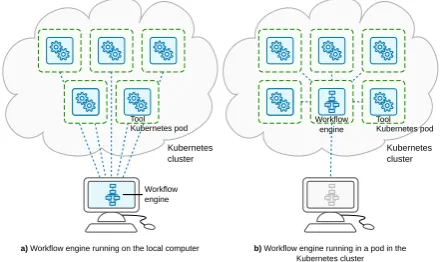
a) Workflow engine running on the local computer Kubernetes pod Tool
b) Workflow engine running in a pod in the Kubernetes cluster
Workflow engine
Kubernetes cluster
Kubernetes cluster Kubernetes pod Tool
Workflow engine
Figure 2: Comparison between two approaches for how to run the workflow engine. It can run either a) on the user’s computer, or b) in a pod in the ku-bernetes (abbreviated “k8s” in the image) cluster.
2.1
Nextflow
Nextflow [22] is a workflow framework that aims to ease the implementation of scientific workflows in a portable and reproducible manner across heterogeneous computing platforms and to en-able the smooth migration of these applications
to the cloud. The framework is based on the
dataflow paradigm, a functional/reactive program-ming model in which tasks are isolated from each other and are expected to be executed in a stateless manner. This paradigm simplifies the deployment of complex workflows in distributed computing en-vironments and matches the immutable execution model of containers.
Singularity or in the cloud with Docker).
Great flexibility is given for container image con-figuration. Nextflow supports both the image-per-workflow pattern (the same image for all executed tasks) and the image-per-task pattern (each task uses a different container image). The container image used by a task can even be specified at run-time by a given input configuration.
Nextflow allows the deployment of containerized workloads in a cloud-native manner using differ-ent strategies, as briefly discussed in the following paragraphs.
Cloud-managed computing service: in this ap-proach workflow tasks are submitted to a cloud provider batch execution service. The containeriza-tion and auto-scaling are delegated to the cloud ser-vice. The workflow inputs/outputs and intermedi-ate result files need to be stored using the provider object storage service. Nextflow adapts the task definition, resource requests and container image to the cloud provider format, submitting the cor-responding API requests and properly staging the task data. Currently, Nextflow has built-in sup-port for the AWS Batch service and the Google Genomics Pipelines service.
Cloud unmanaged computing service: when us-ing this deployment strategy Nextflow takes care of the provisioning of a set of cloud VM instances in which it automatically sets up its own clustering en-gine for the distributed execution of the workflow. The VM instances only require the availability of a Docker runtime and the Java virtual machine. Workflow tasks exchange data via a shared file sys-tem or by using a cloud object storage service. The workflow execution is managed by Nextflow which also handles the cluster auto-scaling i.e. adds or removes VM instances on-demand to adapt the ac-tual needs of a workload at any point in time and optimizes the overall computing cost when applica-ble. At the time of writing, this feature supports the use of the AWS EC2 cloud service and Google Compute Engine service.
2.2
Galaxy
Galaxy (Galaxy, RRID:SCR 006281) is a data-analysis workflow platform that has probably the most active development community in the field of workflow environments in Bioinformatics. This has enabled it to persist as an active project and to
con-Figure 3: Overview of a containerized workflow with a workflow engine managing the dependency graph and scheduling of the containers encompass-ing the tools to run. The tools pass data between each other by reading and writing to a shared stor-age system.
tinue to evolve since 2005, enabling reproducible research through active channels for sharing tools, workflows and datasets [23]. Galaxy is currently used by tens of thousands of scientists across the globe [24]. Besides offering a modern user interface (UI) for end users, Galaxy is accessible through its REST API or through the Bioblend Python bind-ing (that talks to this REST API).
For execution versatility, Galaxy has adapters to offload jobs in a wide variety of systems, from lo-cal Docker containers to different batch systems. In Galaxy, there is a complete separation of con-cerns between tools, workflows and execution en-vironments, meaning that a workflow definition is not bound to a particular execution environment. Within the last five years Galaxy gained the ability to launch on Amazon AWS through the CloudMan Launcher Galaxy sub-project [25]. This setup fol-lows a relative VM centric approach, which has nat-ural limitations for scaling in the number of tools included as they all need to be provisioned inside the VM used for the provisioned cluster.
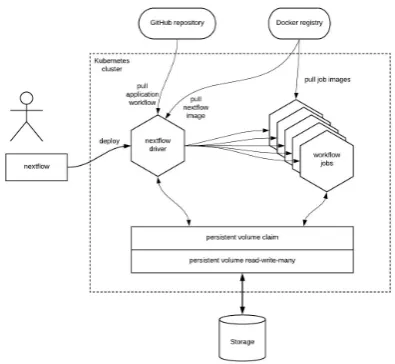
ability to deploy inside Kubernetes in an automated fashion through the use of Helm Charts [27]. The Galaxy-stable Helm chart makes use of commu-nity maintained Galaxy container images (Docker-Galaxy-stable), which are used on other container orchestrators, and include support for SSH file transfer protocol (SFTP) access, database back-ends and even deployment/compatibility of HPC scheduling systems like Condor or SLURM for hy-brid cloud setups. The Kubernetes job runner, also contributed to the Galaxy community by the Phe-noMeNal H2020 Project, allows Galaxy to offload jobs to Kubernetes, either when Galaxy runs in-side the container orchestrator or from the outin-side (provided that the shared file system is accessible to both the container orchestrator and Galaxy). The Kubernetes runner for Galaxy will take care of re-source requirement settings, recovery of jobs in Ku-bernetes if there is a restart, auto-upgrading of re-source utilization, Persistent Volume Claim mount-ing both for Galaxy and in each job’s pod, as well as adequate supplementary groups handling for net-work filesystem (NFS) and other shared file sys-tems. This integration requires the use of a shared file system, which needs to be mountable in Kuber-netes in a read-write-many configuration, as both the main Galaxy pod and the job pods need to mount it at the same time (through the PV/PVC abstraction). The Kubernetes runner for Galaxy adheres to the principles of failsafeness and redun-dancy commonly considered in cloud computing, providing ways to recover from jobs being lost by cluster nodes going down in the middle of an exe-cution.
The Kubernetes runner for Galaxy can benefit from explicit tool-to-containers mapping through Galaxy dynamic destinations, or take advantage of dynamic bioconda-to-containers mapping thanks to built-in functionality in Galaxy for this purpose. This means that if a Galaxy tool declares a Bio-conda package as the dependency to be resolved, it will bring an automatically built container for that Bioconda package [28] from BioContainers [13].
The Galaxy-Kubernetes integration, which in-cludes all the aspects related to Kubernetes men-tioned in the previous paragraphs, has been bat-tle tested by the PhenoMeNal H2020 Project, hav-ing its public instance received in the order of tens of thousands of jobs during the past 2 years, hav-ing tens of deployments in production environments
and possibly hundreds of deployments in
develop-ment settings. This integration has been tested
locally on Minikube, on OpenStack deployments, on Google Cloud Platform (GCP) and Amazon Web Services (AWS). It is expected that in the next few years the Galaxy-Kubernetes integration is embraced in the areas of Proteomics and
Tran-scriptomics. The CloudMan Galaxy launcher is
being considered to be migrated to a more con-tainerized deployment scheme based on the Galaxy-Kubernetes setup.
2.3
Pachyderm
Pachyderm [29] is a large-scale data processing tool
built natively on top of Kubernetes. This
plat-form offers: i) a data management system based on Git semantics and ii) a workflow system for cre-ating distributed and reproducible pipelines based on application containers. In order to create work-flows with Pachyderm, users simply need to supply a JSON pipeline specification including a Docker image, an entrypoint command to execute in the user containers and one or more data input(s). Af-terwards, Pachyderm will ensure that the corre-sponding pods are created in Kubernetes, and will share the input data across them and collect the
corresponding outputs. Thanks to using
Kuber-netes for container orchestration, Pachyderm is able to, among other things: i) optimize cluster resource utilization, ii) run seamlessly on multiple cloud and on-premise environments, iii) self-heal pipeline jobs and related resources.
This workflow tool provides an easy mechanism to distribute computations over a collection of con-tainers. In other words, it offers similar capabilities to frameworks such as Apache Spark, but replaces MapReduce syntax with legacy code. More specif-ically, Pachyderm is able to distribute workloads over collections of containers by partitioning the data into minimal data units of computation called “datums”. The contents of these datums are de-fined by glob patterns such as ”/” or “/*”, which instruct Pachyderm how to process the input data: all together as a single datum, or in isolation (as
separate datums). Users can define the number
correspond-ing to each datum, combines them and versions the complete output of the pipeline. The scheduling of pipeline workers is determined by the resource utilization status of the workers nodes and the re-source requests that are made for each pipeline, al-lowing for efficiently distributing workloads. Re-cently, work to integrate and demonstrate Pachy-derm in bioinformatics was published [30].
2.4
Luigi
Luigi [31] is an open-source Python module for
defining and running batch-like workflows. The
system is strongly oriented towards Big Data, and it comes as a convenience tool to pipe jobs from well-established analytics frameworks (e.g. Hadoop, Spark, Pig and Hive). Hence, instead of trying to substitute any of the available analytics systems, Luigi provides the means to plug together jobs from different frameworks in a single batch-oriented workflow. In doing so, Luigi seamlessly handles many boilerplate operations such as: de-pendency resolution, visualization, failure tolerance and atomic file system operations.
The Kubernetes integration was developed by the PhenoMeNal consortium, and it is now part of the official Luigi project and thus being
sup-ported and maintained by the community. The
integration enables to include pipeline processing steps as Kubernetes Jobs, which represent batch-like application containers that run until command completion. Hence, Luigi mainly uses Kubernetes as a cluster-resource manager where multiple par-allel jobs can be run concurrently. To this extent, it is important to point out that Luigi is not meant to be used as a substitute for parallel processing frameworks (such as Spark and Hadoop), as it has limited support for concurrent tasks. In fact, in our experience Luigi can handle up to 300 parallel
tasks before it starts to break down, or 64
par-allel tasks if running on a single node. A project to adapt Luigi for scientific applications in general and bioinformatics in particular resulted in a tool named SciLuigi [32].
We benchmarked Luigi on Kubernetes by repro-ducing a large-scale metabolomics study [33]. The analysis was carried out on a cloud-based Kuber-netes cluster, provisioned via KubeNow and hosted by EMBL-EBI, showing good scalability up to 40 concurrent jobs [34]. Workflow definition, and
in-structions to reproduce the experiment, are pub-licly available on GitHub [35].
2.5
SciPipe
SciPipe [36] (SciPipe, RRID:SCR 017086) is a workflow library based on Flow-based program-ming principles, which enables building workflows from component libraries of predefined workflow components. SciPipe is implemented as a program-ming library in Go, which enables using the full power of the Go programming language to define workflows, as well as to compile workflows to ex-ecutable files, for maximum ease of deployment in cloud scenarios.
SciPipe has been used to orchestrate machine learning pipelines to build predictive models for off-target binding in pharmacology [37]. SciPipe cur-rently provides early support for container based workloads via Kubernetes, implemented through the official Kubernetes Go client library [38]. The Go client library enables transparent access to a Kubernetes cluster regardless of whether the SciP-ipe workflow runs outside the cluster or inside, in a pod. When running inside the cluster, it
auto-matically detects cluster settings. When not
in-side a cluster, the connection to a cluster can be configured by setting the appropriate environment variables. The Kubernetes integration in SciPipe is demonstrated through the implementation of a use case workflow consisting of a set of data prepa-ration steps for mass-spectrometry data, using the OpenMS software suite [39]. It contains a Go file (With the .go extension) with the workflow, and a Kubernetes job-spec file in YAML format (with the .yml extension) for starting SciPipe inside a Kuber-netes cluster is together with the workflow [40].
Singularity containers [9] can already today be used from SciPipe on a simple level, by configuring the appropriate shell commands when creating new processes through the shell-command process con-structor (the scipipe.NewProc() function in SciP-ipe). Development of a more integrated support for Singularity containers is planned.
2.6
Argo workflow
integration / continuous deployment (CI/CD) so-lution but matured into a generalized workflow
en-gine. It was open sourced by Intuit and is now
adopted across several industries and companies
among them life science and biopharma. A big
differentiator of Argo is that no domain specific language knowledge is required to build workflows. The workflows are instead constructed by a clearly defined declarative approach manifested as Kuber-netes custom resource definitions (CRDs), which is a templated approach to enable composability and extendability to the original Kubernetes re-source orchestration. Argo is often referred to as a cloud native workflow orchestration tool and is de-signed for container native execution without the overhead of other non native container solutions. Argo provides a robust way to declare and run workflows as arguments and artifact objects can be declared as input and output and containers run as state transitions merely passing objects and
arguments through the pipeline. In each
work-flow step the state is stored in redundant etcd [42]
memory for resilience and reproducibility. Argo
is complemented by an artifacts concept that en-ables data and parameter versioning through com-plementing Argo with an s3 compatible storage backend. Furthermore Argo events enables signals and events for triggering workflows on webhooks, resource changes, GitHub or Docker image changes etc. enabling additional automation scenarios.
2.7
Kubeflow
Kubeflow [43] is another open-source platform for Kubernetes, specifically aimed at building and run-ning machine learrun-ning workflows and is developed by Google. As a framework, Kubeflow is intended to provide a set of tools for various tasks in the process of machine learning workflows, from data preparation and training to model serving and maintenance. Many of the tools are existing tools with a user base in the industry, such as Jupyter Notebook and Seldon, while others are customized wrappers or endpoints to frameworks like Tensor-Flow, PyTorch.
In particular, Kubeflow provides a workflow tool called Kubeflow Pipelines, which allows users to create workflows of varying complexity, chaining together series of container operations. The tool is based on the workflow engine Argo, which has been
integrated with the Kubeflow ecosystem with a dif-ferent UI than the original Argo UI. In essence, a user declares a workflow in the Kubeflow Pipelines software development kit (SDK), defining the dif-ferent steps in terms of container operations, i.e. what container to use for the step, Kubernetes re-source allocations, commands to execute in the con-tainer and so on. The user also declares the order of these container operations and any desired in-put parameters to the workflow, and from this def-inition a pipeline can be compiled. This pipeline is a portable configuration which in theory can be uploaded and used in any Kubeflow environment. With the pipeline deployed in Kubeflow, a user can start a run where available pipeline parameters can be provided and the progress of the run tracked in the Kubeflow Pipelines UI. Here, logs of the container’s standard output, output artifacts and various Kubernetes information can be tracked for each step, along with a visualization of the work-flow graph.
As an evaluation of the Kubeflow Pipelines sys-tem, a simple pipeline was developed, based on pre-vious work [44] where a convolutional neural net-work is trained to “... predict cell mechanisms of action in response to chemical perturbations. . . ”, based on a dataset of cell microscopy images from the Broad Bioimage Benchmark Collection. The pipeline covers the following steps of the machine learning process: data pre-processing, model train-ing, model evaluation and model serving prepara-tion. The result is a workflow that handles the en-tire process end-to-end, building a servable machine learning model and publishing this as a Docker con-tainer that can be deployed for serving predictions. The pipeline source code, while partly tailored to a specific environment, is available in [45].
3
Discussion
The tools covered in this study have taken slightly different approaches to work with containers, with different implications. Most tools are designed to work with general command-line tools while also
supporting containers. except Pachyderm, Argo
and Kubeflow which are Kubernetes-native and only support containers as means of processing.
‘docker run’ command, and taking advantage of an external scheduling system such as a batch sched-uler (e.g. SLURM). When deployed in cloud envi-ronments, Kubernetes is the most widely used or-chestration framework by the tools, though Galaxy also supports Docker Swarm as well as provides a convenient mapping from the Conda package man-ager to containers. For Kubernetes, tools differ in the way they interact with its API; Pachyderm, Argo, Kubeflow Pipelines and SciPipe interact via the Go API whereas Nextflow, Galaxy and Luigi communicate via the REST API. While these APIs are not identical, the API designs are very similar in terms of data structures and in effect allow for the same level of control. In more detail, the structure of the JSON documents sent to the REST API is closely matched by the hierarchic structure of the ‘spec’ structs in the Go API. The workflow tools also differ somewhat in the level of flexibility they allow for utilizing the API features, where Luigi is the most versatile as it allows for passing a raw JSON string with full flexibility but also requires the most skills from workflow authors.
Error management for containerized workflows is an important concept. Kubernetes is designed to restart pods that fail, which is not particularly useful if there is an error reported from the con-tainerized tool. The cloud paradigm includes fault-tolerance, and the tools differ in their strategies. Galaxy, Luigi and SciPipe use Kubernetes Jobs, which allows restarting the pods N times before reporting as failure. Argo and Kubeflow Pipelines run workflow steps as pods that are governed by Argo’s custom Kubernetes resource workflow; as such errors for individual containers are handled as for normal Kubernetes pods, including error mes-sages detailing reasons for failure etc. Nextflow of-fers the possibility to automatically tune the job, e.g. to increase the available memory for a job be-fore reporting it as failed.
The way in which workflow systems schedule con-tainers on Kubernetes is one factor where they dif-fer from each other. Nextflow implements an actor-like model to handle job requests. Jobs are submit-ted in a manner similar to an internal job queue. Then a separate thread submits a request to the Kubernetes cluster for each of them and periodi-cally checks their status until the job completion is detected. Galaxy has two handlers iterating over all running jobs. It keeps no separate threads or
processes per Kubernetes job. Pachyderm makes direct use of Kubernetes scheduling and uses etcd for storing metadata for data versioning and sta-tus of all jobs. It is also the only system that uses the Kubernetes feature of “parallel jobs”. Argo and Kubeflow Pipelines similarly utilize etcd for storing metadata of workflows and executions, and employ a workflow controller component to schedule con-tainers based on the state of deployed workflows. Luigi keeps a thread open and continuously polls the job status. SciPipe keeps a lightweight thread (go-routine) alive for each created job, as the Go API call for creating jobs do block the calling go-routine until the job finishes or is stopped for other reasons.
Handling many concurrent jobs can become a problem in Luigi/SciLuigi, where a separate Python process is started for each job which im-poses a practical limit on the number of concur-rent jobs; in the authors’ experience 64 is a rule of thumb for an upper limit if running on a single node, or else 300. Going above this tends to result in HTTP timeouts since workers are talking to the central scheduler via HTTP calls over the network. So what are the main differences between the systems when running containers in cloud environ-ments? Galaxy has a graphical user interface and might be more attractive for users with less exper-tise in programming/scripting. Workflows in Argo can be submitted and controlled both from multi platform cli’s as well as monitored through a graph-ical user interface but can also be controlled by other Kubernetes cluster resources since workflows are standard custom resource description (CRD)
resources. Kubeflow also provides a GUI as the
sup-ports many data sources out of the box, includ-ing HDFS, S3, etc. and integrates seamlessly with
Apache Hadoop and Spark. SciPipe implements
an agile workflow programming API that smoothly integrates with the fast growing Go programming language ecosystem.
We would like to end with a word of caution regarding the use of containers. While containers have many advantages from a technical perspective and alleviates many of the problems with depen-dency management, it also comes with implications as it can make tools more opaque and discourage accessing and inspecting the inner workings of con-tainers. This could potentially lead to misuse or lack of understanding of what a specific tool does. Thus, when wiring together containers in a scien-tific workflow, proper care needs to be taken that the observed output matches what would be ex-pected from using the tool directly [46]. Also for this reason we strongly suggest to follow commu-nity best practices for packaging and containeriza-tion of bioinformatics software [47].
4
Declarations
4.1
List of abbreviations
• API: Application programming interface
• AWS: Amazon web services
• CI/CD: Continuous integration / continuous
deployment
• CRD: Custom resource description
• DSL: Domain-specific language
• GCP: Google cloud platform
• GUI: Graphical user interface
• HPC: High-performance computing
• HTC: High-throughput computing
• NFS: Network file system
• NGS: Next-generation sequencing
• PV: Persistent volume
• PVC: Persistent volume claim
• SDK: Software development kit
• SFTP: SSH file transfer protocol
• UI: User interface
• VM: Virtual machine
• VMI: Virtual machine image
• WMS: Workflow management system
4.2
Funding
This research was supported by The European Commission’s Horizon 2020 programme funded un-der grant agreement number 654241 (PhenoMe-Nal) and grant agreement number 731075 (Open-RiskNet), the Swedish Foundation for Strategic Research, the Swedish Research Council FOR-MAS, the Swedish e-Science Research Centre
(SeRC), ˚Ake Wiberg Foundation, and the Nordic
e-Infrastructure Collaboration (NeIC) via the Glenna2 project. The funders had no role in study design, data collection and analysis, decision to publish, or preparation of the manuscript.
4.3
Author’s Contributions
OS and SL coordinated the project. All authors contributed with experiences on containers and workflow systems as well as manuscript prepara-tion.
4.4
Competing Interests
References
[1] Vivien Marx. Biology: The big challenges
of big data. Nature, 498(7453):255–260, Jun
2013.
[2] Bertil Schmidt and Andreas Hildebrandt. Next-generation sequencing: big data meets
high performance computing. Drug discovery
today, 22(4):712–717, Apr 2017.
[3] Mike May. Big data, big picture:
Metabolomics meets systems biology.Science,
356(6338):646–648, 2017.
[4] Vivien Marx. Genomics in the clouds. Nature
Methods, 10(10):941–945, September 2013.
[5] Nadia Drake. How to catch a cloud. Nature,
522(7554):115–116, June 2015.
[6] Bj¨orn A Gr¨uning, Samuel Lampa, Marc
Vaudel, and Daniel Blankenberg. Software
en-gineering for scientific big data analysis.
Gi-gaScience, 8(5), May 2019.
[7] Martin Dahl¨o, Fr´ed´eric Haziza, Aleksi Kallio,
Eija Korpelainen, Erik Bongcam-Rudloff, and Ola Spjuth. BioImg.org: A Catalog of Virtual
Machine Images for the Life Sciences.
Bioin-formatics and Biology Insights, 9:BBI.S28636, 2015.
[8] Andrew Silver. Software simplified. Nature,
546(7656):173–174, June 2017.
[9] Gregory M. Kurtzer, Vanessa Sochat, and Michael W. Bauer. Singularity: Scientific
con-tainers for mobility of compute. PLOS ONE,
12(5):e0177459, May 2017.
[10] Jorge Gomes, Emanuele Bagnaschi, Isabel
Campos, Mario David, Lu´ıs Alves, Jo˜ao
Mar-tins, Jo˜ao Pina, Alvaro L´opez-Garc´ıa, and
Pablo Orviz. Enabling rootless linux contain-ers in multi-user environments: The udocker
tool. Computer Physics Communications,
232:84–97, November 2018.
[11] Richard Shane Canon and Doug Jacobsen.
Shifter: containers for hpc. Proceedings of the
Cray User Group, 2016.
[12] Docker Hub. Accessed 20 Jan 2020.
[13] Felipe da Veiga Leprevost, Bj¨orn A Gr¨uning,
Saulo Alves Aflitos, Hannes L R¨ost,
Ju-lian Uszkoreit, Harald Barsnes, Marc Vaudel, Pablo Moreno, Laurent Gatto, Jonas Weber, Mingze Bai, Rafael C Jimenez, Timo Sach-senberg, Julianus Pfeuffer, Roberto Vera Al-varez, Johannes Griss, Alexey I Nesvizhskii, and Yasset Perez-Riverol. BioContainers: an open-source and community-driven framework
for software standardization. Bioinformatics,
33(16):2580–2582, March 2017.
[14] Reem Almugbel, Ling-Hong Hung, Jiaming
Hu, Abeer Almutairy, Nicole Ortogero,
Yashaswi Tamta, and Ka Yee Yeung. Repro-ducible bioconductor workflows using browser-based interactive notebooks and containers.
Journal of the American Medical Informatics Association, 25(1):4–12, October 2017.
[15] Heru Suhartanto, Agung P Pasaribu, mad F Siddiq, Muhammad I Fadhila, Muham-mad H Hilman, and Arry Yanuar. A prelimi-nary study on shifting from virtual machine to docker container for insilico drug discovery in
the cloud. International Journal of
Technol-ogy, 8(4):611, July 2017.
[16] Ling-Hong Hung, Daniel Kristiyanto,
Sung Bong Lee, and Ka Yee Yeung. GUIdock: Using docker containers with a common graphics user interface to address the
re-producibility of research. PLOS ONE,
11(4):e0152686, April 2016.
[17] Baekdoo Kim, Thahmina Ali, Carlos Lijeron, Enis Afgan, and Konstantinos Krampis. Bio-docklets: virtualization containers for
single-step execution of NGS pipelines. GigaScience,
6(8), June 2017.
[18] Wade L Schulz, Thomas Durant, Alexa J Sid-don, and Richard Torres. Use of application containers and workflows for genomic data
analysis. Journal of Pathology Informatics,
7(1):53, 2016.
[19] Kubernetes Project. Accessed 20 Jan 2020.
[20] Docker Swarm. Accessed 20 Jan 2020.
[22] Paolo Di Tommaso, Maria Chatzou, Evan W Floden, Pablo Prieto Barja, Emilio Palumbo, and Cedric Notredame. Nextflow enables
re-producible computational workflows. Nature
Biotechnology, 35(4):316–319, April 2017.
[23] Daniel Blankenberg, Gregory Von Kuster, Emil Bouvier, Dannon Baker, Enis Afgan,
Nicholas Stoler, James Taylor, and
An-ton Nekrutenko and. Dissemination of
scien-tific software with galaxy ToolShed. Genome
Biology, 15(2):403, 2014.
[24] Enis Afgan, Dannon Baker, B´er´enice Batut,
Marius van den Beek, Dave Bouvier,
Mar-tin ˇCech, John Chilton, Dave Clements, Nate
Coraor, Bj¨orn A Gr¨uning, Aysam
Guer-ler, Jennifer Hillman-Jackson, Saskia Hilte-mann, Vahid Jalili, Helena Rasche, Nicola Soranzo, Jeremy Goecks, James Taylor, An-ton Nekrutenko, and Daniel Blankenberg. The galaxy platform for accessible, repro-ducible and collaborative biomedical
analy-ses: 2018 update. Nucleic Acids Research,
46(W1):W537–W544, May 2018.
[25] C. Sloggett, N. Goonasekera, and E. Af-gan. BioBlend: automating pipeline analyses
within galaxy and CloudMan.Bioinformatics,
29(13):1685–1686, April 2013.
[26] Kristian Peters, James Bradbury, Sven
Bergmann, Marco Capuccini, Marta Cascante, Pedro de Atauri, Timothy M D Ebbels, Car-les Foguet, Robert Glen, Alejandra
Gonzalez-Beltran, Ulrich L G¨unther, Evangelos
Han-dakas, Thomas Hankemeier, Kenneth Haug, Stephanie Herman, Petr Holub, Massimiliano Izzo, Daniel Jacob, David Johnson, Fabien Jourdan, Namrata Kale, Ibrahim Karaman, Bita Khalili, Payam Emami Khonsari, Kim Kultima, Samuel Lampa, Anders Larsson, Christian Ludwig, Pablo Moreno, Steffen Neu-mann, Jon Ander Novella, Claire O’Donovan, Jake T M Pearce, Alina Peluso, Marco En-rico Piras, Luca Pireddu, Michelle A C Reed, Philippe Rocca-Serra, Pierrick Roger, An-tonio Rosato, Rico Rueedi, Christoph
Rut-tkies, Noureddin Sadawi, Reza M Salek,
Susanna-Assunta Sansone, Vitaly Selivanov,
Ola Spjuth, Daniel Schober, Etienne A
Th´evenot, Mattia Tomasoni, Merlijn van
Ri-jswijk, Michael van Vliet, Mark R Viant, Ralf J M Weber, Gianluigi Zanetti, and Christoph Steinbeck. PhenoMeNal: processing and
anal-ysis of metabolomics data in the cloud.
Giga-Science, 8(2), 12 2018. giy149.
[27] Pablo Moreno, Luca Pireddu, Pierrick Roger,
Nuwan Goonasekera, Enis Afgan, Marius
van den Beek, Sijin He, Anders Larsson, Daniel Schober, Christoph Ruttkies, David Johnson, Philippe Rocca-Serra, Ralf JM
We-ber, Bj¨orn Gruening, Reza M Salek,
Nam-rata Kale, Yasset Perez-Riverol, Irene Pap-atheodorou, Ola Spjuth, and Steffen Neu-mann. Galaxy-kubernetes integration: scaling
bioinformatics workflows in the cloud.bioRxiv,
December 2018.
[28] Bj¨orn Gr¨uning, Ryan Dale, Andreas Sj¨odin,
Brad A. Chapman, Jillian Rowe, Christo-pher H. Tomkins-Tinch, Renan Valieris,
Jo-hannes K¨oster, and The BioConda Team.
Bio-conda: sustainable and comprehensive
soft-ware distribution for the life sciences. Nature
Methods, 15(7):475–476, July 2018.
[29] Pachyderm. Accessed 20 Jan 2020.
[30] Jon Ander Novella, Payam Emami Khoonsari, Stephanie Herman, Daniel Whitenack, Marco Capuccini, Joachim Burman, Kim Kultima,
and Ola Spjuth. Container-based
bioin-formatics with pachyderm. Bioinformatics,
35(5):839–846, August 2018.
[31] Luigi. Accessed 20 Jan 2020.
[32] Samuel Lampa, Jonathan Alvarsson, and Ola
Spjuth. Towards agile large-scale predictive
modelling in drug discovery with flow-based
programming design principles. Journal of
Cheminformatics, 8(1), November 2016.
[33] Christina Ranninger, Lukas Schmidt, Marc Rurik, Alice Limonciel, Paul Jennings, Oliver
Kohlbacher, and Christian Huber.
[34] Marco Capuccini, Anders Larsson, Mat-teo Carone, Jon Ander Novella, Noureddin Sadawi, Jianliang Gao, Salman Toor, and Ola Spjuth. On-demand virtual research
environ-ments using microservices. PeerJ Computer
Science, 5:e232, November 2019.
[35] MTBLS233 with PhenoMeNal Jupyter. Ac-cessed 20 Jan 2020.
[36] Samuel Lampa, Martin Dahl¨o, Jonathan
Al-varsson, and Ola Spjuth. SciPipe: A work-flow library for agile development of complex
and dynamic bioinformatics pipelines.
Giga-Science, 8(5), April 2019.
[37] Samuel Lampa, Jonathan Alvarsson, Staffan
Arvidsson Mc Shane, Arvid Berg, Ernst
Ahlberg, and Ola Spjuth. Predicting off-target binding profiles with confidence using
confor-mal prediction. Frontiers in Pharmacology, 9,
November 2018.
[38] The Kubernetes Community (2016). Go client for kubernetes. Accessed 16 Jan 2018.
[39] Hannes L R¨ost, Timo Sachsenberg, Stephan
Aiche, Chris Bielow, Hendrik Weisser, Fabian Aicheler, Sandro Andreotti, Hans-Christian Ehrlich, Petra Gutenbrunner, Erhan Kenar, Xiao Liang, Sven Nahnsen, Lars Nilse, Ju-lianus Pfeuffer, George Rosenberger, Marc Rurik, Uwe Schmitt, Johannes Veit, Math-ias Walzer, David Wojnar, Witold E Wol-ski, Oliver Schilling, Jyoti S Choudhary, Lars
Malmstr¨om, Ruedi Aebersold, Knut Reinert,
and Oliver Kohlbacher. OpenMS: a
flexi-ble open-source software platform for mass
spectrometry data analysis. Nature Methods,
13(9):741–748, August 2016.
[40] Samuel Lampa. OpenMS SciPipe workflow
example. OpenMS SciPipe workflow example. Accessed 16 Jan 2018.
[41] The Argo Authors (2019). Argo project. Ac-cessed 14 Oct 2019.
[42] The Etcd Community (2019). Distributed re-liable key-value store for the most critical data of a distributed system. Accessed 14 Oct 2019.
[43] Kubeflow. Accessed 20 Jan 2020.
[44] Alexander Kensert, Philip J. Harrison, and
Ola Spjuth. Transfer learning with deep
convolutional neural networks for
classify-ing cellular morphological changes. SLAS
DISCOVERY: Advancing Life Sciences R&D, 24(4):466–475, January 2019.
[45] Alexander Kensert. CNN example pipeline.
Accessed 20 Jan 2020.
[46] Konrad Hinsen. Verifiability in
computer-aided research: the role of digital scientific notations at the human-computer interface.
PeerJ Computer Science, 4:e158, July 2018.
[47] B Gruening, O Sallou, P Moreno,
F da Veiga Leprevost, H M´enager,
D Søndergaard, H R¨ost, T Sachsenberg,
B O’Connor, F Madeira, V Dominguez
Del Angel, MR Crusoe, S Varma, D Blanken-berg, RC Jimenez, null null, and Y Perez-Riverol. Recommendations for the packaging and containerizing of bioinformatics software [version 2; peer review: 2 approved, 1
ap-proved with reservations]. F1000Research,