This is an Accepted Manuscript of an article published by Springer in Memory & Cognition. The final publication is available at Springer via http://dx.doi.org/ 10.3758/s13421-014-0408-z
Errorful and errorless learning:
The impact of cue-target constraint in learning from errors
Emma K. Bridger, Axel Mecklinger
Experimental Neuropsychology Unit, Department of Psychology, Saarland University, 66123 Saarbrücken, Germany
Corresponding Author: Dr Emma Bridger
Department of Psychology Saarland University
66123 Saarbrücken, Germany Tel: 0049-681-302-58082 [email protected]
Acknowledgements
Abstract
The benefits of testing on learning are well described, and attention has recently turned to what
happens when errors are elicited during learning: Is testing nonetheless beneficial, or can errors
hinder learning? Whilst recent findings have indicated that tests boost learning even if errors are
made on every trial, other reports, emphasizing the benefits of errorless learning, have indicated
that errors lead to poorerlater memory performance. The possibility that this discrepancy is a
function of the materials that must be learned—in particular, the relationship between the cues
and targets—was addressed here. Cued recall after either a study-only errorless condition or an
errorful learning condition was contrasted across cue–target associations, for which the extent to
which the target was constrained by the cue was either high or low. Experiment 1 showed that
whereas errorful learning led to greater recall for low-constraint stimuli, it led to a significant
decrease in recall for high-constraint stimuli. This interaction is thought to reflect the extent to
which retrieval is constrained by the cue–target association, as well as by the presence of
preexisting semantic associations. The advantage of errorful retrieval for low-constraint stimuli
was replicated in Experiment 2, and the interaction with stimulus type wasreplicated in
Experiment 3, even when guesses were randomlydesignated as being either correct or incorrect.
This pattern provides support for inferences derived from reports in which participants made
errors on all learning trials, whilst highlighting the impact of material characteristics on the
Introduction
The significant boost in memory retention for items that are tested rather than restudied during learning is one of the best characterized memory phenomena to date (Carrier & Pashler, 1992; Karpicke & Roediger, 2008). The retention advantage that this incurs, known as the testing effect, has been replicated across numerous materials including simple word lists (Carpenter & DeLosh, 2006), foreign language associates (Carrier & Pashler, 1992) and general knowledge facts (Carpenter, Pashler, Wixted, & Vul, 2008). The robustness of this phenomenon has led to repeated calls from empirical researchers for testing to be employed more frequently as a tool for boosting retention in educational settings (e.g., McDaniel, Roediger, & McDermott, 2007), calls that are supported by evidence of testing effects elicited in real classroom and learning
environments (Carpenter, Pashler, & Cepeda, 2009; Carpenter, Sachs, Martin, Schmidt, & Looft, 2012; Larsen et al. 2009). One of the key facets of the argument for pushing testing as an
instrument for learning as well as assessment (Metcalfe & Kornell, 2007) is the claim that the advantages that arise from recall during learning outweigh the losses that might arise from any errors that this could elicit. Put another way, this is the perspective that tests boost retention, even when they are errorful.
Kornell and colleagues presented participants with a series of word cues and asked them to generate a semantic associate for each, before showing them the associate that they should actually learn for that item. In the overwhelming majority of instances, participants failed to correctly generate the to-be-learned word, but were nonetheless more likely to recall the correct answer in a final cued-recall phase than for pairs that they had studied for the same amount of time. Guessing with immediate corrective feedback thus appeared relatively beneficial for learning, even if it elicited a very high proportion of errors.
Given the practical implications this finding has for the endorsement of retrieval-based learning strategies even when the likelihood of making an error is high, subsequent reports have sought to define the boundary conditions under which an errorful learning benefit can be
always elicit an “incorrect” response. This allowed for a more accurate assessment of the impact of incorrect guessing, by ensuring that participants could not ignore their own self-generated responses, but instead had to learn to distinguish correct and incorrect guesses. In a final experiment, both of these aspects were brought together in one design.
Errorful versus errorless learning
According to some models of associative learning theory, learning comes about following the correction of an error signal (the difference between a predicted and actual outcome) over time (Rescorla & Wagner, 1972) and as such is most powerful when an error signal is present during learning. In line with this are data that show that the physiological correlates of error signals such as the error-related negativity (ERN: Holroyd & Coles, 2002) and the similar feedback-related negativity (FRN), which operate in line with basic principles of associative learning theory (Luque, López, Marco-Pallares, Càmara, & Rodriguez-Fornells, 2012) are associated with a reduction in the repetition of errors in some tasks (van der Helden, Boksem, & Blom, 2010). This perspective might lead one to predict that errorful learning conditions, should lead to better later memory performance. The extent to which these mechanisms can be applied to long-term episodic memory performance remains an open question, however, and alternative accounts state that retrieving during learning strengthens the associative links between cues and associated representations (e.g., Bjork, 1988; McDaniel, Kowitz, & Dunay, 1989). This
for individuals with memory impairments such as in the early stages of Alzheimer’s disease (Clare & Jones, 2008).
In the first influential report of this kind, Baddeley and Wilson (1994) compared final cued recall between amnesic patients with a variety of etiologies and younger and older control participants. During learning, participants were told either to write down words to learn (errorless learning) or to generate a number of words (i.e., “brother,” “broom,” and “brown”) when given a word stem (“B–R–O”) before being told which item to write down and learn (errorful learning). Whilst all participants were more likely to later correctly recall words from the errorless
condition, amnesic patients’ performance suffered especially in the errorful learning condition. The vulnerability of this group to errors during learning is thought to come about, at least in part, because of their inability to use explicit recollection mechanisms to identify and reject errors at test (Anderson & Craik, 2006). Although little investigation has focused on the impact of errorless learning conditions in normal populations (Kang et al., 2011), the data from Baddeley and Wilson’s control participants, as well as from more recent reports that have borrowed heavily from their original paradigm (Hammer, Mohammadi, Schmicker, Saliger, & Münte, 2011;
Heldmann, Markgraf, Rodríguez-Fornells, & Münte, 2008; Rodriguez-Fornells, Kofidis, & Münte, 2004), indicate that errorless learning conditions may also be relatively beneficial for young healthy participants. These findings clearly diverge with the advantage for errorful learning reported by Kornell et al. (2009). Whilst a close look at the particular tasks employed reveals a variety of factors that might account for this discrepancy, we have good reasons to presume that this is in fact a consequence of the particular materials employed in the two cases.
which word-stem cues are used to generate words. There are several reasons to suspect that this would lead to a difference in recall performance, as compared to the word pairs employed by Kornell et al. (2009). First, it appears that the presence of a semantic relationship between cue and target(s) predicts the extent to which errorful conditions will lead to a learning advantage over errorless read-only conditions (Grimaldi & Karpicke, 2012; Knight et al., 2012), and this relationship is necessarily absent between stem cues and their word targets. A stem-completion task also differs in the size of the set of possible answers through which one can search to provide an answer. Constraining the number of potential responses may disproportionately strengthen the representation of self-generated items, leading to greater later interference from these items if they are designated as errors. In line with this is one experiment reported by Grimaldi and Karpicke, in which later recall for a condition in which guessing was constrained by the stem of the 2nd word (i.e., TIDE–WA__) was significantly reduced relative to a read-only study
condition. This decrease in performance came about because participants were more likely to remember “incorrect” guesses they had originally made at study during the final recall test. Whereas word-stem cues can elicit only a highly select group of words, the requirement to generate an associate for an arbitrary word, as is the case for weak semantic pairs, is constrained only by the limits of the participant’s semantic knowledge. Changes in stimulus and task
characteristics of this kind may determine whether incorrect guessing will be relatively advantageous or detrimental for learning at a given time.
which participants had to discriminate between old and new/lure items (see also Hammer et al., 2011; Heldmann et al., 2008, for comparable results from the same task). The presence of a final recognition rather than cued-recall task could influence the results in two ways. Firstly, the testing advantage has been shown to selectively boost recollection-based retrieval whilst leaving familiarity relatively unaffected (Chan & McDermott, 2007). The testing effect is thus observed primarily in recall tasks that are reliant upon recollection, rather than recognition tasks, in which familiarity may buffer the retrieval benefit. Secondly, the measures of recognition discrimination for the errorful and errorless conditions were confounded by difficulty: The errorless contrast entailed simple old/new discrimination, which is markedly easier than discriminating between words that have been generated by the participant but only one of which has been designated as “correct.” Discrimination requirements were thus intrinsically more difficult in the errorful than in the errorless recognition condition and this alone could account for the accuracy advantage for errorless learning in these studies.
because they elicited two nouns with relatively high and approximately equal probabilities (e.g., Bir–Birne/Birke; cf. Rodriguez-Fornells et al., 2005). If testing is beneficial for learning even if it leads to an error, errorful learning should always lead to a relative cued-recall advantage over errorless learning, regardless of how constrained target retrieval is. If the learning outcomes of errorful conditions depend upon how constrained the association between cue and target is, however, the relative advantage for errorful learning will be seen for low- but not for high-constraint cue–target stimuli.
Experiment 1
Method
Participants and Design
A group of 48 native German speakers (29 female, 19 male; age range = 18 – 30 years) were recruited from the student population of Saarland University. Informed consent was required, payment was provided at a rate of €8/h or course credit, and participants were debriefed after the experiment. A 2 × 2 mixed design was employed with cue–target constraint as a between-subjects variable and learning condition (errorless vs. errorful learning) within subjects. One participant from the low-constraint group was excluded because he or she failed to provide at least four correct answers in each condition.
Word pairs were 60 weakly associated semantic pairs, each comprising two German nouns with a range of 4–11 letters in length. The strengths of associations for 40 of the pairs were quantified using the Noun Associates for German database (Melinger & Weber, 2006). This database represents the three associate responses provided by 50 native German speakers when presented with a list of approximately 400 German words. For each cue of a pair, a target was selected from this database if the likelihood with which it was generated from the first was less than .03. The mean proportion of occurrence for targets from this database was .008 (range = 0– .03). For the remaining pairs, association strengths were taken from English translations of German words entered into the Edinburgh Associative Thesaurus (Kiss, Armstrong, Milroy, & Piper, 1973). Pairs were only taken if the forward association strengths were less than .05 (mean = .014, range = 0 –.05). The frequency (Mannheim frequency per million: Baayen, Piepenbrock, & van Rijn, 1993) range of stimuli was variable (0–304) but did not significantly differ between cues (mean = 45) and targets (mean = 57), t(59) = 1.27, p = .21.
Word-stem stimuli were generated on the basis of the modal responses given by native German speakers to a series of three-letter word stems (e.g., BIR). A total of 86 raters were randomly allocated one of two lists each containing 140 word stems and were required to write down the first two German nouns beginning with these letters that came to mind. For each word stem, the probability of generating the first and second most common response (hereafter referred to as targets) was compared and only those stimuli for which the difference between these
1,041) but did not significantly differ for the first (mean = 28) and second response (mean = 36), t(59) = 0.46. We found no significant differences in frequency between stimuli in the word-pair and word-stem tasks (all ps > .238).
The two classes of stimuli thus differed primarily in the degree to which targets were likely to be generated during initial retrieval. The high constraints of the word-stem stimuli inevitably increased the likelihood that participants would give a correct answer to these stimuli during the initial retrieval phase. In order to ensure that guesses were thus truly errorful, the word-stem task was programmed to replace correct answers with the 2nd word that preratings indicated was equally likely to be generated. Thus it was possible to ensure that all errorful trials led to an error for the high-constraint stimuli. Piloting indicated that on a minority of trials in the low-constraint condition, however, participants answered correctly (mean = .03, SD = .03). This proportion is comparable to that reported in previous studies (Grimaldi & Karpicke, 2012; Knight et al., 2012; Kornell et al., 2009). In order to ensure that the difference between the two stimuli was not a consequence of the likelihood of giving a correct answer at study, five additional “correct” filler trials were included in the high-constraint experiment, in which the to-be-learned item provided was identical to the participant’s input. Later memory for these items was not tested.
Both the word pairs and word-stem stimuli were allocated to one of two lists of 30 items, matched for word length, frequency, strength of association/probability of word generation. The allocation of these lists to the errorful and errorless conditions was counterbalanced across participants.
Each testing session comprised a study, distractor and test phase and lasted approximately 40 min. The distractor task was an automated version of Unsworth’s Ospan task (Unsworth, Heitz, Schrock, & Engle, 2005). This task was included both to maintain a meaningful interval (15 – 20 min) between study and test and to address the possibility that the sensitivity to the two learning conditions might interact with working memory capacity (Unsworth, 2009). No
interactions of this kind were observed in any of the experiments reported here and these data will not be discussed further.
The study phase began with five practice trials in which the participant familiarized themselves with the timing parameters of the task. All trials began with a 1,500-ms blank screen. On errorless trials, this was followed by the cue and target presented vertically above one
Results
Participants responded correctly on an average of .78 (2.6%) study trials of the word pairs (hereafter referred to as low-constraint cue–targets). These correct answers were excluded from further analysis for each participant, in line with the approach originally taken by Kornell et al. (2009; see also Grimaldi & Karpicke, 2012; Vaughn & Rawson, 2012). Answers correctly given at study were always correct at test, and thus removing these items led to an apparent decrease in final performance for the errorful condition. Figure 1 shows the mean final correct recall for the critical conditions in Experiment 1. A mixed ANOVA with the between-group factor Cue–Target Constraint and the within-group factor Learning Condition elicited a main effect of cue–target constraint [F(1, 45) = 14.54, MSE = .038, p < .001, p2 =.243], following the higher performance
level in the high-constraint condition, alongside a significant interaction [F(1,45) = 25.33, MSE = .009, p < .001, p2= .360]. The reason for the interaction is clear; whereas errorful study
conditions led to better performance than did errorless study conditions for low-constraint stimuli [t(22) = 2.91, p < .01, d = 0.433], errorful study led to relatively poorer performance for high- constraint stimuli [t(23) = 4.21, p < .001, d = 0.956]. Whilst the two levels of cue–target constraint did not significantly differ on accuracy for the errorful condition (p = .19), accuracy was significantly higher in the errorless high-constraint than in the errorless low-constraint condition [t(45) = 5.44, p < .001, d = 1.62]. Thus, incorrect guessing at study enhanced learning for low-constraint, but diminished learning for high-constraint, stimuli.
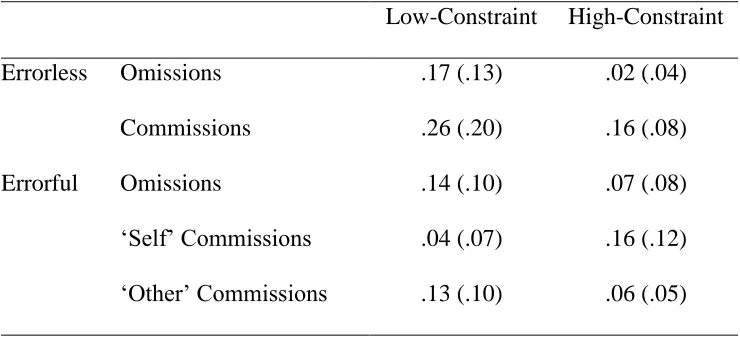
stimulus type, although subsequent analyses were limited to errors in the errorful condition. A mixed ANOVA with the between-group factor Cue–Target Constraint and the within-group factor Error Type (omissions, self-commissions, other-commissions) was conducted. Only interactions containing the factor Error Type are of interest here. We found a Cue–Target × Error Type interaction [F(2, 90) = 422 18.55, MSE= .009, p < .001, p2 = .292]. This reflects the fact that participants were significantly more likely to make an omission [t(45) = –2.78, p = .024, d = 0.83; p values for all follow-up t-tests are Holm–Bonferroni corrected: Holm, 1979] or an other-commission [t(45) = –3.32, p = .004, d = 0.99] for the low- than for the high-constraint stimuli at test. Self-commissions were significantly more likely for high- than for low-constraint stimuli, however [t(45) = 4.35, p < .001, d = 1.30]. These analyses reveal an important pattern:
Participants were much more likely to make the same self-generated errors at test that they had made at study when stimuli were high-constraint than when they were low-constraint.
Discussion
The results from Experiment 1 replicate and extend the pattern reported in recent articles that have investigated the impact of errorful learning on later cued recall of semantically
during study, and this increase in self-generated errors accounts for the relative disadvantage in performance for the errorful condition for these stimuli. Why might participants be able to exclude their own self-generated responses for low- but not for high-constraint stimuli? One reason is likely to be the number of possible responses that the respective cue types are associated with before learning. The very small set of possible targets that word-stem cues are associated with, by virtue of the way in which these stimuli are constructed, decreases considerably the number of possible answers that can be given at test. This small set size may strengthen the representations of erroneous responses and increase the likelihood that an incorrect answer given at test will be the same incorrect answer that was given at study. The high constraint on possible guesses is also likely to explain the main effect of performance between the two stimulus types: Guessing within a very small set of highly constrained responses is much more likely to lead to the correct answer.
were almost always wrong. In Experiment 2, the extent to which the errorful learning advantage might be a consequence of participants’ ability to ignore their own responses was investigated.
Experiment 2
Examination of test errors made for low-constraint cue–target associations in Experiment 1 indicated that participants very rarely gave the same error at test that they made at study. It is not appropriate to assume that this came about because participants failed to remember these items, given what is known about the mnemonic advantages for self-generated responses. In line with this, Vaughn and Rawson (2012) have shown that participants remember their own guesses at test with high accuracy. If participants can remember their responses, why do they not tend to report them in the current task? The most obvious answer is that participants are aware that their own answers are never correct and explicitly withhold them during the final test. This possibility comes about because the task used in Experiment 1, and in previous reports, employs a condition in which almost all responses that participants make are deemed incorrect, in order to circumvent the problem of item characteristics (Pashler, Zarow, & Triplett, 2003). The outcome of this is that self-generated errors can never be confused with correct self-generated items. Instead, these responses could be used as an additional—and, presumably, potent—retrieval cue.
low-constraint stimuli is not a consequence of participants’ ability to use a strategy in which they can discount all self-generated responses, and genuinely provides a learning benefit over errorless learning, then the errorful learning conditions should also lead to higher later recall relative to errorless study trials in Experiment 2.
Method
Participants
A group of 27 native German speakers successfully completed Experiment 2a (12 female, 15 male), and 28 participants (22 female, six male) completed Experiment 2b for course credit or monetary payment (€8 per hour). One additional participant was excluded from the final analysis in Experiment 2a for failing to provide at least four correct answers in each experimental
condition.
Stimuli and design
Two versions of Experiment 2 were conducted, and the procedural difference between Experiments 2a and 2b is delineated further below. Stimuli in Experiment 2a comprised 90 weakly semantically associated word pairs, whilst in Experiment 2b they comprised 90 semantic triplets. Word pairs were constructed under identical constraints as those employed in Experiment 1. Triplets were created by adding a 2nd weak semantic associate to each cue–target pair
word length, frequency and strength of association, and these lists were counterbalanced across experimental conditions.
Procedure
The trial parameters and task instructions in both Experiments 2a and 2b were identical to those used for low-constraint stimuli in Experiment 1 with the exception that 30 errorless-generate trials were added to both study and test. For these study trials, participants were required to input an associated word within the 6,000-ms input screen identical to the requirements during Errorful trials. For the final 4,000 ms of these trials, both the cue and participant’s input were presented. The remaining 60 trials comprised 30 errorless and 30 errorful trials and all three trial types were randomly intermixed at study and test. As in Experiment 1, it remained possible for participants to occasionally guess correctly on errorful trials in Experiment 2a. Experiment 2b was identical, with the exception that the experiment was programmed such that, on errorful trials, the
participants’ input was compared with one of the two targets. If the participants’ input matched this target (i.e., the participant made the correct response), the 2nd target would be presented to be learned. Which of the two targets was compared with the participants’ input was
counterbalanced across participants. In this way, it was possible to ensure that all errorful trials in Experiment 2b were truly errorful.
Results and discussion
three learning conditions for Experiments 2a and 2b. As would be expected, the final cued recall was greatest for the errorless-generate condition in both experiments. A mixed ANOVA with three levels of learning condition and the between-subjects factor Experiment (2a, 2b) revealed a main effect of learning condition [F(2, 106) = 72.12, MSE = .013, p < .001, p2 = .576], and planned t-tests revealed that recall in the errorless-generate condition was significantly higher than that in the other conditions [ts(54) > 8.88, ps < .001, ds > 1.33]. We also observed a
significant increase in cued-recall performance for errorful learning relative to errorless learning [t(54) = 3.08, p = .003, d = 0.378]. No interactions with the Experiment factor emerged.
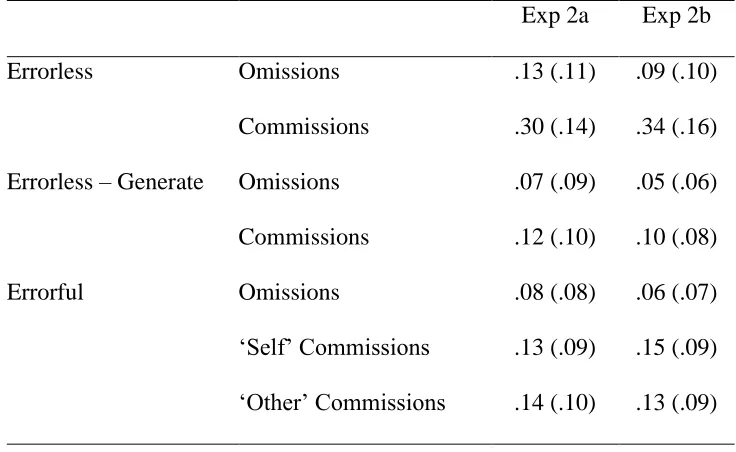
The data from Experiment 2 indicate that the relative mnemonic advantage for errorful learning is reduced when testing does not always lead to an error, although an advantage was nonetheless present. Participants were more likely to provide their own incorrect study answers in the final test phase when self-generated answers were no longer consistently deemed incorrect during learning. This is consistent with the idea that participants in Experiment 1 were able to retrieve their own generated responses and, being aware that they were always incorrect, they tended to withhold these responses. Important to note is that although the pattern of errors changed qualitatively from Experiment 1, the overall numbers of errors at test remained broadly comparable across the two experiments, and final cued recall for the errorful condition did not differ across Experiments 1 and 2 (p > .31).
Experiment 3
Experiment 2 revealed that the errorful learning advantage relative to items in the
this may have played a role comes from a comparison of the kinds of errors made to errorless items, which also differed across experiments: Participants generally made fewer omissions in Experiment 2 than in Experiment 1 (p < .002). In order to provide a more robust test of the impact of making an error, Experiment 3 was conducted, in which the likelihood of making an error during testing (50% or 100%) was explicitly manipulated whilst leaving all other factors comparable. A final motivation for Experiment 3 was to determine whether the likelihood of making an error would interact with cue–target constraints. In Experiment 1, high-constraint cue– targets elicited significantly more self-commissions than low-constraint cue–targets. Increasing the number of instances at study in which generated responses are correct may in turn further increase the number of self-commissions given for these items in the final test phase. In this case, high-constraint cue–targets might be more sensitive to an increase in the number of correct responses given at study than low-constraint stimuli, and errorful performance for these items would be even worse in the 50% error-likelihood condition.
Method
Participants and design
Stimuli
The stimuli comprised the 90 weakly semantically associated word triplets used in Experiment 2b as well as 90 word-stem stimuli taken from the pilot rating study described in Experiment 1. For each word stem, the probabilities of generating the first and second most common response were compared, and only those stimuli for which the difference between these probabilities was no greater than .12 were selected. From these, the 90 word stems whose modal responses had the highest probability were selected for the experiment. All participants were required to learn 90 items in the word-stem and 90 items in the word-pair task. In the 100%-errorful condition, participants encountered 45 of each stimulus type in the 100%-errorful condition and 45 in the errorless condition. In the 50%-errorful condition, participants encountered 30 of each item in the errorful, 30 in the errorless condition and 30 items in the errorless-generate condition. Separate counterbalanced versions of lists were made for each error-likelihood condition, in which lists were matched for word length, frequency, and strength of association.
Procedure
The trial parameters and task instructions were identical to those used in Experiments 1 and 2. Participants completed a practice block at the beginning of the experiment in which they completed an equal number of practice study trials for the two stimulus types. These practice trials were blocked according to stimulus, and participants always completed three errorful and one errorless trial for each stimulus type. Participants in the 50%-errorful condition also
distractor tasks. These were a digit symbol task and the digit span task between study and test phase, which led to an average study–test interval of approximately 5 min. The test phase was also blocked according to stimulus type and kept in the same order as blocks presented at study. The experiment lasted on average 80 min.
Results
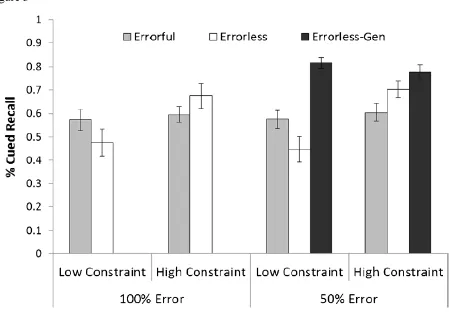
Figure 3 shows the final cued-recall patterns in Experiment 3. A 2 × 2 × 2 ANOVA with the factors Error Likelihood, Cue–Target Constraint, and Learning Condition (errorless, errorful) revealed a main effect of cue–target constraint [F(1, 30) = 19.80, MSE = .028, p < .001, p2 = .40] and an interaction between learning condition and cue–target constraint [F(1, 30) = 29.13, MSE = .012, p < .001, p2 = .493]. No significant interactions included the Error Likelihood factor (all ps >.654). As in Experiment 1, the reason for the Learning Condition × Cue–Target Constraint interaction is clear: Errorful learning led to better performance than did errorless learning for low-constraint stimuli [t(31) = 4.06, p < .001, d = 0.56], but to poorer performance for high-constraint stimuli [t(31) = 4.30, p < .05, d = 0.70], when collapsed across
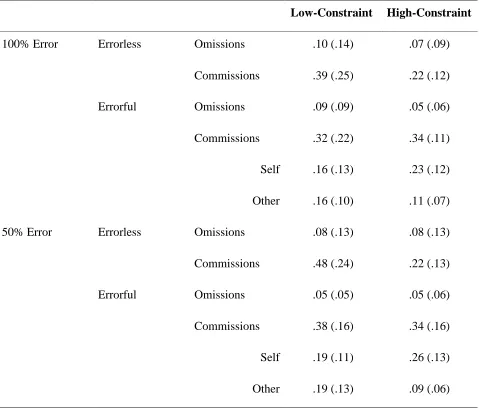
Table 3 shows the errors made at test for all conditions in Experiment 3. A first 2 × 2 × 3 ANOVA contained the between-group factor Error Likelihood and the within-subjects factors Cue–Target Constraint and Error Type (omissions, self-commissions, other-commissions). This revealed a main effect of error type [F(2, 60) = 28.39, MSE = .013, p <.001, p2 = .486] and an interaction between cue–target constraint and error type [F(2, 60) = 12.59, MSE = .008, p < .001,
p2 = .296]. This reflects the fact that participants were significantly more likely to make a self-commission [t(31) = 2.76, p = .020, d = 0.56] and significantly less likely to make an other-commission [t(31) = –3.99, p < .001, d = 0.82] for the high- than for the low-constraint stimuli at test. We found no significant difference in the likelihoods of making an omission across cue– target constraint (p = .153).
Discussion
ignore all of their own self-generated responses. This pattern is clear, but it doesn’t explain the change in the pattern of errors at test (i.e., ratio of omissions to self-commissions) for low-constraint stimuli from Experiment 1 to 2. The principal remaining difference between Experiments 1, 2, and 3 is the overall number of items that participants had to learn, which increased in each successive experiment (Exp. 1 = 60 items, Exp. 2 = 90, Exp. 3 = 180). One possibility is that the smaller set of items to be learned in Experiment 1 led participants to be more conservative overall when responding in situations in which they were uncertain. Given a possible low-confidence response, one might be more certain about whether or not that item was present within a list of studied items if that list is relatively short. When the list goes beyond this size, it may be less easy to determine the likelihood with which a low-confidence response was within the list of studied items, making participants relatively more liberal with uncertain responses.
General discussion
The importance of determining the consequences of making an error during learning is reflected in the recent spike of studies in which the conditions under which errorful learning is beneficial for learning have been investigated (Grimaldi & Karpicke, 2012; Knight et al., 2012; Vaughn & Rawson, 2012). The data from Experiments 1 and 3 add to these reports by
demonstrating that a central factor determining whether errorful learning conditions will be beneficial or detrimental to performance is how constrained targets are by a given retrieval cue, and that guessing may in fact be detrimental when the target information is highly constrained by a cue. The findings from Experiments 2 and 3 indicate that although the errorful learning
to an error (see Exp. 2a), this advantage is still observed when participants are required to determine between self-generated correct and incorrect responses.
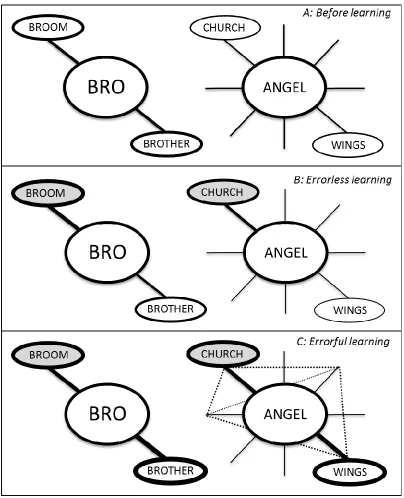
Experiments 1 and 3 comprise an explicit endeavour to connect the distinct patterns observed in one set of recent reports (Kang et al., 2011; Kornell et al., 2009) with other work based on the errorless-learning paradigm (Hammer et al., 2011; Rodriguez-Fornells et al., 2004), by focusing upon the stimulus characteristics employed in the respective literatures. Figure 4 depicts two components of the relationship between the two types of cues and target answers, which are presumed to contribute to the impact that errorful learning has on final recall: specifically, the number of associates and the strength of association between cue and target, characterized in the figure by the thickness of connecting lines. Word-stem items were specifically constructed to lead to the generation of two words with relatively high and equal probabilities, and thus the strength of activation between the cue and target for these items is necessarily greater than that between weakly associated words, for which multiple associates exist (upper panel). After errorless learning in which the cue and target are presented together to be studied, the to-be-learned item should have a relative increase in the strength of its association (see the shaded target nodes in Fig. 4). This increase in activation is a function of both the
preexisting association strengths and the number of potential items associated with each cue. The latter stipulation is comparable to the architecture of spreading activation in Reder et al.’s source-of-activation confusion model (Reder, Paynter, Diana, Ngiam, & Dickison, 2007), which states that the more links are associated with a particular cue, the less activation will spread along each particular link. It is also consistent with data indicating that recall is lower for items with
following errorless learning for the two different materials reported in Experiment 1. Strength of activation is assumed to increase to a greater extent following retrieval than following studying alone, so that incorrect answers given in the errorful learning condition have the highest overall strength at the end of a study trial (see the unshaded nodes in the lower panel of Fig. 4). For high-constraint cues, this marked increase in activation leads to considerable interference from the self-generated item at test. This is represented in the present data by the relative decrease in accuracy for errorful learning of high-constraint stimuli, alongside the high proportion of commissions for these items observed in Experiments 1 and 3. Such interference from self-generated errors is also likely to operate during the errorful learning of word pairs, although it should not lead to such a high level of self-commissions, because the number of potential responses that can be given at test is not so highly constrained. Further research could test these predictions using word-stem stimuli that differed in their numbers of associates only (i.e., the word-stem cue “BAL” can generate fewer candidate words than can “BA”), in order to determine whether errorful learning is significantly worse for more- than for less-constrained cues1.
A simple increase in the number of preexperimental associates cannot account for a benefit in learning during errorful responding, however, if simply being shown the correct answer leads to an increase in activation strength equivalent to that established during errorless learning. If this is the case, then errorful learning of word pairs should lead either to equal performance or to a decrease in accuracy relative to errorless learning, which the present data show not to be the case. The advantage in correctly recalling a to-be-learned word could be explained if the presence of a preexisting semantic network between word pairs were taken into account (Grimaldi & Karpicke, 2012; Knight et al., 2012), and this is represented by the additional dotted lines in the lower panel of Figure 4. Such a network might increase the likelihood that the correct answer is
remembered at test after an errorful response via two complementary routes: a relatively
automatic build-up of activation within an associative network (Collins & Loftus, 1975) leading to an increase in activation for the correct answer (Grimaldi & Karpicke, 2012), as well as the use of explicit retrieval cues to help the recovery of the correct item, as specified by the mediator hypothesis of the testing effect (Carpenter, 2011; Kornell et al., 2012; Pyc & Rawson, 2010). This observation means that where some form of relationship does not already exist, errorful learning conditions will not necessarily be advantageous to learning, and this in turn is consistent with data showing an errorful advantage for cued recall when the stimuli comprise semantically related but not unrelated word pairs (Grimaldi & Karpicke, 2012; Knight et al., 2012). A final point to note, however, is that despite the assumed differences concerning the underlying cue– target networks in the cases represented here, when self-generated responses were judged correct in the errorless-generate condition, performance was comparable across cue-constraint
conditions. Thus, both cue-constraint types showed equivalent generation effects, and differences appeared only when self-generated error conditions were contrasted with the errorless learning condition (see Fig. 3). The term errorless learning, as it has been employed here, borrows heavily from Baddeley and Wilson’s (1994) definition, in order to investigate how these established learning conditions interact with stimulus characteristics, but it may be more appropriate to consider the errorless condition here as being comparable to a read/restudy condition. Another way of considering errorless learning is as a learning environment that requires active
participation from the learner, but for which sufficient support is available to ensure that
From an educational perspective, determining that an errorful learning advantage, as it has been principally defined here, depends on the extent to which to-be-learned stimuli support meaningful semantic elaboration (see Knight et al. 2012, and Kornell, 2014, for direct examples of this) may help set important boundary conditions for situations in which errorful guessing can be recommended: Rather than being conducive to the learning of new information, it may be limited to the strengthening of connections within an already-existing network. The present data indicate that in cases in which the to-be-learned information comprises one of a very small number of possible options, errorful conditions may especially hamper learning. One example of this is encountered when learning a second language with grammatical gender, for which the correct answer would be one of two or three possibilities. Grammatical gender is a widespread linguistic phenomenon common to most Indo-European languages (Grüter, Lew-Williams, & Fernald, 2012) that is particularly difficult for second language learners (Sabourin, Stowe, & De Haan, 2006). An example would be deciding whether the German word for “traffic” (Verkehr) takes a neutral, feminine, or masculine gender. The present high-constraint cue–target data indicate that incorrect guessing within this small pool of items might in fact impair the ability to learn the correct response, and that this might be one factor that makes learning of this kind so difficult.
One possible point of concern that the present data address directly is that the frequency with which errors are made during test does not appear to influence the errorful learning
advantage for those stimuli for which it is observed. This provides important validation for those reports in which errorful learning has been investigated with paradigms wherein self-generated responses are deemed to be always incorrect. Nonetheless, in line with findings that have
error likelihood in order to determine the point at which errors are sufficiently rare such that they always boost performance. A final point concerns the general increase in the number of
commission errors in the final cued-recall task in Experiments 2 and 3, as compared to
References
Anderson, N. D., & Craik, F. I. M. (2006). The mnemonic mechanisms of errorless learning. Neuropsychologia, 44(14), 2806–2813.
Baayen, H., Piepenbrock, R., & Rijn, H. van. (1993). The CELEX lexical database. University of Pennsylvania, Linguistic Data Consortium.
Baddeley, A., & Wilson, B. A. (1994). When implicit learning fails: amnesia and the problem of error elimination. Neuropsychologia, 32, 53-68.
Carpenter, S. K., & DeLosh, E. L. (2006). Impoverished cue support enhances subsequent retention: support for the elaborative retrieval explanation of the testing effect. Memory & Cognition, 34(2), 268-76.
Carpenter, S. K., Pashler, H., & Cepeda, N. J. (2009). Using Tests to Enhance 8th Grade Students’ Retention of U.S. History Facts. Applied Cognitive Psychology, 77, 760-771. Carpenter, S. K., Pashler, H., Wixted, J. T., & Vul, E. (2008). The effects of tests on learning and
forgetting. Memory & Cognition, 36(2), 438-448.
Carrier, M., & Pashler, H. (1992). The influence of retrieval on retention. Memory & Cognition, 20, 633-642.
Chan, J. C. K., & McDermott, K. B. (2007). The Testing Effect in Recognition Memory : A Dual Process Account. Journal of Experimental Psychology: Learning, Memory & Cognition, 33(2), 431- 437.
Clare, L., & Jones, R. S. P. (2008). Errorless learning in the rehabilitation of memory impairment: a critical review. Neuropsychology Review, 18(1), 1-23.
Collins, A. M., & Loftus, E. F. (1975). A spreading-activation theory of semantic processing. Psychological Review, 82(6), 407-428.
Grimaldi, P. J., & Karpicke, J. D. (2012). When and why do retrieval attempts enhance subsequent encoding? Memory & Cognition, 40(4), 505-513.
Heldmann, M., Markgraf, U., Rodríguez-Fornells, A., & Münte, T. F. (2008). Brain potentials reveal the role of conflict in human errorful and errorless learning. Neuroscience Letters, 444(1), 64-68.
Holm, S. (1979). A simple sequentially rejective multiple test procedure. Scandinavian Journal of Statistics, 6, 65-70.
Johnson, M. K., Hashtroudi, S., & Lindsay, D. S. (1993). Source Monitoring. Psychological Bulletin, 114(1), 3–28.
Kang, S. H. K., Pashler, H., Cepeda, N. J., Rohrer, D., Carpenter, S. K., & Mozer, M. C. (2011). Does incorrect guessing impair fact learning? Journal of Educational Psychology, 103(1), 48-59.
Karpicke, J. D., & Roediger, H. L. (2008). The critical importance of retrieval for learning. Science, 319(5865), 966-968.
Kiss, G. R., Armstrong, C., Milroy, R., & Piper, J. (1973). An associative thesaurus of English and its computer analysis. In Aitken, A. J., Bailey, R. W., & Hamilton-Smith, N. (Eds.), The Computer and Literary Studies. Edinburgh: University Press
Knight, J. B., Hunter Ball, B., Brewer, G. A., DeWitt, M. R., & Marsh, R. L. (2012). Testing unsuccessfully: A specification of the underlying mechanisms supporting its influence on retention. Journal of Memory and Language, 66(4), 731-746
Kornell, N., Hays, M. J., & Bjork, R. A. (2009). Unsuccessful retrieval attempts enhance subsequent learning. Journal of Experimental Psychology: Learning, Memory, and Cognition, 35(4), 989-98.
Larsen, D. P., Butler, A. C., & Roediger, H. L. (2009). Repeated testing improves long-term retention relative to repeated study: a randomised controlled trial. Medical Education, 43(12), 1174-81.
McDaniel, M. A., Agarwal, P. K., Huelser, B. J., McDermott, K. B., & Roediger, H. L. (2011). Test-enhanced learning in a middle school science classroom: The effects of quiz frequency and placement. Journal of Educational Psychology, 103(2), 399-414.
Melinger, A. & Weber, A. (2006). Database of Noun Associations for German. http://www.coli.uni-saarland.de/projects/nag/.
Metcalfe, J., & Kornell, N. (2007). Principles of cognitive science in education: the effects of generation, errors, and feedback. Psychonomic Bulletin & Review, 14(2), 225-229.
Pashler, H., Zarow, G., & Triplett, B. (2003). Is temporal spacing of tests helpful even when it inflates error rates? Journal of Experimental Psychology: Learning, Memory, and Cognition, 29(6), 1051-7.
Pyc, M. A, & Rawson, K. A. (2010). Why testing improves memory: mediator effectiveness hypothesis. Science, 330(6002), 335.
Reder, L. M., Nhouyvanisvong, A., Schunn, C. D., Ayers, M. S., Angstadt, P., & Hiraki, K. (2000). A mechanistic account of the mirror effect for word frequency: A computational model of remember-know judgments in a continuous recognition paradigm. Journal of Experimental Psychology: Learning, Memory, and Cognition, 26(2), 294-320.
Reder, L. M., Paynter, C., Diana, R. A., Ngiam, J., & Dickison, D. (2007). Experience is a double-edged sword: A computational model of the Encoding/Retrieval trade-off with familiarity. Psychology of Learning and Motivation, 48, 271-312.
Rodriguez-Fornells, A., Kofidis, C., & Münte, T. F. (2004). An electrophysiological study of errorless learning. Cognitive Brain Research, 19(2), 160-73.
Skinner, B. F. (1958). Teaching Machines. Science, 128(3330).
Terrace, H. S. (1963). Discrimination learning with and without “errors”. Journal of the
Experimental Analysis of Behavior, 6(1), 1–27.
Unsworth, N. (2009). Examining variation in working memory capacity and retrieval in cued recall. Memory, 17(4), 386-396.
Unsworth, N., Heitz, R. P., Schrock, J. C., & Engle, R. W. (2005). An automated version of the operation span task. Behavior Research Methods, 37, 498-505.
Table 1: Proportion of omissions and total commissions (separated into self- and other-commissions) which were made at test for Experiment 1. Standard deviations are shown in parentheses.
Low-Constraint High-Constraint
Errorless Omissions .17 (.13) .02 (.04)
Commissions .26 (.20) .16 (.08)
Errorful Omissions .14 (.10) .07 (.08)
Table 2: Proportions of omissions and total commissions (separated into self- and other-commissions) made at test for Experiment 2. Standard deviations are shown in parentheses.
Exp 2a Exp 2b
Errorless Omissions .13 (.11) .09 (.10)
Commissions .30 (.14) .34 (.16) Errorless – Generate Omissions .07 (.09) .05 (.06) Commissions .12 (.10) .10 (.08)
Errorful Omissions .08 (.08) .06 (.07)
Table 3: Proportions of omissions and total commissions (separated into self- and other-commissions) made at test in the errorless and errorful conditions of Experiment 3. Standard deviations are shown in parentheses.
Low-Constraint High-Constraint
100% Error Errorless Omissions .10 (.14) .07 (.09)
Commissions .39 (.25) .22 (.12)
Errorful Omissions .09 (.09) .05 (.06)
Commissions .32 (.22) .34 (.11)
Self .16 (.13) .23 (.12) Other .16 (.10) .11 (.07)
50% Error Errorless Omissions .08 (.13) .08 (.13)
Commissions .48 (.24) .22 (.13)
Errorful Omissions .05 (.05) .05 (.06)
Commissions .38 (.16) .34 (.16)
Figure Captions
Figure 1: Mean proportion correct in the final cued recall test for the low and high cue-target constraint stimuli in Experiment 1. Error bars reflect +/- 1 standard error of the means.
Figure 2: Mean proportions correct in the final cued recall test for the three learning conditions in Experiments 2a and 2b. Error bars reflect +/- 1 standard error of the mean.
Figure 3. Mean proportions correct in the final cued recall test for the low and high cue-target constraint stimuli for the two different error-likelihood conditions in Experiment 3. Error bars reflect +/- 1 standard error of the mean.