Tanaka PP, Santos JC et al. (2020) Crispr-Cas9 editing of human ACE2 gene.
A Crispr-Cas9 system designed to introduce point mutations into the
human
ACE2
gene to weaken the interaction of the ACE2 receptor with
the SARS-CoV-2 S protein
Pedro P. Tanaka 1*, Jadson C. Santos 1*, Ernna H. Oliveira 1, Natane A. Miglioli 1,2,
Amanda F. Assis 1, Ana C. Monteleone-Cassiano 1,2, Vitor L. Ribeiro 3,4, Max J. Duarte 1,
Mayara V. Machado 1, Romário S. Mascarenhas 1, Alex C. Souza 1, Letícia A. Brito 1,
Letícia S. Oliveira 3, Eduardo A. Donadi 1,5, Geraldo A. Passos 1,2,3,4,#,&
Keywords: Crispr-Cas9, ACE2 gene, SARS-CoV-2, new coronavirus, COVID-19.
1 Molecular Immunogenetics Group, Department of Genetics, Ribeirão Preto Medical School, University of São Paulo, Ribeirão Preto, São Paulo, Brazil.
2 Program in Basic and Applied Immunology, Ribeirão Preto Medical School, University of São Paulo, Ribeirão Preto, São Paulo, Brazil.
3 Laboratory of Genetics and Molecular Biology, Department of Basic and Oral Biology, School of Dentistry of Ribeirão Preto, University of São Paulo, Ribeirão Preto, São Paulo, Brazil.
4 Program in Restorative Dentistry, Department of Restorative Dentistry, School of Dentistry of Ribeirão Preto, University of São Paulo, Ribeirão Preto, São Paulo, Brazil. 5 Division of Clinical Immunology, Department of Clinical Medicine, Ribeirão Preto Medical School, University of São Paulo, Ribeirão Preto, São Paulo, Brazil.
# Corresponding author at Molecular Immunogenetics Group, Department of Genetics,
Ribeirão Preto Medical School, University of São Paulo, 14049-900, Ribeirão Preto, São Paulo, Brazil. E-mail: [email protected]
& G. A. Passos ORCID: 0000-0002-4408-140X * Equal contribution.
Competing interest: Authors have declared no competing interest.
Ethical commitments: This work does not involve experimentation with animals or patients.
Tanaka PP, Santos JC et al. (2020) Crispr-Cas9 editing of human ACE2 gene.
ABSTRACT
The human angiotensin-converting enzyme 2 (ACE2) has a crucial role on blood pressure control; however, ACE2 is also the primary SARS-CoV-2 (S domain) virus receptor. Inhibiting or even reducing the expression of the native ACE2 might diminish the viral entry into the cells, but may cause a failure of ACE2 biological activity, primarily in
patients with comorbidities, including diabetes mellitus or hypertension. Since the ACE2
catalytic site and the SARS-Cov-2 receptor are distinct, we designed a Crispr-Cas9 model system, predicting the respective sequences for a guide RNA (gRNA) and a single-stranded oligo dideoxy nucleotide (ssODN), to introduce point mutations into the exon
1 of the human ACE2 gene, which encodes the alpha-helix, implicated on the binding of
the SARS-CoV-2 envelope S protein. Protein modeling predicted that the specific
substitutions of residues Phe28, Lys31, and Tyr41 for Ala at the ACE2 alpha-helix do not significantly alter ACE2 native conformation. The analysis of the impact of these
mutations on ACE2 receptor function predicted a weakening of the binding of the
SARS-CoV-2 protein S. An experimental genome editing of cells based on these Crispr-Cas9 elements might reduce the SARS-CoV-2 ability to enter the epithelial cell, preserving the biological activity of ACE2 enzyme.
INTRODUCTION
New coronavirus 2019 (SARS-CoV-2), the agent of COVID-19, belongs to a family of four Coronaviridae genera of probable bat origin (CIOTTI et al., 2020; ZHOU et al., 2020). CoVs are single-stranded positive RNA viruses with a 5'-cap structure and a 3'-poly-A tail, surrounded by an envelope. Additionally, Covs exhibit a spike glycoprotein (S), composed of the S1 and S2 subunits, which permit virus to enter the host cell, fusing into viral and cell membranes, respectively (CIOTTI et al., 2020). The interaction of the SARS-CoV-2 spike S1 subunit with the human angiotensin-converting enzyme 2 (ACE2), present on many epithelial cell surfaces, is believed to be the major mechanism for cell invasion (CIOTTI et al. 2020; LAN et al., 2020).
Diabetes mellitus (DM) and hypertension have been pointed as major comorbidity factors associated with mortality due to SARS-CoV-2 infection. Therefore, concern and interest have preoccupied physicians and researchers regarding the relationship between these comorbidities and COVID-19 fatalities (GUAN et al., 2020; DANSER et al., 2020; MUNIYAPPA and GUBBI, 2020).
Tanaka PP, Santos JC et al. (2020) Crispr-Cas9 editing of human ACE2 gene.
susceptibility to hyperactive inflammation, iv) cytokine storm; and iv) the presence of underlying cardiovascular disorders (MUNIYAPPA and GUBBI, 2020).
Blockade of the enzymatic conversion of angiotensin 2 into angiotensin 1-7 represents the key mechanism for the treatment of hypertension (TURNER 2015), propitiating an overexpression of ACE2 enzyme in lung, kidney and heart cells; however, this effect may favor the attachment of SARS-CoV-2 to epithelial cells (DANSER et al. 2020). Nevertheless, there is no reason for hypertensive patients to abandon the use of antihypertensive treatment due to concerns about the susceptibility of contracting COVID-19, since the damage to the body without these drugs may be accrued (MUNIYAPPA and GUBBI, 2020).
Literature data mining on the comorbidities associated with severe COVID-19 (e.g., cardiovascular disease, familial pulmonary hypertension, chronic obstructive pulmonary disease, diabetes, lung cancer, chronic renal failure, asthma, autoimmune diseases) revealed a broad set of shared genes, stressing ACE2 that was induced in four or more of these comorbidities (PINTO et al., 2020). To reduce infection by SARS-CoV-2, researchers have proposed pharmacological strategies to inhibit ACE2 (Sanders et al. 2020). However, the ACE2 enzyme plays a crucial role in the conversion of angiotensin 2 by controlling blood pressure, and a reduction or inhibition of its expression may have deleterious consequences. Considering that the catalytic site of ACE2 and the domain associated with SARS-CoV-2 entry into the cell present distinct locations, we addressed the possibility of developing a strategy to decrease the potential binding of the SARS-CoV-2 virus S protein to the ACE2 alpha-helix, preserving the catalytic site of the enzyme. Researchers are also concerned about devising pharmacological strategies to inhibit ACE2 in an attempt to reduce infection by SARS-CoV-2 (SANDERS et al., 2020). However, the ACE2 enzyme plays a crucial role on the conversion of angiotensin 2 by controlling blood pressure, and a reduction or inhibition of its expression may have deleterious consequences. Considering that the catalytic site of ACE2 and the domain associated with SARS-CoV-2 entry into the cell present distinct locations, we addressed the possibility of developing a strategy to decrease the potential binding of the SARS-CoV-2 virus S protein to the ACE2 alpha-helix, preserving the catalytic site of the enzyme. MATERIAL AND METHODS
Protein interaction of the ACE2 alpha-helix with the SARS-CoV-2 S1 protein
Tanaka PP, Santos JC et al. (2020) Crispr-Cas9 editing of human ACE2 gene.
was predicted using Mutabind2 (ZHANG et al., 2020) (available at https://lilab.jysw.suda.edu.cn/research/mutabind2/).
The destabilization of the ACE2 N-terminal alpha-helix was analyzed using SwissModel homology modeling and ab initio protein software (https://swissmodel.expasy.org/) and PEP-FOLD3 (https://bioserv.rpbs.univ-paris-diderot.fr/services/PEP-FOLD3/). For the analysis, a sequence of 25 amino acid residues that constitute the ACE2 N-terminal alpha-helix was considered.
Crispr-Cas9 gRNA and ssODN designdirected toACE2 gene
The single guide RNA (gRNA) was defined using the pipeline offered by the Benchling platform (available at https://www.benchling.com). For setting a gRNA to be used together with a single-stranded oligo dideoxy nucleotide (ssODN), we used the following ACE2 genomic coordinates, GRCh38, hg38, Homo sapiens, gene ACE2 ENSG00000130234, chromosomal localization chrX 15.561.033-15.602.148 (-), exon 1, transcript ACE2-201 ENST000004274411, CCDS14169.
Since spCas9 recognizes the protospacer adjacent motif (PAM) NGG sequence, this system was selected as a major guide varaible for a 20 nucleotide gRNA. We focused on a region of the ACE2 gene that encodes the protein alpha-helix, close to the target for the desired mutation. The different gRNAs designed were then visualized with their respective on-target and off-target scores, their nucleotide positions at ACE2 exon 1, and their respective PAM sequences.
Genetic polymorphism of ACE2
To evaluate the worldwide nucleotide variability at the ACE2 gene segment, we used data from the International Genome Sample Resource that includes data from the
1000 Genomes Project among other projects
(https://www.internationalgenome.org/data). RESULTS
Protein analyses of wild type and Crispr-Cas9 edited ACE-2alpha-helix
Tanaka PP, Santos JC et al. (2020) Crispr-Cas9 editing of human ACE2 gene.
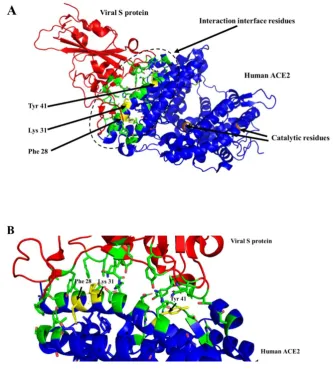
Figure 1. Modeling of the interaction of SARS-CoV-2 protein S (red) with ACE2 receptor (blue). In green is represented the interaction interface and in yellow the position of the amino acid residues (Phe28, Lys31, Tyr41), which when substituted by Ala affected the interaction (A). A detailed view showing the interaction of the amino acid residues (Phe28, Lys31, Tyr41 in yellow) from the ACE2 side (blue) with SARS-CoV-2 protein S (red) (B).
Analysis of the impact of mutations introduced in each of these residues demonstrated a high potential effect on destabilizing the ACE2-viral protein S interaction interface when a non-synonymous mutation changed the Phe 28, Lys 31 and Tyr 41 residues to Ala in each of these positions. Together, these three mutations represent an increase in free energy of 5.26 kcal mol-1, a value predicted to destabilize
the interaction interface of ACE2 with viral S protein.
Tanaka PP, Santos JC et al. (2020) Crispr-Cas9 editing of human ACE2 gene.
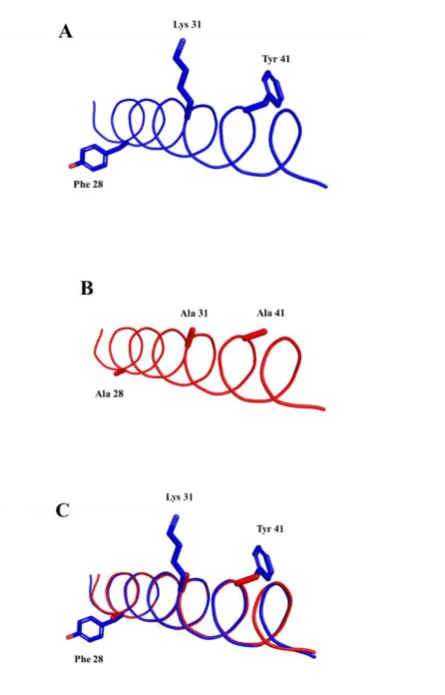
Figure 2. Modeling of the ACE2 N-terminal alpha-helix. In blue is represented the wild type ACE2 N-terminal alpha-helix (A), in red the edited ACE2 N-terminal alpha-helix (B) and the superposition of the two structures (wild type and edited) (C).
Designing gRNA and ssODN directed to exon 1 of ACE2 gene
We designed the respective sequences for gRNA and ssODN directed at the exon 1 of the ACE2 gene, encoding the N-terminal alpha helix, defining the gRNA (ACTTTGATAGAACAGGTCTT) and the PAM (CGG) sequences, which presented specificity = 40 and efficiency = 59.6, accordingly to the Benchling scores.
The ssODN was designed with equal arms presenting 60 nucleotides in length, positioned to the left of the first base pair (bp) and to the right of the last altered bp to be edited in the target gene region. The total length of the ssODN was 161 bp, and the
full ssODN sequence was defined as:
Tanaka PP, Santos JC et al. (2020) Crispr-Cas9 editing of human ACE2 gene.
The gRNA, PAM and ssODN sequences were positioned in the antisense chain within ACE2 exon 1 (Figures 3 and 4) and, therefore, at the time of use, they should be written as a complementary reverse sequence. The prediction of off-targets for this system is shown in the Supplemental Table 1 available at (www.rge.fmrp.usp.br/passos/off_targets_gRNA_ACE2).
ENSG00000130234 Homo sapiens ACE2 gene
ATGTCAAGCTCTTCCTGGCTCCTTCTCAGCCTTGTTGCTGTAACTGCTGCTCAGTCCACCATTGAGGAACAGGCCAAGACATTTTT GGACAAGTTTAACCACGAAGCCGAAGACCTGTTCTATCAAAGTTCACTTGCTTCTTGGAATTATAACACCAATATTACTGAAGAG AATGTCCAAAACATGAATAATGCTGGGGACAAATGGTCTGCCTTTTTAAAGGAACAGTCCACACTTGCCCAAATGTATCCACTAC AAGAAATTCAGAATCTCACAGTCAAGCTTCAGCTGCAGGCTCTTCAGCAAAATGGGTCTTCAGTGCTCTCAGAAGACAAGAGCA AACGGTTGAACACAATTCTAAATACAATGAGCACCATCTACAGTACTGGAAAAGTTTGTAACCCAGATAATCCACAAGAATGCTT ATTACTTGAACCAGGTTTGAATGAAATAATGGCAAACAGTTTAGACTACAATGAGAGGCTCTGGGCTTGGGAAAGCTGGAGAT CTGAGGTCGGCAAGCAGCTGAGGCCATTATATGAAGAGTATGTGGTCTTGAAAAATGAGATGGCAAGAGCAAATCATTATGAG GACTATGGGGATTATTGGAGAGGAGACTATGAAGTAAATGGGGTAGATGGCTATGACTACAGCCGCGGCCAGTTGATTGAAG ATGTGGAACATACCTTTGAAGAGATTAAACCATTATATGAACATCTTCATGCCTATGTGAGGGCAAAGTTGATGAATGCCTATCC TTCCTATATCAGTCCAATTGGATGCCTCCCTGCTCATTTGCTTGGTGATATGTGGGGTAGATTTTGGACAAATCTGTACTCTTTGA CAGTTCCCTTTGGACAGAAACCAAACATAGATGTTACTGATGCAATGGTGGACCAGGCCTGGGATGCACAGAGAATATTCAAG GAGGCCGAGAAGTTCTTTGTATCTGTTGGTCTTCCTAATATGACTCAAGGATTCTGGGAAAATTCCATGCTAACGGACCCAGGA AATGTTCAGAAAGCAGTCTGCCATCCCACAGCTTGGGACCTGGGGAAGGGCGACTTCAGGATCCTTATGTGCACAAAGGTGAC AATGGACGACTTCCTGACAGCTCATCATGAGATGGGGCATATCCAGTATGATATGGCATATGCTGCACAACCTTTTCTGCTAAGA AATGGAGCTAATGAAGGATTCCATGAAGCTGTTGGGGAAATCATGTCACTTTCTGCAGCCACACCTAAGCATTTAAAATCCATT GGTCTTCTGTCACCCGATTTTCAAGAAGACAATGAAACAGAAATAAACTTCCTGCTCAAACAAGCACTCACGATTGTTGGGACTC TGCCATTTACTTACATGTTAGAGAAGTGGAGGTGGATGGTCTTTAAAGGGGAAATTCCCAAAGACCAGTGGATGAAAAAGTGG TGGGAGATGAAGCGAGAGATAGTTGGGGTGGTGGAACCTGTGCCCCATGATGAAACATACTGTGACCCCGCATCTCTGTTCCA TGTTTCTGATGATTACTCATTCATTCGATATTACACAAGGACCCTTTACCAATTCCAGTTTCAAGAAGCACTTTGTCAAGCAGCTA AACATGAAGGCCCTCTGCACAAATGTGACATCTCAAACTCTACAGAAGCTGGACAGAAACTGTTGTAA
Tanaka PP, Santos JC et al. (2020) Crispr-Cas9 editing of human ACE2 gene. ENSG00000130234 Homo sapiens ACE2 gene
ATGTCAAGCTCTTCCTGGCTCCTTCTCAGCCTTGTTGCTGTAACTGCTGCTCAGTCCACCATTGAGGAACAGGCCAAGACAGCT TTGGACGCGTTTAACCACGAAGCTGAAGACCTGTTCGCTCAAAGTTCACTTGCTTCTTGGAATTATAACACCAATATTACTGAA GAGAATGTCCAAAACATGAATAATGCTGGGGACAAATGGTCTGCCTTTTTAAAGGAACAGTCCACACTTGCCCAAATGTATCCA CTACAAGAAATTCAGAATCTCACAGTCAAGCTTCAGCTGCAGGCTCTTCAGCAAAATGGGTCTTCAGTGCTCTCAGAAGACAAG AGCAAACGGTTGAACACAATTCTAAATACAATGAGCACCATCTACAGTACTGGAAAAGTTTGTAACCCAGATAATCCACAAGAA TGCTTATTACTTGAACCAGGTTTGAATGAAATAATGGCAAACAGTTTAGACTACAATGAGAGGCTCTGGGCTTGGGAAAGCTGG AGATCTGAGGTCGGCAAGCAGCTGAGGCCATTATATGAAGAGTATGTGGTCTTGAAAAATGAGATGGCAAGAGCAAATCATTA TGAGGACTATGGGGATTATTGGAGAGGAGACTATGAAGTAAATGGGGTAGATGGCTATGACTACAGCCGCGGCCAGTTGATT GAAGATGTGGAACATACCTTTGAAGAGATTAAACCATTATATGAACATCTTCATGCCTATGTGAGGGCAAAGTTGATGAATGCC TATCCTTCCTATATCAGTCCAATTGGATGCCTCCCTGCTCATTTGCTTGGTGATATGTGGGGTAGATTTTGGACAAATCTGTACTC TTTGACAGTTCCCTTTGGACAGAAACCAAACATAGATGTTACTGATGCAATGGTGGACCAGGCCTGGGATGCACAGAGAATATT CAAGGAGGCCGAGAAGTTCTTTGTATCTGTTGGTCTTCCTAATATGACTCAAGGATTCTGGGAAAATTCCATGCTAACGGACCCA GGAAATGTTCAGAAAGCAGTCTGCCATCCCACAGCTTGGGACCTGGGGAAGGGCGACTTCAGGATCCTTATGTGCACAAAGGT GACAATGGACGACTTCCTGACAGCTCATCATGAGATGGGGCATATCCAGTATGATATGGCATATGCTGCACAACCTTTTCTGCTA AGAAATGGAGCTAATGAAGGATTCCATGAAGCTGTTGGGGAAATCATGTCACTTTCTGCAGCCACACCTAAGCATTTAAAATCC ATTGGTCTTCTGTCACCCGATTTTCAAGAAGACAATGAAACAGAAATAAACTTCCTGCTCAAACAAGCACTCACGATTGTTGGGA CTCTGCCATTTACTTACATGTTAGAGAAGTGGAGGTGGATGGTCTTTAAAGGGGAAATTCCCAAAGACCAGTGGATGAAAAAG TGGTGGGAGATGAAGCGAGAGATAGTTGGGGTGGTGGAACCTGTGCCCCATGATGAAACATACTGTGACCCCGCATCTCTGTT CCATGTTTCTGATGATTACTCATTCATTCGATATTACACAAGGACCCTTTACCAATTCCAGTTTCAAGAAGCACTTTGTCAAGCAG CTAAACATGAAGGCCCTCTGCACAAATGTGACATCTCAAACTCTACAGAAGCTGGACAGAAACTGTTGTAA
Figure 4. FASTA sequence of the genomic region that encodes the human ACE2 [chrX 15.561.033-15.602.148 (-), gene ENSG00000130234, transcript ENST000004274411, CCDS14169]after Crispr-Cas9 editing. The respective codon changes are shown in green. TTT (Phe) to GCT (Ala) at position 28, AAG (Lys) to GCG (Ala) at position 31 and TAT (Tyr) to GCT (Ala) at position 41 in the N-terminal alpha-helix of ACE2. In blue is shown the silent mutation introduced in the PAM sequence, exon 1 of the ACE2 gene is underlined and the ssODN sequence is in bold.
Genetic polymorphism of ACE2
To date, the human ACE2 gene presents 317 non-synonymous single-nucleotide polymorphisms (SNPs) across its 18 coding exons, exhibiting population frequencies below 0.1%. None of these variations has been associated with any clinical phenotype registered in the ClinVardatabase (https://www.ncbi.nlm.nih.gov/clinvar/) (LANDRUM, 2014).
DISCUSSION
The intrinsic characteristic of SARS-CoV-2, which emerged in late 2019, as a highly infectious COVID-19 pandemic has been defying worldwide scientists to scrutinize new antiviral drugs, take advantage of the ones already in use or propose new strategies to lessen the burden of the pandemics (SANDERS et al., 2020).
Tanaka PP, Santos JC et al. (2020) Crispr-Cas9 editing of human ACE2 gene.
We predicted the elements of the Crispr-Cas9 system, i.e., the gRNA and ssODN, to selectively introduce destabilizing point mutations in specific amino acid residues of
the N-terminal alpha-helix of the human ACE2 gene, the main SARS-CoV-2 receptor. The
destabilizing effect of the edited mutations weakened the interface interaction between ACE2 alpha-helix and SARS-CoV-2 S protein, while preserving the helicoidally structure at the ACE2 side.
Since the binding site between CoVs and ACE2 has been identified (LI et al., 2005,
HOFFMANN et al., 2020; ZHANG et al., 2020), several strategies have been proposed directed to ACE2, including ACE inhibition or ACE2 administration. The blockage of human ACE2 with small molecules or even with antibodies (ZHANG et al., 2020) could be an alternative for COVID-19 treatment. The antiviral umifenovir acts as an inhibitor of the fusion between the SARS-CoV-2 S protein and ACE2; however, this drug has not yet been approved for use outside of Russia and China (KADAM and WILSON, 2017; SANDERS et al., 2020). On the other hand, the use of ACE2 blockers could worsen COVID-19 (SANDERS et al., 2020; FANG et al., 2020; SOMMERSTEIN et al., 2020; ESLER et al., 2020; DIAZ, 2020; VADUGANATHAN et al., 2020), since the increased expression of ACE2
may facilitate the entry of SARS-CoV-2 into cells. In addition, ACE2 blockade per se can
complicate the condition of patients with arterial hypertension.
Administration of soluble ACE2 could compete with membrane ACE2 and reduce SARS-CoV-2 entry into the cells. Indeed, the excess of ACE2 could competitively bind to SARS-CoV-2, not only preventing the virus to enter the cells, but also rescuing ACE2's cellular activity, which negatively regulates the renin-angiotensin system and protects the lung from injury (IMAI et al., 2005; YU et al., 2020). Therefore, treatment with a soluble form of ACE2 could inhibit viral entry into cells (LI et al., 2003; LI et al., 2005) and protect the lung from injury (KUBA et al., 2005; IMAI et al., 2005; WOSTEN-VAN ASPEREN et al., 2011).
Epidemiological, clinical, laboratory and systems biology approaches have corroborated the role of ACE2 in the pathogenesis of COVI-19, including: i) increased disease morbidity and mortality in the presence of comorbidities (CHEN et al. 2020; ZHOU et al., 2020), ii) association of comorbidities with ACE2, required for the SARS-COV-2 virus to bind and enter host cells (KUBA et al., 2005; YAN et al., 2020; ZHOU et al., 2020), iii) increased ACE2 levels in the pulmonary endothelium arteries of patients
with pulmonary hypertension (ORTE et al., 2000), and iv) in silico studies encompassing
co-expression analyzes, meta-analyzes and construction of gene networks have
indicated the gene networks associated with increased expression of ACE2 in the lung
of patients with comorbidities (PINTO et al., 2020).
ACE2 exhibits a double role on COVID-19, it is an important enzyme to control
blood pressure and, at the same time, is the main receptor for SARS-CoV-2. ACE2
Tanaka PP, Santos JC et al. (2020) Crispr-Cas9 editing of human ACE2 gene.
administration of ACE2 may impede virus entry to the cell, but may produce unforeseen
collateral effects.
In this context, we designed a Crispr-Cas9 model system that destabilizes part of
the ACE2 protein that interacts with the virus (amino acid residues Phe28, Lys31 and
Tyr41 of the N-terminal alpha-helix). At the same time, this system preserves the structural conformation and the most critical amino acid residues (Arg273, His505, His345, Arg169, Arg514 and Tyr515) responsible for ACE2 catalytic function (GUY et al., 2005).
We further verified whether mutations in the ACE2 gene have been described in
human populations that could be associated with any disease. The genetic variations in this gene are below 0.1% in worldwide populations and at the time of writing this paper, no clinical condition thing has been associated.
To the best of our knowledge, this is the first research work that shows a perspective for the use of the Crispr-Cas9 system to edit the human ACE2 gene within the context of COVID-19, which focuses on reduction the SARS-CoV-2 interaction, while preserving the physiological function of the ACE2 enzyme.
ACKNOWLEDGEMENTS
This study was funded in part with resources of the Sao Paulo Research Foundation (FAPESP, Sao Paulo, Brazil, grant # 17/10780-4 to GAP and EAD). Also, we received financial support from the Brazilian National Council for Scientific and Technologic Development (CNPq, grants # 305787/2017-9 to GAP and #302060/2019-7 to EAD) and from CAPES Foundation through financial code 001. ACM-C and LAB received fellowships from FAPESP, grants #19/23448-3, and #20/01879-0, respectively.
REFERENCES
CIOTTI M, Angeletti S, Minieri M et al (2020) COVID-19 outbreak: An overview. Chemotherapy 7:1-9 [Epub ahead of print] doi: 10.1159/000507423.
CHEN N, Zhou M, Dong X et al. (2020)
Epidemiological and clinical characteristics of 99 cases of 2019 novel coronavirus pnem onia in Wuhan, China: a descriptive study. Lancet 395(10223):507-513. doi: 10.1016/S0140-6736(20)30211-7.
DANSER AH, Epstein M, Battle D (2020) Renin-angiotensin system blockers and the COVID-19 pandemic – at present there is no evidence to abandon renin-angiotensin system blockers. Hypertension [Epub ahead of print] doi: 10.1161/HYPERTENSIONAHA.120.15082.
Tanaka PP, Santos JC et al. (2020) Crispr-Cas9 editing of human ACE2 gene.
ESLER M, Esler D (2020) Can angiotensin receptor-blocking drugs perhaps be harmful in the COVID-19 pandemic? J Hypertens 38(5): 781-782. doi: 10.1097/HJH.0000000000002450.
FANG L, Karakiulakis G, Roth M (2020) Are patients with hypertension and diabetes mellitus at increased risk for COVID-19 infection? Lancet Respir Med 8(4): e21. doi: 10.1016/S2213-2600(20)30116-8.
GUAN W, Liang W, Zhao Y et al (2020) Comorbidity and its impact on 1590 patients with Covid-19 in China: A nationwide analysis. Eur Respir J doi: 10.1183/13993003.00547-2020.
GUY JL, Jackson RM, Jensen HA et al (2005) Identification of critical active-site residues in angiotensin-converting enzyme-2 (ACE2) by active-site-directed mutagenesis. FEBS J 272(14): 3512-3520. doi: 10.1111/j.1742-4658.2005.04756.x.
HOFFMANN M, Kleine-Weber H, Schroeder S et al (2020)
SARS-CoV-2 cell entry depends on ACESARS-CoV-2 and TMPRSSSARS-CoV-2 and is blocked by
a clinically proven protease inhibitor. Cell 181: 271-280 doi: 10.1016/j.cell.2020.02.052. IMAI Y, Kuba K, Rao S et al (2005) Angiotensin-converting enzyme 2 protects from severe acute lung failure. Nature 436: 112–116. doi: 10.1038/nature03712.
KADAM RA, Wilson IA (2017) Structural basis of influenza virus fusion inhibition by the antiviral drug Arbidol. Proc Natl Acad Sci USA 114: 206-214. doi: 101073/pnas.1617020114.
KUBA K, Imai Y, Rao S et al. (2005) A crucial role of angiotensin converting enzyme 2 (ACE2) in SARS coronavirus-induced lung injury. Nat Med 11(8): 875-879. doi: 10.1038/nm1267.
LAN J, Ge J, Yu J et al (2020) Structure of the SARS-CoV-2 spike receptor-binding domain bound to the ACE2 receptor. Nature [Epub ahead of print] doi: 10.1038/s41586-020-2180-2185.
LANDRUM MJ, Lee JM, Riley GR et al. (2014) ClinVar: public archive of relationships among sequence variation and human phenotype. Nucleic Acids Res. 42(Database issue): D980-5. doi: 10.1093/nar/gkt1113.
LI F, Li W, Farzan M et al (2005) Structure of SARS coronavirus Spike receptor-binding domain complexed with receptor. Science 309: 1864–1868. doi: 10.1126/science.1116480.
LI W, Moore MJ, Vasilieva N et al (2003) Angiotensin-converting enzyme 2 is a functional receptor for the SARS coronavirus. Nature 426: 450–454. doi: 10.1038/nature02145. MUNIYAPPA R, Gubbi S (2020) COVID-19 pandemic, coronaviruses, and diabetes mellitus. Am J Physiol Endocrinol Metab 318(5): E736-E741. doi: 10.1152/ajpendo.00124.2020.
Tanaka PP, Santos JC et al. (2020) Crispr-Cas9 editing of human ACE2 gene.
hypertension.J Pathol 192(3): 379-384. doi: 10.1002/1096-9896(2000)9999:9999<::AID-PATH715>3.0.CO;2-Q.
PINTO B, Oliveira A, Singh Y, et al. (2020) ACE2 expression is increased in the lungs of patients with comorbidities associated with severe COVID-19. medRxiv 2020.03.21.20040261. doi: https://doi.org/10.1101/2020.03.21.20040261.
SANDERS JM, Monogue ML, Jodlowski TZ et al. (2020) Pharmacologic treatments for coronavirus disease 2019 (COVID-19). JAMA [Epub ahead of print] doi: 10.1001/jama.2020.6019.
SOMMERSTEIN R, Kochen MM, Messerli FH et al (2020) Coronavirus disease 2019 (COVID-19): Do angiotensin-converting enzyme inhibitors/angiotensin receptor blockers have a biphasic effect? J Am Heart Assoc 9(7): e016509. doi: 10.1161/JAHA.120.016509. TURNER AJ (2015) ACE2 Cell Biology, Regulation, and Physiological Functions. Chapter 25 In: Unger T, Ulrike M, Steckelings UM, dos Santos RA (Eds). The Protective Arm of the Renin Angiotensin System (RAS): Functional Aspects and Therapeutic Implications. Academic Press. pp 185-189. doi: 10.1016/B978-0-12-801364-9.00025-0.
VADUGANATHAN M, Vardeny O, Michel T et al. (2020) Renin-angiotensin-aldosterone system inhibitors in patients with covid-19. N Engl J Med 382(17): 1653-1659. doi: 10.1056/NEJMsr2005760.
XU L, Yang H, Gao Y et al (2017) Crispr/Cas9-mediated CCR5 ablation in human hematopoietic stem/progenitor cells confers HIV-1 resistance in vivo. Mol Ther 25(8): 1782-1789. doi: 10.1016/j.ymthe.2017.04.027.
YAN R, Zhang Y, Li Y et al. (2020) Structural basis for the recognition of SARS-CoV-2 by full-length human ACESARS-CoV-2. Science 367(6485): 1444-1448. doi: 10.1126/science.abb2762.
YU L, Yuan K, Phuong HT et al (2016) Angiotensin-(1-5), an active mediator of renin-angiotensin system, stimulates ANP secretion via Mas receptor. Peptides 86: 33–41. doi: 10.1016/j.peptides.2016.09.009.
WÖSTEN-VAN-ASPEREN RM, Lutter R, Specht PA et al (2011) Acute respiratory distress syndrome leads to reduced ratio of ACE/ACE2 activities and is prevented by angiotensin-(1-7) or an angiotensin II receptor antagonist. J Pathol 225: 618–627. doi: 10.1002/path.2987.
ZHANG H, Penninger JM, Li Y et al. Angiotensin-converting enzyme 2 (ACE2) as a SARS-CoV-2 receptor: molecular mechanisms and potential therapeutic target. Intensive Care Med 46: 586–590. doi: 10.1007/s00134-020-05985-9.
ZHOU F, Yu T, Du R et al. (2020) Clinical course and risk factors for mortality of adult inpatients with COVID-19 in Wuhan, China: a retrospective cohort study. Lancet 395(10229): 1054-1062. doi: 10.1016/S0140-6736(20)30566-3.