The International Journal of the First Year in Higher Education
ISSN: 1838-2959
Volume 4, Issue 2, pp. 131-136
August 2013
“Third generation” conversations – A partnership
approach to embedding research and learning
skills development in the first year. A Practice
Report
Anne Taib and Julie Holden
Monash University, Melbourne, Australia
Abstract
This Practice Report offers a strategic approach to making research and learning skills explicit within the curriculum of first year core units, by enabling a systematic process of pedagogical conversations between teaching faculty, learning skills advisers and librarians. It reports on a collaborative project between staff of Monash Library and academic staff of the faculties of Business and Economics and Information Technology. It offers tools and protocols for the review and renewal of curricula and co-curricula practice within a partnership model, informed by the Research Skills Development (RSD) Framework. It takes into account teaching and learning approaches, intervention and support strategies, assessment, and feedback mechanisms. It also responds to emerging trends in higher education delivery such as blended learning and the flipped classroom model (Baker, 2000).
Please cite this practice report as:
Taib, A., & Holden, J. (2013). “Third generation” conversations – A partnership approach to embedding research and learning skills development in the first year. A Practice Report. The International Journal of the First Year in Higher Education, 4(2). 131-136. doi: 10.5204/intjfyhe.v4i2.178
This practice report has been accepted for publication in Int J FYHE. Please see the Editorial Policies under the ‘About’ section of the Journal website for further information.
Context
A common theme across the extensive first year experience (FYE) literature of the last decade has been the call for a systematic, coordinated, organisational approach to the first year experience that brings together the various academic and professional learning systems within universities, and moves beyond a triage, scattergun approach (Coates, 2005; Krause, Hartley, James & McInnis, 2005; Kuh, 2007; Tinto, 2009).
Some of the strongest voices have come from the exponents of Transition Pedagogy (Kift & Nelson, 2005). Described as “everybody’s business,” Transition Pedagogy is defined as the coming together of “first generation” co-curricular learning activities such as those traditionally delivered by non-faculty staff and “second generation” curricular initiatives such as those embedded within a curriculum context, to create a coherent “third generation” partnership FYE approach which is integrated, intentional and cross-institutional (Kift, Nelson & Clarke, 2010).
While Kift et al. (2010) report that “third generation” uptake has been slow and “piecemeal,” the model has generated a range of recently reported FYE initiatives at Australian universities based upon academic and non-faculty partnerships. These include an assessment design and management project (Macleod & Wilson, 2012), the Queensland University of Technology’s (QUT) Study Solutions model outlined by Derrington, Hayes, Batchelor and Peacock (2011), a project to embed inquiry and research skills development at La Trobe University (Salisbury, Yager, & Kirkman, 2012) and a foundation year writing and research initiative at Monash University (Png & McKeown, 2011).
A recent case study by Kift et al. (2010) considers the lessons learned from the development of Transition Pedagogy initiatives at QUT over the last ten years, and argues for a top down-bottom up approach, that fosters ground-up initiatives in an environment of institutional endorsement and support, an approach that mitigates against the “piecemeal.”
This Practice Report describes a professional and academic partnership project that reflects the QUT model and the recommendation of Kift and colleagues to adopt a stance of shared responsibility. It involves the collaboration of three sets of key players: faculty academics, Librarians and Learning Skills Advisers. The faculty components include the unit coordinators and teachers of the common core units from two first year degrees: the Bachelor of Business and Economics and the Bachelor or Information Technology. The Librarians and Learning Skills Advisers are part of a faculty-specific team, whose role is to provide co-curricula research and learning skills development as well as in-curricula support to both students and teachers. Like QUT, Librarians and Learning Skills Advisers are co-located within the Monash Library in the same student-facing space, under the banner of Research and Learning (R&L). Echoing the QUT experience reported by Derrington et al. (2011) in their 2011 Nuts and Bolts session paper, this integrated delivery model increases accessibility and visibility to students and provides research and learning support which is “normalised, open, positive and the responsibility of many” (p. 1).
the Research Skills Development (RSD) Framework as a critical element of the Monash Education Strategic Plan 2011– 2015. Alignment of all Monash courses against the RSD Framework is a current institutional goal. At an operational level, the Monash Library has been tasked with achieving this across the university. This commitment has fostered a wide variety of library and faculty partnerships and opened up professional/academic dialogue, paving the way for this project.
Now in use at five Australian universities, the RSD Framework is a conceptual framework intended to inform curriculum design and assessment, and to promote a community of practice committed to approaches and resources targeting explicit and incremental development of students’ research and learning skills across a range of contexts (Willison & O'Regan, 2007).
An additional important factor to be acknowledged within the context of this project, is the openness of both faculties involved, to a process of curriculum renewal and to the adoption of new modes of delivery that address the changing pattern of student engagement. The project described in this session builds upon an earlier initiative in 2007 to radically review the core Bachelor of Business first year units in order to develop a common foundation curriculum that incorporates meta skills, including academic literacy and academic culture as well as research and learning skills. An internal discussion paper entitled Foundation Year – A proposal for change 2008 (Monash University, 2007), also made way for the way for the current consultative model.
Background
The purpose of the project, which commenced in Semester 2, 2012, is to map and align research and learning skills against the core curricula of the first year of two degrees, drawing upon the Research Skills Development (RSD) Framework. The intention was to review current delivery of research and learning skills and explore the potential for better integration with faculty programs as well as identify gaps and opportunities for further collaboration. This includes opportunities for learning activities to be delivered in co-curricula and in-curricula modes, as well as via blended learning contexts.
Our aim was to create a project informed by collaborative, action research principles and employ a cycle of action, review and systematic reflection (Dick, 2002) resulting in a consultative protocol which forms the basis for the ongoing conversations within Research & Learning (R&L) and between R&L and Faculty.
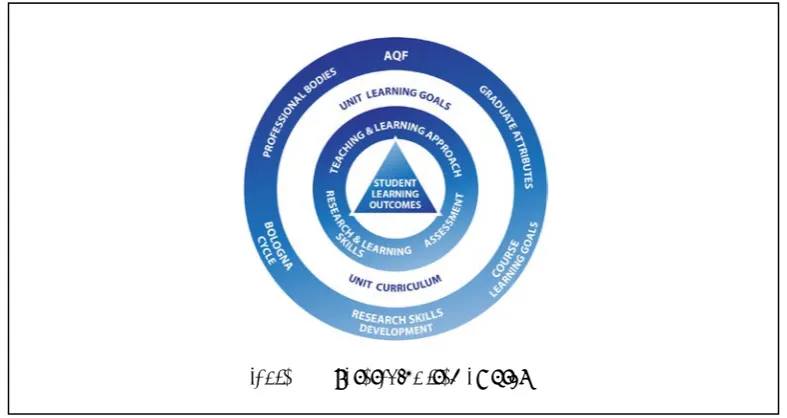
Figure 1: Overarching frameworks
Another bi-product of the process was the creation of an overview matrix of all the overarching quality frameworks governing curriculum. The process of developing this matrix presented a first time opportunity for some of the R&L and academic staff to view in depth the details of these frameworks. A graphical representation of the key frameworks and learning outcomes was created. (See Figure 1) Student Outcomes were positioned at the centre, with Curriculum, Teaching Approach, Assessment and Research and Learning, equally placed around the inner circle. Creation of this artifact helped to change the perceptions of the partner members about our roles leading to further collaborative work such as the creation of assessment rubrics integrating research and learning skills.
The documenting process identified all R&L delivery and content to determine the breadth and efficiency of the current model, and informed us of development opportunities to target our delivery more strategically and with more relevance.
Session Overview
To maximise feedback and exchange of ideas, this session first included a presentation, focusing on the background to the project and the processes and tools under development. followed by an interactive segment, which included group tasks and opportunities for both small and large-group discussion.
assessment tasks.
The wider whole-group discussion underscored the need for scaffolding and staging within course delivery and assessment to recognise the developmental needs of first year students as apprentice scholars, writers and researchers. It also raised the value of collaborative and partnership curriculum design models for academics who are often working in isolation and who face increasing challenges to incorporate new online and blended learning delivery models.
Discussion also provided positive feedback on the applicability of the mapping process and conversation protocol to wider contexts. Participants were asked to consider the feasibility of adopting the
project’s professional/academic partnership model in their own settings.
Comments pointed to the potential impact of frameworks such as the Australian Quality Framework and the RSD Framework to explicitly locate research and learning skills in the first year curriculum and to promote a more inclusive “one team” curriculum design and delivery approach. It was generally acknowledged that whole-of-institution, policy-led initiatives such as the Monash University Library partnership model provide a sound basis for sustainable change.
References
Baker, J. (2000, February). The "classroom flip": Using web course management tools to become the guide by the side. Paper presented at the 11th International Conference on College Teaching and Learning, Jacksonville, Florida.
Coates, H. (2005). The value of student engagement for higher education quality assurance. Quality in Higher Education, 11(1), 25-36. doi: 10.1080/13538320500074915
Derrington, K., Hayes, G., Batchelor, H., & Peacock, J. (2011). One more tier, no more tears: Students’ perceptions of QUT Library’s 2nd tier learning and study support. In J. Thomas (Ed.), Proceedings of the 14th Pacific Rim First Year in Higher Education Conference 2011: Design for student success, Fremantle, Australia.
Dick, B. (2002), Postgraduate programs using action research, The Learning Organization, 9(4),
159-170. doi:
10.1108/09696470210428886
Kift, S., & Nelson, K. (2005). Beyond curriculum reform: Embedding the transition experience In A. Brew, & C. Asmar (Eds.),
Higher Education in a changing world: Research and Development in Higher Education (pp. 225-235). Milperra, Australia: HERDSA.
Kift, S., Nelson, K., & Clarke, J. (2010). Transition pedagogy: A third generation approach to FYE – A case study of policy and practice for the higher education sector. The International Journal of the First Year in Higher Education, 1(1), 1-20. doi: 10.5204/intjfyhe.v1i1.13
Krause, K-L., Hartley, R., James, R., & McInnis, C. (2005). The first year experience in Australian universities: Findings from a decade of national studies. Canberra, Australia: Australian Department of Education, Science and Training. Retrieved from
http://www.griffith.edu.au/__data/assets/ pdf_file/0006/37491/FYEReport05.pdf Kuh, G. (2007). What matters to student success in the
first year of university? Keynote address at the 10th Pacific Rim First Year Experience in Higher Education Conference, “Regenerate-Engage-Experiment.”
Brisbane, Australia. Retrieved from http://www.fyhe.com.au/past_papers/pap ers07/abstracts/george_kuh.html
Monash University. (2007). Foundation Year 2008: A proposal for change. A CALT, Library and LSU paper: Monash University Library Png, V., & McKeown, T. (2011, July). Integrating
academic writing and information research skills in the first year subject unit MGC1010 – Introduction to Management. Paper presented at 10th Pacific Rim First Year Experience in Higher Education Conference. Retrieved from http://fyhe.com.au/past_papers/papers11 /FYHE-2011/content/pdf/3E.pdf
Salisbury, F., Yager, Z., & Kirkman, L. (2012, June).
Embedding Inquiry/Research: Moving from a minimalist model to constructive alignment. Paper presented at the 15th International First Year in Higher Education Conference. Brisbane, Australia.
Retrieved from http://www.fyhe.com.au/past_papers/pap
ers12/Papers/11A.pdf
Tinto, V. (2009, February). Taking student retention seriously: Rethinking the first year of university. Paper presented at the FYE Curriculum Design Symposium 2009, Queensland University of Technology. Brisbane, Australia. Retrieved from http://www.fyecd2009.qut.edu.au/resourc es/SPE_VincentTinto_5Feb09.pdf