Whole body vibration and cerebral palsy:
a systematic review
Sean A. Duquette,
BA, DC1Anthony M. Guiliano
1David J. Starmer,
BSc, DC11 Canadian Memorial Chiropractic College, Toronto, ON Corresponding author: Sean A. Duquette
Canadian Memorial Chiropractic College, 6100 Leslie St, Toronto, ON M2H 3J1 T: 416-899-1034, F: 416-744-3082
Declaration: No external sources of funding were provided. The authors have no conflicts of interest to declare regarding this paper or the material described therein.
© JCCA 2015
Purpose: The goal of this review is to evaluate the effects
of whole body vibration on outcomes in patients with cerebral palsy. The findings in this review may help clinicians make evidence informed decisions on the use of whole body vibration for cerebral palsy.
Methods: A systematic search was conducted on April 29, 2014.The following search terms were used to search of several databases: (whole body vibration OR whole-body vibration OR whole whole-body-vibration OR WBV) AND (cerebral palsy). Articles that met the inclusion criteria were assessed using the Scottish intercollegiate guidelines network (SIGN) rating system to assess the methodology and bias of the articles for randomized control trials.
Results: The search produced 25 articles, of which 12 duplicates were identified and removed. Another seven articles were not considered since they did not fit the inclusion criteria, leaving a total of five studies for
Objectif : L’objectif de cette étude est d’évaluer les effets
de la vibration du corps entier sur les résultats chez les patients atteints de paralysie cérébrale. Les conclusions de cette étude peuvent aider les cliniciens à prendre des décisions éclairées par des données probantes sur le recours à des vibrations du corps entier pour la paralysie cérébrale.
Introduction
Dynamic mechanical loading of the skeleton is an ardu-ous task and troublesome to induce in children who suffer from severe cerebral palsy (CP). Most of this difficulty results from the fact that these children are unable to achieve and maintain an upright position. The lack of dy-namic weight bearing in this population predisposes them to reduced bone mineral density (BMD) and pre-mature osteoporosis.1-3 These children are also more prone to
muscle weakness, which contributes to pain, deformity and functional loss.4,5
Cerebral palsy is a disease that has a prevalence of two cases per 1,000 live born neonates.6 The first signs
tend to appear around 19 months however mild cases can present as late as five years old.7 The symptoms can
in-clude motor problems, cognitive impairment or seizures.7
CP can be grouped based on the motor effects it has on the individual, these can include pyramidal/spastic CP or extrapyramidal/non-spastic CP.7,8 Pyramidal or spastic CP
is the most common type and is associated with tight or contracted muscles.6,8 These motor changes are caused by
damage to the brain tissue, which can result from various possible mechanisms.7
Recently, whole body vibration (WBV) has become more popular in a rehabilitation setting. There are three components to vibration: frequency, amplitude and dir-ection. Frequency is the number of complete cycles per second measured in Hertz (Hz). Amplitude is the amount of displacement measured in mm. WBV plates vibrate in one of two directions; either a vertical displacement or a side-to-side alternating vertical sinusoidal vibration. The vertical vibration creates a uniform amplitude through-out the vibration plate, whereas the sinusoidal vibration creates increased amplitude the further from the pivoting fulcrum at the centre of the vibration plate. Typical vibra-tion sessions consists of the user standing on the platform statically, or while performing dynamic movements for a fixed duration of time.9 Intensity is controlled through the
frequency and amplitude components.9
Although vibration therapy has gained such popularity, exact action of the therapy is yet to be determined.10 Many
authors hypothesize that muscle spindles and alpha motor neurons are stimulated by the vibrations, which initiates a muscle contraction.11 Short-term effects of vibration
therapy include increased oxygen consumption, muscle temperature, skin blood flow, muscle power, and
circulat-review. Four of the articles analyzed the effects of WBV in childrenwhile the other study focused on adults with cerebral palsy. There was one low quality article, four acceptable quality articles and one high quality article when assessed using the SIGN criteria.
Conclusions: It appears that whole body vibration has the potential to provide symptomatic relief for patients with cerebral palsy. Whole body vibration may improve spasticity, muscle strength and coordination. There is a lack of research to conclusively determine whether it does alter bone mineral density.
(JCCA. 2015;59(3):245-252)
k e y w o r d s : cerebral palsy, whole body vibration,
chiropractic
total cinq articles pour l’étude. Quatre des articles analysaient les effets de la vibration du corps entier chez les enfants tandis que l’autre étude portait sur des adultes atteints de paralysie cérébrale. L’évaluation de la qualité des articles selon les critères SIGN a révélé un article de qualité médiocre, quatre articles de qualité acceptable et un article de bonne qualité.
Conclusions : Il semble que le traitement par vibrations du corps entier a le potentiel de fournir un soulagement symptomatique chez les patients atteints de paralysie cérébrale. La vibration du corps entier peut améliorer la spasticité, la force musculaire et la coordination. Les recherches ne sont pas suffisantes pour permettre de déterminer de façon concluante si elle modifie la densité minérale osseuse.
(JCCA. 2015;59(3):245-252)
m o t s c l é s : paralysie cérébrale, vibration du corps
ing levels of insulin.12-14 It has been suggested that
acti-vation of the musculoskeletal (MSK) system via WBV appears to be a promising approach to increase BMD and to improve gross motor function in patients with CP.15,16
Locally administered vibration has been used to decrease spasticity in children with CP.17,18
In a recent study, WBV has been utilized to assist in strength training in the legs.19 Several studies have shown
the influence of muscle strength on improved walking ability in children with CP.20,21 Activation of the
muscu-loskeletal system seems to be a promising approach to increase BMD, muscle volume, strength, walking ability and improve gross motor function in these children.4,15
Similar results have been reported following strength training or exercise training interventions.22,23
The purpose of this review is to evaluate the effects of whole body vibration on outcomes in patients with cere-bral palsy. The findings in this review may help clinicians make evidence informed decisions on the use of whole body vibration for cerebral palsy.24
Methods
Studies were identified by searching the following elec-tronic databases: CINAHL (Cumulative Index to Nurs-ing and Allied Health Literature), AMED (The Allied and Complementary Medicine Database), MEDLINE, SPORTDiscus, and Rehabilitation and Sports Medicine Source. The results were limited to studies published in 2002 to April 2014.
A systematic search was conducted on April 29, 2014. The following search terms were used: (whole body vi-bration OR whole-body vivi-bration OR whole body-vibra-tion OR WBV) AND (cerebral palsy). The articles were then selected based on the following inclusion criteria: 1) Randomized controlled trial; 2) Human participants with CP; 3) Intervention specifically described as whole body vibration; 4) Written in English; 5) Published in a peer-re-view journal; 6) Outcome measures include increasing muscle strength, motor function, balance, postural con-trol, ambulation, mobility and bone mineral density. Two reviewers independently reviewed the results to identify any articles that fit the inclusion criteria. If dis-agreement between the two reviewers occurred, a third independent reviewer would have the final decision to determine if the article met the inclusion criteria. The selected articles were then assessed with the Scottish
intercollegiate guidelines network (SIGN) rating system to assess the methodology and bias of the articles for ran-domized control trials.25 The articles were assessed by
two reviewers with a third reviewer available to settle any discrepancies. Finally the data was extracted and placed into Table 1.
Results
The search came up with a total of 25 articles. There were a total of 14 duplicates that were removed (see Figure 1). Another six articles were removed as they did not fit the inclusion criteria, leaving a total of five study studies.
5 articles included in this
systematic literature review
Excluded 6:
1 Systematic review on neurological diseases – Not a RCT
1 Narrative review on WBV therapy – Not a RCT
1 Retrospective Cohort Study – Not a RCT
1 Case report – Not a RCT 1 Intervention was not WBV – No WBV intervention indicated 1 Subjects were children with disabling conditions – Participants not diagnosed with CP
AMED, MEDLINE, CINAHL, SPORTDiscus, Rehabilition and Sports Medicine Source, using the date range 2002 to the April 2014 – producing a result of 25 articles.
14 copies found
were duplicates and removed.
Figure 1.
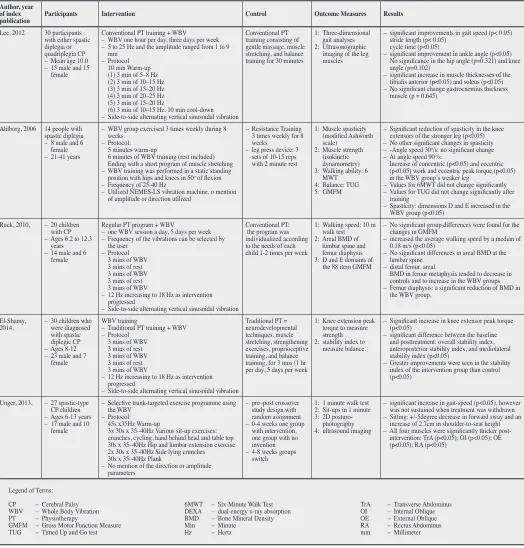
Table 1.
Summary of reviewed articles
Author, year of index
publication Participants Intervention Control Outcome Measures Results
Lee, 2012 30 participants with either spastic diplegia or quadriplegia CP – Mean age 10.0 – 15 male and 15
female
Conventional PT training + WBV – WBV one hour per day, three days per week – 5 to 25 Hz and the amplitude ranged from 1 to 9
mm – Protocol
10 min Warm-up (1) 3 min of 5–8 Hz (2) 3 min of 10–15 Hz (3) 3 min of 15–20 Hz (4) 3 min of 20–25 Hz (5) 3 min of 15–20 Hz
(6) 3 min of 10–15 Hz. 10 min cool-down – Side-to-side alternating vertical sinusoidal vibration
Conventional PT training consisting of gentle massage, muscle stretching, and balance training for 30 minutes
1: Three-dimensional gait analyses 2: Ultrasonographic
imaging of the leg muscles
– significant improvements in gait speed (p< 0.05) stride length (p< 0.05)
cycle time (p<0.05)
– significant improvement in ankle angle (p<0.05) No significance in the hip angle (p=0.321) and knee angle (p=0.102)
– significant increase in muscle thicknesses of the tibialis anterior (p<0.05) and soleus (p<0.05) – No significant change gastrocnemius thickness
muscle (p = 0.645)
Ahlborg, 2006 14 people with spastic diplegia – 8 male and 6
female – 21-41 years
– WBV group exercised 3 times weekly during 8 weeks.
– Protocol: 5 minutes warm-up
6 minutes of WBV training (rest included) Ending with a short program of muscle stretching – WBV training was performed in a static standing
position with hips and knees in 50o of flexion
– Frequency of 25-40 Hz
– Utilized NEMES-LS vibration machine, o mention of amplitude or direction utilized
– Resistance Training 3 times weekly for 8 weeks
– leg press device: 3 sets of 10-15 reps with 2 minute rest
1: Muscle spasticity (modified Ashworth scale)
2: Muscle strength (isokinetic dynamometry) 3: Walking ability: 6
MWT 4: Balance: TUG 5: GMFM
– Significant reduction of spasticity in the knee extensors of the stronger leg (p<0.05) – No other significant changes in spasticity – -Angle speed 30o/s: no significant change
– At angle speed 90o/s:
Increase of concentric (p<0.05) and eccentric (p<0.05) work and eccentric peak torque (p<0.05) in the WBV group’s weaker leg
– Values for 6MWT did not change significantly – Values for TUG did not change significantly after
training
– Spasticity: dimensions D and E increased in the WBV group (p<0.05)
Ruck, 2010, – 20 children with CP – Ages 6.2 to 12.3
years – 14 male and 6
female
Regular PT program + WBV
– one WBV session a day, 5 days per week – Frequency of the vibrations can be selected by
the user – Protocol
3 mins of WBV 3 mins of rest 3 mins of WBV 3 mins of rest 3 mins of WBV
– 12 Hz increasing to 18 Hz as intervention progressed
– Side-to-side alternating vertical sinusoidal vibration
Conventional PT: the program was individualized according to the needs of each child 1-2 times per week
1: Walking speed: 10 m walk test 2: Areal BMD of
lumbar spine and femur diaphysis 3: D and E domains of
the 88 item GMFM
– No significant group differences were found for the changes in GMFM
– increased the average walking speed by a median of 0.18 m/s (p<0.05)
– No significant differences in areal BMD at the lumbar spine
– distal femur, areal
BMD in femur metaphysis tended to decrease in controls and to increase in the WBV groups – Femur diaphysis: a significant reduction of BMD in
the WBV group.
El-Shamy,
2014, – 30 children who were diagnosed with spastic diplegic CP – Ages 8-12 – 23 male and 7
female
WBV training
– Traditional PT training + WBV – Protocol
3 mins of WBV 3 mins of rest 3 mins of WBV 3 mins of rest 3 mins of WBV
– 12 Hz increasing to 18 Hz as intervention progressed
– Side-to-side alternating vertical sinusoidal vibration
Traditional PT = neurodevelopmental techniques, muscle stretching, strengthening exercises, proprioceptive training, and balance training, for 3 mos (1 hr per day, 5 days per week
1: Knee extension peak torque to measure strength 2: stability index to
measure balance.
– Significant increase in knee extensor peak torque (p<0.05)
– significant difference between the baseline and posttreatment: overall stability index, anteroposterior stability index, and mediolateral stability index (p<0.05)
– Greater improvements were seen in the stability index of the intervention group than control (p<0.05)
Unger, 2013, – 27 spastic-type CP children – Ages 6-13 years – 17 male and 10
female
– Selective trunk-targeted exercise programme using the WBV
– Protocol: 45s x35Hz Warm-up
3x 30s x 35–40Hz Various sit-up exercises: crunches, cycling, hand behind head and table top 30s x 35–40Hz Hip and lumbar extension exercise 2x 30s x 35–40Hz Side lying crunches 30s x 35–40Hz Plank
– No mention of the direction or amplitude parameters
– pre–post crossover study design with random assignment – 0-4 weeks one group
with intervention, one group with no invention – 4-8 weeks groups
switch
1: 1 minute walk test 2: Sit-ups in 1 minute 3: 2D
posturo-photography 4: ultrasound imaging
– significant increase in gait-speed (p<0.05), however was not sustained when treatment was withdrawn – Sitting: +/-5degree decrease in forward sway and an
increase of 2.7cm in shoulder-to-seat height – All four muscles were significantly thicker
post-intervention: TrA (p<0.05); OI (p<0.05); OE (p<0.05); RA (p<0.05)
Legend of Terms: CP – Cerebral Palsy WBV – Whole Body Vibration PT – Physiotherapy
GMFM – Gross Motor Function Measure TUG – Timed Up and Go test
6MWT – Six-Minute Walk Test DEXA – dual-energy x-ray absorption BMD – Bone Mineral Density Min – Minute
Hz – Hertz
Four of the articles analyzed the effects of WBV in chil-dren19,26-28 while the other study focused on adults with
CP.29 These studies had interventions ranging from the
immediate acute effects of WBV up to six month after intervention. The type of CP was heterogeneous across the studies and included children and adults with spastic diplegic, hemiplegic, and quadriplegia forms of CP. There were four acceptable quality and one high quality article when assessed using the SIGN criteria.
Lee and Chon used a WBV protocol that was unique from the other studies.19 WBV was performed three
times a week for eight weeks. The protocol involved six three-minute vibration sessions while squatting with fre-quencies varying in Hz (5-25) and received three-minute breaks. The experimental group had an increase in gait speed, stride length, cycle time and ankle angle as well as hypertrophy of the tibialis anterior and the soleus com-pared to the control group. The control group consisted of general physiotherapy, stretching and balance training. This was rated as a high quality randomized control trial (RCT).
Ahlborg et al., utilized WBV three times a week for eight weeks compared to a resistance training control group.29 The experimental protocol consisted of six
min-utes of WBV including rest; the frequency was 25–40Hz. The protocol included a five minute warm-up and ended with static stretching. Spasticity, walking, balance and gross motor function were measured pre and post inter-vention. It was found that there was no significant dif-ference between the groups in any of the measured vari-ables. However, for time to complete each intervention, the WBV training intervention required less time than the resistance training to complete the protocol. This article was rated as an acceptable RCT.
Ruck et al. studied the effects of WBV on walking speed and BMD in a younger CP population (5-12.9).26
The experimental group underwent their regular physio-therapy treatments plus five vibration sessions per week for six months, whereas the control group only underwent the regular physical therapy. The WBV sessions consisted of three minute periods with three minutes of rest in be-tween. The frequency depended upon the child’s tolerabil-ity to the vibration. There was a significant difference in the 10m walk times with the experimental group decreas-ing their time by a median of 18m/s, while the control group showed no change. The differences in BMD after
the intervention period, however, were unexpected. The distal femur metaphysis tended to increase in the WBV group, whereas there was a reduction in BMD in the fem-oral diaphysis.26 This article was rated as an acceptable
RCT.
El-Shamy looked at the of WBV on both muscle strength and balance.28 The experimental protocol
con-sisted of WBV with conventional physiotherapy com-pared to a control group who only received conventional physiotherapy. The WBV intervention consisted of a nine minute intermittent WBV with the frequency controlled by the user. The author evaluated knee extension peak torque to measure strength and a stability index to meas-ure balance. After the intervention, there was a significant increase in the knee extensor torque (p<0.05) as well as improved anteroposterior stability and mediolateral sta-bility index (p<0.05). The stasta-bility improvements were found in both the control and intervention groups, how-ever the control group had a significantly larger increase (p<0.05). This article was rated as an acceptable RCT. Finally, Unger et al. looked at the effectiveness of a trunk strengthening program using WBV.27 This
experi-mental intervention consisted of the patients performing different selective trunk-targeted exercises while using WBV. The protocol consisted of a 45 second(s) warm-up at 35Hz, followed by three 30 second exercises (crunches, cycling, hand behind head and table top) at 35–40Hz, then 30 seconds of hip and lumbar extension exercise at 35– 40Hz, then finished with two 30 second side lying crunch-es and a 30 second plank. Gait and core improvements were tested using the 1-Minute Walk Test, 2D-posturog-raphy, ultrasound imaging and sit-ups in one minute. The authors found that there was a significant increase in dis-tance walked (p<0.05), more upright posture, an increase in sit-ups executed (p<0.05) and an increase in resting thicknesses of all the four abdominal muscles was re-corded: transversus abdominis (p<0.05) obliquus internus (p<0.05), obliquus externus (p<0.05) and the rectus ab-dominis (p<0.05). It was also noted that the strength and posture gains were maintained at four weeks post-inter-vention. This article was rated as an acceptable RCT.
Strength and Motor Function
physiotherapy versus WBV found increased thickness of tibialis anterior (31%) and soleus muscles (40%).19
The comparison study of exercise versus WBV found no significant differences in isokinetic quadriceps muscle strength between groups.29 However, El-Shamy found
that there was an increase in the significant increase in the knee extensor torque.28 Additionally, Unger et al.
found that there was increase in the abdominal muscula-ture thickness with a core targeting WBV intervention.27
This was accompanied by the number of sit-ups a partici-pant could perform in one minute.27 Alhborg, and Ruck
all used the Gross Motor Function Measure (GMFM) to assess motor function and found improvements in the sit-ting and crawling sections.26,29
Spasticity
One study (Ahlborg) found that there was a significant decrease in knee extensor spasticity using the modified Ashworth scale in the WBV group. Additionally, there was a decrease side effects of muscle stiffness and sore-ness noted in the WBV compared to the exercise group.29
Bone Density
One study (Ruck) found a paradoxical change in BMD within participants’ femurs.26 This change consisted of an
increase within the distal femur metaphysis in the inter-vention group compared to the control group. However it was also noted that there was significant decrease in BMD in the femoral diaphysis. Finally it was noted that there was no changes to the BMD of the lumbar spine. The authors suggested that one possible explanation for this finding is the difficulty in performing densitometry for the distal femur with CP patients. This is due to posi-tioning and movement artifacts.
Walking speed
Four studies found that WBV resulted in improved walk-ing speed (Lee, Ruck, Unger, Ahlborg).19,26,27,29 One study
used Kinematic data obtained by three-dimensional an-alysis to evaluate gait speed which showed that WBV improved gait speed by 0.110m/s.19 Lee and Chon found
there was improvement in walking and mobility, specif-ically gait speed, stride length, cycle time and ankle an-gle.19 Unger found that with the improved core strength
that there was an improvement in the 1-minute walk test.27
WBV intervention demonstrated a 38% improvement in
walking speed above baseline in a 10-meter walk.26 The
WBV group had an increase in their average walking speed of 0.180m/s while the control group had no change.
Vibration Parameters
A summary of the frequency, amplitude and time on vi-bration plate utilized within the interventions showed sig-nificant heterogeneity within the protocols. The follow-ing are the ranges: frequency 5–40 Hz, 1- 9 millimeters (mm) and 30 seconds – 6 minutes. The majority of studies utilized the Galieo system for the vibration intervention, this machine involves a side-to-side alternating vertical sinusoidal vibration. To control for the differences in dis-placement due to the teetering action, the authors would have marked distances from the centre for foot placement. As the participants’ feet moved further from the fulcrum; the amplitude of the vibration increases. With this con-cern, there was variable reporting of the amplitude util-ized within the studies. Finally the exercises utilutil-ized on the machine included squats, core exercises, standing and lunges.
Discussion
Whole body vibration as a treatment option for CP is a relatively new subject with limited high quality research. The results of most of the included articles appear prom-ising in terms of WBV as an intervention in CP patients, in regards to building strength, decreasing spasticity, in-creasing functionality in the short term (up to six months); however, positive effects on bone mineral density are questionable.
Throughout the five studies investigated there was a large amount of heterogeneity in almost all aspects: WBV protocols, vibrating platforms, setups and type of CP. CP is an umbrella term and the types of CP included in the studies were heterogeneous making it difficult to extrapo-late the findings to all patients with CP.30,31 Future research
into the effects of WBV on CP, need to better address the type of CP they are investigating. With the heterogeneity of CP, it could be possible that WBV may be effective for one group while less effective or ineffective for another group.
walking ability and increase walking speeds, overall mo-bility, muscle mass and force production, and decreasing spasticity. However, there should be further investigation into the effects of WBV on BMD, due to the paradoxical decreased bone mineral density seen in the WBV group by Ruck et al.26 Based on all the studies, the most
com-monly utilized time intervals for the vibration was three minutes maximum per interval. Further research into this subject must include determining the optimal protocol to achieve therapeutic result. Other possible areas of inves-tigation could include determining if individualized treat-ment protocols are more effective than a standardized programs, including investigations into the optimal time, direction of vibration, amplitude, and frequency to gain clinically relevant changes, as well as studies looking at the long-term follow-ups to determine whether these results from WBV are retained. Future research should include additional reporting of the vibration parameters utilized within the study to allow better implementation by clinician wishing to use vibration as a treatment mo-dality.
One area for concern with investigating WBV is the difficulty in blinding participants and investigators. The nature of the intervention of WBV makes patient blinding difficult. One of the previous blinding method utilized included using a physiotherapist who was blinded to the type of intervention the patients received to perform out-come measure testing.19 This change would limit the
po-tential for measurement bias and further strengthen the research protocols.
Although all studies used WBV as the primary vention, the studies did not administer identical inter-ventions in terms of the frequency, duration, or interval times. Not only were the interventions not heterogeneous, but the types and forms of CP were not heterogeneous between the populations either. Due to the small sample size, it can be argued that the results are unable to be gen-eralized to other CP patients and populations. Further re-search needs to be completed with larger sample sizes and homogenous CP populations, with consistently adminis-tered treatment frequencies, durations and intervals over a set period of time.
Conclusion
In conclusion, it appears that WBV has the potential to improve symptoms in those patients with cerebral
pal-sy. It has been shown to help improve spasticity, muscle strength and coordination. There is a lack of research to conclusively state whether it does in fact alter bone min-eral density. The aim of this systematic review was to compile the recent literature on vibration therapy in pa-tients with CP in order to guide future clinical decisions when treating these patients. The authors hope that this systematic review stimulates further research in regards to WBV and its effects on the CP population.
Acknowledgements
The authors would like to thank Dr. Dominic Giuliano, and Jessie Hsieh for their substantive contributions to the completion of this paper.
References
1. Dalen Y, Saaf M, Nyren S, Mattsson E, Haglund-Akerlind Y, Klefbeck B. Observations of four children with severe cerebral palsy using a novel dynamic platform. A case report. Adv Physiother. 2012;14:132-139.
2. Henderson RC, Lark RK, Gurka MJ, Worley G, Fung EB, Conaway M, et al. Bone density and metabolism in children and adolescents with moderate to severe cerebral palsy. Pediatr. 2002;110(1Pt1):e5.
3. Kilpinen-Loisa P, Paasio T, Soiva M, Ritanen UM, Lautala P, Palmu P, et al. Low bone mass in patients with motor disability: prevalence and risk factors in 59 Finnish children. Dev Med Child Neurol. 2010;52(3):276-282. 4. Bryant E, Pountney T, Williams H, Edelman N. Can a
six-week exercise intervention improve gross motor function for non-ambulant children with cerebral palsy? A pilot randomized controlled trial. Clin Rehab. 2013;27(2):150-159.
5. Rauch F. Vibration therapy. Dev Med Child Neurol. 2009;51:4166-4168.
6. Yeargin-Allsopp M, Van Naarden Braun K, Doernberg NS, Benedict RE, Kirby RS, Durkin MS. Prevalence of cerebral palsy in 8-year-old children in three areas of the United States in 2002: a multisite collaboration. Pediatr. 2008;121(3):547-554.
7. McIntyre S, Morgan C, Walker K, Novak I. Cerebral palsy – don’t delay. Dev Disabil Res Rev. 2011;17(2):114-129. 8. Mockford M, Caulton JM. The pathophysiological basis of weakness in children with cerebral palsy. Pediatr Phys Ther. 2010;22(2):222-233.
9. Lorenzen C, Maschette W, Koh M, Wilson C. Inconsistent use of terminology in whole body vibration exercise research. J Sci Med Sport. 2009;12(6):676-678.
11. Cardinale M, Bosco C. The use of vibration as an exercise intervention. Exerc Sport Sci Rev. 2003;31:3–7.
12. Cochrane DJ, Stannard SR, Sargeant AJ, Rittweger J. The rate of muscle temperature increase during acute whole-body vibration exercise. Eur J Appl Physiol. 2008;103:441–448.
13. Lohman EB 3rd, Petrofsky JS, Maloney-Hinds C, Betts-Schwab H, Thorpe D. The effect of whole body vibration on lower extremity skin blood flow in normal subjects. Med Sci Monit. 2007;13:CR71–76.
14. Cardinale M, Soiza RL, Leiper JB, Gibson A,
Primrose WR. Hormonal responses to a single session of whole body vibration exercise in elderly individuals. Br J Sports Med. 2010;44(4):284-288.
15. Stark C, Nikopoulou-Smyrni P, Stabrey A, Semler O, Schoenau E. Effect of a new physiotherapy concept on bone mineral density, muscle force and gross motor function in children with bilateral cerebral palsy. J Musculoskel Neur Interact. 2010;10(2):151-158.
16. Ward K, Alsop C, Caulton J, Rubin C, Adams J, Mughal Z. Low magnitude mechanical loading is osteogenic in children with disabling conditions. J Bone Min Res. 2004;19(3):360-369.
17. Eklund G, Steen M. Muscle vibration therapy in children with cerebral palsy. Scand J Rehab Med. 1969;1(1):35-37. 18. Cannon SE, Rues JP, Melnick ME, Guess D. Head-erect
behavior in children with cerebral palsy. Phys Ther. 1987;67:1198-1204.
19. Lee B, Chon S. Effect of whole body vibration training on mobility in children with cerebral palsy: a randomized controlled experimenter-blinded study. Clin Rehab. 2013;27(7):599-607.
20. Scholtes VA, Becher JG, Janssen-Potten YJ, Dekkers H, Smallenbroek L, Dallmeijer AJ. Effectiveness of functional progressive resistance exercise training on walking ability in children with cerebral palsy: a randomized controlled trial. Res Dev Disabil. 2012;33:181–188.
21. Thompson N, Stebbins J, Seniorou M, Newham D. Muscle strength and walking ability in diplegic cerebral palsy: implications for assessment and management. Gait Posture. 2011;33:321–325.
22. Dodd K, Taylor N, Graham H. A randomized clinical trial of strength training in young people with cerebral palsy. Dev Med Child Neurol. 2003;45(10):652-657.
23. Verschueren SMP, Roelants M, Delecluse C, Swinnen S, Vanderschueren D, Boonen S. Effect of 6-month whole body vibration training on hip density, muscle strength, and postural control in postmenopausal women: a randomized controlled pilot study. J Bone Miner Res. 2004;19:352-359.
24. Krägeloh-Mann I, Cans C. Cerebral palsy update. Brain Dev. 2009;31(7):537-544.
25. Scottish Intercollegiate Guidelines Network Critical Appraisal: Notes and Checklists. Edinburgh: Scottish Intercollegiate Guidelines Network; 2013 [cited 2013 Mar 26]. Available from: http://www.sign.ac.uk/methodology/ checklists.html#.
26. Ruck J, Chabot G, Rauch F. Vibration treatment in cerebral palsy: a randomized controlled pilot study. J Musculoskel Neur Interact. 2010;10(1):77-83.
27. Unger M, Jelsma J, Stark C. Effect of a trunk-targeted intervention using vibration on posture and gait in children with spastic type cerebral palsy: a randomized control trial. Dev Neurorehab. 2013;16(2):79-88.
28. El-Shamy SM. Effect of whole-body vibration on muscle strength and balance in diplegic cerebral palsy: a randomized controlled trial. Am J Phys Med Rehabil. 2014;93(2):114-131.
29. Ahlborg L, Andersson C, Julin P. Whole-body vibration training compared with resistance training: effect on spasticity, muscle strength and motor performance in adults with cerebral palsy. J Rehab Med. 2006;38(5):302-308.
30. del Pozo-Cruz B, Adsuar J, Parraca J, del Pozo-Cruz J, Olivares P, Gusi N. Using whole-body vibration training in patients affected with common neurological diseases: a systematic literature review. J Alt Complement Med. 2012;18(1):29-41.