RVC OPEN ACCESS REPOSITORY – COPYRIGHT NOTICE
This author’s accepted manuscript may be used for non-commercial purposes in accordance with Wiley Terms and Conditions for Self-Archiving.
The full details of the published version of the article are as follows:
TITLE: What is lameness and what (or who) is the gold standard to detect it?
AUTHORS: P. R. van Weeren, T. Pfau, M. Rhodin, L. Roepstorff, F. Serra Bragança, M. A. Weishaupt
JOURNAL: EQUINE VETERINARY JOURNAL
PUBLISHER: Wiley
PUBLICATION DATE: 28 June 2018 (online)
What is lameness and what (or who) is the gold standard to detect it?
The editorial “Do we have to redefine lameness in the era of quantitative gait analysis?” [1] has unleashed an interesting scientific discussion. In a first reaction, Drs Bathe, Judy and Dyson agreed that modern quantitative gait analysis techniques outperform the human eye regarding spatial and temporal resolution, but stated that lameness evaluation is more complex than the measurement of asymmetries only [2]. Their main argument is that accurate lameness evaluation in horses should remain exclusively in the hands of experienced clinicians, as only these can make the correct synthesis of the huge number of variables they consider. They do not shy from quoting the acronym VOMIT, created by the medical community, which stands for “Victim of Modern Investigational Technology” and to end with the Latin phrase caveat utilitor, meant for the user of modern gait analysis technology. Adair and 38 other equine vets, all working in the area of lameness assessment responded [3]. They strongly disagreed with Bathe and colleagues’ assertions, which they interpreted as fear for what objective measurements may do and how it might affect current methods for lameness evaluation and with that the position of the equine clinician. Their main argument is that the new quantitative techniques will not, nor should, replace the clinician, but should be seen as a valuable complementary tool for the clinician helping her/him in clinical decision making, and indeed, also serving as a test to keep the own objectivity and clinical skills sharp. Adair and colleagues see the use of quantitative gait analysis techniques as evidence-based veterinary medicine.
It is interesting to see that the original core subject of the editorial (“how should we define lameness”) has been given little attention in both letters. Bathe and co-authors agree that “lameness is a continuum rather than a binary concept” and Adair et al. state that “lameness is a simple concept that is sometimes difficult to detect”, with which they implicitly state that lameness is identical to asymmetry. The rest of the debate mainly focuses on the role of the technology versus that of the clinician. In fact, we now have two issues: what is lameness and what (or who) is the gold standard to detect it? As authors of the original editorial, we would like to address both issues and to start with the second one, which seems to be most polemic in nature.
very well in his statement that “Technology won’t replace vets…but vets who use technology logically and carefully will replace those who don’t” [5].
In this context, it may be good to draw the attention to a well-known phenomenon in the psychology of learning, which is the so-called Dunning-Kruger effect that describes the relationship of confidence and experience as a hyperbole (Fig. 1). It shows that the self-confidence of inexperienced professionals rises very sharply after beginning exercising some professional skills and quickly reaches a level that is unjustified by their real skills, i.e. a clear situation of overconfidence [6]. After that, there comes a much longer period of gradually decreasing confidence that almost hits bottom before starting to increase gradually again. One of the biggest advantages of objective lameness assessment is that this strong fluctuation of self-confidence may be dampened and remains closer to what is justified given the real level of expertise of the professional. Quantitative gait data gives us the tool to better confront young clinicians with their limitations, especially in hind limb lameness cases where it has been shown that the ability to recognise lameness is quite poor. To move forward, we need to accept our own limitations, learn with the cases where we might be wrong, and only then we can become more competent. This does not only apply to beginning clinicians, but also to the very experienced ones where the curve creeps very close to the initial high level. Peak confidence sells well to horse owners, but we should remain honest and be prepared to self-criticism. If not, the warning caveat utilitor has a counterpart that is certainly as relevant, which is caveat clinicus.
Whereas the issue of whom or which should be considered the supreme authority in lameness detection raises most emotion, the discussion of what we should consider lameness is more critical in our perspective. This discussion may seem technical, but is primarily a linguistic one. In the original editorial, we stated that the word “lameness”, both in the professional and in the lay world, has a negative emotional value. For millennia already lameness in horses has a negative meaning and is associated with unfitness to perform, loss of value, and impaired welfare. It is never used in a positive sense and even never has a neutral value. Unless we are arrogant enough to assume that we, as equine orthopaedists in the era of quantitative gait analysis, are so powerful that we can change this societal appreciation of the word lameness, we cannot and should not equal “lameness” to asymmetry. This because in that case we implicitly say that perfect symmetry should be considered normal and all asymmetries, aberrations of that. Do we expect all horses to move perfectly symmetrical? What about young, immature horses - if they are asymmetrical, do we then assume that they are lame? Also, if we assume that perfect symmetry is desirable, we place ourselves in a position where any small deviations of perfect symmetry should be considered lameness.
of a healthy status. All biological processes can be seen as equilibria within a given area in the middle of a linear scale that we use to call “physiological” and that gradually changes into some state of pathology when moving too far to either the left or the right. The variation in these balances regarding bandwidth, type and way of occurrence of pathology et cetera, is virtually endless, but the basic pattern is immutable. In medical terminology, these biological variables themselves should be designated by neutral terms, such as blood pressure, heart rate or pH. Clinically relevant imbalances can be indicated by terminology having a negative association, such as hypertension, arrhythmia and acidosis. (Degree of) asymmetry is a neutral term, lameness not.
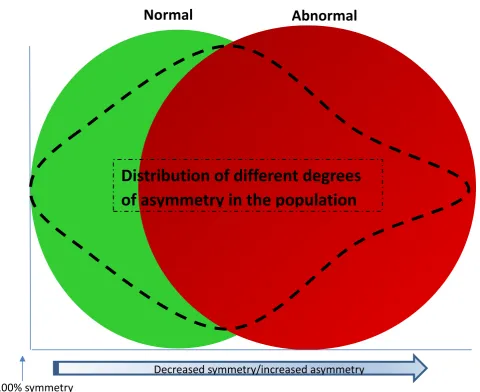
Based on the reasoning given above, it will be clear that we fiercely oppose the interchangeable use of the terms “lameness” and “asymmetry”. Instead, we propose that “asymmetry” is just a biological variable like any other that obeys basic biological laws. Figure 2 is an attempt to demonstrate this visually. In that case, we should do the same what both the medical and veterinary profession has done already for ages, i.e. establishing reference values for a respective variable just like we have for any clinical chemistry parameter, heart rate, body temperature, et cetera. A first attempt in this direction has been proposed for the weight-bearing (a)symmetry of contralateral limbs using vertical ground reaction forces [7]. It is more than likely that, as in other biological variables, also in the case of locomotion asymmetry these reference values may vary a little with characteristics of the population studied, like breed, equestrian use, age and perhaps other factors. In fact, we already have scientific data pointing in this direction [8]. It can, therefore, be expected that in the coming years with ongoing data collection we will be able to tailor and refine these reference values. In the end it is up to the clinician, Luddite by conviction or not, to interpret the outcome of the measurements. This should be done within the bigger picture as described by Bathe et al. and it is the clinician who should decide whether the measurement, which may fall outside or even inside the reference range, should be deemed clinically relevant or not. It is the outcome of this clinical evaluation process that does or does not justify the use of the term “lameness” by the professional, not the measurement in itself.
Legends for figures:
Fig. 1: The level of self-confidence of professionals is highest when starting carrying out a certain professional skill, then falls dramatically with increasing experience to almost regain the initial high level when reaching the expert status.
References
1. Van Weeren, P.R., Pfau, T., Rhodin, M., Roepstorff, L., Serra Bragança, F., and Weishaupt, M.A. (2017) Do we have to redefine lameness in the era of quantitative gait analysis? Equine Vet J. 49, 567-569.
2. Bathe, A.P., Judy, C..and E, Dyson, S. (2018) Letter to the Editor: Do we have to redefine lameness in the era of quantitative gait analysis? Equine Vet J. 50, 273.
3. Adair, S., Baus, M., Belknap, J., Bell, R. Boero, M., Bussy, C., Cardenas, F., Casey, T., Castro, J., Davis, W., Erskine, M., Farr, R., Fischer, T., Forbes, B., Ford, T., Genovese, R., Gottschalk, R. Hoge, M. Honnas, C., Hunter, G., Joyce, J., Kaneps, A., Keegan, K., Kramer, J., Lischer, C., Marshall, J., Oosterlinck, M., Radue, P., Redding, R., Reed, S.K. Rick, M., Santschi, E. Schoonover, M., Schramme, M., Schumacher, J., Stephenson, R., Thaler, R., Vedding Neilsen, J. and Wilson, D.A. (2018) Response to Letter to the Editor: Do we have to redefine lameness in the era of quantitative gait analysis. Equine Vet. J. 50, 415–417.
4. https://en.wikipedia.org/wiki/Luddite (accessed April 11th, 2018).
5. Knottenbelt, D.C. (2017) Using the past to make the future better: the long and winding road. Plenary opening lecture, 56th Annual Congress British Equine Veterinary Association, Liverpool, UK.
6. https://en.wikipedia.org/wiki/Dunning–Kruger_effect (accessed April 12th, 2018)
7. Weishaupt, M.A., Wiestner T., Hogg H.P., Jordan P., Auer J.A. (2004) Vertical ground reaction force-time histories of sound Warmblood horses trotting on a treadmill. Vet. J. 168, 304-311.
Figures
Figure 2 Conceptual visualisation of distribution of asymmetries and lameness (abnormal function) in the equine population. Technically, asymmetries can be both negative and positive (i.e. occur to the left and to the right of the ‘perfect symmetry’ line), but for reasons of clarity, the X‐axis represents absolute values.
100% symmetry
Decreased symmetry/increased asymmetry