Graph of Regular Dendrimer
Atulya K. Nagar1and S. Sriram2
1 Department of Mathematics and Computer Science,
Liverpool Hope University, Liverpool L16 9JD UK
2
Department of Mathematics, Vels University, Pallavaram, Chennai 600 117 India
Abstract. The eccentric connectivity indexξc(G) of a connected graph
Gis defined asξc(G) =∑v∈V(G)deg(v)e(v),wheredeg(v) is the degree of vertex v and e(v) is the eccentricity of v. The eccentric graph Ge
of a graphG has the same set of vertices as G,with two vertices u, v
adjacent inGeif and only if eitheruis an eccentric vertex ofvorvis an
eccentric vertex ofu.In this paper, we obtain a formula for the eccentric connectivity index of the eccentric graph of a regular dendrimer. We also derive a formula for the eccentric connectivity index for the second iteration of eccentric graph of regular dendrimer.
1
Introduction
Chemical graph theory [4] is one of the well-investigated application areas with several researchers working on applying graph theory to mathematical modeling of chemical phenomena. The molecular graph or chemical graph gives a graph-theoretical representation of a molecule and provides valuable information into the chemical phenomena. The atoms of a molecule are represented by vertices or nodes and the edges of the graph stand for the covalent bonds among the atoms. A class of highly branched molecules, called dendrimers [9] are known to be suit-able for a number of biomedical applications. Many of the structural properties of a molecular graphs have been studied in terms of topological indices that are numeric quantities developed as molecular descriptors. Weiner-Index [12] is one of the earliest topological indices introduced by Weiner in connection with mod-eling of organic molecules in Chemistry. Several such indices (see, for example, [5, 8] ) have been introduced and investigated subsequently. The eccentric con-nectivity index is a parameter recently introduced [10] and subsequently studied (see for example [2, 6, 7, 11, 13]) with regard to physical / biological properties of molecules.
2
Eccentric Connectivity Index
The eccentric connectivity index of a connected graph G is defined as ξc(G) = ∑
v∈V(G)
deg(v)e(v), wheredeg(v) is the degree of the vertex v.
Example 1.
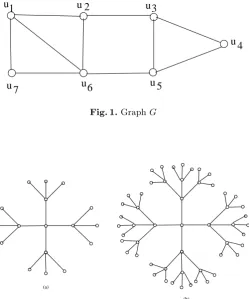
For the connected graphG, shown in Figure 1,
deg(u1) = 3;deg(u2) = 3;deg(u3) = 3;deg(u4) = 2;deg(u5) = 3; deg(u6) = 4;deg(u7) = 2.
e(u1) = 3;e(u2) = 2;e(u3) = 3;e(u4) = 3;e(u5) = 2;e(u6) = 2;e(u7) = 3. The eccentric connectivity index ofGis
ξc(G) = 3×3 + 3×2 + 3×3 + 2×3 + 3×2 + 4×2 + 2×3 = 50.
u
u
u
u
u
u
u1
2
3
4
5
6
7
Fig. 1.GraphG
(a)
(b)
3
Dendrimers
A class of highly branched molecules, called dendrimers [9] are known to be suitable for a number of biomedical applications. A regular dendrimer Tk,d, is
a tree with a unique central vertex v0. Every non-pendant vertex of Tk,d is of
degreed≥2 and the radius is k,the distance from v0 to each pendant vertex. The dendrimersT2,4, T3,4[13] are shown in Figures 2(a) and 2(b).
Lemma 1.
If Tk,d is a tree with unique central vertexv0, then
(i) the order ofTk,d is1 +
d[(d−1)k−1] d−2
(ii) Tk,d has dbranches
(iii) each branch ofTk,d has (d−1) k−1
d−2 vertices.
(iv) each branch ofTk,d has(d−1)k−1 pendant vertices.
(v) each branch ofTk,d has (d−1) k−1−1
d−2 non pendant vertices.
(vi) the radius and diameter ofTk,d arek and2k respectively.
Remark 1. In the Lemma 1, property (i) is given in [13]. The other properties are straightforward to obtain and so proofs are not included here.
4
Eccentric Graphs of Dendrimers
We define thekthiterated eccentric graph of a graphGasGk
e = (Gke−1)e, where
G0e=G.Thus (Tk,d)e and (Tk,d)2e, are respectively eccentric graphs and second
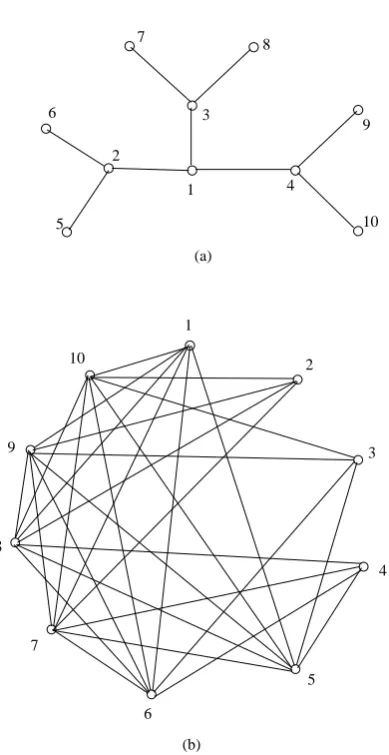
iterated eccentric graphs of dendrimers. The dendrimer T2,3 and its eccentric graph (T2,3)e are shown in Figure 3(a) and 3(b).
Theorem 1.
The eccentric graph of a regular dendrimerTk,dis a(d+ 1)−partite graph where
one partition has only one vertex v0 and each of the remaining dpartitions has (d−1)k−1
d−2 vertices, ford≥3 and has kvertices ford= 2.
Proof.
Letv0 be the central vertex ofTk,d, d̸= 2.LetN(v0) ={v1, v2, v3,· · ·, vd}. LetB1, B2, B3,· · · , Bd be the subtrees of the regular dendrimerTk,d such that
vi is the unique central vertex of Bi,1≤i ≤d. SinceTk,d has 1 +
d((d−1)k−1) d−2 vertices, eachBi has
(d−1)k−1
d−2 vertices. Also sinceTk,d hasd(d−1)
k−1 pendant vertices, eachBi has (d−1)k−1pendant vertices.
Now all the pendant vertices are eccentric vertices of the central vertex v0 and for each vertex inBi all the pendant vertices ofTk,d that are not in Bi are
eccentric vertices. In the eccentric graph ofTk,d, the vertex set V is partitioned
into V1, V2, V3,· · ·Vd+1,where V1 ={v0}, Vi =V(Bi−1),2 ≤i≤d.Further, no edge in (Tk,d)ehas both end vertices in the same partition. This implies that in
4
9
10 3
8 7
2 6
5
1 1
2
3
4
5
6 7
8 9
10
(a)
(b)
vertices ofTk,d and each vertex ofBi,1≤i≤dis adjacent to all the pendant
vertices of Bj,1≤j≤d, j≠ i. Therefore (Tk,d)e is a (d+ 1)−partite graph in
which one partition has only one vertexv0and each of the remainingdpartitions has (d−d1)−k2−1 vertices,d̸= 2.
Whend= 2,the eccentric graph of (Tk,2)e is a 3 partite graph with 2k+ 1
vertices, one of the partition hasv0as the only vertex and each of the remaining
two partitions haskvertices. ⊓⊔
Corollary 1.
Whend≥3,(Tk,d)e is a self centered graph with radius two.
Proof.
By Theorem 1, the eccentric graph of a regular dendrimer (Tk,d)e is a
(d+ 1)-partite graph. It is clear that there is no vertex of degreen−1,wheren is the number of vertices in (Tk,d)e
Claim :d(u, v)≤2 for alluandv in (Tk,d)e
Ifuandvare in the same partition of (Tk,d)ethen they have common neighbors
and hence d(u, v) = 2, whereas if u and v are in the different partitions and either uor v is a pendant vertex in Tk,d then d(u, v) = 1 in (Tk,d)e; otherwise
they have common neighbors and henced(u, v) = 2 in (Tk,d)e.
Therefore (Tk,d)e is a self centered graph with radius two. ⊓⊔
Theorem 2.
The second iterated eccentric graph of the regular dendrimer is (Tk,d)2e= (Tk,d)ewhen d≥3.
Proof.
If Tk,d is a regular dendrimer such that d ≥ 3 then by Corollary 1, (Tk,d)e is
self centered with radius two. This implies that any two vertices of (Tk,d)e are
either neighbors or eccentric vertices of each other. Hence (Tk,d)2e= (Tk,d)ewhen
d≥3. ⊓⊔
Theorem 3.
IfTk,2is a regular dendrimer havingv0as central vertex anduandv as pendant
vertices, then (Tk,2)2e is a 3− partite graph, where one partition has 3 vertices
v0, u, v and each of the remaining two partitions has k−1 vertices.
Proof.
Let Tk,2 = (V, E) be a regular dendrimer with a unique central vertexv0. Let N(v0) ={u1, v1} and let B1 and B2 be the subtrees of Tk,2 having u1 and v1 as their respective unique central vertex. Let V(B1) = {u1, u2, u3,· · ·, uk =u}
andV(B2) ={v1, v2, v3,· · ·, vk=v} such thatuk=uandvk =v both are the
only pendant vertices. Then by Theorem 1, (Tk,2)e is a 3−partite graph with
partitions V1 ={v0}, V2 =V(B1) andV3 =V(B2).It is noted that in (Tk,2)e,
vi,1 ≤i ≤ k−1 and the vertices vi,1 ≤i ≤ k−1 are the eccentric vertices
of vk as well as ui,1 ≤ i ≤ k−1. This implies that in (Tk,2)2e the vertex set
gets partitioned intoV1′, V2′ andV3′ such that V1′ ={v0, uk, vk}, V2′ =V2− {uk} and V3′ =V3− {vk}. Moreover, no edge in (Tk,2)2e has both ends in the same
partition. Hence (Tk,d)2eis a 3−partite graph, where one partition has 3 vertices
v0, uk, vk and each of the remaining two partitions hask−1 vertices. ⊓⊔
5
Eccentric Connectivity Index of (
T
k,d)
eYang and Xia [13] have obtained the eccentric connectivity indexξc(Tk,d) of a
regular dendrimerTk,d. For any pair of integers (k, d),
ξc(Tk,d) =dk+
d2k(1−(d−1)k−1)
2−d + 2dk(d−1)
k−1
+d2 (
1−(d−1)k−1 (2−d)2 +
(k−1)(d−1)k−1 d−2
)
, ifd≥3
ξc(Tk,d) = 6k2, ifd= 2
In particular, for a fixedk, we have
ξc(Tk,3) = 3(4k−3)2k−3(2k−3), ξc(Tk,4) = 4(2k−1)3k−4(k−1)
We now obtain formulae for the eccentric connectivity index of (Tk,d)e and
(Tk,d)2e.
Theorem 4.
(i) The eccentric connectivity index of the eccentric graph of the regular den-drimerTk,d is
ξc((Tk,d)e) =
2d(d−1)k−1(d(d−1)k−2)
d−2 ,whend≥3.
(ii) The eccentric connectivity index of (Tk,d)2e is
ξc((Tk,d)2e) =
d((d−1)k−1−1)((d−1)k(3d−2)−4)
(d−2)2 ,whend≥3.
Proof.
Let Tk,d = (V, E) be the regular dendrimer with unique central vertex v0. We prove statement (i), letV =V1∪V2∪V3such thatV1={v0}, V2be the set of all pendant vertices andV3={u/uis neither a central nor a pendant vertex}.Then
deg(v) = (d−1)d−k+12 −1 ∀ v∈V2;deg(v) = (d−1)k ∀ v∈V3. Now by Corollary 1, e(u) = 2 for all verticesuin (Tk,d)e.Now
ξc((Tk,d)e) =
∑
v∈V
deg(v)e(v)
= ∑
v∈V1
deg(v)e(v) + ∑
v∈V2
deg(v)e(v) + ∑
v∈V3
deg(v)e(v)
= 2 ∑
v∈V1
deg(v) + 2∑
v∈V2
deg(v) + 2∑
v∈V3
deg(v)
= 2 [
d(d−1)k−1+d(d−1)k−1 [
(d−1)k+1−1 d−2
]
+ d
d−2[(d−1)
k−1−1](d−1)k
]
=2d(d−1)
k−1(d(d−1)k−2)
d−2
Thus
ξc((Tk,d)e) =
2d(d−1)k−1(d(d−1)k−2)
d−2 ,whend≥3.
Now, we prove statement(ii). LetB1, B2, B3,· · · , Bd be the subtrees ofTk,d
with unique central vertex v1, v2, v3,· · · , vd respectively, such that
d(v0, vi) = 1,1 ≤ i ≤ d. Let V = V1∪V2∪V3 where V1, V2, V3 are as de-scribed in the proof of statement (i). Then by Theorem 2, (Tk,d)2e= (Tk,d)e.
This implies thatN(Tk,d)2e(v0) =V3,and hence
deg(Tk,d)2
e(v0) =
d[(d−1)k−1−1] d−2 .
Further, forv∈V2, N(Tk,d)2e(v) ={u∈V3/u, v∈Bi}and hence forv∈V2,
deg(Tk,d)2 e(v) =
2d(d−1)k−1−1 d−2 −1.
Also, for v ∈V3,N(Tk,d)e2(v) = {u∈V2/uand v are in the same subtree Bi} ∪ {u∈V3/uandv are in the different subtrees} and hence
deg(Tk,d)2e(v) =
2(d−1)k−d
It is clear that for allv∈V1 orV3,e(v) = 2 and for allv∈V2,e(v) = 3.Now
ξc((Tk,d)2e) =
∑
v∈V
deg(v)e(v)
= ∑
v∈V1
deg(v)e(v) + ∑
v∈V2
deg(v)e(v) + ∑
v∈V3
deg(v)e(v)
= 2d
d−2[(d−1)
k−1−1] + 3d(d−1)k−1 [
(d−1)k−1
d−2 −1 ]
+ 2d
d−2[(d−1)
k−1−1] [
2(d−1)k−d
d−2 ]
= d((d−1)
k−1−1)((d−1)k(3d−2)−4)
(d−2)2
Therefore
ξc((Tk,d)2e) =
d((d−1)k−1−1)((d−1)k(3d−2)−4)
(d−2)2
whend≥3. ⊓⊔
Theorem 5.
(i) ξc((T
k,2)e) = 10k+ 2
(ii) ξc((T
k,2)2e) = 4k2+ 10k−14.
Proof.
Let Tk,2 = (V, E) be a regular dendrimer with a unique central vertex v0. We prove statement (i), letB1, B2be as in the proof of Theorem 3. Then by Theorem 3, (Tk,2)e is a 3−partite graph with partitions V1 = {v0}, V2=V(B1) andV3=V(B2).It is noted that in (Tk,2)e, v0is adjacent touk, vk,
the vertices ofV2are adjacent tovkand the vertices ofV3are adjacent touk.This
implies that in (Tk,2)e, deg(v0) = 2 ande(v0) = 2,also deg(ui) =deg(vi) = 1,
e(ui) =e(vi) = 3,1≤i≤k−1 anddeg(uk) =deg(vk) =kand
e(uk) =e(vk) = 2.Now the eccentric connectivity index of (Tk,2)eis
ξc((Tk,2)e) = k−1 ∑
i=1
deg(ui)e(ui) + k∑−1
i=1
deg(vi)e(vi)
+deg(v0)e(v0) +deg(uk)e(uk) +deg(vk)e(vk)
= 10K+ 2
Now we prove statement (ii). Let V1, V2 and V3 be as in the proof of Theo-rem 3. Then by TheoTheo-rem 3, (Tk,2)2e is a 3− partite graph with Vi′s as
parti-tion sets. It is clear that v0 is adjacent to ui, vi,1 ≤ i ≤ k−1, and hence
deg(v0) = 2(k−1) the verticesuk andvk are adjacent toui,1≤i≤k−1 and
i ≤ k − 1. It follows that deg(v0) = 2(k − 1); deg(uk) = k−1 = deg(vk);deg(ui) = k+ 1 = deg(vi), 1 ≤ i ≤ k−1.
Fur-ther,e(v0) = 2;e(uk) = 3 =e(vk);e(ui) = 2 =e(vi).
Now the eccentric connectivity index of (Tk,2)2eis
ξc((Tk,2)e) = k−1 ∑
i=1
deg(ui)e(ui) + k∑−1
i=1
deg(vi)e(vi)
+deg(v0)e(v0) +deg(uk)e(uk) +deg(vk)e(vk)
= 4k2+ 10k−14
⊓ ⊔
6
Eccentric Connectivity Polynomial
The eccentric connectivity polynomial inxis defined as ECP(G, x) =∑
v∈V
deg(v)xe(v).
Alikhani and Iranmanesh [14] have considered the notion of eccentric con-nectivity polynomialECP(G, x) with the eccentric connectivity index being the first derivative ofECP(G, x) atx= 1. Here we obtain the eccentric connectivity polynomial of (Tk,d)eand (Tk,d)2e.
Example 2.
For the connected graphG, shown in Figure 1. The eccentric connectivity poly-nomial ofGis,ECP(G, x) = 2x10+ 3x10.
Now, d
dxECP(G, x) = 20x
9+ 30x9
=⇒ {dxd ECP(G, x)}x=1= 20 + 30 = 50 =ξc(G).
Theorem 6.
(i) The eccentric connectivity polynomial of the eccentric graph of the regular dendrimer is
ECP((Tk,d)e, x) =
d(d−1)k−1(d(d−1)k−2)
d−2 x
2, when d≥3.
(ii) The eccentric connectivity polynomial of(Tk,d)2e is
ECP((Tk,d)2e, x) =
d(d−1)k−1
d−2 [(d−1)
k−d+ 1]x3
+ 2d
(d−2)2[(d−1)
k−1−1][(d−1)k−1]x2,
Proof.
Let Tk,d = (V, E) be the regular dendrimer with unique central vertex v0. We prove statement (i) and the proof of statement (ii) is similar. LetV1, V2andV3 be as in the proof of Theorem 4. Then by Theorem 1, the eccentric graph of Tk,d is a (d+ 1)-partite graph anddeg(v0) =d(d−1)k−1; deg(v) = (d−1)
k+1−1 d−2
∀ v ∈V2; deg(v) = (d−1)k ∀ v ∈V3. Now by Corollary 1, e(u) = 2 for all verticesuin (Tk,d)e.Now
ECP((Tk,d)e, x) =
( ∑
v∈V1
deg(v) + ∑
v∈V2
deg(v) + ∑
v∈V3
deg(v) )
x2
= d(d−1)
k−1(d(d−1)k−2)
d−2 x
2
ThereforeECP((Tk,d)e, x) =
d(d−1)k−1(d(d−1)k−2)
d−2 x
2,when d≥3 ⊓⊔
Theorem 7.
(i) The eccentric connectivity polynomial of the eccentric graph of the regular dendrimer(Tk,2)e is
ECP((Tk,2)e, x) = 2(k−1)x3+ 2(k+ 2)x2.
(ii) The eccentric connectivity polynomial of(Tk,2)2e is
ECP((Tk,2)2e, x) = 2(k−1)(k+ 2)x
2+ 2(k−1)x3
Proof.
Let Tk,2 = (V, E) be the regular dendrimer with unique central vertex v0. We prove statement (i) and the proof of statement (ii) is similar.
As explained in the proof of Theorem 5, we have deg(v0) = 2 and e(v0) = 2, also deg(ui) = deg(vi) = 1, e(ui) = e(vi) = 3,1 ≤ i ≤ k−1 and
deg(uk) =deg(vk) =k and e(uk) =e(vk) = 2. Now the eccentric connectivity
polynomial of (Tk,2)eis
ECP((Tk,2)e, x) =
∑
v∈V
deg(v)xe(v)= 2(k−1)x3+ 2(k+ 2)x2
ThereforeECP((Tk,2)e, x) = 2(k−1)x3+ 2(k+ 2)x2 ⊓⊔
Theorem 8.
Let G=Tk,d (d≥2) be a regular dendrimer. Then the domination number of
Ge isγ(Ge) = 2.
Proof.
set of all vertices that are neither pendant nor central vertices. Then by Theorem 1, the eccentric graph ofTk,d is ad+ 1 partite graph, where one partition has
only one vertex{v0}and the remainingdpartitions,P1, P2, P3,· · ·, Pd,each has
(d−1)k−1
d−2 vertices. Further eachPihas (d−1)
k−1vertices ofV
2.This implies that any vertex inPi∩V2dominatesv0and all other verticesv∈Pj,1≤j ≤d, j̸=i
and the set S = {u, v/u, v ∈ V2 and they are not in the same d partitions Pi}. This implies that S is the minimal dominating set in (Tk,d)e. Therefore
γ((Tk,d)e) = 2. ⊓⊔
References
1. J. Akiyama, K. Ando and D. Avis,Eccentric graphs, Discrete Math., 56 (1985), 1-6.
2. M.B. Ahmadi and M. Sadeghimehr, Second-order connectivity index of an infinite class of dendrimer nanostars. Digest Journal of Nanomaterials and Biostructures, 4,(2009) 639-643.
3. F. Buckley and F. Harary, Distance in Graphs, Addison-Wesley, Redwood city CA ,1990.
4. D. Bonchev and D.H. Rouvray(eds.), Chemical Graph Theory: Introduction and Fundamentals, Taylor and Francis (1991).
5. D. Stevanovic, Comparing the Zagreb indices of the NEPS of graphs, Applied Mathematics and Computation 219(3):1082-1086(2012).
6. M. Ghorbani and M. Jalali, A simple algorithm for computing topological indices of dendrimers, Iranian J.Math.Sci. and Informatics, 2,2007, 17-23.
7. M. Ghorbani and M. Jalali, Some Topological Indicies of Nanostar Dendrimers, Iranian J.Math.Chem.,1,2010,57-65.
8. K. C. Das, I. Gutman and B. Furtula, On atom-bond connectivity index, Filomat 26.4(2012) 733-738.
9. G.R. Newkome, C.N. Moorefield and F. Vogtle, Dendrimers and Dendrons: Con-cepts, Syntheses, Applications, Wiley-VCH, verlag GmbH and Co.KGaA (2002). 10. V. Sharma, R. Goswami and A.K. Madan, Eccentric connectivity Index: A novel
highly discriminating topological descriptor for structural property and structure activity studies, J.Chemical information and Modeling, 37,1997 273-282.
11. H. Shabani(2010),Computing vertex PI index of tetrathiafulvalene dendrimers, Ira-nian J.Math.Chem.,1, 125-130.
12. H.J. Weiner, Structural determination of Paraffin boiling points. J.Amer.Chem.Soc,69,1947, 17-20.
13. J. Yang and F. Xia, The eccentric connectivity index of Dendrimers. Int. J.Contem. Math. Sciences, 5, 2010, 2231-2236.