How to deal with range-based packet classifiers
Vitalii Demianiuk
IMDEA Networks Institute
Steklov Institute of Mathematics at St. Petersburg
Kirill Kogan
IMDEA Networks Institute
ABSTRACT
Efficient representations of multi-field packet classifiers with fields represented by ranges is a core mechanism to express services on data plane. To implement classifiers in ternary-addressablememory (TCAM), each range should be encoded into multiple ternary bit strings whose number is at most lin-ear to the width (in bits) of a represented field independently from range encoding method. In this paper we introduce a notion of asubrangeallowing to represent a field range on any chosen subset of bit indices that significantly improve efficiency of classifier representations. Our analytic results are confirmed with a comprehensive evaluation study show-ing applicability of our approach to implement desired levels of expressiveness and scalability in packet classifiers.
1
INTRODUCTION AND MOTIVATION
Packet classification is a core building block implementing packet processing programs on data plane. With the adop-tion of OpenFlow [14] and P4 [15], packet classificaadop-tion has become even more prominent. Eachpacket classifieris an ordered set of rules, where aruleconsists of the filter (match-ing packet headers) and the associated action to be applied on matched packets. Afilteris a concatenation of field repre-sentations participating during classification; in the simplest form each field in a filter is represented by exact values. In this case packet classifiers can be implemented with a con-stant lookup time but the number of rules can be infeasible to fit in memory. In the other extreme case, to address the scalability constraint, fields can be represented by ranges of values. In this case the number of rules is significantly re-duced but the lookup complexity increases. As a result, some intermediate forms of field representations were introduced asprefixesor more general ternary bit strings, where every bit has three values: zero, one, or don’t care. For ternary
Permission to make digital or hard copies of all or part of this work for
personal or classroom use is granted without fee provided that copies are not
made or distributed for profit or commercial advantage and that copies bear
this notice and the full citation on the first page. Copyrights for components
of this work owned by others than ACM must be honored. Abstracting with
credit is permitted. To copy otherwise, or republish, to post on servers or to
redistribute to lists, requires prior specific permission and /or a fee. Request
permissions from [email protected].
SOSR’ 19, April 2019, San Jose, California, USA
© 2019 Association for Computing Machinery. ACM ISBN 978-x-xxxx-xxxx-x/YY/MM. . . $15.00
https://doi.org/10.1145/nnnnnnn.nnnnnnn
bit strings, a specializedternary content addressable(TCAM) memory was introduced that is actually a coprocessor run-ning multiple searches in parallel [12].
Related work. There are two major directions dealing with range-base packet classifiers. The first one is indepen-dent from structural properties of classifiers encoding every field range by multiple prefixes or ternary bit strings whose number is at most linear to the field size (in bits) [3, 4, 11, 16, 17]. Hence, each rule whose fields are represented by ranges is actually a classifier with exponential number of rules based on ternary bit strings. Recently, [1] proposes efficient encoding for the special case of short ranges. Other range encoding methods exploiting structural properties can achieve more compact representations [2, 5] but usually they perform well only when the number of encoded ranges is rel-atively small. Note that both these lines of research consider transformations toequivalentclassifiers.
Recently, [6, 9, 10, 13] proposed representations of packet classifiers exploiting their structural properties likerule dis-jointness; observe that these representations become
equiv-alent to originally given classifiers only when the lookup table based on a subset of fields is complemented by the false-positive check on a single matched rule. This allows to balance which fields are required to implement desired structural properties in the lookup table and which are going to the false-positive check where range encoding is unneces-sary. It allows to reduce the size of classifier representations. To store classifier in TCAM, a participating subset of ranges in the lookup table should be encoded by one of the previ-ously mentioned methods [3, 4, 11, 16, 17].
Our contributions. In this paper we are going beyond [10] and proposerange reduction(RR) methods allowing to im-plement structural properties of classifiers with per-bit res-olution (and not with per-field as in [10]), when fields are represented by ranges. We introduce an interesting notion of asubrangeon a predefined set of range bit-indices allowing to construct equivalent representations of packet classifiers with per-bit resolution avoiding intermediate range expan-sions. To illustrate this, consider a classifierK in Fig. 1a based on three range fields. For an incoming headerH, the R3rule is matched. All three rules aredisjoint(do not match
H=(10010, 10011, 01000) H{F1,F2}=(10010, 10011) HB={ {2},{1,2},∅}=(0, 10) H=(10010, 10011, 01000)
K I1 I2 I3 Action
R1 [24, 30] [5, 28] [9, 16] A1 R2 [18, 20] [25, 31] [12, 20] A2
R3 [17, 23] [5, 21] [8, 15] A3
K{F1,F2} I1 I2
R1 [24, 30] [5, 28] R2 [18, 20] [25, 31]
R3 [17, 23] [5, 21]
H
false positive
check: R3= [8, 15]
KB IB1
1 I
B2
2 R1 [1][0, 3] R2 [0][3, 3]
R3 [0] [0, 2] H
R3= [17, 23][5, 21][8, 15]
range encoding methods
prefix [17] SRGE [3]
# entries # bits # entries # bits
K 105 1575 60 900
K{F1,F2}[10] 39 390 30 300
KB, RR 4 12 4 12
(a) (b) (c) (d)
Figure 1: Our RR method vs. previous works: (a) original classifierKwhose rules consist of three5-bit fields; (b) the
representation ofKas in [10] exploiting rule disjointness based on two ranges; (c) the proposed RR implementing rule disjointness on three bits; (d) comparison of three different representations based on prefix and SRGE range encoding methods.
based on Gray encoding [3]). Intuitively, representations narrowing down the covered field ranges can significantly improve memory requirements. This is a reason why the notion of subranges introduced in this paper allow to imple-ment rule disjointedness only on 3 bit indices (see Fig. 1c). Fig. 1d demonstrates advantages of per-bit resolution leading to significant reduction in TCAM memory requirements both in total bits and ternary entries (e.g., RR allows to reduce the number of ternary entries maintained in TCAM from 60 to 4 for SRGE range encoding).
Based on properties of subranges, we introduce heuris-tics to find efficient classifier representations in TCAMs. We demonstrate the viability of our approach through compre-hensive evaluation where in the extreme case all six fields are based on ranges. Such classifiers cannot be implemented in TCAM with the conventional methods dealing with equiva-lent classifiers. The evaluation results together with analytic observations confirm that subranges could be an interest-ing direction to implement a fundamental tradeoff between expressiveness and scalability.
2
MODEL DESCRIPTION
A packetheaderH = (H1,. . .,Hk)is a concatenation ofk
header fields, where each header fieldHi is a binary string onwi bits; headers are matched by classifiers. Aclassifier
K ={R1,. . .,RN}≺is an ordered (by≺) set of rules, where eachruleRi =(Fi,Ai)consists of afilterFi and the associ-atedactionAi. A filterF =(F1,. . .,Fk) is a sequence ofk
field representations, where eachfield representationFiis on wi bits corresponding to the header fieldHi. In this paper we consider two types of field representations: (1) a range of values; and (2) aternarybit string, where each bit can have one of the three values 0, 1, or∗(“don’t care”). We say that a rangeI ismatchinga valuexifx ∈I. We say that a ternary bit stringT matchinga binary stringH of the same lengthl if for each bit index 1 ≤i ≤l eitherH[i] =T[i] orT[i] =∗. In the case of ternary field representations, a
filter is a ternary bit string produced by concatenation of the ternary bit strings of the corresponding field representations. A filterF matchesa headerHif everyFiofF matches the corresponding header fieldHi. We say that two filtersF1and
F2aredisjointif no single header matches both of them.
Oth-erwise,F1andF2intersect. Two rules intersect (are disjoint)
if their filters intersect (are disjoint). The main purpose of the classification process is to find the action corresponding to the highest priority rule matching a given header that we call aclassifyingrule. If there is no rule matchingH inK, the classification result is a default action that differs from all actions inK. Two classifiers (or their representations) areequivalentif the classification result coincides in both classifiers (representations) for all headers.
Example 2.1. A sample 2-field (k =2) range-based classi-fierK with 3-bit fields (w1=w2=3).
K I1 I2 Action
R1 [0, 6] [2, 5] A1 R2 [0, 3] [1, 3] A2
A headerH =(010, 001)is classified byR2since it is matched
only byR2; a headerH′=(010, 011)is matched by bothR1 andR2butH
′is classified byR
1.
3
RANGE ON A SUBSET OF BITS
Consider a non-empty subset of bit indicesB⊆ {1, 2. . .,w} of aw-bit rangeI. For a valuex, denote byxBa value ob-tained fromx by taking the values of bits at the positions inB. Also we denote byIBa set of values onBbit indices obtained from the values in a rangeI.
Example 3.1. Consider a 5-bit rangeI =[23, 25]. The fol-lowing table consists of valuesx∈IandxB ∈IBfor a subset of bit-indicesB={1, 3, 5};IB={4, 5, 7}.
x 23 24 25
xB 7 (111
2) 4 (1002) 5 (1012)
In the following we explore structural properties ofIB in details. First, note thatIBis not necessarily a range, in Example 3.1,IB ={4, 5, 7}. Second, for a range containing a single valueI = [l,l], the corresponding IB = [lB,lB] contains also a single value. Next we exploreIBproperties on ranges containing at least two values.
For a rangeI =[l,r], letsim(I)be a first bit index whose value differs in the binary representations ofl andr; in Ex-ample 3.1sim(I) =2. We say that aw-bit rangeI =[l,r]
is aleft border range ifl mod2w−sim(I) = 0; and I is a right border range if (r +1) mod 2w−sim(I) = 0. For in-stance,I =[24(110002), 28(111002)] is a left border range;
andI =[19(100112), 23(101112)] is a right border range.
Observation 1. A rangeI =[l,r]can be represented as a union of a right border rangeI1=[l,lor(2w
−sim(I)−1)]1
and a left border rangeI2=[r −r mod2w
−sim(I),r].
For instance, [9, 14] is a union ofI1 = [9, 11] andI2 =
[12, 14]. To understand the properties ofIB, we are starting with a special case of a rangeIwhenI is a left (right) border range.
Lemma 3.2. For a subset of bit-indicesB ⊆ {1,. . .,w}and aw-bit rangeI =[l,r], ifIis a left (right) border range, the correspondingIBis a|B|-bit left (right) border range.
Proof. We show the lemma only for the case whenI is a left border range. For the right border range the proof is symmetric. Note that it is sufficient to show the lemma only for the case whensim(I) =1 (i.e.,l=0) since in other cases the bits at the firstsim(I)−1 positions coincide for all values belonging toI. For a rangeI =[0,r], consider two valuesx, ysuch thatx <randy=x+1; then, eitheryB =xB+1 or yB ≤xB. Thus,IBis a range [0,mB], wheremBis a maximal
value belonging toIB. □
Now we are ready to show that the structure ofIBis similar to the structure of a regular rangeI; namely, bothIBandI can be represented as a union of the left and right border ranges despite the fact thatIBis not necessary a range.
1
oris a bitwise operation
Algorithm 1Construction ofIBforw-bit rangeI =[l,r]
1: procedureis_different_bit(l, r, w, x) 2: if(land2w−x),(rand2w−x)then
3: return true
4: else
5: return false
6: procedurereduce_left(I=[l, r], B)
7: p={x:x<B, is_different_bit(l,r,w,x)} 8: ifp=∅then return[lB,rB]
9: m=ror(2w−min(p)−1)−2w−min(p)
▷set (w-min(p))th bit ofrto 0 and bits after(w−min(p))th to 1 10: return[lB,mB]
11: procedurereduce_right(I=[l, r], B)
12: p={x:x<B, is_different_bit(l,r,w,x)} 13: ifp=∅then return[lB,rB]
14: m=l−lmod(2w−min(p))+2w−min(p)
▷set (w-min(p))th bit oflto 1 and bits after(w−min(p))th to 0
15: return[mB,rB]
16: procedurereduce(I=[l, r], B)
17: ifl=rthen return[lB,rB] 18: I1=[l,lor(2w−s im(I)−1)] 19: I2=[r−rmod2w−s im(I),r]
▷Split I into two border rangesI1andI2 20: returnreduce_right(I1,B)∪reduce_left(I2,B)
Theorem 3.3. For a subset of bit-indicesB ⊆ {1,. . .,w} and aw-bit rangeI, the setIBof values can be represented as
a union of the|B|-bit left border range and|B|-bit right border range.
Proof. By Observation 1 a rangeIcan be splitted into the left and right border ranges. Applying Lemma 3.2 for these border ranges, the theorem immediately follows. □
By definition we knew that in generalIBis a set of values, Theorem 3.3 sheds a light on internals ofIB. From now on, we call a setIBof values as asub-rangeof a w-bit rangeI on bit-indicesB ⊆ {1,. . .,w}. Algorithm 1 shows how to constructIBfor a given rangeI and a subset of bit-indicesB.
Lemma 3.4. For a set of indices B ⊆ {1,. . .,w} and a left (right) border rangeI, the procedure reduce_left
(re-duce_right) in Algorithm 1 correctly constructsIB.
Proof. We show the lemma only for the case whenI is a left border range; for the right border range the proof is symmetric. SinceI is a left border range,IB=[lB,mB] for somem ∈ I. Denote byt a minimal bit index such that t <Band the binary representations oflandr differ at the positiont. SinceI is a left border range values of bit ofl andr at the positiont equals 0 and 1, respectively. Forr andm, the values of bits at the bit positions inBprecedingt coincide; otherwise, there exists a bit indext′<tsuch that t′
<B,land2w−t
′
,r and2w−t
′
H=(11001, 10100, 10011) H{F1}=(11001) H{F2,F3}=(10100, 10011) HB={ {1},∅,∅}=(1) HB′={
∅,{1,2},{2} }=(10, 0) H=(11001, 10100, 10011)
K I1 I2 I3 Action
R1 [0, 13] [5, 14] [3, 28] A1 R2 [20, 30][5, 14] [3, 28] A2 R3 [2, 31] [5, 28] [24, 30] A3
R4 [2, 31] [5, 21] [18, 20] A4 R5 [2, 31][25, 31] [17, 23] A5
G{F1} I
1
R1 [0, 13]
R2 [20, 30]
H
false positive
check: R2=
[3, 28]
G{F2,F3} I
2 I3
R3 [5, 28] [24, 30]
R4 [5, 21] [18, 20] R5 [25, 31] [17, 23]
H
R4=[18, 20]
GB
1 I B1
1
R1 [0]
R2 [1]
H
R2=[20, 30][5, 14][3, 28]
GB′
2 I
B′
2
2 I B′
3
3 R3 [0, 3][1]
R4 [0, 2] [0] R5 [3, 3][0]
H
R4=[2, 31][5, 21][18, 20]
(a) (b) (c)
Figure 2: Multigroup representations our RR method vs. SAX-PAC [10]: (a) an original classifierK with 3-field rules, each field is on 5 bits; (b) SAX-PAC representation ofKon two groups: the first group rules are disjoint on a single field; the second group rules are disjoint on two fields; (c) the proposed RR implementing rule disjointness on a single bit in the first group and on three bits in the second group.
0 and the bits at the positions succedingtto 1. If there is no
such positiontthenm=r. □
Theorem 3.5. For a given subset of indicesB⊆ {1,. . .,w} and aw-bit rangeI =[l,r], the procedure reduce in Algo-rithm 1 correctly calculatesIBinO(w)time.
Proof. If a rangeI contains a single value,IB=[lB,lB], otherwiseI can be splitted into the left and right border rangesI1,I2and then their sub-ranges are constructed
cor-rectly by Lemma 3.4. The running time immediately follows
by construction of Algorithm 1 □
Recall that encoding of aw-bit regular range consists of 2·w−2 ternary bit strings for the prefix expansion and 2·w−4 for SRGE in the worst case. The following theorem shows that despite the fact that a subrangeIB is not necessary a range, its ternary encoding consists of at most 2· |B| − 2 ternary bit strings for both prefix expansion and SRGE encoding.
Theorem 3.6. A subrangeIBcan be encoded by at most 2· |B| −2ternary bit strings using prefix expansion or SRGE encoding.
Proof. The correctness of the theorem immediately fol-lows from the fact that prefix expansion or SRGE encoding of a singlew-bit left (right) border range consists of at most
w−1 ternary bit strings. □
Note that we can operate on subranges as on regular ranges since the intersection of two subranges can be ver-ified in a constant time. Now we are ready to move on to equivalent representations of multi-field range-based classi-fiers.
4
EQUIVALENT REPRESENTATIONS
In difference from the previous works considering equivalent classifiers by encoding all ranges of every field [3, 17] (to list a few), [10] proposes equivalent multigroup representations
range encoding methods
prefix [17] SRGE [3]
# entries # bits # entries # bits
K 358 5370 188 2820 G{F1}+G{F2,F3}[10] 44 405 35 320
GB 1 +G
B′
2 , RR 6 14 6 14
Figure 3: Memory requirements for the reprsentations in Fig. 2.
(not classifiers). These representations consist of at mostβ lookup tables implementing rule disjointness on a subset of fields followed by false-positive checks, whereβis a constant corresponding to a number of “pseudo-parallel” lookups that can be issued at line-rate. Representations in [10] allow to encode only a subset of ranges participating in lookup tables in difference from equivalent classifiers requiring encoding all range fields of every rule. Because of rule disjointness only a single rule can be matched at each lookup table; hence, for an incoming header, the false-positive check is done only on matched rules whose ranges can be verified without en-coding. Multiple lookup tables (amulti-group representation) are necessary to deal with general classifiers whose rules can intersect on all fields and to improve representation ef-ficiency. Note that different lookup tables (groups) can use different subsets of fields to implement rule disjointness.
Algorithm 2Heuristic for SAX-PAC [10] representation
1: proceduregroup_build(K,L)
2: G={ } 3: forR∈ Kdo
4: ifRLis disjoint to allR′L:R′∈Gthen 5: G=G∪ {R}
6: returnG
7: procedurefind_max_group(K,l)
8: L= a set oflfields maximizing group_build(K,L)
9: return(group_build(K,L),L)
10: proceduregreedy_group(K,l)
11: G={ }
12: whileK,∅do
13: G,L= find_max_group(K,l) 14: K=K \G;
15: G=G ∪ {GL}
16: returnG
Fig. 2b. In [10] the authors show that this representation is equivalent to an originally givenk-field classifier whose fields are represented by ranges.
Since our goal is to demonstrate advantages of per-bit over per-field resolution, we follow the same classification process and consider the similar representation(G,C)but now each group implements rule disjointness on a subset of subranges (at most one per field) onB={B1,B2,. . .,Bk},
whereBi is a subset of bit indices of a fieldFi. Note that Bi can be empty meaning that the corresponding field does not participate in the lookup table. Observe that different groups inGcan implement rule disjointness on differentBs. The classification process is illustrated in Fig. 2c. Similarly to the representation with per-field resolution this repre-sentation is equivalent to an originally given classifier with two differences: the matching property of subranges and the false-positive check that should be done on allkfields (and not only on the remaining fields as in [10]). The impact of per-bit versus per-field resolution can be seen in Fig. 3.
We assume that bothGandC(ifCexists) are implemented in TCAM. For a given range encoding methodEand a classi-fierKBonBbit indices, denote byE(KB)the total size in bits of all ternary rules constructed fromKB. Similarly, the sizeE(G)is a total size of containing groups.
Problem 1. For a given range encoding method E and a range-based classifierK find a multigroup representation
(G,C)minimizingE(G)+E(C).
Even in the special case of aβ = 1 this problem is in-tractable that can be shown by reduction from SetCover [8].
5
EVALUATION STUDY
In this section we explore the impact of subranges on effi-ciency of classifier representations.
Evaluated heuristics.Since we want to demonstrate the impact of range representations with per-bit versus per-field resolution, we use the same heuristic as in SAX-PAC [10] to build a multi-group representation; we consider two cases:
Algorithm 3Heuristic for RR representation
1: procedurereduce_group(G)
2: B= set of sets of all bit-indices of all fields ofG
3: whileit is possibledo
4: remove a bit-index from one of sets inBminimizingE(GB) and preserving pairwise disjointness of all rules inGB.
5: returnGB
6: proceduregreedy_group_bit(K,l)
7: G={ }
8: whileK,∅do
9: G,F= find_max_group(K,l) ▷F is ignored 10: K=K \G;
11: G=G ∪ {reduce_group(G)}
12: returnG
at every group the rules are pairwise disjoint based on one or two fields (l =1 orl =2); see greedy_group(K,l) in Algo-rithm 2. Since SAX-PAC implements per-field resolution for range-based fields, to be stored in TCAM, they are encoded into ternary entries by one of the encoding methods (in our case prefix [17] or SRGE [3]). The proposed RR starts with the same assignment ofK rules into multiple groups as in SAX-PAC but now for every range-based field a subrange is found minimizing the total size in bits or in ternary entries; see greedy_group_bit(K,l) in Algorithm 3. For cases when l ≤2 the running time of Algorithm 2 isO(N2·k2·β)and the running time of Algorithm 3 isO(N2·k2·β+N2·w2), whereN is a number of rules inK.
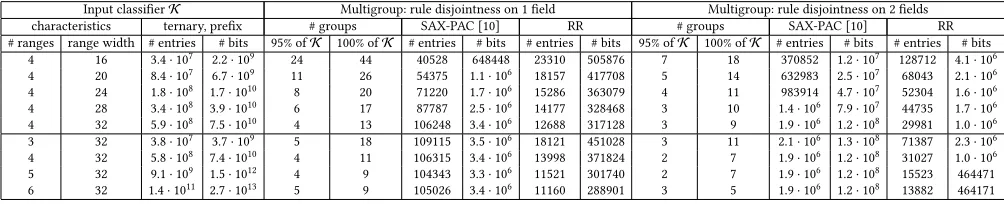
Methodology.Since the goal of this paper is to under-stand design principals to represent desired levels of expres-siveness and scalability, we assume the extreme case when all classifier fields are represented by ranges. Each synthet-ically generated classifier consists of 10000 rules that are generated independently. Each field rangeI =[l,r] is gener-ated independently according to the following distribution: (1) the value ofsim(I)is chosen uniformly at random; (2) the range boundslandr are generated uniformly such that the binary representations ofl andr coincide on the first sim(I)−1 bits. Though other distributions are possible, we choose this one to simulate sparseness of covered range val-ues. In our experiments we vary a number of range-based fields in a rule and a range width in bits. For both SRGE and prefix range encodings, we compare the total size in bits and entries among (1) conventional equivalent ternary classifiers, (2) multi-group representations with per-field resolution as in SAX-PAC (the columns SAX-PAC in Fig. 4 and Fig. 5), and (3) multigroup representations with per-bit resolution constructed by greedy_group_bit (the columns RR in Fig. 4 and Fig. 5). We release the code for our evaluation study as an open source [7].
Impact of range width. In the following denote byG1
andG2multi-group representations implementing rule
Input classifierK Multigroup: rule disjointness on 1 field Multigroup: rule disjointness on 2 fields
characteristics ternary, prefix # groups SAX-PAC [10] RR # groups SAX-PAC [10] RR
# ranges range width # entries # bits 95% ofK 100% ofK # entries # bits # entries # bits 95% ofK 100% ofK # entries # bits # entries # bits
4 16 3.4·107 2.2·109 24 44 40528 648448 23310 505876 7 18 370852 1.2·107 128712 4.1·106
4 20 8.4·107 6.7·109 11 26 54375 1.1·106 18157 417708 5 14 632983 2.5·107 68043 2.1·106
4 24 1.8·108
1.7·1010
8 20 71220 1.7·106
15286 363079 4 11 983914 4.7·107
52304 1.6·106
4 28 3.4·108
3.9·1010
6 17 87787 2.5·106
14177 328468 3 10 1.4·106
7.9·107
44735 1.7·106
4 32 5.9·108
7.5·1010
4 13 106248 3.4·106
12688 317128 3 9 1.9·106
1.2·108
29981 1.0·106
3 32 3.8·107
3.7·109
5 18 109115 3.5·106
18121 451028 3 11 2.1·106
1.3·108
71387 2.3·106
4 32 5.8·108
7.4·1010
4 11 106315 3.4·106
13998 371824 2 7 1.9·106
1.2·108
31027 1.0·106
5 32 9.1·109
1.5·1012
4 9 104343 3.3·106
11521 301740 2 7 1.9·106
1.2·108
15523 464471
6 32 1.4·1011 2.7·1013 5 9 105026 3.4·106 11160 288901 3 5 1.9·106 1.2·108 13882 464171
Figure 4: Total size of ternary rules in entries and in bits by prefix expansion.
Input classifierK Multigroup: rule disjointness on 1 field Multigroup: rule disjointness on 2 fields
characteristics ternary, SRGE # groups SAX-PAC [10] RR # groups SAX-PAC [10] RR
# ranges range width # entries # bits 95% ofK 100% ofK # entries # bits # entries # bits 95% ofK 100% ofK # entries # bits # entries # bits
4 16 2.1·107
1.4·109
24 44 34620 553920 19053 405194 7 18 286856 9.2·106
87677 2.8·106
4 20 5.8·107
4.6·109
11 26 47328 946560 16084 374638 5 14 512044 2.0·107
46351 1.5·106
4 24 1.3·108
1.3·1010
8 20 63513 1.5·106
14055 341758 4 11 824121 4.0·107
37976 1.2·106
4 28 2.6·108 2.9·1010 6 17 79694 2.2·106 12903 305834 3 10 1.2·106 6.8·107 40733 1.5·106
4 32 4.6·108 5.9·1010 4 13 97917 3.1·106 11899 292533 3 9 1.7·106 1.1·108 24192 775260
3 32 3.2·107
3.1·109
5 18 100641 3.2·106
16286 399179 3 11 1.8·106
1.2·108
58765 1.9·106
4 32 4.5·108 5.8·1010 4 11 97835 3.1·106 13263 350490 2 7 1.7·106 1.1·108 24976 805932
5 32 6.7·109 1.1·1012 4 9 95834 3.1·106 11229 285668 2 7 1.7·106 1.1·108 14516 444518
6 32 1.0·1011 1.9·1013 5 9 96610 3.1·106 10830 284829 3 5 1.6·106 1.0·108 12355 380373
Figure 5: Total size of ternary rules in entries and in bits by SRGE.
bigger than with per-bit; this ratio is rapidly growing when range width is increasing; e.g., for 32-bit ranges the same ratio is already equal to 10. The similar effect is seen on the total size in bits for the both range encoding methods. ForG2
representations, the effect of per-bit resolution is even more pronounced; e.g., for classifier rules consisting of four 32-bits ranges encoded by SRGE, the ratio between per-field and per-bit resolution in ternary entries is already 70 times since the total size ofG2depends quadratically on range width.
Number of fields in a rule.Increasing the number of fields has no significant effect on the total size of multi-group representations with per-field resolution and this is a signifi-cant advantage of SAX-PAC versus equivalent classifiers en-coding all ranges. The per-bit resolution provides additional memory saving since it allows to pickup multiple subranges minimizing the total size; e.g., for classifier rules on six 32-bit ranges, the size of SRGE encoding forG1 with per-bit
resolution is 10830 ternary entries which is very close to the optimal case when every range-based rule is encoded by a single ternary entry; from the other hand,G1with per-field
resolution and SRGE encoding requires 96610 entries. In the worst case among all experiments, the average number of ternary entries inG1with per-bit resolution does not exceed
2.4 entries per rule.
Number of groups.G2requires smaller number of groups
thanG1when per-field resolution is considered; from the
other hand, the total size of encoded ternary entries is signif-icantly bigger forG2than forG1; e.g., for rules on five 32-bit ranges, the total size ofG2 in entries for SRGE encdoing
is 17 times bigger than forG1. For per-bit resolution, this
effect is less pronounced and does not exceed 6 times in all experiments. Note that in all experiments for classifiers with at least 24-bits range width, the number of entries required forG2with per-bit resolution is smaller even than forG1
with per-field resolution showing effectiveness of per-bit resolution for reduction not only of the total size (both in entries and bits) but also of the number of required groups.
6
CONCLUSION
Range-based field representation is an important abstrac-tion to balance between scalability and expressiveness in packet classifiers; when a number of range-based fields is growing, equivalent classifiers encoding all ranges is not the right direction. Equivalent representations (not classifiers) as SAX-PAC [10] significantly improve memory requirements but still operating with per-field resolution can demand sig-nificant memory resources and the number of groups to implement desired structural properties. In this paper we in-troduce a notion of subranges allowing to operate on ranges with per-bit resolution and overcome constraints of per-field representations. Coexistence of subranges with other en-coding methods as [1, 2, 5] and software-based classifier representations in regular memory we leave for the future study.
REFERENCES
[1] Anat Bremler-Barr, Yotam Harchol, David Hay, and Yacov Hel-Or.
2018. Encoding Short Ranges in TCAM Without Expansion: Efficient
Algorithm and Applications.IEEE/ACM Trans. Netw.26, 2 (2018), 835– 850.
[2] Anat Bremler-Barr, David Hay, and Danny Hendler. 2012. Layered
interval codes for TCAM-based classification.Computer Networks56, 13 (2012), 3023–3039.
[3] Anat Bremler-Barr and Danny Hendler. 2012. Space-Efficient
TCAM-Based Classification Using Gray Coding.Trans. Computers61, 1 (2012), 18–30.
[4] Yeim-Kuan Chang and Cheng-Chien Su. 2007. Efficient TCAM
Encod-ing Schemes for Packet Classification UsEncod-ing Gray Code. InGLOBECOM. 1834–1839.
[5] Hao Che, Zhijun Wang, Kai Zheng, and Bin Liu. 2008. DRES: Dynamic
Range Encoding Scheme for TCAM Coprocessors.Trans. Computers
57, 7 (2008), 902–915.
[6] Pavel Chuprikov, Kirill Kogan, and Sergey I. Nikolenko. 2017. General
ternary bit strings on commodity longest-prefix-match infrastructures. InICNP. 1–10.
[7] How to deal with range-based packet classifiers [n.
d.]. How to deal with range-based packet classifiers.
https://github.com/sosrranges/subranges.
[8] Richard M. Karp. 1972. Reducibility among Combinatorial Problems. Springer US, Boston, MA, 85–103.
[9] Kirill Kogan, Sergey I. Nikolenko, Patrick Eugster, Alexander Shalimov,
and Ori Rottenstreich. 2016. FIB efficiency in distributed platforms. In
ICNP. 1–10.
[10]Kirill Kogan, Sergey I. Nikolenko, Ori Rottenstreich, William Culhane,
and Patrick Th. Eugster. 2016. Exploiting Order Independence for
Scalable and Expressive Packet Classification.Trans. Networking24, 2 (2016), 1251–1264.
[11]Karthik Lakshminarayanan, Anand Rangarajan, and Srinivasan
Venkat-achary. 2005. Algorithms for advanced packet classification with
ternary CAMs. InSIGCOMM. 193–204.
[12]Netlogic Microsystems. Content addressable memory [n. d.]. Netlogic Microsystems. Content addressable memory.
http://www.netlogicmicro.com.
[13]Sergey I. Nikolenko, Kirill Kogan, Gábor Rétvári, Erika R.
Bérczi-Kovács, and Alexander Shalimov. 2016. How to represent IPv6
for-warding tables on IPv4 or MPLS dataplanes. InINFOCOM Workshops. 521–526.
[14]OpenFlow 1.3 specification, 2012 2012. OpenFlow
1.3 specification, 2012. http://www.openflow.org/
wk/index.php/OpenFlow_1_3_proposal.
[15]P416 Language Specification 2017. P416 Language Specification.
https://p4.org/p4-spec/docs/P4-16-v1.0.0-spec.pdf.
[16]Ori Rottenstreich, Rami Cohen, Danny Raz, and Isaac Keslassy. 2013.
Exact Worst Case TCAM Rule Expansion.IEEE Trans. Computers62, 6 (2013), 1127–1140.
[17]Venkatachary Srinivasan, George Varghese, Subhash Suri, and Marcel
![Figure 1: Our RR method vs. previous works: (a) original classifier K whose rules consist of three 5-bit fields; (b) therepresentation of K as in [10] exploiting rule disjointness based on two ranges; (c) the proposed RR implementingrule disjointness on three bits; (d) comparison of three different representations based on prefix and SRGE rangeencoding methods.](https://thumb-us.123doks.com/thumbv2/123dok_us/1107881.1611875/2.612.64.560.86.198/classifier-therepresentation-disjointness-implementingrule-disjointness-comparison-representations-rangeencoding.webp)
![Figure 2: Multigroup representations our RR method vs. SAX-PAC [10]: (a) an original classifier Krules, each field is on 5 bits; (b) SAX-PAC representation ofsingle field; the second group rules are disjoint on two fields; (c) the proposed RR implementing rule disjointness with 3-field K on two groups: the first group rules are disjoint on aon a single bit in the first group and on three bits in the second group.](https://thumb-us.123doks.com/thumbv2/123dok_us/1107881.1611875/4.612.349.525.257.312/multigroup-representations-classifier-representation-disjoint-implementing-disjointness-disjoint.webp)
![Fig. 2b. In [10fields are represented by ranges.] the authors show that this representationis equivalent to an originally given k-field classifier whoseSince our goal is to demonstrate advantages of per-bit](https://thumb-us.123doks.com/thumbv2/123dok_us/1107881.1611875/5.612.316.561.88.223/represented-representationis-equivalent-originally-classifier-whosesince-demonstrate-advantages.webp)