Testing the exclusivity effect in location memory
Abstract
Acknowledgements
Introduction
Memory for object location is an everyday process. An example of this can be seen in giving directions: we can easily provide directions to other locations that are not visible on both a small (“Your keys are on the table.”) and a large scale (“The library is opposite the student union.”). Research into memory for object location has received increased interest in recent years, with a central theme being whether multiple representations of space can be accessed in parallel to locate a target object and if so, how these representations interact.
are arranged to form a logical grid) or egocentric frames of reference when the items comprising the array are displayed in an irregular fashion (Xiao, Mou & MaNamara, 2009; Mou, Liu & McNamara, 2009). As well as exploring the interplay of allocentric and egocentric frames of reference in memory for object location, scholars have also explored the interactions between multiple allocentric representations. For instance, Brockmole and Wang (2002) explored switching between multiple representations of space. They asked participants (all current Professors at the University of Illinois, for at least 2 years prior to testing) to make judgements about the location of objects in two familiar environments: 1) the Psychology building, and 2) their own office. The stimuli used were designed to reflect the actual positioning of target objects in relation to the points of reference (i.e. the relative position of another building on campus, or the location of the bin in the participant’s office). The participants were shown schematic images outlining the location of target objects around a point of reference and were asked to indicate as quickly as possible whether or not the target object was displayed in the correct location (using response keys labelled yes and no). The results indicated that there was a time cost associated with switching between the different representations of space, suggesting that the different representations were not accessed concurrently. The average relative time cost associated with switching between these representations was approximately 110ms.
item two). Again they demonstrated that participants were faster to respond if the two words came from the same category (e.g., both target words) as opposed to different categories. The findings reported here suggest that parallel retrieval of multiple memories is possible, at least in some instances.
All the literature discussed thus far has explored parallel retrieval in memory using time as the dependent variable with little research focusing on the accuracy of location memory judgements. However, recall accuracy is important for two main reasons. First, precision of recall cannot be determined from time alone (and studies that use time as a measure tend to work only with exact recall). Second, accuracy is usually the measure of primary interest in applied work. We would also argue that conclusions are strengthened by converging evidence using different measures rather than focus on just one. Therefore, it is recall accuracy not speed that will be the focus of the remainder of this paper.
As Mou & McNamara (2002) indicated, it is not possible to describe an object’s location in space without relating it to a point of reference. Therefore, consider a scene where a target object is flanked by two points of reference (points A and B). In this example, it is possible to describe the target object’s location in relation to either point of reference A or B separately, with each providing a distinctly different representation of the target’s location in space.
accuracy for recalled location. These processes were exclusivity, independence and superadditivity:
Exclusivity: only one spatial representation can be accessed at any one time (A or
B but not both). Critically, if one memory representation were to fail to retrieve the target object’s location, the second memory trace cannot then be used in reserve.
Independence: both spatial representations can be accessed concurrently but are
mutually independent, potentially yielding greater recall accuracy than would be observed under exclusivity (A or B). Independence differs from exclusivity in that failed retrieval of A may be followed by attempted retrieval of B (and vice versa).
Superadditivity: there is integration or summation of the two spatial
representations, leading to increased accuracy in recall relative to independence
Such definitions have been outlined elsewhere in the literature (i.e., Rohrer et al., 1998; Maylor, Charter & Jones, 2001) but Baguley et al.’s (2006) are specialised for location memory where information about inexact recall is as important as exact recall.
The exclusivity finding is counterintuitive and there is evidence in the literature that greater overlap of information between encoding and retrieval should improve memory performance (e.g., Morris, Bransford & Franks, 1977; de Winstanley, Bjork & Bjork, 1996; Meier & Graf, 2001). In addition, non-exclusive recall has been reported in the wider memory literature (Logan and Schulkind, 2000; Logan and Delheimer, 2001). However, exclusive recall has been shown in both location memory (Brockmole and Wang, 2002) and other areas of memory recall (Rohrer et al., 1998; Maylor, Charter & Jones, 2001). Therefore, if time is not a limiting factor and participants are instructed to recall a target object’s location accurately not quickly, it ought to be possible for participants to utilise multiple representations of target location and subsequently generate recall accuracy consistent with either independence or superadditivity.
One explanation of exclusive recall in Baguley et al.’s (2006) experiment is that as the anchor labels were only weak semantic associates, the participants were not binding and accessing multiple representations at retrieval in the paired single anchor and dual anchor conditions. This is consistent with the wider memory literature, where parallel retrieval of multiple memories has been demonstrated within strongly associated same word categories (Rohrer et al., 1998; Logan & Schulkind, 2000; Logan & Delheimer, 2001).
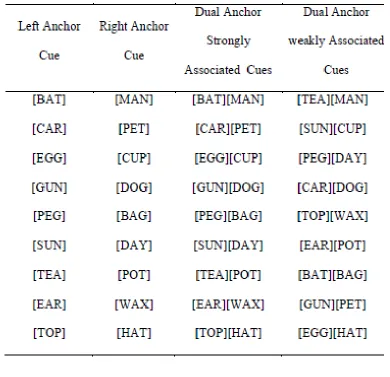
(three-letter, monosyllabic words) that could be read consecutively to form a strongly associated six-letter combination in a dual anchor condition (for example, [EGG]+[CUP] = [EGGCUP]). Recall performance could then be compared with that of single anchor conditions and with a dual anchor weakly associated (control) condition. This weakly associated condition employed three-letter, monosyllabic words that when read consecutively formed only weakly associated six letter combination (for example, [SUN]+[CUP] = [SUNCUP]). It was predicted that where participants could combine the anchor labels to form a strongly associated combination at encoding, they should be able to access more than one representation at retrieval and hence demonstrate recall accuracy consistent with either independence or superadditivity.
Method Design
Participants
Ninety (22 male; 68 female) participants naive to the true aims of the research took part in the experiment. The participants were Psychology staff and students (who received course credits) from Nottingham Trent University. The mean participant age was 20.69 years (SD = 4.68). The sample contained 87 right handed and 3 left handed participants. The participants were all fluent English speakers with normal or corrected normal vision and they were all verbally screened for colour blindness.
Stimuli
The word pairs were selected to maximise word frequency (using the Kucera-Francis (1967) and Thorndike-Lorge (Leech, Rayson & Wilson, 2001) word lists) and word imagability (using Wilson, 1988). Furthermore, the combinations were selected to preserve phonetic structure (for example, phonetically [TOP]+[HAT] reads as [TOPHAT] but [DIG]+[ITS] does not sound like [DIGITS]). This was to promote the amalgamation of the anchor labels in the dual strongly associated condition and subsequently produce the maximum likelihood of anchor combination during encoding and retrieval. The selected words were displayed in size 18, Times New Roman font. The 9 weakly associated anchor label combinations were generated by changing the order of the two columns for the left and right stimuli, so that each anchor label was displayed on the same anchor (left vs. right) but with a different partner label (e.g., [SUN] + [CUP]).
The target objects in the current experiment were 9 Hornby Ford Sierra cars (OO/HO scale, model number R271). Each car was 60mm in length and 20mm in height. Each car was painted a different colour and the colours used were black, blue, green, grey, orange, purple, red, white or yellow. Each car colour was partnered to a particular pair of words and these pairings remained constant throughout the experiment. Thus, every participant saw the orange car with the anchor labels [SUN] and [DAY], though the car could appear in any of the 9 locations in any given trial.
background support system. Three standard Redhead studio lights (800W each) with dichroic filters were used to light the scene and to remove any shadows in the image. Each of the bridge scenes were photographed with a car in each of the nine target locations, travelling in both a left-to-right direction and a right-to-left direction.
The images were later edited, using Adobe Photoshop CS2 version 9, to ensure that the background had a uniform grey appearance (red, green and blue value of 170 for all three constituent colours). The single anchor conditions were constructed by replacing the bridge tower with the grey background and fading the edge of the road using a motion blur of 60 pixels. The stimuli were displayed on a 19” flat scene monitor that had a refresh rate of 60 hertz and a screen resolution of 1024 x 768 pixels (which was the same resolution as the stimuli).
Procedure
The experiment scripts were generated using the Eprime 2.0 computer programme on a Pentium 4 computer running Microsoft Windows XP, and were used to control the display times, randomisation of the stimuli and to record the participant’s responses. The experimental procedure was divided into two stages; stimuli familiarisation and the location memory task.
Stimuli Familiarisation
centre of the computer screen for 3 seconds and was then immediately replaced by an image of the corresponding car. The target car remained on screen until the participant pressed the space bar and the process was repeated for each target car colour. Upon completion of the stimuli familiarisation task, the participants were verbally screened about their ability to distinguish between all of the target car colours and only continued to the location memory task if they believed they could confidently differentiate between these colours.
Location Memory Task
In phase two, the participants were again presented with the bridge scenes they had seen in phase one, however, this time the target car was presented below the bridge. The participants’ task was to use the scenes to recall and indicate the location of the target car (by a mouse click along the bridge in the recalled location). The images were displayed in a random order and each picture remained on the screen until a response had been made. There was a 2 second inter stimulus interval (ISI) between each response and the presentation of the next test image.
Results
General pattern of recall across anchor conditions.
Owing to the mounting evidence indicating that near miss errors in location memory can still represent important information about memory retrieval (Huttenlocher, Hedges & Duncan, 1991; Lansdale, 1998; Lansdale, Oliff & Baguley, 2005), the data collected were used to calculate the root mean square deviation corrected (RMSDcorrected) values for each
participant. This value is computed as
RMSDcorrected 1 m
Dobserved
2
Dchance2
m1
m
,where m is the number of trials, Dobserved is the observed deviation from the target location
chance recall and below 1 it indicates better than chance recall. To assess evidence for exclusivity, independence or superadditivity, it is necessary to compare the observed RMSDcorrected scores with modelled scores expected under both exclusivity and serial independence. Baguley et al. (2006) used a measure of proportion of location information transmitted (T) to derive these predictions from observed levels of memory in the single anchor conditions. For a single sample T can be estimated as:
T 1RMSDcorrected
Under exclusivity the expected performance is identical to that for single anchor presentations, and (assuming that recall of left and single anchor presentations is equally likely) can be estimated from the average of the observed performance in the left and right single anchor conditions:
Texclusive
Tleft Tright
2Under independence the expected performance is given by the sum of the left and right hand anchor performance minus their product:
Tindependent Tleft Tright Tleft Tright
Translation back into an RMSDcorrected score is trivial (as RMSDcorrected 1T ).
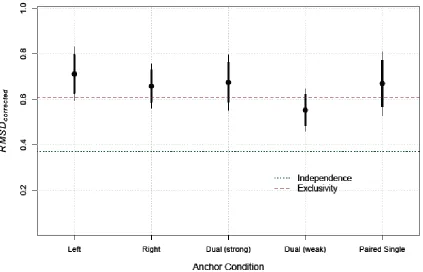
both dual anchor conditions and the paired single anchor condition all overlap with the predictions of the exclusivity model (the average of the right and left levels of recall) and none include the level of recall expected under independence. The left and right anchor conditions are included in the plot for completeness only, as recall in these conditions can only be exclusive owing to the absence of the second anchor. The average RMSDcorrected values for each location can be seen in Figure 4. These are presented separately for left and right anchors, but combined for the dual and paired single anchor conditions for convenience.
Figure 4. The mean RMSDcorrected scores by location for each anchor condition. All
means are plotted with two-tiered 95% CIs. The outer tier (thin lines) depict 95% CIs for the location means. The inner tier (thick lines) are adjusted so that means that are
different at the 95% confidence level have non-overlapping error bars.
formal analysis was conducted using a mixed ANOVA with two factors, anchor condition (with 5 levels left anchor, right anchor, dual strongly associated anchor, dual weakly associated anchor and paired single anchor) and location (with 9 levels, locations 1 to 9). This revealed a significant effect of location, F8,680 = 4.219, MSE = 0.315, p < .05, but no significant effect of anchor condition, F4,85 = 1.199, MSE = 0.483, p >.05, and a significant anchor condition × location interaction, F32,680 =1.970, MSE = 0.315, p < .05. The significant effect of location was further explored using post hoc pairwise comparisons. Post hoc analysis (using a Bonferroni correction) of the main effect of location revealed a significant difference between location 1 and 7 (p < .05), between locations 4 and 9 (p < .05) and between locations 7 and 9 (p < .05). The right and left anchor conditions show different patterns of recall across locations – with evidence of better recall close to anchor points and close to the central location (a ‘virtual’ anchor), though this is more marked for the left anchor than the right anchor presentations. The dual anchor and paired single anchor conditions show patterns broadly consistent with responses sampled exclusively from memories of left and right anchor presentations; levels of recall tend to fall between those of the respective single anchor presentation.
Detecting an exclusivity effect
predict performance under independence it is possible to estimate the expected RMSDcorrected under independence as 0.37. When compared with single anchor performance, this corresponds to a standardized mean difference of d0.6110.371 0.2171.1. The paired single anchor and the dual anchor conditions (n = 18) each have one-sided statistical power of .98 to detect an advantage of this magnitude, relative to the pooled single anchor conditions (n = 36). Thus, the key comparisons do not appear to be underpowered.
Evidence for a null effect can be assessed more directly by Bayesian methods. One relatively simple approach suitable for experimental tests is to use Bayes factors (Rouder, Speckman, Sun, Morey & Iverson, 2009). In the present case it is instructive to compare three different hypotheses: the null hypothesis (H0) that all conditions produce equal levels of recall (as expected under exclusivity), the alternative hypothesis (H1) that only strongly associated dual anchors produce independence, and the alternative hypothesis (H2) that independence holds in paired single anchor and both dual anchor conditions. The expected pattern of RMSDcorrected scores under each hypothesis can therefore be set out as
H0 sa psa dw ds
H1 sa psa dw ds
H2 sa psa dw ds
However, Rossell, Baladandayuthapani and Johnson (2008) describe Bayes factors for order-restricted inference in ANOVA. This method is implemented in R (R Core Development Team, 2012) via their isoregbf library. Bayes factors are a measure of the extent to which the observed data change the posterior odds relative to the prior odds of one hypothesis relative to another. To compute these it is necessary to know or to assume the prior probability of the hypotheses. The approach advocated by Rouder et al. (2009) is to set objective priors based on a range of effect sizes common to a research field. A scale factor makes it possible to adjust the anticipated effect size. In addition to incorporating order restrictions, Rossell et al.’s approach uses a prior that more strongly favours the alternative hypothesis over the null hypothesis when the observed effects are relatively small (as is the case here). A natural scale factor to plug into the analysis is expected standardized effect size for the difference in conditions under independence (d = 1.1). With this scale factor, the Bayes factor (computed from 10^6 Monte Carlo samples) of H0 relative to H1 is 7.4. The corresponding Bayes factor for H0 relative to H2 is 16.3. 1 Thus an exclusivity account is considerably more plausible than either of the alternative accounts.
Assuming that all three hypotheses are equally plausible a priori, the Bayes factors can be transformed into posterior probabilities for each hypothesis (where the Bayes factor is
1
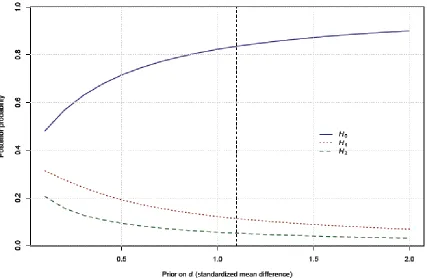
the ratio of the posterior probabilities). Figure 5 plots the posterior probabilities of each hypothesis as a function of the scale parameter (or expected standardized mean difference) with d = 1.1 indicated by a dashed line. The hypothesis H1 (exclusivity) dominates across a range of plausible prior effect sizes, its probability diminishing markedly only when d approaches zero.
Figure 5. Posterior model probabilities for a null hypothesis corresponding to exclusivity and two alternative hypotheses as a function the expected standardized mean difference for the effect if exclusivity does not hold.
Discussion
participants were able to recall the target location in relation to multiple anchors as opposed to a single anchor. Our results also suggest that the possibility of combining the anchor labels into a strongly associated combination (dual anchor condition) produced no improvement in recall accuracy when compared to the dual weakly associated anchor condition. This in turn suggests that the opportunity to combine the anchors does not lead to a greater level of recall accuracy in location memory judgements in the current paradigm. These findings are consistent with the current literature surrounding parallel retrieval in location memory in respect to both retrieval accuracy (Baguley et al., 2006) and the speed of retrieving multiple representations (Brockmole & Wang, 2002), suggesting that even when time is not a limiting factor (fast processing is not required), participants still process location memory information in an exclusive fashion.
The post hoc analysis of the effect of location revealed three significant differences in location. These were between locations 1 and 7, locations 7 and 9 and also locations 4 and 9. Similar findings have been seen elsewhere in the literature (e.g., Baguley et al., 2006) and are most likely caused by a combination of the overuse of a central virtual anchor (location 5) and a left/right anchor bias (Chockron, Bartolomeo, Perenin, Heft & Ingbert, 1998).
the participants have potentially two completely separate representations for a target object’s location, which could both be accessed at retrieval. The findings here suggest that exclusivity cannot be solely the result of the participants encoding the dual anchor scene as a single large representation (comprising two anchors and the target object), instead of two distinctly separate smaller representations (left anchor to target and right anchor to target). If this were the case, it would be expected that the paired single anchor condition would yield higher levels of recall than the dual anchor condition (which would contain only a single representation). This was not observed in the current experiment.
Baguley et al. (2006) demonstrated no such increase in recall accuracy after the removal of a single anchor at retrieval, subsequently offering no empirical support for the polarity explanation; the memory traces remained exclusive and apparently without conflict.
suggested that allocentric frames of reference are more likely to be employed in a regular array, such as the one used in the current experiment (9 distinct locations along the horizontal axis, flanked by one or two anchors).
Finally, the interplay of allocentric and egocentric representations of space has been previously explored using the “Milner paradigm” (Milner, Johnsrude & Crane, 1997; Wang, Johnson, Sun & Zhang, 2005), which has been shown to limit the influence of other factors, such as screen-based representations and egocentric representations. It would therefore be interesting to explore the exclusivity hypothesis under such circumstances.
References
Baguley, T., Lansdale, M. W., Lines, L. K., & Parkin, J.K. (2006). Two spatial memories are not better than one: Evidence of exclusivity in memory for object location. Cognitive Psychology, 52, 243-289.
Baguley, T. (2012). Calculating and graphing within-subject confidence intervals for ANOVA. Behavior Research Methods, 44, 158-175.
Brockmole, J. R. & Wang, R. F. (2002). Switching between environmental representations in memory. Cognition, 83, 295-316.
Chockron, S., Bartolomeo, P., Perenin, M., Helft, G., & Imbert, M. (1998). Scanning direction and line bisection: A study of normal subjects and unilateral neglect patients with opposite reading habits. Cognitive Brain Research, 7, 173-178. de Winstanley, P. A., Bjork, E. L., & Bjork, R. A. (1996). Generation effects and the lack
Huttenlocher, J., Hedges, L. V., & Duncan, S. (1991). Categories and particulars:
Prototype effects in estimating spatial location. Psychological Review, 98, 352-376. Kucera, H. & Francis, W. N. (1967) Computational analysis of present-day American
English. Brown University Press.
Lansdale, M. W. (1998). Modelling memory for absolute location. Psychological Review, 105, 351-378.
Lansdale, M. W., Oliff, L., & Baguley, T. (2005). Quantifying precision and availability of location memory in everyday pictures and some implications for picture database design. Journal of Experimental Psychology: Applied, 11, 67-83.
Leech, G., Rayson, P., & Wilson, A. (2001). Word frequencies in written and spoken English. Harlow: Longman.
Logan, G. D., & Delheimer, J. A. (2001). Parallel memory retrieval in dual-task situations: II. Episodic memory. Journal of Experimental Psychology: Learning, Memory and Cognition, 27, 668-685.
Logan, G. D., & Schulkind, M. D. (2000). Parallel memory retrieval in dual-task situations: I. Semantic memory. Journal of Experimental Psychology: Human Perception and Performance. 26, 1072-1090.
Maylor, E. A., Chater, N., & Jones, G. V. (2001). Searching for two things at once: Evidence of exclusivity in semantic and autobiographical memory retrieval. Memory & Cognition, 29, 1185-1195.
Milner, B., Johnsrude, I. & Crane, J. (1997). Right medial temporal lobe contribution to object-location memory. Philosophical Transactions of the Royale Society of London: Series B, 352, 1469-1474.
Morris, C. D., Bransford, J. D., & Franks, J. J. (1977) Levels of processing verses transfer appropriate processing. Journal of Verbal Learning and Verbal Behaviour, 16, 519-533.
Mou, W., Liu, X. & McNamara, T. P. (2009). Layout geometry in encoding and retrieval of spatial memory. Journal of Experimental Psychology: Human Perception and Performance. 35, 83-93.
Mou, W. & McNamara, T. P. (2002). Intrinsic frames of reference in spatial memory. Journal of Experimental Psychology: Learning, Memory and Cognition, 28, 162-170.
R Development Core Team. (2012). R: A language and environment for statistical computing. R Foundation for Statistical Computing, Vienna, Austria.
Rohrer, D., Pashler, H. & Etchegaray, J. (1998). When two memories can and cannot be retrieved concurrently. Memory & Cognition. 26, 731-739.
Rouder, J. N., Speckman, P. L., Sun, D., Morey, R. D., & Iverson, G. (2009). Bayesian t tests for accepting and rejecting the null hypothesis. Psychonomic Bulletin & Review, 16, 225-37.
Wang, H., Johnson, T. R., Sun, Y. & Zhang, J. (2005). Object location memory: The interplay of multiple representations. Memory & Cognition. 33, 1147-1159.