
102
DEVELOPING SKILLS FOR A LIFETIME OF
LEARNING: STRATEGIES TO DEVELOP
FLEXIBLE THINKING
Maura Sellars University of Newcastle, Australia E-mail: [email protected]
Abstract
This research investigated forty, ten to twelve year students in their final two years of primary schooling. It investigated their capacities to develop the cognitive competencies of executive function. The framework used was the Multiple Intelligences perspective of executive function. The findings discussed are those pertaining to the students’ development of the component of executive function known as flexible thinking. Investigated as part of a larger action research study which was implemented in three classrooms over a six month period, the findings in this domain demonstrated considerable improvement from the skills recorded as part of the baseline data. The baseline data had indicated that none of the students were able to demonstrate the cognitive capacities of flexible thinking. The results are significant in that they can be directly related to changes in pedagogical practice. The findings are significant also for the three participating teachers as they serve to highlight the challenges they faced. They are indicative of challenges that may be faced by other teachers as they seek to implement intervention programs effectively and to question some of the pedagogical strategies and beliefs with which they had formerly engaged confidently.
Key words: executive function, differentiation, flexible thinking, pedagogy, intrapersonal intelligence.
Introduction
in the 21st century Volume 29, 2011
103
Problems of the Research
the lack of research in this area became particularly problematic for australian teachers in the aftermath of the melbourne declaration on educational Goals for young australiansmelbourne declaration on educational Goals for young australians (barr, bartlett, constable, firth, Gillard, lomax-smith, pike, scrymgour & Welford, 2009). this document contained two major goals for schooling in australia. the first goal is to promote excellence and equity for all australian students. the second includes the need for schooling to develop the learning potential of all young australians so that they may each become successful learners. the document requires schools to educate students so that they are able to ‘develop their capacity to learn and play an active role in their own learning (barr, bartlett, constable, firth, Gillard, lomax-smith, pike, scrymgour & Welford, 2009, p.8). there is a clear focus on facilitating learning for individuals so that they can each reach their full potential as learners. there is also the suggestion that that one of the ways this can be achieved would be by the provision of individualised programs for students. these programs would need to be designed to build on the student’s individual relative strengths and build capacity in the student’s relative limitations in order to support students’ efforts to become the most effective learners they could be.
Research Focus
the specific foci of this study were to (i) examine the multiple intelligences (mi) (Gardner 1983, 1993, 1993b 1999) perspective of executive function in an applied research context, (ii) investigate the capacities of ten –twelve year old students to develop the cognitive competencies of executive function and become better thinkers and learners. the mi perspective of executive function identifies it as the other aspect of intrapersonal intelligence. one aspect of intrapersonal intelligence is accurate self knowledge; the other is the capacity to use self knowledge to achieve personal goals, in this case, learning goals. moran and Gardner (2007) definition of executive function is congruent with those offered by others, but they place ‘expression of self’ in real contexts to firmly establish this construct as the other aspect of intrapersonal intelligence.
104 the significance of this study lies not only in the lack of similar research reports, but
also in its contribution to understanding the types of pedagogical practices which contribute significantly to understanding how effective thinking skills appropriate to the ‘apprentice stage’
of executive function can be promoted in regular classrooms. it also presents an opportunity to explore and discuss the considerable challenges for everyone involved in educational leadership and practice, given the degree of student diversity that exists in any group of learners.
Methodology of Research
General Background of Research
the research was implemented in an australian school which has three classes of 10-12 year old students. the students were familiar with the bloom’s /Gardner’s matrix (mcGrath &noble, 2005) and its use as tool for planning teaching and learning tasks. these stage based classes were girls and boys from primary year five and year six aged ten to twelve years. these stage based classes were not uncommon in schools and were developed as the result of the curriculum becoming stage based over a decade ago. all the students were invited to participate in the study. the intervention program described below was implemented by all three class teachers with all of the students. the participants (n=40) were the students who give permission for their assessments to be accessed, who also had parental permission to take part in the study and who had retained enough documentation from the implementation program records and procedures to facilitate triangulation of the findings of the various research tools. the school was situated in the suburbs of a large city outside the state capital and the clientele were from a variety of socio-economic backgrounds. this was reflected in the student diversity.
Sample of Research
the executive function capacities of the forty (n=40), ten to twelve year old participants were investigated over a six month period in their usual classroom contexts and their skills assessed in the various components of executive function, including flexible thinking. prior to the implementation of the intervention program, the students regularly worked on a daily program of skill development from traditionally developed resources. these included spelling books that facilitated practice in spelling commonalities and exceptions, comprehension passages that were accompanied by a variety of similarly developed questions for each passage, a text for practicing english grammar and a school based sequence of teaching text types. none of these were explicitly linked to the english syllabus (board of studies, 1998) or to each other. baseline data was established by the teachers prior to the introduction of the intervention program by a series of observations and one to one discussions (conferences) with the students.
Instrument and Procedures
in the 21st century Volume 29, 2011
105
classroom and was preceded by each day by approximately one hour of teaching and learning of literacy skills. there were two aspects of the intervention program that were to not able to be negotiated or changed during the modifications at the conclusion of each cycle. firstly, the students must have choice. they were to choose their leaning tasks from anywhere on the matrix. secondly, their self selected learning goals must always comprise at least one task from each of these three categories: easy, consolidate, challenge. the tasks were not graded and each student was required to nominate their own choice of task in each of these categories. teachers were required to change their usual student-teacher interaction and undertake the roles of facilitators and mentors instead of instructors and providers of knowledge and skills. the teachers also undertook to complete a student observation checklist (adapted from dawson & Guare, 2004) as one of the research tools. they were assisted in the implementation of the tool by two strategies. firstly, they watched a video of students in a classroom and moderated their observations with the researcher and their colleagues in the project. secondly, they were provided with some aspects of student behavior on which to focus in order to establish the students’ capacities for flexible thinking. these were evidence of students (i) revising their own choice of goals in face of recognized, substantial difficulty, (ii) finding an alternative way to complete self selected task, (iii) persistence (iv) perseverance. although the tool was titled student observation checklist, it was recognized that the most authentic means by which to confirm what was thought to be observed was by one to one student teacher conferences. much of the data recorded on this implement was the result of both observation and conferencing.
Data Analysis
the data recorded on this research tool consisted of the (i) baseline data that the teachers established prior to the introduction of the intervention program in their classes, (ii) the date at which each student began to demonstrate evidence of flexible thinking skills and (iii) the summative assessment, using the given criteria, of the degree of competence of each student with regards to this cognitive capacity. the data was charted as raw scores and then subjected to a two tailed t test which indicated, as expected, that the progress made was statistically significant.
Results of Research
at the commencement of the intervention program, the three participating teachers could not find any evidence of the flexible thinking criteria in any of their student participants; either by observation or conferencing with them. at the conclusion of the thirty four students were established to have demonstrated the cognitive capacities of thinking flexibly. the remaining six students were just beginning to develop these skills and were not counted in those who had established competences. they were counted in the section titled ‘beginning to develop….’ skills in the progress chart below.
Table 1. Teachers’ assessment of students’ progress in developing flexible think
-ing skills.
Developing flexible
thinking skills Consolidating flexible thinking skills Has strong flexible thinking skills
Number of students 18 14 8
106 class teachers using the summative data from the Student Observation Checklist in november.
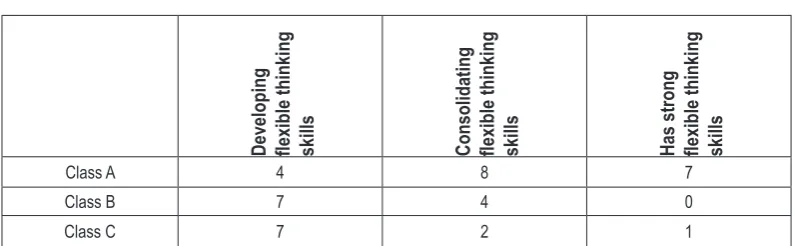
these assessments were supported by evidence from the teachers’ assessments of progress in english using the agreed sample outcomes from the english K-6 english syllabus (board of studies, 1998) and the students’ work samples. they were also confirmed by student comments in their reflective responses which were compiled at the completion of each task. the data was also gathered from each of the three groups of students across the three classes. although each class had a different number of participating students, it can be observed that the class that had the most student participants also had the students who had the strongest flexible thinking skills. this finding may simply have been the result of the impact of the type of interaction, social support and common focus amongst these students, although all students in all classes participated in the intervention irrespective of whether their data was able to be included or not in the research results. other evidence indicates that the teacher of class a was more enthusiastic about the potential of the intervention program and spent an increased amount of time developing strategies to overcome the inevitable challenges that the implementation of the intervention program presented.
Table 2. Teachers’ assessment of students’ progress in developing flexible think
-ing skills
Class A (n=19), Class B (n=11) and Class C (n=9).
Developing flexible thinking skills Consolidating flexible thinking skills Has strong flexible thinking skills
Class A 4 8 7
Class B 7 4 0
Class C 7 2 1
table 2 presents the number of students at each of the levels of competency in their class groups as determined by their class teachers using the summative data from the Student Observation Checklist in november.
in the 21st century Volume 29, 2011
107
Conclusions
the findings show a considerable increase in the students’ flexible thinking skills over show a considerable increase in the students’ flexible thinking skills overconsiderable increase in the students’ flexible thinking skills over increase in the students’ flexible thinking skills overincrease in the students’ flexible thinking skills over in the students’ flexible thinking skills over a relatively short period of time. there are two possible reasons for this. firstly, the students’ period of time. there are two possible reasons for this. firstly, the students’ of time. there are two possible reasons for this. firstly, the students’there are two possible reasons for this. firstly, the students’reasons for this. firstly, the students’ for this. firstly, the students’ engagement in the intervention program allowed them to select not only their preferred learningallowed them to select not only their preferred learning them to select not only their preferred learningthem to select not only their preferred learningto select not only their preferred learningonly their preferred learning tasks, but also to determine how their tasks were to be completed. additionally, they were able to choose which type of product they would best demonstrate their mastery of the skills embedded in the tasks and their mode of presentation. this interaction was very different to the learning experiences and materials they had engaged with prior to the commencement of the research study and with which they were still engaged for the first half of the literacy session each day during the project. these teaching and learning resources contained tasks that were determined by their teachers, were prescriptive in directions and procedures for completion and teachers, were prescriptive in directions and procedures for completion andteachers, were prescriptive in directions and procedures for completion and dictated the final product that was acceptable. in other words, these activities, although useful to some degree in consolidating literacy skills, did not provide any opportunity for students to solve problems for themselves. they simply did not have to think about their personal strategies and preferences and how they might use and showcase their individual learning strengths and capacities. as a result, students were either unable to develop the skills of flexible thinking in the pedagogical model that required these types of resources to be exclusively implemented in their classrooms or they were so unaccustomed to using any flexible thinking skills in their formal learning contexts that they were unable to demonstrate any competency in this cognitive domain.
secondly, the intervention program required the three teachers to interact in a more personal, individual manner with each of their students. the teachers had to became mentors and guides for their students, prompting their students’ thinking and encouraging task completion by making suggestions, asking personally relevant questions and providing advice and skill development when the students needed it for a specific purpose. they were no longer the exclusive decision makers in the students’ learning process in the way that they had previously been whilst implementing a program using their regular resources. the students took responsibility for making many decisions related to their learning in english that were formerly made exclusively by their teachers.
it is suggested, however, that the significant increase in flexible thinking that became evident to the teachers was the result of both of these changes to the more traditional pedagogy that dominated the customary teaching and learning activities and teacher- student interaction. the teachers themselves acknowledged that that, initially, the intervention program was more challenging in its implementation than their customary practices. they each independently indicated that they were challenged by their roles in the project and that there were personal difficulties involved in undertaking their mentoring and facilitating responsibilities instead of their customary teacher’s roles. one significant challenge was the need to be exceedingly well organized and have classroom planning highly structured so that the role of facilitating and mentoring could be undertaken effectively for all the students and their diverse needs. despite these difficulties, by the conclusion of the implementation of the intervention program, the teachers did successfully engage with the project. the degree to which each of them did this may vary, but their participation made possible the significant change in their students’ capacities to become more effective thinkers.
108 their self selected processes, procedures and products. it also challenged the basic ideas and
perhaps misconceptions related to the nature of the teaching and learning dynamic. allowing the students to make task choices within the parameters of the syllabus requirements presented the learners with opportunities to make decisions in the formal learning environment that are traditionally thought to be best made by teachers. the research also allowed students to take more responsibility for their own learning, again contesting the necessity for teachers to be in exclusive charge of the information and its means of dissemination and presentation. it has provided evidence that more effective thinking skills can be developed by students with diverse academic competencies if they are given opportunities, with teacher support, to become active, decisive partners in their own learning. What remains to be, seen in future studies, is the degree to which the teachers themselves are willing to face the challenges that so often accompany innovative pedagogical practices.
References
anderson, l., Krathwohl, d. (2000). Taxonomy of teaching and learning: a revision of Bloom‘s Taxonomy of educational objectives. new york: longman.
barr, a., d. bartlett, et al. (2009). Melbourne Declaration on Educational Goals for Young Australians. ministerial council, employment, training and youth affairs.
beare, h. (2003). the future school. Prime Focus, (32), 2-6.
board of studies. (1998). English K-6 Syllabus. sydney: board of studies nsW.
burchsted, s. (2003). future studies: preparing learners for success in the 21st century. New Horizons (february, 2003).
davidson, J. (2005). Multiple intelligences. retrieved 29/04, 2005, from http://www.childdevelopmentinfo. com/learning/multiple_intelligences.htm
dawson, p., Guare, r. (2004). Executive skills in children and adolescents. new york: Guildford press.
dendy, c. (2002). executive function. Chadd’s Attention Magazine. retrieved 12/7, 2006, from http:// www.chrisdendy.com/executive.htm
dickenson, d. (2000). learning society of the future. New Horizons for Learning. retrieved 24/7, 2006, from http://www.newhorizons.org
dickinson, d. (2002). positive trends in learning: meeting the needs of a rapidly changing world. New Horizons, 11-13
Gardner, h. (1983). Frames of mind: The theory of multiple intelligences. new york: basic books.
Gardner, h. (1993a). Frames of mind. Tenth Anniversary Edition. new york: basic books
Gardner, h. (1993b). Multiple intelligences. The theory in practiceThe theory in practice. new york: basic books.
Gardner, h. (1999a). The disciplined mind. What all students should understand. new york: simon and shuster.
in the 21st century Volume 29, 2011
109
henderson, h. (2002, april). Education for the third millennium. paper presented at the education for the third millennium, catamarca, argentina.
lepani, b. (1995). Implications for change in a learning culture: Meeting the challenges of the knowledge economy. paper presented at the international confederation of principals second World convention, sydney.
marshall, p (1999). principles for a new story of learning. New Horizons, 25-28.
mcGrath, h., noble, t. (2005). Eight ways at once: Multiple intelligences + revised bloom’s taxonomy; 200 differentiated classroom strategies (book 1). frenchs forest: pearson education australia.
meltzer, l. (2007). executive function: theoretical and conceptual frameworks. in l. meltzer (ed.), Executive function in education: From theory to practice. new york: the Guildford press.
moran, s., Gardner, h. (2007). “hill, skill and will”: executive function from a multiple intelligences perspective. in l. meltzer (ed.), Understanding Executive Function: Guildford.
Advised by Kathryn Grushka, School of Education, University of Newcastle, Australia
received: February 26, 2011 accepted: March 16, 2011
Maura Sellars PhD, Lecturer, Assistant Director of Professional Experience, School of Education, Uni-versity of Newcastle, UniUni-versity Drive, Callaghan 2308, NSW, Australia.
Phone: ��1 2 4�217�1�.��1 2 4�217�1�.
E-mail: [email protected]

![BM6 dsDNA circular Polyomaviridae Alphapolyomavirus Cardioderma polyomavirus Chiroptera [TAX:9397] ; Cardioderma cor [TAX:270764] NC_020067 CardiodermaPyV 5372 41.269546](data:image/gif;base64,R0lGODlhAQABAIAAAP///wAAACH5BAEAAAAALAAAAAABAAEAAAICRAEAOw==)