Negociaciones entre parejas de estudiantes al desarrollar
ejercicios de conversación en la clase de inglés
Ingrid Liliana Bohórquez Suárez
[email protected] Colegio Julia López Martínez, Bogotá - ColombiaMary Mily Gómez Sará
[email protected] Universidad Distrital “Francisco José de Caldas”, Bogotá - ColombiaSindy Lorena Medina Mosquera
[email protected] Colegio Instituto de Integración CulturalIDIC, Bogotá - ColombiaThis study analyzes what characterizes the negotiations of seventh graders at a public school in Bogotá when working in pairs to develop speaking tasks inEFLclasses. The inquiry is a descriptive case study that follows the qualitative paradigm. As a result of analyzing the data, we obtained four consecutive steps that characterize students’ negotiations: Establishing a connection with a partner to work with, proposing practical alternatives, refusing mates’ propositions, and making practical decisions. Moreover, we found that the constant performance of the process of negotiation provokes students to construct a sociolinguistic identity that allows agreements to emerge.
Key words:Interaction, negotiation, skill
de-cisiones prácticas. Además, nosotras encontramos que la ejecución constante del proceso de negociación provoca que los estudiantes construyan una identidad sociolingüística que permite que los acuerdos emerjan.
Palabras clave:habilidades, interacción, negociación
Introduction
Through our educational practices in distinct schools, grades and courses, we realized that there were students who faced problems when working with others. We noticed that this happened due to diverse reasons, such as differences of interests, lack of commitment of some participants, lack of trusting in others’ capabilities, disagreement in the work distribution, allocation of responsibilities, and assignation or appropriation of the role of leader. Thus, we created a research proposal which consisted of observing, analyzing, and discovering what characterizes students’ negotiations. We believe that achieving a deeper understanding of students’ joint work will provide teachers with tools that enable them to propose more suitable ways to foster and guide students’ shared work.
Literature Review
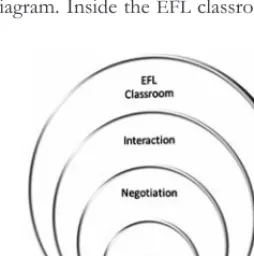
The bases of our research study are three constructs: interaction, negotiation and negotiation skill. Figure1 illustrates the relationship our constructs have among themselves and how they are involved in our study.
TheEFLclassroom is the environment where our constructs take place. For that reason, it surrounds them in the diagram. Inside theEFLclassroom different types of interactions
occur. Those interactions result in events such as exchanging thoughts, sharing ideas and implements, and negotiating, among others. In spite of the fact that interaction involves all these actions, in our study we focus specifically on the phenomenon of negotiation. Within the negotiation, we enclose the negotiation skill, which involves the set of abilities that enables the establishment and mediation of any negotiation.
Interaction
If we divide the word “interaction”we obtain the prefix “inter”which means “between, among, from one to another”, and the root “action”,which is “any activity that is susceptible to be done”. These definitions could be found in any dictionary. Taking as base these meanings,we built the concept of interaction as the mutual relationship that subjects/objects establish as a result of the development of An activity. Hence, there are two essential components for an interaction to take place: An activity, and at least two subjects or objects, or a combination of these elements that perform the activity and establish some kind of relationship as a result of the development of it.
The concepts “activity”,“subject”and“object”are too general since they can refer to any type of activity, and to any type of subject or object. Therefore, by deductive reasoning we transfer these elements to the specific scope of our research study. In our inquiry the activities we refer to are English speaking tasks and the subjects (there are no objects in our research since we deal with people) are seventh grade students who work in pairs developing their English speaking tasks.
Now that we have located the concept of interaction in the classroom environment, we can refer to Moore (1993) who identified three types of interactions that occur in this context; these are: Learner-Content Interaction, Learner-Instructor Interaction, and Learner-Learner Interaction. In our study we concentrate on the learner-learner interaction, which consists of students establishing relationships with their equals.
Negotiation
In this sense, Breen and Littlejohn (2005) talk about procedural negotiation which they describe as the discussions carried out by a group of people who have different interests or different points of view, but who have as their definitive goal to reach agreements on decisions. This is the case of our students who join with mates during class time with the mission of developing English speaking tasks, so they have to find a way of making the decisions that allow them to carry out the assigned activities.
Ramos (2009) provides a view that we think complements Breen and Littlejohn’s definition. She asserts that the conditions that encourage the emergence of negotiation are the cyclical steps of agreement and disagreement that students take when interacting. Based on her perceptions, and the ones provided by Breen and Littlejohn, we built our own conceptualization of negotiation. For us, negotiation is the discussion process where students take cyclical steps of agreement and disagreement that prompt the exchange of proposals, debate of possible alternatives, and construction of practical decisions that allow the achievement of a common goal.
Negotiation Skill
Negotiation skill is a composed concept that joins the definitions ofnegotiationandskill. As we have already discussednegotiationin the previous subtitle, we now defineskill, and then, build the concept ofnegotiation skillas a unit. In this sense, Bygate (2001) understands skill as the capability to put theoretical knowledge into practice. He also considers that having skill in doing an activity involves the use of specific abilities that enable the development of such activity. Taking this into account, we constructed our own understanding of negotiation skill. In our study,we understand negotiation skill as the set of abilities which enables students to establish and mediate the negotiations they engage in.
Hannay (2009) and Billikopf (2007) talk about the abilities that are involved in the negotiation skill. We combined their proposals and obtained the idea of negotiation skill being formed by the following: Having a vision of what is to be achieved, breaking down bigger issues into smaller ones, seeking interest-based decisions, ability to be a team player, open mindedness, ability to disagree when necessary, ability to move on when things are not working out as desired, be able to communicate and persuade, avoiding threats and manipulative tactics, tolerance of criticism, persistence, tolerance of risk, showing patience-empathy, controlling emotions, understanding the role of time restraints, and rejecting weak solutions.
Research Design
Paradigm
as a main component, so the researcher requires direct contact with the problem stated and the population. Secondly, the researcher is interested in understanding the meaning people have constructed. Thirdly, qualitative studies use “inductive research strategies”, which explain and evaluate the data. Finally, the ending product of the study is richly descriptive.
Method
The method we implemented was a descriptive case study as explained by Stake (1995), who affirms that this type of study is based on a selection of objects/subjects of study. This method of research is part of a social-science research tradition that stresses observation as the primary mode of inquiry. It is the study of real-life contemporary phenomena like interactions, meanings, and policies within a particular setting. The case-study researcher is therefore an observer of interactions within a particular context over which he/she has little control.
Instruments
Video recording transcriptions. Firstly, we video recorded seven of the nine classes we had. Secondly, we transcribed those parts of the videos where there was learner-learner interaction which was the situation we analyze in our study. We made these decision based on Ramos (2009), who asserts that it is not necessary to transcribe everything from the videos since it is time consuming and not all information recorded is pertinent and relevant to the study. Thirdly, we applied a color coding strategy which Bonilla and Rodríguez (2005) define as marking with different colors similarities and differences among the parts that comprise a conversation that has been transcribed. Through this strategy we classified and grouped the diverse students’ performances.
Participants
The study was conducted with both genders of seventh grade students in a public school in Bogotá. The group was formed by forty students that constitute the population. All students studied in the afternoon shift. Their ages ranged from eleven to thirteen years old. Through the development of the classes, we noticed that students were respectful, friendly, collaborative, and enthusiastic toward the English class.
Although we carried out the pedagogical activities with the whole group, only twenty one students signed the consent form, which means that these twenty-one students accepted our video recording their performances during class time and interviewing them; in our study they play the role of informants. From the group of twenty-one students, we selected only four to collect data from and to analyze their processes. They were a pair of males and a pair of females who were our participants. They were selected because during the stage of piloting the camera, it was noted that these students felt comfortable and behaved naturally in front of it.
Data Analysis and Interpretation
As a result of the classification, analysis and interpretation of the data we collected, we obtained four consecutive steps that characterize students’ negotiations. These four steps that we call sub-categories represent a cycle that students tend to repeat when negotiating. The repetition of these steps allows students to construct a sociolinguistic identity that enables agreements to emerge; we call thismacro-category.
Sub-categories
Establishing a connection with a partner to work with.The first negotiation students faced, at the moment of working together with someone else, happened during the process of establishing a connection with a partner to work with. In this first step students try to join with friends; if it is not possible to work with a friend they try to select someone they can establish a connection with, that is to say, someone who agrees to work in a peaceful and comfortable way. Having as reference the experiences we lived in the classroom and the video recording transcriptions, we noticed that some male students rejected the idea of working with female students and vice versa. Excerpt 1 is an example of this situation (S1 is a female student and S3 a male student).
aspecto?” “When you have to work with a partner do you prefer to work with someone of your same gender, someone of the opposite gender, in a mixed group, or are you not interested in this aspect?”
Most students, fourteen of the thirty-one, which is 45.2% of the students, answered that they preferred to work with someone of their same gender. Thirteen (41.9%) replied that they were not interested in this aspect. Three (9.7%) responded that they preferred a mixed group, and just one (3.2%) answered that they preferred to work with someone of the opposite gender. We found it curious that the student who checked the discriminatory act of excerpt 1, S3, answered that he does not pay attention to this aspect.
Excerpt 1 – Video Recording Transcription #2
English Transcription
302. TL: Y ¿Por qué no quieres trabajar con (Name omitted S1)?
303. S3: No me gusta trabajar con mujeres. 304. TL: ¿No te gusta trabajar con mujeres?
¿Por qué? 305. S3: No.
306. TL: ¿Qué tiene de malo trabajar con niñas? 307. S3: Ah… (He looks to other side)
302. TL: Why do you not want to work with (Name omitted S1)?
303. S3: I do not like to work with women. 304. TL: You don’t like to work with women?
Why? 305. S3: No.
306. TL: What is wrong with working with girls? 307. S3: Ah… (He looks to the other side)
To those students who answered that they preferred to work with someone of their same gender, we asked why. On the one hand, most girls explained that they preferred to work with other girls due to boys being disorganized and noisy. On the other hand, most boys said that girls were bossy and complicated. Consequently, the data analysis revealed an important aspect that affects the negotiation: “the gender issue”.
Proposing practical alternatives.We found that the second step students perform when negotiating is proposing practical alternatives. This means that students state, explain and support their ideas about how to deal with answers, materials and procedures that enable the development of a specific assigned task. Excerpt 2 is an example of a student’s proposal of a practical alternative that has as its purpose to enable the development of an assigned activity.
the partner. These actions do not happen in Excerpt 2 where just one student is doing the proposing and he/she does not ask for the other’s opinion and/or consent; the other student simply obeys the first one.
Excerpt 2 – Video Recording Transcription #5
English Transcription
895. S1: Ay, bueno. (She copies something on the board) ¿Quiere “morning” o “afternoon”? 896. S2: Eh… afternoon.
897. S1: (She writes it on her paper) Bueno ya, aquí así… el saludo, yo digo “Good afternoon” y entonces usted me dice…
898. S2: (She interrupts S1) Hi.
899. S1: ¿Hi? Bueno, “hi”, pero entonces cópielo. 900. S2: (She copies it on her piece of paper) 901. S1: Bueno, entonces yo le digo “would…” 902. S2: (She interrupts S1) Hello
(Name omitted S1).
903. S1: No… pero si usted no sabe mi nombre. 904. S2: (She moves her head meaning yes) 905. S1: Ah ¿sí?
906. S2: (She moves her head meaning yes) 907. S1: Bueno.
908. S2: Yo la invité a almorzar.
909. S1: Bueno… entonces usted me tiene que… usted tiene que ofrecerme a mí.
895. S1: Ok, well. (She copies something on the board) Do you like “morning” or “afternoon”? 896. S2: Eh… afternoon.
897. S1: (She writes it on her paper) Ok, done, like this… the greeting, I say “Good afternoon” and then you say…
898. S2: (She interrupts S1) Hi. 899. S1:¿Hi? Ok, “hi”, but copy it. 900. S2: (She copies it on her piece of paper) 901. S1: Ok, then I ask “would…” 902. S2: (She interrupts S1) Hello
(Name omitted S1).
903. S1: No… but, you do not know my name. 904. S2: (She moves her head meaning yes) 905. S1: Ah, yeah?
906. S2: (She moves her head meaning yes) 907. S1: Ok.
908. S2: I invited you for lunch.
909. S1: Ok… then you have to… you have to offer me something.
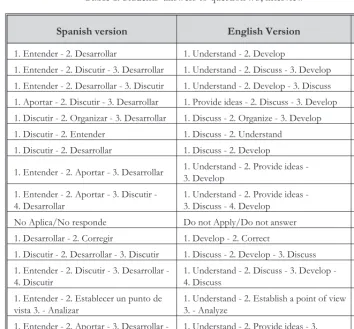
In the interviews we wanted to know if students recognizedproposing as a step in the development of their negotiations. Hence, we inquired: “Enumera los pasos en el trabajo en pareja para llevar a cabo una tarea en el salón de clase” “List the steps in the pair work to carry out a task in the classroom”. The answers students provided were very varied, as can be seen in Table 1, so the groups of students who had similar responses were very small.
“understand”, still others after “develop” and so on. Nonetheless, it was evident that this act characterized the negotiations that students carried out.
Table 1.Students’ answers to question #3, interview
Spanish version English Version #
Sts
1. Entender - 2. Desarrollar 1. Understand - 2. Develop 4
1. Entender - 2. Discutir - 3. Desarrollar 1. Understand - 2. Discuss - 3. Develop 3
1. Entender - 2. Desarrollar - 3. Discutir 1. Understand - 2. Develop - 3. Discuss 3
1. Aportar - 2. Discutir - 3. Desarrollar 1. Provide ideas - 2. Discuss - 3. Develop 3
1. Discutir - 2. Organizar - 3. Desarrollar 1. Discuss - 2. Organize - 3. Develop 3
1. Discutir - 2. Entender 1. Discuss - 2. Understand 2
1. Discutir - 2. Desarrollar 1. Discuss - 2. Develop 2
1. Entender - 2. Aportar - 3. Desarrollar 1. Understand 2. Provide ideas
-3. Develop 2
1. Entender 2. Aportar 3. Discutir -4. Desarrollar
1. Understand 2. Provide ideas
-3. Discuss - 4. Develop 2
No Aplica/No responde Do not Apply/Do not answer 2
1. Desarrollar - 2. Corregir 1. Develop - 2. Correct 1
1. Discutir - 2. Desarrollar - 3. Discutir 1. Discuss - 2. Develop - 3. Discuss 1
1. Entender 2. Discutir 3. Desarrollar -4. Discutir
1. Understand 2. Discuss 3. Develop
-4. Discuss 1
1. Entender - 2. Establecer un punto de vista 3. - Analizar
1. Understand - 2. Establish a point of view
3. - Analyze 1
1. Entender 2. Aportar 3. Desarrollar -4. Discutir
1. Understand - 2. Provide ideas - 3.
Develop - 4. Discuss 1
31
Students do this different ways such as using their own knowledge, requesting support from other classmates, asking the teachers, checking the material of the task or examining their previous notes. Excerpt 3 illustrates the step of refusing in a negotiation.
Excerpt 3 – Video Recording Transcription #5
English Transcription
914. S2: ¿Qué le gustaría? 915. S1: No sé, cualquier cosa.
A ver, pregúnteme algo.
916. S2: (She watches the photocopy that has the vocabulary) Would you like… carrots? (Laughs)
917. S1: ¿Zanahorias? No… eh, pizza.
918. S2: No… pero es para que me conteste que no. 919. S1: Ah, ya sé “peas”.
920. S2: No… zanahorias porque no le gustan. 921. S1: (She moves her head meaning that she
agrees)
914. S2: What would you like? 915. S1: I do not know, whatever.
Let’s ask me something.
916. S2: (She looks at the photocopy that has the vocabulary) Would you like… carrots? (Laughs)
917. S1: ¿Carrots? No… eh, pizza.
918. S2: No… the idea is that you answer no. 919. S1: Well, I know “peas”.
920. S2: No… carrots because you do not like them. 921. S1: (She nods her head meaning that she
agrees)
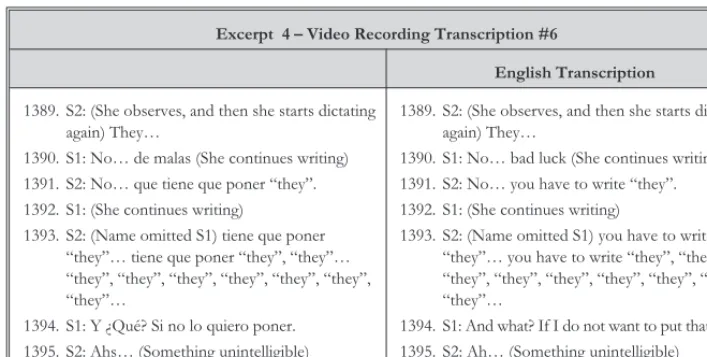
The situation in Excerpt 3 evidences refutation in a peaceful and tolerant way. Notwithstanding, Excerpt 4 shows a more rude interaction where students face a disagreement, refuse, but they did not achieve an explicit agreement. S1 just does what she wants, ignoring her partner’s opinion.
Referring to the semi-structured students’ interviews, the question we formulated to obtain data related to this aspect was: “Imagina que hay un trabajo en clase, tu compañero quiere desarrollar la actividad de una manera y tú de una muy diferente. ¿Cuál es tu posición y acciones? ¿Cuál es la posición y acciones de tu compañero?” “Imagine that there is a classroom task. Your mate wants to develop the activity one way and you in another very different way. What is your position and actions? What is the position and actions of your mate?” The students’ answers can be seen in Table 2.
Excerpt 4 – Video Recording Transcription #6
English Transcription
1389. S2: (She observes, and then she starts dictating again) They…
1390. S1: No… de malas (She continues writing) 1391. S2: No… que tiene que poner “they”. 1392. S1: (She continues writing)
1393. S2: (Name omitted S1) tiene que poner “they”… tiene que poner “they”, “they”… “they”, “they”, “they”, “they”, “they”, “they”, “they”…
1394. S1: Y ¿Qué? Si no lo quiero poner. 1395. S2: Ahs… (Something unintelligible) 1396. S1: (She continues writing)
1389. S2: (She observes, and then she starts dictating again) They…
1390. S1: No… bad luck (She continues writing) 1391. S2: No… you have to write “they”. 1392. S1: (She continues writing)
1393. S2: (Name omitted S1) you have to write “they”… you have to write “they”, “they”… “they”, “they”, “they”, “they”, “they”, “they”, “they”…
1394. S1: And what? If I do not want to put that word. 1395. S2: Ah… (Something unintelligible) 1396. S1: (She continues writing)
Table 2.Students’ answers to question 4, interview
Spanish version English Version # Sts
Dialogar y fusionar respuestas Dialogue and fusion answers 15
Dialogar y escoger la mejor respuesta Dialogue and choose the best answer 6
Proponer – Sustentar - Elegir Propose – Argue – Choose 4
Molestarse y no ceder Get angry and do not cede 3
Hacer lo que el otro diga (Ceder) Do what the other says (Cede) 1
Molestarse - Discutir – Llegar a acuerdos Get angry - Discuss – Come to an agreement 1
Proponer y desarrollar Propose and develop 1
31
Excerpt 5 – Video Recording Transcription 6
English Transcription
1371. S2: Next (She indicates in the paper the word that S1 has to erase) ¡Mire, aquí! (Pointing in the paper)
1372. S1: Ay, no sé. (She continues erasing) Ay, no, (Name omitted S2), cambiemos esa hoja.
1373. S2: ¡Ay! (Name omitted S1)… Bueno, entonces hágala rápido acá (She takes the sheet and shows a part of it that is empty). (Name omitted S1) arránquela y ponga eso rápido más bien que ya van a timbrar (She passes the paper to S1)
1374. S1: (She passes the liquid paper to S2) Ciérreme aquí.
1375. S2: (She receives it and closes it)
1376. S1: (She cuts the paper in a wrong way) ¡Ahs! 1377. S2: Entonces habrá que trabajarlo aquí
(Pointing S1’s notebook)
1378. S1: (She passes the sheets to S2) Sí, es mucho mejor. (She pulls out a new sheet from her notebook)
1379. S2: Ya.
1380. S1: (She starts writing)
1371. S2: Next (She indicates on the paper the word that S1 has to erase) Look right here! (Pointing in the paper)
1372. S1: Ay, I do not know. (She continues erasing) Ay, no, (Name omitted S2), let’s change this sheet.
1373. S2: ¡Ay! (Name omitted S1)… Ok, do it quickly, quickly right here! (She takes the sheet and shows a part of it that is empty). (Name omitted S1) pull it and write that quickly because the class is almost over (She passes the paper to S1)
1374. S1: (She passes the Liquid Paper to S2) Close it.
1375. S2: (She receives it and closes it) 1376. S1: (She cuts the paper wrong) ¡Ah! 1377. S2: So, we have to do it here (Pointing at S1’s
notebook)
1378. S1: (She passes the sheets to S2) Yes, it is much better. (From her notebook she pulls out a new sheet)
1379. S2: Done.
1380. S1: (She starts writing)
We found that most of the students’ negotiations we analyzed were about procedural aspects such as which material, procedure and way of presenting the work to use, implement, and follow. Our findings are similar to what Ochoa (2004) and Breen and Littlejohn (2005) described in their books.
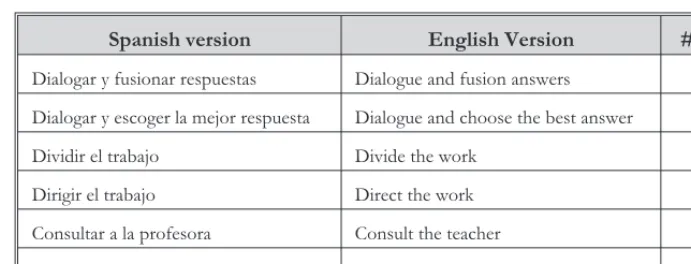
Table 3. Students’ answers to question 2, interview
Spanish version English Version # Sts
Dialogar y fusionar respuestas Dialogue and fusion answers 13
Dialogar y escoger la mejor respuesta Dialogue and choose the best answer 11
Dividir el trabajo Divide the work 5
Dirigir el trabajo Direct the work 1
Consultar a la profesora Consult the teacher 1
31
The responses “Dialogue and fusion answers”, “Dialogue and choose the best answer”, and “Divide the work” suggest that students need to carry out negotiations as the process that allows them to achieve the agreements on decisions. Notwithstanding, the replies “Direct the work” and “Consult the teacher” evidence that these students do not really work with their partners jointly, but prefer to work individually, receiving the guidance of an expert represented by the teacher.
Macro-category
The steps we described in the sub-categories are procedural aspects that students carry out when negotiating. Nevertheless, the constant repetition of this process of negotiation provokes students to construct a sociolinguistic identity that allows agreements to emerge. We understand this sociolinguistic identity as a personality that students built in order to be able to relate to their equals when establishing and maintaining negotiations. The macro-category corresponds to a social behavior that reflects the students’ personal growth as human beings who learned to cooperate benefiting not only themselves, but the team and the activity that is being developed.
Conclusions
We found that what characterizes students’ negotiations is a cyclical process students tend to follow each time they negotiate. We discovered that this process is comprised of four consecutive steps: Establishing a connection with a partner to work with, proposing practical alternatives, refusing mates’ propositions, and making practical decisions.
Like us, Meister, Urbig, Schröter and Gerstl (2005) conceive negotiation as being a complex process comprised of groups of actions. They call these groups of actions “phases”. In their book, they identify three phases: the pre-negotiation phase, the main negotiation phase and the post-negotiation phase. We believe that the phases they describe serve to structure and explain the findings of our study due to the fact that we understand the process of negotiation as a unit conformed by phases and steps.
In this sense, we comprehend the process of negotiation as follows: Firstly, the pre-negotiation phase in our study corresponds to the step of establishing a connection with a partner to work with. This step sets the conditions to establish deeper negotiations. Secondly, we believe that the cyclical performance of the steps “proposing practical alternatives” and “refusing mates’ propositions” correspond to the main negotiation phase. Finally, as a result of the repetition of the steps proposing and refusing, students make practical decisions that are not part of the main negotiation phase, but results from it; we identify this as the post-negotiation phase.
Repeatedly performing the process of negotiation enables students to construct a sociolinguistic identity that allows agreements to emerge. We understand this sociolinguistic identity as being the collection of characteristics and abilities that allow students to negotiate with respect, tolerance, responsibility and maturity. In this way, they achieve to build agreements that benefit their team, themselves, and the activity that is being developed.
References
Billikopf, G. (2007). Interpersonal negotiation skills. University of California. Retrieved from http://cnr.berkeley.edu/ucce50/ag-labor/7labor/17.htm
Bonilla, E. & Rodríguez, P. (2005).Más allá del dilema de los métodos: la investigación en ciencias sociales. Bogotá: Grupo Editorial Norma.
Bygate, M. (2001).Speaking. Oxford: Oxford University Press.
Hannay, M. (2009). Developing negotiation skills in the classroom: A case simulation [Adobe Digital Editions version]. Journal of Human Resources Education, 3(1). Retrieved from http://business.troy.edu/JHRE/Articles/PDF/3-1/23.pdf
Kajornboon, A. B. (2006).Using interviews as research instruments[Adobe Digital Editions version].
Retrieved from http://www.culi.chula.ac.th/e-Journal/bod/Annabel.pdf
Meister, M., Urbig, D., Schröter, K. & Gerstl, R. (2005). Agents enacting social roles. Balancing formal structure and practical rationality in MAS design. In K. Fischer, M. Florian & T. Malsch (Eds.), Socionics. Scalability of Complex Social Systems (pp. 104-131). Retrieved from http://books.google.com.co/books?id=ABQcgnKaScgC&pg=PA118&dq=social+negotiat ion+step+propose&hl=es&ei=CFKrTKjQDsP58Abv_sSMCA&sa=X&oi=book_result&c t=result&resnum=1&ved=0CCcQ6AEwAA#v=onepage&q&f=false
Merriam, S. B. (1998). Qualitative research and case study applications in education. San Francisco: Jossey-Bass.
Moore, M. G. (1993).Three types of interaction. Retrieved from http:// cdl.panam.edu/Home/ Files/
MMOORE.doc.
Ochoa, M. (2004).Meaning negotiation inEFLproject work: How students express themselves and interact with others(Unpublished master’s thesis). Universidad Distrital Francisco José de Caldas, Bogotá. Ramos, S. (2009).The role of collaboration and negotiation among English teachers when implementing an EFL
curriculum(Unpublished master’s thesis) Universidad Distrital Francisco José de Caldas, Bogotá. Stake, R. E. (1995).Investigación con estudio de casos(Original title:The art of case study research). Madrid:
Morata.
The Authors
Ingrid Liliana Bohórquez Suárezholds a bachelor’s degree in Basic Education with an emphasis in English as a Foreign Language from Universidad Distrital Francisco José de Caldas. She is currently working as a full-time teacher at Colegio Julia López Martínez.
Mary Mily Gómez Saráholds a bachelor’s degree in Basic Education with an emphasis in English as a Foreign Language from Universidad Distrital Francisco José de Caldas.
Sindy Lorena Medina Mosqueraholds a bachelor’s degree in Basic Education with an emphasis in English as a Foreign Language from Universidad Distrital Francisco José de Caldas. She is currently working as a full-time teacher at Colegio Instituto de Integración CulturalIDIC.