Ferdosi et al. World Journal of Engineering Research and Technology
PERFORMANCE EVALUATION OF SHAPE-SPECIFIC AND
GENERAL DEFINITION OF MODELS USING DYNAMIC
DEFORMABLE TEMPLATE FOR IMAGE-BASED OBJECT
RECOGNITION
Bilkis Jamal Ferdosi*1 and Muhammad Masud Tarek2 1
Associate Professor, Department of CSE, University of Asia Pacific, Dhaka, Bangladesh. 2
Associate Professor, Department of CSE, State University of Bangladesh, Dhaka,
Bangladesh.
Article Received on 22/02/2018 Article Revised on 15/03/2018 Article Accepted on 05/04/2018
ABSTRACT
Model-based segmentation and recognition can be invaluable if a prior knowledge about the object’s shape is available. It enables a model
description that may even override data information in case of
inaccurate and missing information. However, achieving proper model
description and its in-class variation is not a trivial task. In literature
there exist several approaches. Some require enough representative samples, some fails in
case of large size and shape variation etc. In our work, we propose a template combining
deformable templates and physically based models together. Using the proposed template we
study i) whether object’s shape-only-template is sufficient or information about the space
surrounding the object should be incorporated, iii) whether there exist a useful quality
measure for matching templates. We found that the proposed dynamic deformable template
works successfully. Incorporation of the surrounding space information in the template
significantly improves the recognition rate which also enables a better template matching
criteria.
KEYWORDS: Segmentation; recognition; deformable template; physically based model.
World Journal of Engineering Research and Technology
WJERT
www.wjert.org
SJIF Impact Factor: 5.218*Corresponding Author
Bilkis Jamal Ferdosi
Associate Professor,
Department of CSE
University of Asia Pacific,
I. INTRODUCTION
To extract and recognize an object from an image of medical data or similar application areas
where shape and structure of the region of interest such as organs, bones, tissues etc. are
available or known a priori, efficient use of model-based image segmentation and recognition
is very common. However, in such case, main obstacles to overcome is to obtain an efficient
model description and its shape variation in the object class.
In free-form models, no global structure is used where the model is constrained only by local
continuity and smoothness constraints.[1–3] On the other hand, in,[4–7] contour or skeleton of the object is utilized to obtain the model description. To obtain the shape and shape variation of a
class different approaches are used, such as in[4] statistical distribution of shape and its variation is learned from training on enough representative samples. However, the success of
the approach severely depends on the availability of enough samples that truly represent the
object variation.
Along with the shape description, it is also essential to incorporate the in-class shape variation
in the model. Deformable templates that incorporate prior geometric shape information and
shape variation in terms of non-parameterized bitmap images,[8] or parameterized curves,[9–11] can be useful. In the first type, separate deformation mechanism is needed and in the second
type, setting a large number of parameters is not trivial.
Another solution can be the use of physically based deformable models[5,12] that also incorporate prior shape information in the model. The model deformation is achieved by
changing the physical properties of the model itself. Being intuitive in nature, physically based
models provide the advantage of not requiring any prior training and incorporation of the
shape variation into model parameters. Therefore, combining a template-based and a
physically-based strategy seems to be reasonable. A template could be modeled using a
physically based model (PBM) and utilize the inherent quality of PBM for model deformation
instead of using a separate deformation mechanism.
Therefore, in this paper, we propose a Dynamic Deformable Template (DDT) using a Stable
Mass-Spring Model (SMSM). DDT is a template whose deformation is governed by its physical properties. Unlike the state of the art approaches, our approach incorporates object’s
Handcrafted DDTs are specific to the shape of the object class and vary among the classes. A different object class is represented by a different number of masses and
springs. Thus, the inter-class comparison is possible only in terms of global energy (total
energy experienced by all of the masses of a class model).
Rectangular grid DDTs are structurally equal for all the shape classes and capable of sampling space around the object. Object-specific shape information is introduced into the
templates as model forces. In this model inter-class comparison is possible both in terms of
global energy and local energy (energy experienced by mass, m of the model, x can be compared with mass, m of the model, y).
We also experimented with two different matching quality measures: global and local measures.
The first one measures the quality of global fitting of the templates. It compares total
energy required for a template of class, x and a template for class, y to fit in to object, m. If
the class, x template requires less energy to fit into an object, m, then the object will be classified as a class, x, and vice versa. It can be applied to both types of templates.
The second one measures the quality of fitting of the templates at the local level. In this
measure, we compare two templates in terms of energy experienced by corresponding
mass points of the templates. It can only be applied to the rectangular grid DDTs as it
requires a comparison between corresponding parts of templates.
We investigate the capability of proposed DDTs of capturing shape variations using
handwritten digits because of their high shape variation.
II. THE STABLE MASS-SPRING MODEL (SMSM)
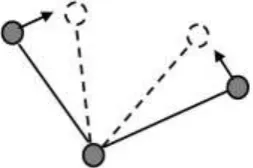
The mass-spring model is a geometric entity that receives its shape from physical constraints.
It is usually represented by a graph where nodes are mass points and edges are springs
connecting two mass points. Using a prior knowledge of the object shape, mass positions and
springs rest lengths are estimated. The model dynamics are governed by internal forces, which
are defined within the model graph, and external forces that are computed from the image
data. The model deforms only under external force. The external force acts as some kind of
attraction force that attracts the model towards the features in the image. The magnitude of the
attraction force increases with decreasing distance to the attraction point. The model
Consider a mass-spring model consisting of mass points with masses mi and initial position
vector, pi and connected with springs of spring constant, kij. The rest length, Rlij that are spatially associated with two mass points i and j can be calculated using equation 1.
(1) j i
ij p p
Rl
The dynamics of such a system can be described by Newtonian mechanics. The movement of
the model is influenced by the forces acting on the mass points.
A. Internal Forces
1) Spring Force: The elastically deformed springs exert spring forces, i S
F on the mass points
as they deviate from their rest lengths i.e. mass points gets new position vector, pnewi.
The spring force, i S
F acting on mass point i can be calculated using equation 2.
(2) ) ).( .(
j new new new new ij new new ij S j i j i j i i p p p p Rl p p k F2) Torsion Force:For model stability, another internal force called torsion force is included in the model dynamics.[12] To introduce torsion force in the model, rest directions rdij of the springs starting from one mass point i to all adjacent mass point j along the lines of the spring rest length is calculated.
Springs deviations from their rest direction exert a torsion force to the mass points in the
direction of their rest directions to restore the original position. The torsion force, FTi
,
exerts on mass point i can be calculated using equation 3.
(3) . ) , ( . ji ji j ji d ji j T n n p r p t F ji i
Where, j i new newji p p
p and tj = torsion constant of the mass point j
The working direction of the torsion forces, nji is calculated using equation 4.
(4) all for . , 2 j p p r p r n ji ji d ji d ji ji ji
B. External Force
Image-Force The model is constrained to lie on the image allowing it to deform according to
the image topography. Image feature collected by each mass point act as a force on that mass
and the image force, i I
F exerted on mass point i can be calculated using equation 5.[7]
(5) )) ( (loci image F
i I
Where loc(i) gives the coordinates of the current location of the sensor i in the image and image( ) gives the image information at that position.
1) Damping Force: Damping force is used to prevent oscillatory behavior of the model. It can be defined as a function of velocity as in[5] or the speed of motion of the model can be damped by a factor, d as in.[12]
2) Discrete Equations of Motion
Given the forces discussed above, applying Newton’s second law of motion can be simulated
in a discrete time step of distance t . According to Newton’s second law of motion,
acceleration ai of mass point i can be calculated using equation 6.
(6) i i i m F a
(7) . .
. i i i i i
i S T T I I
S
i w F w F w F
F
Where,
i S
w = weight for the spring force acting on mass point i,
i T
w = weight for the torsion force acting on mass point i,
i I
w = weight for the image force acting on mass point i.
Following the calculation of the mass point forces we can compute the new velocity, vi and
position, pi of each mass point given the old velocity,violdand old position values, old i
p as
follows: (8) ) 1 ).( .
(v a t d
vi iold i
(9) . t v p
pi iold t
The model adaptation to the image will continue until equilibrium when external forces cancel
out internal forces i.e., FinternalFexternal.
III. APPLICATION OF SMSM AS DDT A. Handcrafted DDTs (hcDDTs)
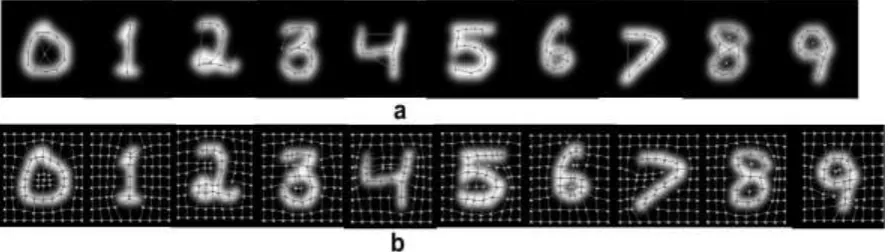
The hcDDTs are generated by placing the mass points along the medial axis of the digit as we
are interested in the actual shape of the digits. In some of the hcDDTs, for example in the
templates for digit 0, 6, 8 or 9, we include some mass points that have dark intensity sensors
associated with them for a better description of their shape (see fig. 2a).
B. Rectangular Grid DDTs (rgDDTs)
This template has similarity with the 2D planar rubber sheet used by Jain et al.[6] for deformation transformation of the bit map image templates. However, in Jain’s approach, a
parametric statistical mapping is needed to generate random variations in the template. In
rectangular grid DDT deformation is guided by forces, which can be determined by features in
the image to be segmented and by geometric constraints within the model. Therefore,
statistical mapping of template deformation can be avoided in our proposed rectangular
template. The template used by Jain et al. is a bit map image of the object to be found. On the
other hand, the template used in this paper is based on a mass-spring model that can be
IV. MNIST DATABASE
All of our investigations related to DDTs are based on the handwritten digits from the MNIST
database.[17] The digits are size-normalized and centered in a 28x28 grey level image. We are interested in the template’s ability to catch essential aspects of a digit’s shape and not so much
in improving the quite impressive recognition rates of trained classification on all the samples.
Therefore, in our experiments we took a subset of 18 samples for each digit for training,
considering their morphological similarity in shape, so that the variation among the samples
can be learned with a single template. For the test data set, we selected 850 digit images from
the first 1000 images of MNIST test data set. In our work, we super-sampled the image into
112x112 pixels with the resolution of 600 dpi using the nearest neighbor method.
In order to allow the deformation process some room for adjusting the template, a
32-pixel-wide border was placed around each image. This increased the actual image size to 144x144
pixels.
V. SENSORS
Each mass point in the model can be made sensitive to different sensors. Sensors are defined
application-specific and may be sensitive, e.g., to corners, edges, or specific intensities. In our
work we used (dark/bright) intensity sensor convolved with distance kernel (fig. 3).
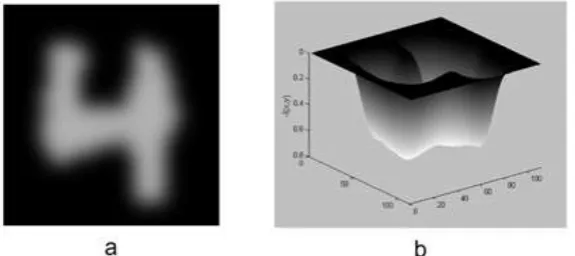
Figure 3: Image seen as 3D surface. In (a) is shown a convoluted image of intensities of digit 4. In (b) is shown its representation as a 3D surface. This representation corresponds to the graph of the function -I(x,y).
VI. TEMPLATE MATCHING MEASURES FOR CLASSIFICATION
A. Global Energy Measure (GEM)
In GEM classification, we use the adapted model energy normalized by the expected model
energy, as the decision measure. The expected model energy, Eexpected of template i is obtained
from the training data according to the equation 10, where Ek is the energy of the template on
the kth sample.
(10) 1
)
( 1
exp
mpes NumberOfSa
k k
ected E
mples NumberOfSa i
E
and Ek Fk (11)
All the 10 templates for 10 digits are applied to the image of the digit to be classified one after
another. After adaptation, the rest energy, Eadapted of template i is normalized by its expected energy, Eexpected that yields global decision measure, Edecision (as in equation 12).
(12) )
( ) ( )
(
exp i
E
i E i E
It is likely that the template on wrong digit image will have higher Edecision measure than the template on the correct digit. Therefore, the template that will have the lowest Edecision measure should be declared as a winner (equation 13).
(13) )) ( min(
arg E i
Winner decision
B. Local Energy Measure (LEM)
LEM bears some similarity to correlation measures used in rigid template matching and
requires templates for every class that have the same number of elements (springs and
masses). LEM is calculated using equation 14.
(14) )) ( )
( (
)
(i , , 1 E j Eexp j
E DSI ected
des NumberOfNo
j adapted
n
correlatio
VII. RESULTS AND DISCUSSION
A. hcDDTs vs. rgDDTs using Global Measure
Using global measures hcDDTs achieved 69:44% success rate on the training set and 31.84%
success rate on the test data set. On the other hand, rgDDT achieved 72.78% success rate on
training data which is 3.34% improvement over hcDDTs. On test dataset rgDDT achieved
49.82% success rate which is 17.98% improvement compared to the performance of hcDDTs.
It indicates the capability of rgDDT in generalizing training results to unknown samples of the
same type.
B. hcDDTs vs. rgDDTs using Local Measure
In hcDDT different models are represented by different numbers of masses and springs, thus it
is not possible to use local measures for hcDDT. Using correlation measure for classification,
rgDDTs gained 96.67% success rate on the training data set which is 23.89% improvement if
compared to its own performance using global measure and 27.23% improvement if compared
to the performance of hcDDTs. For the test data set rgDDT obtained 74.69% success rate
using a local measure which is 24.87% improvement compared to global measure, and
42.85% if compared to hcDDTs.
The success of rgDDT using local measure may lie in the fact that the rgDDT incorporates
more information about the object and it enables comparison of the templates at the local
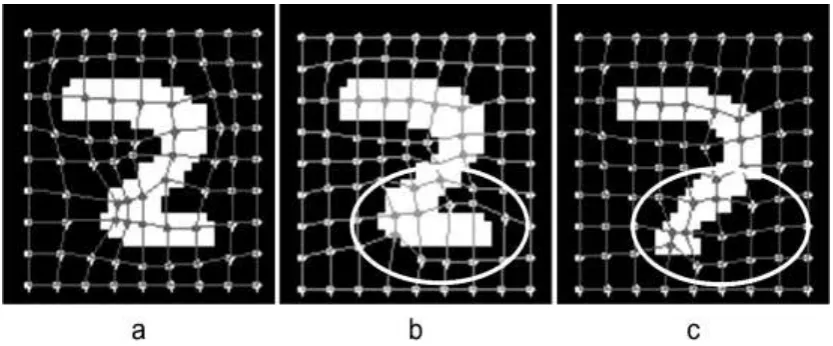
level. For example, in fig. 4a digit 2 is adapted with the template for digit 2 that results in
global decision measure Edecision (2) = 1.13415 and in fig. 4b digit 2 is adapted with the template for digit 7 that results in global normalized Edecision (7) = 1.09002. Thus the digit 2 is
wrongly classified as digit 7. If the local node by node energy measure is considered then it
would not be the case. As indicated in figure 4b the nodes in the region encircled have higher
variation than the region in fig. 4c.
However, the performance of such models severely depends on the initial placement. If the
model is not placed sufficiently close to the target, finding shapes cannot be ensured. In most
of the cases, user interaction and expert knowledge are needed for the placement of the model.
VIII. CONCLUSION
Deformable models are used in different application areas such medical imaging[15,16] where achieving proper model definition is crucial. In our experiments, we used handwritten digits of
MNIST database for investigating the potential of DDTs. The success rate of using match
quality for classification is far from results of state-of-the-art statistical methods for classifying
digits, where error rates of less than 1% can be obtained. Jain et al.[13] achieved similar results using deformable templates on a 2000 character training set. Using syntactic pattern
recognition Lopez et al.[14] obtained 83.83% recognition rate on a 300 character training set. On the other hand, using our rgDDTs we achieved 96.67% recognition rate using only 18
character training set. The power of DDTs is their ability to provide a meaningful match
quality based on very few samples and little apriori information by directly incorporating
obtained from our experiments are sufficient to support our hypothesis of “better
representation of a template that incorporates additional scope for template matching is necessary to improve the object recognition”. Therefore, our proposed DDTs qualify for
further investigation to find out more about its use for recognizing objects. In future, we will
investigate its potential for general object recognition.
REFERENCES
1. Kass, M., Witkin, A., Terzopoulos, D.: Snakes (1988): Active contour models.
INTERNATIONAL JOURNAL OF COMPUTER VISION, 1(4): 321–331.
2. Cohen, L.D. (1991): On active contour models and balloons. CVGIP: Image Underst,
53(2): 211–218.
3. Xu, C., Prince, J.L. (1998): Snakes, shapes, and gradient vector flow. IEEE
TRANSACTIONS ON IMAGE PROCESSING, 7(3): 359–369.
4. Cootes, T.F., Taylor, C.J., Cooper, D.H., Graham, J. (1995): Active shape models their
training and application. Comput. Vis. Image Underst, 61(1): 38–59.
5. Hamarneh, G., McInerney, T. (2003): Physics-based shape deformations for medical
image analysis. In: SPIE Electronic Imaging, 5014: 354–362.
6. Jain, A.K., Zhong, Y., Dubuisson-Jolly, M.P. (1998): Deformable template models: A
review. Signal Processing, 71(2): 109–129.
7. T¨oennies, K.D., Benedix, P. (2005): A weight-adaptive dynamic model for shape
segmentation. In: IEEE International Conference on Image Processing ICIP. (11.-14.
September 2005).
8. Jain, A.K., Zhong, Y., Lakshmanan, S. (1996): Object matching using deformable
templates. IEEE Trans. Pattern Anal. Mach. Intell, 18(3): 267–278.
9. Yuille, A., Hallinan, P., Cohen, D. (1992): Feature extraction from faces using
deformable templates. International Journal of Computer Vision, 8: 99–111.
10. Li, C., Xu, C., Gui, C., Fox, M.D. (2010): Distance regularized level set evolution and its
application to image segmentation. Trans. Img. Proc., 19(12): 3243–3254.
11. Wang, Q., Boyer, K.L. (2012): The active geometric shape model: A new robust
deformable shape model and its applications. Comput. Vis. Image Underst, 116(12):
1178–1194.
12. Dornheim, L., Tonnies, K.D., Dornheim, J. (2005): Stable dynamic 3d shape models. In:
13. Jain, A.K., Zongker, D. (1997): Representation and recognition of handwritten digits
using deformable templates. IEEE Transactions on Pattern Analysis and Machine
Intelligence, 19: 1386–1391.
14. L´opez, D., Pinaga, I. (2000): Syntactic pattern recognition by error correcting analysis on
tree automata. In Ferri, F.J., Quereda, J.M.I., Amin, A., Pudil, P., eds.: Advances in
Pattern Recognition, Joint IAPR International Workshops SSPR 2000 and SPR 2000,
Alicante. Volume 1876 of Lecture Notes in Computer Science, Springer, 133–142.
15. Camara, M., Mayer, E., Darzi, A. et al. Int J CARS, 2016; 11: 919.
16. Yanni Zou, Peter X. Liu, A. (2017): high-resolution model for soft tissue deformation
based on point primitives, Computer Methods and Programs in Biomedicine, 148; Pages
113-121, ISSN 0169-2607.