Volume 51, 2013
18
COURSE IN NEW THINKING IN HIGHER
EDUCATION: ENHANCING CREATIVITY
THROUGH THE MEANS OF TRAINING,
THEORY AND WORKSHOP
Christian Byrge, Søren Hansen
Aalborg University, Aalborg, Denmark E-mail: [email protected], [email protected]
Abstract
This paper presents a study on how a new (5 ECTS/2.5 American credit) stand-alone course for higher
education in new thinking may influence key aspects of creative abilities. The course structure and con
-tent is based primarily on The Creative Platform with a focus on training, theory and workshop. The study uses the Torrance Test for Creative Thinking and a Reflection Report for Creativity Teaching to identify effects from the course. The results from the Torrance Test for Creative Thinking showed a significant increase in students’ ability in figural and verbal fluency, flexibility, figural and verbal originality, and elaboration as well as in resistance to premature closure. The results show no significant increase in stu
-dents’ ability in the abstractness of titles. The results from the Reflection Report for Creativity Teaching showed that the majority of students experienced that they were capable of both developing understand
-ing of creativity theory, becom-ing better at participat-ing in a creative process as well as becom-ing better at generating and developing new ideas, thoughts and new knowledge. However, some students experi
-enced problems especially related to creativity training. Implications and potentials of a combined focus on training, theory and workshop in creativity courses for higher education is discussed.
Key words:creative method, creativity training, the creative platform, university curriculum.
Introduction
the importance of developing creative abilities for students in the educational system are recognised by employees (runco, 2004; deweett & Gruys, 2007) and by the students them-selves (mccorkle, payan, reardon & Kling, 2007). it is also believed that higher education institutions can play a key role in developing this creative ability (Vance, 2007; Wince-smith, 2006). there have been several previous attempts developing courses with the sole objective of developing students’ creative ability (smith, 1998; bull et al., 1995). nickerson (1999) stresses the need for studies of effectiveness of courses and training programs for creativity. this study attempts to investigate the effectiveness of a new creativity course referred to as a course in new thinking (nt). new thinking is the part of creativity that deals with the production of new ideas, new thoughts and new knowledge in a psychological context. therefore it is neither focused on artistic nor historical creativity (innovation/invention).
in the 21 century Volume 51, 2013 19
a 2010 master thesis (elbæk & sørensen, 2010) studying users of the creative platform (byrge & hansen, 2009a) revealed an interesting increase in the level of creativity when the creative platform was used as a process for 25 hours during 3 months. this master thesis in-spired the authors to design a creativity course based on the creative platform. the course in nt is based on both the theory and practice of the creative platform (byrge & hansen, 2009a; byrge, 2011; byrge & hansen 2011; hansen & byrge, 2010; byrge & lund, 2010; osmundsen et al., 2009; byrge & hansen, 2009b; hansen & byrge, 2009; hansen & byrge, 2007; byrge & hansen, 2008).
the creative platform (tcp) is an approach for teaching creativity and/or facilitating creative processes. it presents an ideal mental workplace for interdisciplinary, intersocial and intercultural groups. the platform makes it easier for professionals from all kinds of disciplines, cultural and social backgrounds to apply their knowledge in solving a common task/problem. tcp consists of 3 elements: a six-phase model, four basic principles, and a 3d didactic (creativity training exercises). the six phase model is described in the following.
1. preparation for facilitating the process, composition of participants to ensure diversity, preparing the physical frames for a process with no interruption and easy access to all necessary equipment, and writing down a minute-by-minute program of the process to avoid discussions on the process during the creative work.
2. the red carpet is a ritual in which participants get onto the creative platform and develop the motivation, concentration and confidence to engage in the process. the red carpet is meant to “calibrate” the students to a common creative mindset through instructed exercises in creativity training.
3. The problem/task is briefly presented and without professional/academic input of any kind.
4. idea development where knowledge is unlimitly applied in a creative generation and development of solutions for the problem/task. in this phase all kinds of idea generation and selection tools are used (see examples in part 2.2). this phase ends with a selection of potential ideas using the “heart” (no analysis) as the selection mechanism.
5. professional/academic input is brought into the process when potential ideas have been chosen for further development. the professional/academic input should contain the “missing parts” for each of the ideas selected in phase 4. this input can take form as a lecture, an article, a book, an interview etc. the input does not necessarily relate directly to the problem but does relate directly to the potential idea(s). for example if the problem is to develop suggestions for “a future shoe” and a potential idea is “magnets instead of laces/velcro” then the professional/ academic input could be about “magnetism”.
6. the blue carpet is a ritual in which participants are taken down from the creative platform and will be prepared for the ordinary world again (judgement, vertical knowledge, person focus and discussion). the blue carpet can have the form of a detailed presentation, a discussion on the process, or on the ideas developed etc.
there are feedback loops between phase 5 and 4. it is the same six-phase process that is used for developing a new idea for a product, service, organisational problem, what to do on the weekend, what to cook for dinner, etc.
Volume 51, 2013
20 alternating between a 3d case - then working on a problem - then returning to a new 3d case - then working on a problem... Therefore the 3D cases are only used to train a specific behavior and thinking that participants need when working on their subproblem. the 3d cases are used in phase 2, 4 and 5. examples of 3d cases can be found in the appendix.
the entire process of the creative platform including 3d cases, the work on the problem, the six-phase model follows four basic principles. these principles are as follows:
no-experienced judgement: no one should feel judged on their person 1.
or their output (ideas, thoughts etc.).
parallel thinking: all participants have the same focus at any given 2.
time.
task focus: all focus is always on the task – no person focus. 3.
horizontal thinking: apply all kinds of knowledge for the generation 4.
and the development of ideas, thoughts and new knowledge.
The Creative Platform defines creativity as an unlimited application of knowledge (Byrge & Hansen, 2009A). This definition has a strong focus on knowledge compared to other exist -ing definitions that often emphasise the generation of new products, ideas, original invention, re-elaboration, or the improvement of products or ideas (alencar & fleith, 2003. in almeida et al., 2008); fluid, flexible, original and elaborative thinking (Guilford, 1967) or detecting gaps, production of novel ideas, re-combining ideas, and making novel relationships between ideas (Torrance, 1969). However, there seems to be a common acceptance of a significant cognitive role in creativity by both the creative platform and other theories. participants in tcp, un-der the facilitation of an instructor, develop new ideas by applying their knowledge unlimitly. Hansen & Byrge (2007) use the metaphor of a mental library to define unlimited application of knowledge. using the books in the library that are directly related to a subject matter (marketing books for marketing problems) is a vertical application of knowledge. using the books in the library that are not directly related to a subject matter (garden books for marketing problems) is a horizontal application of knowledge. finally, using books from other libraries (other people) than your own is included in either vertical or horizontal application of knowledge depending on the relation to the subject matter (byrge & hansen, 2008). Vertical and horizontal applica-tion of knowledge that is free of cultural, professional and social limitaapplica-tions is an unlimited application of knowledge. being completely free of cultural, professional and social limitation may be a solely theoretical concept. however, for the creative moment, period or process such limitations can have less influence on the application of knowledge. Therefore the (un) limita -tion may be relative and not absolute. tcp is further elaborated in part 2.1, 2.2. and 2.3 as part of the course descriptions.
The Objectives of the Course in New Thinking
the course in nt is not the same as the creative platform. however, the creative platform forms a foundation for the design of nt. While the creative platform is a creative process, nt is a course on creativity including workshops, theory and training. the learning objectives of NT are defined as follows (A) the student should have knowledge to reflect their creative experience in relation to the literature; (b) the student should have skills in participat-; (b) the student should have skills in participat-b) the student should have skills in participat-ing in a creative process; (c) the student should have competence to think creative. each of the three elements will be explained in the following.
A: Knowledge to reflect their creative experience in relation to the literature
in the 21 century Volume 51, 2013 21
basic principles (hansen & byrge, 2010) of tcp: no-experienced judgement, parallel thinking, task focus and horizontal thinking. the hope with this element is that the students will develop knowledge to be able to reflect past, present and future experiences in relation to creativity – in particular the experiences they get during the other course activities (workshop and training).
B: Skills in participating in a creative process
Most creative process tools/models belong to the stream of thought defined by sternberg (2003) as pragmatic. this approach is primarily focused on how to develop creativity rather than studying it. however, some researchers combine this focus with research and found evidence that participants in creative processes can enhance creative ability (torrance 1972). hui and lau (2006) and lin (2010) studied drama education and found that it has a significant positive impact on creative and storytelling abilities. The same has been found for teaching of other processes for creativity like creative reversal act (sak & oz, 2010) and creative drama process (Karakelle, 2009). this course element provides the students with an experience of a creative process. the students in the course on NT use a battery of idea generation tools for solving a real-life problem defined by a major danish theme park. the idea generation tools include random words, provocations and movement (de bono 1970), analogies (Gordon 1961), inventive principles (altshuller et al. 1997) and pictures. the students are facilitated through a process that follows the six-phases suggested in the tcp (byrge & hansen, 2009a). the hope is that the experience of participating in a creative process will provide the students with skills for participating in future formal and informal creative processes, as well as creating their own creative process.
C: Competence to think creatively
Volume 51, 2013
22 The Course in New Thinking
the course was conducted in the spring of 2011.
Instructional design
the course was conducted over a 10-week period including pre- and post-tests, 5 course sessions, 1 presentation session and an exam. the exam was oral and lasted for 20 minutes per student. Marking was based on the students’ ability to fulfil the three learning objectives of the course (see section 2.1, 2.2 and 2.3). the course sessions lasted each from 08.30 – 15.30 (7 hours) including one half hour lunch break. a session of 4 hours was conducted where the students presented and discussed their ideas for the problem provider (a major danish theme park).
the course sessions were conducted in a normal classroom setting. the tables and chairs were organised before the start of each course session to fit the need of the particular curriculum of the session. the students took part in this re-organisation. during sessions necessary equip-ment like paper, pencil, flip-overs, training cards, idea generation tools and instruction cards was provided to the students, but only when they were needed. all mobile phones, watches and computers were collected by the teacher at the start of each course session and during the presentation session and kept until after the individual session had ended. this was to enhance participants’ focus on the problem.
Instructional content
The first two course sessions consisted of a mix of teaching creative techniques and facilitating a creative process both in a workshop format. during these sessions the following areas were covered: experiencing the six-phases of the creative process, using the various crea-tive techniques, working creacrea-tively both individually and in groups, creacrea-tive selection of ideas, mapping knowledge needed for further development of ideas, and presenting ideas for others to get feedback. 3d cases were instructed for creativity training as part of the workshop.
the third session presented theories on general creativity (focused on theory related to motivation, concentration, confidence and knowledge application) as well as the four working principles of tcp. 3d cases were instructed for creativity training as part of this session.
the forth session presented theory on creativity training (including the 3d didactic) as well as instructions for the development of new 3d cases. 3d cases were instructed for creativ-ity training as part of this session.
The fifth session presented theory on creative processes and the six-phase process of tcp. 3d cases were instructed for creativity training as part of this session.
each session started with warm-up exercises including one or two energizers followed by one, two or three 3d cases. the 3d cases in the warm-ups each focused on either acceptance of mistakes, using idea generation tools for knowledge application, saying yes to ideas indi-vidually. Warm-ups were also conducted after each lunch. in total 43 3d cases were instructed to the students for creativity training as part of the course in nt. this equals around 4.3 hours of pure creativity training.
Instructional form
in the 21 century Volume 51, 2013 23
was tested by scott, leritz and mumford (2004). they found that studies where the researcher was also a teacher did not differ significantly from studies where the teacher was someone else than the researcher.
during the course sessions the students had particular question slots, where they were allowed and encouraged to ask any kind of question. however, during the rest of the course sessions the students were not allowed to ask questions, but were encouraged to write any ques-tion down and save it for a quesques-tion slot later. the noques-tion of these quesques-tion slots was to enhance the experience of being part of a creative process and to ensure focus on experience rather than reflection during the training and workshop periods.
Methodology of Research
the study of tcp started in a university-industry collaboration project in 2004 by one of the authors taking part in the project. the main purpose of the project was to make knowledge application between university and industry easier. tcp was developed and used as the work method in the project. the use of tcp for knowledge application became popular in schools, higher education, industry, public institutions and the danish defence. this expansive interest among practitioners made the study of the tcp even more interesting. the aim of this study is therefore to find out to what extent the use of TCP in higher education contributes to the devel -opment of students’ creative ability.
Participants
the course was conducted for 6th semester (3rd year) bachelor students in the hospitality management in 2011. 28 students participated in the study/course, which is an average class size for a seminar-structured course. there were 8 male and 20 female students. the average age was 23.9 with a standard deviation of 3.3.
Instruments
The difficulties of measuring creativity should be stressed due to its complex nature involving several variables and also due to a broad and diverse use of definitions of the subject matter. for measuring of creativity several instruments have been developed and applied. one instrument, in particular, is widely used and accepted for the measure of creative ability - the torrance test for creative thinking (almeida et al., 2008). the torrance test for creative thinking (torrance, 1974) includes a pre-test and a post-test and both tests consist of a verbal and a figural part. The verbal parts primarily assesses fluency (number of ideas a person ex -presses), originality (number of unusual ideas) and flexibility (number of categories of ideas) in thinking, while the figural part primarily assesses fluency, originality, elaboration (number of add-ons to an existing ideas), abstractness of title (synthesis) and resistance to premature closure. the results of the torrance test for creative thinking were analysed according to the 2010 manual for the test.
Volume 51, 2013
24 objectives of the course and in terms of the experienced content of the course, the experienced context of the course and the experienced learning outcome of the course.
Procedure
the torrance test for creative thinking were administered by a third party consultant who was not involved in any other relation to this course or other activities for the students. the pre-test was conducted on the same day as the first course session, but before the course started. the post-test was conducted 14 days after the last course session, on the day of the presentation session. the analysis of the tests was conducted by the authors who strictly followed the direc-tions in the 2010 manual for the torrance test for creative thinking.
the rrct was instructed by one of the authors. the analysis of the rrct was con-ducted by the authors.
Data Analysis
the researcher’s purpose in this study was to determine how the course in nt would af-fect the students A: Knowledge to reflect their creative experience in relation to the literature; b: skills in participating in a creative process; c: competence to think creative. thus, a pre-test and post-test design of the Torrance Test for Creative Thinking as well as a Reflection Report for creativity teaching in a course setting was employed.
The Torrance Test for Creative Thinking analysis will show if there is any significant enhancement in their competence to think creatively, and partly to show if the students have enhanced their skills in participating in a creative process. the rrct analysis will show the reflections the students made during the course.
table 1 illustrates the pre-test and post-test scores for the torrance test for creative thinking analysis (standard grade).
Table 1. Pre-test and post-test scores for the Torrance Test of Creative Think-ing.
Figural subtest Verbal subtest
Pre-test Post-test Pre-test Post-test
Mean SD Mean SD Mean SD Mean SD
Fluency 98.71 14.40 131.20 17.87 82.32 8.83 85.39 9.89
Flexibility 83.96 17.54 89.82 11.97
Originality 86.64 16.16 104.00 15.89 95.86 17.52 104.43 12.80
Elaboration 122.54 30.08 146.96 18.64
Abstractness of titles 91.79 17.77 96.43 24.91
Resistance to premature
closure 71.04 12.49 91.54 13.57
General mean 94.10 114.00 87.38 93.21
Paired samples t-test was used to test the significance of differences between pre-test and post-test scores for figural fluency, verbal fluency, flexibility, figural originality, verbal origi -nality, elaboration, abstractness of titles and resistance to premature closure. a separate t-test analysis was run for each comparison.
in the 21 century Volume 51, 2013 25
Results of Research
The analysis showed that there was a significant difference between the pre-test and post-test scores at the p < 0.01 level for figural fluency (pre-test mean = 98.71; post-test mean 131.20; p < 0.001), figural originality (pre-test mean = 86.64; post-test mean 104.00; p < 0.001), elaboration (pre-test mean = 122.54; post-test mean 146.96; p < 0.001), resistance to premature closure (pre-test mean = 71.04; post-test mean 91.54; p < 0.001), as well as for verbal original -ity (pre-test mean = 95.86; post-test mean 104.43; p = 0.003).
The analysis showed that there was a significant difference between the pre-test and post-test scores at the p < 0.05 level for flexibility (pre-test mean = 83.96; post-test mean 89.82; p = 0.02), as well as for verbal fluency (pre-test mean = 95.86; post-test mean 104.43; p = 0.0375).
No significant differences where found for abstractness of titles (pre-test mean = 82.32; post-test mean 85.39; p = 0.192),
the cohen’s d analysis showed that the magnitude of the difference between the mean of the pre-test and the post-test was large for figural fluency (d = 2.00), verbal originality (d = 1.08), figural originality (d = 0.56), elaboration (d = 0.96) and resistance to premature closure (d = 1.57). The effect size was moderate for verbal fluency (d = 0.33) and flexibility (d = 0.39) and small for the abstractness of titles (d = 0.21).
These results show that the course in NT may have a significant positive influence on the enhancement of the creative abilities fi gural fl uency, verbal fl uency, fl exibility, fi gural original-figural fluency, verbal fluency, flexibility, figural original -ity, verbal original-ity, elaboration and resistance to premature closure for students in higher education. The course seems to have no significant positive effect in enhancing abstractness of titles.
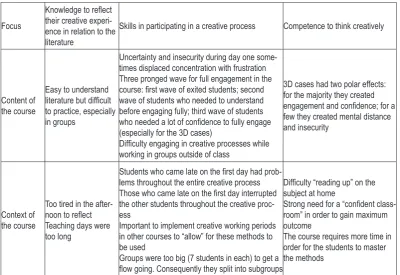
the results of the rrct test are shown in table 2.
Table 2. Key findings from participants’ reflection reports on creativity teach -ing.
Focus
Knowledge to reflect
their creative experi-ence in relation to the literature
Skills in participating in a creative process Competence to think creatively
Content of the course
Easy to understand
literature but difficult
to practice, especially in groups
Uncertainty and insecurity during day one some-times displaced concentration with frustration Three pronged wave for full engagement in the
course: first wave of exited students; second
wave of students who needed to understand
before engaging fully; third wave of students who needed a lot of confidence to fully engage
(especially for the 3D cases)
Difficulty engaging in creative processes while
working in groups outside of class
3D cases had two polar effects: for the majority they created
engagement and confidence; for a
few they created mental distance and insecurity
Context of the course
Too tired in the
after-noon to reflect
Teaching days were too long
Students who came late on the first day had prob -lems throughout the entire creative process
Those who came late on the first day interrupted
the other students throughout the creative proc-ess
Important to implement creative working periods in other courses to “allow” for these methods to be used
Groups were too big (7 students in each) to get a
flow going. Consequently they split into subgroups
Difficulty “reading up” on the
subject at home
Strong need for a “confident class -room” in order to gain maximum outcome
The course requires more time in
Volume 51, 2013 26
Learning outcome
Generally a good overview over important literature presented in the course (analysed from the examination of the students)
Positive experience in using “force” of thought (idea generation tools) and group behaviour (facilitation)
Personal challenge for students to be “offline”
from computers and mobile phones during most of the course but positive experience for most 3D cases were often immediately experienced as
interruptions when initiated but after finishing a 3D
case students experienced that it made continuing their work easier
3D cases helped to “do it” instead of “talking about it”
Most groups managed to use the six-phase proc-ess in group work (outside class) with succproc-ess Students experienced it was easier to make use of diversity in groups when working in the creative process
Found it easier developing new ideas, thought and concepts Still serious problems selecting the “right” idea in groups Some of the students used the tools and methods in other courses and group work Use of idea generation tools were easier to apply to other courses and activities – but also 3D cases were used outside classes in group work
Students experienced that it was easier to minimise discussion dur-ing idea development
the rrct is the qualitative part of this research. the results show that the students gained an understanding of important creativity literature. the experience in the creative proc-ess (workshop) had mixed results depending on the character of the students and groups. Work in smaller groups was experienced as more creative than in larger groups. students taking part in the entire workshop were early engaged in the process, while students less confident with the situation and students late for class had more difficulties and were later engaged in the process and other course activities. the facilitation and the use of 3d cases were positively experienced in relation to “doing” instead of “talking about doing”. a few students related the 3d cases to insecurity and stressed the importance of a confident classroom. Most students experienced that after the class they were better at developing new ideas, thoughts and concepts but had prob-lems selecting the right ideas. some students/groups reported using the six-phase process, the 3d cases and the idea generation tools in other classes.
Discussion
The quantitative enhancement is significant for all Torrance test measures even with the limited population of 28 participants. the effect size is large for 5 and moderate for 2 out of 8 measures. this points toward a strong quantitative effect compared to the amount of time spent (5 ects/2.5 american credits). also the qualitative enhancement seems evident. how-ever, some limitations in the study are important to note. first of all, the study has only 28 participants. it would be interesting to replicate this study or conduct a similar study with more participants or more groups of participants. secondly, the participants are all related to business and enrolled on a specialisation on hospitality management. scott, leritz and mumford (2004) found that creativity training in general seems to have effect on all kinds of population. howev-er, for this particular course it may not be the case. different kinds of students may be affected differently by such a course. The age group and gender mix may also have an influence. Using a population of younger/older students or majority of male may change the results of the study. Recognising these (and potentially more limitations in this study) the paper finds the results to be important for the ongoing debate on “what is effective creativity training in education and at work”. it is hoped that this paper can provide further insight necessary for developing a founda-tion for this debate both on a practical and a scientific level.
in the 21 century Volume 51, 2013 27
1.08. Why such a result? Maybe the difference is a reflection of the students’ language skills. even though they are students in the 3rd year of university they have only been taught english from the beginning of the 3rd year (7 months before the study). therefore their verbal english skills may be limiting the expression of creativity in the verbal test. In the figural test it is easier to express creativity with limited verbal english skills. this would mean that even though they may have enhanced their creative abilities both verbally and figurally in their native language, they may score low in particular on the english verbal test (both in the pre- and post-test). had the test been conducted in the students native language the results may have been different. Looking from another perspective it may be that this course in NT enhances the figural creative abilities in a high degree and enhances the verbal creative abilities to a low degree. however, it is unsure which elements of the course elements have such an effect. further research on this difference is needed for developing understanding.
the results from this study contribute to the notion that it seems to be possible to enhance students’ creativity as part of higher education. there may be several ways to enhance students’ creativity. the study shows that it is possible to teach them how to participate in a creative process. this will help them to follow the rules of the creative “game” when a formal or infor-mal creative process is planned. however, the effect of this kind of teaching may be limited to enhance creativity in situations that are explicitly set-up like a process (or a workshop). it may neither help students to be creative in everyday settings, nor may it help them create environ-ments positive for creativity. the study also shows that it is possible to teach the students’ theo-ries of creativity. this will help them understand what is needed in an environment (in a broad sense) to be conducive for creativity. however, the very essence of understanding creativity theory may neither make a student more creative, nor may it necessarily help them in following the rules of the creative “game”. finally this study shows that it is possible to train the students in creativity. this will help them to be creative in everyday life. however, being the only crea-tive around can be hard for any person and training may not provide an understanding of how to create better environmental conditions for enhancing the creativity among colleagues or friends. nor may it necessary make sure that the students will be able to follow the rules of the creative “game” in processes. another perspective on the enhancement of students’ creativity is to divide the efforts into two general methods: a reflective method and an embodied method. The reflective method focus on creating an understanding about the phenomenon of creativity. In this study the reflective method includes the theory and the reflective part of the workshop. the student will become better at understanding creativity and how to enhance it. the learning will primarily be theoretical, exemplified or a mix of the two. The embodied method focuses on developing creative thinking and behaviour. in this study the embodied method includes the training and the embodied part of the workshop. the student will become more creative. the learning will primarily be a practical experience. a creativity course can have more or less of the two methods. Which of these methods or mixes of the two that are most effective in enhanc-ing creativity for students seems to be unanswered so far. however, the answer may not be so easy. it may be that the one is better for instant enhancement and the other for long-term en-hancement. The RRCT showed that the theory was easy to understand but difficult to practice, which suggests that the reflective method may not easily become practical. On the other hand some of the students related the training to uncertainty and insecurity and stressed the need for a confident classroom atmosphere in which to engage in the creativity training. This suggests that the training may not be easy for all students. further studies are needed for developing a better understanding in this perspective.
Volume 51, 2013
28 tools. some students indicated that more time was needed to properly master especially the practical tools. another study of the creative platform has shown that it has a positive effect on the level of motivation, confidence, concentration and knowledge application of participants. in a 2009-2010 study on a network of product developers who used the creative platform as a process model for their meetings the participants were given a basic questionnaire handout every 3 hours during a 45 hour process that lasted over 3 months. the questionnaire asked four questions: “how motivated have you felt during the last 2-3 hours?”, “how concentrated have you felt during the last 2-3 hours?”, “How confident have you felt during the last 2-3 hours?”, and “how much have you felt you could apply your knowledge during the last 2-3 hours?”. the questions could be answered on a scale from 1 to 10, where 10 was the highest level and 1 was the lowest level. the participants were allowed 2-3 minutes to answer each questionnaire. The study showed a significant high level in all four areas (Byrge, 2011). Most interesting is the level of confidence 8.66 (SD=1.46), which suggest that The Creative Platform itself may provide an environment for making participants feel confident in their creative work. The lev -els of motivation, confidence, concentration and knowledge application are important aspects of an educational system both for learning and for creativity. therefore creativity and creative methods may have potential for enhancing not only creativity but also the students’ grades of their various subjects. further studies on creativity courses/activities are needed for a better understanding of how to enhance students’ creativity throughout the educational system and for higher education in particular.
in the 21 century Volume 51, 2013 29
Conclusions
this study has shown that:
The individual ability in fluency, flexibility, originality, elaboration and resistance •
to premature closure can be enhanced to a moderate or large extend by engaging in a 5 ects / 2.5 american credit creativity course in higher education. the course includes creativity training, theory and workshop.
the individual ability in the abstractness of titles might need other kinds or a larger •
amount of course content to be enhanced
an english taught creativity course for non-native students has a larger effect on the •
figural creative abilities and a lower effect on the verbal creative abilities when the students are measured on their creative abilities using an english test.
creativity theory helps students to understand creativity but it does not help them •
to practice creativity.
creativity training and workshop helps students to practice creativity in relation to •
the creativity course. evidence of transfer effects to other university courses was found.
Creativity training builds up a confident classroom but it also requires a confident •
classroom in the first place.
Latecomers in the first part of the creative process can create a disturbance for the •
other students for the entire period of the process.
Appendix
“items meet party” 1. please stand up.
2. find together two and two with a partner who has the same pair of trouser on as yourself.
3. take each an item from the item box (place a box with many different items such as a watch, a spoon, a tissue etc.).
4. now your two items meet and you should help each other to generate ideas on how principles from the one item can improve the other item and vice versa.
5. (demonstrate in front of the participants).
6. start by improving the heaviest item. i will tell you when to switch. 7. (tell them to switch item after about 1 minute).
8. (Instruct them to find a new partner after another minute and continue the exercise). 9. (stop the exercise after about 6 minutes).
“develop a future bicycle using principles” 1. please stand up.
2. find together two and two with a partner who the same kind of shoes on as yourself. 3. (hand out one principle-card per two-man group. the card should contain 4-6
inventive principles like “multicultural”, “segmentation”, “asymmetry” and “sensor” etc.).
4. you are now about to develop a future bicycle using inventive principles. use one principle at a time from your card in order to develop ideas for this bike.
5. (demonstrate in front of the participants).
6. you are supposed to help each other and to get as many different ideas for a future bike as possible.
Volume 51, 2013 30
“yes, we made a mistake” 1. please stand up.
2. find together two and two with a partner who was born in the same month as yourself.
3. stretch your arms above your head and say: yes, we made a mistake (make them do it 3-4 times).
4. Now select a category (e.g. things placed in a fridge-door) – take turns to fill out the category (milk, juice, yoghurt etc.). When one of you fails to continue filling out the category within 2 seconds you as a team have made a mistake. now you both celebrate by shouting: yes, we made a mistake. continue the exercise by making a new category (e.g. car brands).
5. (demonstrate in front of the participants)
6. the one with the longest hair starts by making a category. 7. (stop the exercise after about 6 minutes).
“What happens next” 1. please stand up.
2. find together two and two with a partner who has the same bed time as yourself. 3. imagine you are standing in the middle of a fantasy forest. you are about to make
a story of how you get out of the forest. on your way out you experience strange things.
4. the one of you starts by saying: look, here is a path. let’s follow it, and then asks the other what happens next? then the other person continues the story by adding a sentence and always finished by asking the other “what happens next”.
5. (demonstrate in front of the participants).
6. the tallest one of you starts the story by saying: look, here is a path… now. continue the story until i say stop.
7. (stop the exercise after about 6 minutes).
References
almeida, l. s., prieto, l. p., ferrando, m., oliveira, e., & ferrámdiz, c. (2008). torrance test of creative thinking: the question of its construct. Thinking Skills and Creativity,3, 53-58.
altshuller, G., shulyak, l., rodman, s. & fedoseev, u. (1997). 40 principles: TRIZ keys to innovation.
technical innovation center.
amabile, t. m. (1983). the social psychology of creativity: a componential conceptualization. Journal of
Personality and Psychology, 45, 357-376.
bull, K. s., montgomery, d., & baloche, l. (1995). teaching creativity at the college level: a synthesis of curricular components perceived as important by instructors. Creativity Research Journal, 8, 83-90.
burke, l. a., & Williams, J. m. (2008). developing young thinkers: an intervention aimed to enhance children’s thinking skills. Thinking Skills and Creativity, 3, 104-124.
byrge, c. (2011). Conceptualisation of creativity practices through action research: The case of the creative platform at Aalborg university. unpublished doctoral dissertation, aalborg university, denmark.
byrge, c., & hansen, s. (2008). tværfaglighed på den kreative platform. in stolt, J. & Vintergaard, c. (2008). Tværfaglighed og Entreprenørskab. copenhagen: idea copenhagen.
byrge, c., & hansen, s. (2009a). the creative platform: a new paradigm for teaching creativity. Prob -lems of Education in the 21st Century,18, 33-50.
in the 21 century Volume 51, 2013 31
byrge, c., & hansen, s. (ed) (2011). den kreative platform antologi: praksisanvendelse af den kreative platform i uddannelse, læring og undervisning. aalborg: udvind Vækst.
byrge, c., & lund, m. (2010). Kreativitet og nytænkning. aarhus: systime. de bono, e. (1970). Lateral Thinking: Creativity Step by Step, harper & row.
dewett, t., & Gruys, m. (2007). advancing the case for creativity through graduate business education.
Thinking Skills and Creativity, 2, 85-95.
elbæk, m., & sørensen, c. (2010). Creativity and The Creative Platform? unpublished master thesis, aalborg university, denmark.
Eubanks, D. L., Murphy, S. T., & Mumford, M. D. (2010). Intuition as an influence on creative problem-solving: the effects of intuition, positive affect, and training. Creativity Research Journal, 22 (2), 170-184.
Gordon, W. J. (1961). Synectics. new york: harper.
Guilford, J. p. (1967). The nature of human intelligence. new york: mcGraw-hill.
hansen, s., & byrge, c. (2007). Den Kreative Platform: Uhæmmet anvendelse af viden og erfaring – pædagogik for facilitering af kreative processer. aalborg: ideanord.
Hansen, S., & Byrge, C. (2009). Wofie: Fire dages workshop for 450 studerende i entreprenørskab. In bager, t. & nielsen, s. l. (2009). GEM antologi. copenhagen: borsen.
hansen, s., & byrge, c. (2010). Den kreative platform i skolen: Uhæmmet anvendelse af viden fra børnehaven til arbejdspladsen. odense: fonden for entreprenørskab.
hui, a., & lau, s. (2006). drama education: a touch of the creative mind and communicative-expressive ability of elementary school children in hong Kong. Thinking Skills and Creativity, 1, 34-40. Karakelle, S. (2009). Enhancing fluent and flexible thinking through the creative drama process. Thinking
Skills and Creativity, 4, 124-129.
Karwowski, m., & soszynski, m. (2008). how to develop creative imagination? assumptions aims and effectiveness of role play traning in creativity (rptc). Thinking Skills and Creativity, 3, 163-171.
lin, y. (2010). drama and possibility thinking – taiwanese pupils’ perspectives regarding creative peda-gogy in drama. Thinking Skills and Creativity, 5, 108-119.
markley, o. W. (1988). using depth intuition in creative problem solving and strategic innovation.
Jour-nal of Creative Behavior, 22, 85-100.
mccorkle, d., payan, J., reardon, J., & Kling, n. (2007). perceptions and reality: creativity in the mar-keting classroom. Journal of Marketing Education, 29, 254-261.
nickerson, r. s. (1999). enhancing creativity. in sternberg, r. J. (ed.) (1999). Handbook of creativity. cambridge: cambridge university press.
osmundsen, r., byrge, c. & hansen, s. (2009). Den Kreative Platform: vidensanvendelse, nærvær og
energi. aalborg: cepra.
resnick, m. (2007). Sowing the seeds for a more creative society: Learning and Leading with Technol -ogy. international society for technology in education, december.
robbins, t. l., & Kegley, K. (2010). playing with thinker toys to build creative abilities through online instruction. Thinking Skills and Creativity, 5, 40-48.
rockenstein, Z. (1988). intuitive processes in executive decision making. Journal of Creative Behavior, 22, 77-84.
runco, m. (2004). creativity. Annual Review of Psychology, 55, 657-687.
sak, u., & oz, o. (2010). the effectiveness of the creative reversal act (creact) on students’ creative thinking. Thinking Skills and Creativity, 5, 33-39.
sawyer, r. K. (2006). education for innovation. Thinking Skills and Creativity, 1, 41-48.
scott, G., leritz, l. e., & mumford, m. (2004). the effectiveness of creative training a quantitative re-view. Creativity Research Journal, 16, 361-388.
smith, G. f. (1998). idea generation techniques: a formulary of active ingredients. Journal of Creative Behavior, 32, 107-134.
sternberg, r. J. (2003). Wisdom, intelligence and creativity synthesized. cambridge: cambridge press. torrance, e. p. (1969). Creativity: What research says to the teacher. Washington, dc: national
educa-tion associaeduca-tion.
torrance, e. p. (1972). can we teach children to think creatively? Journal of Creative Behavior, 6, 114-143.
Volume 51, 2013
32 Vance, e. (2007). colleges should teach broader skills to prepare students to work force, report says. The
Chronicle of Higher Education, retrieved 05 february 2013, from http://chronicle.com/article/ colleges-should-teach-broad/122735/
Wallach, m., & Kogan, n. (1965). Modes of thinking in young children. new york: holt, rinehart and Winston.
Wince-smith, d. l. (2006). the creativity imperative: a national perspective. Peer Review, 8, 12-14. Wonder, J., & blake, J. (1992). creativity east and west: intuition vs. logic? Journal of Creative Behavior,
26, 172-185.
Advised by Frederik Hertel, Aalborg University, Aalborg, Denmark
received: January 14, 2013 accepted: February 16, 2013
Christian Byrge Ph.D., Assistant Professor, Department of Business and Management, Aalborg
University, Denmark.
E-mail: [email protected] Website: http://www.christianbyrge.com
Søren Hansen Ph.D., Associate Professor, Department of Business and Management, Aalborg
University, Denmark. E-mail: [email protected]