Advised by Judita Stankutė, SMC “Scientia Educologica”, Lithuania
received: February 07, 2014 accepted: March 22, 2014
Lenita Hietanen PhD, University Lecturer, University of Lapland, PO Box 122, 96101 Rovaniemi, Finland.
E-mail: [email protected]
Satu Uusiautti PhD, Researcher, Adjunct Professor, University of Lapland, PO Box 122, 96101 Rovaniemi, Finland.
E-mail: [email protected]
Kaarina Määttä PhD, Professor, Vice-Rector, University of Lapland, PO Box 122, 96101 Rovaniemi, Finland.
E-mail: [email protected]
TableTS aS learNINg SupporT IN
SpecIal SchoolS
Peter Karlsudd
linnaeus university, Kalmar, Sweden e-mail: [email protected]
Abstract
Within special education research, ICT has occupied a relatively small space, especially when it comes to implementation and pupils’ learning effects. Few studies emphasize how ICT can promote a learning environment for pupils with cognitive disadvantages. The studies conducted in Sweden are about children and young people with physical rather than cognitive disabilities. Against this background and with the view to find new ways of learning for special school pupils the present research started. The overall aim was to increase pupil participation and promote learning in special schools by means of tablets.
The research project involved researchers, teachers and student assistants in research circles, a method that can in many respects be compared with action research. Three special schools, two middle schools and one high school participated in the research project in which teachers and pupils were given Tablets. The data were using four different methods: Interview, Observation, Questionnaire and Essays.
The data were tested against Professor Englund’s theory of Educational Philosophies. The theory has been a valuable tool for measuring and discussing how the discourse of change has occurred. The results show improved skills and a clear declaration of intent of staff to work in a reconstructive direction. Key words: tablets, special schools, education, learning.
Introduction
the swedish school for pupils with cognitive disabilities is a special school form with special needs educational activities directed towards such children. among its activities here is a fairly long tradition of using information and communication technology (ict). in the late 80s and early 90s, this school form was at the forefront with regard to technology use. in recent years the development and use of ict in this school form has been arrested. a few schools are still at the forefront while the updating of competence and investment in new equipment has
decreased. This has probably several explanations, not least financial priorities and teachers’
lack of continuous professional development (lindstrand & brodin, 2006). another possible reason may be that the application of ict has a low status in the traditional view of knowledge and skills in school, even though it is viewed in recent policy documents as a key competence (eu, 2006). special-school activities have been described in a number of studies and evalua-tions as welfare-oriented, intermediary and traditionally academic (perennialistic) (Karlsudd, 2007; mineur, 2013; rosenqvist, 2009).
Within special school research, ict has occupied a fairly small space. there are few studies of, for instance, how digital tools can promote learning, and those conducted in sweden preferably deal with children and young people with physical disabilities (lindstrand & bro-din, 2006; brobro-din, 2010; brodin & lindstrand, 2008). While ict use is relatively sparse in this school form, many of its pupils uses computers and the internet as a natural ingredient in their
homes. It is easy to establish that the majority of these pupils needs support and help to find, for
example, suitable computer games, learning programs and to create positive networks on the
web. It is well known that children with learning difficulties are greatly helped by methods and
tools, which activate several faculties and abilities. examples of such methods include the use
50 has opened up new possibilities in this direction, it is very important to implement methods that
utilize modern information technology in teaching. “the rapid development and ubiquity of ict, and its importance, especially in the life of young people, are re-setting the boundaries of educational possibilities and augmenting the role of non- formal learning“ (dumont, & istance, 2010, s, 21). We have moved from technology-oriented teaching/learning towards student ori-ented learning with technology.
to face the contemporary information and knowledge society it is important that teachers are given time to develop their technological familiarity and educational knowledge (Glover, et.
al. 2007). The outcome depends very much on teachers’ attitudes.
against this background it feels urgent to carry out a research project testing methods for
using tablets with the aim of finding new ways for pupils’ learning in special schools. It is also important to find methods and theories for evaluating and analyzing initiatives in this direction.
this article describes a research project in which researchers and special school staff work
to-gether through the ‘research circles’ methodology to implement practices that promote learning
in a progressive and reconstructionist direction. another goal was to develop and test a model to analyze and discuss the work of teachers with ict as a learning resource.
Theory
to introduce new technology into teaching is neither simple nor self-evident. it is often a complicated and time-consuming process (Karlsudd, 2008). there may exist a series of ob-stacles, which cause people to oppose changes. these obstacles can be divided into practical, psychological, power and value barriers (Karlsudd, 2012). for an overarching change to take place these barriers have to be forced. practical obstacles may comprise economy, accessibility, educational possibilities, etc. a psychological barrier may be that teachers feel threatened in their professional role, fearing that pupils may know more than they. Value barriers may imply that values accompanying the technology do not agree with those of the teacher. When a
power-ful barrier occurs, a teacher’s entire situation may feel threatened.
analyses of ict initiatives in the swedish school have been summed up by Jedeskog
(2005) in four arguments. The first are democratic arguments, implying that everyone has a
right of access to digital technology. the second argument emanates from what knowledge will
be required in a future society. The third argument is to improve pupils’ learning, and the fourth
argument is about ict as a power for transforming school teaching. in the present research project the second, third and fourth arguments form the guiding principle. the last two
argu-ments remind us of the last two steps in Puentedura’s (2006) reflection on ICT implementation,
which involves replacing, effectivating, modifying and, what was the chief target of the project,
redefining. This division has often formed the background to analyses of teachers’ use of mod
-ern technology, but is not directly funded in any theoretical model. Using this deficiency as a
starting point, a different quadripartite system for discussing the outcome was tested, namely a division into educational directions or conceptions.
in several countries the educational debate throughout the 20th century has been domi-nated by four different educational philosophies: perennialism, essentialism, progressivism and reconstructionism (englund, 1995).
perennialism entails an education to preserve society, with learning as a core activity.
This direction focuses on mankind’s eternally recurrent questions: What is true and false, right
and wrong, good and evil, beautiful and ugly? there are permanent truths and values, and highlighting them is the responsibility of education. the perennial educational ideal is classical humanism, emanating from the idea that nature and mankind remain the same over time. the teacher should be a model of classical education and common sense (stensmo, 1994).
51
foundation in the essential, on the academically inherited and on proven knowledge. learn-ing should focus on distant goals disregardlearn-ing close and immediate interests. the introductory courses should concentrate on basic skills. Within this direction the emphasis is on teacher authority and subject knowledge. the teacher mediates and the pupils learn through hard work (ibid.)
progressivism places the pupil at the core but is also subordinate to social development.
The starting point of this direction is that the education is rooted in pupils’ interests, current and
future needs. it should be individual and socially progressive, focusing on problem solution. pupils are viewed as thinking, feeling and acting human beings, involving all aspects of their personality. the education is characterized by activity pedagogy and by working with projects chosen by the pupils themselves. a searching approach provides direct experiences in contrast to descriptions mediated by the teacher or handbooks. the education constitutes life itself, not
a preparation for life. The teacher’s role is to stimulate and supervise pupils’ target-oriented
activities (ibid.).
reconstructionism regards conversation/communication as its central activity. the basis of the direction is that education should be future-oriented and visionary. the preference is to construct the good society. activity pedagogy and interdisciplinary project work and thematic
studies should set its stamp on the work. This education aims at changing people’s awareness
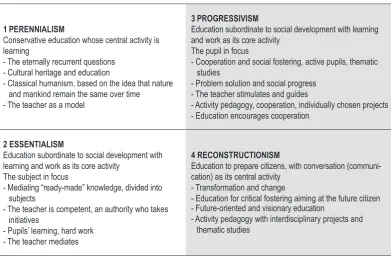
and in the event society with the support of reformulated goals. hence, education is an impor-tant aspect of social planning. it can be looked upon as social self-realization, with pupils being prepared for the task of building a new society. the syllabuses must integrate the subjects into larger units to encourage an interdisciplinary approach (ibid.). table 1 below presents a model summarizing the different directions included in the above survey.
Table 1. Map of educational philosophy (largely based on Englund, 1995).
1 PERENNIALISM
Conservative education whose central activity is learning
- The eternally recurrent questions - Cultural heritage and education
- Classical humanism, based on the idea that nature and mankind remain the same over time - The teacher as a model
3 PROGRESSIVISM
Education subordinate to social development with learning and work as its core activity
The pupil in focus
- Cooperation and social fostering, active pupils, thematic studies
- Problem solution and social progress - The teacher stimulates and guides
- Activity pedagogy, cooperation, individually chosen projects - Education encourages cooperation
2ESSENTIALISM
Education subordinate to social development with learning and work as its core activity
The subject in focus
- Mediating “ready-made” knowledge, divided into subjects
- The teacher is competent, an authority who takes initiatives
- Pupils’ learning, hard work - The teacher mediates
4 RECONSTRUCTIONISM
Education to prepare citizens, with conversation (communi-cation) as its central activity
- Transformation and change
- Education for critical fostering aiming at the future citizen - Future-oriented and visionary education
52 Problem of Research
the main aim of the research project was to develop and implement methods promoting learning, especially for children in need of special support. With the support of both teacher-guided and student active tasks the learning support of tablets was led in a progressive and reconstructionist direction. a further goal was to develop and test a model for analyzing and
discussing teachers’ work with ICT as a learning resource with children from special schools.
Methodology of Research
General Background of Research
in the project researchers, special needs teachers, student assistants and ict teachers got together in research circles. a research circle can be simply described as a study circle that includes one or more researchers. the research circle always starts from some common problem that is to be elucidated to further knowledge about it. it is a meeting-place - a forum – where organized search for knowledge and knowledge development takes place by cooperation between all participants. the circle starts with a joint problem that is illustrated from as many points of view as possible so as to further knowledge about it. the joint problem and the mutual knowledge growth are in focus. Working with contributions from everybody involved with their different experiences and knowledge entails that something new is created, a knowledge base which can neither grow solely out of practice, nor out of research (holmstrand & härn-sten, 2003). the method is in many respects comparable to action research. the most common type of action research is when teachers work together with researchers (cohen & manion, 1994) usually for the purpose of increasing critical thinking and creating new issues (feldman & minstrell, 2000; archer, holly & Kasten, 2001). research circles may be an example of how participants can play an even more equal role within action research.
the research project brought together the school staff every month. plenty of time was allocated for reporting and exchanging experiences. the discussions were carried out with an alternating presidency, and the entire meeting was recorded on tape. discussions were con-ducted in an open and democratic spirit.
Sample Selection
in the research project 10 teachers participated from three special schools with a total of 22 middle and high school pupils with various degrees of cognitive disability. in order to
categorize teacher attitudes to ICT a tripartite division was applied. The first group, the “mis -sioners”, are convinced of the excellence of the technology. the second group, the “tentatives”, are willing to change, but the last group, the “luddites” more or less refuse to accept the new technology (Glover & millers, 2001; cuthell, 2007). half of the teachers in the group may be
defined as missioners and the other half as tentatives, and they had all declared their interest in taking part. Teachers and pupils were equipped with tablets, and in the first step the teachers
were able to acquaint themselves with the technology to be able to introduce it to the students after a month or so. the tablet device was used as a teaching tool for the teacher, but also as a
learning tool for the student. A great deal of freedom was left to the pupils’ participation and exploration. There was a significant transfer of pupils’ skills to teachers and peers, and therefore
pupils can both be seen as a study object and as an active part in skills development efforts.
Data was gathered from four different sources, which well fulfils the requirements for method
triangulation (bryman, 2011). in the focus of the triangulation method was data that studied the
presence of the learning orientations described by Englund (1995). The first data gathering was
multiple-53
choice and two open questions. the multiple-choice questions were formulated as statements where the respondents were to estimate on a 5-grade scale whether they entirely agreed or did not agree with the statement. the questions were constructed so that they represented the pos-sibilities of the tablet to support the educational direction in question. examples of questions about the different directions are presented in table 2 below. in each area, nine questions repre-senting each direction of learning were constructed. one example is the question: “the tablet is suitable for exercises and revision” this question should represent the perennialism direction. for responses belonging to each area, the mean value was calculated and presented in table 4.
Table 2. Examples of questions in the study questionnaire.
1. PERENNIALISM
- The tablet is suitable for exercises and revision 1 2 3 4 5
- Books are superior to the tablet as educational material - The tablet is a good tool for conveying facts
- The tablet is suitable for conveying classical values
3. PROGRESSIVISM
- The tablet is suitable for problem solving 1 2 3 4 5 - The tablet is suitable for communication between pupils - The tablet can help the teacher to capture pupils’
inter-est
- The table supports thematic work
2.ESSENTIALISM
- It is important that it is the teacher that introduces new programs and apps 1 2 3 4 5
- The tablet invites pupils to work individually - The tablet invites to hard work
- The tablet is valuable for introducing subject knowledge
4. RECONSTRUCTIONISM
- The tablet is important for other areas that are not directly linked to scholastic attainments 1 2 3 4 5
- The tablet is primarily a tool for finding new knowledge
- The tablet increases pupils’ chances of acquiring a critical approach
- The tablet can help pupils to plan their future
the two open questions were formulated: What factors can facilitate developing/work-ing with the tablet? What factors may prevent developdeveloping/work-ing/workdeveloping/work-ing with the tablet? the third method of gathering material consisted of individual interviews, which took between 30 min-utes and one hour. finally, as a fourth gathering method, the three work teams were given the task of writing an ideal story under the heading “a good day with the tablet”, which was to il-lustrate a desirable use of the tablet.
Data Processing and Analysis
the data material from the different gathering methods was categorized into the four
ed-ucational directions. From the project meetings and from interviews the participants’ statements
and descriptions of work in progress were sorted as well as their attitudes to the possibilities of the tablet. in the questionnaire the mean was calculated of the values the various directions
re-ceived in the staff’s individual assessment. The text of the final story was categorized the same way. It is inevitable that some statements were hard to place in a specific category, but most of the material was separated and placed in one specific category. The statements that were impos -sible to categorize amounted to between 11 % and 18 %, depending on the type of gathering method. two of the staff were missing from interviews and answers to the questionnaire, but it were not the same persons on both occasions. the three “wishful stories” submitted by the
staff contained 53 statements and 94 were identified in the interviews and were subsequently
categorized.
in the project meetings conducted the missioner group took more of the speaking time,
which may skew the picture of participant attitude. The project management’s expectations
54 were answered anonymously, and the documentation and the individual interviews conducted,
the agreement among the staff was good.
Results of Research
The results are divided into two phases, 0-2 months and 3-18 months. The first phase
should be regarded as a start and an orientation for realizing the research project. the second
phase should be regarded as an actions phase with a continuous and efficient transfer of knowl -edge between participants.
months 0-2
documentation of research circle discussions:
During the first two meetings the participants described their work and their attitude to
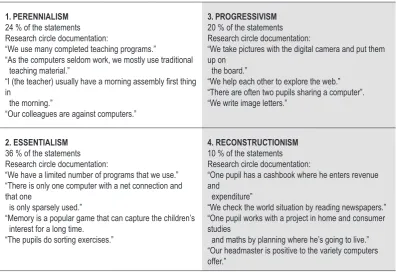
digital learning material. in the main, stationary computers were used with traditional learning programs that may be placed in categories perennialism and essentialism (see table 3 below). the communicative possibilities of the internet are rarely used. picture documentation with
computer support and individually produced sound and films were also sparsely represented.
Quite a few teachers expressed a need for continuing professional development and better ict support. despite the rather limited opportunities, using computers was popular among the pu-pils. a minority of the teachers explored the technology in a more multifaceted way. When the tablets were introduced, a majority of the participants required plenty of time to learn the tech-nology and how to operate it. then began the process of testing the “apps” that the colleagues with a greater experience of ict recommended. some teachers took help from family members
and in some cases from students. The first few months may be considered as basic training in
the area. initially traditional pedagogy was used with the teacher having control of the tablet. the table below presents the distribution on the basis of the four educational conceptions and
exemplifies the statements identified from the first two project meetings.
Table 3. Distribution and examples of statements from participating schools at
the first two meetings.
1. PERENNIALISM
24 % of the statements Research circle documentation:
“We use many completed teaching programs.”
“As the computers seldom work, we mostly use traditional teaching material.”
“I (the teacher) usually have a morning assembly first thing
in
the morning.”
“Our colleagues are against computers.”
3. PROGRESSIVISM
20 % of the statements Research circle documentation:
“We take pictures with the digital camera and put them up on
the board.”
“We help each other to explore the web.” “There are often two pupils sharing a computer”. “We write image letters.”
2.ESSENTIALISM
36 % of the statements Research circle documentation:
“We have a limited number of programs that we use.” “There is only one computer with a net connection and that one
is only sparsely used.”
“Memory is a popular game that can capture the children’s interest for a long time.
“The pupils do sorting exercises.”
4. RECONSTRUCTIONISM
10 % of the statements Research circle documentation:
“One pupil has a cashbook where he enters revenue and
expenditure”
“We check the world situation by reading newspapers.” “One pupil works with a project in home and consumer studies
55
months 3-18
Questionnaire, interviews and wishful descriptions:
Table 4. Distribution and examples of statements from participating schools at the end of the research project.
1. PERENNIALISM
Questionnaire: Mean: 2.8 Interview: 18 %
“I think computers may take over too much in society.”
“We must offer alternatives to all the new things, like telephones and such.”
“It’s important that everyone learns to use paper and pencil.”
“It hasn’t changed the basic idea of a tool; we’re going on as usual.”
Wishful description: 2 %
“Milla presents her homework by showing her work about how Christianity came to Sweden.”
3. PROGRESSIVISM
Questionnaire: Mean: 4.5 Interview: 39 %
“In Music the pupils record tunes they have written themselves.” “One pupil takes pictures of birds in the trees and shows to the class. What species is this? What does it eat? What does it sound like?”
“The pupils work by individual schedules that are found on their tablets.”
“The social bit has grown. Better contacts with the home lead to a better understanding of the pupil.”
Wishful description: 35 %
“One pupil video films the three chords on the guitar that he is sup
-posed to practise further until the next week.”
“One pupil sees a blue flower during the walk, he checks in the My Flora app and looks at flowers sorted by colour.”
“In our film project the pupils work intensively with the iMovie app and easily create films on various themes.”
“The pupils take pretty pictures for covers and record labels.”
2.ESSENTIALISM
Questionnaire: Mean: 3.5 Interview: 20 %
“There are good apps for training memory.” “It’s easy to give the pupil a task with the tablet, simple
constructive tasks.”
“It will be easier to individualize for a pupil.” “We use the tablet for Swedish grammar, where there are good self-marking programs.” Wishful description: 24 %
“Kalle trains writing letters and numbers in the Letter School app.”
“Evert mails his weekly task to the teacher for marking.”
“One of the staff plans tomorrow’s excursion by creating a picture orienteering in the immediate surroundings.”
“One pupil writes vocabulary on Google Docs which the teacher then marks.”
4. RECONSTRUCTIONISM
Questionnaire: Mean: 3.9 Interview: 23 %
“One pupil mails a company and asks if he can do a week’s work experience there.”
“Skype is used for contacts with the home and family during breaks.”
“Networking with other teachers.”
“It is as if school and leisure are integrated in the tablet. School becomes more fun.”
Wishful description: 39 %
“They have to furnish their own flat and there’s a lot to find out
about insurances, tenancy agreements and various subscriptions.” “Lisa reads the news on the web; the iPad reads out the text when she marks what she wants to hear. Lisa then tells us about two of the news items she listened to and she and the staff discuss
difficult words.”
“Siri is shopping for tomorrow’s home economics class. She has recorded the purchase list so that she knows what to buy. She scans the bar codes so that the ‘shopping’ app works out what it will cost.”
56 in the open questions dealing with chances and obstacles the following emerged: ● there are fewer technical faults with the tablet in comparison with a stationary
computer.
● The tablet has many functions, it´s mobile, which offers a number of pedagogical
possibilities.
● The tablet stimulates to alternative ways of communication via sound and picture and
the web.
● Facilitating contacts with parents and homes.
● Offering cheaper and more alternative learning resources. ● A computer may stigmatize the pupil. The tablet provides status.
● Ethics are difficult. It is important to cope with integrity and confidentiality. ● Work is becoming less monotonous.
● It may be stressful to find new teaching material when the benefit is so great.
● Parents make suggestions about teaching material, which was unusual before the
tablet got into the classroom.
Discussion
in the analysis of the gathered data, a clear development was noticeable over the 18 months the research lasted. among students and adults digital activities had increased
mark-edly. The teachers who had developed the most were those defined in the project as missioners
(cuthell, 2007), but also the less experienced developed knowledge and methods in a progres-sive and reconstructionist direction. in the requests for future development, a clear preference emerges for working in a more pupil-active and outgoing teaching. the respondents describe an increased proportion of activities in progressive and reconstructionist direction (englund, 1995) and indicate that they are interested in going on working towards that approach. despite their willingness they run the risk of being stopped by the lack of time, educational and ict re-sources, which proved to be a common problem in previous studies (Karlsudd, 2008, 2012). the methods used (holmstrand & härnsten, 2003) to effectuate the change have functioned well. the teachers who feel most at home with digital technology have acted as creative prompters. the directions within the philosophy of education philosophy which were used for interpreting work/learning have been valuable tools for discussing the changes that have taken place. the variation in pupil development level has somewhat affected the chances of performing activi-ties in a progressive and reconstructionist direction. even more imagination and inventiveness
are required to find activities that agree with these philosophical directions as regards pupils with major cognitive difficulties (Karlsudd, 2007).
one disadvantage is that the space for talking has not always been evenly distributed at
the project meetings with the consequence that some people’s answers may represent attitudes
and intentions of the whole team. this means, of course, that in one sense the answer is not representative, but when objections sometimes were made from others in the team, the answers are considered highly representative. this is further validated by the result of the questionnaire and also to some extent by the visits on the spot that were conducted but neither systematized nor included in the data.
Conclusions
research circles with collegial exchange and specially invited pedagogues with experi-ence of successful ict-supported teaching have in this research project proved successful in
driving development in a more progressive and reconstructionist direction. Englund’s division
ict-57
based activities, it would be appropriate to use classroom observations in a future survey. one possibility is to perform these by a peer workplace exchange. involving pupils and parents in research circles should be tried in a future research project as well as developing and identifying
ways to increase the participation of the students who have significant learning disabilities.
References
archer, J. m., holly, m. l., & Kasten, W. c. (2001). Action research for teachers. merill/prentice hall, upper saddle river, n.J.
brodin, J. (2010). can ict give children with disabilities equal opportunities in school? Improving Schools, 13 (1), 99-112.
brodin, J., & lindstrand, p. (2008). ict and inclusive education in primary schools: pupils with motor disabilities. Journal of Assistive Technologies, 2 (3).
bryman, a. (2011). Samhällsvetenskapliga metoder. [social methods]. (2., [rev.] edn.) malmö: liber. cohen, l., & manion, l. (1994). Research methods in education. 4th edn. london: routledge.
cuthell, J. p. (2007). ambassadors for actiV learning. in carlsen, r., mcferrin, K., price, J. Weber, r., Willis, d. a. (eds.), Proceedings of SITE 2007 (pp. 1443 – 1499) norfolk, Va: association for the advancement of computing in education.
derek, G., & miller, d. (2001). Missioners, tentatives and luddites: leadership challenges for school and classroom posed by the introduction of interactive whiteboards into schools in the United King -dom. conference paper. paper for bemas conference, newport pagnell.
derek, G., miller, d., averis, d., & door, V. (2007). the evolution of an effective pedagogy for teachers using the interactive whiteboard in mathematics and modern languages: an empirical analysis from the secondary sector. Learning, Media and Technology, 32 (1),5 - 20.
dumont, h., & david istance, d. (2010). analysing and designing learning environments for the 21st century. in dumont, h., david istance, d., & benavides, f. The Nature of Learning, Using Re -search to Inspire Practice, centre for educational re-search and innovation: oecd.
englund, t. (1995). på väg mot undervisning som det ordnade samtalet? [towards teaching against the parent call?] in berg, G; englund, t. & lindblad, s, (eds.) Kunskap organisation, demokrati. (49-71) lund: studentlitteratur.
Europaparlamentets och rådets rekommendation 2006/962/EG av den 18 december 2006 om nyckel -kompetenser för livslångt lärande. [european parliament and council recommendation on key competences for lifelong learning] Europeiska unionens officiella tidning L 394 den 30.12.2006. feldman, a., & minstrell, J. (2000). action research as a research methodology for the study of the teach-ing and learnteach-ing of science. in a. e. Kelly & r. a. lesh (eds), Research Design in Mathematics and Science Education, pp. 78–96. london: lawrence erlbaum associates.
holmstrand, l., & härnsten, G. (2003). Förutsättningar för forskningscirklar i skolan. En kritisk gran-En kritisk gran -skning. [conditions for research circles in school. a critical review.] forskning i fokus, nr.10. stockholm: myndigheten för skolutveckling.
Jedeskog, G. (2005). Ch@nging school: implementation of ICT in Swedish school, campaigns and expe -riences 1984-2004. uppsala: pedagogiska institutionen, uppsala universitet.
Karlsudd, p. (2007). the “narrow” and the “Wide” activity: the circumstances of integration. The Inter -national Journal of Disability, Community & Rehabilitation, 6 (1).
Karlsudd, p. (2008). collaboration around children with functional disabilities. Telemedicine and e-Health, 14 (7), 687-694.
Karlsudd, p. (2012). family interaction and consensus with it support. International Journal of Telemedi -cine and Applications, id 269637. http://dx.doi.org/10.1155/2012/269637.
lindstrand, p., & brodin, J. (2006). IKT som en integrerande länk för barn och ungdomar med rörelse -hinder. [ict as an integral link for children and youth with disabilities.] iol, lärarhögskolan i stockholm.
mineur, t. (2013). Skolformens komplexitet- elevers erfarenheter av skolvardag och tillhörighet i gymna -siesärskolan. [School configuration complexity, students’ experiences of everyday life at school and affiliation in upper secondary education.] Örebro: Örebro universitet.
58 rosenqvist, J. (2007). Specialpedagogik i mångfaldens Sverige. Delstudie II: Särskoleelever med ut -ländsk bakgrund i storstäder. [special education in multicultural sweden. study ii: learning dis-[special education in multicultural sweden. study ii: learning dis-abilities with a foreign background in big cities.] specialpedagogiska rapporter och notiser, nr 4. högskolan Kristianstad.
stensmo, c. (1994). Pedagogisk filosofi. [educational philosophy.] lund: studentlitteratur.
Advised by Boris Abersek,University of Maribor, Slovenia
received: January 27, 2014 accepted: March 31, 2014
Peter Karlsudd PhD., Professor, School of Education, Psychology and Sport Science, Linnaeus University, SE-391 82 Kalmar, Sweden.