Copyrights © International Journal of Intellectual Advancements and Research in Engineering Computations, www.ijiarec.com
Volume-6 Issue-2
International Journal of Intellectual Advancements
and Research in Engineering Computations
Efficient Steganography in Encoded Video Streams Using
Motion Vector Difference
M.Shankar
1, M.Usha
2, M.Ranjitha
21
Assistant Professor, Department of Information Technology,
2
final year, Department of Information Technology,
M.P.Nachimuthu M.Jaganathan Engineering College
Email: [email protected]
ABSTRACT : Generally, digital video sometimes are stored and
processed in an encrypted format to maintain privacy and
security. For the purpose of content notation, it is necessary to
perform data hiding in these encrypted videos. In this way, data
hiding in encrypted domain without decryption preserves the
confidentiality of the content. In addition, it is more efficient
without decryption followed by data hiding and re-encryption.
This project proposes a novel scheme of data hiding directly in
the encrypted version of AVI video stream, which includes the
following three parts, i.e.,AVI video encryption, data
embedding, and data extraction. By analyzing the property of
AVI codec and the codeword substitution of motion vector
differences are encrypted with stream ciphers. Then, a data
hider may embed additional data in the encrypted domain by
using codeword substitution technique, without knowing the
original video content. In order to adapt to different
application scenarios, data extraction can be done either in the
encrypted domain or in the decrypted domain. Furthermore,
video file size is strictly preserved even after encryption and
data embedding.
Index Terms: Data hiding, encrypted domain,
H.264/AVC, codeword substituting.
I. INTRODUCTION
CLOUD computing has become an important
technology trend, which can provide highly efficient
computation and large-scale storage solution for video data.
Given that cloud services may attract more attacks and are
vulnerable to untrustworthy system administrators, it is
desired that the video content is accessible in encrypted form.
The capability of performing data hiding directly in
encrypted H.264/AVC video streams would avoid the leakage of video content, which can help address the security
and privacy concerns with cloud computing. For example, a
cloud server can embed the additional information (e.g.,
video notation, or authentication data) into an encrypted
version of an H.264/AVC video by using data hiding
technique. With the hidden information, the server can
manage the video or verify its integrity without knowing the original content, and thus the security and privacy can be
protected. In addition to cloud computing, this technology
can also be applied to other prominent application scenarios.
For example, when medical videos or surveillance videos
have been encrypted for protecting the privacy of the people,
a database manager may embed the personal information into
the corresponding encrypted videos to provide the data
management capabilities in the encrypted domain.
II. .PROPOSEDSCHEME
In this section, a novel scheme of data hiding in the
encrypted version of H.264/AVC videos is presented, which
includes three parts, i.e., H.264/AVC video encryption, data
embedding and data extraction. The content owner encrypts
the original H.264/AVC video stream using standard stream
ciphers with encryption keys to produce an encrypted video stream. Then, the data-hider (e.g., a cloud server) can embed
the additional data into the encrypted video stream by using
codeword substituting method, without knowing the original
video content. At the receiver end, the hidden data extraction
can be accomplished either in encrypted or in decrypted
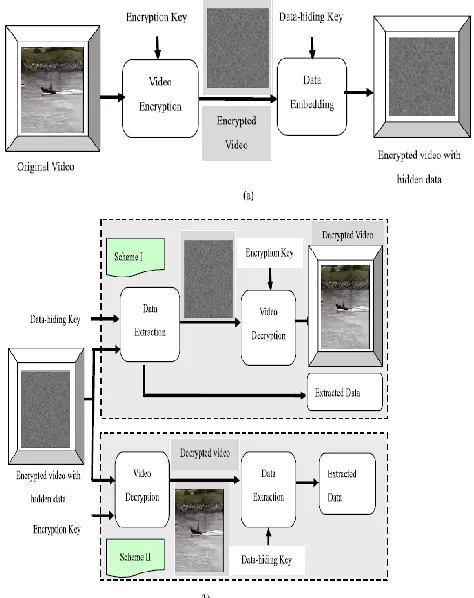
version. The diagram of the proposed framework is shown in
Fig. 1, where the encryption and data embedding are depicted in part (a), and the data extraction and video decryption are
shown in part (b).
A.Encryption of H.264/AVC Video Stream Video encryption
often requires that the scheme be time efficient to meet the
requirement of real time and format compliance. It is not
practical to encrypt the whole compressed video bit stream
like what the traditional ciphers do because of the following
two constraints, i.e., format compliance and computational
cost. Alternatively, only a fraction of video data is encrypted to improve the efficiency while still achieving adequate
security. The key issue is then how to select the sensitive
data to encrypt. According to the analysis given in [13], it is
reasonable to encrypt both spatial information (IPM and
residual data) and motion information (MVD) during
H.264/AVC encoding.
In this paper, an H.264/AVC video encryption scheme with
good performance including security, efficiency, and format compliance is proposed. By analyzing the property of
H.264/AVC codec, three sensitive parts (i.e., IPMs, MVDs,
and residual coefficients) are encrypted with stream ciphers.
The proposed encryption algorithm is performed not during
H.264/AVC encoding but in the H.264/AVC compressed
domain. In this case, the bit stream will be modified directly.
Selective encryption in the H.264/AVC compressed domain
has been already presented on context-adaptive variable length coding (CAVLC) and context-adaptive binary
arithmetic coding (CABAC) .In this paper, we have
improved and enhanced the previous proposed approach by
encrypting more syntax elements. We encrypt the codewords
of IPMs, the codewords of MVDs, and the codewords of
residual coefficients. The encrypted bitstream is still
H.264/AVC compliant and can be decoded by any
standard-compliant H.264/AVC decoder, but the encrypted video data is treated completely different compared to plaintext video
data. In fact, performing the format-compliant encryption
directly on the compressed bitstream is extremely
complicated as the internal states of the encoder have to be
preserved, otherwise the remaining data is interpreted falsely
which may easily lead to format violations.
Fig. 1. Diagram of proposed scheme. (a) Video encryption
and data embedding at the sender end. (b) Data extraction
Copyrights © International Journal of Intellectual Advancements and Research in Engineering Computations,
1)Intra-Prediction Mode (IPM) Encryption: According to
AVI standard, the following four types of intra coding are supported, which are denoted as Intra_4 × 4, Intra_16× 16,
Intra_chroma, and I_PCM. Here, IPMs in the Intra_4 × 4 and
Intra_16 × 16 blocks are chosen to encrypt. Four intra
prediction modes (IPMs) are available in the Intra_16 × 16.
The IPM for Intra_16 × 16 block is specified in the mb_type
(macroblock type) field which also specifies other parameters
about this block such as coded block pattern (CBP).
2) Motion Vector Difference (MVD) Encryption: In order to protect both texture information and motion information, not
only the IPMs but also the motion vectors should be
encrypted. In AVI , motion vector prediction is further
performed on the motion vectors, which yields MVD. In AVI
baseline profile, Exp-Golomb entropy coding is used to
encode MVD. The codeword of Exp-Golomb is constructed
as[M zeros] [I N FO ], where I N FO is an M-bit field
carrying information.
3) Residual Data Encryption: In order to keep high security, another type of sensitive data, i.e., the residual data in both
I-frames and P-I-frames should be encrypted. In AVI baseline
profile, CAVLC entropy coding is used to encode the
quantized coefficients of a residual block. Each CAVLC
codeword can be expressed as the following format:
{Coeff token, Sign of Trailing Ones, Level, Total
zeros, Run before}
TABLE I MACROBLOCK TYPES FOR I SLICES AND VARIABLE
LENGTH OF CODEWORD IN H.264/AVC [17]
TABLE II
MVDs AND CORRESPONDING EXP-GOLOMB
CODEWORDS
B. Data Embedding: In the encrypted bitstream of AVI , the
proposed data embedding is accomplished by substituting
eligible codewords of Levels. Since the sign of Levels are encrypted, data hiding should not affect the sign of Levels.
Besides, the codewords substitution should satisfy the
following three limitations.
First, the bitstream after codeword substituting must remain
syntax compliance so that it can be decoded by standard
decoder.
Second, to keep the bit-rate unchanged, the substituted codeword should have the same size as the original
codeword.
Third, data hiding does cause visual degradation but the
impact should be kept to minimum. That is, the embedded
data after video decryption has to be invisible to a human
observer.
So the value of Level corresponding to the
substituted codeword should keep close to the value of Level
corresponding to the original codeword. In addition, the codewords of Levels within P-frames are used for data
hiding, while the codewords of Levels in I-frames are
remained unchanged. Because I-frame is the first frame in a
group of pictures (GOPs), the error occurred in I-frame will
be propagated to subsequent P-frames.
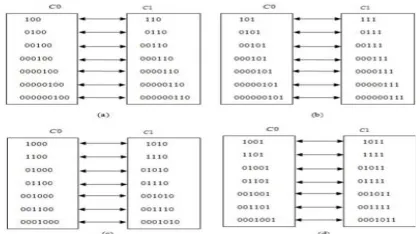
Fig. 2. CAVLC codeword mapping. (a) suffix Length =
2& Level > 0. (b) suffix Length = 2& Level > 0. (c) suffix
Length = 3& Level > 0. (d) suffix Length = 3& Level < 0
C. Data Extraction:
Scheme I: Encrypted Domain Extraction
To protect privacy, a database manager (e.g., cloud server)
may only get access to the data hiding key and have to
manipulate data in encrypted domain.
In encrypted domain, encrypted video with hidden data is
directly sent to the data extraction module, and the extraction
process is given as follows.
Step1: The codewords of Levels are firstly identified by
parsing the encrypted bitstream.
Step2: If the codeword belongs to codespace C0, the extracted data bit is “0”. If the codeword belongs to codespace C1, the extracted data bit is “1”.
Step3: According to the data hiding key, the same chaotic
pseudo-random sequence P that was used in the embedding
process can be generated. Then the extracted bit sequence
could be decrypted by using P to get the original additional
information. Since the whole process is entirely operated in
encrypted domain, it effectively avoids the leakage of
original video content.
Scheme II: Decrypted Domain Extraction.
In scheme I, both embedding and extraction of the data are performed in encrypted domain. However, in some
cases, users want to decrypt the video first and extract the
hidden data from the decrypted video. For example, an
authorized user, which owned the encryption key, received
the encrypted video with hidden data. The received video can
be decrypted using the encryption key. That is, the decrypted
video still includes the hidden data, which can be used to
trace the source of the data. Data extraction in decrypted domain is suitable for this case.
Step1: Generate encryption streams with the encryption keys
as given in encryption process.
Step2:The codewords of IPMs, MVDs,
Sign_of_TrailingOnes and Levels are identified by parsing
the encrypted bitstream.
Step3: The decryption process is identical to the encryption
process, since XOR operation is symmetric. The encrypted codewords can be decrypted by performing XOR operation
with generated encryption streams, and then two XOR
Copyrights © International Journal of Intellectual Advancements and Research in Engineering Computations, plaintext. Since the encryption streams depend on the
encryption keys, the decryption is possible only for the
authorized users. After generating the decrypted codewords with hidden data, the content owner can further extract the
hidden information.
Data extraction in encrypted domain
Step4: The last bit encryption may change the sign of Level.
Encrypted codeword and the original codeword are still in
the same codespaces. If the decrypted codeword of Level belongs to codespace C0, the extracted data bit is “0”. If the
decrypted codeword of Level belongs to codespace C1, the extracted data bit is “1”.
Step5: Generate the same pseudo-random sequence P that was used in embedding process according to the data hiding
key. The extracted bit sequence should be decrypted to get
the original additional information.
III. ARCHITECTURALDIAGRAM:
The process of data hiding method consists of
following three main procedures such as Image encryption,
data embedding and data extraction/image recovery. The
separable scheme the content owner encrypts the original uncompressed image using an encryption key to produce an
encrypted image. Then using a data-hiding key the data-hider
compresses the Least Significant Bits (LSB) of the encrypted
image to create some space to accommodate the additional
data.
At the receiver side the data embedded can be easily
retrieved from the encrypted image containing additional data according to the data-hiding key. As the data embedding
only affects the LSB a decryption with the encryption key
may result in an image similar to the original version. With
an encrypted image containing additional data which is
hidden case one is when the receiver has only the data-
hiding key, he is able to extract the additional data even if he does not know the image content
IV. CONCLUSION
Data hiding in encrypted media is a new topic that has started
to draw attention because of the privacy-preserving
requirements from cloud data management. In this paper, an algorithm to embed additional data in encrypted H.264/AVC
bitstream is presented, which consists of video encryption,
data embedding and data extraction phases. The algorithm
can preserve the bit-rate exactly even after encryption and
data embedding, and is simple to implement as it is
directlyperformed in the compressed and encrypted domain,
i.e., it does not require decrypting or partial decompression of the video stream thus making it ideal for real-time video
applications. The data-hider can embed additional data into
the encrypted bitstream using codeword substituting, even
though he does not know the original video content. Since
data hiding is completed entirely in the encrypted domain,
our method can preserve the confidentiality of the content
completely. With an encrypted video containing hidden data,
data extraction can be carried out either in encrypted or
decrypted domain, which provides two different practical applications. Another advantage is that it is fully compliant
with the H.264/AVC syntax. Experimental results have
shown that the proposed encryption and data embedding
scheme can preserve file-size, whereas the degradation in
video quality caused by data hiding is quite small.
REFERENCES
[1] W. J. Lu, A. Varna, and M. Wu, “Secure video processing:
Problems and
challenges,” in Proc. IEEE Int. Conf. Acoust., Speech, Signal
Processing,
[2] B. Zhao, W. D. Kou, and H. Li, “Effective watermarking
scheme in
the encrypted domain for buyer-seller watermarking protocol,” Inf.
Sci.,
vol. 180, no. 23, pp. 4672–4684, 2010.
[3] P. J. Zheng and J. W. Huang, “Walsh-Hadamard transform in
the homomorphic
encrypted domain and its application in image watermarking,”
in Proc. 14th Inf. Hiding Conf., Berkeley, CA, USA, 2012, pp. 1–
15.
[4] W. Puech, M. Chaumont, and O. Strauss, “A reversible data hiding method for encrypted images,” Proc. SPIE, vol. 6819,