Aditya Chopra
Australian National University Abstract
While gazing at the Earth from orbit, some astronauts have described a cognitive shift known as the overview effect. Here we describe an analogous biological overview effect produced by looking at the tiny twig of humanity on the tree of life. We describe the increasingly precise phylogenetic tree of all life on Earth and how it shows us our place in nature. We discuss problems with this tree including the assumption of sexual isolation, purely vertical gene transmission and the dependence of LUCA (Last Universal Common Ancestor) on the completeness of the tree. We compile and present the most concise taxonomic overview of the evolution of our lineage from Archaea to humans.
Correspondence | Charles H. Lineweaver, [email protected]; Aditya Chopra, aditya.chopra@anu. edu.au
Citation | Lineweaver, C. H. and A. Chopra. (2019) The Biological Overview Effect: Our Place in Nature. Journal of Big History, III(3); 109 - 122.
DOI | https://doi.org/10.22339/jbh.v3i3.3360
verview Effects
The overview effect is a cognitive shift in awareness reported by some astronauts during spaceflight, often while viewing the Earth from outer space. It is the experience of seeing firsthand the reality of the Earth in space,
which is immediately understood to be a tiny, fragile ball of life, “hanging in the void”, shielded and nourished
by a paper-thin atmosphere. From space, national boundaries vanish, the conflicts that divide people become less
important, and the need to create a planetary society with the united will to protect this “pale blue dot” becomes both obvious and imperative. (O’Neill 2008)
O
Broadly speaking, the overview effect is a new larger perspective that shifts our ideas of where we think we are (White 2014, 2019). The effect can be induced by the awe-inspiring vista from a mountain top, or by mind-broadening experiences in foreign lands. It can come when a peasant farmer visits Paris for the first time, or when a renaissance explorer peruses a new, more comprehensive map of the world. The overview effect involves a new perspective that turns fanciful labels for the unknown (“here be dragons”, “terra nullius”, “sphere of the gods”) into meaningful labels, and for the first time, embeds these regions into the rest of the known world or universe.
The overview effect can be personal and private, or it can be the transformation of an entire culture’s weltanschauung. Seeing the Earth from orbit transformed astronauts (e.g. White 2014). Images such as Apollo 8’s “Earthrise” and Sagan’s “Pale Blue Dot” have helped transform a civilization (Brand 1968, Sagan 1994).
The Spatial Overview Effect
around us. A spatial or astronomical overview effect comes from understanding the size of the universe and our place in it. One hundred years ago the size of the known universe was thousands of light years. Now it is billions of light years – an increase of about six orders of magnitude.
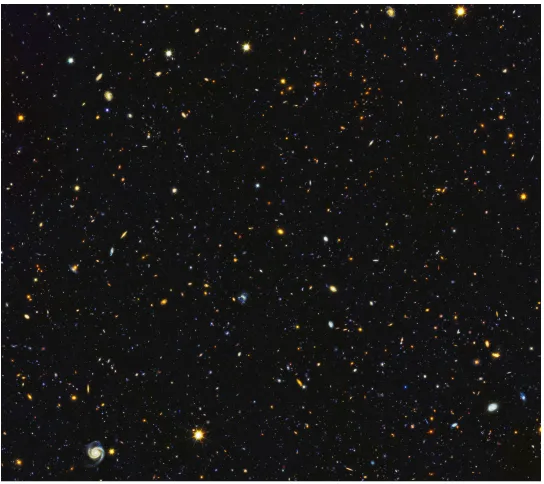
Figure 2 gives us a feeling for the enormous size of the universe compared to our tiny home planet. The comparison makes our bodies, homes, countries, planet, Solar System and even our Milky Way galaxy seem small and insignificant. Everything that was previously unimaginably large, becomes unimaginably small. We become more anonymous,
trivial and humble – and we haven’t even broached the topic of the multiverse.
We can make images of the universe and map the space around us to distances of billions of light years. The ability to produce such images and to understand how small we are is an achievement that few species can boast about. Apollo, Voyager, astronomy, cartography,
GPS and Google Maps offer us a broader and richer
spatial map of where we are. However, overview
effects are not limited to a spatial re-conceptualization
of where we are. They can be categorized into three
classes: spatial, temporal and biological. All of these overview effects contribute to big history: the attempt
0.4 Candidate Phyla Radiation Microgenomates Parcubacteria Eukaryotes Archaea Bacteria DPANN Opisthokonta Amoebozoa Chromalveolata Archaeplastida Excavata RBX1 WOR1 Cyanobacteria Melainabacteria PVC superphylum TACK
Major lineage lacking isolated representative: Major lineages with isolated representative: italics Dojkabacteria WS6
Peregrinibacteria Gracilibacteria BD1-5, GN02
Absconditabacteria SR1 Katanobacteria WWE3 Berkelbacteria SM2F11 CPR1 CPR3 Nomurabacteria Kaiserbacteria Adlerbacteria Campbellbacteria Wirthbacteria
Chloroflexi Armatimonadetes Giovannonibacteria Wolfebacteria Jorgensenbacteria Azambacteria Yanofskybacteria Moranbacteria Magasanikbacteria Uhrbacteria Falkowbacteria Saccharibacteria Woesebacteria Amesbacteria Shapirobacteria Collierbacteria Pacebacteria Beckwithbacteria Roizmanbacteria Gottesmanbacteria Levybacteria Daviesbacteria Curtissbacteria Nanoarchaeota Woesearchaeota Pacearchaeota Nanohaloarchaeota Micrarchaeota Altiarchaeales Aenigmarchaeota Diapherotrites Z7ME43 Loki. Thaumarchaeota Archaeoglobi Methanomicrobia Halobacteria Thermoplasmata Methanococci Spirochaetes Firmicutes
(Tenericutes)
Bacteroidetes Chlorobi Gammaproteobacteria Alphaproteobacteria Betaproteobacteria Actinobacteria Planctomycetes Chlamydiae, Lentisphaerae, Verrucomicrobia Omnitrophica
AminicentantesRokubacteria NC10 Elusimicrobia Poribacteria Ignavibacteria Dadabacteria TM6 Atribacteria Gemmatimonadetes Cloacimonetes Fibrobacteres Nitrospirae Latescibacteria TA06 Caldithrix Marinimicrobia WOR-3 Zixibacteria Synergistetes Fusobacteria
Aquificae
Calescamantes Deinococcus-Therm. Caldiserica Dictyoglomi Deltaprotebacteria (Thermodesulfobacteria) Epsilonproteobacteria DeferribacteresChrysiogenetes
Tectomicrobia, ModulibacteriaAcidobacteriaNitrospinae
Zetaproteo. Thermotogae Acidithiobacillia Parvarchaeota Hydrogenedentes NKB19 Thor. BRC1 Thermococci Methanobacteria Hadesarchaea Methanopyri Aigarch. Crenarch. YNPFFA Korarch. Bathyarc. you are here you are here
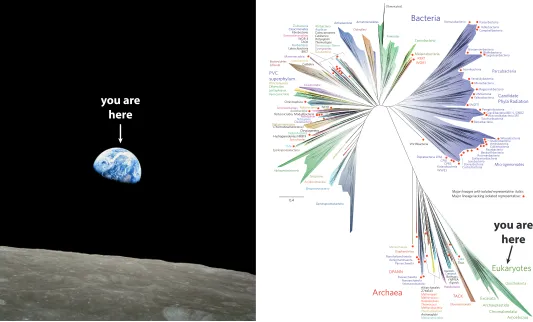
Figure 1. Comparison of Overview Effects. Left: the astronomical overview effect evoked by “Earthrise” taken on 24
December 1968 by astronaut William Anders during Apollo 8. This was the first time humans travelled beyond low Earth orbit and saw their own home planet rising above the horizon of the Moon. Right: the biological overview effect evoked by
a new more comprehensive tree of life including metagenomic sampling (Hug et al. 2016). The pale green sliver in the lower
Figure 2. Hubble Space Telescope image of a patch of sky about the size of a sheet of paper seen from 100 meters away. The ~15,000 galaxies in this image are millions and billions of light years away. A dozen stars from our galaxy are in the foreground. All the other points of light are other galaxies – each having hundreds of billions of stars. Hubble Deep UV
to understand the integrated history of the cosmos, Earth, life and humanity (Rodrigue et al. 2017, Christian 2004, 2018). The combination of modern geology, paleontology, biology, primatology and anthropology gives us a broader picture of where we have come from, how we got here, who we are – and maybe even where we are going and why?
Kuhn (1962) has coined the term “paradigm shift” to describe a re-conceptualization intrinsic to scientific revolutions: Copernican, Darwinian, Einsteinian and Quantum Mechanical. The overview effect involves a rapid paradigm shift, in which previous ideas and fundamental assumptions are undermined, rejected, and replaced by a larger, more accurate perspective.
For astronauts, the Earth was no longer a map divided into different coloured nations. Warring religions, ideologies and economic doctrines cannot be seen from space. The Earth is a blue marble hanging in the black void. This new bigger picture challenges our identity and offers us a better answer to the question: What is our place in nature?
The Temporal Overview Effect
The temporal overview effect is a re-conceptualization of when we are, based on new temporal information such as: the universe is ~13.8 billion years old; Earth is ~4.5 billion years old; life on Earth is about 4 billion years old; and our species, Homo sapiens, is about 100,000 years old, or 2 million years old – depending on how one defines our species.
Big history is arguably best presented as a series of events viewed through the lenses of different sciences as one progresses chronologically from the Big Bang (cosmology) to the formation of the Sun and Earth (astronomy, planetary science, earth science), to the origin and evolution of life (biochemistry, microbiology and evolutionary biology), to the evolution of humans (archaeology, anthropology, history). For example, in Christian (2004), the sections are listed chronologically, starting with the Big Bang; “the inanimate universe”, then “life on Earth”, “early human history”, “the Holocene”, “modern era” and finally “future”. Christian (2018) also has chronologically arranged sections beginning with the
Log time [seconds since the big bang]
10-40 10-30 10-20 10-10 10-5 100 105 1010 1015 1020
10-25
10-35 10-15
Planck time
10-43 seconds
after the big bang
now:
4.4 x 10¹⁷ seconds
(≈13.8 billion years) after the big bang first atoms
1013 seconds after the big bang
formation of Sun and Earth
3 x 10¹⁷ seconds
after the big bang
death of Sun and Earth
6 x 10¹⁷ seconds
after the big bang formation of
protons and neutrons
10-6 seconds after the big bang
inflation
10-35 -- 10-30 seconds
after the big bang
first second after the big bang
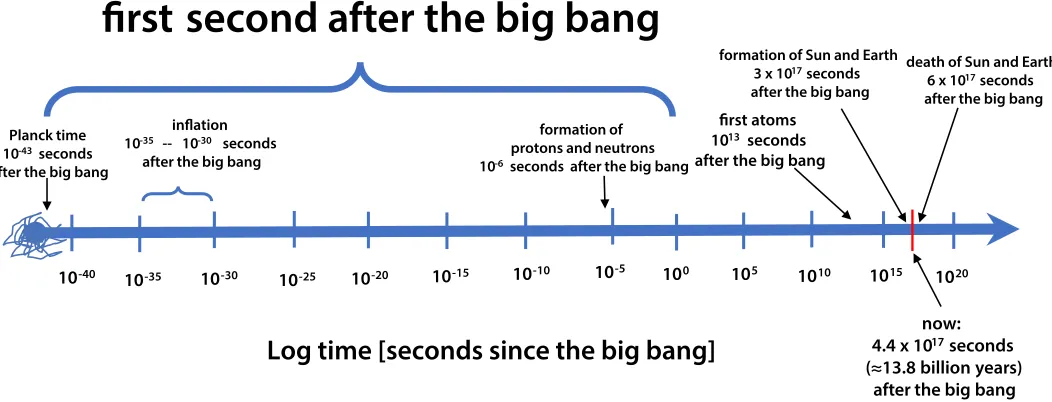
Figure 3. The first second after the Big Bang. The cosmological clock ticks logarithmically. The biological clock probably
also ticks logarithmically. For example, the earliest events of embryogenesis are paramount; “It is not birth, marriage or death, but gastrulation which is truly the most important time in your life” (Wolpert 1991). The heat death of the universe is
ancient “cosmos”, then the more recent “biosphere”, and finally the most recent “us”.
Logarithmic scales of space and time are often used to encompass and understand processes that have a large dynamic range (e.g. Adams & Laughlin 1997, 1999). For cosmologists interested in the origin and evolution of the universe, the cosmological clock ticks logarithmically (Figure 3 above). Every order of magnitude of time is examined for important events. Starting at the highest energy and earliest time possible (the Planck time 10-43 seconds after the Big Bang), the
interval 10-43 of a second to 10-42 of a second is studied.
Then the interval 10-42 of a second to 10-41 of a second
is examined, etc. Equal attention is given to each such interval. The particle physicist Rocky Kolb (2006) explains:
In this presentation, I will describe events that
occurred in the first second of the life of the
universe. There have been approximately four-hundred-thousand-million-million seconds since the beginning of the universe, so to concentrate on only one of them might seem the ultimate
degree of overspecialization. But the very first
second was really something special.
The Biological Overview Effect
The biological overview effect is a cognitive shift in
identity that occurs while viewing the phylogenetic tree of all life on Earth. It is the experience of recognizing how small our tiny human twig is among the vast genetic diversity of life. Our twig on the tree of life can be seen as just another species, hanging in the phylogenetic void. Our human twig is unique, just like the twig of every other species.
A large part of big history is the integrated history of life. Figure 4 is the best current map of our integrated
biological history. The tree of life is constructed from the conserved and recognizably related sequences of
DNA base pairs inside almost every cell of extant organisms. Our biological identity can be read from the hierarchy of taxonomic divergences in which we are embedded, along with every other living organism (Figure 4 and Table 1).
Only the twigs of the tree of life are alive. The branches holding up the twigs represent the past lives of millions of ancestors and cousins. Our branch has grown as the bodies of our dead ancestors have piled up chronologically. The tree of life is principally arranged using the chemical fossils of conserved genomes in all extant life forms. The tree has been put together from the chemical footprints that our parents and earlier ancestors left inside us.
Here and there, the tree has been calibrated by the petrified remains of fossilized distant cousins. Since the vast majority of species that have ever lived have gone extinct, dead fossilized individuals with no extant descendants vastly out-number the dead individuals who are our ancestors. Thus, when we find a fossil who looks remarkably like what we imagine our ancestors to have looked like, it is usually a dead distant cousin, not a great-great-great-great-… -grandparent (Dawkins & Wong 2016, Fournier et al. 2009).
In this tree of life, ours is a small voice in a chorus of hundreds of millions of voices. We often think we are the soloist, but in the tree of all life, we are a small new voice in an ancient choir of prokaryotes.
New landscapes of biological diversity show us our
little lonely eukaryotic valley. In the most recent
0.4 Microgenomates Parcubacteria
Eukaryotes
Archaea
Bacteria
Opisthokonta (you are here)Amoebozoa Chromalveolata Archaeplastida Excavata RBX1 WOR1 Cyanobacteria Melainabacteria PVC superphylum TACK
Major lineage lacking isolated representative: Major lineages with isolated representative: italics
Dojkabacteria WS6
Peregrinibacteria
Gracilibacteria BD1-5, GN02
Absconditabacteria SR1 Katanobacteria WWE3 Berkelbacteria SM2F11 CPR1 CPR3 Nomurabacteria Kaiserbacteria Adlerbacteria Campbellbacteria Wirthbacteria Chloroflexi
Armatimonadetes Giovannonibacteria Wolfebacteria Jorgensenbacteria Azambacteria Yanofskybacteria Moranbacteria Magasanikbacteria Uhrbacteria Falkowbacteria Saccharibacteria Woesebacteria Amesbacteria Shapirobacteria Collierbacteria Pacebacteria Beckwithbacteria Roizmanbacteria Gottesmanbacteria Levybacteria Daviesbacteria Curtissbacteria Nanoarchaeota Woesearchaeota Pacearchaeota Nanohaloarchaeota Micrarchaeota Altiarchaeales Aenigmarchaeota Diapherotrites Z7ME43 Loki. Thaumarchaeota Archaeoglobi Methanomicrobia Halobacteria Thermoplasmata Methanococci Spirochaetes Firmicutes (Tenericutes)
Bacteroidetes Chlorobi Gammaproteobacteria Alphaproteobacteria Betaproteobacteria Actinobacteria Planctomycetes Chlamydiae, Lentisphaerae, Verrucomicrobia Omnitrophica
AminicentantesRokubacteria NC10 Elusimicrobia Poribacteria Ignavibacteria Dadabacteria TM6 Atribacteria Gemmatimonadetes Cloacimonetes Fibrobacteres Nitrospirae Latescibacteria TA06 Caldithrix Marinimicrobia WOR-3 Zixibacteria Synergistetes Fusobacteria Aquificae Calescamantes Deinococcus-Therm. Caldiserica Dictyoglomi Deltaprotebacteria (Thermodesulfobacteria) Epsilonproteobacteria DeferribacteresChrysiogenetes Tectomicrobia, Modulibacteria Nitrospinae Acidobacteria Zetaproteo. Thermotogae Acidithiobacillia Parvarchaeota Hydrogenedentes NKB19 Thor. BRC1 Thermococci Methanobacteria Hadesarchaea Methanopyri Aigarch. Crenarch. YNPFFA Korarch. Bathyarc. Candidate Phyla Radiation DPANN
Root
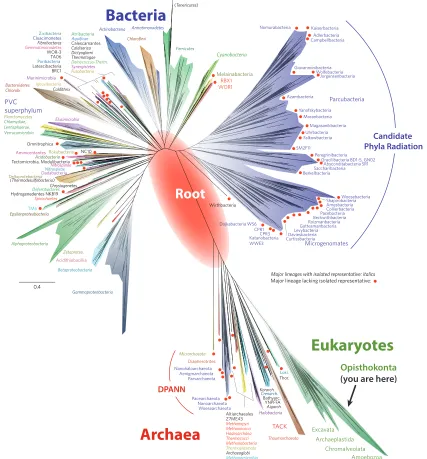
Figure 4. The tree of life (modified from Hug et al. 2016). The diversity of all eukaryotes is represented by the green sliver
in the lower right. On the right side of the green sliver, the small branch labelled “Opisthokonta” encompasses all animals
and fungi (see node 35 of Table 1). The twigs with red dots are organisms that have been identified with metagenomics
and have not been cultured. Whether through cultures or metagenomics, the microbial diversity on Earth is still far from complete. Also, viruses are not shown. The red oval in the center is an estimate of where the root of the tree lies. The “root” is another name for LUCA (Last Universal Common Ancestor). The large purple group in the upper right is the new
genealogy has us welcoming new members to our family. Now we can talk about “our close cousins the mushrooms”.
Our position in the lower right of Figure 4 can be described by paraphrasing Sagan’s description of our pale blue dot (Sagan, 1994 – excerpt in Planetary
Society, 2019)
Look again at this pale green sliver. That’s home. That’s us. Within its genetic boundaries every organism you have ever seen, every vertebrate you have ever loved, lived out their lives. The aggregate of our breaths, heartbeats, and sexual desires, every human and non-human eukaryote, every playful puppy and petunia, every meerkat and mite, every mammal, reptile, amphibian and fish, every mushroom and mayfly, every dandelion and dragonfly, every blade of grass and every innocent wasp larvae eating its way out of a caterpillar, every parrot and paramecium, every oak tree and antelope, every kookaburra and cuttlefish, every deuterostome and protostome, every ant and anteater, every poisonous snake and harmless tadpole, every orca and ostrich, every salamander and sardine, every top predator and bottom feeder, every amoeba and armadillo, every loving octopus mother guarding her eggs and every predator trying to eat them, every dinosaur and dinoflagellate, and every tree fern and trilobite, every elephant and eel, every jawed fish and every jawless fish, and every life form with a rib or a jaw or a brain, every vertebrate and invertebrate in the history of eukaryotes lived there – in a pale green genetic sliver that emerged ~3 billion years ago from a small branch of the Archaea.
Eukaryotes are a very small genetic afterthought on the giant prokaryotic stage. Think of the rivers of blood and cytoplasm spilled by all those predators and parasites so that in glory and triumph they could become the momentary masters of a eukaryotic corpse. Our posturings, our imagined self-importance, the delusion that we have some privileged position in the genetic
universe, are challenged by this trivial triangle. Our eukaryotic domain is a pale green sliver among the huge genetic diversity of life on Earth. The extent of our genetic diversity will fade even further if we can compare it to the diversity of life that may exist elsewhere. In the great enveloping
genetic unknown – in our obscure
sexually-isolated eukaryotic corner, among enormous diversity, there is no hint that help will come from elsewhere to save us from our swollen brains and multicellular megalomania. There is perhaps no better demonstration of the folly of human conceits than this green sliver of genetic space. To us, it underscores our responsibility to deal more kindly with other species, to preserve and
cherish the diversity of life – the only life we’ve
ever known.
Where is the Root of the Tree of Life?
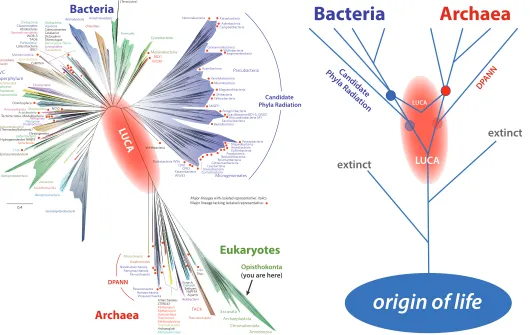
The branches in Figure 4 show the extent of genetic diversity. We have inserted the large red oval to indicate the most likely position of the root. As we follow the eukaryotic branch back in time, we rendezvous with the Asgard group (represented in Figure 4 by Lokiarchaeota (“Loki.”) and Thorarchaeota (“Thor.”) and then with the TACK group and then with DPANN and the rest of the Archaea (see nodes 42-45 and caption of Table 1). Notice that most of the basal or shortest branched Archaean lineages are in DPANN and have a red metagenomic dot at their tips. They have not been cultured.
which precedes LUCA by some significant amount – perhaps by a few hundred million years.
As we find shorter branches in the tree of life such as the Candidate Phyla Radiation (CPR) and DPANN, estimates for the time of LUCA become earlier and come closer to the time of the origin of all life. This is shown in Figure 5 as “LUCA” (in small font higher up
in the tree) becomes “LUCA” (in larger font lower in the tree) after the inclusion of CPR and DPANN.
Hierarchy of Taxonomic Divergences Along Our Lineage
Inspired by Dawkins & Wong (2016) to get a better overview of our evolutionary identities, in Table 1 we
0.4 Microgenomates Parcubacteria Eukaryotes Archaea Bacteria Amoebozoa Chromalveolata Archaeplastida Excavata RBX1 WOR1 Cyanobacteria Melainabacteria PVC superphylum TACK
Major lineage lacking isolated representative: Major lineages with isolated representative: italics Dojkabacteria WS6
Peregrinibacteria Gracilibacteria BD1-5, GN02
Absconditabacteria SR1 Katanobacteria WWE3 Berkelbacteria SM2F11 CPR1 CPR3 Nomurabacteria Kaiserbacteria Adlerbacteria Campbellbacteria Wirthbacteria Chloroflexi
Armatimonadetes Giovannonibacteria Wolfebacteria Jorgensenbacteria Azambacteria Yanofskybacteria Moranbacteria Magasanikbacteria Uhrbacteria Falkowbacteria Saccharibacteria Woesebacteria Amesbacteria Shapirobacteria Collierbacteria Pacebacteria Beckwithbacteria Roizmanbacteria Gottesmanbacteria Levybacteria Daviesbacteria Curtissbacteria Nanoarchaeota Woesearchaeota Pacearchaeota Nanohaloarchaeota Micrarchaeota Altiarchaeales Aenigmarchaeota Diapherotrites Z7ME43 Loki. Thaumarchaeota Archaeoglobi Methanomicrobia Halobacteria Thermoplasmata Methanococci Spirochaetes Firmicutes (Tenericutes)
Bacteroidetes Chlorobi Gammaproteobacteria Alphaproteobacteria Betaproteobacteria Actinobacteria Planctomycetes Chlamydiae, Lentisphaerae, Verrucomicrobia Omnitrophica AminicentantesRokubacteria NC10
Elusimicrobia Poribacteria Ignavibacteria Dadabacteria TM6 Atribacteria Gemmatimonadetes Cloacimonetes Fibrobacteres Nitrospirae Latescibacteria TA06 Caldithrix Marinimicrobia WOR-3 Zixibacteria Synergistetes Fusobacteria
Aquificae
Calescamantes Deinococcus-Therm. Caldiserica Dictyoglomi Deltaprotebacteria (Thermodesulfobacteria) Epsilonproteobacteria DeferribacteresChrysiogenetes Tectomicrobia, Modulibacteria Nitrospinae Acidobacteria Zetaproteo. Thermotogae Acidithiobacillia Parvarchaeota Hydrogenedentes NKB19 Thor. BRC1 Thermococci Methanobacteria Hadesarchaea Methanopyri Aigarch. Crenarch. YNPFFA Korarch. Bathyarc. Candidate Phyla Radiation DPANN LUC A
origin of life
extinct extinct
Archaea
Bacteria
Candidate Phyla Radiation DPANN LUCA LUCA Opisthokonta (you are here)Figure 5. Where is the Last Universal Common Ancestor (LUCA)? Left: Hug et al. (2016) identified many new short
branches on the tree of life. The shortest branches extending out of the red oval labelled “LUCA”, are the best representatives
of what LUCA was like. Weiss et al. (2016) did not use these short metagenomically identified twigs when looking for the metabolisms of LUCA. If they had, LUCA would have been deeper and LUCA’s metabolisms at least slightly different. The
illustration on the right shows how the position of LUCA depends on the deepest, shortest branches. Before the discovery
of CPR and DPANN, LUCA was in the position of the LUCA label in small font. After the discovery of CPR and DPANN,
LUCA is now earlier in the tree at the position of the LUCA label in a larger font. As long as we have an incomplete sampling of the deepest shortest branches on the tree of life, LUCA will appear more recent than it really is. We have the
have compiled the most concise taxonomic overview of the evolution of our lineage. The divergences seen in phylogenetic trees (e.g. Figure 4) become convergences or rendezvous when we imagine travelling backwards in time along our lineage. In Table 1, the numbers in the first column are rendezvous numbers (also known as phylostratigraphic nodes, cf. Domazet-Lošo & Tautz 2010, Trigos et al. 2017). These rendezvous are when our closest relatives merge with us at the time of the common ancestor. We start our voyage backward in time at node 1, 6.5 million years ago where we meet our most recent common ancestor with chimpanzees. At node 12, 96 million years ago we meet our common ancestor with dogs and cats. At node 40, about 2 billion years ago we meet our common ancestor with apple trees and bananas.
Numbers (1 – 37) in the first column are the rendezvous numbers from Dawkins and Wong (2016) with the name of the new group that is joining our lineage at each rendezvous in the second column. The third column is the name of our lineage before being joined by the group in the second column. The fourth column is the name of our group after being joined by the group in the second column. Notice that there is redundancy in that the name in the fourth column in rendezvous N, is the same as the name in the third column for rendezvous N+1.
For some of the less well-understood, recently proposed branches, we have adopted the nomenclature of Cavalier-Smith and co-authors (e.g. Cavalier-Smith et al. 2014, Ruggiero et al. 2015). This was necessary because Dawkins & Wong (2016) gave the name of the new group that was joining our group, but sometimes ignored the name of our group before and after the rendezvous. For a given node N, the uncertainties on its date can sometimes overlap with the dates of nodes N+1 or N-1. The larger this overlap, the more uncertain is the order of the nodes.
Problems with Phylogenetic Trees
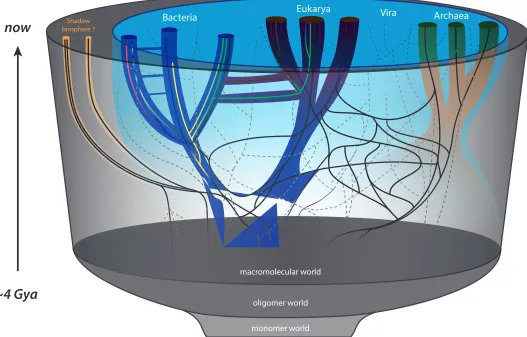
The powerful perspective and simplicity of Figure 4 and Table 1 are based on the vertical transmission of the most conserved core genes. Such trees are very useful as a reference for the vertical transmission of genes, but not as a full picture of evolution. More realistic network-like evolution can be informatively compared to this vertical-transmission-only tree (Doolittle & Bapteste 2007, Bapteste et al. 2009).
There are many well-known problems with such “vertical-only”, “divergence-only” approaches to the evolution of life. What happens when two organisms from different parts of the tree merge? Where in the tree does the new chimeric organism belong? Some horizontal convergences have been well-documented as endosymbiotic events. Mitochondria and plastids in eukaryotes have endosymbiotic origins but many other organelles could have such endosymbiotic origins (Sagan 1967, Margulis et al. 2000, 2006). Deeper in the tree and even more prevalent is the horizontal gene transfer (HGT) between bacteria and archaea. A vertical-transmission-only tree should be based on genes that have not been horizontally transferred, but as we explore deeper and earlier in evolution, such non-HGT genes become rarer. Another problem is the discrete nature of the branches. The sexual isolation of most eukaryotic species is legitimately represented by discrete branches, but bacteria exchange genes with other bacteria, near and far – indiscriminately and promiscuously. This HGT undermines the genetic isolation of bacterial and archaeal “species” (Doolittle & Papke 2006).
Table 1. Hierarchy of Taxonomic Convergences Along Our Lineage (rendezvous with sister taxa)*
*Names in parentheses are common names. Estimated dates for nodes 1- 40 are from Kumar et al. (2017). Dates for nodes 41-47 are from Betts et al. (2018). Kumar et al. (2017) do not have the same branching order and dates for some rendezvous points listed in Table 1. Thus, the dates for nodes 24, 29-31, 33-34, 37-40 are our estimates based on the catalogued divergence dates associated with the closest lineages described by Kumar et al. (2017). Uncertainties on rendezvous ages for nodes 1-40 are our estimates that account for
the upper and lower range of divergence dates catalogued by Kumar et al. (2017). Uncertainties on rendezvous ages for nodes 41-46 are estimates reported by Betts et al. (2018). Some estimated dates reported in the table have been rounded to the nearest five Myr (nodes
14-32) or nearest ten Myr (nodes 32-47). We used the age of the Moon-forming impact ~4.5 Gyr (Stevenson & Halliday 2014) and the
date associated with the putative earliest evidence for life on Earth ~3.8 Gya (Dodd et al. 2017, Nutman et al. 2016) to set the uncertainty associated with node 47. Branching orders and group names for lineages joining at: nodes 1-31 are based on Kumar et al. (2017); nodes
32-41 are based on Cavalier-Smith et al. (2014) and Shalchian-Tabriz et al. (2008); nodes 42-47 are based on Betts et al. (2018). TACK
superphylum (Node 43) consists of Thaum-, Aig-, Cren- and Kor-archaeota. DPANN superphylum (Node 45) consists of Diapherotrites, Micr-, Parv-, Aenigm-, Nano-, Nanohalo-, Woese- and Pace-archaeota.
node the group that is joining our lineage our lineage before rendezvous our lineage a�er rendezvous rendezvous age (MYA)
1 Pan (chimpanzees) Homo (humans) Hominini 6.5 ± 0.5
2 Gorilla (gorillas) Hominini Homininae 9.1 ± 0.5
3 Pongo (orangutans) Homininae Hominidae (great apes) 16 ± 1
4 Hyloba�dae (gibbons) Hominidae Hominoidea (apes) 20 ± 2
5 Cercopithecoidea (old world monkeys) Hominoidea Catarrhini 29 ± 2
6 Platyrrhini (new world monkeys) Catarrhini Simiformes 43 ± 3
7 Tarsiiformes (tarsiers) Simiformes Haplorhini 67 ± 4
8 Strepsirrhini (lemurs, lorises, bushbabies ) Haplorhini Primates 74 ± 3
9 Dermoptera (colugos) Primates Primatomorpha 76 ± 11
10 Scanden�a (tree shrews) Primatomorpha Euarchonta 82 ± 7
11 Glires (rodents, rabbits) Euarchonta Euarchonoglires 90 ± 5
12 Laurasiatheres (bats, whales, lions, dogs, horses) Euarchonoglires Boreoeutheria 96 ± 5
13 Xenarthrans (anteaters)+ Afrotheres (elephants) Boreoeutheria Eutheria (placentals) 105 ± 5
14 Marsupials (kangaroos, opossums) Eutheria Theria 160 ± 10
15 Monotremes (platypuses, echidnas) Theria Mammalia 175 ± 15
16 Sauropsids (rep�les, birds) Mammalia Amniota 310 ± 15
17 Amphibians (frogs, salamanders, caecilians) Amniota Tetrapoda 350 ± 5
18 Dipnoi (lungfish) Tetrapoda Sarcopterygii (lobe-finned fish) 395 ± 25
19 Ac�nis�a (coelacanths) Sarcopterygii Dipnomorpha 415 ± 10
20 Ac�nopterygii (ray-finned fish) Dipnomorpha Euteleostomi (bony vertebrates) 435 ± 10
21 Chondrichthyes (sharks, rays, chimaeras) Euteleostomi Gnathostomata (jawed fish) 475 ± 25
22 Cyclostomata (lampreys, hagfish) Gnathostomata Vertebrata 615 ± 90
23 Urochordata (sea squirts) Vertebrata Olfactores 675 ± 130
24 Cephalochordata (lancelets) Olfactores Chordata 680 ± 90
25 Ambulacrarians (starfish, acorn worms) Chordata Deuterostomia 685 ± 130
26 Protostomia (arthropods, nematodes, molluscs) Deuterostomia Nephrozoa (coelomates) 795 ± 120
27 Acoelomorpha (acoel flatworms) Nephrozoa Bilateria (triploblasts) 820 ± 330
28 Cnidaria (hydra, jellyfish, anemones, corals) Bilateria Parazoa 825 ± 210
29 Ctenophores (comb jellies) Parazoa ParaHoxozoa 945 ± 220
30 Placozoans (trichoplax) ParaHoxozoa Eumetazoa (diploblasts) 950 ± 180
31 Porifera (sponges) Eumetazoa Metazoa 955 ± 200
32 Choanoflagellates Metazoa Choanozoa 1025 ± 330
33 Filasterea (Ministeria, Capsapora) Choanozoa Filozoa 1050 ± 90
34 Mesomycetozoea or Ichthyosporea (DRIPs) Filozoa Holozoa 1080 ± 90
35 Fungi (mushrooms, moulds, nucleariids) Holozoa Opisthokonta 1110 ± 360
36 Apusomonads + Ancyromonads + Breviatea Opisthokonta Obazoa 1420 ± 290
37 Amoebozoans (Amoeba, slime moulds) Obazoa Unikonta or Amorphea 1480 ± 350
38 Collodictyonids + Rigifilids + Mantamonas Unikonta or Amorphea Podiata 1600 ± 350
39 Metamonada + Malawimonas (Trichomonas, Giardia) Podiata Scotokaryotes 1750 ± 350
40 Bikonts (plants, algae, diatoms) Scotokaryotes Neokaryotes 2000 ± 260
41 Excavata (Euglena, Trypanosoma) Neokaryotes Eukaryota 2100 ± 260
42 Asgard (Loki-, Thor-, Odin-archaeota) Eukaryota Asgard + Eukaryota 2720 ± 370
43 TACK superphylum Asgard + Eukaryota Proteoarchaeota + Eukaryota 2940 ± 400
44 Euryarchaeota (methanogens, halobacteria) Proteoarchaeota + Eukaryota Eury- + Proteo- + Eukaryota 3150 ± 410
45 DPANN superphylum Eury- + Proteo-archaeota + Eukaryota Archaea 3300 ± 430
46 Eubacteria + Candidate Phyla Radia�on Archaea Known Life on Earth 3950 ± 550
therefore uniquely identified as a lineage or a branch on the tree of life.
The branches of almost all sexual species diverge nicely like the branches of a real tree. But the tree of all life, especially as we get closer to the root, is not so simple. The earliest branches are vague. Without sex, bacterial species are not isolated and so aren’t
branches (Doolittle & Papke 2006). They are networks
of molecules and genes and endosymbiotic unions – perhaps as many convergences as divergences. There are groupings on many scales. Overlay a few
thousand gene-trees and an average species-tree will emerge, but the prevalence of endosymbiotic events during the origin of the eukaryotic cell, and the increasing prevalence of HGT as we go deeper into the prokaryotic tree produces a complex network of divergences and convergences that we are still trying to unravel.
As more genomes are sequenced, the resulting
phylogenetic trees reveal more about who we are and our humble sliver of genetic space. These
sequences have also become the most fertile sources
Pan (chimpanzees)
Gorilla (gorillas)
Pongo (orangutans)
Hylobatidae (gibbons) Cercopithecoidea (old world monkeys) Platyrrhini (new world monkeys) Tarsiiformes (tarsiers) Strepsirrhini (lemurs, lorises, bushbabies) Dermoptera (colugos) Scandentia (tree shrews) Glires (rodents, rabbits) Laurasiatheres (bats, whales, lions, dogs, horses) Xenarthrans (anteaters)+ Afrotheres (elephants) Marsupials (kangaroos, opossums) Monotremes (platypuses, echidnas) Sauropsids (reptiles, birds) Amphibians (frogs, salamanders, caecilians) Dipnoi (lungfish) Actinistia (coelacanths) Actinopterygii (ray-finned fish) Chonrichthyes (sharks, rays, chimaeras) Cyclostomata (lampreys, hagfish) Urochordata (sea squirts) Cephalochordata (lancelets) Ambulacrarians (starfish, acorn worms) Protostomia (arthropods, nematodes, molluscs) Acoelomorpha (acoel flatworms) Cnidaria (hydra, jellyfish, anemones, corals) Ctenophores (comb jellies) Placozoans (trichoplax) Porifera (sponges) Choanoflagellates Filasterea (Ministeria, Capsapora) Mesomycetozoea or Ichthyosporea (DRIPs) Fungi (mushrooms, molds, nucleariids) Apusomonads + Ancyromonads + Breviatea Amoebozoans (Amoeba, slime molds) Collodictyonids + Rigifilids + Mantamonas
Metamonada + Malawimonas (Trichomonas, Giardia) Bikonts (plants, algae, diatoms) Excavata (Euglena, Trypanosoma) Asgard (Lokiarchaeota, Thorarchaeota, Odinarchaeota) TACK superphylum Euryarchaeota (methanogens, halobacteria) DPANN superphylum Eubacteria + Candidate Phyla Radiation Second Life + Dark Life?
Rendezvous with our lineage (million years ago)
5 50 500 5000
of information about the Last Universal Common Ancestor (LUCA) and the origin of life on Earth.
Summary
Just as the Apollo and Voyager missions showed us spaceship Earth as a pale blue dot (the spatial overview
effect), we propose a biological overview effect
produced by looking at the tiny twig of humanity on the
phylogenetic tree of life. Modern genome sequencing
shows us our humble, pale green eukaryotic island among the ocean of genetic diversity of life on Earth. Based on increasingly precise phylogenetic trees and
molecular clocks, we compile and present the most concise taxonomic overview of our lineage as we evolved over the past ~4 billion years, from Archaea
into humans. This biological overview can help us
understand and navigate the integrated history of life
and humanity.
Shadow biosphere ?
macromolecular world
oligomer world
monomer world
Bacteria Eukarya Vira Archaea
now
~4 Gya
Figure 7. Our attempt to improve on the divergence-only tree in Figure 4 and Table 1. We have schematically added
References
Adams, F. & Laughlin, G. 1997. “A Dying Universe:
the long term fate and evolution of astrophysical
objects.” Rev. Mod. Phys., 69, 337.
Adams, F. & Laughlin, G. 1999. Five Ages of the
Universe: inside the physics of eternity. Free Press Publishers.
Bapteste, E. et al. 2009. “Prokaryotic evolution and the tree of life are two different things.” Biology Direct, 2009, 4, 34.
Betts et al. 2018. “Integrated genomic and fossil evidence illuminates life’s early evolution and
eukaryote origin.” Nature Ecology & Evolution, 2,
1556-1562.
Brand, S. 1968. Whole Earth Catalog, Whole Earth
Publishing.
Cavalier-Smith, T. Ema E. Chao, Elizabeth A. Snell, Cédric Berney, Anna Maria Fiore-Donno, Rhodri Lewis 2014. “Multigene eukaryote phylogeny reveals the likely protozoan ancestors of opisthokonts (animals, fungi, choanozoans)
and Amoebozoa.” Molecular Phylogenetics and
Evolution, 81, 71-85.
Christian, D. 2004. Maps of Time: an introduction to
big history. Berkeley: Univ. California Press.
Christian, D. 2018. Origin Story, New York: Little,
Brown and Company.
Dawkins, R. & Wong, Y. 2016. The Ancestor’s Tale: A Pilgrimage to the Dawn of Evolution. Mariner. Dodd, M.S. et al. 2017. “Evidence for early life in Earth’s oldest hydrothermal vent precipitates.”
Nature, 543, 7643, 60-64.
Domazet-Lošo T. & Tautz D. 2010.
“Phylostratigraphic tracking of cancer genes
suggests a link to the emergence of multicellularity
in metazoa.” BMC Biol 8, 66.
Doolittle, W.F. & Papke, R.T. 2006. “Genomics and
the bacterial species problem”, Genome Biol., 7, 9,
116.
Doolittle, W.F. & Bapteste, E. 2007. “Pattern
pluralism and the Tree of Life hypothesis.” PNAS,
104, 7, 2043-2049.
Fournier, G.P. Huang, J. & Gogarten, J.P. 2009.
“Horizontal gene transfer from extinct and extant
lineages: biological innovation and the coral of
life.” Phil. Trans. Roy. Soc. B, 364, 1527.
Hug, L. et al. 2016. “A new view of the tree of life.”
Nature Microbiology, 1, 16048.
Kolb, R. 2006. “A Recipe for Primordial Soup,
in Cosmic Questions”, Annals of the N.Y. Acad.
Sciences, 950, 1, 54-65.
Kuhn, T. 1962. The Structure of Scientific
Revolutions. Chicago: University of Chicago Press.
Kumar S., Stecher G., Suleski M., Hedges S.B. 2017.
“TimeTree: A Resource for Timelines, Timetrees,
and Divergence Times.” Mol Biol Evol 34, 7,
1812-1819.
Lineweaver, C.H. & Egan, C. 2007, “The Cosmic
Coincidence as a Temporal Selection Effect Produced by the Age Distribution of Terrestrial Planets in the Universe” Astrophysical Journal,
671, 853.
Margulis, L. Dolan, M.F. & Guerrero, R. 2000. “The
chimeric eukaryote: Origin of the nucleus from
PNAS, 97, 13, 6954–6959.
Margulis, L. et al. 2006. “The last eukaryotic common ancestor (LECA): Acquisition of
cytoskeletal motility from aerotolerant spirochetes
in the Proterozoic Eon.” PNAS, 103, 35, 13080–13085.
Nutman, A.P, Bennett, V.C., Friend, C.R.L., Van Kranendonk, M.J. & Chivas, A.R. 2016.
“Rapid emergence of life shown by discovery of 3,700-million-year-old microbial structures.”
Nature, 537, 535-538.
Oesch, P.A. et al. 2018. “HDUV: The Hubble Deep
UV Legacy Survey.” Astrophys. Jour. Supp. Ser.,
237, 1.
O’Neill, I. 2008. “The Human Brain in Space: Euphoria and the “Overview Effect” Experienced
by Astronauts”, Universe Today, 2008-05-22,
www.universetoday.com/14455/the-human-
brain-in-space-euphoria-and-the-overview-effect-experienced-by-astronauts/ (Accessed 27/03/2019).
Planetary Society. 2019. “A Pale Blue Dot”, http://
www.planetary.org/explore/space-topics/earth/pale-blue-dot.html (Accessed 27/03/2019).
Rodrigue, B., Grinin, L. & Korotayev, A. 2017. From Big Bang to Galactic Civilization: A Big History Anthology, Primus.
Ruggiero, M.A., Gordon, D.P., Orrell, T.M. Bailly, N. Bourgoin, T. Brusca, R.C. Cavalier-Smith, T. Buiry, M.D. & Kirk, P.M. 2015. “A Higher Level Classification of All Living Organisms” PLoS ONE 10(4):e0119248.
Sagan, C. 1994. Pale Blue Dot: A Vision of the
Human Future in Space, Ballantine Books.
Sagan, L. 1967. “On the Origin of Mitosing Cells.” J. Theor. Biol., 14, 225-274.
Shalchian-Tabrizi K, Minge MA, Espelund M, Orr R, Ruden T, Jakobsen KS, et al. 2008. “Multigene
Phylogeny of Choanozoa and the Origin of
Animals.” PLoS ONE 3(5): e2098.
Stevenson, D.J. & Halliday, A.N. 2014. “Origin of
the Moon: challenges and prospects.” Phil. Trans. Roy. Soc. A, 372, 2024.
Trigos, A. et al. 2017. “Altered interactions between unicellular and multicellular genes drive hallmarks of transformation in a diverse range of solid
tumors.” PNAS 114, 24, 6406-6411.
Weiss, M.C. et al. 2016. “The physiology and habitat
of the last universal common ancestor.” Nature
Microbiology, 16116.
White, F. 2014. The Overview Effect: Space
Exploration and Human Evolution. American Institute of Aeronautics and Astronautics, Reston.
White, F. 2019. The Cosma Hypothesis, Morgan
Brook Media.
Wolpert, L. 1991. The triumph of the embryo. Oxford